
Archived decisions
APPENDIX 1
HAMPSHIRE COUNTY COUNCIL
LOCAL TRANSPORT PLAN
PROGRESS REPORT
2008
Produced by Highways and Transport Policy
Environment Department
Hampshire County Council
December 2008
CONTENTS
1 |
Foreword and executive summary |
1 | ||
2 |
Introduction |
2 | ||
3 |
Local Transport Plan in context: change and consistency |
3 | ||
Changes |
3 | |||
3.2 |
National level |
3 | ||
3.3 |
Regional level |
3 | ||
3.4 |
County level |
|||
3.5 |
Sub-regional level |
|||
3.6 |
District, local and community level |
6 | ||
Consistency |
||||
3.7 |
Continuity of Local Transport Plan working |
9 | ||
4 |
Progress on shared priorities and wider objectives |
11 | ||
4.1 |
Introduction |
11 | ||
4.2 |
Transport's contribution to wider objective and local priorities |
11 | ||
4.3 |
Congestion and Network Management Duty (LTP shared priority) |
12 | ||
4.4 |
Delivering accessibility |
15 | ||
4.5 |
Passenger transport patronage |
17 | ||
4.6 |
Safer roads |
17 | ||
4.7 |
Better air quality |
20 | ||
4.8 |
Asset management and use of resources |
21 | ||
4.9 |
Rights of Way |
23 | ||
4.10 |
Progress with targets and risk management |
24 | ||
5 |
Funding issues |
36 | ||
List of tables |
||||
Table 4.10.11: LTP targets - performance monitoring |
27 | |||
Table 5.3: LTP funding |
36 | |||
Table 5.13: Capital maintenance expenditure 2006/07 and 2007/08 |
39 | |||
List of figures |
||||
Figure 4.3.6: Example of CJAMS mapping - Gosport and Fareham am peak |
14 | |||
Figure 4.4.3: Front cover of Andover Town Centre Access Plan |
16 | |||
Figure 5.3: Comparison of 2006/07 and 2007/08 LTP funding |
37 | |||
Appendices |
|
Appendix 1 |
Statutory Network Management Duty |
Appendix 2 |
Response to GOSE's settlement letter |
Appendix 3 |
Delivery of scheme in support of achieving air quality targets |
Appendix 4 |
Progress with accessibility pilots |
1 FOREWORD AND EXECUTIVE SUMMARY
I am pleased to present Hampshire County Council's Local Transport Plan Progress Report December 2008.
The Local Transport Plan (LTP) Progress Report has been completed in line with the Department for Transport's guidance and in consultation with officers from the Government Office for the South East (GOSE).
Much has happened at the national, regional, county, sub-regional and local level since the LTP was published in March 2006. There is now increased emphasis on sub-regional transport planning and Hampshire County Council's Sustainable Community Strategy and Local Area Agreement (LAA). Partnership working is often the key to success and the LAA has partners ranging from government departments at one level through regional, district and local authorities and agencies to operators, businesses, local communities and voluntary groups.
Hampshire County Council has launched a number of important initiatives including the Climate Change Commission of Inquiry, another into the Personalisation agenda, its Rural Delivery Strategy and is also reviewing its approach to rural transport and community transport.
Major scheme funding is predominantly available through national and regional funding streams. The County Council is developing potential projects and policy initiatives to promote a transport system for Hampshire that will support the economic well-being of the county (its businesses and its international gateways), while protecting its unique environment.
Financially the situation has been difficult, exacerbated by the economic downturn and in particular by the constraints imposed on a `floor authority', which has led to less funding being available for investment through the LTP process.
Having said that I am generally pleased with the progress that has been made in delivering the second LTP. While some of the targets required in the LTP are clearly better related to an urban, unitary authority and do not fit well in a large and complex environment like Hampshire, we have built on the `excellent' rating of the LTP and addressed comments in the December 2006 GOSE decision letter where improvements were suggested.
I look forward to the guidance for the LTP3 and in continuing to work with all our partners towards promoting a successful county.
Councillor Melville Kendal
Executive Member for Environment
2 INTRODUCTION
2.1 This Local Transport Plan Progress Report follows the guidance in looking particularly at progress being made towards the Local Transport Plan (LTP).
2.2 Section 3 looks into the context of the LTP, which has changed markedly since March 2006 when Hampshire County Council's second LTP was produced. This section also considers the role of the LTP in supporting the wider objectives of Hampshire County Council and its partners.
2.3 Section 4 covers the shared priorities and progress with targets within the four priority areas set out in the LTP guidance: congestion, accessibility, safety and air quality. It also discusses the approach to risk management, comments on asset management and the use of resources as well as Rights of Way.
2.4 Section 5 provides a brief analysis of the investment programme over the first two years of the LTP period in comparison with the proposals in the LTP.
2.5 There are four appendices covering Hampshire County Council's approach to the Network Management Duty under the Traffic Management Act (2004) (Appendix 1), responses to the Government Office for the South East's settlement letter in December 2006 (Appendix 2), air quality (Appendix 3) and details of accessibility pilots (Appendix 4).
3 LOCAL TRANSPORT PLAN IN CONTEXT: CHANGES AND CONSISTENCY
Changes
3.1 Many policy developments since 2006 affect the Local Transport Plan (LTP) and its delivery. This section looks at some of these changes, particularly those initiated by Hampshire County Council. Progress on the LTP set out in this section should be read in the light of these developments.
3.2 At the national level:
· The Eddington and Stern reports provide strong guidance on the way forward for transport policy and investment in terms of economic competitiveness and the environment - especially climate change.
· The findings of these reports have influenced the development of government policy towards long-term transport planning as set out within the discussion document `Towards a Sustainable Transport System' and subsequently taken forward within the `Delivering a Sustainable Transport System'.
· The approach taken in updating Planning Policy Statements (PPSs) demonstrates the greater emphasis the government is placing on economic competitiveness and climate change. Examples of this include the Planning and Climate Change Supplement to PPS1 (published in December 2007) and Draft PPS4 on Planning for Sustainable Economic Development. The former sets out how planning, in providing for the new homes, jobs and infrastructure needed by communities, should help shape places with lower carbon emissions that are resilient to climate change.
· The Pitt report provided added emphasis on flooding that Hampshire County Council is including in asset management and climate change actions. The Pitt report and the new Floods and Water Bill will place new duties on authorities with drainage infrastructure in terms of asset management and adaptation to climate change.
· The Climate Change Bill aims to address the causes and consequences of climate change - adaptation and mitigation. The Bill commits the government to reducing carbon emissions by 80% by 2050 from a 1990 baseline.
3.3 At the regional level:
· The final South East Plan (SEP) is expected shortly. This has significant consequences for Hampshire, particularly in South Hampshire, Basingstoke and Whitehill/Bordon in East Hampshire. |
· The SEP states that Hampshire (including the two unitary authorities of Portsmouth and Southampton) must deliver a minimum of 133,700 dwellings by 2026. Hampshire has two Growth Points at Basingstoke and South Hampshire including the cities of Portsmouth and Southampton. These growth points are designated hubs in the SEP. The Basingstoke Growth Point involves the building of around 9,650 homes by 2016. The South Hampshire Growth Point includes two Strategic Development Areas (SDAs) one at North/North East Hedge End (6,000 homes) and the other at North Fareham (10,000 homes). The government's proposed changes to the SEP include the designation of Whitehill/Bordon in East Hampshire as an SDA, to accommodate the building of 5,500 homes by 2026. Whitehill/Bordon is also a candidate for the eco-town programme. |
· In addition to this housing growth, the South Hampshire sub-regional strategy of the SEP aims to deliver around 2,000,000m² of new business floor space and in Basingstoke, the Basing View development will contribute significantly to growth in the north of the County |
· South Hampshire and the Western Corridor Blackwater Valley sub-region (including Basingstoke) are discussed in more detail in the sub-regional section (paragraphs 3.5.2 and 3.5.6). |
3.4 At the county level:
· Hampshire County Council aims to lead and work in partnership with other organisations to remove barriers and improve choices while encouraging people to make their own decisions on the way they access services. The County Council's three corporate priorities are:
_ Hampshire safer and more secure for all.
_ Maximising wellbeing.
_ Enhancing our quality of place.
· Underpinning these priorities are the following set of values:
_ Removing barriers to opportunities and improving choice for all.
_ Responding to the improvements that people say they want.
_ Planning for and investing in the future.
_ Encouraging partnership, participation and contribution.
· The Hampshire Sustainable Community Strategy (HSCS) is an important document for Hampshire County Council and its partners. The vision of the HSCS is that `Hampshire continues to prosper, providing greater opportunity for all without risking the environment'. This vision has clear implications for transport strategies that the County Council is pursuing.
· The Local Area Agreement (2008-11) is the delivery arm of the HSCS. The priorities in the Hampshire LAA are arranged under eight themes and for each priority, one or more targets are set. In total, there are 33 agreed national targets, 14 local targets and 10 education related statutory targets. Specific transport indicators are covered within theme C Accessibility and transport - considered in detail in Section 4.
· The Hampshire Senate is a voluntary partnership of Hampshire County Council and district council leaders together with major public sector partners. It provides a strategic leadership and priority-setting role for the LAA, as well as promoting integration and efficiency of public services across Hampshire.
· Hampshire County Council is liaising with partners to develop a county freight strategy.
· The County Council's Climate Change Commission of Inquiry examined the role that it can play with partners in adapting to the effects of climate change.
· Hampshire County Council's recent commission into Personalisation is developing an action plan to transform the provision of social care for adults with the emphasis on the individual's dignity, right to self-determination, choice, control and power over the support services they receive.
· Hampshire County Council is preparing a Rural Delivery Strategy and is reviewing its approach to community transport, as well as carrying out rural transport pilots to determine the best way forward.
· The County Council is working with West Sussex County Council and Southampton City Council to conclude a Private Finance Initiative for street lighting, which balances the objectives to reduce accidents, crime and the fear of crime with carbon reduction ambitions.
· MATISSE, (Mobile And Teleworking Initiative for a Smarter South East) is a partnership project led by Hampshire County Council and initiated by SEEDA (South East England Development Agency). MATISSE aims to better understand the economic, social and environmental benefits of mobile and home working.
· Hampshire County Council is working with district councils to help with the community planning process. As transport is a significant consideration for those involved in developing community plans, the County Council is using this opportunity to listen to communities at pilot surgeries where local people can meet with officers - including transport officers - to discuss the issues that they want addressed.
· The `Village 30' programme aims to improve safety and improve quality of life within villages and encourage sustainable modes and is introducing 30 mph speed limits and associated works in 106 villages, supported by the `Choose 30' campaign.
· "Twenty is Plenty", focused around schools is another campaign aimed at reducing vehicle speeds.
· Transport is linking with the new requirements for future access to new diploma courses for 14-19 year olds. Getting young people to the places providing the right course is challenging and as part of this, associated access issues are being reviewed.
· Community liaison and responding to key concerns about maintenance and the upkeep of the highway network led to a change in Hampshire County Council's spending priorities on maintenance.
· Finally, the change in funding for Hampshire County Council as a `floor authority' has seriously affected its ability to fund transport improvements.
3.5 At the sub-regional level:
· As a key function of Hampshire County Council, transport is an important consideration across all areas of its business. The links between transport and other activities continue to grow stronger in recognition of the benefits of cross-working and a joined-up approach.
· The SEP includes policies for nine sub-regional areas. These policies address specific strategic cross-boundary issues within the South East and adjoining regions that cannot be dealt with by individual or joint local development documents or by the policies in the Regional Policy Framework. Two of these sub-regions are South Hampshire and the Western Corridor and Blackwater Valley (WCBV).
· The Regional Economic Strategy identified Basingstoke and South Hampshire as `diamonds for investment and growth'. These `diamonds' have the potential to act as catalysts to stimulate prosperity across wider areas. Of the `diamonds for investment and growth', South Hampshire has been identified for substantial early support, investment and activity reflecting the Partnership for Urban South Hampshire's clear agenda to progress an economic growth-led strategy for the sub-region, with growth rising to at least the South East average by 2026. See paragraphs 3.5.1 for more details on the Partnership for Urban South Hampshire.
3.5.1 South Hampshire - Partnership for Urban South Hampshire (PUSH) and Transport for South Hampshire (TfSH):
· As a growth point for the national economy, South Hampshire has to provide a further 80,000 homes and around 2,000,000 million m2 of employment floor space by 2026.
· PUSH is a joint committee of all the local authorities in South Hampshire coordinating spatial planning and the delivery of growth in the sub-region.
· PUSH has developed significantly in terms of its governance arrangements and focus on delivering improved economic growth. PUSH's business plan, subject to regular reviews, sets out how each partner contributes to the growth agenda up to 2011. In June 2008, PUSH agreed the South Hampshire Agreement, a Multi Area Agreement (MAA) for the sub-region. This aims to deliver highway improvements, including managed motorways (incorporating hard shoulder running) on appropriate sections of the M3 and M27. The MAA recognised the importance of developing a robust evidence base to support the development of business cases for major schemes. The MAA seeks to make best use of funding towards new infrastructure from a range of sources (developer contributions, Community Infrastructure Levy, prudential borrowing, etc).
· TfSH is the sister organisation to PUSH with an executive comprising of the transport portfolio members of the three transport authorities in the area (Hampshire County Council, Portsmouth City Council and Southampton City Council). It aims to lead the planning and delivery of the transport improvements and investment required to achieve the levels of growth and development set out in the SEP. Formally constituted in October 2007 as a joint committee, TfSH developed from the informal working relationship of transport authorities through Solent Transport.
· Key partners are invited to the TfSH Strategy Working Group meetings including the Department for Transport (DfT), the Government Office for the South East (GOSE), regional bodies, government agencies (Highway Agency and Network Rail), business representatives, major transport operators and district council representatives.
· The South Hampshire Bus Operators' Association, covering the 14 bus companies that operate 640 services in the sub-region, reinforces the passenger transport work of TfSH.
· TfSH is funded by the three authorities and has a work programme of strategy development and studies into policy interventions including new infrastructure. TfSH has put forward proposals in a coordinated way supported by its strategy group, which includes national and regional agencies that provide support through advice and where appropriate funding.
· More recently, TfSH has signed a Memorandum of Understanding (MoU) for highways with the DfT, Highways Agency and GOSE. The MoU will play an important role in reducing travel delays on congested road networks and will allow key local parties to develop joint approaches to transport and housing planning and delivery.
· A transport strategy for South Hampshire is being produced for the sub-region. The current Community Infrastructure Fund (CIF) bid submitted through TfSH is for the first stage of the South East Hampshire Bus Rapid Transit (Fareham to Gosport). Other submissions made through TfSH are for regional funding as part of the Regional Funding Allocation (RFA) process.
3.5.2 Western Corridor and Blackwater Valley, including Basingstoke:
· The Western Corridor and Blackwater Valley (WCBV) sub-region extends into the north of the county. Basingstoke is the key Hampshire settlement within this region and is identified within the SEP as a hub.
· Hampshire County Council continues its involvement in developing initiatives in the WCBV. In particular, progressing the Thames Valley Quality Bus Contract, looking at options for introducing inter-urban bus and coach services.
· The County Council is a member of the neighbouring authorities' officer group established to help develop the Reading Transport Innovation Fund bid and put together an effective and comprehensive package of schemes to address transport issues in this area. These include improvements to the Reading to Basingstoke rail line and potentially a new rail station at Chineham.
Basingstoke:
· Basingstoke is identified as an economic `diamond for growth' and for significant housing growth within the draft SEP.
· Hampshire County Council has a developed transport model for the Basingstoke town and its surrounding area, working with Basingstoke and Deane Borough Council and the Highways Agency.
· These authorities are now working together looking at the transport issues relating to the future development of Basingstoke, its Local Development Framework (LDF) and transport needs. Groups have been established to cover economic development, property, planning and transport. These will steer local strategies up to the point of project development.
· A group of interested national and regional bodies is advising on the way forward on the lines of the strategy group operating in South Hampshire.
· Liaison continues with West Berkshire Council and Basingstoke and Deane Borough Council (through the Cross Border Working Group)on planning and transport matters including the future roles of the A339 and A340 roads.
3.5.3 South East Dorset:
· The Hampshire and Dorset authorities are mutually interested in access to the South East Dorset and South Hampshire sub-regions - including international gateways - which are heavily reliant on the A34/M3/M27/A31 corridor.
3.6 District, local and community level:
· Partnerships with district councils and local communities are helping to develop the local LAA priorities for congestion and accessibility.
· Hampshire County Council continues to work with district councils (both within and bordering the county) to support the development of Local Development Frameworks (LDFs).
· Following the creation of the New Forest National Park in March 2005, the Park Authority took up its full powers in April 2006 and has recently published a Core Strategy consultation paper.
Consistency
Continuity of LTP working
3.7 The wide range of significant changes has led to a changed emphasis across the county but at the same time substantial progress is being made with the delivery of the LTPs objectives, programmes and targets.
· The LAA includes a number of the LTP themes - highway condition and casualty reduction - as priorities from the national indicator set.
· Accessibility and congestion are local priorities within the LAA, developing the work done in accessibility pilots and working in partnership with district councils. These programmes will lead to the development and implementation of local projects through 2009.
· Area transport strategies - which are the main building blocks of the LTP at the local level - continue to provide the basis for the transport capital programme and the principal focus for development related investment.
· Town Access Plans (TAPs), as identified in the LTP are progressing, often alongside the district council LDF, through partnership working between the authorities to address local accessibility issues in urban areas.
· The overall strategy of reduce, manage and invest is carried through to the sub-regional strategies. The TfSH strategy group has commissioned consultants to identify the evidence base required to support the strategy.
· Other studies have looked at: Access to the Sub-Region, Access to Southampton from the east, Access to Portsmouth/South East Hampshire and Access to Employment in Eastleigh.
· Complementary work is progressing on the potential for reduce and manage.
· Developing the Network Management Duty involves the investigation of coordinating systems and approaches linking the short-term and real-time streetworks and incident management work of Hampshire County Council and its partners with the traffic management work of Intelligent Transport Systems and the longer term transport planning requirements. This work is a natural extension of the manage philosophy embodied in the LTP, bringing together the complete range of highway and transport management.
4. PROGRESS ON SHARED PRIORITIES AND WIDER OBJECTIVES
4.1 Introduction
4.1.1 Section 3 looked at the significant changes taken place since the adoption of the second LTP. This section specifically addresses progress with the LTP shared priorities (congestion, accessibility, safety and air quality), the targets associated with the LTP as well as some wider issues set out in the progress report guidance.
This section covers:
· Transport's contribution to wider objectives and local priorities
· Tackling congestion and Network Management Duty
· Delivering accessibility
· Safer roads
· Better air quality
· Asset management
· Use of resources
4.2 |
Transport's contribution to wider objectives and local priorities |
4.2.1 As discussed in Section 3, transport has an important part to play in economic, social and environmental matters.
4.2.2 Hampshire has international gateways and with its two city neighbours, Hampshire is looking to develop its economy with particular emphasis on the growth agenda and working at the sub-regional level where there is the greatest need for major transport investment. Working through the Partnership for Urban South Hampshire, the South Hampshire authorities share a common vision and a clear agenda to progress an economic growth-led strategy for the sub-region, which aims to improve its economic performance to at least match the regional average, with a target of achieving a Gross Value Added of 3.5% per year by 2026.
4.2.3 Highways and transport feature strongly in the new county Local Area Agreement (LAA) with good highway links recognised as being essential to the economy of the county. Safety continues to be a high priority, again recognised in the LAA, while speed reduction in villages promotes both safety and quality of place as a key local LAA priority. The LAA also includes priorities for congestion and accessibility. Through working in partnership with local communities, opportunities for local action can be identified that can make a difference. This can be achieved by improving the quality of place and addressing real and perceived access problems, particularly in rural areas.
4.2.4 Transport considerations are an integral part of Hampshire County Council's work on adaptation to climate change with particular efforts into anticipating the effects of climate change on drainage and highway flooding. Transport has a key role to play in reducing the carbon footprint, which is an important element of the LAA.
4.2.5 Similarly, transport is a high priority for rural areas and Hampshire County Council's review of rural and community transport will inform the Rural Development Strategy.
4.3 |
Congestion and Network Management Duty (LTP shared priority) |
Congestion in Hampshire
4.3.1 Hampshire was not one of the designated areas specifically required to measure peak hour traffic congestion as part of the LTP.
4.3.2 As set out in the LTP, Hampshire experiences three main types of traffic congestion:
· Congestion on the strategic road network (motorways and trunk roads).
· Congestion associated with access to the strategic road network.
· Urban congestion.
4.3.3 While much of this congestion is associated with `normal' Monday to Friday peak periods, the impact of tourism related traffic means that weekends can be particularly difficult both on trunk roads and in tourist areas like the New Forest. The social economic situation of the Gosport peninsula has led to high numbers of out-commuting in the morning peak with corresponding inbound congestion in the evening, on a peninsula with one principal road in and out.
4.3.4 Hampshire County Council's approach is one of reduce, manage and invest, looking at the sub-regional level in South Hampshire through TfSH with partners as described in Section 3. The major scheme bid for Community Infrastructure Funding for Bus Rapid Transit Fareham-Gosport is the most advanced example of the outcome of this work that has also developed a strong strategy with regional funding packages for Access to the Sub-Region, Access to Southampton, Access to Portsmouth/South East Hampshire and Access to the South Hampshire Employment Zone.
4.3.5 The CJAMS (Congestion and Journey-time Acquisition and Monitoring System) allows the county's A and B roads to be mapped in terms of peak hour congestion (using satellite data) - example shown in figure 4.3.6 on page 14. This provides a baseline for comparing changes in congestion - an objective measure of congestion that with the application of traffic flow information can assess the relative costs of problems and help identify priority road links for treatment
4.3.6 The same information backed up with real-time information from buses helps assessments through Bus Punctuality Improvement Partnerships that will guide future investment programmes and other policy interventions.
Figure 4.3.6: Example of CJAMS mapping - Gosport and Fareham am peak (0700 - 0900)
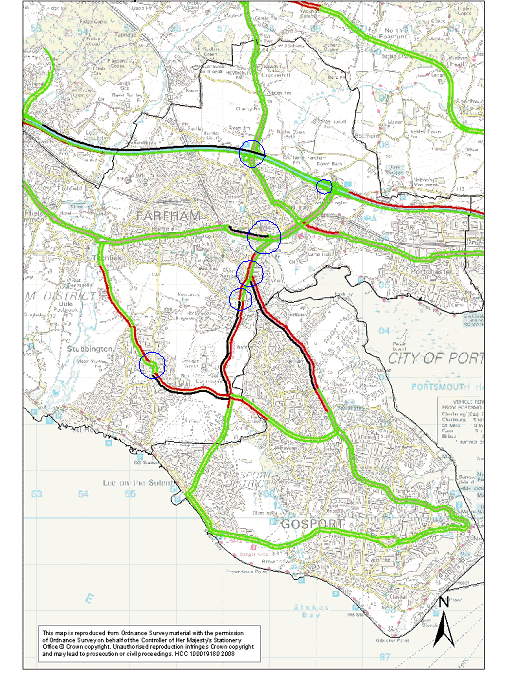
Key: |
||
Green |
- |
0-30 seconds delay |
Red |
- |
30-58 seconds delay |
Black |
- |
> 58 seconds delay (within Hampshire's top 100 delayed links for AM peak) |
LTP congestion proxy targets
LAA local priority indicators
4.3.7 As an indicator for road congestion, Hampshire County Council measures the levels of traffic on Hampshire roads using a series of permanent traffic counters. Between 2004 and 2007, the 24-hour annual average daily traffic flow at 30 representative traffic count sites across Hampshire's non-trunk roads rose by 0.7%. This is below the target of not exceeding 1% annual growth rate set in the LTP and suggests traffic growth is slowing. This figure is lower than traffic levels on trunk roads in Hampshire, which over the same period rose by 1.7%.
4.3.8 There are a number of targets that are described in the LTP guidance as proxies for congestion measurement. These include passenger transport patronage, bus punctuality, cycle use, vehicle mileage and mode choice on the journey to school. Table 4.10.11 on page 27 shows that positive progress is being made with all these indicators. There are also links to wider policy agendas eg carbon footprint and health.
Network Management Duty (Traffic Management Act (2004))
4.3.9 Hampshire County Council is continuing to develop its approach to the Network Management Duty outlined in the Traffic Management Act (2004). A summary of the approach is set out in Appendix 1.
4.3.10 Hampshire County Council is working with consultants EnZen to coordinate its various management systems across the whole transport field. In the past, the management systems dealing with roadworks and incidents were developed separately from the traffic management/urban traffic control systems and Intelligent Transport Systems information based approach. The County Council has an excellent record in the ITS field helping to pioneer telematics through ROMANSE (ROad MANanagement System for Europe) and other EU supported project partnerships with Southampton City Council and European partners lately through the CIVITAS (CIty - VITAlity - Sustainability) network as well as POLIS (European association of cities and regions networking for innovative transport solutions).
4.4 |
Delivering accessibility |
4.4.1 Accessibility to services and facilities is one of the primary objectives of Hampshire County Council's Corporate Strategy and Hampshire Strategic Partnership's Sustainable Community Strategy. Other partners and key stakeholders, such as district councils, Local Strategic Partnerships and neighbouring authorities also place considerable importance on the need to improve accessibility.
 Town Access Plans
4.4.2 The LTP proposed developing Town Access Plans (TAPs) for key settlements in Hampshire to identify and tackle issues of access to and within these urban areas. TAPs recognise the diverse nature of the county and its settlements by not assuming that a single solution will suit all locations. Instead, each settlement develops its own bespoke access plan.
4.4.3 Figure 4.4.3: Front cover of Andover Town Centre Access Plan
4.4.4 TAPs are improving accessibility to a wide range of destinations and services and are vital in encouraging people to use local facilities, tackling congestion and poor air quality by encouraging shorter journeys to local facilities; promoting healthy travel by encouraging the use of non-car modes especially walking and cycling and by providing improvements for people with mobility impairments.
Accessibility pilots (LAA1 - 2000 -2004)
4.4.5 The completion of three accessibility pilot schemes across Hampshire is another key element of the work delivered. These schemes were a representative cross-section of different issues related to accessibility, reflecting the diversity of Hampshire as a whole. The experience gained from these pilots has led to and informed the developing accessibility indicator within the second LAA. The three pilot schemes were:
· Andover to Winchester hospital (Royal Hampshire County Hospital).
· Access to a wide range of services in the Whitehill/Bordon area.
· Access to healthcare in the southern part of the New Forest.
4.4.6 Each pilot involved cross-sector working with a range of public, private and voluntary groups looking at the key issues related to accessibility in the area. Appendix 4 provides full details of the pilots. Work from the pilots has already led to the introduction of a new bus service between Andover and Winchester hospital and schemes addressing pedestrian severance in Whitehill/Bordon.
Local priority indicators - accessibility (LAA2 2008 - 2011)
Accessibility in the LAA
4.4.7 Recognising the importance of accessibility to people's health and well-being and the economy, the LAA identified accessibility as a local priority target with locally derived targets.
4.4.8 The work will look at developing an index of perceived accessibility problems, drawing on and analysing data collected. This will involve developing a perception-based score for each identified area using car availability, needs, frequency of required access and degree of difficulty to access services.
4.4.9 The delivery of this indicator will result from liaison with a range of key partners, with bespoke solutions for each area, which may involve improved transport, coordination, information, service delivery or a combination.
4.4.10 Liaison with each district council and voluntary organisations will help to identify and agree key accessibility problems within each Hampshire district, and subject to the initiatives identified, to agree final priorities.
4.5 |
Passenger transport patronage |
4.5.1 The LTP target is to increase journeys by passenger transport by 2% by 2010/11 above a 2003/04 baseline. This equates to a total of 44,168,000 passenger journeys by bus, rail and ferry.
4.5.2 In 2007/08, passenger numbers were 49,088,712. This is already 11% above the original LTP target, so in response to this success, Hampshire County Council has set a more ambitious target of nearly a further 2% growth on 2007/08 figures by 2010/11, equating to 50,000,000 passengers.
4.6 |
Safer roads |
4.6.1 Hampshire County Council's Road Safety Strategy and programmes provide a robust approach, delivering best value for money that is consistent and coordinated with the wider local policy and planning agenda at the local and national levels. The priorities within the strategy set out in the second LTP are set to achieve or exceed local and national targets. Improving road safety through reduction in casualties and traffic speeds are identified as priority indicators in the Hampshire LAA.
4.6.2 Hampshire County Council has an excellent record and reputation in reducing casualty rates. The County Council has a particularly successful programme of engineering measures at accident sites, complemented by strong educational and promotional programmes. Figures show a significant improvement over recent years but with a propensity for variation in specific years as occurred in 2007. Further reductions in deaths and seriously injured on the highway network remain a high priority.
Casualty reduction targets
4.6.3 Hampshire County Council has a very good record in reducing casualties, being consistently ahead of national targets. The LTP targets were essentially to maintain this position through the LTP period. Safety is a priority within the LAA and a stretch target for reducing killed and seriously injured casualties (KSIs) has been agreed. The LAA targets is 643 Killed or Seriously Injured (KSIs)(average 2008-2010).
4.6.4 In 2006 and 2007, 618 and 713 people were killed or seriously injured on Hampshire roads respectively. The increase in 2007 was also experienced by other highway authorities in the South East region. No specific attributing factors have been identified. The first five months of 2008 - taking into account seasonal variations - show a return to 2006/07 casualty levels, which if continued will see casualties return to a position ahead of the national and local LTP targets and the LAA stretch target.
4.6.5 In 2006 and 2007 respectively, 41 and 57 children were killed or seriously injured on Hampshire roads. This was a reduction of 63% and 49% respectively over the baseline figure of 110 and well on track to meet the target level of 55. Early indications from the first five months of 2008 show child casualties have returned to previous levels below the 2007 figure.
4.6.6 The number of slight casualties in Hampshire has reduced year on year throughout the period of the LTP. In 2007, 4,112 slight casualties occurred - a 30% reduction on the 1994/98 baseline and 22% reduction on the 2000/04 `stretching' baseline.
Casualty reduction programmes
4.6.7 Five well-established and successful programmes support the delivery of these targets. Hampshire County Council expenditure through its capital programme remained high during the first two years of the second LTP with £7.4 million allocated for the three-year period 2008-2011.
4.6.8 The five separate programmes allow Hampshire County Council to target areas of concern, respond to emerging accident trends and involve other policy areas where they can be most effective. Collectively, these complementary programmes produce impressive rates of return, helping to keep the County Council on track to meeting the various targets:
Low Cost Casualty Reduction Programme has yielded excellent accident savings, achieving an average rate of return in excess of 2000%.
Casualty Reduction Partnership initiated in 2003, has introduced measures at 194 sites, resulting in no repeat fatal accidents at any of the sites under similar circumstances.
Carriageway Surface Treatment Programme introduced in 2003/04 using carriageway surface treatments as a measure to reduce `loss of control' and `skidding' related accidents. The rates of return are well in excess of 1,500%.
Casualty Reduction Audit Programme ensures that the 700 or more low-cost safety schemes remain effective.
Higher cost schemes. In some cases, low cost action cannot achieve significant improvements at casualty black spots and higher cost schemes are required. The 39 major schemes introduced since 1993 ranged in cost between £50,000 and £400,000 and typically included new roundabouts, traffic signals and traffic management schemes. The rate of return on this programme over the period 1997 to 2006 is in excess of 400% but the emphasis of the programme will be on the lower cost schemes while they continue to provide better rates of return.
4.6.9 In addition to physical works on the highway, Hampshire County Council has an education training and publicity programme. Initiatives include driver and motorcycle rider assessments and pedestrian and cycle training in schools. Speed limit enforcement with cameras continues to be an important part of partnership working with the police as well as training and road safety education programmes.
4.6.10 Road Safety Councils established in each district council area, coordinate the activities of local groups, play an active part in local campaigns and promote road safety education.
Speed in rural villages
4.6.11 In response to concerns about speeding traffic and its effects on safety and the quality of life in rural villages, Hampshire County Council has reviewed village speed limits in line with revised Department for Transport guidance that 30 mph should be the norm in villages. The priority is to significantly reduce average speed in villages where a 30 mph restriction is introduced as well as reducing average speed in villages that already have a 30 mph speed restriction.
4.6.12 The county-wide Village 30 Programme delivered 43 schemes in September 2008, with a further 62 schemes planned by April 2009. This is supported by the `Choose 30' campaign launched in September 2008 providing increased police enforcement and community involvement to deliver a change in driver behaviour.
4.7 |
Better air quality |
4.7.1 Most parts of the county enjoy good levels of air quality. As reported in the second LTP, Hampshire has 10 Air Quality Management Areas (AQMAs), all but one (Fawley) due to significant traffic emissions. Since the publication of the second LTP all are still in place with additional ones declared at:
· Bursledon (Hamble Lane)
· Eastleigh (M3 junctions 12 to 14)
· Fareham (Portland Street)
4.7.2 Air Quality Action Plans (AQAPs) for each of the areas are at various stages of development. Each details measures to address the air quality problems identified and highlights where Hampshire County Council as highway authority is the appropriate body to lead on addressing problems.
4.7.3 As each district council in Hampshire is developing action plans at a different pace for direct submission to the Department for Environment Food and Rural Affairs, a complete picture of these actions plans is not included in this report. Appendix 3 details current schemes being delivered to improve air quality and the future likely schemes to address these issues.
4.7.4 A Hampshire Air Quality Steering Group develops policy and considers issues of common interest, such as monitoring and liaison with the Highways Agency. The group is made up of Hampshire County Council together with each unitary and district authority in the area that has declared an AQMA.
4.7.5 District councils are continually reviewing air quality and it is possible that other AQMAs could be declared. District councils carry out monitoring, with Hampshire County Council often helping to fund real-time monitoring equipment.
4.7.6 The LTP included headline targets for pollution levels for each AQMA declared before April 2006. Appendix 3 summarises progress towards these with examples of the schemes being delivered to help meet these targets. The target for each AQMA is to ensure that the average annual NO2 levels in the area do not exceed 40 µg/m3. For subsequent AQMAs, targets are included in the AQAPs, which the appropriate district council is developing.
4.7.7 Levels of NO2 have increased from the previous two years results, although still remain below the 2004 baseline. When the baseline was agreed in 2004, the current NO2 levels were slightly below the maximum target level of 40 µg/m3. Levels in 2007 are still below the maximum of 40 µg/m3, but local authorities will need to take action to maintain this. Further monitoring is needed as it is difficult to draw firm conclusions from the data to date.
4.8 |
Asset management and use of resources |
4.8.1 In 2006, Hampshire County Council appended their draft Transport Asset Management Plan to the LTP, which defined areas for development and set down an improvement/action plan.
4.8.2 It was realised at an early stage that the successful implementation of asset management principles would depend largely on developing an understanding at all levels. In 2006, an Asset Management Team and an Asset Management Board were set up to progress all aspects of highway asset management. This was quickly reinforced with Asset Representatives who have a responsibility to develop asset management principles for their nominated asset.
4.8.3 Since 2006, Hampshire County Council has developed and implemented a number of these improvement actions, including:
· Setting up a formal infrastructure for the implementation of asset management principles within the authority.
· Installation of an operational UKPMS (UK Pavement Management System), which will help to support investment planning.
· Development of a data collection strategy, programmed for implementation in early 2009.
· Initiation of data collection trials (video data) currently assessing the business case for an extended roll out.
· Developing long-term investment plans based on route strategies.
· Completion of extensive customer-focussed workshops to gain a better understanding of customer perspectives.
· Reviewing financial management to provide better monitoring and analysis.
· Developing a costed level of service approach for consideration as an aid to the budget process.
4.8.4 Hampshire County Council has a lead role on a number of regional and national groups all influencing the development of highway asset management:
· Setting up and chairing the South East Counties Service Improvement Group, specifically for the development of asset management and the sharing of information across the region.
· Member of the Footway and Cycleways Management Group (sub-group of the UK Roads Board).
· Taken an active role at a national level and has had officers from the authority present at a number of national conferences.
· Helping in the development of a national asset management qualification (through the Institute of Highway Incorporate Engineers), recognisable to professional bodies.
4.8.5 Hampshire County Council's overall strategy has involved employing a number of consultants, all highly regarded nationally, and working closely with them to develop aspects of asset management that are appropriate for the County Council. A number of consultants are helping on a range of projects and they will continue to do so for the foreseeable future.
4.8.6 As part of developing its asset management work and in its approach to climate change adaptation and the Pitt Report, Hampshire County Council is investigating the development of surface water management plans and a new comprehensive approach to developing a strategy for future highway related drainage.
Highway condition targets
4.8.7 The LTP includes highway and footway condition targets (detailed in table 4.10.11 on page 27) - all are currently performing well and are likely to be met.
4.8.8 Two targets, principal road and non-principal classified road condition have stretch targets in the Hampshire LAA. These are forecast to be achieved, subject to maintaining the programme and there being no exceptionally bad weather conditions within the next two years.
4.8.9 The good progress made towards meeting the targets for highway condition does not necessarily reflect improved public perception. Good practice from elsewhere will help to consider the reasons for this difference. Workshops will look at the relationship between the actual delivery and public perception to help improve the latter.
4.9 |
Rights of Way |
Improvement plan for Hampshire
4.9.1 Hampshire County Council has a good record of managing the county's public Rights of Way network. A comparison of authorities using the Audit Commission's supported methodology for measuring the condition of Rights of Way (BVPI 178) consistently placed the County Council as one of the top five performing county highway authorities. Despite this success, Hampshire County Council welcomed the government's decision to introduce a new duty for highway authorities to produce a Rights of Way Improvement Plan (RoWIP). In 2002, the Countryside Agency chose the County Council to be one of the eight national `exemplars'. Not only did this give Hampshire County Council a head start in producing its own RoWIP, it also provided a wider definition of the task, recognising that the problems people experience in accessing the countryside are not limited to the condition of the Rights of Way network. This broader approach, influenced by the County Council's own corporate priorities, went beyond a review of whether the Rights of Way network met current and future needs. Hampshire County Council's approach has considered how people access the countryside, as well as the use of off-road routes to access places and services. It also takes account of local variations.
4.9.2 Hampshire County Council's RoWIP comprises of seven area-based Countryside Access Plans and a county-wide overview plan, which pulls together the common priorities of the area plans. The Countryside Agency (now Natural England) has commended this approach and complimented Hampshire County Council on the high standard of its work mentioning it served as "an inspiration to similar authorities in coping with this new and potentially difficult statutory duty".
4.9.3 Extensive public consultation helped to develop all these plans. This gives Hampshire County Council the confidence to know that these documents offer a credible representation of the issues facing people who live and work in the county.
4.9.4 Over the first three years of the LTP, funding has delivered:
· Six off-road schemes in urban areas that link people to services or for recreation and exercise.
· Eight schemes that link urban areas directly with the countryside via safe, multi-user, off-road routes.
· Five schemes specifically designed to make routes more accessible, particularly to wheelchair users or people who have difficulty using stiles or gates.
· Eight schemes to complete existing strategic links that enable people to travel further on foot, cycle or horse without interruption by traffic and busy roads.
· Eleven schemes that help provide routes and facilities for cyclists and riders in areas where these are currently lacking.
· Three schemes that create safe off-road arterial routes for walkers and riders into the deeper countryside.
4.10 |
Progress with targets and risk management |
4.10.1 Hampshire County Council has 15 principal LTP targets (not having the specific peak hour congestion measures associated with urban areas). The details are set out in table 4.10.11 and the following paragraphs detail the progress so far and the likely actions, with an explanation of the County Council's approach to risk.
Highway condition
4.10.2 Four main targets are associated with highway condition and all are currently on target to be met. The new Hampshire LAA includes stretch targets of two of these (for principal and non-principal road condition), also on target to be met. The approach is to maintain the current programmes while continuing to advance the asset management plan principles.
Casualty reduction
4.10.3 The three casualty reduction targets are on target to be met, the programmes are set out in paragraph 4.6.8. Casualties did increase in 2007, but figures reduced in 2008. The programme and performance are kept under continual review and while there is no complacency there is confidence that the targets will be met. There is a stretch target for killed and seriously injured casualties in the Hampshire LAA and this is also on target to be met. Village speed reduction is a local priority in the LAA, which will bring quality of place as well as safety benefits.
Congestion
4.10.4 The LTP guidance describes a number of areas as proxies for congestion. Table 4.10.11 shows encouraging developments in passenger transport patronage, bus punctuality, area traffic mileage, cycle trips and mode share of car journeys to school. As discussed in paragraph 4.5.2, this does not cover congestion comprehensively for Hampshire and work is ongoing at national, regional and sub-regional level to identify and secure the investment needed in both highway and passenger transport to facilitate the economic progress that Hampshire needs.
4.10.5 As well as the major schemes, the LAA is looking at local congestion issues where community partnership action can make a difference.
Passenger transport access to hospitals
4.10.6 Hampshire County Council has one LTP target related to passenger transport access to hospitals and is at an early stage. The measurement system with Accession needs upgrading in 2009 and continued pressure on the bus subsidies budget makes progress difficult. The LAA has a local priority where community level action is proposed for access problems in each district. These projects are being developed over the next year.
Air quality
4.10.7 Progress towards the air quality targets is slow as larger scale solutions such as the Winchester park and ride scheme and the Eastleigh Town Centre Access Plan are often needed to make a significant impact.
Risk management
4.10.8 All Hampshire County Council's activities involve some risk. For the County Council to be successful, it needs to take risks and it needs to be innovative and exploit opportunities. It also needs to minimise the cost and disruption caused by undesirable events.
4.10.9 Effective risk management will help Hampshire County Council to improve its performance through increased certainty, fewer surprises, better service delivery and avoidance of anything that could damage the County Council's reputation and undermine public confidence. At a strategic level, it is about identifying the `showstoppers' that could seriously effect the County Council's ability to deliver services and prevent achieving its aims and objectives. At an operational level it deals with the risks inherent in the day-to-day activities of service delivery.
4.10.10 Applying this approach to the LTP issues and giving priority to areas produces benefits in terms of the corporate objectives and the wider priorities discussed in section 4.2. All LTP targets are kept under review.
4.10.11 Transport schemes that Hampshire County Council promotes pass through the Gateway Project Control System. The Gateway Scheme Risk Register allows the client and project managers to consistently report any known risks to a project, quantify the overall risk `seriousness', show how the risks will be mitigated and confirm those responsible for each individual risk.
Table 4.10.11: LTP targets - performance monitoring
LTP mandatory targets | ||||||
Shared Priority |
Local Transport Plan 2006/11 target |
Target |
Performance 2006/07 |
Performance 2007/08 | ||
Congestion and network management |
BVPI96 Principal road condition1 (updated to BV 223) Status Green |
To maintain a steady state of road condition on the principal road network of 7.5%, + or - 1.5% for the plan period (2006 to 2011) |
8% of the network was in a condition where maintenance should be considered. |
7% of the network was in a condition where maintenance should be considered. | ||
BVPI97a Non-principal classified road condition1 (updated to BV 224a) Status Green |
To maintain a steady state of road condition on the non-principal road network of 10.0%, + or - 2% for the plan period (2006 to 2011) |
16% of the network was in a condition where maintenance should be considered. |
9% of the network was in a condition where maintenance should be considered. | |||
Congestion and network management BVPI97b Unclassified road condition (updated to BV 224b) Status Green |
To maintain a steady state of road condition on the unclassified road network of 10%, + or- 2% (2006 to 2011) |
12% of the network in a condition where maintenance should be considered. |
11% of the network in a condition where maintenance should be considered. | |||
BVPI87 Footway condition Status Green |
To achieve a detailed visual inspection condition on footways of 15% over the ten year plan period (up to 2012/13) and maintaining steady state thereafter. |
5% of footways above performance indicator threshold. |
12% of footways above performance indicator threshold.
| |||
| Congestion and network management LTP2 Change in area-wide road traffic mileage Status Green |
To not exceed a 1% annual growth rate of all motor vehicle traffic on Hampshire's road network (excluding trunk roads and motorways) by 2010/11. (From a 2004 baseline, an index has been created to measure changes in vehicle traffic. The 2004 baseline is the AADT3 surveyed at 30 representative sites around the County. The total AADT3 traffic flows at these sites in 2004 was 341,957.) |
Index value 101.5 (AADT at the sites was 347,071 vehicles that represent a 0.1% reduction on 2005 flows but an increase of 1.5% over the two-year period from the 2004 baseline.) |
Index value 100.7 (AADT at the sites was 344,183 vehicles that represent a 0.8% reduction on 2006 flows but an increase of 0.7% over the three-year period from the 2004 baseline.)
| |||
LTP4 Mode share of journeys to school (ages 5 - 16) Target revised 2007 Status Green |
No increase above 31.9% of children being driven to school and that the number starts falling no later than 2008/09. |
31.9% |
29.6% | |||
|
BVPI102 Bus transport patronage and Var 102 ALL public transport patronage Status Green |
To increase journeys by passenger transport by 2% by 2010/11 above 2003/04 base. This equates to 44,168,000 by the end of 2010/11 split between each mode as follows: bus (BVPI 102) 26,683,000, rail 13,400,000 and ferry 4,085,000. |
Total |
46,788,249 |
49,088,712 | |
Bus |
28,491,692 |
29,795,293 | ||||
Rail |
14,243,970 |
15,218,505 | ||||
Ferry |
4,052,587 |
4,074,914 | ||||
BVPI104 Bus satisfaction Status Amber |
To achieve a satisfaction rating for local bus services above the national average in 2006/07 and 2009/10 (Median average for Counties was 54% for 2006/07) |
51% |
Not measured in 2007/08 | |||
Congestion and network management LTP3 Cycling trips Status Green |
To halt the decline in cycling by 2007 from a 2004 base and increase the levels of cycling from 2007 back to 2004 levels by 2010. (An index has been created to measure the change in cycle journeys at 44 representative automatic cycle count sites installed in 2004. The total annual number of cycle journeys at these sites in 2005 was 1,841,010 (Index value 100).) |
Index value 99.94 |
Index value 99.81 | |||
LTP5 Bus punctuality Status Amber |
To achieve 90% bus punctuality on local bus services (defined as less than one minute early or five minutes late) by 2012/13, with an interim target of 85.45% punctuality by 2010/11 from a baseline of 79% in 2005/06 |
83.90% |
84.01% | |||
Safer roads |
BVPI99(x) Total KSI casualties Status Green |
National target: 40% reduction of total KSI4 casualties from 1994-98 average to 2010. Baseline figure: 1055. |
618 KSI casualties 41% reduction on 1994/98 baseline average |
713 KSI casualties 32% reduction on the 1994/98 baseline average | ||
LTP Stretching target: 30% reduction in the total of KSI4 casualties from five year 2000-04 average baseline to 2010. Baseline figure: 867. |
618 KSI casualties 28% reduction on the 2000/04 baseline average |
713 KSI casualties 18% reduction on the 2000/04 baseline average | ||||
BVPI99(y) Child KSI casualties Status Green |
National target: 50% reduction of total child KSI4 casualties from 1994-98 average to 2010. Baseline figure: 110. |
41 child KSI casualties 63% reduction on the 1994/98 baseline average |
57 child KSI casualties 49% reduction on the 1994/98 baseline average | |||
LTP Stretching target: 35% reduction of the total child KSI4 casualties from five year 2000-04 average baseline to 2010. Baseline figure: 78. |
41 child KSI casualties 47% reduction on the 2000/04 baseline average |
57 child KSI casualties 27% reduction on the 2000/04 baseline average | ||||
Safer roads BVPI199(z) Total slight casualties Status Green |
National target to stabilise slight casualty numbers from 1994 - 98 average to 2010. Baseline figure: 5832. |
4175 slight casualties 28% reduction on 1994/98 average baseline |
4112 slight casualties 30% reduction on 1994/98 average baseline | |||
LTP Stretching target: 10% reduction in slight casualty numbers from 2000-04 average by 2010. Baseline figure: 5282. |
4175 slight casualties 21% reduction on 2000/04 baseline |
4112 slight casualties 22% reduction on 2000/04 baseline | ||||
Delivering accessibility |
LTP1 Accessibility2 National Indicator 175 Status Green |
To enable access to a hospital by walking or public transport within 60 minutes journey time for an additional 7000 people by 2010/11 from a 2006/07 baseline of 1,188,302. The 2010/11 target is 1,195,302 people |
1,188,302 people |
1,183,924 people | ||
Better air quality |
LTP8 Air quality -Winchester Status Amber (NO2) Status Green (PM10) |
To seek reductions in the level of nitrogen dioxide (NO2) related to the annual mean and particulates (PM10) related to the 24-hour mean in the Winchester Air Quality Management Area (AQMA) so that it can be withdrawn within the LTP period and by 2011 at the latest. |
NO2 |
51µg/m3 |
51µg/m3 | |
PM10 |
27 µg/m3 |
25 µg/m3 | ||||
LTP8 Air quality - Eastleigh Status Amber |
To seek reductions in the level of Nitrogen Dioxide (NO2) in the Eastleigh AQMA so that it can be withdrawn within the LTP period and by 2011 at the latest. |
42 µg/m3 |
47 µg/m3 | |||
LTP8 Air quality -Totton Status Amber |
To seek reductions in the level of nitrogen dioxide (NO2) in the Totton AQMA so that it can be withdrawn within the LTP period and by 2011 at the latest. |
32.23 µg/m3 |
37.55 µg/m3 | |||
Better air quality |
LTP8 Air quality - Lyndhurst Status Green |
To seek reductions in the level of Nitrogen Dioxide (NO2) in the Lyndhurst AQMA5 so it can be withdrawn within the LTP period and by 2011 at the latest |
32.11 µg/m3 |
37.00 µg/m3 | ||
 Congestion and network management
1 revised target
2 LTP1 headline accessibility target revised August 2008
3 AADT - annual average daily total
4KSI - killed or seriously injured
5 AQMA - air quality management area
5. FUNDING ISSUES
Local Transport Plan integrated transport
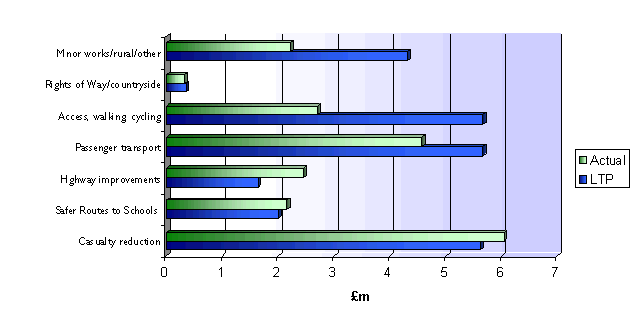
5.1 Table 5.3 and figure 5.3 show the proposed Local Transport Plan (LTP) capital funding on integrated transport set out in the LTP in March 2006 for 2006/07 and for 2007/08.
5.2 Despite additional funding because of the LTP's `excellent' rating, it has not been possible to fund integrated transport in full. As a `floor' authority, Hampshire County Council is effectively restricted in the total funding available, which has necessitated difficult and wide-ranging funding decisions. The correspondence between the County Council and the Department of Transport about this issue is not repeated here.
5.3 As a result, Hampshire County Council has invested £20.75 million in integrated transport through the LTP. Table 5.3 and figure 5.3 show that safety schemes are a priority and that passenger transport infrastructure including bus quality partnerships are being maintained above £4 million over the two years. Work on Town Access Plan delivery, walking and cycling has been reduced together with programmes of smaller projects that are important locally.
Table 5.3: LTP funding
2006/07 and 2007/08 | ||
£m | ||
LTP |
Actual | |
Casualty reduction |
2.97 |
2.94 |
Safer Routes to Schools |
1.07 |
1.10 |
Highway improvements |
1.60 |
0.91 |
Passenger transport |
2.00 |
2.92 |
Access, walking, cycling |
1.48 |
1.29 |
Rights of Way/countryside access |
0.16 |
0.16 |
Minor works/rural/other |
1.06 |
1.09 |
Total |
£10.34 |
£10.41 |
Figure 5.3: Comparison of 2006/07 and 2007/08 LTP funding
Safety expenditure
5.4 Safety expenditure in 2006/07 focused on the Carriageway Surface Treatment Programme (£1.2 million), Safer Routes to Schools (£1.1 million) and pedestrian crossings (£280,000), delivering a large number of schemes with wide-ranging benefits. In 2007/08, these programmes were given a similar level of priority.
Congestion expenditure
5.5 Addressing congestion involved significant expenditure of nearly £2.5 million over the two years on passenger transport infrastructure, including £624,000 on improving Havant Bus Station. Infrastructure in support of Bus Quality Partnerships (BQPs) were provided in Havant (£642,000), Andover (£171,000), Southampton-Waterside (£424,000), Basingstoke (Route 3) (£130,000), and Southampton to Winchester (£216,000), complemented by BQP information strategies in all these areas.
Accessibility expenditure
5.6 Expenditure on accessibility focused on pedestrian severance (£934,000) in 2006/07 with schemes in Hayling Island, North Baddesley and Chilworth, and £298,000 on community transport. In 2007/08, £737,000 was spent on rural partnership schemes. Town Access Plans featured strongly in the programme with schemes delivered in Alton, Andover and Emsworth.
5.7 External contributions have supported area transport strategies with £6.37 million in 2006/07 and £9.04 million in 2007/08. These contributions must relate to the local area that they are derived from and are not available for general programme support.
External funding
5.8 Hampshire County Council uses external funding generated from developers - principally through Section 106 agreements - to supplement the LTP funded capital programme. In 2006/07, £6.2 million of developers' contributions were spent on a range of transport related infrastructure and in 2007/08, this increased to £8.8 million as the County Council looked to cover the shortfall resulting from being a `floor' authority. However, the effect of the economic downturn is likely to mean that this source of funding is going to be more difficult to secure in future years.
5.9 Examples of significant expenditure from this budget during the past two years are the provision of traffic signals on the A33 Ringway in Basingstoke; contributions towards a range of bus infrastructure and information improvements in the Basingstoke and Farnborough areas and the construction of Witherbed Lane Link Road and capacity improvements to Segensworth Roundabout.
LTP maintenance spending and use of local resources
5.10 Hampshire County Council's highway maintenance is partly funded from the LTP and partly from local resources. A summary of the spending in 2006/07 and 2007/08 is set out in the following paragraphs.
5.11 The total capital highways maintenance funding for Hampshire from central government in 2006/07 was £14.601m rising to £16.145m in 2007/08.
5.12 Recognising the importance of highway maintenance, Hampshire County Council supplemented LTP funding with a locally resourced capital programme resulting in the total capital programme of £28.310m in 2006/07 and £28.774m in 2007/08 - table 5.13 details the expenditure.
5.13 In addition, the County Council also spends a significant amount of its own revenue funding on road maintenance, giving a total maintenance expenditure of £51.907m in 2006/07 increasing to £53.789m in 2007/08.
5.14 In 2006/07, major maintenance schemes were delivered on the A325 (£1.35m) and on the A338 (£800,000). In 2007/08, the most significant scheme delivered was on the A327 at Minley costing £1.65m.
5.15 Expenditure on the bridges capital funding for 2006/07 and 2007/08 was in excess of £8 million on an ongoing programme of structural bridge maintenance involving assessments, road/rail interface protective measures, parapet upgrading, strengthening and footbridge maintenance.
Table 5.13: Capital maintenance expenditure 2006/07 and 2007/08
Capital budget highway maintenance |
(£ `000) | |
2006/07 |
2007/08 | |
Roads and footways |
||
Routine structural maintenance* |
4,702 |
5,234 |
Major maintenance schemes |
2,510 |
2,264 |
Planned structural maintenance |
8,381 |
7,371 |
Resurfacing schemes |
3,568 |
4,950 |
Improving quality of place schemes |
- |
435 |
Surface dressing |
3,468 |
3,338 |
Design and supervision fees |
1,292 |
1,194 |
Bridges |
||
Structural bridge maintenance |
4,389 |
3,716 |
Other |
- |
272 |
Total capital expenditure |
£28,310 |
£28,774 |
Total revenue expenditure |
£23,597 |
£25,015 |
Overall total highway maintenance revenue and capital |
£51,907 |
£53,789 |
* eg patching, permanent repairs to potholes, drainage structures, safety fencing
Major scheme funding
5.16 Hampshire County Council's only supported major capital scheme, A3 ZIP Corridor bus priority route, is now substantially complete apart from some minor works and the final level of available government support is outstanding.
5.17 Transport Minister Paul Clark officially launched the scheme in November 2008, when increases in passenger numbers of 17% were announced. The quality of service and the cooperation between authorities, principally Hampshire County Council and Portsmouth City Council in liaison with others and the operators, will be a model for the rest of the South East Hampshire Bus Rapid Transit network. Hampshire County Council submitted a bid for £20 million Community Infrastructure Funding in October 2008.
5.18 Transport for South Hampshire includes further major scheme bids for regional funding with bids to be developed for the Basingstoke area in 2009.
5.19 Further evidence base work and preparatory work for future major schemes will be developed as resources allow and Hampshire County Council is looking forward to working with the Government Office for the South East and the Department of Transport and other partners building on the good working relationships already established.
Future programmes
5.20 At the time of writing this report, Hampshire County Council's programmes are being reviewed in the light of the effects of the economic downturn on the County Council's financial resources.
5.21 The economic downturn is already affecting local property markets. This has a knock-on effect on the capital programme, as developers are less likely to progress with developments and even if they do, are going to be more reluctant to fund transport and other related infrastructure.
5.22 The new funding systems such as the Regional Funding Allocation and the Community Infrastructure Funding, provide an opportunity to secure funding. However, to take advantage of funding opportunities, Hampshire County Council has to carry out expensive, significant preparatory works, especially in those cases where it is bidding for financial support that it is not guaranteed to get.
5.23
APPENDIX 1: Statutory Network Management Duty |
1 Outline of the Network Management Duty 1
2 Hampshire County Council's approach 2
3 Shorter term management 3
4 The LTP and the LAA 5
5 Longer term planning 9
1 |
Outline of the Network Management Duty |
Overview
1.1 This appendix details Hampshire County Council's approach to its Network Management Duties as defined by the Traffic Management Act (2004), Section 17.
1.2 The Traffic Management Act (2004), (referred to as `the Act') sets out the Network Management Duty (NMD), which requires local traffic authorities to `do all that is reasonably practicable to manage the network effectively to keep traffic moving'.1
1.3 The Act has set out the objectives of the NMD:
· Securing the expeditious movement of traffic on the authority's road network.
· Facilitating the expeditious movement of traffic on road networks for which another authority is the traffic authority.
1.4 Section 17 of the Act outlines the authorities' duties in carrying out that duty, and this appendix explains how Hampshire County Council performs these duties.
Looking ahead
1.5 Many factors affect area-wide traffic growth and lie outside Hampshire County Council's control. For its part, the County Council will continue the Local Transport Plan's (LTP) philosophy of reduce, manage, invest to minimise the damaging effect that road traffic growth can have on the environment, economy and public health.
2 |
Hampshire County Council's approach |
Arrangements for performing the NMD
2.1 To effectively meet the requirements of the NMD, specifically to secure the expeditious movement of traffic on the network, Hampshire County Council appointed a Traffic Manager. This Traffic Manager reports to the Traffic Manager Board, consisting of senior officers, about progress on the NMD and to identify further work in meeting the duties. Hampshire County Council has developed a number of approaches in carrying out its NMD.
2.2 Shorter term management (see Section 3 of this appendix) includes the coordination of road works, incident management and planned events together with the continued development of traffic management systems that exist in many of Hampshire's towns. Also included are information systems such as real-time information for passenger transport users and the promotion of the smarter choices agenda.
2.3 EnZen, a specialist consultant employed by Hampshire County Council is reviewing coordination of traffic management and street work management functions. The County Council is working with EnZen on how these services - that were previously delivered independently - are incorporated to deliver the Act's objectives. Work is progressing on a five-year vision for delivering these functions.
2.4 The LTP sets out the County Council's transport policies and five-year implementation plan. Since the adoption of the LTP in 2006, Transport for South Hampshire (TfSH) has been formally constituted and the new Local Area Agreement (LAA) is now in place. The approach and progress with the LTP and the LAA are set out in Section 4 of this appendix.
2.5 Longer term planning is dominated by the economic growth and associated development agendas. Discussed briefly in Section 5, looking in particular at the South Hampshire and Basingstoke growth areas and working together with regional and national agencies including the Department for Transport, Government Office for the South East, South East England Regional Assembly, South East England Development Agency, Highways Agency and Network Rail to progress the transport and policy interventions needed to ensure that the transport systems (both local and national) can support growth and accommodate developments.
Looking ahead
2.6 A Network Management Plan is being prepared for completion in draft by April 2009, to bring together these issues to cover all aspects of the approach. Many elements, such as smarter choices, promoting passenger transport, Bus Punctuality Improvement Partnerships, have important roles throughout the process.
3 |
Shorter term management |
Hampshire County Council works
3.1 Hampshire County Council recognises that its own works on the highway are a potential cause of traffic disruption and require the same management principles used to coordinate utility works. Accordingly, the County Council has processes and support systems to ensure notification of its own works in a similar manner to those of utilities. Hampshire County Council with Jacobs Babtie developed an innovative and user friendly, map based IT system using Elgin (www.elgin.gov.uk) as a base model. An added benefit is that Hampshire County Council is seeing a financial return on this development as other authorities adopt it for their own use.
3.2 Hampshire County Council's own works are also regulated and directed using mirror powers to those under the New Roads and Street Works Act (1991) (NRSWA). New contracts now include financial and other penalties if poor performance prevents the County Council from executing its NMD.
Dealing with planned events
3.3 Coordination of all works and events is separate from works promotion activities and is supported by an independent overview undertaken by the Traffic Manager and the Traffic Manager Board. A number of robust systems manage and coordinate planned works:
· Regular coordination meetings with all works promoters, interested organisations, the Highways Agency and neighbouring authorities.
· Map based, EToN 4 compliant, IT Register and support systems.
· Regularly updated Local Street Gazetteer to provide details of restrictions.
· Regular staff briefings to ensure training is up-to-date and best practice shared.
· Specific project meetings to discuss works that will significantly effect the network.
· Maintaining a database of all known planned events.
3.4 Events are assessed for their likely impact on the highway network and if significant, traffic management meetings are convened, followed by the production of a Traffic Management Plan. These plans are held on file and reused for similar or repeat events. The meetings are attended by all interested organisations, including the event organisers, police, emergency services, neighbouring authorities, the Highways Agency and local district councils. Review meetings are also held to discuss performance and the whole process is used to improve network management in the future.
3.5 Utilities, neighbouring authorities and local people can access information on planned works and details of roads protected under Section 58 of NRSWA through Elgin and Hampshire County Council's own website:
http://www3.hants.gov.uk/roads
Traffic management systems
3.6 Hampshire County Council is a leader in traffic management and information systems including the EU supported ROMANSE telematics system started in Southampton. Development work is looking at combining the needs of road works, incident management and day-to-day traffic management, bus punctuality and transport planning proposals from the various monitoring sources available including real-time information on passenger transport, satellite data and automatic number-plate recognition. A commission to consultants is expected shortly.
Smarter choices
3.7 Hampshire County Council has considerable experience and expertise in smarter choices, particularly in travel planning and the promotion of sustainable transport as well as pioneering smarter working including the MATISSE project. Promotion of smarter choices is part of the short- and long-term approaches to congestion.
Collaborative working
3.8 The County Council makes full use of its legislative powers to regulate and direct works while still promoting a collaborative approach with all works promoters. Biannual Highway Authorities and Utilities Committee meetings are held and attended by both Southampton and Portsmouth city councils. The Highways Agency and its network operators are also invited.
3.9 Operational performance indicators are shared with promoters at performance meetings to identify areas for improvement. This drives improvements while removing the need to take unnecessary and expensive legal action. However, Hampshire County Council will prosecute persistent poor performers or promoters that commit serious offences. Three utility companies were successfully prosecuted in 2008 for serious safety related offences.
Looking ahead
3.10 Developing further policies will ensure the efficient deployment of limited resources to maximise the opportunities to reduce traffic disruption from works and events, these include:
· Route-based Traffic Management Plans that clearly set out standard restrictions, directions and guidance to all works and event promoters for strategic or vulnerable highways.
· A network hierarchy of key routes and highways requiring works and event promoters to identify ways of operating that minimises disruption to traffic.
· Processes to identify opportunities to harmonise authority and utility works programmes at the design stage.
· Partnerships with works promoters to further improve joint understanding of duties and responsibilities and to improve performance.
· Develop a five-year vision for coordinating street works and traffic management systems.
4 |
The LTP and the LAA |
4.1 The LTP is discussed elsewhere in this report, but included here are some specific examples of initiatives that support the NMD. Also described, are the specific LAA congestion indicators.
Bus Punctuality Improvement Partnerships (BPIP)
4.2 Hampshire and the main bus operators are developing BPIPs. A pilot series of route audits on a number of busy urban corridors identified measures required to improve the reliability and punctuality of bus services.
4.3 Investigations into detailed punctuality monitoring (using data from the County Council's real-time bus information system) will help to identify locations on the network where buses experience delays by analysing average journey times per route throughout the day. Action plans will help to deal with these areas. This information will also help in performing the wider network management duties.
ITIS and traffic data collection
4.4 Hampshire County Council is making use of ITIS data to monitor and measure congestion. This methodology provides a more scientific approach to identifying congestion by comparing peak hour journey times with free flowing conditions and taking the difference as a measure of delay. Work is underway to identify congestion priorities (as part of the LAA work).
4.5 The County Council undertakes regular traffic counts and reviews the data collected from various surveys including vehicle, pedestrian, cycle and turning counts, queue length surveys and origin and destination surveys.
4.6 One example of how this data is used is that of measuring LTP and LAA targets and trends identified to establish future congestion (based on traffic growth and travel patterns). This data is used to support policy decisions and capital expenditure in developing measures that reduce current and future congestion.
Town Access Plans (TAPs)
4.7 The LTP introduces TAPs to improve access to and within urban areas. TAPs aim to identify barriers to accessibility including severance and congestion and produce actions and recommendations to overcome them. Improving accessibility can support sustainable travel behaviour which in turn can underpin and maintain vibrant, healthy communities and prosperous places to live. TAPs are site specific and can include a number of initiatives and measures to remove the identified barriers.
4.8 The rolling TAP programme already has the first plans drawn up, which are often included in Local Development Frameworks (LDFs).
4.9 TAPs are providing new crossing facilities to remove barriers that create severance for people walking and cycling.
4.10 TAPs also perform the following functions:
· A tool developed to implement the LTP accessibility strategy within identified key settlements.
· Providing a list of schemes and strategies at the local level to support the development control process.
· Providing an implementation plan of highway schemes funded by secured and future external funding.
· A tool to encourage the use of sustainable modes, while reducing reliance on and providing alternatives to single occupancy vehicle trips.
4.11 TAPs are providing a range of transport improvements to overcome real and perceived barriers, including:
· Widening narrow footways and treating poor surfaces.
· Improved signing and lighting. Improving streets subject to vandalism.
· Introducing more CCTV to tackle problems of crime and fear of crime.
· Better cleansing and enforcement regimes.
· Improved walking, cycling and passenger transport links within and to towns, including promoting the concept of towns as transport hubs.
· Improving facilities to help people with mobility problems.
· Reviewing access arrangements for all people and transport groups including taxis, motorcycles and cars (including motorists with special needs).
Road network hierarchy
4.12 As well as developing a detailed hierarchy of routes for the purposes of coordinating management of the network, Hampshire County Council is also developing a network hierarchy to reflect the strategic importance of routes in connecting urban centres and employment areas. The hierarchy will reflect the primary network of motorways and trunk roads that provide regional, national and international links to and from Hampshire. A full network hierarchy is planned for December 2008.
Road user hierarchy
4.13 The NMD guidance clearly defines `traffic' as including all road users, depending on the nature and location of the network. Hampshire County Council is supportive of the recent Manual for Streets publication, and through its TAP programme is investigating practical measures for improving accessibility and reducing congestion for all road users.
Impact on other authorities' road networks
4.14 The NMD places a responsibility on each authority to have regard for road networks where another authority is the traffic authority. Hampshire County Council already has in place a number of measures to ensure that partnership working with other highway authorities secures the expeditious movement of traffic across networks. The longer term aspects of this are included in Section 5 of this appendix.
The LAA
4.15 Congestion is a focal element of the LAA and it recognises that congestion effects people's quality of life, imposes significant and increasing economic costs and is related to priorities such as air quality and climate change. As such, reducing its effects will benefit many of the LTP and LAA objectives.
4.16 Through the LAA, Hampshire County Council has a local indicator for tackling congestion hot spots. This indicator has two objectives:
· Reductions in congestion or congestion growth at strategic hot spots.
· Reductions in congestion or congestion growth at locally identified hot spots.
Strategic hot spots
4.17 This addresses strategic congestion areas requiring major intervention. Many of these require large scale interventions at a sub-regional level and major schemes that take a long-time to develop. Comparing measures of congestion help to prioritise actions and funding to relieve congestion at a strategic level. This indicator is defined as vehicle delay multiplied by the number of vehicles affected.
4.18 The approach with strategic congestion is to identify and measure congestion followed by working with local partners such as the Hampshire Economic Partnership and regional and national bodies on prioritising major schemes within appropriate programmes.
Locally identified hot spots
4.19 Working with local partners addresses issues of local importance. Interventions may include traffic management and initiatives to tackle congestion outside schools. As with the strategic hot spot measure, congestion can be based on vehicle delay but could also include impedance to passenger transport or pedestrian movement. Indicators of this type have not been measured previously and the congestion index needs to be determined.
Looking ahead
4.20 Road traffic congestion impacts on quality of life, health, the economy and the environment. Preparatory work for this target is currently underway. Meetings with district councils will determine the index of hot spots and targets, followed by action plans for the annual update of the LAA.
4.21 For addressing strategic congestion hotspots, primarily, actions will involve making bids for funding and working with partners to lobby government and other funding organisations. For local congestion, liaison with district councils and other stakeholders will help to identify low-cost interventions such as traffic management measures or travel planning.
5 |
Longer term planning |
5.1 Longer term planning in Hampshire is dominated by the South East Plan (SEP) agenda. Both South Hampshire and Basingstoke are growth areas with significant development proposed for both. The Secretary of State's proposed modifications to the SEP includes a Strategic Development Area (SDA) in East Hampshire at Whitehill/Bordon as well as the two SDAs already proposed for South Hampshire.
5.2 Much of the approach to longer term planning concentrates on the major transport networks, the need for area-wide traffic management and information systems and the need to accommodate the new development.
South Hampshire
Partnership for Urban South Hampshire
5.3 South Hampshire is designated as a growth point for the economy and by 2026, the area will see a further 80,000 homes and around 2,000,000 million m2 of employment floor space. Of this, South East Hampshire is to provide approximately 44,000 homes and 800,000 m2 of employment floor space with 14,700 new homes in Portsmouth. The scale of development, together with anticipated growth in the demand for travel from the existing communities within Fareham, Gosport, Havant and Portsmouth (the `harbours authorities'), will place further demand on already stretched transport networks.
5.4 As part of the evidence base for their LDFs, the `harbour authorities' jointly commissioned consultants to investigate and report on the potential impact of their development proposals on the Strategic Road Network and major links to/from it. A steering group made up of representatives of the four authorities and the Highways Agency managed the study. The consultants reported in June 2008.
Transport for South Hampshire (TfSH)
5.5 TfSH is the transport delivery agency for the South Hampshire sub-region and covers Portsmouth, Southampton and part of Hampshire. It is a formal partnership of the three transport authorities of Hampshire, Southampton City Council, and Portsmouth City Council and has a joint committee with decision making and budgeting powers. The Highways Agency plays an active part in this partnership as the trunk road network is closely linked with the three local transport authorities' networks.
5.6 In April 2008, the three authorities jointly published `Towards Delivery - the Transport for South Hampshire Statement'. This sets out the transport challenges for the sub-region, the strategy and priorities to address these and sources of funding.
5.7 The new housing and employment for the area included in the SEP means that increased travel will accompany economic vitality and growth - much of which is likely to be by car. This is a significant challenge for transport. A strategy is in place to consider how and when journeys are made and how they could be dealt with in the future. The strategy has three main strands: reduce, manage and invest. As with the LTP, all can work together to enable the planned growth and to deliver the development sites identified.
5.8 The strategy includes initiatives to reduce the need to travel including planning policies and careful design of development sites, significant passenger transport improvements and the scope to support the sustainable modes of walking and cycling. The reduce element also considers better ways of providing car parking and discouraging the use of cars where appropriate. In addition, the manage element of the strategy addresses ways of making better use of existing networks such as changing the way that motorways and trunk roads are used, improving bus services, introducing park and ride sites and improvements that allow more trains to operate. Technology applications such as management and information systems and smart cards have been considered as well. Alongside reduce and manage measures, the invest infrastructure schemes can be delivered. A number of studies aim to identify infrastructure requirements and to prioritise these for Regional Funding Allocation and other funding sources.
Basingstoke
5.9 Basingstoke district is an economic `diamond for growth' and may need to accommodate approximately 20,000 new dwellings and associated employment growth as part of the SEP. The local planning authority - Basingstoke and Deane Borough Council (BDBC) - is preparing its LDF and Hampshire County Council is working with BDBC on the transport assessment and strategy required. This includes the interaction with the Highways Agency's network. A strategy group of national and regional partners, similar to that for TfSH, will advise on the approach and interventions required.
Whitehill/Bordon
5.10 Whitehill/Bordon in East Hampshire is the subject of an eco-town bid and is a proposed SDA within the Secretary of State's proposed modifications to the SEP. Should this go ahead together with the proposed SDAs in South Hampshire, careful master-planning of the area in terms of their special layout and content together with the promotion of sustainable transport modes will help to reduce traffic generation.
Monitoring and performance
5.11 The Traffic Manager's service plan covers the NMD responsibilities and is used to measure performance, including effectiveness of decision making, as well as the performance of managing the road network. The Traffic Manager Board monitors and assesses performance.
5.12 Certain parts of the NMD, such as identifying current and future causes of congestion and considering action to tackle them, are covered by a number of policies as illustrated in this report. Many of these are already monitored through the LTP and LAA targets.
Traffic growth
5.13 Hampshire County Council's LTP has a target for area-wide traffic mileage growth:
To not exceed a 1% annual growth rate of all motor vehicle traffic on Hampshire's road network (excluding trunk roads and motorways) by 2010/11.
Performance and review
5.14 Between 2004 and 2007, the 24 hour annual average daily traffic (AADT) for all Hampshire non-trunk roads rose by only 0.3% against a target of keeping growth to 1% per year. By comparison, area-wide traffic mileage on trunk roads in Hampshire over the same period rose by 1.7%.
5.15 A number of factors affect road traffic growth over which Hampshire County Council has little influence, for example performance of the national and regional economy.
Network Management Plan
5.16 The Network Management Plan (NMP) is planned for completion by April 2009 to incorporate the short- and long-term planning including those actions in the LTP and the LAA.
5.17 The NMP will help to monitor performance, including the decision making processes employed, and together with the EnZen coordination strategy, will set out Hampshire County Council's approach to meeting the NMD.
5.18
APPENDIX 2: Response to GOSE's settlement letter |
GOSE comment |
Action |
Analysis of problems and opportunities | |
The evidence that the Rights of Way network will be used to deliver the Local Transport Plan (LTP) objectives was not particularly strong. |
· The Rights of Way Improvement Plan (RoWIP) has been developed as a `distinct strand' of the LTP, with the two plans complementing one another. · The criteria for allocating funding has been informed by the priorities emerging from public consultation, and then agreed with the Hampshire Countryside Access Forum, elected members and officers. This has met the shared objectives of the LTP and RoWIP of enabling people to access places and services in a safe and convenient way without recourse to the private car. A high priority has been to enable access for people with reduced mobility and to encourage outdoor exercise for health and informal recreation. Priority schemes aim to reduce journeys made by car thereby easing road traffic and improving air quality congested areas. · Over the first three years of the LTP, funding has been used to deliver a range of schemes detailed in Section 5 of this report. |
Consultation and involvement of stakeholders | |
Unclear how discussions with local operators, users, environmental groups etc will influence delivery of the Plan. |
Involvement of partners has been a key element of delivery of the plan and there are a number of examples in the progress report. In particular, the transport elements of the Local Area Agreement (LAA) are being delivered as part of a close working relationship with a wide range of partners. |
GOSE comment |
Action | |
Accessibility | ||
Strategy has not clearly demonstrated any priorities for action. |
Initial priorities were identified and met through the accessibility pilots and subsequently as part of the rural transport pilots. This work is now leading into the delivery of further schemes to improve local accessibility that are being developed with each district council and other key stakeholders as part of the LAA. | |
Evidence base did not use a wide range of sources. |
Hampshire County Council provides the evidence required to inform decision making. Qualitative and quantitative data is collected from a wide range of sources; household surveys, a Planning for Real exercise and community street audits have all taken place in the first two years of the LTP. Increasing use is also now made of the MOSAIC and CJAMS packages. Other sources of information used include crime, road traffic accidents, street lighting, traffic flow and bus punctuality databases. | |
Prioritisation criteria was not applied to identifying priorities and hence unclear why `pilots' were chosen as priorities. |
A strategic mapping audit of accessibility in Hampshire was carried out against the government's criteria outlined in `Guidance on accessibility planning in local transport plans'. This assessment was conducted using the Accession software. Based on this assessment, the working group on accessibility of the Hampshire Strategic Partnership identified three possible pilot areas for further study. These were chosen to represent a cross-section of several different issues related to accessibility as part of the delivery of Priority C, from the first round of the LAA. | |
Little evidence to back up importance of severance as an issue. |
· Addressing severance was identified as a key issue within the Whitehill/Bordon pilot. The A325 effectively severs the mainly residential area to the east from the existing employment areas and MoD land to the west. This physical barrier acts as a constraint to local mode choice in as much as because it is difficult to cross, it is more likely that people will travel by car even for local journeys. With high traffic flows, or greater traffic speeds, the potential for conflict between cars and pedestrians or cyclists will increase, consequently with the potential for increased slow mode activity as a result of development, the likelihood of increased safety problems arising from a perpetuation of this severance will grow. · This has been addressed to an extent following the Community Street Audit element of the pilot and in a key element of the eco-town proposals for the area. | |
No target or trajectory was included in the draft plan, and the indicator itself is likely to be based on perception only. |
This was addressed in work carried out in August 2006, where an Accession based target was produced and agreed with the Government Office for the South East. | |
No indication of targeted actions. |
A detailed action plan, containing timescales, responsibilities and funding for each possible intervention was produced for each of the accessibility pilots. | |
No indication of partner commitment to the delivery of the strategy or detailed timetable. |
A range of partnerships has been developed in delivering the accessibility pilots. In particular, the Hampshire Primary Care Trust (PCT) were closely involved in the Andover to Winchester hospital and access to healthcare in the New Forest pilots. As a result the PCT is now taking forward a number of actions themselves. | |
Congestion | ||
Limited evidence that a wider range of tools such as parking policies and road space reallocation have been considered. |
These issues were covered in the congestion section of the LTP although it is accepted that they were not given a high level of prominence. As part of the local congestion priority in the new LAA, a number of local congestion schemes are being developed, which will consider the full range of tools depending on the particular local circumstances. | |
GOSE comment |
Action | |
Air quality | ||
Plan does not link any modelling to date with the setting of the air quality target. |
Modelling has been carried out by most of the district councils in Hampshire that have declared or considered declaring an Air Quality Management Area. Where an Air Quality Action Plan has been produced, modelling has been a integral part of apportionment work and helping to establish the impact of various different interventions. Hampshire County Council has supported this work, particularly through the provision of traffic information. | |
Road safety | ||
Limited reference to the role played by partners and stakeholders in formulating road safety strategies. |
Partnership working has been key in developing the road safety strategies. Both the police and Hampshire Association of Local Councils have participated in the process, with individual parish councils being involved in local schemes. Parish packs have also been produced to allow local people direct involvement in publicising local road safety. | |
APPENDIX 3: Delivery of schemes in support of achieving air quality targets |
page no.
1 Winchester AQMA 1
2 Eastleigh AQMA 2
3 Totton AQMA 2
4 Lyndhurst AQMA 3
1 Winchester Air Quality Management Area (AQMA)
1.1 Air quality monitoring results in 2007 were similar to previous years, with average annual NO2 for Winchester remaining constant at the roadside monitoring station since 2006 at 51 µg/m3 and still below the 2005 level of 53.5 µg/m3. The background NO2 has fallen since 2006 from 28 µg/m3 to 27 µg/m3 in 2007, remaining well below the annual mean limit value. The annual average particulate (PM10) levels have decreased since 2005 from 28.1 µg/m3 to 25 µg/m3 roadside and from 21.3 µg/m3 to 19 µg/m3 background, with both the 24 hour and annual objectives PM10 being met.
1.2 There are ranges of initiatives taking place in Winchester that will help to contribute to meeting the air quality targets:
The Winchester Town Access Plan is being jointly progressed by Hampshire County Council and Winchester City Council as part of a long-term strategy that will set out a programme of transport and access improvements for Winchester.
The Winchester Car Club was launched by the Major of Winchester on 9 May 2008. The scheme started with four new silver-coloured vehicles - a pair of Citroen C1s and two Citroen C3s. This can be extended if the car club proves popular.
Park and ride. Planning permission has been granted to construct an 864 space site south of the city centre adjacent to M3 junction 11. The scheme forms part of a programme of measures for the town centre that aim to:
· Reduce city centre traffic and congestion.
· Improve the city centre environment.
· Contribute to the Winchester Air Quality Management Plan.
· Maintain the economic viability of the city.
2 Eastleigh AQMA
2.1 Annual average NO2 levels in Eastleigh increased in 2007 following a fall in the previous year, resulting in a 2007 level similar to that recorded in 2004 at 47 µg/m3. In isolation this is disappointing; particularly as in the previous years Eastleigh was on target to meet the level of 40 µg/m3 by 2011. However, the overall trend throughout the Local Transport Plan (LTP) period remains downward. The explanation for the variations in results may be due to a poor data capture.
2.2 Specific initiatives for improving air quality include:
· The Eastleigh Town Access Plan, along with Eastleigh Borough Council's Area Action Plan is being developed to include a series of improvements in the town centre, some of which should be beneficial in reducing the level of emissions, including:
_ Pedestrianisation of Market Street. Apart from providing a pleasant shopping environment, this proposal would prevent traffic from circulating around the town centre in search of parking.
_ Relocation of the bus station next to the rail station. Buses have to circulate around a loop to access the station with adverse effects on air quality. As well as reducing emissions, collocation will provide a high quality transport interchange with the rail station.
_ Chickenhall Lane Link Road if delivered as part of developments in the South Hampshire Strategic Employment Zone (SHSEZ) will help divert HGVs away from the town centre and hence improving air quality in the area.
2.3 Investigations are also taking place into the potential to restrict heavy goods vehicle movements along Southampton Road/Leigh Road at peak times and to create a Low Emission Zone to discourage high polluting vehicles from accessing the town centre.
2.4 Although it is unlikely that the initiatives listed in paragraph 2.2 will be delivered, a package of schemes developed from these proposals would have an overall beneficial impact on air quality and traffic levels, allowing the targets to be reached.
2 Totton AQMA
3.1 Levels of NO2 have increased from the previous two years results, although still remain below the 2004 baseline. When the baseline was agreed in 2004, the current NO2 levels were slightly below the maximum target level of 40 µg/m3. Levels in 2007 are still below the maximum of 40 µg/m3, but actions from the local authorities will need to be taken to maintain this. Further monitoring will be carried out, as it is difficult to draw firm conclusions from the data to date.
3.2 A feasibility study was started in July 2008 to assess the impact of a range of transport schemes that could help to improve air quality and reduce traffic within the Totton AQMA. In addition, New Forest District Council will be undertaking work to feed in to this study, reviewing the existing static `cut engine cut pollution' signs to assess their effectiveness based on a level of zero compliance beforehand.
3 Lyndhurst AQMA
3.1 In 2007, the average annual NO2 for Lyndhurst was 37 µg/m3 and remains below the maximum value of 40 µg/m3. This is an increase from previous years of monitoring; especially as in 2006 the average annual recording of NO2 was only 32 µg/m3. While the level is below the original baseline figure of 38 µg/m3 and does not exceed the maximum value, there is some cause for concern and monitoring of the sites on the High Street will continue.
3.2 Feasibility work assessing the need and justification for a village bypass and/or other traffic management options has recently been completed. This included extensive traffic surveys and public opinion surveys regarding a bypass as well as other alternative measures. All bypass options have now been ruled out and the focus for relieving the effects of traffic congestion and improving the AQMA will now concentrate on traffic management (including traffic technology) and smarter choices in the village centre. Further work is being carried out in 2008/09 to assess possible traffic enhancements and routing strategies
.
APPENDIX 4: Progress with accessibility pilots |
page no.
1 Introduction 1
2 Andover to Winchester hospital 1
3 Whitehill/Bordon 2
4 New Forest 3
1 Introduction
1.1 This appendix summarises the delivery of the accessibility pilots identified in the Local Transport Plan (LTP) and also developed as part of Priority C, from the first round of the Local Area Agreement (LAA). The aim was to improve the coordination of transport and access to services across the county. This work has achieved real benefits on the ground and also helped to inform the development of the priorities for accessibility in the second round of the LAA and the lessons learnt are therefore important in ensuring success.
I-Value project
1.2 Hampshire County Council is working on a project to investigate how urban layout affects accessibility, and in turn impacts land values. This is being taken forward with consultants as part of a University College London research project and will provide practical skills in mapping and modelling accessibility.
2 Andover to Winchester hospital
2.1 The Andover to Winchester Hospital Accessibility Pilot came out of a meeting which was held in October 2005 between Hampshire County Council, Test Valley Borough Council and the Winchester & Eastleigh NHS Trust to discuss the difficulties that many patients, visitors and staff experience in getting to either Andover or Winchester hospitals from many of the villages in Test Valley.
2.2 As a consequence of the meeting, the pilot was included within the LTP and work started in looking at accessibility to the hospitals using `Accession' and maps were produced as a base for starting the process.
2.3 An informal working group was then established with representatives from Winchester & Eastleigh NHS Trust, Stagecoach, Hampshire County Council, SOS Group, Test Valley Community Services, Test Valley Borough Council and the Local Strategic Partnership Chairman.
2.4 A draft action plan was produced in April 2007 detailing a variety of actions which could be undertaken by the members of the steering group to enhance accessibility to Winchester hospital. These were:
· Monitoring and review of car parking at Winchester hospital.
· Investigating improvements to signing within the hospital and within Winchester.
· Discussions with bus operators about timetable improvements.
· Completion of the rural bus pilot.
· Investigation of a shuttle bus proposal.
· Improved information, based on advice offered in a travel information leaflet.
· Further investigation into taxi share, possibly as part of a rural bus pilot.
2.5 The production of the Action Plan represented the completion of the pilot.
2.6 The idea of a shuttle bus had been developed as part of the rural bus pilot looking at brokerage options in northern Test Valley. It has been introduced with four return trips per day stopping at: Andover War Memorial Hospital; Andover Bus Station; Stockbridge; Royal Hampshire County Hospital, Winchester. In conjunction with this an information leaflet, which highlights the full range of travel options available for people travelling to Winchester hospital from northern Test Valley has been produced.
3 Whitehill/Bordon
2.1 The Whitehill, Bordon and Lindford accessibility pilot sought to address the issue of poor accessibility to a wide range of facilities in the area. The pilot study was underpinned by a thorough data collection exercise.
2.2 Audit work suggested four main barriers to accessibility:
· The lack of some services in the area. This includes larger hospitals, some larger shops, employment, job centre plus office and colleges of further education.
· Poor public transport links to surrounding large towns (Guildford, Basingstoke, Winchester, Petersfield, Portsmouth) where these facilities can be found.
· Limited information about the passenger transport links that do exist.
· Residents' concerns about footpaths and pedestrian access within Whitehill and Bordon. In particular, residents were concerned about severance caused by the A325.
2.3 One of the key recommendations was for a Community Street Audit (CSA) to be undertaken to focus on walking routes to local shops.
2.4 A CSA was undertaken in October 2007 and will also be used to inform the Whitehill, Bordon and Lindford Town Access Plan. Invitees included county, district, town and parish members, the police, representatives from a parent and toddler group, visually impaired people, the local school, the hospital, the town partnership and a member of the CTC (Cyclists Touring Club). The lack of dropped kerbs and pedestrian crossings was highlighted as an issue from the Forest Centre towards Mill Chase Road.
2.5 As a result of issues raised at the CSA, four local projects have been completed:
· Completion of missing footway on Conde Way.
· Improvements to pedestrian crossing and footways on Chalet Hill.
· Improvements to pedestrian access between Forest Centre and Mill Chase School.
· New bus stop infrastructure at selected stops.
2.6 Access to partnership funding was used to deliver these projects.
Whitehill/Bordon opportunity/eco-town bid
2.7 The pilot study has been completed but the information gathered is now being used in the development of the Whitehill/Bordon opportunity and is informing the transport assessment for the eco-town submission.
4 New Forest - access to healthcare
4.1 A preliminary meeting was held in September 2007 to begin to scope the pilot study. This was followed by the formation of a steering group comprising Hampshire County Council, New Forest District Council (NFDC), Hampshire Primary Care Trust (PCT), the Royal Bournemouth and Christchurch NHS Hospitals Trust and a representative from the Patient & Public Involvement Group. This met for the first time in November 2007, and met again in January, March and June 2008.
4.2 The steering group made use of Accession GIS software to assess gaps in public transport provision, but it was recognised that this has a number of limitations and should be best used in combination with other data sources. Evidence was collated from a range of secondary data sources (such as the Hampshire County Council's 2006 MORI survey on public perceptions of accessibility, a 2004 NFDC and PCT district wide health survey and work done in 2007 by MottGifford matching Accession data with 2001 Census data). This indicated that access to GP surgeries was only a problem for 0.45% of the population of the New Forest. Therefore the steering group chose to concentrate further investigations on access to hospitals.
4.3 Evidence was used to define the geographical scope of the pilot study area as encompassing 18 wards in the southern and south eastern coastal part of the New Forest district, from New Milton in the west to Hythe in the east, including Lymington, Beaulieu and Brockenhurst. This was because this area contained the five most deprived super-output areas within the New Forest as defined by the Indices of Deprivation 2007, and this south eastern area had several wards with among the highest proportion of "no car" households. This SE New Forest area contains two community hospitals (Hythe and Milford-on-Sea) and residents make use of either Southampton General, the Royal Bournemouth Hospital and Lymington New Forest Hospital (which falls somewhere in between a community hospital and main hospital in terms of range of services offered).
4.4 Partners fed in a variety of data on volumes of patients attending the main hospitals from postcodes within the pilot study area. This data was analysed and mapped to paint a picture of hospital use. Southampton General is the most heavily used hospital within the pilot study area, followed by Lymington New Forest Hospital, then Bournemouth and then Salisbury District Hospital (which sees very low numbers of attendances).
4.5 It was recognised that conventional passenger transport based solutions would not be a cost effective way of meeting a relatively small need.
4.6 Scope exists for the health sector to use non-urgent patient transport (NUPT) provision more effectively by better contract management.
4.7 Care groups play an important role in providing access to healthcare. Seven of the 8 local care groups operating in the pilot study area did 6,732 tasks a year (561 per month), of which nearly all were health-related. Care groups rely on user donations to cover costs. Most care groups were short of volunteer drivers and are struggling to cope with the volume of demand for health-related trips, and are taking some people who are eligible to use NUPT.
4.8 In light of this evidence, the steering group concluded that Hampshire County Council has limited scope for intervention to tackle problems of access to healthcare. The data collected suggests that the scale of the problem is smaller than was initially thought. Evidence shows that access to GP surgeries and pharmacies is only a problem for a small number of households (327), and access to hospitals can be a problem for 6,854 households within the NFDC area without a car or a reasonable bus journey to their nearest hospital (9.5% of all households).
4.9 No `one size fits all' solution exists for tackling access issues that affect a relatively small number of geographically dispersed people. Recommendations are for a limited number of actions (mainly within the remit of the PCT), which if possible are taken forward by the various stakeholders to tackle the identified shortcomings. The Hampshire County Council Health Overview and Scrutiny Committee will be asked to keep a watching brief on the outcomes of the actions.
4.10 The steering group included the following main initiatives in action plan:
· The PCT to work more closely with care groups.
· The PCT to review how it contracts for NUPT services.
· The PCT intends to recruit a site parking manager for Lymington Hospital. Additional duties for this post might include holding regular meetings with care group coordinators.
· The PCT to take transport and access to healthcare more closely into account in its strategic decision making about re-use of sites and planning of future service delivery, utilising an accessibility checklist.
· Scope exists for smarter working between NUPT providers and care groups.
· The PCT should be encouraged in its efforts to expand the range of services available at Lymington Hospital, the rollout of Practice Based Commissioning and re-using community hospital facilities as `one-stop shop' specialist centres, as all these initiatives would help to reduce the need to travel.
· Hampshire County Council to play an enabling role to foster closer partnership working.
· Hampshire County Council to carry out a Health Impact Assessment of all new (or updated) transport policy documents produced.
· Hampshire County Council is seeking to develop a rural pilot scheme in the New Forest, which will involve working closely with existing care groups to address issues such as volunteer recruitment. It will also be identifying gaps in car scheme provision and exploring the feasibility of increasing car scheme provision.