
Archived decisions
HAMPSHIRE COUNTY COUNCIL
Decision Report :
Decision Maker: |
Cabinet | ||||
Date of Decision: |
22 December 2008 | ||||
Decision Title: |
Corporate Performance Report - 2008/09 Half Year | ||||
Decision Reference: |
379 | ||||
Report From: |
Chief Executive | ||||
Contact name: |
Sue Sylvester / Gary Smith | ||||
Tel: |
01962 847493 |
Email: |
|||
EXECUTIVE SUMMARY
1. Summary:
1.1. The County Council is performing and improving extremely strongly. Improving community outcomes, innovating and providing value for money continue to be the overriding focus for the authority. Strong progress is being made in each of these categories.
1.2. This report summarises the performance of the County Council at the half year point of the 2008/09 financial year. It contains three main sections considering progress and risks against local priorities, partnership priorities and the National Indicator Set. There have been significant improvements in all three of these areas in what has been a challenging time.
1.3. Overall, very strong progress has been made by the County Council since April 2008. Good progress has been made on 125 of the 128 actions within the Corporate Business Plan, leaving only three actions where further activity is required to achieve success. Our performance in relation to the Local Area Agreement is progressing well at this early stage. Excellent progress has been made towards most of the LPSA2 (Local Public Sector Agreement 2) targets, for which 2008/09 is the final year. Since the introduction of the National Indicator Set in April 2008, strong progress has been made to identify and mitigate risk which, in many instances, concerns areas not wholly under the control of the County Council. The Council is well positioned in relation to these indicators.
1.4. At the same time, the Council continues to be rated extremely highly in external, independent audit and inspection. Of particular note is that Adult Services have been awarded Three Stars, the highest rating, for the second year running and the effective work that has taken place in delivering a compelling self assessment for improving our CPA Use of Resources block score, with the aim of achieving an overall four out of four.
1.5. This is the last report that will be brought to Cabinet relating to the current Corporate Performance Management Framework and Corporate Business Plan. `Driving Success', approved by Cabinet in November, sets out a new corporate Performance Management Framework and Corporate Improvement Plan which will enable an improved approach, content and format to future corporate performance reports.
2. Recommendations
It is recommended that:
2.1. Departments are requested to engage with LAA theme leads, to enable performance information to be available at local (district) levels, to assist partners to assess, monitor and manage performance.
2.2. Regarding LPSA2, departments are requested to continue to support target leads in improving performance, particularly in relation to the target areas that are still able to be influenced.
2.3. Departments are requested to continue actions to address the three areas within the Corporate Business Plan identified as requiring further work and report progress to the Corporate Performance and Efficiency Group (CPEG).
2.4. The opportunity given by the relaxation in the statutory requirements around an annual Performance Plan is taken to develop an `Annual Report of the County Council' which would provide an annual summary of the performance, financial and workforce position and achievements of the Council. This will flow from implementation of the new `Driving Success' corporate Performance Management Framework.
2.5. Cabinet formally acknowledges the importance of the role played by the County Council's Select Committees in monitoring the performance of both County Council partner agencies and the County Council itself.
CORPORATE OR LEGAL INFORMATION:
LINKS TO THE CORPORATE STRATEGY | ||||
Yes |
No | |||
Hampshire safer and more secure for all |
_ |
|||
Corporate Business plan link no (if appropriate) |
_ |
|||
Maximising well-being |
_ |
|||
Corporate Business plan link no (if appropriate) |
_ |
|||
Enhancing our quality of place |
_ |
|||
Corporate Business plan link no (if appropriate) |
_ |
|||
OTHER SIGNIFICANT LINKS: | ||
Links to Previous member decisions: | ||
Title |
Ref |
Date |
Direct Links to Specific Legislation or Government Directives | ||
Title |
Date | |
Section 100 D - Local Government Act 1972 - background documents | |
The following documents discuss facts or matters on which this report, or an important part of it, is based and have been relied upon to a material extent in the preparation of this report. (NB: the list excludes published works and any documents which disclose exempt or confidential information as defined in the Act.) | |
Document |
Location |
Departmental performance submissions and further information |
Corporate Performance Team |
Departmental budget submissions and further information |
Corporate Finance Team |
IMPACT ASSESSMENTS:
1. Equalities Impact Assessment:
The updated Corporate Strategy was risk and impact assessed in autumn 2007. Copies of the assessments are available on request
2. Impact on Crime and Disorder:
This report gives details of progress towards the achievement of council and partnership priorities. Within these priorities are those specifically relating to crime and disorder.
3. Climate Change:
a) How does what is being proposed impact on our carbon footprint / energy consumption?
This report gives details of progress towards the achievement of council and partnership priorities. Within these priorities are those specifically relating to energy consumption.
b) How does what is being proposed consider the need to adapt to climate change, and be resilient to its longer term impacts?
This report gives details of progress towards the achievement of council and partnership priorities. Within these priorities are those specifically relating to climate change.



CORPORATE PERFORMANCE REPORT:
HAMPSHIRE COUNTY COUNCIL
HALF YEAR 2008/09




Views of a Service User ...
Self-directed support user - man of 78:
"Following my stroke I have not been able to participate in my activities and would like to follow my interests. One of my main interests would be to play snooker. Part of my budget will be used to take me to the local snooker club. I need help when I am in unfamiliar places due to my short term memory loss and I become disorientated. The funding will help my wife to have a rest as she is my main carer."
MAIN REPORT
1. Purpose of the Report:
1.1. The County Council is performing and improving extremely strongly. Improving community outcomes, innovating and providing value for money continue to be the overriding focus for the authority. Strong progress is being made in each of these categories.
1.2. This report summarises the performance of the County Council at the half year point of the 2008/09 financial year. It provides information about progress towards achieving the three corporate priorities (Hampshire Safer and More Secure for All, Maximising Wellbeing and Enhancing our quality of place) and an indication of our performance in relation to the new National Indicator Set (NIS). This report also contains an update on progress in relation to two of our key partnership agreements - the recently agreed statutory Local Area Agreement and the Local Public Service Agreement 2.
1.3. The report is structured in four main sections with a summary of the County Council's performance in relation to:
- Its priorities (the Corporate Business Plan)
- Its priorities working in partnership with others (the new Local Area Agreement and the Local Public Service Agreement 2)
- The National Indicator Set
- External inspection
A summary of performance is shown in Appendix 1.
1.4. To bring to life how the County Council is providing improved community outcomes, real life examples (case studies) are included in this report to provide a valuable insight into the difference that the County Council is able to make to service users and the wider community.
1.5. This report should be read in conjunction with the `Half Yearly Budget Monitoring Update' to give an overall picture of how Hampshire County Council is performing at this half year stage.
2. Overview:
2.1 In the things that are a priority for the Council and the local community the Council is improving strongly. There are a huge number of areas of service delivery where performance is required to be monitored which have varying degrees of relevance for the authority in terms of level of importance or level of influence the County Council has.
2.2 No organisation can achieve the top score, ranking or performance in every area. Nor is it sensible to attempt to improve in everything that is measured. It is more important to focus on the areas that matter most to the Council and the local community. Having said that, clearly, aspiring to the best in everything is a driver to continual improvement.
2.3 The Council's operations are massive and complex. The authority focuses on managing the many competing priorities to maximise the impact of the services delivered and work with partners to improve outcomes for the community. Striking a balance between performance improvements and managing very tight budgets is constantly at the fore.
2.4 Taking improving performance in the areas that matter to the Council and the local community as the main aim, the County Council has performed extremely strongly. It has done so in increasingly challenging times - in terms of finances, service demands and expectations - and achieved value for money in the way it has gone about this. This report outlines some of the key achievements over the first half of the 2008/09 financial year and paints a positive story in terms of improvement and direction of travel.
2.5 In addition, considerable effort has been invested in building on the already high base to strengthen the corporate and partnership improvement infrastructure as well as to increase the delivery capacity of the Council. The revised corporate Performance Management Framework and the corporate and central services reviews are just two top-level examples of this. This puts the Council in an extremely strong position to sustain and increase the rate of improvement in the areas that are important and to tackle the areas where the Council's performance is not at the highest level.
3. Contextual Information:
3.1. The County Council is focussed on ensuring that the right improvement infrastructure is in place to drive forward innovation, value for money and improved community outcomes. The Council believes it is improving strongly and over the last couple of months has undertaken a review to ensure the appropriate arrangements are in place to sustain this through the challenges ahead.
3.2. This has resulted in a revised corporate Performance Management Framework and new Corporate Improvement Plan under the banner `Driving Success'. It is felt that these two initiatives and associated work strands put the Council in one of the strongest positions of any County Council. Their emphasis is on proactively taking action to manage and improve further the performance outcomes in the areas that are important to the Council and local residents. Therefore, this will be the last time that this report will be presented in this format.
3.3. Alongside this, the current year sees the introduction of a new national performance framework for local government. The previous national Best Value performance indicator set is being replaced by a new National Indicator Set. The CPA (Comprehensive Performance Assessment) is being replaced with the new CAA (Comprehensive Area Assessment) which is intended to take a more area outcome, forward looking and risk based approach to assessment. Locally, a new Local Area Agreement (2008-11) has been agreed with partners and negotiated with the Government. (Details of proposals to replace the current annual `Performance Plan' with an `Annual Report', afforded by recent changes to legislation, are detailed in paragraph 8 of this report.)
4 Progress against Council priorities: the Corporate Business Plan
4.1 The three County Council priorities, together with a management plan, constitute the Corporate Business Plan of the County Council. The Plan was `refreshed' during 2007/08, to ensure that the outcomes remained relevant. (See Appendix 2 for list of outcomes). Actions to be taken to contribute towards the outcomes were identified. (A detailed list of these actions is available on the Corporate Strategy website at: http://www3.hants.gov.uk/corporatestrategy/the_corporate_business_plan.htm ).
4.2 This performance summary reports on progress towards achieving each Corporate Business Plan activity. Each Activity has been given a `RAG' (Red, Amber, Green) colour coding by departments as follows:
`RAG' Colour |
Risk level |
On track | |
To watch | |
Action needed |
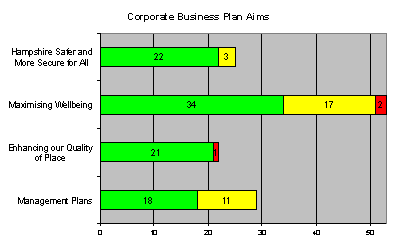
The numbers on each block of colour indicate the number of activities that relate to each outcome.
Hampshire Safer & more Secure for All
4.3 The bar graph below shows progress towards achieving each activity that contributes towards each Corporate Business Plan outcome (1.1 - 1.7):-
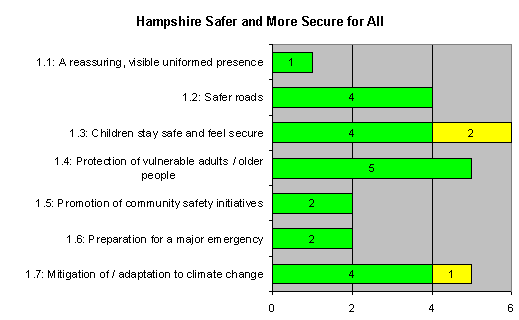
4.4 The chart above indicates that out of 25 activities, 22 are `on track' to being achieved and three are areas `to watch'. No areas have been identified as areas for further action.
Performance Highlights:
_ The `Protecting Older People' initiative, which seeks to protect senior citizens from doorstep criminals and rogue traders has been extended. Seven `no cold calling zones' have been introduced, with a further ten in development.
_ The strong commitment to improve road safety and address the 2007 `blip' upwards in casualty numbers continues. As part of the Local Area Agreement, the "Village 30" initiative is underway in conjunction with the `Safer Roads Partnership'. New speed limits are on track to be implemented in 39 villages by December 2008.
_ Regulatory Services have been asked to play an increasing role in managing community safety issues across Hampshire. A key role has been helping to develop the County Strategy group with the delivery of the areas first strategic assessments.
_ Work has been undertaken with young adults with learning difficulties to help them become independent consumers. This is particularly relevant for when they may be receiving direct payments under the social care personalisation agenda.
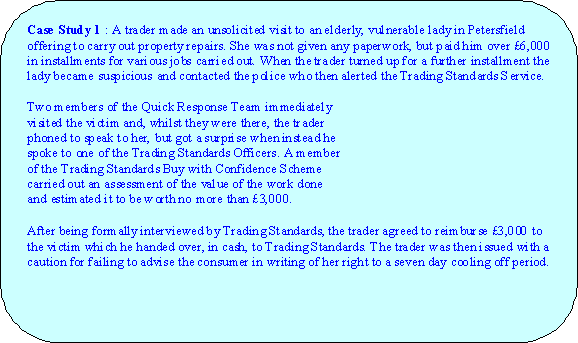
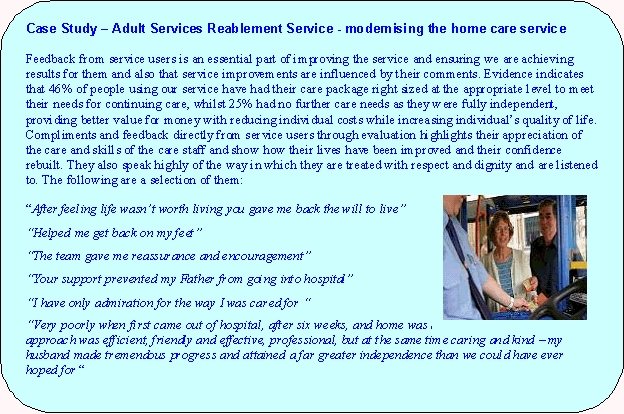
4.5 The following case study is a typical case of how Trading Standards officers have successfully intervened in many situations over the past few months to protect vulnerable Hampshire residents:

Area for further work and development:
· Timely progress continues to be made to enable the massive investment required in upgrading and renewing the County Council's stock of street lighting, illuminated signs and bollards through a Private Finance Initiative contract utilising central Government funding. The contract value is circa £400 million and negotiations with two major contractors are progressing with final bids expected to be received in the early part of 2009 and service commencement is programmed for Autumn 2009.
Maximising wellbeing
4.6 The bar graph below shows progress of each activity that contributes towards the Corporate Business Plan outcomes (2.1 - 2.9):-
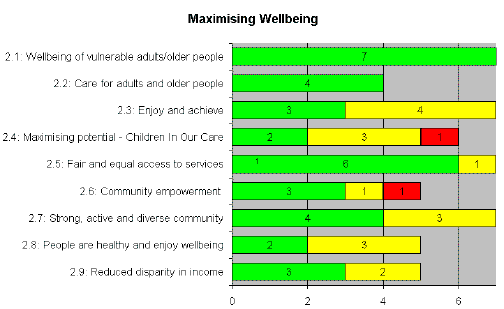
4.7 The chart above indicates that out of 53 activities, 34 are on track to being achieved,17 are areas to watch and two are areas for further action. The two areas for further action, together with the actions being undertaken to minimise the risks are as follows:
Area for further action: Placement Stability Action Plan 2.4.1
What we said we would do: Reduce the number of children in care with three or more placements in a single year.
Current situation: Although performance has stabilised, latest figures do not evidence an improvement.
Mitigating actions being taken:
· The Care Matters implementation group chaired by the Director of Children's Services is overseeing delivery of the action plan to improve placement stability - focussing on long term improvements in outcomes for children in care.
· Intensive monitoring and `gate keeping' of placements is in place.
· Work is also being carried out, with support from DCSF consultancy, to learn from best practice in other authorities.
· There is robust performance management by branch and area performance action groups, with quarterly reporting to Children's Services Department Management Team.
· Internal restructuring is creating dedicated children in care teams.
· Successful recruitment of additional foster carers has improved placement choice, with increased levels of support provided, to help secure placements.
Area for further action: The voluntary sector Diversity Networks project (2.6.6)
What we said we would do: Support the voluntary sector Diversity Networks Project to build capacity in diverse communities and enable them to participate, linking with District / Borough Councils.
Current situation: This project has played an important role in establishing better local links with diverse groups. It is helping the Council with the external challenge for the Equality Scheme and the level 3 assessment. Initial funding expired in May 2008. Community Action Hampshire has continued to fund the project for 2008/09 out of their contingency budget- so funding is secure for the rest of this financial year but not thereafter. A proposal has been developed to secure this project and develop it into an Independent Diversity Forum.
Mitigating actions being taken: This project is of importance to all our partners and so the County Council is supporting the development of the proposal and intends to present this to LAA partners in order to find ways to jointly fund this project for the next 3 years.
Performance Highlights:
· Self Directed Support Phase 1 in Basingstoke has supported 47 people since April. Extremely vulnerable adults have been supported to carry out a self-assessment and allocated an indicative budget. 29 have completed a Support Plan detailing how they have chosen to spend the money to meet their assessed needs. Of these 29, some will be managing at least part of their Support Plan themselves through a Direct Payment scheme with the remaining individuals working with local staff to commission their care.
· Opening of the Horrill Centre in the New Forest to combat rural isolation has taken place. The well-being and day opportunities centre offers activities and services to older people and vulnerable younger adults in the Waterside area of the New Forest.
· The Eastleigh Mela was an event supported by the County Council and attended by approximately 15,000 people from all backgrounds. The opportunity was taken to give out information on a range of services, especially information about Mental Health and Well-being.
· Overall standards of educational attainment are consistently high across the key stages with provisional results indicating further improvements
· Hampshire has the lowest percentage of schools placed in special measures since 2005 (1.12%: below the national average of 1.6%). 54 Hampshire primary schools have been inspected in the last six months, with 30 judged as good, 10 as outstanding and 12 as satisfactory with two schools given notice to improve. 5 of the 9 secondary schools inspected in the last six months were judged as good, with the remaining 4 judged as satisfactory.
· 91% of pupils in Hampshire are participating in at least two hours of high quality physical education and out of hours school sports in a typical week, exceeding the national PSA target by six percentage points and also exceeding the uplift in the CPA upper threshold for this indicator of 90%.
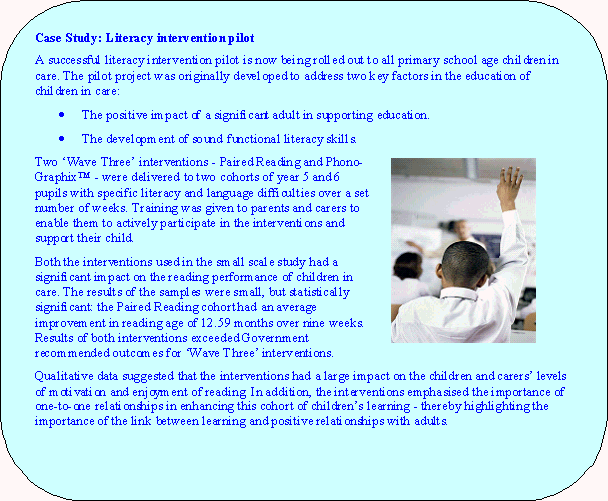
· An increase in school meal provision in primary schools.
Case Study: Meeting the needs of children and young people through positive activities and experiences
The Recreation and Heritage Outdoor Centres are heavily involved in helping Children's Services, schools, teachers, youth leaders and others meet the needs of their children and young people. Two highly successful projects involving the centres are Trailblazer and Aiming High. Aiming High is the Outdoor Centres Services project which works with Year 7 and 8 students at risk of exclusion from Secondary School. Working with schools in Andover and Leigh Park, the 2008 project took 40 young people for an extended (7 month) journey of self discovery involving all the Hampshire Outdoor Centres (Tile Barn, the Mountain Centre, Beaulieu Development Centre and Calshot Activities Centre).
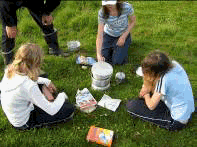
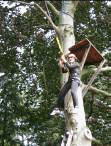

During this period they engaged with many challenging outdoor activities (eg: climbing, mountain biking, caving, canoeing, mountain walking), took part in survival and wilderness training and expeditions, and had to produce presentations for their teachers, parents and other audiences. Previous Aiming High programmes in 2006 and 2007 have resulted in virtually all those involved becoming more immersed in their schools, applying themselves to their studies and avoiding the exclusions that had resulted in previous years with such cohorts of young people. All the evidence suggest that Aiming High 2008 will be similarly successful, and the 2009 project is already developed and in place.
Areas for further work and development:
· These include increasing the take up of Direct Payments for social care clients, further reducing waiting times for social care clients equipment and improving joint working with Health, addressing hospital delays, use of NHS campus accommodation and single assessments. Following the recent transfer of reception functions to HantsDirect, Children's social care teams are being re-structured to provide an emphasis on preventative work, intensive support and children in care. The Children and Young People's Plan (CYPP) is being revised for 2009-12 with a strong focus on improving outcomes for vulnerable groups of children and young people.
Enhancing our quality of place
4.8 The graph below shows progress of each activity that contributes towards the Corporate Business Plan outcomes 3.1 to 3.5:-
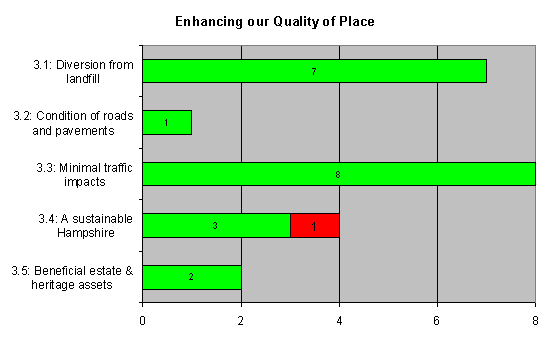
4.9 The chart above indicates that out of 22 activities, 21 are on track to being achieved, there are no `areas to watch' and one area for further action.
4.10 The one area for further action is as follows:-
Area for further action: Regeneration of housing and community facilities in Rowner (3.4.3)
What we said we would do: Regenerate housing and community facilities in Rowner, Gosport to improve surroundings and facilities for residents over the next five years.
Current situation: Like most other development projects, the Rowner regeneration proposals have been affected by the current economic and financial climate, but the Rowner Renewal partners are taking action to ensure the Project can still proceed.
Mitigating actions being taken: Work is being undertaken with the other Rowner Renewal partners to provide appropriate support to ensure continuing viability. A separate report has been prepared for Cabinet which identifies actions the County Council can take to address current issues.
Performance Highlights:
_ Launch of a tailored programme of road shows designed to showcase a wide range of the authority's services in local areas. The events targeted both rural and hard to reach areas of the county seeking to address issues of both a lack of engagement and dissatisfaction.
_ New Village Community Grant Scheme - securing £300,000 from SEEDA with £100,000 from Hampshire County Council LABGI funds to set up a grant scheme to support rural village shops and Post Offices. Seven shops grant aided in first six months of the scheme.
_ Delivery of education (building) projects including Andover Education Centre, Kings Copse Primary School and the first phase of the Children's Centres programme.
_ The provision of socially necessary bus services in rural areas and during evenings and weekends. The continuing approach across Hampshire is to review services on an area basis to best meet needs taking account of long standing service patterns, commercially-led enhancements and withdrawals
_ The Countryside Access Plans have been completed for the whole county. The plans cover seven areas and have been completed in less than four years and are based on consultation with users of the rights of way network, the local community, public and private landowners, farmers and land managers.
_ A number of lottery funded projects are progressing that will have a significant impact to preserve, develop access and enhance Hampshire's quality of place; King John's Castle at Odiham, Basing House restoration; Living Links Community archives and Community Libraries award together bringing significant additional financial resource.
_ Our commitment to improving highway maintenance standards has been supplemented by an additional £1m being directed to address the public's concerns about potholes. The funding is providing twenty extra gangs of County Council `Pothole Busters' to fill holes in roads across Hampshire in 2008/9.
Case Study - Countryside Access and the Small Grants Scheme -
engaging with the local community
The Small Grants Scheme 2008/2009 has benefited 16 Parish Councils providing funding for each to make improvements to access their local countryside. To date HCC has invested £13,000 which each local authority has at least matched along with over 650 volunteer hours.
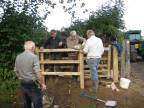
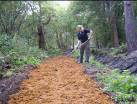
The Paths to Partnership Conference held in October was attended by over 120 parishes who came to find out more about working with Hampshire County Council to improve the management of rights of way and access in their parishes.
Areas for further work and development:
· Developing a lower cost Bus Rapid Transit scheme in conjunction with Fareham and Gosport Borough Councils and local bus operators in South Hampshire, following the Government's decision in 2006 not to fund the proposed Portsmouth-Fareham tram scheme. Work is progressing in line with a demanding timescale and consultations were recently undertaken with a view to securing finance with government in early 2009.
The Management Plan
4.11 The graph below shows progress of each activity that contributes towards this Corporate Business Plan outcome:-
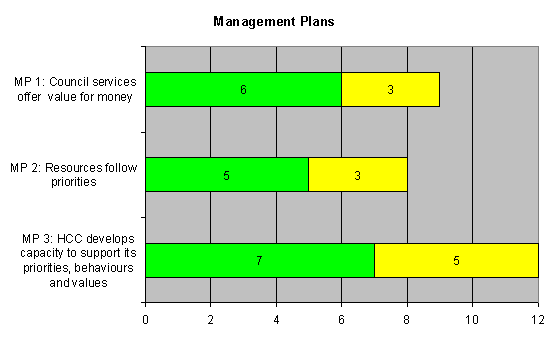
4.12 The chart above indicates that out of 29 activities, 18 are on track to being achieved and 11 are ` areas to watch'. There are no areas for further action.
Performance Highlights:
_ The County Council is now operating at Local Government Equality Standard Level Three and is expecting an external validation of this assessment in February 2009. In addition, both of the County's equality managers have been involved in direct advice and support to public sector partners. These officers have also, recently, been accepted as peer assessors for the Equality Standard and they will be assisting members of the network to establish a peer challenge for each other.
_ Implementation of recruitment portal - In the first six months since the launch of this portal, there have been total savings of £311,000. Over 95% of candidates rated the application process as good or better with 76% rating it as very good or excellent.
_ A new statutory Local Area Agreement was successfully agreed, underpinned by a new Sustainable Community Strategy. The Hampshire Senate has also been launched.
_ Completion of the IT Disaster Recovery Services Contract following a complex procurement procedure. This is important to the Council in managing the risks associated with business continuity in the event of major IT failure.
_ To aid flexible working - multi-functional devices are being introduced that combine photocopying and printing, replacing a number of local printers and photocopiers and providing secure printing of confidential documents. Secure USB Keys have been introduced offering a secure way to transfer data between an HCC computer and home or outside agency.
_ Hantsfile - a corporate document and record management system has been successfully piloted in the Environment Department.
_ Flexible and mobile working has now been launched under the `Hampshire Workstyle' banner with a "drop in" pilot scheme launched in September 2008 to target teams of potential users.
_ Implementation of a risk assessed approach to budget monitoring enabling SAP savings and increased capacity to be developed in Departmental Finance Units.
_ There has been a successful roll out of electronic self service travel claims, delivering benefits as both cash savings and service improvements
_ The Place Survey (a nationally prescribed postal residents survey, that delivers a number of the new National Indicators) is being jointly delivered with the eleven district councils. This provides value for money and will produce better quality and richer data.
_ 2.5% reduction in Hampshire Transport Management vehicle contract hire rates
_ A `Best Practice Procurement Guide' is now available to staff electronically, setting out clear guidance on the procurement process.
Area for further work and development:
· Several departments have sickness absence levels above the County Council targets. The Manager's toolkit to assist in reducing sickness absence levels is being used across departments to try and reduce this.
5. Progress against Partnership Priorities:
5.1 Partnerships are an essential tool in the drive to ensure service improvements. The County Council works in partnership at all levels in the organisation to plan and deliver services a way of working that is growing and strengthening.
5.2 Progress made by key partnership groups since April 2008, is as follows:-
_ Hampshire Senate. The newly formed Senate has commenced meeting, bringing together all of the Leaders of the local authorities alongside the other main public, private and voluntary sector agencies in Hampshire including the PCT, Police, Army and SEEDA. The objectives for the Senate are to deliver the Local Area Agreement for Hampshire, to bring people together to keep government as local as possible, to add value to and reduce the costs of public service through working with all the public services and partners, to act as a strong united voice for all of Hampshire and to secure extra government funding for infrastructure needs without the cost and disruption of reorganisations. The Senate has subsumed the work of the LAA Board, thus saving the cost of that Board.
_ Hampshire and Isle of Wight Improvement Board / Group. The group is delivering many projects designed to improve efficiency and shared services. A key success over the past few months has been that the recruitment portal has been awarded the 2008 Local Government IT Excellence Award in the Shared Services Category. The awards seek to highlight and reward Local Authorities that have used IT systems or processes to improve the efficiency and delivery of services within local communities.
_ County Strategy Group for Crime and Disorder. This new group has developed a county agreement (linked to the Local Area Agreement) and has established performance and commissioning sub group to look at delivery outcomes and mechanisms.
_ Children & Young People's Partnership (also known as the Children's Trust): this established and successful partnership group, which includes the voluntary and community sector, has developed a greater focus on performance monitoring in the last year. Regular updates have been received on progress against LAA targets and National Indicators. In addition, the Partnership has supported drafting of a new Children and Young People's Plan (to be published in 2009), completion of the Joint Strategic Needs Assessment and the APA self-assessment for 2008. The Partnership provides a strong foundation for expected changes in legislation that will place Children's Trusts on a statutory footing and extended the duty to co-operate to schools and colleges. (Government consultation on legislation is currently underway).
_ Hampshire Strategic Partnership. The County Council has worked with the Hampshire Strategic Partnership to revise the Hampshire Community Strategy published in 2004. A Sustainable Community Strategy (SCS) has been prepared by the partnership and was adopted by the County Council in September 2008. This sets out a vision and 11 long term ambitions for a sustainable Hampshire. As required by law, the Hampshire Local Area Agreement targets are based on these long term ambitions in the SCS. In establishing the Hampshire Senate, the Hampshire Strategic Partnership Steering Group has been disbanded and the HSP will operate as a virtual network and meet annually to review priorities and issues facing Hampshire.
_ The Health and Wellbeing Partnership Board. This Board was successfully launched in June 2008 to support delivery of the Local Area Agreement. It is improving links between key partners involved in ensuring the health and wellbeing of local people, drawing together representatives from the health sector, local authorities at District and County level, voluntary organisations and users of health services.
5.3 Two key partnership agreements of the County Council are the Local Area Agreement (LAA) and the Local Public Service Agreement 2 (LPSA2).
Local Area Agreement (LAA)
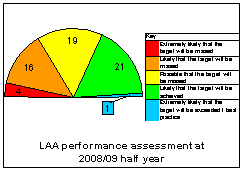
5.4 A new statutory Local Area Agreement was agreed in June 2008. Performance is being reported on a quarterly basis to the Senate.
5.5 This report covers performance in relation to the Local Area Agreement for the six months leading up to the end of September 2008. Theme leads were asked to report on:
· any actual outturns against the PI or proxies
· undertake a risk based self-assessment of each target within their theme scoring performance (from one - extremely likely that the target will be missed to five - extremely likely that the target will be achieved) and data confidence (from one - little or poor quality information to five - regular and recent high quality information) and partner engagement (from one - partners have not been engaged to five - all partners are committed / delivery plans are in place).
· key risks to achieving the target together with actions identified to address those risks.
5.6 The self assessment scores of performance and data confidence, for each target within the LAA were plotted on a scattergram, along with a colour coding to show the degree of partner engagement.
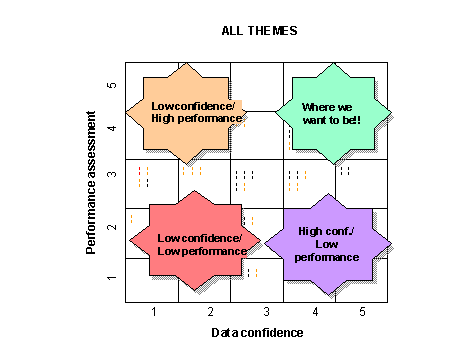
5.7 The following gives a description of the scattergram quadrants:
· Targets falling in the bottom left hand corner of the scattergram have been assessed as having a low data confidence score and low performance. This might indicate that there is, as yet, limited control over this target.
· Targets falling into the bottom right hand corner of the scattergram have high data confidence scores and low performance. These are targets where we know that we are currently performing poorly..
· Targets falling in the top left hand corner of the scattergram have low data confidence scores, but are deemed to have high performance. The performance scores, therefore, may not be sustainable when further data becomes available.
· Targets falling in the top right hand corner of the scattergram have high data confidence scores and high performance ie we are confident in the performance information that is telling us that we are performing well. It is where we would like each target to be.
The following diagram provides an overview `key' to help interpret the scattergrams.
The diagram below shows the data confidence score given to each LAA target, plotted against an assessment of performance:-
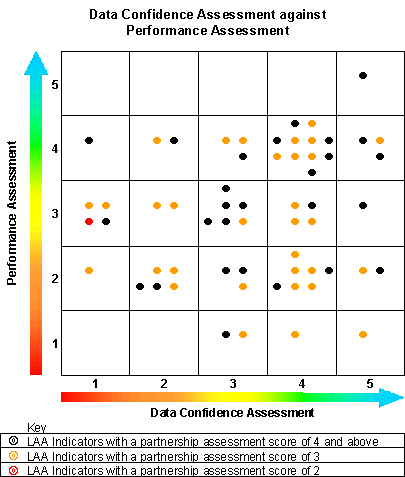
5.8 This provides a basic overall picture of the current position and the areas of strength and weaknesses. It shows that for the majority of targets within the LAA, data confidence is good. There is a mixed picture in relation to the assessment of performance, which is to be expected at this early stage of the agreement. The aim will be to raise the scores for both data confidence and performance for each target, thus moving all the target `dots' towards the top right of the scattergram ie to `where we want to be'.
5.9 A more detailed report was considered by the LAA Executive on the 12 November and the Senate on 28 November. The reports to the LAA Executive and Senate and the full schedule of assessments by LAA indicator are available on the LAA website and on request.
5.10 The LAA Executive and the Hampshire Senate will be identifying areas of concern, monitoring overall progress and direction, and setting targets for improvement of performance, data confidence and partner engagement. A key issue will be for the LAA targets to be translated to a local (district level). This will require further work and commitment but is essential to enable partners at the local level to assess, monitor and manage performance.
5.11 As the LAA progresses, consideration will need to be given to the performance information requirements of the Corporate Performance and Efficiency Group (CPEG), CMT and Cabinet.
Local Public Service Agreement 2 (LPSA2) 2005 - 2009
5.12 For some of the LPSA2 indicators, performance at the end of the current year (ie 2008/09) will determine whether targets have been reached and therefore, reward obtained. For others (eg those dependent on exam results of exams that have already been taken), performance can no longer be influenced.
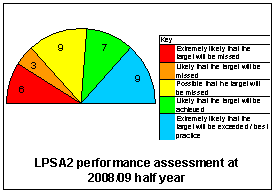
5.13 Irrespective of the achievement of stretch targets for which reward grant is payable, across the LPSA2, there have been many significant improvements in outcome against the baselines over the last 3 years as illustrated below:
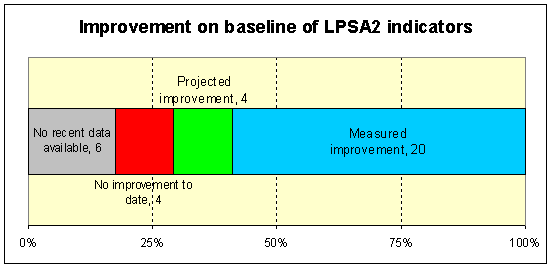
5.14 Some examples of exceptional improvements are:
_ An increase in the number of 19 year old students in Hampshire that are achieving NVQ levels two and three, from 62.6% and 39.6% to 76 and 52% respectively.
_ A fall in the number of pupils leaving a group of 12 secondary schools without any GCSE or equivalent educational attainment from 4.56% to 1.8% (provisional 2007/08 data)
_ An increase in the percentage of pupils leaving a group of 12 schools with 5+ GCSEs (A*-C) from 32% to 49% (provisional 2007/08 GCSE data)
_ A reduction in violent crime in public places from 15,969 cases in 2004/05 to 14,083 cases in 2007/08 (a 12% reduction on baseline).
_ A reduction in deliberate fires (primary, excluding vehicle fires) per 10,000 population from 290 per year to 204 per year - a reduction of nearly 30%.
_ A reduction in emergency unscheduled acute and community hospital bed days occupied by a person age 75 or more in a NHS hospital in Hampshire from 323,281 days to 232,818 days in 2007/08
_ An increase in the number of tonnes per year of material recycled by schools and public sector sites in Hampshire from 0 tonnes per annum to 3952 tonnes per annum.
Progress towards achieving stretch targets
5.15 The scattergram below shows an assessment by each LPSA2 target lead as to the extent to which they believe the full stretch target will be met, mapped against their confidence in the data by which they made their assessment.
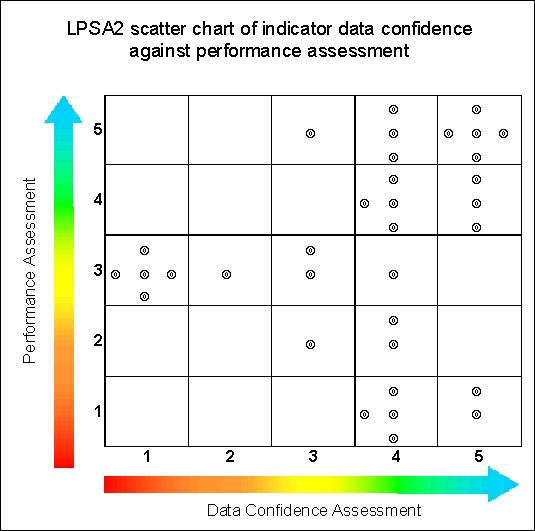
5.16 A performance assessment score of 4 or 5 indicates that it is likely that the target will be achieved. A data confidence score of 4 or 5 indicates that the performance assessment judgement has been based on recent performance information of good quality.
5.17 The scattergram therefore shows that for a large number of indicators, there is high confidence of meeting the full stretch target. Those with low data confidence ratings are targets based on an LPSA2 survey of residents. An initial survey was undertaken in 2005. This is not due to be repeated until summer 2009, which has meant that proxy data has had to be used in the interim.
5.18 Targets unlikely to meet the stretch threshold (at which reward becomes eligible) but which can no longer be influenced are:-
_ Children looked after for whom Hampshire is a corporate parent attaining 5 passes at grades A*-C at GCSE (Year 11 cohort).
_ VAT Registrations. Hampshire's share of SE VAT registrations has not exceeded 15% for 3 out of the 4 years of the LPSA2, therefore, the targets have not been met.
_ Tonnes per annum of commercial waste re-cycled in three areas of Hampshire (East Hants, Rushmoor and Eastleigh). The deadline for achievement of this target was March 08, and although considerable progress has been, and continues to be made, the target wasn't met within the timescale.
5.19 For a small number of indicators where likelihood of achieving the reward threshold is low, performance is still able to be influenced. In general terms, target leads have confirmed that whilst actions are being taken to improve performance, additional financial investment at this stage is unlikely to influence the achievement of targets. These are as follows:
_ % of school absences from a group of 11 secondary schools. The rate of absence is currently around 9%. The level at which some reward is obtained is 6.74%.
_ Care leavers contacted in a 4 month period around their 19th birthday who are in education, training or employment. The target for some reward is 68%. The estimate for October 2008 is 54.7%.
_ Repeat offending rates. 44% of the 2006 cohort reoffended within 12 months against a target of 47.22% reoffending within 24 months.
_ Percentage of children aged 10 and 11 classified as obese or overweight - targets of 19.8% and 14.5% by the academic year 2010/11. Despite latest data indicating strong performance, a number of risks have been identified in relation to these targets which could jeopardise their achievement.
_ The number of schools achieving healthy schools status. Currently about 328 schools have achieved the Status, against a target for some reward of 399 schools having achieved the Status by the end of December 2008.
_ Volunteering. This will be determined by a survey in 2009. However, there are concerns around perceptions as to what `volunteering' actually includes which may result in a poor survey result. Awareness raising measures are being put in place.
5.20 There are nine further targets where performance is on track but still subject to influence and which partners could support. A full table of all the delivery assessments and risks is available on request.
6. Progress against the National Indicator Set:
6.1 From 1 April 2008, the requirement to collect and report on performance in relation to the Best Value Performance Indicator set (BVPIs) was ended and a new National Indicator Set (NIS) of approximately 196 indicators was introduced, which the County Council and its partner organisations in Hampshire are required to report against. As part of the Comprehensive Area Assessment (CAA) process, Hampshire County Council and its partners will be assessed, at least to some degree, on performance in relation to the National Indicator Set.
6.2 Departments are working with partners to ensure performance against these new indicators is adequately captured, monitored and reported. Emphasis over the past few months has been on establishing a network of Hampshire County Council `NIS service managers', who have taken lead responsibility for liaising with partner organisations and putting plans in place to secure good quality data at the times that it becomes available.
6.3 Since August, a report on the National Indicators has been taken to each meeting of the Corporate Performance and Efficiency Group (CPEG), looking at risks of each indicator in relation to data confidence (degree to which data is of good quality and can be relied upon), performance (how we are performing or likely to perform against other similar authorities) and partnership ownership (is the indicator included in a plan or `owned' by a partnership group).
6.4 At this early stage, very little actual performance information is available, as the majority (over 70%) of National Indicators are reported only annually or biannually, including 21 derived from a biannual `Place Survey'. As more performance information becomes available, our performance can be mapped over time to give a `direction of travel' and benchmarked against other similar authorities.
6.5 The analysis below must be viewed in the wider context that it is still early days in relation to these indicators. In some instances national guidance or data sets are still awaited. Whilst the best information has been used to produce this analysis, it must still be seen as subject to change and at present, therefore, must be viewed as carrying a significant health warning.
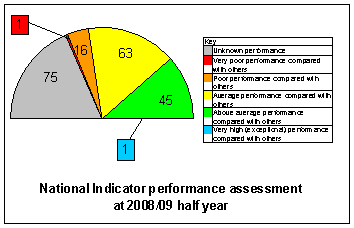
6.6 The scattergram below shows data confidence ranked against performance for each indicator within the national indicator set. NIS service managers were asked to score their level of confidence in the data from 1 (no data available or data known to be unreliable) to 5 (regular and recent performance data of very high quality). They also scored performance 1 (very poor performance compared with others to 5 (very high - exceptional - performance compared with others). (A score of 0 was given where performance wasn't known). These two number ratings were plotted against each other as shown below.
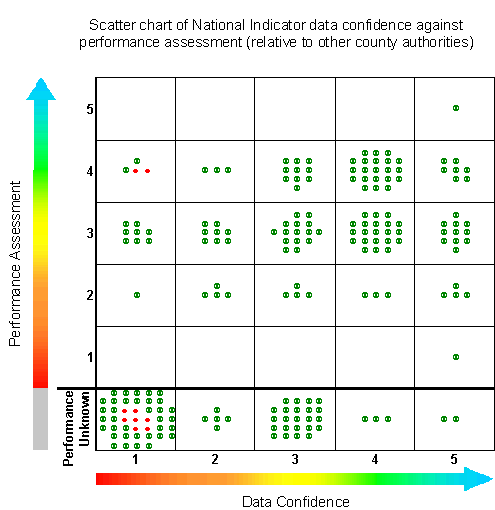
6.7 The green circles above show indicators owned by a partnership or included in a plan. The red circles shown above show indicators not owned by a partnership and not in a plan.
6.8 Patterns emerging from the scattergram are as follows:-
_ Bottom left hand square: There are a large number of NI's in the bottom left hand square of the scattergram, meaning that performance is unknown and there is little or no data. This is due to a large number of the National Indicators being completely new. The majority of national indicators are only reported annually or biannually, so there is unlikely to be any performance data for several months.
_ Bottom right hand square: Two indicators have a high data confidence of 5, but performance is unknown. These are NI's with reliable data sources - but the frequency of reporting is such that data for this year has yet to be made available. Above this square, one national indicator has a data confidence score of 5 and performance of 1, This is NI62 - stability of placements (see narrative relating to this in paragraph 4.7 above).
_ Top right hand square: The national indicator with a data confidence score of 5 and a performance score of 5 is NI193 - percentage of municipal waste landfilled. We are a top performing authority nationally for this indicator.
Best Value Performance Indicators
6.9 The majority of departments are continuing to monitor performance of at least some Best Value Performance Indicators (BVPIs) to fill gaps not covered by the new National Indicator Set and to be able to demonstrate continuity of performance until the new national indicator set indicators become fully established. Performance in relation to the BVPIs that departments are continuing to collect will be reported at this year end on the Performance Plan webpages at http://www3.hants.gov.uk/corporatestrategy/national_performance_indicators.htm . Commentaries will be updated at this half year stage.
6.10 Corporately and departmentally, there has been detailed analysis of the PwC County Council Benchmarking Club BVPI data - this relates to the 2007/08 financial year and is unaudited. Headline figures showed that the County Council's absolute performance was extremely positive with 70% of BVPIs improved or maintained at the same level. Whilst strong improvements have been made, the Council's relative position against County Councils has dropped back. It should be noted that there are known issues with the way that this benchmarking information is brought together and there are some concerns about the appropriateness of the comparator group for certain service areas. There is also indications that relative increases in grant may have influenced relative increases in performance and this may have been a significant factor for Hampshire County Council. It shall be noted that a number of the BVPIs are related to activity which have been identified as low priority in some cases.
6.11 Overall the PwC figures need to be considered in the context of the County Council's generally strong performance and some areas of exceptional performance in 2007/08 as well as highly rated external inspections and assessments (several of which have the top score possible). These external inspections often provide more in depth and considered judgements on absolute and relative performance. It should also be noted that the data related to BVPIs which have now been nationally discontinued and their importance diminished. However, the Council was keen to see what could be learnt from the benchmarking which provided a different perspective on service performance and added to the focus of the Council and Departments to drive improvement. Many of the specific issues that emerged were already known and are reflected in different ways throughout this report.
6.12 There remains some problems with the PwC club around appropriate comparator groups, the balance of the suite of performance indicators used and problems of comparability with specific performance indicators (eg absolute figures used rather than per head population). This means that the information does need to be treated with caution and comes with its own health warning. That said, the analysis from the PwC county council benchmark data has directly informed the areas selected to feature in the Corporate Improvement Plan to ensure areas of concern are addressed. This was considered by Cabinet in the Driving Success paper on the 24/11/08.
7. Inspection results:
7.1 The Council continues to be rated extremely highly in external, independent audit and inspection:-
_ The CPA refresh for 2008 is still underway and we are currently working on the final phase - Direction of Travel. The authority is aiming for four star Improving Strongly.
_ A compelling self assessment was delivered for improving our Use of Resources scores with the aim of delivering an overall four out of four.
_ The Annual Performance Assessment of Adult Services: The Council has been awarded 3 Stars, the highest rating, for the second year running. It has retained its 'excellent' judgement for `Capacity to Improve' and is judged to be 'good' in delivering 6 of the 7 outcomes for Adult Social Care. For the 7th outcome 'Making a Positive Contribution' the Council has improved to 'excellent' in enabling Hampshire residents to be involved in local community activities and in policy development and decision making
_ The Annual Performance Assessment of Children's Services: the Council's self-assessment was positive, with Ofsted judging Children's Services as making a good contribution to improving outcomes for children and young people (grade three out of four); and good capacity to improve (grade three out of four).
_ Following both a written submission and an on-site visit by members of the Youth Justice Board South East Regional Team, Wessex Youth Offending Services have been assessed as `performing excellently' by the Youth Justice Board in their annual Capability and Capacity Assessment.
_ A score of four out of four is anticipated for the culture block assessment of the CPA refresh 2008.
_ Likewise, a score of four out of four is anticipated for the environment block assessment of the CPA refresh 2008, based on strong and improving performance in relation to the indicators that underpin the assessment.
_ The County Council is now operating at Local Government Equality Standard Level Three and is expecting an external validation of this assessment in February 2009.
_ The County's fostering services including, for the first time, private fostering services, were inspected by Ofsted in 2008 and graded as good, with outstanding management.
_ Trading Standards Service was commended as `Very Good' by an external `Peer Review Challenge Team'. 37 areas of strength and only eight areas for improvement were identified. The service was commended for the customer focus of its committed professional staff.
8. Annual Report
8.1 The statutory requirement to publish an annual Performance Plan has recently been relaxed (Section 136 of Local Government and Public Involvement in Health Act 2007). It is proposed to take this opportunity to develop the current web based publication of performance, finance and workforce information into an `Annual Report of the County Council'. This would be an annual summary of the performance, financial and workforce position and achievements of the Council.
8.2 This annual report would be a streamlined process which would draw from the information emerging from the `Driving Success' revised corporate Performance Management Framework and new Corporate Improvement Plan.
Appendices
Appendix 1 - Hampshire County Council Performance Summary
Half Year 2008/09
Performance against our Corporate Business Plan
`RAG' Colour |
Risk level |
On track | |
To watch | |
Action needed |
Performance with our partners
Performance against National Indicators
APPENDIX 2
LIST OF CORPORATE BUSINESS PLAN OUTCOMES
Hampshire Safer and More Secure for All
Outcome 1.1: There is a reassuring, visible uniformed presence
Outcome 1.2: The users of Hampshire's roads are safer
Outcome 1.3: Children stay safe and feel secure
Outcome 1.4: Vulnerable adults and older people are protected
Outcome 1.5: Independent living is promoted through community safety initiatives
Outcome 1.6: Hampshire County Council is prepared in the event of a major emergency / disaster and has adequate contingency arrangements to ensure the continued delivery of vital services
Outcome 1.7: Hampshire contributes to the mitigation of and adaptation to climate change
Maximising Wellbeing
Outcome 2.1: Vulnerable adult and older people are treated in a way which maximises wellbeing, independence and inclusion
Outcome 2.2: Right care in the right place at the right time for adults and older people
Outcome 2.3: All children and young people enjoy learning and achieve to their full potential
Outcome 2.4: Children In Our Care (for whom the County Council is the corporate parent) have the best possible chances in life and are supported to achieve to their full potential
Outcome 2.5: People have fair and equal access to services and information
Outcome 2.6: All local people, including children and young people and their families, can influence decision making and the ways in which services are designed and delivered
Outcome 2.7: Hampshire is a strong, active and diverse community
Outcome 2.8: People in Hampshire are healthy and enjoy wellbeing
Outcome 2.9: Disparities in income across Hampshire are reduced and there is general economic prosperity
Enhancing our quality of place
Outcome 3.1: The majority of waste is diverted from landfill
Outcome 3.2: The roads and pavements of Hampshire are in a good condition
Outcome 3.3: Traffic impacts are kept to a minimum
Outcome 3.4: Hampshire is a sustainable community
Outcome 3.5: The County Council owned and managed estate and heritage assets benefit Hampshire's quality of place
Management Plan
Outcome MP 1: Council services offer value for money
Outcome MP 2: Resources follow priorities
Outcome MP 3: Hampshire County Council develops capacity to support its priorities and behaviours to support its organisational values.
APPENDIX 3
AWARDS & ACCREDITATIONS
AWARDS
County Treasurer Jon Pittam was elected a CIPFA Council member
Tim Light and Lee Maidment from County Treasurer's were elected Association of Accounting Technician council members
Steph Randall from County Treasurer's was selected to be a CIPFA Future Leader
HCC's team of Andrew Boutflower and Emma Gordon won the LGA's Young Local Government of the Year Competition
Hampshire's Music Service has won the Major Trophy 2008 for local authority music services from the National Music Council and the Music Education Council for the second time in five years. The service demonstrates robust and successful partnerships with schools, with an excellent team of teaching staff.
Two Adult Services members of staff won awards in separate categories for their smart working, delivering value for money, efficiency and better outcomes for the people of Hampshire. The `People Moving Business' Awards are an industry benchmark for excellence in mobile working and are run in association with Microsoft, the Chartered Management Institute and the Work Foundation:
Miles Hutchings, Occupational Therapy Team Manager in Gosport won the Mobility Champion Award
Christine Featherstone, Occupational Therapy Assistant won the `Moofer' (Mobile out of office) of the Year worker award.
The PBRS initiated and managed Improvement and Efficiency South East (IESE) Major Framework won the Integration and Collaborative Working category at the Regional Constructing Excellence Awards.
Civic Trust awards: Everest Community College, Commendation: The Civic Trust Awards recognise the best in the built environment, from architecture to planning, townscape to infrastructure. They recognise the public realm in its wider context, and their continuing belief that development should be for the benefit of people
Royal Institute of British Architects (RIBA) Awards (including RIBA South): Pinewood Primary School, and Winchester Cultural Centre receive a regional award each: The National Awards are granted by the RIBA Awards Group based on winners of the RIBA Awards and represent the best architecture in the United Kingdom.
Chartered Institute of Architectural Technologists (CIAT) Open Awards for Technical Excellence: Winner of The CIAT Open Award for Technical Excellence in Architectural Technology 2007: Entrants must demonstrate their achievement of technical excellence in construction by illustrating the composition of ideas put into practice and presented in a working format
Serving Construction & Architecture in Local Authorities (SCALA) Building of the Year Awards: Pinewood Short Listed for the SCALA Civic Building of the Year Competition 2008: The SCALA Civic Building of the Year Award is a celebration of the cream of public sector architecture selected from the submissions accepted for the Yearbook. The aim is to inspire and promote the high quality of work carried out in the public sector and as evidence of the depth of design and management skills available to create such stylish and practical solutions.
Institution of Civil Engineers (ICE) South East England Engineering Awards:Winchester Cultural Centre won ICE award for best building in the south region and an ICE category award for sustainability. ICE South East England runs several different awards throughout the course of the year. These awards are presented by our three branches for excellent projects completed during the previous calendar year.
Royal Institute of Charted Surveyors (RICS) Awards: Everest Community College receives the RICS 2008 SE Region Award for Community Benefit: The RICS Awards celebrate excellence in the built and natural environment by rewarding projects regardless of their size, budget, grandeur or location. They recognise the diversity of talent that it takes to create outstanding buildings and environments: Property developers, engineers, planners, architects and surveyors.
Trading Standards: Martin Dale received a national awarded from the Anti-Counterfeiting Group (ACG) for Individual Excellence in Anti-counterfeiting work and Neil Lawrence from the Food Team studying for the Diploma in Consumer Affairs and Trading Standards (DCATS) was recognised by the Food Standards Agency with an award for achieving the highest mark in the Food Standards Module. His award of a certificate, cheque and engraved rose bowl was presented by Dame Deidre Hutton, Chair of the Food Standards Agency.
Hampshire Catering Services together with County Supplies were presented with a `Good Egg Award' from Compassion in World Farming for introducing local free range eggs for use in its business in April 2008.
Two of our managed country parks, Queen Elizabeth and Staunton, were again awarded the Green Flag national standard for excellence in recreational green areas
Hampshire has won the Innovative Information and Communications Technology Award. The award relates to the development of the CareChoices on-line search facilities, which allow people to access up to date information about both Care homes and Care at home services in their area
Award winning county show stand - the County Council's corporate stand at the Hampshire and New Forest Show won best local trade stand for 2008, making it the fifth successive year the stand has won awards at the show.
ACCREDITATIONS
Hampshire Catering Services:
Hyperactive Children's Support Group's Highest Award for Excellence in School: reaccredited Aug 2008
Hospitality Assured, reaccredited April 08.
Hampshire Catering Services also gained approval from the Marine Stewardship Council in July 2008 for using fish from a sustainable source. These fish products will be highlighted on the new menu running from November 2008:
Registration Service : British Standards Institute (BSI) re-registration to ISO 9001 following external audit in July 08
Hampshire Scientific Service: ISO 17025 (Lab Accreditation by UKAS), reaccredited July 08
Asbestos service: ISO17025 for testing and ISO17020 for Surveying, reaccredited July 08
Trading Standards: BSI accreditation to ISO 9001, reaccredited July 08
Community Safety: BSI Accreditation to ISO 9001, reaccredited May 08
PBRS is also approved by BERR (formerly DTI) to act as a Notified Body for the purposes of the Measuring Instruments Directive: This is ongoing but was subject to an external audit and peer review in June 08
Recreation & Heritage received successful recertification of Charter Mark Award for excellence in customer service for the department in April 2008
Information Security Accreditation ISO27001 We are only the second County Council to gain accreditation and the first public body in the UK to achieve both ISO27001 and ISO20000 (Quality Management) standard.