
Archived decisions
HAMPSHIRE COUNTY COUNCIL
Decision Report :
Decision Maker: |
Cabinet | ||||
Date of Decision: |
22 December 2008 | ||||
Decision Title: |
Provisional local government finance settlement 2009/10 and budget guidelines 2009/10 to 2011/12 | ||||
Decision Reference: |
423 | ||||
Report From: |
County Treasurer | ||||
Contact name: |
Jon Pittam | ||||
Tel: |
01962 847400 |
Email: |
|||
EXECUTIVE SUMMARY
1) Summary of Decision Area:
1.1. This report summarises the provisional local government finance settlement 2009/10 which as expected has not resulted in any changes in Government grant figures.
1.2. This means that no changes are required in the provisional budget guidelines for 2009/10 to 2011/12 as agreed by Cabinet on 27 October 2008. These can now be used as firm guidelines to prepare revenue budgets and capital programmes for final decisions by Cabinet on 6 February 2009.
1.3. The Government has not made any changes in its `supported borrowing' arrangements and it is recommended that the consultation response should make further representations to enable the Council to increase its investment in the Hampshire infrastructure and economy.
2) Issues Covered in the Report:
2.1. A summary of the provisional local government finance settlement.
2.2. Confirmation of the revenue and capital budget guidelines.
2.3. Proposed representations in response to the settlement.
3) Recommendations:
It is recommended:
3.1. To confirm the budget guidelines set in the medium term financial strategy for 2009/10 to 2011/12 (Cabinet, 27 October 2008) since as expected there have been no changes in the provisional local government finance settlement.
3.2. To make representations to Government to facilitate supported borrowing and to review the flexibility of private finance initiative schemes because of the economic downturn and the need to support the infrastructure and economy in Hampshire.
MAIN REPORT
1) Purpose of the report:
1.1. The purpose of this report is to receive a summary of the provisional local government finance settlement, and to confirm the revenue budget and capital programme guidelines for 2009/10 to 2011/12. The relevant issues from the Pre Budget Report 2008 are also summarised.
1.2. Cabinet is also asked to consider the response it wishes to make to this consultation, in particular over the continued lack of full Government grant support towards its `supported borrowing' capital allocations.
2) Contextual information:
2.1. Appendix C summarises the provisional settlement which is the second year of the three year grant settlement announced in 2007. Grant figures remain unchanged as expected and the budget guidelines agreed by Cabinet in October can now be confirmed.
3) Pre Budget Report:
3.1. The main issues for the County Council in the Pre Budget Report 2008, announced by the Chancellor on 25 November 2008 are
· an additional (total) £5 billion public sector value for money target for 2010/11
· the bringing forward of £3 billion of capital spending from 2010/11 to 2008/09 and 2009/10 for housing, transport and other construction projects including £800 million in the priority schools programme
· an increase in the employer (and employee) rates of national insurance contributions by 0.5% from April 2011
· a set of `devolutionary' proposals, to be agreed with local authorities in city-regions on a voluntary basis to increase their ability to drive sustainable economic growth
· reductions in planned spending from 2011/12.
3.2. The value for money target is not yet apportioned between the different parts of the public sector. The issue of efficiency savings for the County Council is returned to later in the report. The Chancellor also announced that Sir Michael Bichard of the Institute for Government will lead the `local incentives and empowerment work strand' of the Operational Efficiency Programme (OEP) to analyse how best to facilitate front-line innovation and to identify future savings. He `will draw on the experiences of front line staff to identify extra savings across all local public services'. These will be in addition to the current 3% efficiency savings requirement. The other elements of the OEP include programmes to identify extra public sector procurement savings and asset sales, which could also add new efficiency requirements on to Councils. The OEP will result in potential local targets being identified in time for the 2009 Budget (2010/11 financial year).
3.3. The Executive Member for Children's Services will consider the scope to bring forward any of the capital programme for schools, but this will not increase the overall level of investment.
3.4. The precise impact of the increase in employers' national insurance contributions for 2011/12 is not yet known, and there will be arguments that this should be covered as a new burden in the 2011/12 grant settlement.
3.5. The Government intends to announce at least two `forerunner' city regions with its Budget for 2009. There will be new statutory arrangements for sub regional cooperation between local authorities `supporting local capacity, governance and accountability at the city region level'. This would include devolving greater responsibility for planning, housing, transport, regeneration, employment and skills, and economic development to city regions. This may extend to the Partnership for Urban South Hampshire (PUSH) so the Cabinet may wish to look in more detail at the `package' of measures being offered to the areas participating to make sure that the extent of devolution is from the region to the partnerships as `forerunner city regions' without impacting on the Council's own statutory responsibilities.
3.6. The most significant impact of the Pre Budget Report was the projected reduction in planned annual increases in current expenditure in real terms;
Table 1 Pre Budget Report - planned annual increases.
CSR 07 - 2008/09 to 2010/11 |
2.2% |
2008 Budget - 2011/12 to 2012/13 |
1.9% |
Pre Budget Report - 2011/12 |
1.3% |
Pre Budget Report - 2012/13 |
1.2% |
Pre Budget Report - 2013/14 |
1.1% |
CSR 07 is the Comprehensive Spending Review 2007
3.7. Local government's share of a declining pot is likely to be a zero increase (or even a real term reduction) if priority continues to be given to the National Health Service and schools. If inflation is assumed to be 2% in 2011/12, then grant might rise by 2% in cash terms overall for local government (at best). The floor could be in the range of 0% to 1% (i.e. lower than assumed inflation). If the Government's assumed level of inflation is lower than 2%, then the overall cash and floor increases could be smaller still. The County Council's assumption in the budget guidelines is 1.25%. This may now be slightly on the high side, but because the formula grant only covers 22% of the Council's budget requirement, a further 0.5% reduction in grant would only affect budget forecasts by £0.7m. Therefore at this stage it is not proposed to change the budget guidelines for 2011/12.
3.8. However this outlook, and the likely requirement for even higher targeted efficiency savings, means that the current corporate services and efficiency reviews, and other proposals from the OEP, will need to target real cash reductions by 2011/12 in order to avoid higher increases in council tax or other cuts in services. There is no impact on Government grant in 2009/10. Grant in 2010/11, as the third year of the current three year settlement, should also remain unchanged, but that may now be less certain. 2010/11 could be the first year of a new three year settlement and the Bichard Review may result in some impact on the planned grant increase.
4) Provisional local government finance settlement 2009/10:
4.1. This is the second year of this three year settlement and as expected the Government grant for 2009/10 remains unchanged at £145m, a £2.5m (1.75%) floor increase for the County Council. This is substantially below inflation (retail price inflation was 5.0% in September 2008 - which is used to set the increases in business rates and state pensions). The overall national increase in total aggregate external finance (all grants plus business rates) is 4.2%, but the general formula grant increase is a lower 2.8%, and the floor increase for the County Council even lower at 1.75%.
4.2. The settlement is summarised in Appendix C but the other main points in the announcement are
· Councils are called on to find more than the £1.5 billion (3%) targeted new savings every year implicit in the 2009/10 and 2010/11 grant settlements
· Councils will have to put statements of efficiency savings on the face of the council tax bill for April
· the Government will make a regulation which will allow those local authorities (not Hampshire) with funds invested in Icelandic banks to postpone the impact of the impairments (possible loss or delay in return of the investments) required by accountancy practice, for budget setting purposes until 2010/11
· no grant change for supported borrowing
· capping is `substantially below 5%', for increases in council tax.
Efficiency savings
4.3. The County Council has achieved efficiency savings over the Gershon period (2004/05 to 2007/08) exceeding the required target. £8.2m of this can be carried forward into 2008/09. The budget guidelines assume that all services meet new priorities and pressures within the budget guidelines and the extent of these will be reported to Cabinet next February. The Chief Executive reported on the Corporate Efficiency Review to Cabinet on 27 October 2008. This confirmed that the higher 3% target for 2008/09 was also expected to be exceeded by some £2m, with the benefit of the carry forward from 2007/08. However, Children's Services and Environment will need to identify more efficiency savings to get nearer to their 3% shares from 2008/09 onward.
4.4. The Council has a good record and will secure its targets for 2008/09 and 2009/10. However it becomes more difficult year on year to achieve. The Corporate Efficiency Review will begin to impact on 2010/11 and it remains to be seen what potential savings will be identified nationally by the Bichard Review which can later be factored in at a local level (if not already achieved). However the longer-term outlook after 2011/12 may require more than efficiency savings, despite Government's optimistic pronouncements.
Efficiency statements on bills
4.5. Despite representations during consultation the Local Government Minister has decided that councils will be required to set out standard efficiency figures on annual tax bills from next year. The aim is `to ensure local residents have easy information about their Council's efficiency performance and to encourage them to challenge their council to do better'. He also said that `the introduction of a three-year settlement, reduction in ring-fenced grants, local area agreements and the new local performance framework offer substantial opportunities for better working and efficiencies across local services in local areas - in order to manage pressure on council tax bills - including in each of the areas under examination by the five workstreams in the Operational Efficiency Programme set out in the Pre Budget Report'.
4.6. Final details of the requirement are awaited and it may well pose logistical difficulties for district councils as billing authorities. The figures published are the efficiency savings councils expect to make during 2008/09 (published with the settlement) and will be expressed in £m and as a % of spending with comparative figures expressed per Band D council tax (£89 nationally at 3%). The requirement to express efficiency savings per Band D council tax has a distorting effect on comparisons between high and low resource authorities to the disadvantage of the County Council.
Supported borrowing
4.7. No changes were made to recognise the problem of floor grant authorities in taking up the nominal level of the Government's supported borrowing allocations for capital programmes. It is recommended that representations be made on this point, and a draft response is set out in Appendix D. This response also covers some general points as well as concerns about the future of the Private Finance Initiative.
Capping
4.8. For 2009/10 the `Government again expects the average council tax increases to be substantially below 5%' (the actual increase in 2008/09 was on average 3.9%), `and again we will not hesitate to use our capping powers as necessary to protect council tax payers from excessive increases'.
4.9. There should be no danger of the Council's 3% planned council tax rises for 2009/10 or 2010/11 being capped, especially in the context of its budget increases and level of efficiency savings whilst receiving the lowest grant per head of all County Councils in 2009/10.
5) Revenue budget and capital guidelines:
5.1. As there are no changes in Government grants it is recommended that Executive Members set their budgets and capital programmes within the guidelines agreed by Cabinet on 27 October 2008 in its Medium Term Financial Strategy.
5.2. In rounded £m terms the revenue budget guidelines for services are set out in Table 2;
Table 2 Service budget guidelines
2009/10 £m |
2010/11 £m |
2011/12 £m | |
Adult Services |
295 |
308 |
318 |
Children's Services |
153 |
158 |
163 |
Environment |
112 |
115 |
116 |
Policy and Resources |
54 |
55 |
56 |
Recreation and Heritage |
34 |
34 |
36 |
648 |
670 |
689 |
5.3. The projected percentage cash increases in services as a result are;
Table 3 Percentage cash increases in service guidelines
2008/09 % |
2009/10 % |
2010/11 % |
2011/12 % | |
Adult Services |
5.7 |
5.4 |
5.4 |
3.4 |
Children's Services |
5.0 |
2.4 |
2.5 |
3.9 |
Environment |
3.3 |
3.2 |
3.5 |
2.3 |
Policy and Resources |
2.4 |
3.8 |
1.2 |
2.2 |
Recreation and Heritage |
4.5 |
1.8 |
2.3 |
2.7 |
4.8 |
4.0 |
3.8 |
3.4 |
5.4. The Children's Services figures exclude schools. The fluctuating increases over the period for Children's Services mainly reflects the impact of the invest to save reserve contribution towards foster care.
5.5. Environment excludes the higher cost increases in the waste contract which are met from the central contingency for this purpose.
5.6. The increase in 2009/10 and the reduction in 2010/11 for Policy and Resources results from the one off cost of County Council elections in 2009.
5.7. The variations in Recreation and Heritage increases reflect the impact of one-off funding in 2008/09 and recovery of an invest to save contribution.
5.8. Capital programmes guidelines are set out in Appendix E.
6) Conclusions:
6.1. The settlement confirms existing grant figures and no changes are required to budget guidelines. However representations should continue to be made about supported borrowing, particularly in the light of the economic recession and the need to continue investment in infrastructure which the Government itself supports.
6.2. The Pre Budget Report suggests a much tighter fiscal regime from 2011/12 when the next three year settlement starts. The Government hopes that gaps can be filled by increased efficiency savings but this may be wishful thinking. However the Council's own three year plan, including 2011/12, suggests that it will be possible to avoid a council tax rise exceeding 4% in 2011/12. The scope for further efficiency reviews is being, and will be pursued, but realistically there will be little scope for service expansion in the three years from 2011/12.
7) Recommendations:
7.1. To confirm the budget guidelines set in the medium term financial strategy for 2009/10 to 2011/12 (Cabinet 27 October 2008) since as expected there have been no changes in the provisional local government finance settlement.
7.2. To make representations to Government to facilitate supported borrowing and to review the flexibility of private finance initiative schemes because of the economic downturn and the need to support the infrastructure and economy in Hampshire.
CORPORATE OR LEGAL INFORMATION:
LINKS TO THE CORPORATE STRATEGY | ||||
Yes |
No | |||
Hampshire safer and more secure for all |
||||
Corporate Business plan link no (if appropriate) |
||||
Maximising well-being |
||||
Corporate Business plan link no (if appropriate) |
||||
Enhancing our quality of place |
||||
Corporate Business plan link no (if appropriate) |
||||
OR |
||||
This proposal does not link to the Corporate Strategy but, nevertheless, requires a decision because: the budget supports all the links in the Corporate Strategy. | ||||
OTHER SIGNIFICANT LINKS: | ||
Links to Previous member decisions: | ||
Title |
Ref |
Date |
Cabinet 27 October 2008. |
||
Direct Links to Specific Legislation or Government Directives | ||
Title |
Date | |
Section 100 D - Local Government Act 1972 - background documents | |
The following documents discuss facts or matters on which this report, or an important part of it, is based and have been relied upon to a material extent in the preparation of this report. (NB: the list excludes published works and any documents which disclose exempt or confidential information as defined in the Act.) | |
Document |
Location |
None |
|
IMPACT ASSESSMENTS:
1. Equalities Impact Assessment:
a) Equality objectives are not considered to be adversely affected by the proposals of this report.
2. Impact on Crime and Disorder:
a) The proposals in this report are not considered to have any direct impact on the prevention of crime.
3. Climate Change:
a) How does what is being proposed impact on our carbon footprint / energy consumption?
· No specific changes.
b) How does what is being proposed consider the need to adapt to climate change, and be resilient to its longer term impacts?
· Services will consider these issues when preparing budgets within the guidelines.
Local Government Finance Settlement 2009/10 and 2010/11
Headlines
The Government announced its provisional local government finance settlement for 2009/10 and 2010/11 on 26 November 2008. There are no significant changes to the figures published by the Government on 24 January 2008 as part of its three-year settlement covering 2008/09, 2009/10 and 2010/11.
The key points of the national settlement are:
· headline increases in formula grant nationally of 2.8% and 2.6% for 2009/10 and 2010/11, after adjusting for function and funding changes
· 3.4% increase in the ring-fenced Dedicated Schools Grant (DSG) for schools for 2009/10 and 4.3% for 2010/11
· continued use of floors to limit formula grant losses - allowing grant increases for social services authorities at the floor of only 1.75% in 2009/10 and 1.5% in 2010/11
· continued threat of capping for "excessive" increases in council taxes, with the Government expecting the average increase to be "substantially below 5% in 2008/09"
Further details of the national and local grant settlements are attached as follows.
pages 4 - 5 |
Government support 2009/10 and 2010/11 - England and Hampshire County Council |
page 6 |
Floors for Formula Grant for 2009/10 and 2010/11 |
pages 7 - 8 |
Formula Grant increases 2009/10 by class of authority and by region - graphs |
page 9 |
County Councils' Formula Grant for 2009/10 - graphs |
page 10 |
Specific Grants 2009/10 and 2010/11 - England totals |
page 11 |
Hampshire local authorities' Formula Grants for 2009/10 |
Analysis of Government Support 2009/10 - England
2008/09 |
2009/10 |
Change | |||
adjusted |
|||||
£m |
% |
£m |
% |
% | |
Dedicated schools grant |
28,867 |
41.1 |
29,836 |
40.8 |
+3.4 |
Police grant |
4,136 |
5.9 |
4,253 |
5.8 |
+2.8 |
Area-based grant |
3,093 |
4.4 |
3,221 |
4.4 |
+4.2 |
PFI grant |
677 |
1.0 |
853 |
1.2 |
+26.0 |
Other specific grants |
10,001 |
14.3 |
10,910 |
14.9 |
+9.1 |
---------- |
-------- |
---------- |
-------- |
||
Total special and general grants |
46,774 |
66.7 |
49,073 |
67.1 |
+4.9 |
Revenue support grant |
2,883 |
4.1 |
4,547 |
6.2 |
+57.7 |
---------- |
-------- |
---------- |
-------- |
||
Total Government grants |
49,657 |
70.8 |
53,620 |
73.3 |
+8.0 |
Business rates |
20,500 |
29.2 |
19,500 |
26.7 |
-4.9 |
---------- |
-------- |
---------- |
-------- |
||
Total Government support |
70,157 |
100.0 |
73,120 |
100.0 |
+4.2 |
---------- |
-------- |
---------- |
-------- |
||
Includes Formula grant: |
|||||
Revenue support grant |
2,883 |
4.1 |
4,547 |
6.2 |
+57.7 |
less RSG for specified bodies |
-45 |
-0.1 |
-46 |
-0.1 |
+2.2 |
Business rates |
20,500 |
29.2 |
19,500 |
26.7 |
-4.9 |
Police grant |
4,136 |
5.9 |
4,253 |
5.8 |
+2.8 |
---------- |
-------- |
---------- |
-------- |
||
Total Formula grant |
27,474 |
39.1 |
28,254 |
38.6 |
+2.8 |
---------- |
-------- |
---------- |
-------- |
||
Analysis of Formula Grant 2009/10 - Hampshire County Council
2008/09 adjusted |
2009/10 |
Change | |||
£m |
£m |
% | |||
Revenue support grant |
17.087 |
12.0 |
27.154 |
18.8 |
+58.9 |
Business rates |
125.220 |
88.0 |
117.643 |
81.2 |
-6.1 |
---------- |
-------- |
---------- |
-------- |
||
Formula grant |
142.307 |
100.0 |
144.797 |
100.0 |
+1.75 |
---------- |
-------- |
---------- |
-------- |
||
Analysis of Government Support 2010/11 - England
2009/10 |
2010/11 |
Change | ||||
adjusted |
||||||
£m |
% |
£m |
% |
% | ||
Dedicated schools grant |
29,836 |
40.8 |
31,115 |
40.8 |
+4.3 | |
Police grant |
4,253 |
5.8 |
4,374 |
5.7 |
+2.8 | |
Area-based grant |
3,250 |
4.4 |
4,795 |
6.3 |
+47.6 | |
PFI grant |
853 |
1.2 |
1,069 |
1.4 |
+25.3 | |
Other specific grants |
10,910 |
14.9 |
10,343 |
13.5 |
-5.2 | |
---------- |
-------- |
---------- |
-------- |
|||
Total special and general grants |
49,102 |
67.1 |
51,696 |
67.7 |
+5.3 | |
Revenue support grant and |
||||||
business rates |
24,041 |
32.9 |
24,661 |
32.3 |
+2.6 | |
---------- |
-------- |
---------- |
-------- |
|||
Total Government support |
73,143 |
100.0 |
76,357 |
100.0 |
+4.4 | |
---------- |
-------- |
---------- |
-------- |
|||
Includes Formula grant: |
||||||
Revenue support grant and |
||||||
business rates |
24,041 |
32.9 |
24,661 |
32.3 |
+2.6 | |
less RSG for specified bodies |
-46 |
-0.1 |
-39 |
-0.1 |
-14.7 | |
Police grant |
4,253 |
5.8 |
4,374 |
5.7 |
+2.8 | |
---------- |
-------- |
---------- |
-------- |
|||
Total Formula grant |
28,248 |
38.6 |
28,996 |
37.9 |
+2.6 | |
---------- |
-------- |
---------- |
-------- |
|||
Analysis of Formula Grant 2010/11 - Hampshire County Council
The Government has not yet provided a split of the County Council's formula grant for 2009/10 between revenue support grant and business rates.
2009/10 |
2010/11 |
Change | |||
adjusted |
|||||
£m |
£m |
% | |||
Formula grant |
144.666 |
146.836 |
+1.5 | ||
Floors for Formula Grant 2009/10 and 2010/11
The floors scheme for 2009/10 provides a minimum 1.75% increase in grant for local authorities that are responsible for education and personal social services, such as Hampshire. This is less than the 2.0% increase in 2008/09. The floor applied to Hampshire's grant for 2010/11 will be are even lower at 1.5%.
Floor |
Scaling of other LAs * | ||||||
% |
No of LAs affected |
% |
No of LAs affected | ||||
Education and social services authorities |
|||||||
2009/10 |
+1.75% |
51 |
-72.9% |
98 | |||
2010/11 |
+1.5% |
49 |
-71.7% |
100 | |||
Police authorities |
|||||||
2009/10 |
+2.5% |
16 |
-87.4% |
22 | |||
2010/11 |
+2.5% |
16 |
-86.2% |
22 | |||
Fire authorities |
|||||||
2009/10 |
+0.5% |
9 |
-66.8% |
22 | |||
2010/11 |
+0.5% |
8 |
-59.1% |
23 | |||
District councils |
|||||||
2009/10 |
+0.5% |
93 |
-62.4% |
145 | |||
2010/11 |
+0.5% |
76 |
-57.9% |
162 | |||
* the scheme is self-financing for each group of authorities. The cost of giving additional grant to authorities that are below the floor, such as Hampshire County Council, is financed by scaling back the above-floor increases in grant for all other authorities by the percentages shown. As the table illustrates, the scaling back required continues to be severe. In 2009/10, education and social services authorities that are above the floor lose 72.9% of their grant above the floor. | |||||||
Formula grant increases 2009/10 by class of authority
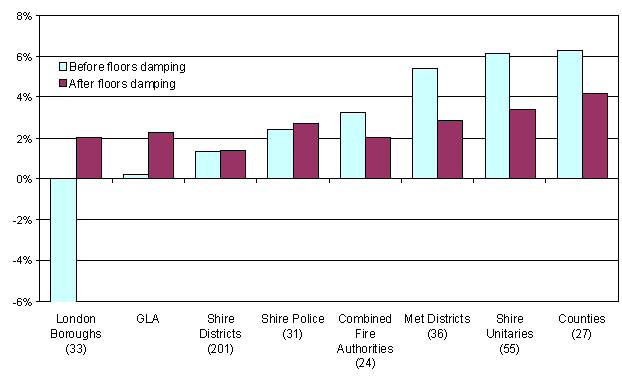
The number of authorities in each class are shown at the foot of the graph
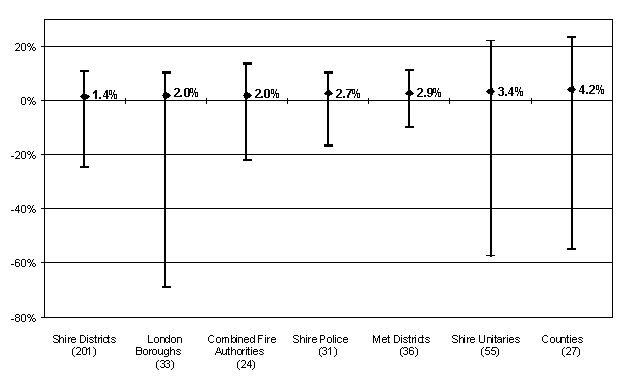
Formula grant increases 2009/10 by class of authority
This diagram shows the range of increases in formula grant for each class of authority before the floor damping arrangements, together with the average increases after floors.
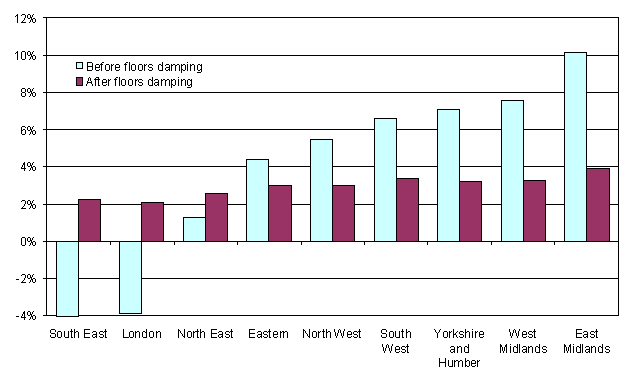
Formula grant increases 2009/10 by region - England average +2.8%
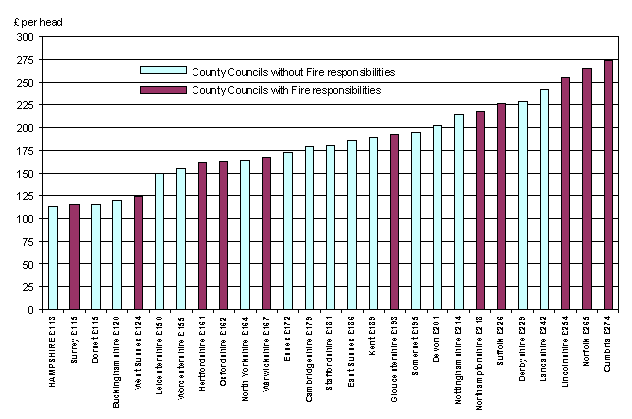
County Councils' Formula Grant 2009/10 per head - after floor damping
County Councils' Formula Grant increases 2009/10
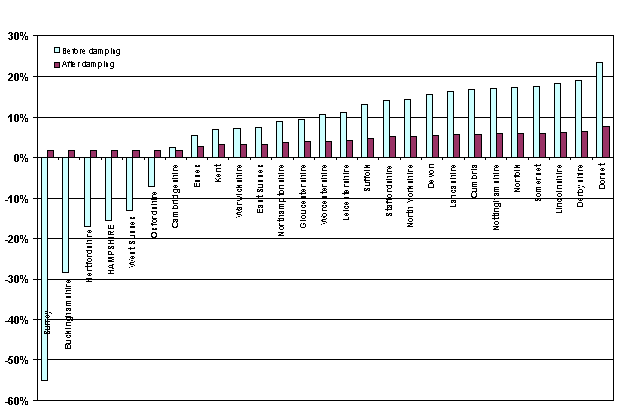
Counties' average: before floor damping +4.2%, after floor damping +6.3%
Specific and General Grants 2009/10 and 2010/11 - England
2009/10 |
2010/11 | |
£m |
£m | |
Children's Services |
||
Dedicated Schools Grant |
29,836 |
31,115 |
School Development Grant (schools element) |
1,947 |
1,979 |
Schools Standards Grant |
1,578 |
1,611 |
Sure Start, Early Years and Childcare Grant |
1,391 |
1,543 |
Standards Fund |
1,287 |
1,957 |
Other Education and Children's Social Services |
185 |
238 |
|
||
Adult Personal Social Services |
260 |
329 |
Police |
||
Principal Grant |
4,253 |
4,374 |
Other Police Grants |
1,371 |
1,418 |
Fire |
23 |
14 |
Environmental, Protective and Cultural Services |
842 |
926 |
Capital Financing - PFI |
853 |
1,069 |
Other |
||
Working Neighbourhoods Fund Reward |
- |
50 |
Growth Points and Eco Towns |
17 |
18 |
Supporting People (see Area Based Grant below) |
1,666 |
- |
Greater London Authority |
48 |
48 |
Local Area Agreement Reward |
209 |
123 |
Homelessness |
49 |
49 |
Free Swimming |
37 |
40 |
|
||
Area Based Grants |
||
Supporting People |
- |
1,636 |
Other |
3,221 |
3,159 |
---------- |
---------- | |
Total Specific and General Grants |
49,073 |
51,696 |
---------- |
---------- | |
Hampshire local authorities' Formula Grant for 2009/10
2008/09 |
2009/10 |
Variation |
||
adjusted |
||||
£m |
£m |
% |
||
Hampshire County Council |
142.307 |
144.797 |
+1.75 |
at the grant floor |
Hampshire Police Authority |
||||
Formula grant |
83.770 |
85.665 |
+2.3 |
|
Police grant |
118.472 |
121.851 |
+2.9 |
|
---------- |
---------- |
|||
Total |
202.242 |
207.516 |
+2.6 |
|
---------- |
---------- |
|||
Hampshire Fire and Rescue |
28.236 |
28.710 |
+1.7 |
|
Portsmouth City Council |
84.660 |
86.142 |
+1.75 |
at the grant floor |
Southampton City Council |
96.288 |
98.276 |
+2.1 |
|
Hampshire district councils |
||||
Basingstoke and Deane |
9.712 |
9.918 |
+2.1 |
|
East Hampshire |
6.151 |
6.182 |
+0.5 |
at the grant floor |
Eastleigh |
7.589 |
7.676 |
+1.1 |
|
Fareham |
6.174 |
6.205 |
+0.5 |
at the grant floor |
Gosport |
7.224 |
7.260 |
+0.5 |
at the grant floor |
Hart |
3.796 |
3.815 |
+0.5 |
at the grant floor |
Havant |
9.778 |
9.827 |
+0.5 |
at the grant floor |
New Forest |
11.392 |
11.467 |
+0.7 |
|
Rushmoor |
6.940 |
6.974 |
+0.5 |
at the grant floor |
Test Valley |
6.745 |
6.920 |
+2.6 |
|
Winchester |
6.944 |
6.978 |
+0.5 |
at the grant floor |
---------- |
---------- |
|||
Total |
82.445 |
83.222 |
+0.9 |
|
---------- |
---------- |
|||
Suggested draft response to Communities and Local Government on the provisional Local Government finance settlement 2009/10
The County Council appreciates the financial stability and predictability arising from the unchanged grant figure in 2009/10. This means that the County Council was at least able to plan for its inadequately low grant increase, as a floor authority, of 1.75% in 2009/10.
The representations made last year therefore remain:
· insufficient grant increases to meet rising costs (with inflation peaking in 2008/09) and demographic pressures
· the unacceptable pressures put on council tax rises as a consequence
· the lack of transparency of the four block model
· specific local issues around waste management costs not supported by grant as the Council's contract arrangements anticipated and pre-dated the private finance initiative (and accompanying grant credits), and the abatement of the area cost adjustment by the inclusion of the Isle of Wight locally rather than nationally.
We are grateful that action was taken in response to last year's consultation on the student support services transfer.
The County Council supports the Government's commitment to investment in capital infrastructure. However the Government's `supported borrowing' allocations do not provide Hampshire with an appropriate grant share at the margin for capital financing costs. This results from `judgements', within the four block model, not the inherent soundness of the underlying formula changes. These changes have redistributed grant money away from Hampshire towards areas with perceived higher `needs' and lower `resources'.
In total the County Council is unable to square the circle and will not be able to afford the full take up of the so called `supported borrowing' allocations over the three year period from 2008/09 to 2010/11. This is about £28m or 32% of the nominal Government allocation. This is done with great reluctance at any time, but is especially galling in this current economic crisis, especially when Government is suggesting that other capital expenditure should be brought forward (on schools and housing) to help mitigate the impact of the recession.
The capital financing system is not on a level playing field, not only because of the floor arrangements but also because of the haphazard incidence of capital grant or private finance initiative schemes which are separately supported outside the formula grant calculation. That leaves the major issue of supported borrowing allocations on which the Council wishes to make further representations in the light of the economic recession and the need to support the local economy and infrastructure investment.
The Government's abolition of the capital adjustment in the general grant floor damping calculation in 2006/07 resulted in the County Council, as a floor authority, receiving no additional revenue grant towards capital financing charges arising from `Government supported' borrowing allocations. Without additional revenue grant, the cost of servicing such borrowing at the margin falls directly on the council tax payers. For 2009/10 this means that the County Council should restrict its net increase in financing costs to 1.75%. In practice general price inflation assumption of 2.5% is used so that marginal borrowing costs are treated in the same way as pressures on other revenue spending. The Government argues that the Council's floor is so far above the grant derived from the formula that the Council is funded for this. But that is a flawed argument - floors are there because of the volatility of the grant formula, to prevent the need for immediate cuts in services. Requiring the floor grant to finance the cost of additional supported borrowing prevents the floor from operating in this way.
In the long run these anomalies require clearer analysis and treatment so that schemes with Government support but financed by different methods are treated equally in future as far as marginal increases in Government grant or credits are concerned.
The Government's approach to capital support is therefore inconsistent. There is one approach in respect of capital grant which is to grant aid approved schemes irrespective of whether the authority is receiving more formula grant than it is entitled to under the formula i.e. is receiving damping grant. However if the scheme is supported by means of supported borrowing, the grant towards the extra borrowing costs has to be offset against damping grant or in the case of a non floor authority is partly clawed back to pay for damping. This situation results in a clamour from local authorities for capital projects to be supported by capital grant, when it was intended that the means of capital support should have a broadly neutral effect. A change is therefore required to level the playing field - this could take the form of withholding capital grants from floor authorities but could also be dealt with by:
· a capital financing grant entirely separate from formula grant
· a five block model with capital financing as the fifth element (taken out of the main needs block), and damping just applying to the other three blocks.
The County Council is also concerned about the future viability of the Private Finance Initiative (PFI) schemes, because of the impact of recession and the inability of the banking system either to provide credit at all, or at such excessive margins that the costs would become unaffordable.
PFI schemes will in future be on the `balance sheet'. In those circumstances the County Council can raise the required finances at very low, almost unprecedented interest rates, which could be used to finance such private finance initiatives in lieu of scarce and expensive banking facilities.
The County Council would therefore appreciate a dialogue with Government in the current economic circumstances about:
· levelling the playing field on the treatment of capital financing, so that supported borrowing is not the poor relation of PFI schemes and capital grant, but receives the same level of marginal grant support
· improving the flexibility of PFI schemes if credit facilities for the banking sector become scarce and too expensive.
Capital Programme guidelines 2009/10 to 2011/12 |
|||||||||||
Adult |
Children's |
Environment |
Policy and |
Recreation |
TOTAL | ||||||
|
Services |
Services |
|
Resources |
and Heritage | ||||||
£000 |
£000 |
£000 |
£000 |
£000 |
£000 | ||||||
2009/10 |
|||||||||||
Locally resourced schemes |
700 |
88 |
9821 |
6380 |
438 |
17427 | |||||
Government supported: |
|||||||||||
Supported borrowing |
11199 |
24732 |
8012 |
43943 | |||||||
Capital grants |
2184 |
45844 |
5733 |
11914 |
422 |
66097 | |||||
Total |
2884 |
57131 |
40286 |
26306 |
860 |
127467 | |||||
2010/11 |
|||||||||||
Locally resourced schemes |
470 |
88 |
9376 |
6351 |
379 |
16664 | |||||
Government supported: |
|||||||||||
Supported borrowing |
7442 |
24501 |
499 |
32442 | |||||||
Capital grants |
612 |
54848 |
5630 |
18137 |
422 |
79649 | |||||
Total |
1082 |
62378 |
39507 |
24987 |
801 |
128755 | |||||
2011/12 |
|||||||||||
Locally resourced schemes |
585 |
88 |
9534 |
6366 |
408 |
16981 | |||||
|
|||||||||||
|
|||||||||||
Details of Government support for capital schemes only extends to 2010/11 |
|||||||||||