
Archived decisions
29 January 2009
Hard to Reach People Review Panel
Council Chamber , The Castle, Winchester
Agenda
Session |
Witness |
Topic |
10:00 - 10:30 |
Jane Goodwin Corporate Equalities and Diversity Manager Mohammed Mossadaq AS Commissioning & Strategy Manager |
Equality and diversity achievements Background paper: Single Equality and Diversity Scheme 2008-2011 at Appendix One |
10:30 - 11:00 |
Teresa Jamieson Consultant/ CABx Consortium |
CAB experience and initiatives: hard to reach people |
11:00 - 11:15 |
Coffee/comfort break |
|
11:15 - 11:45 |
Steve Lincoln ? Winchester City Council |
Initiatives to reach people at Winchester City Council |
11:45 - 12:15 |
Sharon North Commissioning Officer - Children's Services |
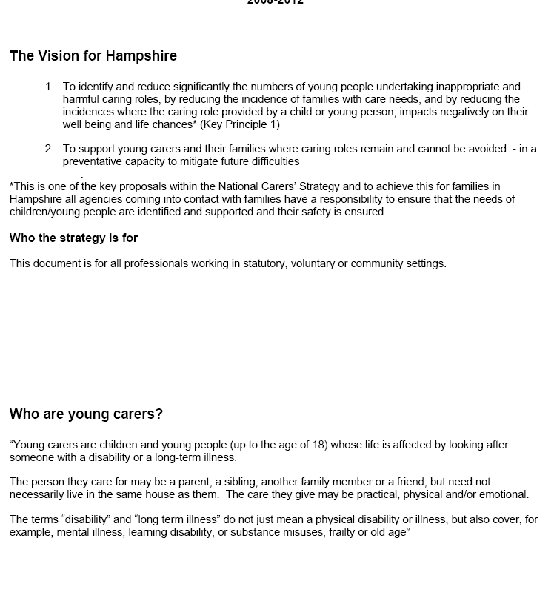
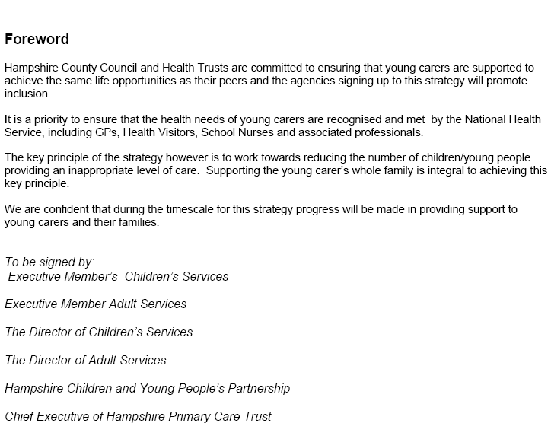
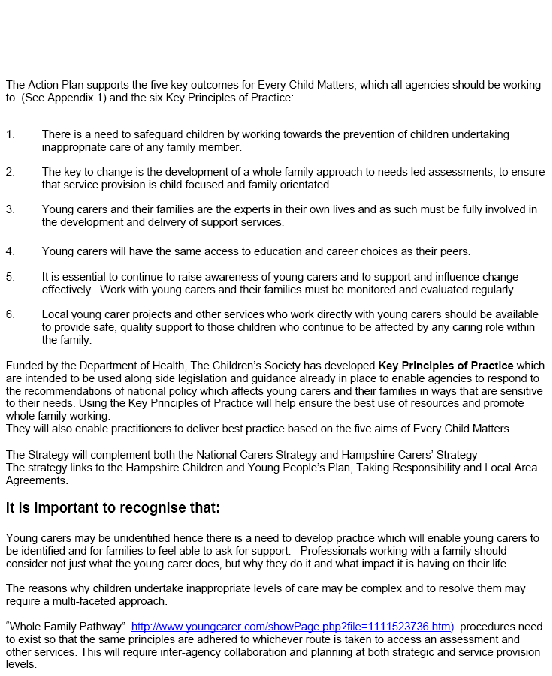
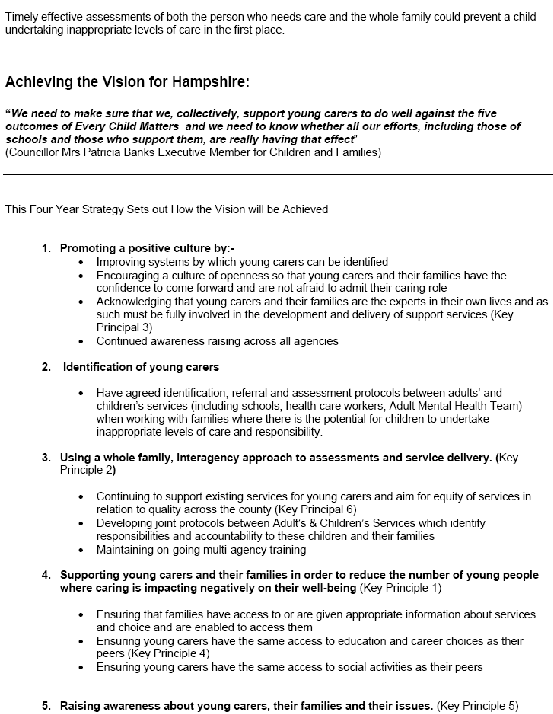
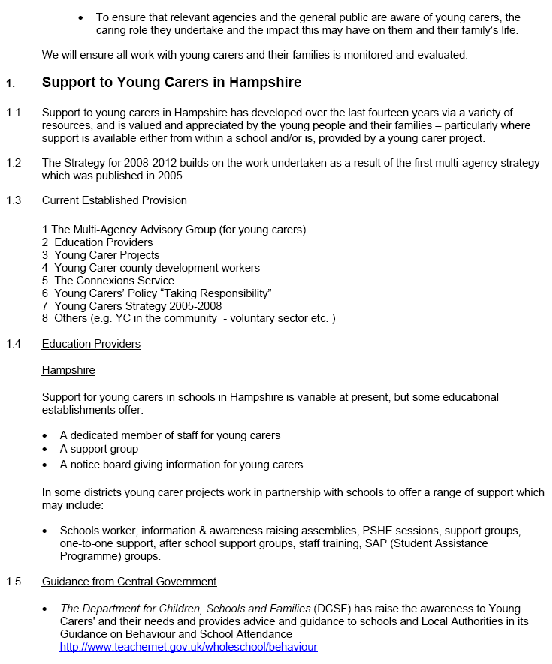
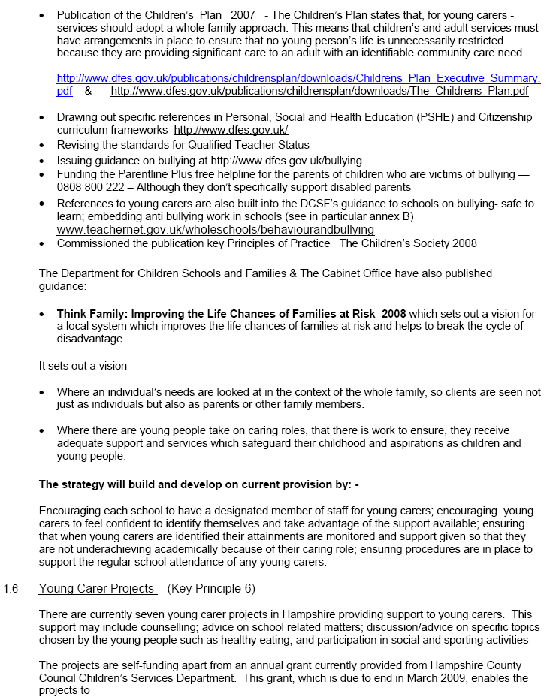
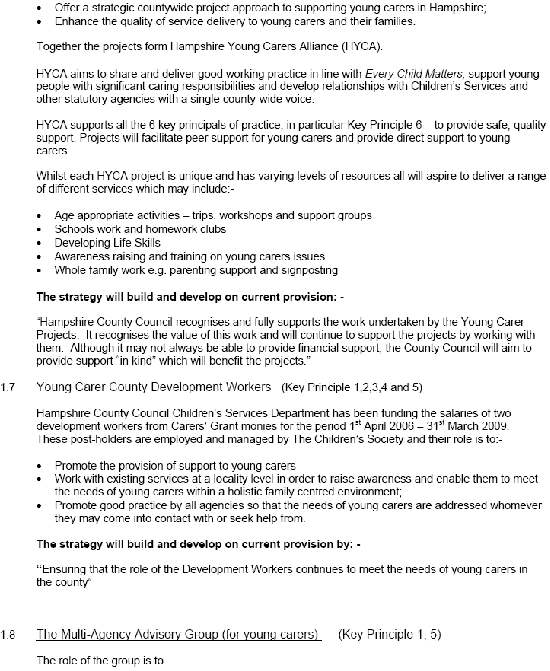
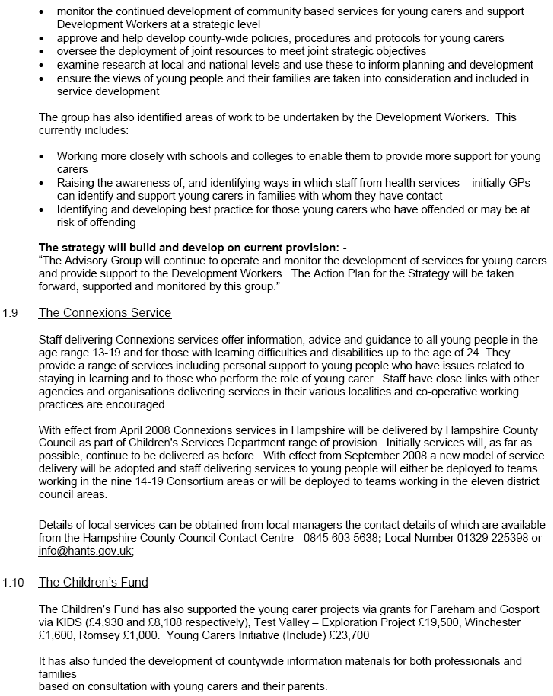
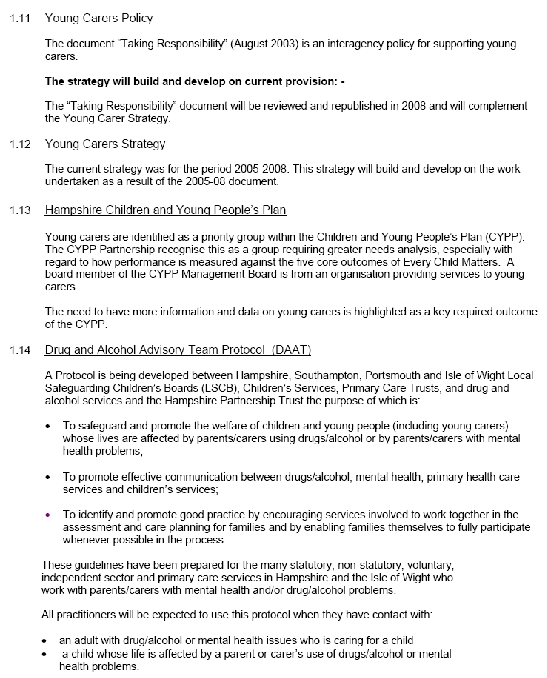
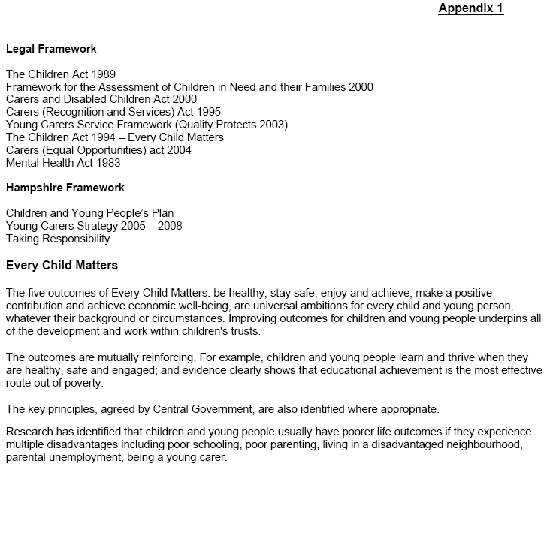
Young carers Background paper: Hampshire Strategy for Young Carers 2008-2012 at Appendix Two |
12:15 - 12:45 |
Mike Wickenden Head of Sports, Community and Outdoor Centres |
Challenges and initiatives: improving access to services in areas of deprivation |
Notes from Review Panel held on 15 December 2008 at Appendix Three
Set of possible questions at Appendix Four
Appendix One: Background for Session 1 - Equality and Diversity
Hampshire County Council
Single Equality Scheme- 2008 -2011
1. Introduction
In April 2000 we published our first Equality Strategy - Quality Through Equality. At the time the strategy was innovative as it committed the Council to equality, fairness and justice. The document described how the Council intended to deal with matters of equality in employment and service delivery. We set out an approach which covered rights and opportunities in respect of age, disability, gender, race, religion, sexual orientation as well as issues of social exclusion arising from poverty or rural isolation. At the time this was above and beyond legal requirements.
Life in local government never stays still so, unsurprisingly, things have changed. The legal framework has developed and duties have been placed on public bodies to promote race, disability and gender equality - a key part of these duties is a requirement to produce specific schemes for each of these areas and we have done so. In addition the law now covers discrimination on grounds of age, religion or belief, and sexual orientation - these are sometimes referred to as the 6 equality strands.
There is now recognition that local authorities have a key role to play in ensuring that all people have equal life chances and that communities get on well together. The legal framework continues to develop and there has been a review of the discrimination laws (Discrimination Law Review)1 as well as the Equalities Review (Our Shared Future)2 which looked at the causes of persistent discrimination and inequality in Britain. Both of these reviews have resulted in plans for Government to pass an Equality Act which will bring together all the various discrimination laws and introduce a legal duty for public bodies to promote equality across all strands of equality.
The development and enforcement of this new law will be overseen by the Equality and Human Rights Commission which was set up in 2007 by merging the 3 previous commissions for Gender, Disability and Race Equality.
The way that the performance of Councils is monitored by the Audit Commission and other inspectorates has also recognised the importance of meeting the needs of different communities and expects authorities to show how they understand and meet the needs of diverse communities.
2. An overview of Hampshire
The county of Hampshire is large, dynamic and successful, but some areas are relatively deprived and vulnerable.
Hampshire is the third-largest shire county, with 1.27 million residents in over 502,000 households. Covering 3,680 square kilometres, it is a diverse county with a mix of urban and large rural areas. Although less than 10% of the county is urban, 87% of the population live in urban areas such as the large towns of Aldershot, Andover, Basingstoke, Eastleigh, Fareham, Farnborough, Gosport, Havant and Winchester.
According to the 2001 census we have an ethnic minority population of 2.3% but we do know that there has been an increase in the past 7 years in particular migrant workers from the EU. Approximately 15% are considered as disabled and there is an increasing number of people over the age of 75.
We provide a range of services to people in the county, many of which are provided in partnership with District and Borough Councils, the National Health Service (NHS) and other community-based organisations. Other public bodies in the county are subject to the same legal requirements and have prepared their own Equality Schemes. We will do our best to make sure their and our services work together to deliver equal life chances for all.
Please see Appendix 4 for further details and Appendix 5 for details of our decision making structure.
3. Hampshire's Vision for Equality:
The Equalities Review used a more inclusive definition of equality:
"An equal society protects and promotes equal, real freedom and substantive opportunity to live in the ways people can value and would choose, so that everyone can flourish. It recognises people's different needs situations and goals; it removes barriers that limit what people can do and can be"
This definition recognises that equality is an issue for everyone and that we don't all start from the same position and to create a fair society we must recognise different needs.
Hampshire County Council accepts this definition and is committed to continuously improve the life chances of all its citizens. This document will tell you how we intend to remove barriers to opportunities and improve choice for all by building on our current equality schemes and setting out an approach which will bring about improving life chances for all. We have begun this approach by agreeing this vision for equality
"Hampshire County Council positively values diversity, respects individual rights, encourages personal responsibility and expects others to do the same"
4. Policy Statement
In Hampshire we want to create a place where people get on well together because they have the right to expect to be treated equally, without discrimination and accept the responsibility to respect the rights of other. This means that the way we employ people and deliver services will take account of the barriers/discrimination that individuals often face on account of their age, disability, gender, race, religion or belief, sexual orientation, social circumstances or personal lifestyle. To achieve this we have agreed the following aims
1. We will take action to tackle inequality and the causes of inequality.
2. We will take steps to counter the effects of past discrimination which may have led to under-representation of certain groups within our workforce and those people who use our service.
3. Where certain people may have been prevented from making their needs known to us we will work with partners to build capacity in different communities to enable them to understand the role of the County Council and encourage them to make their views known.
The Council will expect partner organisations, contractors, community groups and trade unions to share these aims.
5. What we have done so far
We have published the statutory schemes:
The Race Equality Scheme (appendix 3) was first published in 2003 and at the time our main priority was to get a better understanding of the relatively small and dispersed ethnic minority communities in the County. Through working in partnership with other statutory and voluntary partners there is now a network of dedicated community development workers across the County who have helped the Council to engage more proactively with various communities and individuals. This scheme was reviewed in 2006 and a revised scheme published. We have used market research to measure our effectiveness and can see that capacity building takes time so we continue to invest in this approach.
A key achievement has been the work with Community Action Hampshire to develop the capacity of voluntary organisations through the Diversity Networks Project. We need to continue to find ways to support this project. Further information on this project can be obtained from Community Action Hampshire http://www.action.hants.org.uk/index.php?id=50 telephone 01962 857357
Example of positive result of our actions:
The Basingstoke Diversity Forum has been established through a partnership between the County Council and Basingstoke & Deane. They held a successful employment fair which promoted job opportunities for people from minority ethnic communities.
Ten members of the Council staff have taken part in a dvd which told their stories about being seen as a person of a minority group
Gypsies & Travellers
Since the development of this scheme there is a growing recognition that Gypsies and Travellers are among the most marginalised people in society. In Hampshire we have historic and well established communities in the New Forest and in the north of the County. We provide services in particular through our Ethnic Minority and Traveller Achievement Service. Recently there has been the Gypsy & Traveller Accommodation Needs Assessment, currently we provide 4 sites for permanent encampments and this assessment has identified the need to increase this provision.
Example of positive results of our actions:
Hampshire records office worked with the Gypsy & Traveller community to show the history and contemporary culture of Gypsy children and their families http://www.hants.gov.uk/rh/gypsy/ . This has resulted in roving exhibition which visit schools and libraries
Migrant Workers
Hampshire has a long history of attracting migrant workers to the agricultural and tourist industries. There has been a marked increase in migrant workers since the expansion of the EU. We have been working with our partners to understand the nature and needs of these people and hosted an information sharing seminar in May 2006.
Examples of positive results of our actions:
The Disability Equality Scheme (appendix 2) was published in 2006 and we used a number of different ways to involve disabled people in the development. Some people were involved in a development group, others took part in local events which were organised with partner organisations to avoid `consultation fatigue'. We identified priority areas for action with the top priority being issues around transport and employment. Some progress has been made although not as much as we would wish so this scheme will revisit the action plan.
Examples of positive results of our work:
The Access Team has successfully implemented an approach which aims to improve access to our buildings http://www.hants.gov.uk/pbr/access/accessstrategy.html . Many of the audits are undertaken in partnership with local disabled people. The latest phase focuses on our 540 schools.
The ZIP bus priority corridor is being constructed on the A3 between Portsmouth and Clanfield this aims to as accessible as possible and the bus shelters have been developed to cater for the needs of people with visual and mobility impairments. The design was undertaken with members of Havant Access Forum
The Gender Equality Scheme (appendix 1) was published in May 2007 and one of the key areas for action is on Equal Pay. The Council has conducted a comprehensive equal pay audit and the results are now being implemented. When the scheme was published the consultation period was used to ask views on the option to merge the schemes into one. There was overwhelming support for this approach although concern that the momentum on the Race and Disability schemes might be diluted.
Issues relating to transgender people are included in the Gender scheme and through the diversity networks project we are making contact with support groups and beginning to develop our understanding of how our services may impact on the lives of transgendered people.
We have also taken some action for other equality groups:
Age:
We made sure that our employment policies did not discriminate on grounds of age by checking that our policies & guidance do not ask for age requirements unless lawfully justified and we issued guidance for managers. We established an older person's wellbeing project and there are a number of projects across the services which aim to support older people to live safely in their own homes and be as independent as possible. This is in addition to the general services which we provide to older people.
Example of positive results of our actions
The Garden Maintenance Social Enterprise service was partly funded through the Hampshire County Council Older Person Wellbeing Project. It offers a high quality service, at competitive rates for garden maintenance work carried out by highly trained, experienced Staff and skilled Trainees. http://www.beneficial.org.uk/gmaintenance.htm
Religion and Belief:
We wanted to make contact with people from different faith backgrounds to see how our services need to be adapted to meet different needs. The Hampshire Interfaith network started in January 2006 http://www.hants-interfaith.org/ . This group has established an annual faith lecture which looks at current faith related topics. They have just launched a competition in schools for children to help design an interfaith calendar.
Sexual orientation:
The Council was amongst the first to embrace the Civil Partnership laws and these ceremonies are now an integral part of our registration services. We have not been able to make contact with any established Lesbian, Gay, and Bisexual groups and so we are working with Hampshire Constabulary who has started to establish a reference group. However, we are taking steps to consider how our services may impact on people of different sexual orientation.
Schools:
There are 540 schools in Hampshire each one is run by a board of Governors and they all develop their own policies. The County Council supports these schools with advice and develops guidance to assist with their policy making. They are subject to the same legal duties as the Council and we have issued a range of guidance on the public duties and run a number of briefings to help their understanding. In line with the move towards a single equality scheme we have developed a template for schools to use to develop their own equality scheme.
Example of positive support
The Ethnic Minority and Traveller Achievement Service support schools and families across Hampshire in raising ethnic minority achievement, through bilingual assistance, projects, training and advisory support. They also offer bilingual assistance to schools with newly arrived pupils for whom English is an Additional Language (EAL).
Employment
As one of the largest employers in Hampshire we are very aware that by recruiting and supporting a diverse workforce we will also improve the way that our services reach out to improve access for different people. Over the past 5 years we have actively sought to increase the diversity and one of the key actions has been to improve and analyse the information we collect on staff diversity. This has led to some actions which have resulted in a gradual increase in staff from ethnic minorities and the number of women in senior posts - see section 2 for more details. However, despite good intentions and positive actions we have not managed to do likewise for disabled staff - this will be one of our key actions for this scheme.
Example of positive actions
A number of our staff from different backgrounds have told their stories through a DVD which is our web site put in link
6. How this fits with our corporate priorities
The Council has identified the following priority areas for action that will improve the lives of residents:
Hampshire Safe & Secure for All
Our overall priority is to make communities stronger and safer for all by:
· protecting vulnerable people
· making residential areas as safe as possible
· helping young people to live positive lives
· helping diverse communities to feel secure.
Maximising Wellbeing
This priority is about maintaining and improving quality of life. We want to ensure that everyone has the opportunity to:
· support themselves financially
· be active in their community
· get the services they need
· have our support if things go wrong.
Enhancing quality of life
This priority is about making the county a good place to be by:
· protecting the differences between local areas
· making sure we have excellent facilities
· respecting Hampshire's heritage
· planning for the future.
The following set of values explains the way in which we aim to work:
· Removing barriers to opportunities and improving choice for all
· Responding to the improvements that people say they want
· Planning for and investing in the future
· Encouraging partnership, participation and contribution
The Sustainable Community Strategy sets out the vision that we have for the future of our communities and helps to guide the actions of the Local Area Agreement.
`The vision is that Hampshire continues to prosper, providing greater opportunity for all without risking the environment.'
An equality impact assessment ensures that each of the target areas includes equality and diversity issues however aim 5 captures and focuses the aspirations that we have for a more cohesive and inclusive Hampshire
A5. Hampshire's communities are cohesive and inclusive and vulnerable people are safeguarded.
Economic growth in its own right does not bring prosperity to everyone in the county. Steps need to be taken to ensure that everyone has the opportunity to contribute and share in the benefits. It is also important to recognise that economic growth is leading to an increasingly diverse population across Hampshire, which brings particular challenges to ensure our communities are cohesive and inclusive.
This will mean tackling the risk factors for social exclusion; promoting equality of opportunity; supporting the needs of vulnerable groups and individuals; understanding and valuing diversity; and treating all people with respect. It will include co-ordinating our approach to specific places where problems of deprivation have grown and persisted for many years.
7. Monitoring the Scheme through the Equality Standard for local government
In order to deliver our overall commitments on equality and diversity, the County Council has adopted the Equality Standard for Local Government. The Equality Standard includes the six equality strands covered by law; age, disability, gender, race, religion or belief and sexual orientation.
The Equality Standard is not a legal requirement but has been produced to provide a framework through which local authorities can meet their legal obligations under anti-discrimination legislation. It has five levels of achievement:
Level 1 Commitment to a comprehensive Equality Policy
Level 2 Assessment and consultation
Level 3 Setting equality objectives and targets
Level 4 Using information systems and monitoring against equality targets
Level 5 Achieving and reviewing outcomes
The aim of Standard is to make equality and diversity part of our day to day activities. We have currently achieved level 2 of the Standard and are actively working towards the higher levels of the standard.
Each department undertakes a self assessment of progress and this is monitored by EDAG and included in the wider corporate performance monitoring through the Corporate Performance & Efficiency Group. This approach means that the Council is integrating action on equality and diversity into all systems this is sometimes known as `mainstreaming'.
This framework is being updated Nationally and there will be a new measure. We will make sure that we adapt our approach accordingly.
8. Partnership working and the Local Area Agreement
The Local Area Agreement (LAA) is a partnership agreement which sets out how a range of public, voluntary and private sector partners will deliver the aspirations of the Sustainable Community Strategy http://www3.hants.gov.uk/localareaagreement.htm . There are a range of priorities which we will be working on together and each priority considers equality matters in relation to their work.
Example of the result of this work:
The priority B which relates to the economy and skills has agreed an a plan to improve employment opportunities for people who find it hardest to get work http://www3.hants.gov.uk/prosperity_bookletdifinitive_final_version.pdf . The County Council is committed to finding ways to improve work experience opportunities and is actively going out to different communities to tell them about how to get work with the Council.
The priority H is led by the Voluntary & Community sector (VCS) and relates to giving people the chance to have their views heard. A key focus has been to develop the capacity of the sector to help them to reach out to different communities and find out more about their needs. The Diversity Networks Project has been set up to do this.
The Hampshire Race and Equality Network is a group of officers from most of the public sector organisations on the County. They meet on a regular basis to share good practice and undertake joint projects which are mutually beneficial. This group is going to improve the remit of the partnership and make better links with the Local Area Agreement so that it can advise and support the work of each priority area
9. Community engagement/involvement
The information that has informed this scheme has bee gathered from lots of different sources. Our Market Research team undertake a wide range of community research http://www3.hants.gov.uk/communications/market-research.htm . There has been a series of research and consultation with diverse communities.
There is also a range of other ways that each department uses to engage with the people who might use their services. We know that this an area that we have to improve and we are looking at this.
This scheme has been informed by some of the research and direct contact with a number of community groups and contacts. We also ran a series of local staff focus groups to explore the opportunities for change.
Example of the result of this work:
When developing the Disability Equality Schemes local involvement events were organised by a range of partners so that disabled people were consulted only once. It also provided an opportunity to explain how the different services were delivered.
The Diversity Networks Project has been an important part of our work to reach out to different parts of the community and we have supported this project. We have commissioned the project to set up an external reference group to make sure that this scheme makes a real difference.
10. Trade union involvement
This Scheme has been developed in consultation with the Council's Trades Unions in that it has been the subject of consultation with the Joint Consultative Group and trades union representatives have been members of the corporate Project Group, the Equality & Diversity Action Group and participants in the above-mentioned workshop activity.
11. Equality in procurement
As a number of Council services are delivered by external providers we have looked at the best way to make sure that they comply with our Equality commitment. The corporate guidance which explains to officers how to purchase goods and services includes clear equality requirements and tender documents reflect this. We have been developing sensible ways to monitor some of our largest contractors to make sure that they understand the requirements and check progress. This needs to continue to develop.
12. This is what we need to do next
The following priority areas for action have been identified through equality impact assessments and feedback from a range of staff and community consultations:
· Continue to build capacity in and engagement of black & minority ethnic communities through the network of community development workers
· Find ways to make sure that the Diversity networks project can continue to improve local diversity networks and develop external challenge for this scheme
· Make sure that our approach to Equality & Diversity links with our efforts to improve community cohesion
· Continue to include equality and diversity in our processes
· Become more effective in the way we promote our equality commitments with our partners and contrcators
· Improve the information that we have so that we can make better decisions
· Make sure that the actions identified in the Race, Disability and Gender Schemes are taken
· Review the internal structure for managing Equality & Diversity to improve effectiveness
· Continue to find innovative ways to train our staff and make sure they understand how to improve equal life chances for all
· Improve the diversity of our workforce at all levels of the Council
· Find ways to get staff more involved with the way we make decisions on equality
The attached action plan sets out details of how we will achieve this.
13. Putting the scheme into action
The Chief Executive and Council Leader take personal responsibility for the management of equality and diversity across the Council and ensure that each level of the organisation is accountable. They delegate responsibility for implementation to the Corporate Equality and Diversity Action Group which is led by a Cabinet member and Senior Manager. Each department nominates a senior officer as `Equality Champion'. This group has been working for the last 8 years to improve equality in every department. The people involved will make sure that every department identifies specific actions for their services, based on this scheme.
The work of this group is supported with professional advice and guidance from the Equality & Diversity Manager (Corporate Policy Unit) and the Equality and Inclusion Manager (Adult Services).
Performance against this scheme will be measured annually and reported to Chief Officers and Cabinet.
14. Assessing the impact of services on different equality groups
For the past 5 years, public bodies have been working to fulfil their general duty to promote equality. An important part of that duty is assessing how services affect different groups this is known as Equality Impact Assessment.
Policies, services and strategies do not usually discriminate unlawfully on purpose; they just do not cover a wide enough range of needs. `Equality impact assessment' is a way to:
· find out whether a policy, service or strategy will disadvantage any particular group
· try to remove the long-term problem of 'institutional discrimination' from the public sector
· ensure that policies, services and strategies do not discriminate unlawfully .
We have already done some assessments and regularly review our approach to make sure that it is working effectively.
Example of the results of this action:
The Trading Standards Service looked at places where it tested electric blankets for the public. It found that most were hard for disabled people to get into, so it changed the venues to more accessible places.
Communications team assessed the impact of the Council's magazine `Hampshire Now', they found that they were already proactively responding to the needs of people with sight loss through the provision of different formats and decided to expand this service to see if people required different languages. As a result they identify which were the top 5 most spoken other languages and there is now a statement offering the provide articles in other languages.
15. Publishing the scheme
It will be on our web site (http://www3.hants.gov.uk/equality) and available in various other formats. We will send copies to community groups, libraries and information centres and find other ways to make sure that people know about the scheme.
16. Dealing with Complaints
We have a corporate complaints procedure http://www.hants.gov.uk/complaints/ and each department also has its own approach to dealing with complaints. Each complaint is monitored for equality related matters and reported annually.
To find out more about this scheme, please contact:
The Equality and Diversity Manager
Hampshire County Council
Elizabeth II Court
Winchester SO23 8UJ
Email: [email protected]
Telephone: 01962 847789
Mobile or text: 07793758823
Textphone: 0808 100 24 84
Appendix 1 - The Disability Scheme http://www3.hants.gov.uk/equality/disability-home/disabilityequalityscheme.htm
Appendix 2- The Gender Equality Scheme http://intranet.hants.gov.uk/equality/gender_schemes.htm
Appendix 3 - The Race Equality Scheme
http://www3.hants.gov.uk/equality/race-home/race-equality-06.htm
Appendix 4
An overview of Hampshire
The county of Hampshire is large, dynamic and successful, but some areas are relatively deprived and vulnerable.
Hampshire is the third-largest shire county, with 1.27 million residents in over 502,000 households. Covering 3,680 square kilometres, it is a diverse county with a mix of urban and large rural areas. Although less than 10% of the county is urban, 87% of the population live in urban areas such as the large towns of Aldershot, Andover, Basingstoke, Eastleigh, Fareham, Farnborough, Gosport, Havant and Winchester.
The remaining 90% or so of the county is rural, with large areas designated as national or international conservation areas. They include the new national park for the New Forest and the proposed one for the South Downs. We do not cover the port cities of Southampton and Portsmouth, which have their own City Councils. But they work closely with the rest of the county on transport connections, employment, travel-to-work issues, housing and economic needs.
We provide a range of services to people in the county, such as:
· libraries
· museums
· country parks
· education for children and adults
· social care services
· disposal of waste collected by District and Borough Councils
· planning transport
· maintaining public roads
· arts centres
· developing sport (leisure centres being run by District and Borough Councils or private organisations).
We also provide services with District and Borough Councils, the National Health Service (NHS) and other community-based organisations. Other public bodies in the county are subject to the same legal requirements and have prepared their own Equality Schemes. We will do our best to make sure their and our services work together to deliver equal life chances for all.
We collect a range of data about the make up of our community and here is an example of some information that we have about different equality groups.
Population by Age Group | |
|
|
Age group |
Hampshire |
0-15 |
249,600 |
16-24 |
121,800 |
25-59 |
605,800 |
60-69 |
117,400 |
70+ |
145,500 |
All Ages |
1,240,100 |
Disability profile - as defined in census data
Population by long term illness status |
Hampshire |
All People |
1,240,100 |
With a Limiting Long-Term Illness |
185,300 |
Without a Limiting Long-Term Illness |
1,054,800 |
|
|
Ethnic profile
The 2001 census shows the following percentages of people in ethnic groups:
|
All people |
Percentages of people in ethnic groups | ||||
|
White |
Mixed |
Asian or |
Black or |
Chinese or other ethnic group | |
152,573 |
96.56 |
1.03 |
1.23 |
0.57 |
0.61 | |
109,274 |
98.35 |
0.65 |
0.40 |
0.19 |
0.41 | |
116,169 |
97.42 |
0.70 |
1.18 |
0.18 |
0.51 | |
107,977 |
98.26 |
0.60 |
0.48 |
0.15 |
0.51 | |
76,415 |
98.34 |
0.61 |
0.46 |
0.21 |
0.36 | |
83,505 |
97.69 |
0.72 |
0.81 |
0.26 |
0.53 | |
116,849 |
98.54 |
0.57 |
0.40 |
0.15 |
0.34 | |
169,331 |
98.86 |
0.50 |
0.25 |
0.12 |
0.29 | |
90,987 |
95.57 |
1.08 |
1.75 |
0.63 |
0.97 | |
109,801 |
97.93 |
0.65 |
0.74 |
0.20 |
0.48 | |
107,222 |
97.84 |
0.65 |
0.69 |
0.25 |
0.56 | |
186,701 |
94.74 |
1.00 |
2.45 |
0.51 |
1.32 | |
217,445 |
92.37 |
1.50 |
3.79 |
1.03 |
1.30 | |
132,731 |
98.69 |
0.54 |
0.33 |
0.23 |
0.22 | |
1,240,103 |
97.80 |
0.70 |
0.74 |
0.27 |
0.50 | |
1,644,249 |
96.73 |
0.84 |
1.34 |
0.39 |
0.69 | |
1,776,980 |
96.88 |
0.82 |
1.27 |
0.38 |
0.66 | |
We also have emerging communities from Eastern Europe. The Gypsy and Traveller communities have lived in and around the New Forest for a long time.
Population by Religious Group | |
|
|
Religious Group |
Hampshire |
All People |
1,240,100 |
Christian |
944,800 |
Buddhist |
2,300 |
Hindu |
3,100 |
Jewish |
1,300 |
Muslim |
4,300 |
Sikh |
1,700 |
Any other religion |
4,000 |
No religion |
192,900 |
Religion not stated |
85,700 |
Staff profile - Further information can be found on our web site http://www3.hants.gov.uk/equality/policy-guide/policy-plan/monitoring-report.htm
Staff profile 2008. | |||
Age |
Disability |
Gender |
Ethnicity |
16 - 29 = 11.62% |
White = 88.44% | ||
30 - 44 = 33.06% |
1.36% |
Female 76.4% |
Mixed = 0.57% |
45 - 59 = 44.40% |
Male 23.6% |
Asian = 0.39% | |
60 - 64 = 7.43% |
Black = 0.82% | ||
65 - 74 = 3.09% |
Other = 0.43% | ||
75 - 84 = 0.41% |
|||
Appendix 5 The Council - Decision Making structure.
Hampshire County Council consists of 78 councillors (also known as Elected Members). These councillors are accountable to all residents in their area. They are required to follow a Code of Conduct to make sure that they carry out their duties to a high standard. The main decision making body is the Cabinet which is led by the Council Leader. Scrutiny committees monitor the work of the Cabinet, Executive Members and the Council as a whole. All Members meet in full Council meetings to decide the budgets and policies for the vital local services which are provided by Hampshire County Council. The current political composition is 48 Conservatives; 28 Liberal Democrats and 4 Labour.
It is the role of Councillors to help local people influence the way we make decisions. Hampshire Action Teams have been established to assist this and support councillors in their role of leading communities and representing local people. In particular, they ensure that services meet local needs, work with others in the area, and sort out problems that no-one else is dealing with.
The Chief Executive is responsible for providing strategic direction, day to day management of services and allocation of resources. He delegates the operational running of the Council to the Corporate Management Team which consists of Corporate Directors for the following areas:
Children's Services - delivering services to children, young people and their families
Adult Services - delivering social care services to adults
Recreation & Heritage - providing culture and recreational services
Property, Business & Regulatory Services - maintaining our property, and a range of other services
Environment - Looking after the roads, waste and planning development for the future
Corporate Services - providing support services to the Council
Treasurers - providing financial support to the Council
Appendix 6 - The legal framework for equalities
Our commitment to securing genuine equality of opportunity is underpinned by the following legislation designed to eliminate unfair discrimination:
Equal Pay Act 1970
The purpose of this Act is to prevent discrimination between men and women in the terms of their contracts of employment, including pay.
Sex Discrimination Act 1975
It is illegal to discriminate directly or indirectly against men or women in selection for appointment, promotion or training.
Sex Discrimination Act Amendment 1999 - gender reassignment
It is illegal to discriminate against a person who is undergoing a gender reassignment in terms of employment and training.
Race Relations Act 1976
It is illegal to discriminate, directly or indirectly, on grounds of colour, race, ethnic or national origin.
Race Relations (Amendment) Act 2000 - The Race Equality Duty
All public bodies, including local authorities, must eliminate unlawful racial discrimination; promote equality of opportunity; and promote good relations between people of different racial groups. Local authorities have the specific duties of publishing a Race Equality Scheme and monitoring recruitment and training procedures in terms of ethnicity.
Disability Discrimination Act 1995
It is illegal to discriminate against disabled people in employment, provision of goods and services and buying or renting land or property. Employers and service providers are required to make reasonable adjustments to overcome barriers.
DDA amended to introduce the Disability Equality Duties:
· Eliminate unlawful disability discrimination
· Eliminate disability related harassment
· Promote equality of opportunities
· Promote positive attitudes towards disabled persons
· Encourage participation by disabled persons in public life
· Take steps to meet disabled people's needs even if this requires more favourable treatment
There is also a specific requirement to publish a Disability Equality Scheme which sets out the action that will be taken to meet these requirements.
Human Rights Act 1998
Local authorities are legally required to consider the impact on people's human rights when setting policies and making decisions.
The Employment Equality (Religion or Belief) Regulations 2003
protect employees from discrimination because of their actual or perceived religion or belief.
Discrimination is unlawful in relation to:
recruitment and selection
terms and conditions of employment offered and or applied
opportunities for training, training itself, job promotions and transfers
harassment and victimisation
dismissal, including redundancy
post employment, for example provision of references
The Employment Equality (Sexual Orientation) Regulations 2003
The Employment Equality (Sexual Orientation) Regulations 2003 protect employees from discrimination because of their actual or perceived sexual orientation. Discrimination is unlawful in relation to:
· recruitment and selection
· terms and conditions of employment offered and/or applied for
· opportunities for training, training itself, job promotions and transfers
· harassment and victimisation
· dismissal including redundancy
· post employment, for example provision of references
The Equality Act 2000
Introduced the public duty for public bodies to :
· promote equality of opportunity between men and women
· to eliminate unlawful sex discrimination and harassment
This means that local authorities will be required to develop a Gender Equality Scheme explaining how it will promote gender equality in the design and delivery of services and address issues for their workforce. This also includes protection for transgender people.
Part 3 of the Equality Act 2006 also made provision for regulations to be introduced to extend the protection against discrimination on grounds of religion or belief to sexual orientation.
There are now regulations which protect against discrimination on the grounds of sexual orientation (perceived or actual) as well as religion or belief:
· in the provision of goods, facilities, services, education
· in the use and disposal of premises
· in the exercise of public duties
Appendix 5 - Our approach to Equality Impact Assessments
This is an extract from our web pages
Guidance to help you carry out an impact assessment
We know that some people can be unfairly excluded on grounds of age, disability, gender, race, religion or sexual orientation and an impact assessment should consider these factors in particular.
When assessing impact it's vital that we make the effort to understand the perspective of different groups and think about how comfortable they are going to feel in certain circumstances. For example an older Bangladeshi woman needing care may well feel very isolated at a day centre where there is no one else of a similar ethnic background. Teenagers may find a minibus unacceptable as a public transport solution because of its `uncool' association with the older generation
Do I need to do an impact assessment?
It isn't necessary to assess all the activities within the County Council. Our focus needs to be on outcomes, not on process.. So think about the likely impact of the area before decisions are made by using the pre-assessment flow chart and tables.
What areas should we focus an assessment on?
Remember - Impact assessments must become part of core business and planning by making sure that we anticipate the consequences of policies and strategies for vulnerable or disadvantaged groups
We should concentrate on those initiatives which are likely to have the most impact on people, where the completion of an impact assessment will affect outcomes such as:
Service plans - all service plans must be assessed and high impact areas should be given a full assessment so that the outcome actions can feed into the next plan.
· Development of projects and new policies - it will save a lot of time later if we consider the equality impact of a project or policy right at the start.
· Member decisions - make sure that screening for impact is undertaken and actions included in the report.
It is important to consider the likely impact of the area before decisions are made.
How do we do an impact assessment?
Complete the template.
Once the assessment has been completed a summary of the impact assessment must be completed and published on:
· The external Equalities and Diversity website
· Your departmental Equality and Diversity website (contact your web editor)
Include the results of the assessment in your departmental report:
· Equality and diversity action plans
· Business plans
· Service plans
· Reports to management team
Advise your departmental equality and diversity group of the assessment and its outcomes.
You will need to consider how to monitor the results of the assessment.
Appendix Two: Background for Session 4 - Young Carers

Appendix Three: Notes from Review Panel held on 15 December 2008
Culture and Communities
Hard to Reach Review Panel
15 December 2008
Notes
Councillors |
Present |
Absent |
· Keith Chapman (Chairman) · Roger Kimber · Roger Price |
· Anne Edwards | |
Officers |
· Colin Hinxman · Martin Combs |
|
Witnesses |
· Alex Burn, Head of Older People's Wellbeing · Cllr Yvonne Parker-Smith, East Hampshire DC, Chairman of Social Justice Board · Steve Hamm, Asst Chief Officer, Hampshire Fire and Rescue Service · Gareth Miller & Tricia Trott, Marketing, Recreation and Heritage · Stuart Baker, Senior Transport Planning Officer, Environment | |
Key issues and themes from evidence-giving sessions
Below is a short summary of issues and themes that arose from the witness sessions at the 15 December meeting. Following that further notes from each session are included, providing more detail of presentations and the subsequent questions and dialogue with members.
Common themes
Rurality: witnesses recognised that it was difficult to know how to know which people in rural areas are hard to reach, as defined for this review. Possible initiatives or approaches were discussed with members. Transport and poverty were two issues considered to be `hidden' problems for some in rural areas.
Partnership: an often used term, a key element in successful and affordable service delivery at the organisation level and above, but lacking common understanding among partner organisations. This lack of clarity around aims and objectives of partnership coupled with the inertia of old frameworks and the bureaucracy that goes with it, is perceived as a threat to productive `partnership' working.
Communication: several witnesses believe it is important that brochures and other information about services have the right tone for the intended recipients, and that unless information is properly targeted, it is unlikely people will be persuaded to read them properly or attempt to access the services. It was also pointed out several times that people need to be reached with information in a variety of ways, taking account of different people's communication styles.
Issues and perceptions
· Should use existing networks and organisations where possible rather than invent new ones.
· A lot of talking shops around partnership working, more emphasis needed on delivering the fruit of partnership pilots and initiative, and ensuring they are properly facilitated.
· Need a protocol or protocols around data and information sharing, particularly when access to services can be improved for people by multi-agency co-operation.
· Some people may be "easy to reach, but hard to persuade"; innovative quality engagement with, for example, older people may only be possible by local organisations who are trusted.
· Could staff training increase awareness and skills for customer facing staff to reach some people whose needs might otherwise not be noticed?
· Mobile (multi-agency?) service points may be required particularly in rural areas.
Session: 10:00 - 10:30 Alex Burn
· Older people are often the recipients of care, but can also take an active role in supporting others to maintain their independence in older age - The Older People's Wellbeing Project acts as a catalyst, bringing together the right organisations to make things happen.
· Two key issues:
· Social inclusion
· Development of ways to provide help at the right time, so as to obviate the need for crisis intervention later.
· Work strategically to help ensure that initiatives are embedded and taken forward with relevant partner organisations
Questions and dialogue
Q:KC - how are hard to reach people discovered if they are `hard to reach' or `hidden'? - Use grass roots organisations as eyes and ears; Also identify `places that everybody has to go' as natural locations/hubs for literature and information, but it is very important that the literature provided is the `right information'. The edition of Hampshire Now, aimed to interest older people (75+ years) is delivered directly to people's homes in areas identified by Mosaic as having concentrations of such residents to improve the effective and efficient targeting of resources.
Q:KC - Do you use Mosaic? - yes, it helps to assist with targeting information and invitations to local social events. Work with BrendonCare to do this.
Q:RP - do you find that all local councils co-operate equally as well with you? - honestly, co-operation is usually good, however there are occasional hiccups, for example, one council has been waiting to appoint someone to a key role, and meanwhile it has been difficult to take things forward. Another council in the same part of the county apparently found it difficult to identify who in the authority should take responsibility, therefore again, it has been difficult to take things forward because relevant decisions could not be made.
Q:RP - If a local organisation has `eyes and ears' that manage to identify some `hard to reach' people, is it actually possible for that organisation to pass on details to, say, a County Council service without falling foul of data protection? - We (ie. the Older Person's Project) are a catalyst, and thus do not require information about individuals, however the doers (front line services) would have to be aware of what information can or cannot be passed to partner organisations, at least, without permission. This is a difficulty and can mean that people may not receive services that could help them, even though another partner organisation may know about the person's situation.
Q:KC - Do other parts of the County Council ever pass on information about vulnerable/excluded/needy people to departments that could help? Could this be partly about awareness - if all employees and members were more fully aware of what the County provides, such as, Trading Standards, Library services, or highway related services (dropped kerbs or bad pavements?), perhaps they could either do more signposting for residents, or, with permission, pass on details to the relevant service? - You may be right!
Q:KC - What should be done to encourage people who are reluctant? - There is always a small group who will be reluctant, but one key issue is to make sure that the right information is provided in the right context and in the right way. The tone of information and publications is important and needs to be appropriate to those for whom the message is intended.
Q:KC - Do you use Mosaic? - Yes with some quite good results. Able to identify clusters of roads in areas around the New Forest and Bordon where is was possible to distribute literature believed to be relevant to many or most of the residents.
Q:KC - What do you think of the Audit Commission statements such as, there are "health inequalities", "inequalities of access to local services", or, for example, "there is lack of a clear and consistent approach across all service providers"? They are right! Nevertheless, it is still hard to know, who for instance may be living in only one room of a house, because they are only able to afford limited heating and are struggling to survive, if we don't know about them specifically.
Q:RK - Hampshire Now for over 75s; how it is used to communicate with the hard to reach? - Joining it all up is a challenge we all have, but there are locations around the county where good work is being undertaken and initiatives are under way; similar things are being achieved, but not always with the same partners - each is determined locally with the resources available.
Q:RK - How do we know who is asset rich and income poor? - This is where one can see the potential benefits of joined up working. For instance from time to time there may be `benefits campaigns' or other initiatives taken by a government department or arm of local government. A person or household's situation may become known, but the information gained is usually not shared. It may be possible for a person from one organisation to signpost to others that can help, but that might require spending some time patiently sitting with a person in order to understand their circumstances and it would require a knowledge of what other services would be the most appropriate. Even then, it may not be possible to share the personal information with other agencies. There are issues here that can frustrate efficient and effective partnership in ensuring that `hard to reach' people experience ready access to services and the benefits of them.
Q:RK - People sometimes think that people are prying; don't you think that Hampshire Now could insert something to encourage people to participate? Age Concern has publications that are very relevant and good at communicating.
Q:RP - How do you get to people who do not go to, for example, clubs and activities for older people? - We see this from both a `bottom up' perspective where local organisations may have access to local `intelligence' where they know about their locality and perhaps some of the more vulnerable people in it. But organisations with a wider remit take a more `top down' approach which is needed to understand how to plan effectively and efficiently to collate information about areas, and support those who are working in a more bottom up way. To reach people who do not, or cannot get out and about requires both approaches to be joined up if we are to extend care to all who might need it.
Q:KC - How does your project find out about older people who may face particular cultural, language or other barriers to finding out about what services are there to help them, or to obtaining access to them? - We have good contact with the County's Community Development Workers led by Mohammed Mossadaq, and others who can provide advice or information about people from various backgrounds. There have also been benefits campaigns that have meant calling at people's doors, I believe. Mosaic can be useful in highlighting areas where such work might be productive.
Q:RK - Informed the witness of work initiated by the member in the north east of the county.
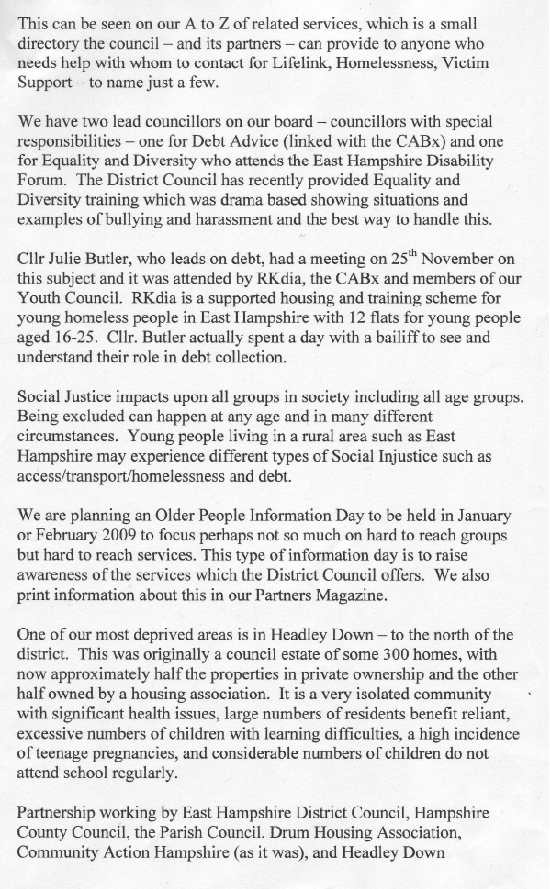
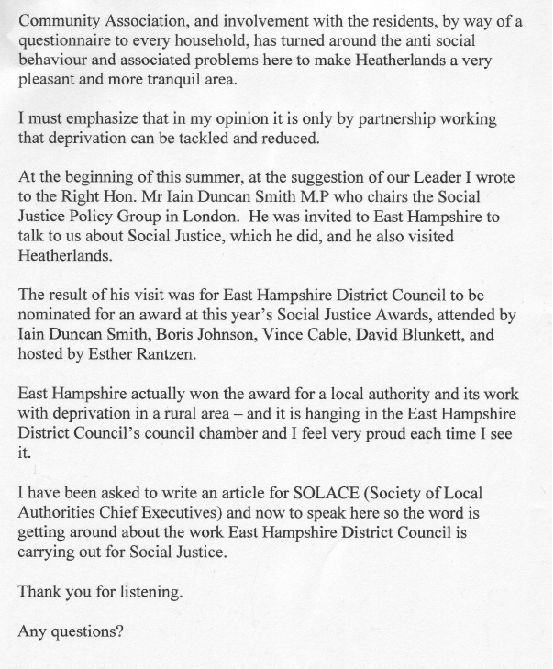
Session: 10:30 - 11:00 Cllr Yvonne Parker-Smith, Chairman of the Social Justice Board, East Hampshire District Council
See Appendix One: Social Justice Presentation to Hampshire County Council
Questions and dialogue
Q:KC - Can the A to Z booklet of services that you have shown us, be read easily by people who are colour blind? - I think so, I understand that black print on yellow paper provides a high contrast that is helpful. The booklet was deliberately made to be relatively small and convenient for people to keep near their telephone.
Q:KC - Where do people put it? - Try to make it available where people normally go, for example to supermarkets, doctors' surgeries and such like. We think that even those who are hard to reach for organisations may either meet each other informally, as some minority groups have done, or else they or possibly carers will venture to places that they need to visit for sustaining their health or sustenance.
Q:KC - Do you do ones for people with poor eyesight? - Good point! We possibly could provide ones with larger print, although that would add expense. We have not so far considered an audio version, but would audio suit a list of possible service providers? We show some of the content of the A to Z on a large TV in the Council reception; also, I understand that translation facilities are available on a demand basis.
Q:KC - Do you use Mosaic? - I don't know what that is.
Q:RP - Do you work with groups or individuals? - We focus on groups or communities rather than individuals, for example where we can see one ward has an average life expectancy that is more than 10 years different to one next to it, we recognise that this has to be a priority for us. We are fortunate to have the CAB in two of our larger settlements who are able to tell us when issues affecting local populations are arising.
Q:RK - You are saying that although towns may offer more access, they can also include areas of deprivation. We want to use the same approach in those areas that we successfully used in the north part of the district. We found the `youth pod' - funded through grants that provide a meeting place for youth where advice is available from partner organisations. This has been an effective and popular initiative in the north of the district - it seemed to turned around that particular area; we would like to repeat that sort of thing elsewhere too!
Q:RK - What do you do for gypsies? - We have very few gypsies/travellers in East Hampshire.
Q:RP - You act as a catalyst to help bring the right resources or organisations together, but do you have any difficulty working with particular partner organisations? - It is not always possible to get good representation from the Primary Care Trust or Adult Services, this may be in part due to the difficulty in sparing people who are already very busy for meetings. On the other hand we work very well with the housing association, although it is, for example in its own interests to be supportive since amongst other things we provide debt advice. Better money management means less rent arrears.
Q:RK - Is there a lack of notice boards? This is something I am aware of in many places! We do recognise this is important, and are planning for one in a new development, but think they are not as expensive as the prices you seem to pay.
Session: 11:15 - 11:45 Steve Hamm, Assistant Chief Officer, Hampshire Fire and Rescue Service
The Fire and Rescue Service needs to be understood in terms of its emerging roll in supporting `sustainable communities'. The Service is structured according to three key themes:
· Operations and emergency response
· Prevention (eg. arson)
· Protection
In addition there are six key `risk probability' theme areas:
· Elderly
· Young people/children
· Living alone
· Multiple occupancy
· Disabilities
· Deprived areas
These areas are based on each `theme' having a distinct set of characteristics that warrant specific approaches being developed to `reach' or engage the people who share those characteristics. As one of the earlier speakers said, one of the key issues is to have the right information if messages are to be communicated effectively. Well targeted information may help overcome some barriers to access and use of services.
The Service is aware of the important links between health inequalities and fire risk where localities summarise a related set of social factors. It is also aware of the linkage between road safety and fire risk, an aspect that may increase in significance as traffic density increases.
Children and Young People
The Service addresses behavioural issues with a schools programme, but is aware that some of those who they want to reach may not be in school. It may only be possible to `get through to' children the Service most wants to reach through `trusted' agencies and local groups/organisations.
Health Inequalities and overlap with Fire and Rescue
Two of the most significant causes of domestic fires are linked to smoking or cooking with fat/oil. The NHS provides a smoking cessation service, and it is also concerned about obesity which can in part be associated with diet and unhealthy eating, which in turn can be related to eating a lot of fried food. There would appear to be scope for the programmes to be mutually reinforcing.
Data/information sharing
This is an important issue. On the one hand individuals have a right to expect their personal data to be guarded and respected, but on the other hand, in the context of partnerships where different agencies are sharing the care of service users, and often need the same or similar information to be able to deliver the care, then there is a common need to resolve how information is managed for the benefit of all, and in particular the service user. This may need to be determined in the context of the partnership frameworks that exist; through LSPs or LAAs. An agreed protocol is needed to move forward.
Partnerships
Critical to the establishment of effective, and what must be efficient partnerships is a common understanding of what is meant by `partnership'. Currently there appears to exist a vast range of perceptions amongst different organisations. It seems very important for partners to sit down and agree a common understanding of aims and objectives. Thinking could then be formalised around that understanding. [diagnostic approach - poss bring up with DC/SH ?]
Challenges for the future
· People who are unaware - most organisations will need to look for `marketing' solutions or approaches to discover and communicate meaningfully with these people. It may, for example, be possible to bundle information/messages where messages are able to strengthen or support each other through one awareness raising programme particularly where one message theme has currency.
· May need to take services to people
· Mobile community contact points/hubs could be considered, for example in conjunction with mobile libraries.
· Could mobile contact points be hubs that represent a number of organisations?
Questions and dialogue
Q:RP - I have two main questions:
a) are there any partners you have problems with? And
b) concerning data protection, if you come across people whose circumstances suggest they might benefit from partner-provided services, how can you pass on the information? - In answer to point `a' then `yes' we have trouble with all of them in the sense that it is apparent that the whole concept of working in partnership tends not to be understood in the same way by partners - understanding, expectations and commitment differ considerably. Also, as yet there is not enough maturity in relationships; and each organisation can be pulled back by its own baggage, assessment regimes or frameworks, rather than looking at potential opportunities that break with past ways of operating. There is also a leadership issue.
Q:RP - Can you give a specific example? - We have been working on developing a process with Adult Services. The officers we work with are very willing, but organisational bureaucracy keeps getting in the way; as well as finance.
In answer to point `b' we don't necessarily want to re-invent or ignore work already underway or achieved. For instance a protocol for the exchange of information has already been developed between Fire and Rescue, the Police, Adult Services, the NHS and Trading Standards which allows some data to be shared concerning individuals' needs.
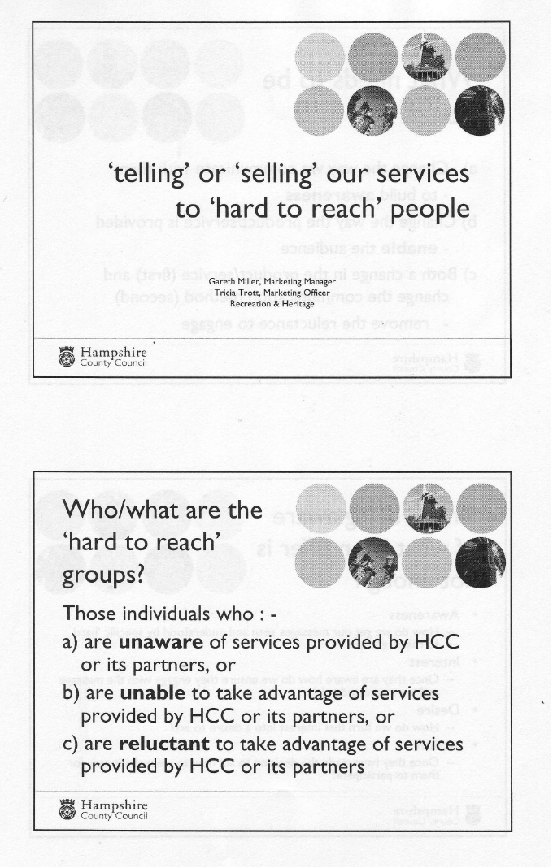
Session: 11:45 - 12:15 Gareth Miller & Tricia Trott, Marketing Team, Recreation and Heritage Dept
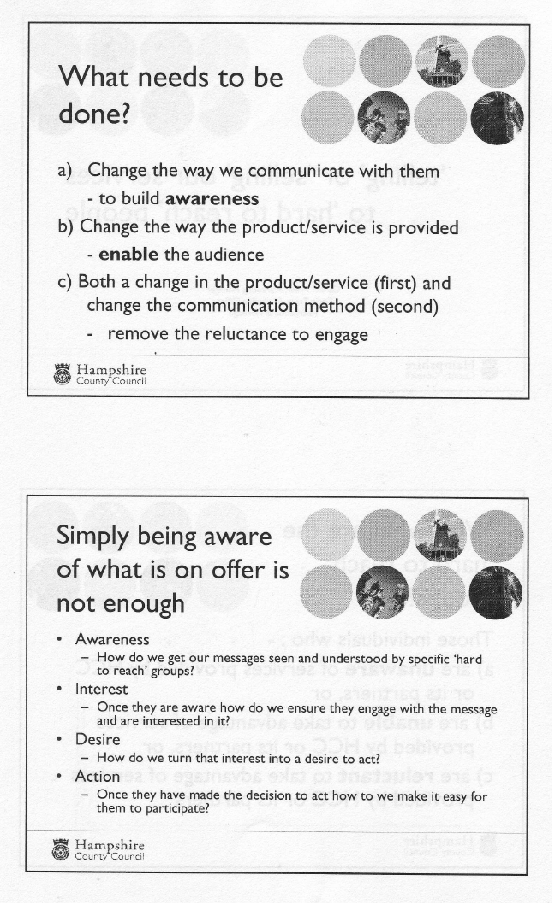
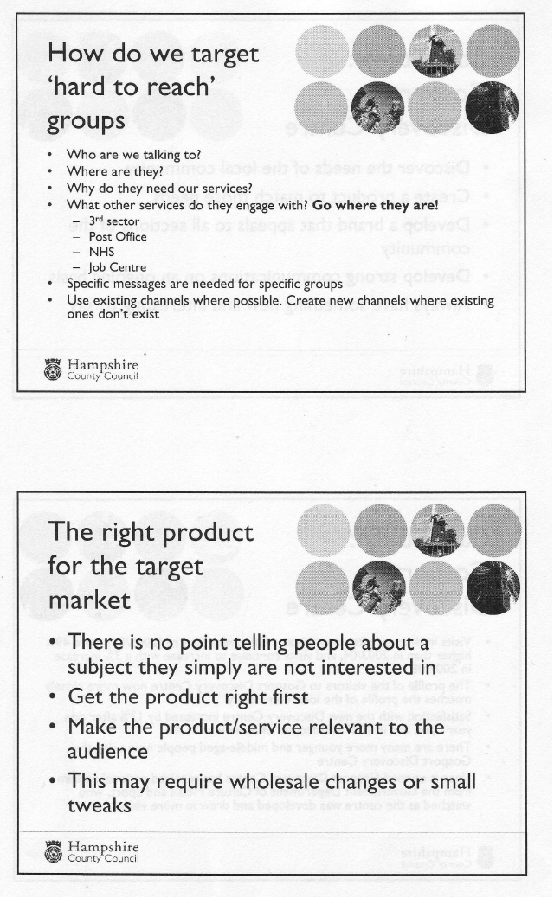
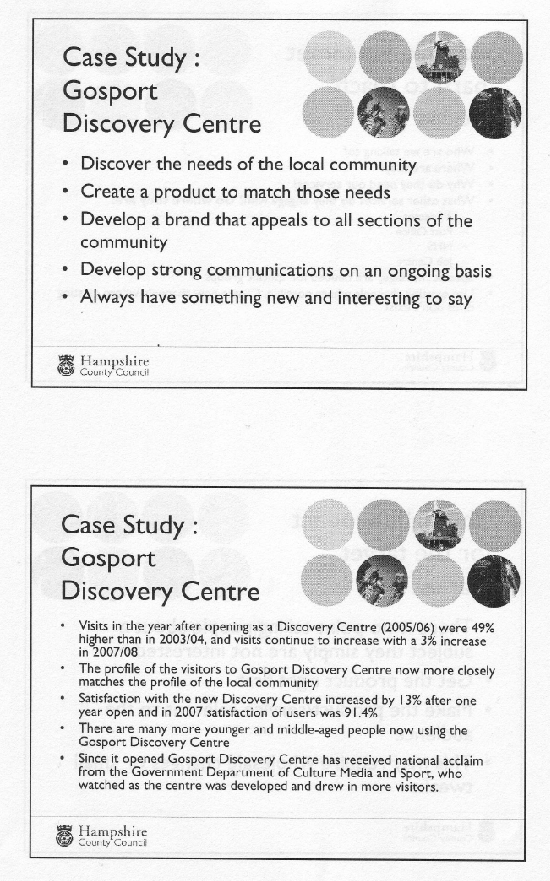
See Appendix Two: Presentation to the Panel of Marketing Model used in R&H
Appendix Three: Library Service key facts
Questions and dialogue
Q:KC - Thank you for your presentation. - GM (Marketing Manager) I would like to make it clear that the challenge we have in Recreation and Heritage is different from most other departments. The services we provide are services that people choose to take advantage of; they are not like those typical of Adult Services which provides services that people need. Our perspective is closer to that of business, and our success is measured in part by how much usage they get. Greater use of other departments' services is usually accompanied by extra costs to the Council.
Q:KC - Is it possible that library staff, for example, might become aware that some of their `customers' could potentially benefit from the services of other departments? - I imagine it might be possible, but how well customers or their circumstances might become known to our staff, I cannot say.
Q:RK - Every child under 10 years should receive a library card; it should be automatic. Is this a policy yet? The school library service is very successful and a lot of reading activities are held in libraries.
Q:RP - Do you put advertisements in the `once a year' edition of Hampshire Now for older people? I am interested to find out how different HCC departments work together or not. - Advertisements in Hampshire Now are expensive for the department, however we work closely with Corporate Communications which is of benefit to all.
Q:RP - How do you actually communicate with the young people who formerly did not use the Gosport Discovery Centre? - we have used a number of ways to obtain views from young people, both users of the Discovery Centre and those who have not yet used it. This would include getting frequent feedback on performances and use of that space; focus groups and other activities to get the views of younger people. Research undertaken for this has been going on, in the case of Gosport for several years. We are very aware that if we are to reach younger people we have to use the ways that are natural to them, for example we are considering an trial at Winchester Discovery Centre to use Bluetooth to reach younger non-library users.
Q:KC - Would it not be possible to target specific age groups in Hampshire Now with literature suitable for those age groups? - I think Corporate Communications should be answering that question.
Q:RP - It strikes me that there is a case for approaching the communications and marketing issues in conjunction with local councils and other partners. Surely this is potentially a partnership challenge? - We have only just begun to explore the potential of marketing our services within a wider partnership context. In our case you realise there may be an element of competition between some partners for the use of services.
Q:RK - Teachers could sort out good books to be read to children. In my experience, being read to as a child was a great encouragement to me, to learn to read for myself, unfortunately neither my teachers nor I realised I was dyslexic, people did not talk about it in those days.
Session: 12:15 - 12:45 Stuart Baker, Senior Transport Planner, Environment Department
See Appendix Four: Presentation `Hard to Reach Groups, a transport perspective'
Appendix Five: Rural Transport and Accessibility Consultation Paper
Questions and dialogue
Q:KC - Do you think there is scope for front line staff providing transport services to `discover' people who we might call hard to reach, ie. who experience barriers to services, or who are reluctant to use them? - Possibly if there were greater awareness, particularly staff who become familiar with localities and the people in them may become aware of valuable information that has potential to help people. (note that some staff in the Salisbury/Wiltshire council areas provide feedback on access and/or social needs ?)
Q:RP - Are you able to use Mosaic to find hard to reach people? - Mosaic is quite new to this section, and we are finding it useful, but it can't be used to identify specific households or people. It provides more of a broad identification of areas where there may be potential access issues. The tool has been used to identify those households less likely to own a car for the LAA accessibility indicator.
Q:RP - How then do you find the hard to reach people? - Well, the elderly are considered hard to reach, and there is a duty on all the districts to ensure that all eligible people in their areas are given the opportunity to apply for bus passes. Teams go into schools (Smarter Choices Teams) and in discussing travel options for all the children they speak to, may also be in a position to discover instances of where some people are prevented from accessing services. Such sessions in schools do, however give much better opportunities for children to learn about the services and opportunities that exist for them.
Q:RK - The take up of bus passes in Rushmoor is overwhelming and unaffordable. Sometimes disabled people cannot get to the bus stops without having to take a taxi. Also, in Aldershot, it is impossible for wheelchair users to get from one platform to another. - Town Access planning may address some of the issues you are raising, and I know that pedestrian access to the station has been considered in the past.
Q:RP - What about access to, and information about bus and train services, is this something that HCC should be responsible for, or is it a partnership issue? - Ultimately is it probably a partnership issue, however HCC already provides a lot of information on its website (http://www3.hants.gov.uk/passengertransport.htm) and has significant roles in transport planning and supporting service delivery.
Appendix One: Social Justice Presentation to Hampshire County Council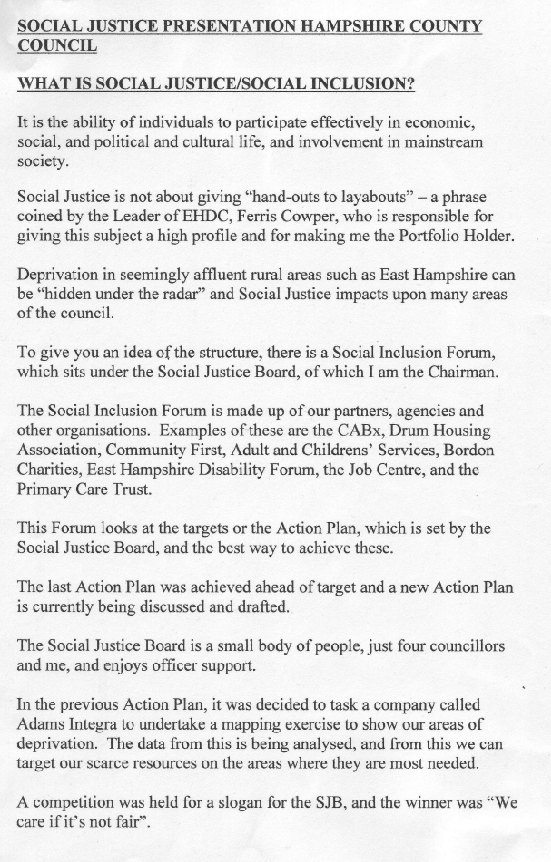
Appendix Two: Presentation to the Panel of Marketing Model used in R&H
Appendix Three: Library Service key facts
Library & Information Service key facts
Key Messages
1. Book issues in a number of our libraries, including Winchester Discovery Centre, and visits have dramatically risen across Hampshire this year
2. Our libraries are tailored to meet the needs of the local community, according to what they have asked for - not a one size fits all approach. The future of our libraries lie in the hands of their local communities
3. We are listening to our residents and providing a facility that people want to use - whether it be to borrow a book, use a computer or take part in an activity - Hampshire libraries are moving forward with evolving trends and needs
4. Books are still at the heart of our libraries and Discovery Centres. This year (2008/9) we have invested £350,000 on top of the £2.2million we already invest in library stock. Our book stock has even been rated as excellent by a survey commissioned by the Department of Culture, Media and Sport
5. The latest independent survey of our users showed that over 93% of Hampshire library users said their local library was either very good or good and Hampshire has been in the top quartile of County Councils for satisfaction of all residents with the library service since 2000
6. A place to stimulate the senses, to inspire creativity - more books, more music, more films, more for everyone - Hampshire people are getting more out of their libraries than ever before
Key data
· With 51 libraries, two Discovery Centres, 19 mobile libraries and 2 local studies centres, residents in Hampshire are able to get their hands on a wealth of free information
· No library closures, unlike other authorities e.g. Devon has closed 6 libraries and Lancashire 8 libraries in the last 2 years. 86% of Hampshire households live within 2 miles of a library building and many others have access to a range of mobile library services
· 5 Hampshire libraries are now open on a Sunday
· Total number of opening hours for branch libraries has increased by 13% over the last 5 years - and additional 218 hours per week. (1,688.5 per week in 2003/4 to 1,906.5 per week at year end 2007/8 )
· Visits to Hampshire's libraries have increased more than 5.34% in the first half of 2008/09 to 3.13 million. If this trend continues for the whole of 2008/09 library visits will increase on the 6.7 million visits to our libraries in 2007/08, bucking national trends
· 613 computers are available throughout Hampshire libraries, completely free to use and extremely popular. In 2007/08 they were in use for over 960,000 sessions.
· In the last 2 years an additional 33 public network computers have been made available and since 2002/3 the number of Peoples' Network computers has more than doubled through additional investment and increased provision in the Discovery Centres and larger libraries
· Just a taste of what you can find in your local library: computer lessons for the visually impaired, silver surfer IT classes, writing workshops, language classes, activity and craft classes such as drumming workshops, puppet making and knitter-natter clubs, baby rhyme time, advice surgeries, family history clinics, vocational qualification classes and lots of reading related activities including story time, reading clubs, poetry groups and author talks
Driving down costs and achieving efficiency
· We aim to provide a high quality service at a low cost to the residents of Hampshire with a good quality of book stock and to achieve the most efficient use of the library stock
· The cost per library visit for Hampshire has remained consistent over the last 3 years (average £2.55) and less than the average of our peer group. As the number of library visits continue to increase the cost per visit will be reduced. Discovery Centres combine services under one roof and help to reduce the overall costs of cultural provision in a local community
What do we spend on books?
· Hampshire does spend a smaller amount per 1000 population on books than most other counties but the total amount we spend on books is still high (£1,290,406 in 2007/08, an increase of 8.1% over the previous year), coming in the top third of English County expenditure on books
· Book spend last year (2007/8) was 12.1% higher than 5 years ago and total materials spend 9.6% higher than 2003/4. The total number of new book acquisitions in 2007/8 was 1.3% higher than the previous year
· In addition to nearly £1.3 million spend on books in 2007/8, an additional spend provides books for the School Library Service taking the total spend on books in 2007/8 to just over £1.6 million
· The predicted spend on books in 2008/9 (including the School Library Service) is anticipated to approach £2 million. The proportion of the total Materials Fund spent on books fluctuates year on year, but a total fund of £2.9 million for 2008/9, includes inflation and £350,000 growth - most of that growth will be for books rather than other media
· Over the last 4 years Hampshire's cost per book has remained one of the 5 lowest for English Counties as efficient procurement contracts enable us to get the best price for new stock. In 2007/8 our average cost per book increased slightly to £6.08 but is still the fifth lowest of all counties
How well used is our stock?
· Hampshire had the third highest book issues of any English county authority in 2007/08 and the fourth highest children's book issues in both years
· In the first half of the current year issues have begun to increase (0.44%), most notably in Winchester, Andover and Stubbington - all libraries which were refurbished during 2007/8 (after a drop of 5.5% in 2007/8)
· Hampshire has the fourth largest total book stock and fourth largest lending stock of English counties (but smaller than our peer group of Essex, Kent and Lancashire).
Quality and satisfaction
· The 2007 Stock Quality Health Check, funded by the Audit Commission, DCMS and the Arts Council, gave Hampshire's book stock an excellent rating, based on the range of titles, format, quality and quantity
· In the 2007 customer survey 92% of customers who came into the library intending to borrow a book actually found one to borrow. In 2006 the result was 90.4%
Future of Libraries - Innovation & investment
· As part of the successful £1.2 million Big Lottery Fund bid - the Community Libraries Project - the libraries involved (Aldershot, Waterlooville, Havant, Leigh Park, Haying Island) will be upgraded, starting in 2009, to improve community learning facilities in these areas
· The existing library management system, Galaxy, is being replaced with a new system, Spydus. All libraries will be using Spydus by the end of November 2008. We are also working on the business case for introducing new technology (RFID) which will allow customers to self-issue and self-return items - this will change working practices and revolutionise stock management
· In Hampshire Libraries and Discovery Centres have a fresh and inviting brand image helping to project the image of a modern service and widen the appeal to both young and old. The Discovery Centre brand has seen a quick return by delivering a huge increase in visits at both sites immediately after reopening
· Hampshire Library and Information Service is continuing to expand its mailing list database of over 115,000 customers. More than 30,000 subscribers have now signed up to receive email marketing. This is put to use to great effect when promoting either the core product or special events held at libraries and Discovery Centres
· Two new high tech mobile vehicles are part of an upgrade programme to ensure people who cannot visit their local library have access to a comprehensive, higher quality and easily accessible service. This includes around 3,000 books, audio cassettes, a selection of DVDs and CDs and internet access.
Discovery Centres
· Cultural Pathfinder - In 2005-7 Hampshire's Discovery Centre model of provision was part of a 2 year national Cultural Pathfinder programme led by the DCMS, focussing on the impact of access to a range of cultural activities on people and communities. The report said:
"Discovery Centres are a model for an improved, more effective and more efficient way of delivering services by co-locating them in one building. The Cultural Pathfinder has helped to successfully showcase a more joined-up approach to service delivery rather than just raising the profile of culture"
Winchester Discovery Centre
Key facts about Winchester Discovery Centre : -
_ More books, more visits, more issues, more opening hours, more satisfied customers....
_ has attracted nearly 500,000 visitors since opening in November 2007
_ 54% increase in visitors (Dec 07 - Oct 08 vs Dec 04 - Oct 05)
_ book borrowing has increased by a huge 22% (Sept 08 vs Sept 05)
_ 8,400 new library members since opening
_ 39,000 new items of stock so far and in total over 100,000 items in stock, 28 public computers, two galleries, a performance and a café bar, quite room for reading. Stock levels have not just been maintained but surpassed
_ There has been a 5% increase in visit numbers to the Winchester DC and a 12% increase in issues in the second quarter 2008/9, compared to the first quarter 2008/9
Gosport Discovery Centre
Key facts about Gosport Discovery Centre : -
_ More visits, more activities, more computers, more satisfied customers, awards and national recognition...
_ Visits in the year after opening as a Discovery Centre (2005/06) were 49% higher than in 2003/04, and visits continue to increase with a 3% increase in 2007/08
_ The profile of the visitors to Gosport Discovery Centre now more closely matches the profile of the local community
_ Satisfaction with the new Discovery Centre increased by 13% after one year open and in 2007 satisfaction of users was 91.4%
_ There are many more younger and middle-aged people now using the Gosport Discovery Centre
_ Since it opened Gosport Discovery Centre has received national acclaim from the Government Department of Culture Media and Sport, who watched as the centre was developed and drew in more visitors.
_ In 2005 Gosport DC won two awards from the Public Library Buildings Award for interior design and accessibility. More recently it was recognised at the 2007 Gosport Business Awards as being one of the Best Leisure and Tourism Venues in Gosport.
Virtual Use
· People are increasingly accessing library services in different ways from their home, office or while travelling and using our growing range of online services that are available 24/7. Our online services help to provide better access to stock for people across Hampshire and beyond, especially for information and reference resources.
· We are actively exploring the potential of new technology such as e-books. With the recent introduction of the e-audio book to the market, Hampshire has embraced this new concept and is currently purchasing devices to trial in two of its leading libraries and get customer views to see if this is something we should invest in.
· Reservations made via the web has nearly doubled in 2007/08 and now accounts for nearly half of all reservations
· Renewals over the web increased by 42% between 2006/07 and 2007/08 and now more than 20% of all renewals take place over the web
· Use of online resources, such as Encyclopaedia Britannica and Which, has trebled in the last 12 months. Usage figures have increased by 227% between 2006/07 and 2007/08 (based on number of times subscription based e-resource content is accessed)
A wider role and a place in the local community
· Home to two flagship Discovery Centres in Gosport and Winchester, we have also invested in refurbishing our libraries to become modern places that people actually want to visit. In a 2007 survey 81.6% of customers were happy with the attractiveness of the inside of their library. There have been 25 new build and refurbishments over the last 5 years and a further ten libraries have planned further improvements over the next 3 years
· Over the last five years, £2.7 million has been invested in three new developments at Alton, Whitchurch and a significant extension to Romsey library, £2.12 million invested in library refurbishments and £9.5 million in Discovery Centre developments. A further £1.3 million has been invested to make physical access improvements at a number of sites, including lifts, parking, ramps and toilet facilities. This investment has improved the quality of our libraries, provided better access, attracted more people and increased visit numbers and satisfaction
· Hampshire also has the highest number of mobile libraries taking services out to communities through 2 high tech multi-purpose mobiles, 9 Rural Library Links, 4 Community Library Link visiting care homes, 3 Home Library Link and 1 Family Library Link
· Hampshire has the most VIP reading groups (14) and the most IT training for VIPs (classes held at 4 libraries) in the south east (which includes Oxfordshire and Bucks). No other authority in the south east other than Portsmouth is doing as much for visually impaired customers
· Events held at libraries are well supported and in demand. Since June 2007 there have been more than 1400 baby rhyme time sessions and 948 Reading Group sessions.
· Hampshire has supported the National Year of Reading with activities such as the Hampshire Big Read which included leaving copies of the Big Read book (Private Peaceful by Michael Morpurgo) on trains and buses for the public to read and return to libraries. Other NYR activities included Walk and Words poetry competitions, in conjunction with the Countryside Service and a six word story competition.
Case study evidence - a wider role in local communities
Full case studies are available on the following:
_ IT4VIPs - IT training for visually impaired people
_ Local Help Point at Andover Library
_ Books on Prescription
_ All Together Now - celebrating diversity
_ Thorney Hill Travellers - access to libraries and reading
_ Gosport Discovery Centre - benefiting the whole community
_ Winchester Discovery Centre activity programme
Children & young people
· In October 2008 97% of Hampshire schools are signed up to the School Library Service making it one of the highest subscribed in the country
· 86% of those aged under 16 using our libraries rate them as very good or good Children's Public Library User Survey (October 2007)
· The 12th Wessex Children's Book Festival takes place in November 2008. Since the first festival over 100,000 children have met almost 200 authors
Summer Reading Challenge
_ 21,893 children started the 2008 Summer Reading Challenge (Team Read) - an increase of 4.6% over 2007
_ 14,565 children completed the challenge, a completion rate of 66.5% and an increase of 6.4% over the previous year
_ Over 23% of 4 - 11 year olds in Hampshire took part (according to the County Primary Inspector, this is a very high rate of participation)
_ Fareham and Gosport area had a 29% increase in the number of children taking part
_ In 2007 the average completion rate for south east libraries was 53.8% and Hampshire's completion rate was 65.3%
Key messages to respond to the specific issues
The above information and following specific responses are key messages to counter the following accusations in relation to Hampshire Libraries performance.
1. "Hampshire invested the lowest amount in book stocks per head of population of any English county"
HCC response: Hampshire's investment in book stock is almost but not quite the lowest. Hampshire does spend a smaller amount per 1000 population on books than most other counties but the total amount we spend on books is still high (£1,290,406 in 2007/08, an increase of 8.1% over the previous year), coming in the top third of English County expenditure on books. Books are an essential part of the library service, but of course we have also been spending money on the library transformation programme, to ensure that our libraries are bright welcoming places that people want to visit, and that they move forwards to meet changes in customer requirements (the Discovery Centre programme).
Book spend in the last financial year was 12.1% higher than 5 years ago and total materials spend 9.6% higher than 2003/4. We continually make improvement to achieve better use of the stock through on-line reservations and ordering systems. Our book stock has been rated as excellent by the DCMS
2. "Hampshire libraries have been downgraded from a two star service to a one star service".
HCC response: This is factually incorrect as it refers to the points system (1-4) for Best Value Performance Indicator 220 for meeting the 10 Public Library Service Standards, and is not a `star' award.
In 2001 Hampshire Libraries external inspection judged the service "a `good' 2 star service that is unlikely to improve". In 2007 we achieved four star rating for the CPA Culture block - "performing strongly, well above minimum requirements" with none of the performance indicators below the lower thresholds set by the audit commission. The four stars will be retained in CPA 2008. (CPA - Comprehensive Performance Assessment)
The Public Library Service Standards are widely seen in the library world as not properly reflecting the performance of modern public library services. They are now redundant and have been dropped from the list of performance indicators against which local authorities are assessed by central government and the Audit Commission - 2007/08 is the last year they were required to be reported. The library standards do not capture the outreach and community activities of libraries, use of the People's Computer Network, web based transactions or the increasing use of online reference material. For these reasons Hampshire County Council has not pursued a policy of trying to achieve the national targets (these are not local Hampshire targets), preferring to concentrate on attracting a wider range of people in Hampshire to make use of their local library services. This has included the very successful introduction of Discovery Centres, major refurbishment of many library buildings, new mobile libraries and spending an additional £350,000 in 2008/09 on books and other library resources.
3. "The service failed to meet targets for library opening hours, visits per 1,000 population, number of computers and new book buying".
See comments above on the Public Library Service Standards
HCC response: We never considered library closures as a way of saving money, we are committed to that, and there are no plans to reduce opening hours; indeed we want to increase opening hours wherever we can. In fact, five of our libraries are now open on Sundays. We have reviewed and extended the total number of library opening hours over the past 5 years. The total hours per week our libraries are open for access has increased by 218 hours, an increase of 13% since 2003/4.
Only 8 counties achieved an increase in visits in 2007/8 while 19 experienced a bigger fall in visits than Hampshire. The total number of visits to Hampshire libraries are the fourth highest of English counties.
4. " reduced the professional library staff by a quarter".
HCC response: We have created a new structure that we believe is in line with new service delivery and with customer needs. We consider all our staff to be professional and this is clearly demonstrated in their enthusiasm and dedication, and in our customers satisfaction with our staff and the customer service they experience. In the 2007 PLUS customer survey which took place very soon after the second service restructure 98% of customers expressed satisfaction with our staff.
We value the professional skills of our Librarians and having reduced numbers from an unsustainable high level in Hampshire, professional staff still represent 17% of our workforce. This compares favourably to the English counties average 19.2%. In addition, now more than ever in the past all our staff have the opportunity to develop
and progress and to use their skills in a more flexible way to provide customers with the service they need and expect.
Hampshire's number of staff per 1,000 population remains the seventh highest of county authorities and mid range of our peer group ( Essex no longer make a distinction between professional and non-professional posts)
The number of staff in post (FTE) decreased by 7% between 2006/7 and 2007/8.
The number of professional posts (FTE) was reduced by 21% (one fifth) in the 2007 service restructure (Kent decreased professional posts by 36% in the same period).
Hampshire has been in the top quartile of English counties for the last 4 years for staff in post per thousand population and remained in that quartile after the reduction in staff numbers in 2007. This is partly because many other authorities have also had to reduce their library staff numbers, including Essex and Kent.
5. " experienced the largest decline in book lending (last year?)".
HCC response: Book issues and lending have traditionally been the key driver for customers making repeat (frequent) visits to libraries, but there are so many alternative ways to spend leisure time or ways to access information now. Customers are borrowing less per visit as they find less time to read. Our response has been to provide more reasons to visit a library, to broaden the appeal to all ages and to put the library back at the heart of the local community.
Inevitably book lending may have suffered during a period when a number of our largest libraries were closed for development (including Winchester and Andover) but this year Hampshire's libraries are now seeing borrowing starting to increase across the county. Despite the reduction in issues Hampshire came within the top four English counties in both 2007/08 and 2006/07 for numbers of adult book issues and children's book issues.
6. " people have recognised how under funded this service is becoming".
The above statement is categorically incorrect. A 93% customer satisfaction rating, an increased number of visits and a book stock independently rated as excellent tell a very different story.
For further information please contact:
Kathy Allen |
Helen Wheeler |
Performance Information Officer |
Policy Manager |
01962 826607 |
01962 845444 |
Appendix Four: Presentation `Hard to Reach Groups, a transport perspective'
Appendix Five: Transport and Accessibility Consultation Paper
Transport and Accessibility Consultation Chapter
Aim
To improve the quality of life for rural communities by improving accessibility through collaborative working and innovative solutions.
Objective 1
To improve access for those living in rural communities.
Objective 2
To reduce the impact of transport in rural areas on climate change.
1. How can we best target and meet rural transport issues?
The County Council has long recognised that transport represents an important issue for people living in rural areas of Hampshire. The quality of transport provision has the potential to impact significantly on the quality of life for rural residents. Whilst it is acknowledged that the car will remain the dominant mode of transport in rural areas, this creates problems in terms of the degree of isolation it can create for those without access to a car.
Whilst car ownership is generally high in rural areas of Hampshire, the provision of facilities and services is generally poor - in line with recent trends to concentrate service provision in single centralised locations - generally in the larger towns and cities. At the same time, rural bus networks have contracted in response to increasing bus industry costs and the linked trends of falling passenger numbers and rising car ownership. It is worth stating here that bus services have to be operated by commercial companies in the UK, and - like any commercial enterprise - will only run where a profit can be made. Where services are deemed socially necessary, although not commercial, the Council may subsidise services. However, this is very costly.
Accessibility is about providing people with the services and facilities that they need to enable them to play an active role in society. This can involve access to jobs, healthcare, education, retail centres etc... It is important to note that accessibility planning is not only about getting people to these services and facilities, but is also about delivering these services and facilities locally (e.g. health, post offices, and schools), therefore reducing the need to travel. To this end, the Council actively pursues opportunities to work with service providers to help tackle accessibility issues. |
|
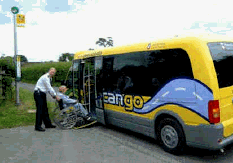
Work undertaken by the Council has consistently shown that accessibility difficulties in rural areas of Hampshire are fragmented with small numbers of people affected. Indeed, there are only very small pockets of Hampshire that are more than 8 miles from a significant service centre. Furthermore, results of surveys conducted in the County show that accessibility issues are indeed very small, and that the vast majority of people are able to obtain transport for the services and facilities that they require. This may either be by car (either as driver or passenger) or by public transport services.
It has also become clear from our work and from experience elsewhere that these issues are generally difficult to target with conventional transport responses and that each accessibility issue is likely to require a specific solution. This calls for an innovative approach to tackle the issues. However, when transport services are introduced to tackle identified access problems, they are not always well patronised - which is further reflective of the limited extent of the issues that Hampshire faces. Despite this, experience is showing increasingly that working with service providers and community groups is essential to the success and thus longevity of resolving transport related issues.
We need to keep our eyes open so as not to miss hidden issues. Whilst modelling may show that a rural community has good levels of access - perhaps due to high car ownership - underlying this there may be specific access issues experienced by individual groups (e.g. the elderly and the young). For example, a household may have a car - but this may be used for travelling to work each day, leaving the rest of the family reliant on non-car modes.
It is important not to overstate rural accessibility issues though. Indeed for many, access is not an issue - particularly those with a car or access to a car. At the same time, we should not underestimate the role of informal car sharing and neighbourliness in rural areas. These practices help reinforce community cohesion.
Current national transport policy is beginning to emphasise a focus on the role that transport can play in the economic growth of the country, whilst ensuring that transport plays an important function in reducing the impact of climate change. National policy is therefore tending to focus on urban areas and access to urban areas, where the impact of transport interventions is likely to result in the greatest benefits for economic growth. Against this policy backdrop it is important that local transport policy pursued by the County Council not only adheres to national policy priorities, but continues to consider and act on the specific transport issues that impact on the quality of life of residents, and the particular difficulties faced by its rural communities.
The Council's transport strategy is set out in the Local Transport Plan (LTP). Objective one of the LTP is to increase accessibility. The objectives are important as they guide policy and any transport interventions must be consistent with these objectives; schemes that do not accord with the objectives will not be pursued. The LTP includes an accessibility strategy which is underpinned by a principle of reduce, manage, invest.
Question 1 Do you think that the accessibility planning approach Hampshire County Council is taking to combat rural accessibility issues is the correct approach? |
Question 2 What are the access issues in rural areas? |
2. What is Hampshire County Council doing now?
Transport is a key consideration across all aspects of service delivery in rural Hampshire. The development and implementation of transport policies and strategy is led by the Environment Department. We provide support to rural communities in the following key ways:
Conventional Public Passenger Transport Bus services in the UK operate in a commercial environment, resulting in services only being provided where a profit can be made. Where commercial operators cannot make a profit, but a service is deemed `socially necessary' it may be supported by the local authority. Hampshire County Council provides support for over 200 such services, filling gaps in the network which do not make a profit. Many of these services are in rural areas. Concessionary travel schemes - coordinated by HCC, but funded by districts, target the elderly and disabled - groups that often find themselves isolated and particularly transport disadvantaged. This provides bus pass holders with free England-wide local bus travel. The Council has set up four local transport forums - with 2 more due in 2008-09 to provide local communities with a voice about their public transport. The County produces travel guides, maps and general public transport information brochures area travel guides delivered door to door in many areas each year. Question 3 Do you think that can we could more effectively reach rural households with the information on travel that we produce by using tools that identify those locations that are likely to not have access to a car and not have good public transport connecting them with services and facilities? This aims to encourage local communities to become more involved in their closest rail stations, gain greater knowledge of services and build working relationships to ensure rail services and stations are sustained and improved in the long term. A separate project has seen grass-roots action result in the designation of community rail status to the line between Brockenhurst and Lymington Pier. | ||||
Demand Responsive Transport and Community Transport Pioneering CANGO demand responsive services - operating in Alton, Andover, Burghclere and New Forest - connect rural residents with service centres. HCC support voluntary organisations who provide a variety of transport services in defined areas and for specific users. Call & Go is a bookable bus service that can take people where they need to go. Anyone whose travel needs are not met by public bus services can use Call & Go. This operates in Hart, Havant and the New Forest. Dial a Ride is a door to door service for anyone who finds it difficult or impossible to use ordinary bus services. This operates in Alton, Andover, Basingstoke, Bishop's Waltham, East Hampshire, Eastleigh, Fareham, Gosport, Romsey, Rushmoor and Winchester. Dial a Bus services operate in East Hampshire. Dial a Bus is like a normal bus service, except that drivers will deviate from the normal route to pick up passengers from outside their home if they have difficulty in walking to a bus stop. Community buses provide timetabled local bus services in rural communities. Community buses operate in Broughton and Mottisfont, the Meon Valley and Whitchurch, providing local bus services that are organised and driven by volunteers. Taxishare is similar to a bus service except a 'taxi' picks up passengers instead of a bus. These services are often put in place when a bus service no longer operates in the area and can be known as either a Taxishare or Carshare. Fares are nearer to those charged on local buses. |
||||
Wheels to Work provides subsidised transport to help individuals access training and employment appointments. Often these schemes are aimed at young people. One example is the moped loan scheme which provides short term loan of a moped to youths in order to access training and job opportunities |
||||
Maintaining the local road network Highways are essential for any area to operate successfully and in rural areas where there is a particular reliance on private transport a good highway network is essential. The Hampshire LAA has recognised the importance of highway condition by introducing both NI168 principal (A class) road condition and (NI169) Non Principal (B and C) roads condition as a priority for improvement in the new agreement running to 2011. Highway maintenance is not just about motorised vehicular use, as use by pedestrians, cyclists and equestrians is just as important. |
||||
Village Speeds The Council has introduced a `Village 30' campaign, with the aim to improve quality of place and safety. Following the introduction of the programme along with accompanying promotion, it is hoped that anyone travelling through a village in Hampshire will expect the speed limit to be 30mph. Villages have been invited to apply for a 30mph speed limit - and where appropriate these will be introduced. |
||||
Pilot Schemes and Studies The accessibility strategy proposed accessibility pilots. Three of these pilots have been progressed in partnership with district councils, community groups and the health sector: o access to Winchester hospital from northern Test Valley o access to services from Whitehill/ Bordon/ Lindford o health care in part of the New Forest, and Case Study 1 - Access to Winchester hospital from northern Test Valley The Andover to Winchester Hospital Accessibility Pilot represents a response to the difficulties that many patients, visitors and staff experience in getting to either Andover or Winchester hospital from many of the villages of Test Valley. The Pilot was included within the Local Transport Plan and an informal Working Group was established with representatives from key stakeholder groups. A draft action plan was produced in April 2007 detailing a variety of actions which could be undertaken by the members of the Steering Group to enhance accessibility to Winchester Hospital. The idea of a shuttle bus had been developed as part of the rural bus pilot looking at brokerage options in Northern Test Valley (see below). It has been introduced with four return trips per day stopping at: Andover War Memorial Hospital; Andover Bus Station; Stockbridge; and Royal Hampshire County Hospital, Winchester. In conjunction with this an information leaflet was produced, which highlights the full range of travel options available for people travelling to Winchester Hospital from northern Test Valley.
|
||||
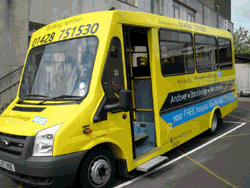
Question 4 From the summary of interventions above, do you consider that the Council is targeting sufficient time and resources to the scale of the issues, remembering that the majority of the population live in urban areas? |
3. What can we do in the future?
There is a lot of good work being done already to improve transport and accessibility in rural areas of the County. As we move forward a key short term challenge will be to let rural communities know what is available to them and how their quality of life can be improved. This challenge is being addressed through the pilot schemes, the results of which will - in the medium-term - inform transport policy and provide opportunities for wider usage where need and funding exist.
The new Local Area Agreement (LAA) (2008-2011) will see the County Council monitored against the following indicators relevant to transport:
NI47 People killed or seriously injured in road traffic accidents
NI48 Children killed or seriously injured in road traffic accidents
NI167 Congestion - average journey time per mile during the morning peak
NI168 Principal roads where maintenance should be considered
NI169 Non-principal classified roads where maintenance should be considered
NI175 Access to services and facilities by public transport, walking and cycling
NI176 Working age people with access to employment by public transport (and other specified modes)
NI177 Local bus and light rail passenger journeys originating in the authority area
NI178 Bus services running on time
NI198 Children travelling to school - mode of transport usually used
In addition to these indicators the LAA partners have chosen to develop three local indicators - one on accessibility, one on congestion and one on village speeds. The accessibility and village speeds indicators, in particular, have the potential to improve the quality of life in rural areas. For the accessibility indicator, the County Council is working with partners to develop schemes across the county aimed at improving locally highlighted access issues. For village speeds the council will be monitoring the speed of vehicles in villages following the introduction of the `Village 30' campaign.
4. New initiatives
Recognising the challenges that the authority faces in improving access in the more rural areas of Hampshire and that a `one size fits all' approach will not be the answer in the future, a number of rural transport pilots are being developed. Five very different approaches are being trialled through these pilots in order to understand which approaches may best be applied across a wider area in the future. These pilots include:
o a brokerage scheme in Test Valley, whereby HCC act as a transport information provider;
o an audit of Public Transport services available and which services are available direct to the public (e.g. Tesco home shopping / mobile library etc...) in Winchester;
o better use of existing infrastructure in East Hampshire (e.g. can a school bus / minibus be better utilised?);
o plugging gaps in existing service provision in the New Forest, and
o Wheels to Work
Case Study 2 - Car-Free Tourism in Lyndhurst (New Forest)
Source: http://www.newforestnpa.gov.uk/travel_information This pilot seeks to address travel barriers and reduce congestion for weekend visitors to Lyndhurst who wish to travel by rail. Partnership working between the County, New Forest District Council, the National Park Authority, South West Trains, Local businesses, taxi operators and Wilts & Dorset Bus Company, has seen the launch of a scheme for summer weekends that offers free travel for rail ticket holders: o on special shuttle buses on Sundays o by showing their rail ticket on local service buses on Saturdays and o providing taxi discount vouchers with hotel bookings for Friday nights |
A review of community transport and demand responsive services in Hampshire is underway that will consider and undertake an audit of the existing Hampshire approach (in terms of policy, operations, resources and delivery) and conduct a brief regional and national comparison of Community Transport provision in other similar Local Authorities, comparing these with the approach in Hampshire.
This review will enable the Council to consider other possible options for enabling the delivery of community transport and demand responsive services in the future.
The review will result in a comprehensive report, which evaluates the current Hampshire approach, highlight good practice and alternative methods of delivery and identifies a range of possible options for the future delivery of the community transport service. The Council is particularly keen to continue to develop an innovative approach in order to ensure that Hampshire remains at the forefront in this area of delivery.
Appendix Four: Set of possible questions
Set of possible questions for Review Panel and Select Committee to ask invited witnesses
Communication/Engagement
- What opportunities might exist for partner organisations to cross `sell/promote' services of other providers, particularly to those who are `hard to reach'?
- Is it possible, without `customer insight' ie. good customer information, to connect with people for whom there are barriers to accessing services, or people who are reluctant to access services?
- Do you think partnership/collaborative working provides greater opportunity to `sell/promote' the use of a wider range of services to Hard to Reach people?
Unable to access services/barriers to
- Are you aware of people who face barriers when they want to access services provided by HCC or other agencies, if so, what are some of those barriers?
- What do you think that HCC or other service providers could do to overcome barriers to accessing services?
- What approaches are you aware of for discovering `hard to reach' people, particularly in rural areas?
- What kinds of barriers to access are recognised by HCC and partners? And what approaches are (or could be) used to overcome them?
Reluctant/unwilling to access services
- What do you think that we should be doing to encourage people who are currently reluctant, to consider accessing services that may help them?
- If trust in councils or other government bodies is an issue for some people who might otherwise access services, what approaches are needed to overcome such barriers?
- What negative associations might people have with service providing organisations that could be addressed?
Partnership issues
- What approaches can / does HCC and partners take to reach `hard to reach' people?
- What advantages do you see to effective partnership working?
- What do you see as the strengths of partnership working, and what are its weaknesses?
- What examples can you give of successful partnership working, or of lessons learnt where partnership working was less successful than hoped for?
- Is partnership working likely to be successful in improving access to services across partner organisations if it is no one person's responsibility to coordinate and drive solutions?
- Do you think that HCC is best placed as an organisation to locate the `hidden' people who are hard to reach, for example, older frail people in rural areas or people in areas of deprivation? If not which organisations might be?
- What do you think are the best things that a:
o county council,
o district council,
o fire or police services, or
o 3rd sector service providers
...can bring to partnership working?
Assessment and performance
- Given that the language of the new local performance framework talks about:
o Alignment around shared goals
o Alignment of resources
o Effective innovation, and
o Engagement of local people
In what ways do believe that HCC and its partners can fulfil these expectations for the benefit of `hard to reach' residents of Hampshire?
- If a chain is as strong as its weakest link, what are the best ways to ensure that individual partners each play their part in ensuring that the `hard to reach' are given every opportunity to access services from which they might benefit?
- What dis-incentives might exist for service providers to ensure that `hard to reach' people are encouraged to use their services?
- What measures or measurable outcomes might be appropriate to evidence success in reaching `hard to reach' people?
Information and data issues
- What value do you see in the development of an observatory and what products would you want to see from it?
- What value would you see in the consolidation of results of all engagement work and initiatives to reach `hard to reach' across the whole county?
- What value would you see in the management of the above, including being able to access information about engagement etc. being made available to the Hampshire Senate or individual service provider organisations?
Customer/ratepayer perspective
- If `hard to reach' represents the gap between people who might benefit from using services, and those who provide them, then in what ways do you think that HCC or/and its partners in service provision, can be hard to reach?
- How many residents are sure about which service might be the most appropriate to meet their needs?
- Is there a full list of all available services (with access criteria), whether provided by a Government Office, County, District, or 3rd sector providers?
- Under what circumstances might some people view HN, other council or NHS publications as `junk mail'? (junk mail has been defined in some places "as items of unsolicited mail such as unsolicited special offers brochures, catalogues and questionnaires" )
Key considerations
Aims
- To identify instances of good practice
- To identify barriers to access and scope to address them where possible
- To identify additional opportunities for possible partnership working to improve effectiveness in `selling' access to services, or improving equitable access for all residents
- To identify opportunities to make practical recommendations, such as, to provide an easily accessible central resource about customer / local area information, or, say, to provide project coordination resources to manage partnership initiatives or pilots to deliver shared outcomes.
Relevant management and audit regimes
A close relationship exists between the targets and priorities that organisations are expected to achieve or deliver on, and the assessment regimes that monitor the success of organisations that are responsible for delivery. Ensuring that people have equitable access to services is a key aspiration for the County Council and its partner service providers. Auditors, inspectors and Hampshire residents all monitor and evaluate success, at least in part, on the basis of how well the minority who experience or perceive barriers to access are served.
Management: core business
· National indicators set by DCLG through the Government Office of the South East (GOSE) - partnership working:
· 196 National Indicators for Local Authorities and Local Authority Partnerships:
· Annex 1: Stronger and Safer Communities
· Annex 2: Children and Young People
· Annex 3: Adult Health & Wellbeing and Tackling Exclusions &
Promoting Equality
· Annex 4: Local Economy and Environmental Sustainability
· Hampshire LAA 2008-2011 Priorities and targets: 33 of the 196 selected and negotiated targets with GOSE to form the priorities of the Hampshire LAA 2008 - 2011, plus 16 mandatory DfES indicators
· Remaining 147 indicators subject to inspection, but with no associated targets
· Corporate Improvement Plan (Hampshire County Council):
(includes and emphasis on reducing inequalities - very close links with access to services)
Audit and inspection
· Comprehensive Performance Assessment (CPA) - phasing out 31/3/09
· Comprehensive Area Assessment (CAA), as per `Prospects for Hampshire' trial - phasing in 1/4/09