
Archived decisions
HAMPSHIRE COUNTY COUNCIL
Decision Report
Decision Maker |
Executive Member - Policy and Resources | ||||
Date of Decision |
29 January 2009 | ||||
Decision Title |
Governance of the Hampshire Public Services Network | ||||
Decision Reference |
359 | ||||
Report From |
County Treasurer | ||||
Contact name: |
Jos Creese | ||||
Tel: |
01962 847436 |
Email: |
|||
EXECUTIVE SUMMARY
An earlier paper to the Executive Member Policy and Resources dated 6 March 2008 gained approval to spend up to £75M (subject to the outcome of tendering and on approval of supplier) over 10 years to replace the County Council's wide area network, Hampshire Public Service Network (HPSN). The paper indicated an intention to procure and subsequently manage the contract with the supplier in partnership with other members of the Hampshire and Isle of Wight Partnership. A joint procurement involving Hampshire and Isle of Wight local authorities and Hampshire Fire and Rescue Service will reach its conclusion in March 2009. This will deliver a contract for a range of telecommunications services, and will be the subject of a separate report at that time.
Much of the value both in terms of improved service delivery and cost minimisation will be achieved through sharing the infrastructure with partners. The purpose of this report is to set out the proposed management arrangements for the HPSN2 shared infrastructure and seek approval for the proposed decision making mechanisms to support these management arrangements.
Various options have been considered for the form of contract used to procure the HPSN2 telecommunications services. The option recommended in this report is a framework contract let by the County Council and directly accessible by partner organisations and agreed by Legal Services who have been involved throughout.
Hampshire County Council is acting as lead partner for the procurement of HPSN2 and will continue to be the lead partner for the contract. The County Council will appoint a Project Director as the responsible officer, reporting to a joint HPSN2 Management Project Board. In addition, the County Council will procure the shared infrastructure and recover a portion of the cost from partners.
The experience of the current HPSN is that decisions concerning this shared infrastructure can usually be made by consensus through negotiation. In the unlikely event that this is unsuccessful, decisions will be made by weighted voting based on the level of financial commitment to the HPSN2 with the caveat that any proposal can be rejected if 75% or more Partners vote against it.
1) Summary of Decision Area:
1.1. HPSN2 Governance. Many of the financial and efficiency benefits of the HPSN2 will come from sharing a common infrastructure. The proposed governance arrangements mean that a proposal tabled by the County Council could be rejected if 75% of the Partners (currently 12 out of 16) voted against it.
1.2. Hampshire County Council's role as lead partner. The County Council will be responsible for ordering and paying the HPSN2 Contractor for shared infrastructure and recovering a portion of this cost from participating partners. For all other services Partners will have a direct contractual relationship with the Contractor and the County Council will have no obligations regarding these arrangements.
2) Issues Covered in Report:
2.1. HPSN2 Governance. There is a risk that a proposal that works in the best interest of the County Council may be rejected by 75% or more of the Partners represented on the HPSN2 Management Project Board. In the unlikely event of this happening the County Council would have the option to ask for a review of the decision through mediation (the mediation process is defined in the HIOW Information Management and Technology Partnership Agreement under which the HPSN2 is being procured and delivered). Given the nature of the services and past experience of joint working, disputes are viewed as unlikely. Possible areas of dispute are the timing of service down time for upgrade or repair and how the cost of service upgrades might be apportioned.
Sound financial management and planning will mitigate these risks. It is also proposed to establish technical and service management groups empowered to make decisions by consensus which will reduce the likelihood of needing to have a formal vote. Only where a group fails to reach agreement would issues be referred to the HPSN2 Management Project Board.
2.2. Hampshire County Council's role as lead partner. There is a risk that a number of partners withdraw from the Contract. This would leave the County Council with the role of managing a shared infrastructure with reduced benefit. There is also a risk that agreement cannot be reached on the cost of supplying and managing the shared infrastructure.
The commercial risk arising from partners withdrawing is mitigated by the requirement on the Contractor to continue to deliver value for money (this is provisioned in the Contract through benchmarking). It is unlikely that the commercial risk will exceed £50,0001.
3) Recommendations:
It is recommended that:
3.1. Executive Member approves the form of contract and approach to decision making for the HPSN2 contract.
3.2. Executive Member agrees to the County Council acting as lead authority for the HPSN2.
MAIN REPORT
1) Contextual Information:
1.1. The current HPSN contract with Unisys delivers the data and voice network to support Hantsnet and telephone services. This contract ends in November 2009. The contract has successfully delivered its original objectives and supports the joint requirements of the HIOW partnership and the local needs of partners.
1.2. There have been many lessons learned concerning the governance, the financial model and the operation of the contract which limited what could be achieved under the current arrangements. There was strong commitment amongst the HIOW Partnership IT Managers to work together on the procurement of the HPSN2.
1.3. The continued commitment of Partners is evident from the financial contributions from all Partners to the procurement costs and the officer time from many of the Partners. A joint procurement group (HPSN2 Procurement Board) have considered a number of approaches to the structure and management of the new HPSN2 contract. The principles established were:
· All Partners would have a direct commercial and operational relationship with the Contractor;
· There would need to be a lead authority but this role should be kept to a minimum;
· There should be an equitable decision making process.
1.4 As a consequence it was agreed that the County Council would manage a procurement for a framework contract on behalf of the partnership. The County Council has been asked to act as lead authority and as such would sign the framework contract on behalf of the partnership.
1.5 The contract for the schools' HPSN network (known as SWAN) currently delivered by Synetrix is also due for renewal in 2010 and is included as part of the HPSN2 requirement. This along with the schools' requirements for our Partners would be over 50% of the network requirements. Schools requirements have been captured as part of the procurement process.
2) Key Issues:
2.1. Executive Member approval is required to agree the governance arrangements because they affect the County Council's freedom to act independently. The Contract will not be exclusive, so the County Council and its partners are not bound to buy services through the contract if they do not choose to do so. The governance arrangements also allow for a group of partners to specify and fund the introduction of new services with others choosing not to participate.
2.2. During the course of the Contract, possible conflicts of interest may occur on the timing of service down time for upgrade or repair and how the cost of service upgrades might be apportioned. However, no significant risks have been identified that cannot be mitigated by sound planning and financial management.
2.3. Executive Member approval is also required for the County Council to act as lead authority as it introduces an element of financial risk.
3) Governance Arrangements:
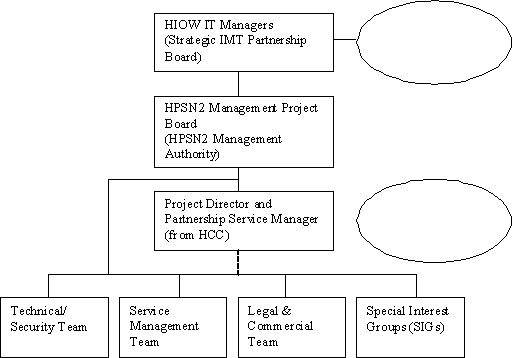
3.1. Governance arrangements have been developed and agreed by the HPSN2 Procurement Board and endorsed by Hampshire County Council legal services. These governance arrangements, which will be in place for the duration of the Contract, are shown in the diagram below:
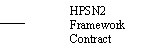
IMT Partnership Agreement
3.2. The HPSN2 Management groups are:
· HPSN2 Management Project Board - This will have a representative from every Partner that has placed orders with the Contractor through the Framework Contract. This Project Board has the final decision concerning any issues. The intention is to reach decisions by consensus but where this is not possible paragraph 4 describes the provisions to resolve this.
· Partnership Management Team - The Project Board will approve the appointment of a Project Director who will work for the Lead Authority. The Project Director will be responsible to the Project Board for the management of the Contract. The Project Director will be assisted by a Partnership Service Manager who will be responsible for working with the Contractor on service management matters that involve more than one Partner.
· Technical/Security Team - This will consist of representatives from the Partnership who will work with the Contractor to develop new services and agree changes to services. This team may make decisions on matters delegated by the Project Board and may only make them by unanimous agreement.
· Service Management Team - This team will consist of the Partners service managers who are responsible for the management of services procured through the Contract. They will work together to develop common service management initiatives and work with the Partnership Service Manager to resolve any common issues with the Contractor. This team may make decisions on matters delegated by the Project Board and may only make them by unanimous agreement.
· Legal and Commercial Team - This team (headed by County Council Legal Services) will be responsible for proposing changes and reviewing changes proposed by the Contractor to the Contract Terms and Conditions. This team may make decisions on matters delegated by the Project Board and may only make them by unanimous agreement.
· Special Interest Group (SIG)s -SIGs will be set up where there are areas of common business interest across more than one Partner. For example, there may be a "School's and Education Sector" Group. SIGs provide a way of directly representing their common interest to the Board as a single voice.
3.3. The need for a School's and Education Sector SIG has already been recognised. Schools are independent contracting organisations and are not bound to buy through the Local Education Authority (LEA) contracts. Each LEA will agree with schools bodies how their group views are represented. In addition to the SIG, it has been agreed that there will be a nominated schools representative(s) on each of the Groups and the Board.
3.4. The Project Director is a role defined in the Partnership Agreement. This person will work for Hampshire County Council as the lead authority, but be approved by the Project Board.
3.5. As the Hampshire Senate develops, services may be commissioned through the HPSN2 contract that are funded solely by Senate members. The proposed decision making arrangements allows for this and non Senate members would not have a say in making decisions regarding these services.
3.6. Outside of the Partnership governance arrangements, a County Council Board (chaired by the Head of IT) will oversee the County's interests and these will be represented on the HPSN2 Management Partnership Board by a member of ITMT.
4) Proposed Approach to Decision Making and Dispute Resolution:
4.1. Negotiation
The HPSN2 Management Project Board will be the management authority for HPSN2. This Board will delegate responsibilities to groups and individuals described in Paragraph 3. In the unlikely event that these groups have issues which they can't resolve by consensus then they will be referred to the Board. The Chair of the Board (the Chair appointed by the HIOW Strategic IMT Partnership Board) assisted by the Project Director will make further attempts to resolve the issue.
4.2. Voting
If it is not possible to reach a consensus then the following process will be followed:
a) The Chair will invite proposals in writing which include a recommendation that can be voted on.
b) The Chair will recommend how these proposals need to be discussed either by correspondence (e-mail) with a set decision day; at the next Board Meeting or in extreme circumstances calling an urgent Board Meeting. Any Partner may demand an urgent Board Meeting.
c) Every Partner must declare their level of interest in the dispute. Any Partner who declares no interest either in writing or by not making a declaration 24hrs before the decision day will be obliged to abstain from any voting.
d) After discussions Partners will be required to vote. Voting will be based on the Partner's level of financial commitment to the Project. This will be the value of services and committed orders for the 12 month period leading up to the vote based on 100% of recurring costs and 10% of any one off charges. A proposal will be defeated if 75% of Partners vote against it, regardless of weighted voting. A quorum of at least 50% of members is needed for the vote to be valid.
4.3. Mediation/Arbitration
If a Partner does not accept the decision of the Board then clause 16 - Dispute Resolution - of the Partnership Agreement will apply.
4.4. Option to withdraw from the Contract
If a Partner is dissatisfied with the Board decision or the outcome of the mediation they have the option to withdraw from the contract. This will involve the termination of services with the Supplier and withdrawing from agreements on shared service costs and responsibilities with the remaining Partners.
Every Partner will have placed orders for services with the Supplier. These orders form a contract which sets the terms for termination of the service and the SLAs. This contract will need to be fulfilled by both parties unless an alternative is negotiated and agreed.
Some services will require all Partners to make a contribution to the cost of the shared component of a service. This contribution will cease when their contract with the Supplier ceases. The Project Director will need to recalculate the remaining Partners' contributions based on an agreed financial model.
5) Outline of Contracting Options:
Governance and financial risk are directly related to the form of contract used to procure the telecommunications services that the County Council requires to meet its own needs and to support partnership working and shared services. The emergence of shared business services reinforces the value that the County Council and its Partners will derive from a shared telecommunications service. Several contracting options have been considered
5.1. Option 1:
Continuing with the current HPSN approach with Hampshire County Council letting a contract and acting as a supplier of services to partners.
5.2. Option 2:
Letting a contract (or contracts) solely for the purpose of Hampshire County Council.
5.3. Option 3:
Hampshire County Council to take on the role of a telecommunications service provider delivering the needs of the County Council and selling services to other organisations.
5.4. Option 4:
Setting up a Joint Venture Company (JVC) or Special Purpose Vehicle (SPV) with partners as shareholders to procure and manage telecommunications services.
5.5. Option 5:
Await the outcome of the Cabinet Office's Public Sector Network Programme and consider using this.
5.6. Option 6:
A framework contract let by the County Council and directly accessible by Partners - the approach that is being recommended.
6) Option Analysis / Comparison:
6.1. The ability to be able to access information when and where it is needed and to be able to communicate with colleagues no matter where they are is fundamental to partnership working and flexible working. An effective data and telephone service is needed to support this. The recommended approach and the six options outlined above can all potentially deliver this. The challenge was to find the approach that will achieve widespread support from Partners and deliver the greatest value for money for the County Council at the lowest possible risk.
6.2. The current contractual arrangements (Option 1) were set in place in 1999, following discussions with Hampshire Districts and Unitary Authorities. Significant success was achieved but the contractual and commercial arrangements have presented a barrier to greater commitment from larger partners. There were also costs and service management obligations that added no value and introduced delays. A new approach was considered necessary, and discussions with partners indicated that there would be resistance to entering into an agreement where the County Council operated as the `supplier'.
6.3. The County Council could consider letting a contract without other organisations (Option 2). This would lose current and potential future economies of scale, but more importantly would reduce the scope for shared IT infrastructure. This is evident from the use of the school's HPSN network (known as SWAN) by Hampshire Fire and Rescue Service which delivered an efficient solution for the Fire Service and reduced the price paid by Children's Services.
6.4. Consideration has been given to delivering the HPSN2 internally (Option 3) which would in practice put the County Council in the position of a telecommunications provider. This will be re-assessed when the recommendation on award of contract and commitment to spend is presented in April 2009. However, it is not currently favoured both because of disfavour from Partners and also because
from the County Council's perspective it is likely to increase the costs and risks over an output based service management contract. The County Council will never be able to achieve the same discounts by buying directly, or the same cost base in terms of employing and retaining sufficient support engineers.
6.5. Discussions within the County Council and with Partners included the option to set up a company to let and manage contracts for telecommunication services (Option 4). This approach would have had the same governance issues as Option 6 (the recommended option) but could open up greater investment opportunities from contractors and the capability to become a supplier to organisations outside the initial partnership. However, given the scope of services being procured and the number of partners involved there would be considerable risks and difficulties in achieving this at this stage. Option 6 does not preclude considering this in the future, following award of contract.
6.6. The County Council is working closely with the National Government Public Sector Network (PSN) programme led by the Cabinet Office (Option 5). This is looking to deliver outcomes similar to the HPSN2, but nationally. Waiting for and using the PSN has been discounted as it will not be in place in time to replace the current contract or to give sufficient confidence that a case for extending this contract could be made. However, HPSN2 will comply with PSN standards and may become the PSN service for HIOW. Hampshire County Council is acting in an advisory capacity to the PSN.
6.7. Option 6 (the recommended option), agreed by the Partners and endorsed by Legal Services, is the approach most likely to deliver a sound basis for partnership working with little financial or operational risk to the County Council. The additional costs of a partnership procurement have already been offset by financial contributions and officer time from all the partners. The framework contract approach will mean that as far as possible Partners will have direct contractual arrangements with the Contractor. The County Council will be responsible for any shared infrastructure costs, a portion of which will be recovered from Partners. On the basis of current costs, the extra cost introduced by Partners being connected to the network is likely to be in the order of £50,000 per year.
7) Conclusions:
7.1. An underlying assumption in this report is that a modern, high performance telecommunications service is essential for partnership working and flexible working. The recommended approach has the benefit of reducing the cost of meeting the County Council's and our partners' needs and providing the telecommunications infrastructure that will be needed to support shared services. While there are risks, the proposed approach restricts them to operational and low risk commercial issues and provides the means to manage and resolve them.
7.2. In any partnership there will at times be differences of opinion that need to be resolved. The nature of the telecommunications services and the past evidence of working together in this area strongly suggest that most, if not all potential issues can be forestalled through sound planning and financial management. Supporting this are the specialist groups that can discuss and review any issues with a high probability that they will reach an informed consensus without the need for referral of issues to the Project Board. It is difficult to foresee circumstances where a formal vote would become necessary and would probably signal the failure of the arrangements.
7.3. The recommended approach does limit the County Council's ability to act independently but it is difficult to envisage a situation where this would have any real impact. Similarly the commercial risk of partners failing to meet financial commitments is small and for many partners is likely to be in the order of hundreds of pounds at most.
8) Recommendations:
Please see Executive Summary for recommendations.
CORPORATE OR LEGAL INFORMATION:
LINKS TO THE CORPORATE STRATEGY | ||||
Yes |
No | |||
Hampshire safer and more secure for all |
X | |||
Corporate Business plan link no (if appropriate) |
||||
Maximising well-being |
X | |||
Corporate Business plan link no (if appropriate) |
||||
Enhancing our quality of place |
X | |||
Corporate Business plan link no (if appropriate) |
||||
OR |
||||
This proposal does not link to the Corporate Strategy but, nevertheless, requires a decision because: | ||||
OTHER SIGNIFICANT LINKS: | ||
Links to Previous member decisions: | ||
Title |
Ref |
Date |
Replacement of the Hampshire Public Services Network |
Item 11 |
6 March 2008 |
Direct Links to Specific Legislation or Government Directives | ||
Title |
Date | |
Section 100 D - Local Government Act 1972 - background documents | |
The following documents discuss facts or matters on which this report, or an important part of it, is based and have been relied upon to a material extent in the preparation of this report. (NB: the list excludes published works and any documents which disclose exempt or confidential information as defined in the Act.) | |
Document |
Location |
None |
|
IMPACT ASSESSMENTS:
1. Equalities Impact Assessment:
a) No direct impact.
2. Impact on Crime and Disorder:
a) No direct impact. This will make collaboration on joint projects more straightforward and potentially lower cost. An example of this would be the capability to stream CCTV pictures from cameras operated by one partner to any other partner.
3. Climate Change:
a) How does what is being proposed impact on our carbon footprint / energy consumption?
· Sharing equipment to deliver services that Partners may otherwise run separately will reduce the total power requirements for the participating Partners
b) How does what is being proposed consider the need to adapt to climate change, and be resilient to its longer term impacts?
· The common approach to delivering telecommunications services is likely to be of more benefit to some of the other Partners. It would for example allow a Borough Council to rapidly relocate and continue to provide services in another Partner site in the event of local weather or flooding problems.