
Archived decisions
HAMPSHIRE COUNTY COUNCIL
Decision Report :
Decision Maker: |
River Hamble Harbour Board |
Date of Decision: |
30 January 2009 |
Decision Title: |
Consultation Report - Safety Ladders |
Decision Reference: |
|
Report From: |
The Director of Recreation and Heritage |
Contact name: Tony Clatworthy
Tel: 01489 576387 email: [email protected]
EXECUTIVE SUMMARY
1. Summary of Decision Area
1.1. This report details the consultation process regarding the fitting of safety ladders to private pontoons within Hamble Harbour. The report also provides a recommendation to the Harbour Board. The report originally went before the Harbour Board on the 21 November 2008 and the Harbour Board requested legal advice on fixing safety ladders to privately owned pontoons and a decision was postponed until legal advice was available. Legal advice has been provided by the Chief Executives Department of Hampshire County Council and that advice is attached as Annex A to this report.
2. Recommendations:
2.1 The Harbour Board to carefully consider the three options given below taking into account the River Hamble Management Committee's advice.
a. Mooring holders who own or are responsible for a private pontoon are to be made aware of the dangers and be advised by the Harbour Authority to consider fitting one safety ladder to their pontoon. The Harbour Authority to continue with an education and information project to inform and warn all harbour users of possible dangers.
b. The Harbour Authority to fit one safety ladder to all pontoons privately owned in the Harbour. The Harbour Authority is to be responsible for the cost of fitting and the continual ongoing maintenance of the safety ladder. The Harbour Authority to be responsible for the cost of any engineering preparations or adjustments to the pontoon or its mooring arrangements to enable ladders to be fitted if required.
c. The Harbour Authority to be responsible for the cost of fitting safety ladders to privately owned pontoons approximately every 150 metres, or a distance to be agreed, where pontoons are moored. The pile nearest the safety ladder to have a yellow ring painted around the top to help identify its location. The Harbour Authority to be responsible for the cost of fitting and the continual ongoing maintenance of the safety ladder. The Harbour Authority to be responsible for the cost of any engineering preparations or adjustments to the pontoon or its mooring tackle to enable ladders to be fitted if required.
2.2 As well as the three options given above the Harbour Authority is to continue a safety initiative to promote personal safety on the water. £2,000 to be set aside for the scheme for posters and leaflets. The initiative is aimed at all those taking part in leisure activities within the Harbour. The initiative's main aims are to promote awareness of the dangers of falling into the Harbour and to promote the need to have the correct safety equipment available and use it when appropriate. This applies especially to those using small low freeboard craft in the Harbour. It is recommended that those using such craft should:
· Wear a life jacket or buoyancy aid.
· Wear the correct clothing or safety equipment.
· Be adequately clothed for the activity being pursued.
· Do not overload tenders.
· Aim to have buoyancy as an integral part of the small craft.
· Carry the recommended safety equipment in tenders, to include:
Bailer, a light or torch and paddles or oars.
MAIN REPORT
1. Background
1.1 On the 20 June 2008 the Management Committee received a report (item 10) to consider whether the installation of safety ladders on every midstream pontoon in the Harbour should be mandatory or optional and, if mandatory, whether they should be funded by the owner or the Harbour Authority.
1.2 The Management Committee decided that a period of consultation was required before advice could be given by the Management Committee to the Harbour Board.
1.3 The consultation period was from the 20 June until 12 September and to ensure full publication of the consultation the following actions were carried out:
1.3.1 Posters explaining the consultation were displayed in yacht clubs, marinas and boatyards.
1.3.2 Those on the email distribution list were contacted giving details of the consultation. This means was also used to inform other organisation such as The Mooring Holders Association and The Crown Estate
1.3.3 A notice was posted on the Harbour Authority website.
1.3.4 An interactive form was established on the website to enable a quick and easy response.
1.3.5 A response form was produced to give to those stakeholders calling at the Harbour Office.
1.4 At the close of the consultation period there were just 16 responses to the consultation on file. These were broken down into the following categories:
a) 3 responses on behalf of associations, clubs or organisations.
i) The Crown Estate, Warsash Sailing Club and the Mooring Holders Association.
b) 4 responses from Harbour Authority staff.
c) 2 responses from berth holders in a yard and a marina.
d) 7 responses from mid-stream mooring holders. Two of these were also from a) above.
1.5 A full breakdown of the consultation responses is given at Annex A to this report.
1.6 Information covering the cost of fitting safety ladders and specification details are given in Annex B to this report.
1.7 The legal implications of fixing safety ladders to private pontoons are attached to this report at Annex D. Annex D was prepared by the Chief Executives department of Hampshire County Council.
Section 100 D - Local Government Act 1972 - background documents | |
The following documents discuss facts or matters on which this report, or an important part of it, is based and have been relied upon to a material extent in the preparation of this report. (NB: the list excludes published works and any documents which disclose exempt or confidential information as defined in the Act.) | |
Document |
Location |
None |
|
Safety Ladders Annex A
Details of responses to the Consultation
1. Introduction
1.1 At the close of the consultation period there were 16 responses to the consultation on file. These were broken down into the following categories:
a. 3 responses on behalf of associations, clubs or organisations.
i. The Crown Estate, Warsash Sailing Club and the Mooring Holders Association.
b. 4 responses from Harbour Authority staff.
c. 2 responses from berth holders in a yard and a marina.
d. 7 responses from mid-stream mooring holders. Two of these were also from a) above.
2. Responses received during the consultation
2.1 Question 1: If you are a boat owner, please indicate where your boat is currently moored.
a. Of the 16 replies 7 have mid-stream moorings and 2 have berths in marinas.
b. The remainder came from organisations and dinghy sailors.
2.2 Question 2: Do you have a pontoon on your mooring?
a. 9 have private pontoons on their mooring.
2.3 Question 3: Do you use a small tender or dinghy on the River?
a. 11 responders do use a small tender on the River.
2.4 Question 4: Do you normally wear a lifejacket or buoyancy aid when moving about the river in a tender or dinghy or other small craft?
a. 5 do wear lifejackets and 8 do not wear a lifejacket.
2.5 Question 5: Have you ever had to climb out of the water onto a pontoon? If so, please describe your experience?
a. 9 have not.
b. 4 have had to and they made the following comments:
· I was wearing a wet suit and we were attempting to recover a capsized sailing dinghy. Obviously I had no trouble getting out on this occasion, with help. The two people from the capsized boat had already got out onto the pontoon.
· Yes...it was not difficult because there was a rope in the right place. I could get my foot on it. (I went into the water deliberately)
· Yes. It was difficult to climb from the water directly onto the pontoon but reasonably easy by using the mooring chains attaching the pontoon to the piles, or using the fore and aft mooring lines.
· While attempting to climb from the tender onto a pontoon in Mercury marina my wife stepped on the gunwhale and capsized the tender. She blacked out. I swam under the pontoon, climbed out using a safety ladder on the other side of the pontoon and retrieved her. Had I been wearing a lifejacket, I should have been unable to swim under the pontoon and she would undoubtedly have drowned.
· I have never had the misfortune to have to climb out of the water onto a pontoon, but do know how difficult it is to climb a ladder to get back onto my boat after going for a swim.
2.6 Question 6: Do you agree that fitting safety ladders onto one end of selected pontoons on the River would enhance safety for River users?
a. 6 answered yes 10 answered no.
2.7 Question 7: Please indicate any potential disadvantages to fitting safety ladders to selected pontoons.
· Are the authorities going to pay?
· We use the end of the pontoon to climb out of the tender and haul the tender onto the pontoon.
· Cost and maintenance.
· Cost - benefit analysis i.e. cost of deployment and ongoing inspection and maintenance costs vs need, which is questionable given number of incidents; possibility of introducing an additional hazard; unauthorised access; question over consistency of approach; question of visibility and signage/marking.
· They would get stolen for the metal; The insurers would raise premiums, since their risk is increased, in case a ladder failed or was slippery, and someone was injured. They would get fouled and increase the drag on piles and chains. People would be more careless, thinking that a pontoon was always reachable. Ladders could violate the principle that the skipper is responsible for the safety of those on board. Ladders could damage sails on small boats trying to come alongside.
· The fitting of safety ladders on selected pontoons have two potential disadvantages: which pontoon are they fitted to and when in the water would you remember which way to head; they become a hazard (trip) to the normal use of the pontoon. There is far more likelihood of falling into the water than the problem of getting out. At my current mooring I would have an extremely extensive swim to reach either end of the pontoon hence my mental assessment to use mooring ropes to get out of the water rather the greater risk in trying to find a ladder.
2.8 Question 8: What do you consider to be the optimum distance between safety ladders?
· Every pontoon.
· Every 30 metres.
· There can be no optimum distance as all other factors are variable. It might be more appropriate to site a ladder close to each lit navigation mark so that its location would easily be remembered.
· 100 metres.
· About twice the width of the River, or more. They would not have to be on every pontoon.
· Depends on location I.e. spaced more densely where there are more pontoons and pile moorings or public access areas.
· Every pontoon.
· About 150 metres
· Not necessary.
2.9 Question 9: Who do you think should pay for the supply and fitting of safety ladders to private pontoons?
· Harbour Authority and for the six monthly inspections and ongoing maintenance.
· A sensible pontoon owner.
· If compulsory the Harbour Authority; any volunteers to pay.
· Harbour Authority & Crown Estate.
· Partnership funding.
· Owners for private pontoons, Harbour Authority for their own pontoons.
· Each pontoon owner and to maintain once installed.
· The authorities.
· If the Harbour Authority could organise group purchase then we would be more likely to comply.
· Harbour Authority.
· Neither the owners, who have no duty to fit ladders, or the dues payers. The Harbour Authority has no powers to provide for general safety in the River. The County Council and riparian boroughs have such powers. If ladders are to be fitted, they should pay.
· Pontoon owners.
2.10 Question 10: If you have any further comments please add them here.
· This is not a good idea.
· What a load of rubbish. I assume that this is to provide something for a jobs-worth to do!
· Due to the length of continuous pontoons and the many areas that would not be covered it is difficult to see that there would be any great improvements in overall safety by a few ladders. Many boats now have sugar scoop sterns with ladders that are easy to use. Some others have stern ladders that could be used in an emergency.
· We await the outcome of this consultation.
· I have sailed in the Hamble since 1982, and have never felt the need for ladders on pontoons, or even noticed their absence. They might enhance safety by a tiny amount, but I feel that it would be a huge over-reaction to the incidents tabulated, since nobody was in the water longer than 5 minutes, except the one person who wouldn't have been able to reach a pontoon anyway.
· The provision of safety ladders might appear to be an obvious answer to dealing with the outcomes of the four recent incidents, but the fitting itself brings other hazards that need to be addressed and considered within the overall scope of safety.
· It is admirable to consider safety ladders but practicality of fitting same to most of the pontoons, which are on chains between piles, is unrealistic. Analysis of the six monthly profile leaves one incident to be considered. Commendable though it may be, it is not enough to warrant a proliferation of ladders.
3. Responses from Clubs and other organisations.
3.1 The letters received from the Warsash Sailing Club and The River Hamble Mooring Holders Association are attached to this annex of the report.


Pontoon Safety Ladders Annex B
Cost and Specification details
1. Fitting Location
1.1 For practical reasons, safety ladders can only be fitted to the ends of pontoons. If every privately owned individual pontoon on the River were fitted with a ladder at one end, there would be a minimum of about 20 metres between ladders, and a maximum of several hundred metres.
1.2 The situation with continuous pontoons is rather more difficult. Some of these are more than 200 metres in length and it would be impractical to fit ladders at intervals along their length (because they would be at risk of damage from manoeuvring yachts), although ladders could easily be installed at each end.
1.3 Safety ladders are already fitted to pontoons in marinas and boatyards, where the structure is attached to the land.
2. Specification
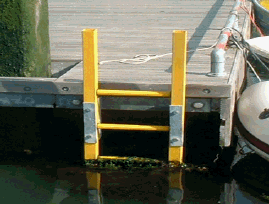
2.1 A glass fibre ladder with robust fixings is thought to be the best option. This type of ladder reduces the weight and also limits corrosion. Glass fibre safety ladders have proved very robust when fitted to the Harbour Authority jetties.
3. Fitting Costs
3.1 A glass-fibre safety ladder, professionally fitted, will cost approximately £175 - £200 (including labour and VAT). There are some 190 individual pontoons on mid-stream moorings on the River and 13 separate lengths of continuous mid-stream pontoon. If each individual pontoon were fitted with a single ladder and each continuous pontoon were fitted with a ladder at each end, this would amount to some 216 ladders at an estimated total cost of between £37,800 and £43,200.
3.2 Example of costs involved for each recommended option:
a. Option A: a mail shot to all mid-stream mooring holders at a cost of £200.
b. Option B: £43,000 with added ongoing administration and inspection costs.
c. Option C: £14,000 with added ongoing administration and inspection costs.
6. Safety benefits
6.1 If every pontoon on the River is fitted with a safety ladder, anyone who finds themselves in the water by accident should be able to swim (or drift on the tide) to the nearest down-tide pontoon and haul themselves out of the water, thereby reducing the risks of hypothermia and increasing their visibility and chances of rescue.
7. Disadvantages
7.1 Apart from the obvious disadvantage of additional cost, either to pontoon owners or the Harbour Authority, there is a possibility that safety ladders would become an attraction to those who choose to swim in the River for pleasure. Other considerations would also have to be taken note of and budgeted for:
a. The ladders would gather drifting debris and become covered in weed.
b. There would be a continuous inspection and maintenance programme required.
c. Some pontoons may have to have work carried out to the structure to enable a ladder to be fitted.
d. Consideration must be given to the insurance of the pontoon as having a safety ladder fitted that was not the responsibility of the owner might affect the policy. This would depend on the insurance company's policy and approach to the matter.
e. There would be an added cost of painting a yellow ring around the top of piles nearest the ladder.
Annex C
RIVER HAMBLE HARBOUR AUTHORITY
DRAFT RISK ASSESSMENT AND MANAGEMENT REPORT
Date: 17 March 2008 updated 9 June 2008 Assessor: AG Clatworthy |
Risk Assessment For General Operations An assessment of the safety equipment that could be installed on mid-stream pontoons to assist persons in the water to safely recover themselves unaided |
1. Introduction
a. An incident occurred following a tender capsize when a person was in the water and unable to climb out of the water onto a pontoon. The person was in the water for approximately 5 minutes and started to feel the effects of the cold. The person was unable to use the pontoon mooring chains as a means of getting onto the pontoon or to pull himself onto the decking unassisted he was assisted and rescued by a passing vessel.
b. Following this incident it was suggested that an emergency ladder could be attached to one end of each pontoon to assist in the self-recovery of similar casualties.
c. This risk assessment looks at the facts of this incident and other incidents and gives recommendations.
2. Associated Incidents:
a. See record of incidents below.
3. Considerations/Remarks
a. In the incident recorded as serial 3 in the table below it was discovered that the casualty in question remained holding onto the painter of his tender with one hand. This could have affected his capacity in self rescue and his failed attempts to climb onto the pontoon.
b. He was unable to use the chains to assist in climbing onto the pontoon.
c. There are eight areas on the River with long continuous pontooning that would only allow safety ladders to be fitted at each end of the pontoon run.
d. When boats are moored alongside pontoons access would be only available at the ends of the pontoon.
e. A small percentage of boats have ladders or have `sugar scoop' sterns. The average height of the sugar scoop is approximately 45cms above the water - the same height of a pontoon.
f. The cost, administration and policing of requiring the fitting of safety ladders to some 190 private pontoons on the River would be substantial (in excess of £37,000).
g. There are many areas of the River that do not have any pontooning.
h. It may not be possible to fit some private midstream pontoons with a safety ladder owing to space available.
i. It may not be possible to fit some private midstream pontoons with a safety ladder because of the positioning of the mooring chains.
j. The average height of a pontoon is approximately 45 cms above the water and a person cold and possibly suffering from exhaustion would find it difficult if not impossible to recover to the pontoon without a ladder.
k. A person lying in the water amongst the warps, chains and possibly hidden by a moored boat is difficult to see.
j. Should it be decided to require the fitting of safety ladders to midstream pontoons, consideration should be given to fitting one on each pontoon i.e. fitted upstream on each pontoon. Thus, on a run of individual pontoons there would be one safety ladder between each pontoon. Some midstream pontoons are moored in isolation so it would have to be widely advertised that the safety ladder will always be at the upstream end. Further, if a boat is moored against the pontoon, the ladder might not be visible to the person in the water.
4. Comments and Remarks from Stakeholders
None received
5. Recommendations
a. That safety ladders should be available to enable self rescue at all suitable locations on the River.
Record of Persons Found in the Water Near Pontoons in the last six months
The details in the table below are from the last six months but are representative of any six month period over the last 5 years. There have also been a number of people rescued from the water in areas of the River where there are no pontoons.
Serial |
Date |
Number of persons |
Pontoon involved |
Able to climb onto pontoon |
Rescued By |
Falling from |
Time In water |
1 |
19/02/08 |
1 |
yes |
Not able to climb onto pontoon |
Passing boat |
Dinghy capsize |
5 minutes |
2 |
06/04/08 |
2 |
yes |
Climbed onto pontoon prior to rescue |
RHHA |
Dinghy capsize |
3 / 4 minutes |
3 |
02/05/08 |
1 |
yes |
Pulled onto a continuous pontoon by Patrol |
RHHA |
Attempted suicide |
5 minutes |
4 |
28/05/08 |
1 |
no |
Could not reach pontoon because of tide |
RHHA |
Yacht |
30 minutes |
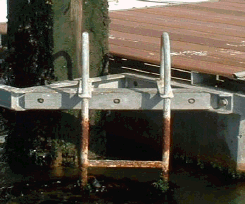
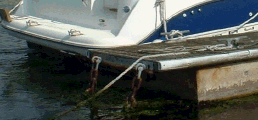
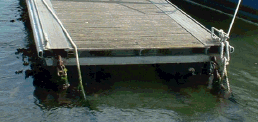
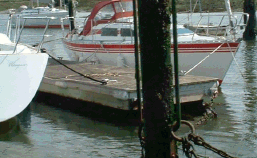
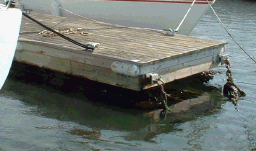
Some examples of safety ladders and mooring arrangements found on the River Hamble |
|
|
Standard Safety Ladder |
Safety ladder found on some commercial pontoons |
|
|
Pontoon with limited space to fit a ladder. Note height fro water |
Example of pontoon fittings |
|
|
Example of mooring arrangements |
Example of pontoon fitting and height from the water |
Safety Ladders - Legal Implications Annex D
1. Following an incident of the River Hamble involving a tender capsize when a person was in the water for five minutes and unable to climb out of the water onto a pontoon, the question of fixing safety ladders to private pontoons was raised and the River Hamble Harbour Authority carried out a risk assessment. The risk assessment identified a risk in that people inadvertently find themselves in water near a mid-stream pontoon currently have no means of assisting themselves to climb out of the water - whether or not they are wearing a life jacket. The risk assessment recommended that reasonable precautions should be put in place to mitigate the risk in that safety ladders should be available to enable self rescue at all suitable locations on the River Hamble.
2. Paragraph 1.2 of the Port Marine Safety Code lays down the general duties and powers of a Harbour Authority. Harbour Authorities have a duty to take reasonable care, so long as the harbour is open for the public use, that all who may choose to navigate it may do so without danger to their lives or property. This duty includes an obligation to conserve, and facilitate the safe use of, the harbour; and a duty of care against loss caused by the authority's negligence.
3. Paragraph 2.2 of the Port Marine Safety Code clearly sets out the risk assessment and safety management principles to be adopted by a harbour. Harbour Authorities have a statutory duty to manage safety developed after a formal risk assessment. Harbours should assess what accidents may happen, take reasonable precautions to prevent such accidents happening and keep appropriate records.
4. The Code also requires that a Harbour Authority must take a pro-active role in managing safety, it is no longer acceptable to wait for an accident to happen and then react. A Harbour Authority is not expected to eradicate all risks but the risks should be managed so that they are reduced to as low as reasonably practical (`ALARP'). Paragraph 2.1.12 of the Code provides that the judgement of risk is an objective one, and the size or financial position of a harbour are immaterial to making it. The degree of risk in a particular activity or environment can, however, be balanced on the following terms against the time, trouble, cost and physical difficulty of taking measures to mitigate the risk. If these are so disproportionate to the risk that it would be unreasonable for the people concerned to incur them, they are not obliged to do so. The greater risk, the more likely it is that it is reasonable to go to very substantial expense, trouble and invention to reduce the risk. But if the consequences and the extent of a risk are small, insistence on great expense would not be considered reasonable.
5. The Port Marine Safety Code requires each harbour authority to hold itself accountable for the discharge of its duties and powers to the standard laid down within the Code. It requires the Board Members to accept responsibility for ensuring that the authority discharges its duties and powers to that standard Board Members are collectively and individually responsible for the proper, exercise of their authority's legal duties.
6. The Government looks to all harbour authorities to implement and comply with the requirements of the Port Marine Safety Code. The Code is not optional. The River Hamble Harbour Authority is committed to meeting national standards laid down in this Code.
7. The risk assessment undertaken by the River Hamble Harbour Authority showed that it would be appropriate to take action to manage the potential risk - that persons who inadvertently find themselves in the water near a mid-stream pontoon currently have no means of assisting themselves to climb out of the water - whether or not they are wearing a lifejacket - and that reasonable precautions should be put in place to mitigate this risk. The Harbour Authority has a duty under the Port Marine Safety Code to manage the risk so that it is reduced to as low as reasonably practicable. The option to `do nothing' is not considered appropriate as a risk has been identified and has to be effectively managed.
8. If the consequences and the extent of the identified risk are considered small compared to the number of incidents occurring on the River Hamble, then Option A - education and making people and the private pontoon owners fully aware of the dangers and asking them to consider installing safety ladders - would be considered reasonable and practical in the circumstances. It would be not unreasonable to put in place an education programme aimed at all River /Harbour users to educate them on the importance of safety equipment and further, that, those using the River Hamble are responsible for their own safety and should wear the correct safety equipment.
9. If however the risk identified is considered to be of a greater extent, then Option A may not be considered appropriate as to reduce the risk to low as reasonably practicable. In such a case the installation of safety ladders to pontoons at regular spaced intervals on the River Hamble could be the most appropriate means to manage the risk.
10. The Crown Estate owns the River Bed of the River Hamble. Hampshire County Council leases the river-bed from the Crown Estate. Public mooring sites in the River Hamble are owned by The Crown Estate. The allocation of the moorings is managed by the River Hamble Harbour Authority on behalf of The Crown Estate in accordance with the terms of its `Management Agreement'. The Agreement provides that the River Hamble Harbour Authority shall carry out the management of the moorings and in doing so shall perform, inter alia, the inspection and supervision of repair and maintenance work of the piles, together with the inspection of pontoons and the checking of insurance.
11. It is a condition of a Mooring License (a formal agreement between the mooring holder and The Crown Estate) that the private mooring holder must maintain third party and public liability insurance in respect of any vessel and private pontoon in the sum of not less than £1,000,000. Furthermore, it is a condition of the License that the private mooring holder must not secure any structure, objects or attachments (other than the vessel a suitable tender and the mooring equipment) on or to the pontoon.
12. In order to install safety ladders to privately owned pontoons the River Hamble Harbour Authority would have to obtain the consent of the pontoon owners and furthermore, consent to amend the conditions of the terms of the their Mooring License as referred to above The River Hamble Harbour Authority does not have the powers to insist that the owners of private pontoons must allow a safety ladder to be attached to their privately owned pontoons. The River Hamble Harbour Authority can only make mooring holders who own or who are responsible for a private pontoon aware of the dangers and advise them to consider fitting a safety ladder to their pontoon.
13. If owners of private pontoons installed safety ladders on their pontoons and maintained the safety ladders at their own expense then the River Hamble Harbour Authority could not be held responsible nor liable for any acts or injury arising out of the use of the safety ladders and/or the pontoons by any third parties. The responsibility and liability would fall upon the private pontoon owners and thus they would have to ensure that their public liability insurance covered such liability. However, it must be noted that until the terms of the Mooring License are amended, any installation of safety ladders by the private owners themselves, would technically be a breach of the terms of their Mooring License.
14. Notwithstanding the above, if the owners of private pontoons installed safety ladders on their pontoons by agreement with the River Hamble Harbour Authority, and the River Hamble Harbour Authority to be responsible for the cost of fitting and the continual ongoing maintenance of the safety ladder, then the Harbour Authority could be held responsible and be liable for any acts arising out of the use of the safety ladders by any third parties. However this liability could effectively be managed and reduced by carrying out regular inspections of the safety ladders to ensure safe and fit for purpose. Regular safety inspections and audits are, of course, a requirement of the Port Marine Safety Code.
15. Neither the River Hamble Harbour Authority nor the private pontoon owner could be liable for negligent acts arising out of the use of the safety ladder and/or the pontoon by any third parties using the safety ladders in a reckless and/or unsafe manner. Case-law provides that it would be unreasonable to impose upon public authorities a duty to protect persons from self-inflicted harm sustained when taking voluntary risks in the face of obvious dangers.
16. As the pontoons are privately owned, the River Hamble Harbour Authority has no powers to grant nor offer grants to the owners of the pontoons to pay for the actual installation of the safety ladders.