1 |
Summary |
|
|
1.1 |
The scheme to introduce Assessment and Development Centres (ADC's) was part of the National Strategy for Fire and Rescue Services (FRS's). The National Framework Document 2004/5 stated that as part of the implementation of the Integrated Personal Development System ( IPDS) each FRS had a clear responsibility to use the Personal Qualities and Attributes (PQA's) Framework and Assessment and Development Centres for the basis of future promotions and the current version of this framework document has a stated requirement for FRS's to utilise ADC's.. Hampshire Fire and Rescue Service (HFRS) implemented arrangements to complete ADC's in 2006. |
|
|
1.2 |
This report summarises the recent activities completed during 2008 in relation to the ADC's for supervisory, middle and strategic managers. The report considers the arrangements that were made and highlights the future requirements in relation to the Service's workforce planning needs at these levels of management. |
|
|
1.3 |
For reference purposes, the HR Committee endorsed the recommendations contained in the following HR Committee Reports referring to this subject matter and in Feb 2008 requested an annual update on these activities: 1 February 2008 - Assessment and Development Centres 29 November 2005 - Workforce Plan and People Strategy 1 February 2005 - Medium Term Plans - Safety and Risk Management, Training and Human Resources 1 December 2004 - Integrated Personal Development System ( IPDS) - Progress Report 8 September 2004 - Three year business plan for Human Resources, Training and Risk Management 7 January 2004 - Training strategy for Crew and Watch Manager IPDS Development Programmes 12 September 2003 - IPDS and Assessment Centres |
|
|
2 |
Recommendations |
|
|
2.1 |
The Human Resources (HR) Committee note the work that has been completed to date to implement the ADC scheme. |
|
|
2.2 |
Agree that the Service continues to implement these arrangements to ensure skilled managers are available at all levels of the organisation to meet future Service needs. |
|
|
3 |
Introduction and Background |
|
|
3.1 3.1.1 3.1.2 3.1.3 3.1.4 |
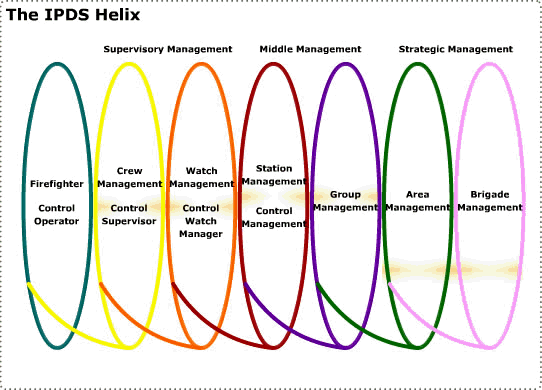
Use of an ADC as a promotion tool The ADC process is part of an integrated approach to organisational, team and individual development, providing a scenario based assessment of competence for role. It replaced the previous statutory examination process that was in place to enable progression for Leading Firefighters, Sub Officers and Station Managers. Please note, that the former 2 ranks no longer exist and were abolished under the `Rank to Role' conversion process. The objective of the ADC is the selection of the most suitable individual(s) for admission onto the development programme underpinning the next level of management. This is depicted in the Integrated Personal Development System (IPDS) helix (see Appendix A). The process is based on the Personal Qualities and Attributes (PQA's) required for each role. The process that would normally be followed is outlined below: · Business need identified by the Workforce Planning Strategy · Application process · Initial Test of Potential (ITOP) · Formal ADC assessment or · Interview for Stage 1 (In Band Interview) followed by · Interview Stage 2 (In Band Interview) · Appointment to substantive position · Development programme · Workplace assessment · Competent in role
|
3.1.5 3.1.6 3.1.7 3.1.8 |
The `In Band' interview process is part of the National ADC toolkit and is applied for candidates wishing to move to a higher level role within the Supervisory and Middle Manager bands e.g. Crew to Watch Manager or Station to Group Manager. The ADC process is used to facilitate entry to each of the management tiers and is the initial test of potential for candidates, whereas the `In Band' interview process is designed for existing competent supervisory or middle managers that wish to move to the next management role within their existing management level. The `In Band' process is an objective and standardised set of interview questions focusing on future potential, by measuring applicants against the Supervisory or Middle Management Level PQAs for the Watch or Group Manager Role. The focus of the interview is on the underlying behaviours that a Supervisory or Middle Management Level Manager needs to display rather than the technical skills and knowledge. Candidates must score sufficient marks from the first set of PQA questions to be invited to undertake the second stage interview. These underlying behaviours are what underpin the evolving culture of the modern UK Fire & Rescue Service and ensure continuous improvement. Substantive promotion is based upon organisational need and is determined within the Service as part of the workforce management process. This is managed via two formal Boards who will consider the service and post requirements at Supervisory Manager (SM) and Middle Manager (MM) level respectively. These consider `Appointments, Transfers and Promotions' (ATP). The ADC is a competitive process in that the number of vacancies will be directly linked to the predicted establishment requirements at a given level of management. ADCs have four common characteristics: · Candidates are observed by a team of trained and qualified assessors. · Combinations of assessment techniques are employed. These may include group discussions, presentations and Occupational Assessment Tests. Using multiple techniques ensure the fullest and clearest indication of competence and predicted future performance (predictive validity). Candidates therefore undertake a series of job related work simulations and job sample tests. For example, problem solving and decision making tests. · Candidates performance during the simulations is recorded and assessed accurately against the PQA's required for the next level of management. Accurate assessment enables the making of more valid decisions. · Several candidates take part in the centre at the same time.
|
|
|
4 |
Completion of the ADC's in 2008 |
|
|
4.1 |
Workforce planning requirements for 2008 Due to the ongoing requirements within the Service Delivery Directorate for crew and watch managers, it was felt that completion of the Supervisory ADC was a top priority in 2008, particularly as the existing pool of successful applicants from the 2007 ADC would all be offered substantive positions within the Service by Mid Year. To fulfil this need planning for the ADC and `In Band' process was completed. The arrangements included the partial outsourcing of assessor duties for the ADC to Capita to reduce the impact on the workloads for Middle Managers. HFRS provide 50% of the assessors for each ADC and Capita provide the other 50% and a Centre Manager. It was also felt that in the early part of 2009 there was the potential for a number of middle managers to retire and that a Middle Managers ADC should be run towards the end of 2008. There was no requirement for Strategic Managers identified for 2008 and as a consequence it was decided that HFRS would not run this level of ADC. |
|
|
4.2 |
Supervisory Manager ADC and `In Band' Interviews The arrangements were finalised with Capita for a minimum of 9 Supervisory ADC's to ensure sufficient Crew Manager candidates to meet future Service needs in 2008/9. Expressions of interest for the Supervisory ADC were invited from competent firefighters within HFRS during the period 17 February 2008 - 28 March 2008. 68 candidates applied ( 66 Male, 2 Female). Ethnicity - All of white origin. All applicants undertook the `first stage' of written tests that were previously called the `Initial Test of Potential'. 53 candidates successfully passed these tests ( 51 male, 2 female) and were offered a place at an ADC. Of these candidates, 2 did not turn up on the date of their event, leaving 51 candidates that took part. Final results 24 successful candidates ( 23 male, 1 female). |
4.3 |
Supervisory `In Band' Interviews The arrangements and assessor duties for the `In Band' process is completed utilising panels of Station managers and HR representatives. Expressions of interest for the Supervisory `In Band' process were invited from competent crew managers within HFRS during the period 1 October 2008 - 7 November 2008. 54 candidates applied ( all male, Ethnicity - all of white origin). All applicants were invited to the stage 1 interviews held between 10 November - 21 November 2008. 3 applicants did not turn up, 23 applicants passed this stage and were invited for the stage 2 interviews which were held from 24 November to 5 December 2008. Final results 15 successful candidates ( all male). Results from both the Supervisory ADC and `In Band' Interview process are valid for 24 months, but we anticipate that we will have offered all successful applicants a substantive role within 12 months. |
|
|
4.4 |
Middle Managers ADC As HFRS has no group managers trained as Middle Manager ADC assessors this process is fully outsourced. It was scheduled to take place in October 2008, but for financial considerations was deferred until April 2009. |
5 |
Future ADC'S |
|
|
5.1 |
As part of the succession planning arrangements, we are currently developing some additional aspects to link to the ADC processes to incorporate operational assessment and line managers feedback on the applicants performance. For 2009 we believe that we will need to complete: Middle Managers ADC in April/May 2009 SM-GM `In Band' Interviews - mid year 2009 Strategic ADC - looking to undertake this an a regional activity in September 2009 Supervisory ADC - Mid Year 2009 CM-WM `In Band' Interviews - latter part of 2009 |
|
|
6 |
Contribution to Corporate Aims and Objectives |
|
|
6.1 |
HFRS remains committed to the continued implementation of the IPDS and the use of ADCs as a key part of a systematic and objective method of identifying individuals with potential for development and promotion within the region. Appointments, transfers and promotions forms a significant part in the management of our human resources in relation to Integrated Risk Management Plan (IRMP) objectives and the Service's Workforce Strategy. |
|
|
7 |
Risk Analysis |
|
|
7.1 |
The national ADC toolkits have been designed to improve FRS selection process predictive validity, this is a requirement in the national framework. HFRS has signed up to this approach on a regional basis. |
7.2 |
Failure to complete appropriate ADC's during 2009 would leave HFRS short of managers eligible to fill predicted vacancies. |
8 |
Resource Implications |
|
|
8.1 |
Human Resources |
|
|
|
The resource requirements for the Workforce Planning Team within HR are considerable to both arrange, participant in the activities and facilitate the notification of results and feedback to candidates. These commitments will be factored into the Medium Term Planning (MTP) considerations for Financial Year (FY) 2009/10. Similarly there will be a requirement for both Station Managers and Group Managers/Area Managers to participate in the assessors duties. |
|
|
8.2 |
Physical Resources |
|
|
|
The physical facilities to undertake each of the ADC's is considerable. Currently, a portion of the prefabricated offices (previously the commercial training/driver training offices) at Eastleigh Fire Station have been taken over for this purpose. The aim is to utilise these as the ADC Suite in the short to medium term and they have recently been redecorated accordingly. We are also looking at the option of utilising the training rooms on the main HQ site. |
|
Purchase of ADC documentation will be required for each candidate on an annual basis, as the toolkits are changed annually. |
8.3 |
Information and Communications Technology Resources |
|
|
|
Currently, HFRS use staff from the HR Team to co-ordinate applications and communicate current arrangements for the ADC processes and to provide advice or guidance as appropriate. These same staff are required to produce the written feedback reports for candidates. |
|
|
8.4 |
Financial Implications |
|
|
|
Assessment centres are run on the basis of day 1 requirements being: 6 role players; 6 assessors; 6 candidates; 2 administrators; 1 centre manager. Day 2 requires 6 Assessors, 1 x centre manager; 2 administrators , no candidates or role players. Please note the costings for the supervisory assessment centres are based on HFRS providing 50% of the assessors for each event. Whilst there is nil financial cost for the Station Managers undertaking this assessor work, this will impact on their availability for other activities. The financial costs of an ADC are based on 6 candidates over a two day period as outlined above. Expenditure for outsourced resources: 2007/08 2008/09 2009/10 Strategic 32,000 0 32,000 Supervisory 39,000 78,000 78,000 Middle Managers 61,000 0 68,000 Total 132,000 78,000 178,000 |
|
|
|
These figures are based on current costings and allow for the following number of candidates to take part in the process: 2007/8 2008/9 2009/10 Strategic 17 0 18 Supervisory 85 68 85 Middle Managers 73 0 73 The figures for 2009/10 are our anticipated costs. Any variation in the number of candidates actually taking part in the process would have a direct impact on the costs. Consequently, we have requested £200k to provide some contingency for increased costs associated with additional candidates, funding to advertise the Middle Managers ADC to potentially external applicants and the possibility that HFRS may need to run the Strategic ADC independently. Not included are costs for the work undertaken by HR to plan and implement the arrangements; facilitate first stage or for HR/Station/Group/Area Managers to undertake Assessor duties and the `In Band' interview processes. |
|
A growth bid of £100,000 for ADC costs in 2009/10 has been submitted to the HFRA, all remaining costs associated with these processes outlined above will be met from within existing budgets and any efficiency savings. |
|
N.B. On 15 January 2009 the F& GP committee agreed to recommend option C ( 3.6% increase to council tax) to the Authority which would finance all the listed growth bids for HFRS which includes the ADC costings. |
9 |
Equality Impact Assessment |
|
|
9.1 |
A People Impact Assessment (PIA) for both the tools and national toolkit have been undertaken by the CLG. HFRS has also undertaken a PIA on its ADC process. |
|
|
10 |
Conclusion |
|
|
10.1 |
The future use of ADC's will continue to be a key part in the national organisational development strategy for FRS's. During the early development stages HFRS has been proactive in their use and has learned significantly by doing so. By using that learning, HFRS will continue to develop the way we use and deliver ADC's to meet our future staffing needs. This will be both as a development tool for staff and as a way to help succession plan to meet HFRS staffing needs in the future. It is likely that this will become an annual requirement for which appropriate funding and resource will be required. |
|
|
Background Information (Section 100D of Local Government Act 1972) |
|
|
The following documents disclose the facts or matters on which this report, or an important part of it, is based and has been relied upon to a material extent in the preparation of the report: None Note: The list excludes: (1) published works; and (2) documents that disclose exempt or confidential information defined in the Act. |
The Helix diagram shows the biggest advantage of IPDS: that it gives you the choice of enhancing and maintaining the skills at your current level or working to gain the skills for the next stage in your career.
If you wish to develop your career and move onto the next stage, it offers a structured, logical path that allows you to achieve your aims. If you prefer to develop your skills at your current level, it gives you the opportunity to continually update them so that you perform at your best all of the time.
Based on National Occupational Standards (NOS), the modules in IPDS have been aligned with National Vocational Qualifications (NVQ's) so that everyone is benchmarked to the same skill level. The NOS have defined the following roles: Firefighter, Control Operator, Crew Manager, Watch Manager, Station Manager, Group Manager, and Area Manager.