Archived decisions
Hampshire Fire and Rescue Authority
Performance Review & Scrutiny Committee Item 6
27th February 2009
Co- responders
Report of the Chief Officer
Contact: Rob Cole T/Station Manager Telephone 0791 888 8089
Email: [email protected]
1. Summary
1.1 This report summarises the aims and objectives and the performance achieved to date of the Co-responder scheme operated by Hampshire Fire and Rescue Service (HFRS) in partnership with South Central Ambulance Service (SCAS).
1.2 Initial collaborative working with Hampshire Ambulance Service NHS Trust commenced on the 8th October 2004. The first three stations to operate as Co-responders were New Milton, Romsey and Bordon Fire Stations.
1.3 Co-responders are firefighters who are trained and assessed in basic life support and in the use of an automatic external defibrillator. They respond to medical emergencies that have been identified as being appropriate for Co-responders to attend by SCAS to carry out medical care in advance of an ambulance resource attending the incident.
1.4 Co-responders operate outside of normal fire calls and therefore have no impact on operational cover. Our priority is to maintain appropriate personnel to crew front line fire appliances on the station where they are based.
1.5 After the success of these original stations, a further three units were introduced to operate from 1st August 2006 located at Liphook, Horndean and Hartley Wintney Fire Stations.
1.6 All six units are very successful responding to approximately 3,000 medical emergency 999 calls per annum.
2 Recommendation
2.1 That the Committee recognise the considerable improvements in the health and well being of our communities by the introduction of this joint working initiative.
3 Introduction and Background
3.1 Despite great advancements in medical techniques the British Heart Foundation identified that there continues to be a high number of cardiac events, and that the first eight minutes are crucial to a patient's chances of survival. They also state that the chances of survival will decrease by 13% for every minute that a patient is not defibrillated.
3.2 The original project was developed in partnership between Hampshire Ambulance Service Community Responder Manager, Keith Boyes, and Hampshire Fire and Rescue Service Watch Manager, Rob Cole. This project formed the basis of a Service Level Agreement signed in October 2004.
3.3 The Communities and Local Government Fire and Rescue National Framework 2008-11 document states that:
Co responder schemes are an example of innovative ways of working which can have significant impact. Assessment of outcomes has shown that firefighters, working in partnership with their local ambulance NHS Trust on co responder schemes, have had an impact on patient outcomes.
The introduction and maintenance of such schemes is a matter for Fire and Rescue Authorities, based on local needs, risk and resource and discussions with partners.
3.4 A Fire Research report14/2008 (Current practice and prospects for FRS Co Responding) has recently been published and its evaluation supports the methods, protocols and working practices in which HFRS operates.
3.5 The Fire Brigades Unions (FBU) national policy regarding Co-Responder schemes is that no union member should undertake co responding duties. Their reasoning at a national level is against the methods used by other Fire and Rescue Services across the country, the way that Hampshire operates co-responder schemes addresses many of the objections from the FBU.
3.6 The key areas of this project that have led to a dynamic and successful way of delivering the service over and above what both services offered, are:
3.6.1 The scheme was introduced in Hampshire on the basis that volunteer personnel from identified stations who wished to participate in the provision of this service could do so without adversely impacting on their HFRS responsibilities.
3.6.2 A dedicated highly visible vehicle is available for the duty Co-responder to attend emergencies in, they do not respond in front line fire appliances, and they take the dedicated vehicle with them. This enables them to operate directly from their home or place of work in the community.
3.6.3 Co-responder units are only available subject to the crewing at the station being maintained.
3.6.4 They are mobilised by SCAS Emergency Operations Centre directly, and are in addition to any ambulance resource deployed.
3.6.5 The main objective is to attend life threatening (these are termed Category A) medical emergencies and maintain life until the arrival of the ambulance.
3.6.6 Personnel operating as Co-responders remain employees of HFRS, but are trained and assessed to the required agreed standard by SCAS. They act as agents for SCAS when asked to attend emergencies calls.
4 Original aim and objectives of Co- responders
4.1 The project aim was to set up Co-responder stations in specific rural localities where, due to geographical locations, the Ambulance Service were encountering difficulty in achieving the eight minute government response target time. Achieving this eight minute response, the Co-Responders contribute towards increased patient care for those suffering in the following ways:
· To improve the outcome of people in cardiac / respiratory arrest
· To improve the outcome of people who are:
- Unconscious and at risk of asphyxiation due to a compromised airway
- In respiratory emergency events
- In cardiac events
- Need control of serious bleeding
- Having a cerebral vascular accident (Stroke)
4.2 These types of emergencies are life threatening and fall into Category A, which the government standards state, are to be reached by an appropriately trained person within eight minutes 75% of the time of the 999 call being made to the Ambulance Service.
5 Performance
5.1 It should be acknowledged that when assessing the contribution of the Co-responders to positively influence patients suffering from a life threatening condition, the interventions of clinicians at further stages of the patients journey and pre-existing medical conditions need to be taken into account and it is therefore difficult to measure the patient's outcome.
5.2 What can be demonstrated is that patients in cardiac arrest or life threatening conditions such as unconsciousness with a compromised airway, choking, or respiratory arrest need to be reached within five minutes, before irreversible brain damage has occurred. If this is not achieved the prognosis of the patient is significantly compromised.
5.3 The speed of response that our Co-responders have achieved can be measured, and this illustrates that those patients suffering from a life threatening injury or illness are given the best possible chance of survival.
5.4 It is important to remember that the performance time starts as soon as the ambulance control operator picks up a call and ends when the responder is on scene.
5.5 The total number of Category A life threatening incidents attended by the original six stations to date is 4,928 with 3,700 being reached within eight minutes, this is delivering a performance standard of 75.08%.
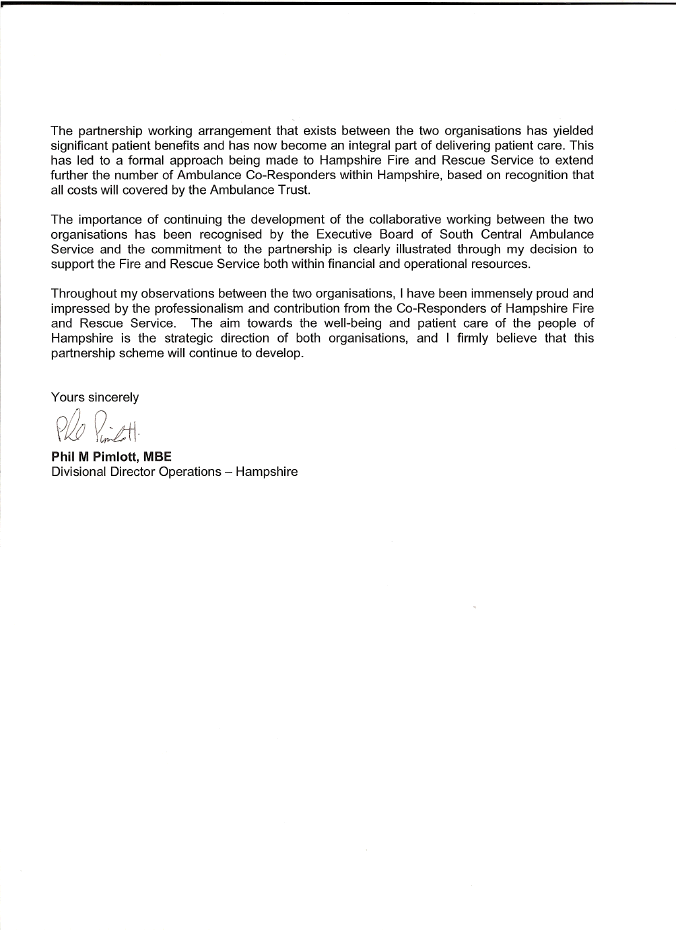
5.6 Please see appendix A for a letter from Phil Pimlott Divisional Director of Operations (Hampshire) South Central Ambulance Service, detailing his observations and general feeling on how the co responder scheme is working in Hampshire.
5.7 Please see appendix B for tables showing the performance of individual stations involved in the co responder scheme. The information is taken from SCAS statistics and outlines the total number of each category of call that was attended by co responders, this table also shows the number of times they reached the patient within eight minutes for Category A calls.
6 Resource implications
6.1 Human resources
6.1.1 60 firefighters currently carry out Co-responder duties from the six retained fire stations (mentioned previously).
6.1.2 The requirements of these personnel is that they have completed the enhanced Criminal Record Bureau check, have attended a medical training course to the Co-Responder standard, have achieved the First Person on Scene award, and have completed driver training appropriate to their level of driving.
6.1.3 Each Co-responder must re qualify every six months to maintain their qualification.
6.1.4 The Co-responders continue to work within their current retained contract, for their station. They are paid within this contract when appropriate.
6.2 Physical Resources
6.2.1 No HFRS physical resources are used to complete the Co-responder work. All physical resources are supplied by South Central Ambulance Service.
6.3 Financial Implications
6.3.1 The original agreement with the Ambulance Service details who will be responsible for each area of cost. The Ambulance Service pay for all vehicles, equipment and training costs together with all consumable items such as fuel and medical supplies.
6.3.2 HFRS are responsible for salaries and Personal Protective Equipment (PPE). This is funded from within existing budgets.
6.3.3 The total cost to HFRS Since 2004 has been £170,000. These costs are attributable to the salaries for HFRS staff and are directly linked to the number of co-responding calls received.
6.3.4 The agreement with the Ambulance Service, is part of a Local Public Service Agreement (LPSA) level 2. If we assist in improving the Ambulance Service's performance by April 2009 then we will receive a significant government reward grant.
6.3.5 This reward grant will cover all areas of expenditure spent on the Co-responder scheme since it's introduction in 2004.
6.3.6 From April 2009 the whole cost of delivering this service will be met by South Central Ambulance Service, with the effect that the project will be cost neutral to HFRS.
7 People Impact Assessment
7.1 No significant issues were highlighted during this assessment.
7.2 The proposals within this report are considered compatible with the provisions of the European Convention on Human Rights, the Human Resources Act 1998, and the Race Relations (Amendment) Act 2000.
8 Future Developments
8.1 Eight further stations are currently being developed and will all be fully operational by the end of February 2009.
8.2 These stations include Ringwood; Lymington; Botley; Hamble; Petersfield; Andover Retained Duty System; Alresford and Hythe.
8.3 These eight stations are cost neutral to HFRS with South Central Ambulance Service meeting all costs.
8.4 The six existing stations, will be from April 2009, cost neutral to HFRS with South central Ambulance Service meeting all costs incurred by HFRS.
8.5 It is envisaged that a further four stations will be required to ensure adequate coverage of the county by May 2009. Joint working is underway to identify and agree these stations.
8.6 Once all identified stations are operating the Co-responder scheme, we expect to be responding to a total of 10,000 emergency calls a year.
9 Conclusion
9.1 We can demonstrate that our Co-responder scheme is an effective response that is both cost effective and sustainable whilst maintaining our core business, aims and objectives of the Service.
9.2 Both organisations recognise the benefits that this scheme brings to the people of Hampshire by responding to medical emergencies in a very quick time and often while the caller is still on the 999 call to the Ambulance Service.
9.3 The firefighters that operate as Co-responders, see daily the difference this project brings to their local communities. They have also built up improved working relationships with Ambulance crews which fosters a better understanding of each others roles at incidents such as road traffic collisions, and fires.
9.4 Co-responding is raising the profile of HFRS in rural areas and is without doubt "Making Hampshire Safer".
Appendix A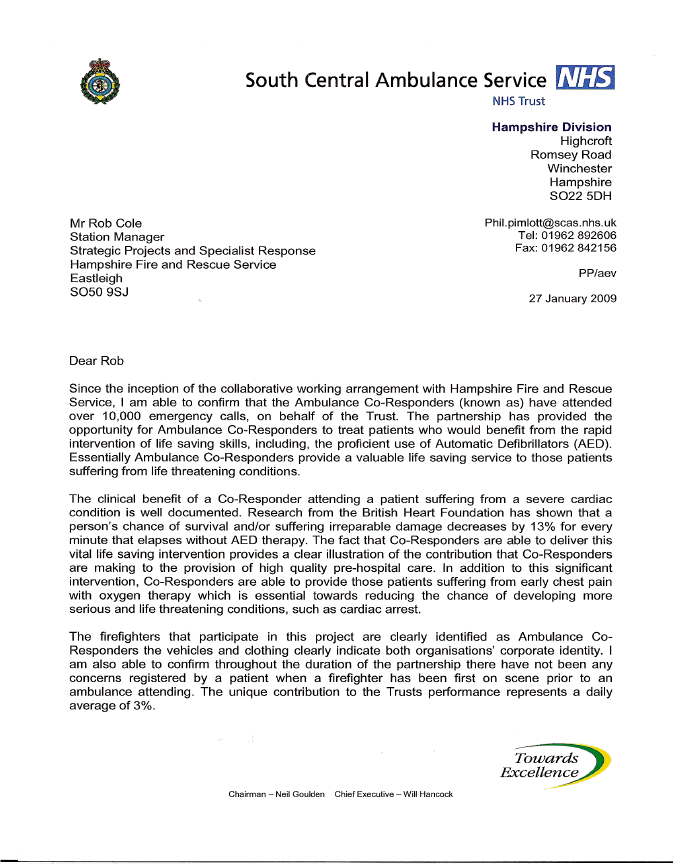
 Appendix B
The tables below show the individual stations total number of calls in each of the three categories and the number or Category A calls that were hit under 8 minutes. 75% is the target set by the government as an ambulance standard. For Category A calls our overall performance is 75.08%
BORDON |
|||||
Year |
Cat A calls |
Within 8 Mins |
Performance |
Cat B Calls |
Cat C Calls |
06 07 |
385 |
346 |
90.58% |
141 |
22 |
07 08 |
262 |
220 |
87.65% |
108 |
26 |
08 09 |
196 |
156 |
81.68% |
77 |
15 |
ROMSEY |
|||||
Year |
Cat A calls |
Within 8 Mins |
Performance |
Cat B Calls |
Cat C Calls |
06 07 |
319 |
263 |
83.76% |
125 |
26 |
07 08 |
314 |
254 |
82.20% |
180 |
28 |
08 09 |
301 |
201 |
70.03% |
151 |
19 |
NEW MILTON |
|||||
Year |
Cat A calls |
Within 8 Mins |
Performance |
Cat B Calls |
Cat C Calls |
06 07 |
546 |
424 |
79.70% |
219 |
41 |
07 08 |
626 |
511 |
84.46% |
326 |
59 |
08 09 |
457 |
342 |
82.61% |
261 |
24 |
HARTLEY WINTNEY |
|||||
Year |
Cat A calls |
Within 8 Mins |
Performance |
Cat B Calls |
Cat C Calls |
06 07 |
62 |
30 |
49.18% |
30 |
2 |
07 08 |
131 |
102 |
81.60% |
72 |
10 |
08 09 |
91 |
65 |
75.58% |
42 |
8 |
LIPHOOK |
|||||
Year |
Cat A calls |
Within 8 Mins |
Performance |
Cat B Calls |
Cat C Calls |
06 07 |
103 |
68 |
66.67% |
30 |
1 |
07 08 |
144 |
104 |
73.76% |
66 |
8 |
08 09 |
114 |
80 |
74.77% |
60 |
7 |
HORNDEAN |
|||||
Year |
Cat A calls |
Within 8 Mins |
Performance |
Cat B Calls |
Cat C Calls |
06 07 |
156 |
97 |
65.10% |
48 |
6 |
07 08 |
339 |
243 |
74.09% |
141 |
25 |
08 09 |
282 |
194 |
73.21% |
120 |
14 |
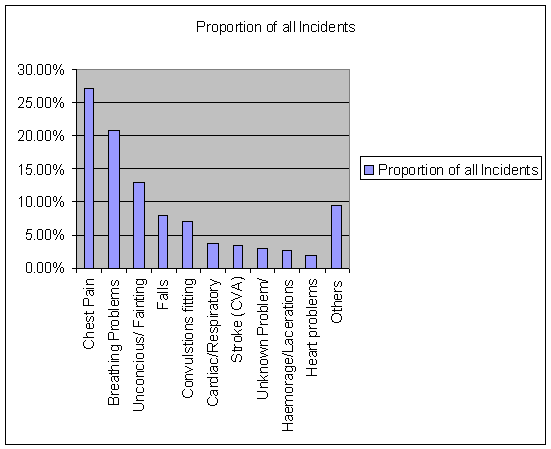
Out of these emergency calls attended, the following table highlights the types of incidents co responders are attending. These are call types at time of mobilisation. This may not be what the patient was actually suffering from.