1 |
Summary |
| |
|
| |
This paper has been prepared to outline the proposed strategy and process for addressing and reducing preventable incidents. The report explains how a reduction in incidents is achievable, manageable and measurable, utilising the Hampshire Fire and Rescue Service (HFRS) Business Education Team to manage the process. |
| |
|
2 |
Recommendations |
| |
|
2.1 |
That the Committee agree the continuation of our current Automatic Fire Alarm (AFA) policy for dealing with AFAs, to enable the Service to maintain our current call challenging process. |
| |
|
2.2 |
That the Committee note the adoption of the proposed strategy for dealing with preventable incidents. |
| |
|
2.3 |
That the Committee approve the principle of the adoption of a charging mechanism, for the recovery of costs incurred as a result of HFRS attendance at identified lift incidents. |
| |
|
2.4 |
That the Committee recommend to the Fire Authority that the charging mechanism for lift incidents be adopted. |
| |
|
2.5 |
That the Committee accept the findings of this report |
| |
|
3 |
Introduction |
| |
|
3.1 |
This report has been produced to explain the processes and implications for HFRS, in progressing Objective 01, within `Our Fire and Rescue Service Plan for 2008 - 2011: Reducing preventable incidents'. |
| |
|
3.2 |
Certain incident types have been identified as being preventable and are therefore areas where Hampshire Fire and Rescue Service can make a positive impact to reduce the number of incidents to which resources respond. |
| |
|
3.3 |
These are currently : · those involving acetylene cylinders; · those involving people stuck within defective lift cars; and · automatic fire alarms. |
| |
|
3.4 |
The report is laid out in three distinct parts, each dealing with one of the above incident types. |
| |
|
4 |
Preventable incidents involving acetylene |
| |
|
| |
Background |
| |
|
4.1 |
Community Risk Intelligence (CRI) figures, indicate that Hampshire Fire and Rescue Service attended 11 incidents involving acetylene cylinders during the calendar year of 2007. |
| |
|
4.2 |
There is currently no formal process for recording details of where the cylinders have been identified prior to an incident; for measuring the outputs (see 6.1), or evaluating the outcomes of this activity (see 6.2); or for reviewing the ongoing status of premises where acetylene is known to be present. |
| |
|
4.3 |
Prior to the introduction of the "acetylene process", (detailed in section 5), the Command and Control database did not contain details for all of the premises where acetylene cylinders were held, of which the Service was aware. Developments within the FireControl and Firelink processes, which enable premises risk information to be captured will further help to address this in due course. |
| |
|
4.4 |
The overall financial costs of an acetylene incident are difficult to assess, but depending on the location of the incident, costs can to run into several millions of pounds due to lost revenue, temporary re-housing costs, policing etc. |
| |
|
4.5 |
The FRS National Framework document for 2008-2011, states in paragraph 1.17 "Fire and Rescue Authorities must have in place arrangements for gathering risk information and making it readily available to operational crews. This should include an effective review system to ensure that the information is current and in the required format." |
| |
|
5 |
Proposed acetylene process |
| |
|
5.1 |
Hampshire Fire and Rescue Service Response and Protection staff, through their integrated service delivery approach, identify premises where acetylene is being stored, in accordance with targets agreed within their individual Group and Station plans. |
| |
|
5.2 |
An online form has been developed to allow the identifier of a premise where acetylene is stored to capture the information, and as a result of sending this form, the following will occur: · Command & Control database updated; · Appliance mobilising sheets will contain acetylene usage and storage details; · Community Fire Risk Management Information System (CFRMIS) premises record updated; · Fire Safety Audits conducted on premises, aimed at encouraging the removal of acetylene; and · Review process instigated by Business Education. |
| |
|
5.3 |
Following the Fire Safety Audit, Command & Control will be informed of any change in status, thereby ensuring the database is kept current. CFRMIS will also be updated. |
| |
|
5.4 |
Business Education will maintain acetylene records and work with occupiers to reduce the risk of an acetylene incident, within those premises that cannot remove acetylene. |
| |
|
5.5 |
They will focus on the areas most likely to result in a high impact incident, which has been determined by Business Education as an incident within 200m of a: · Railway line; · Airport; · Main arterial road; · Hospital; · School; or · High population density housing. |
| |
|
6 |
Measures |
| |
|
6.1 |
Outputs: · The number of premises initially identified as storing acetylene; · The number of Fire Safety Audits conducted as a result of identifying acetylene premises; and · The number of premises receiving follow up contact from the Business Education Unit. |
| |
|
6.2 |
The projected number of premises to be identified and the subsequent number of Fire Safety Audits carried out, will depend on the local targets set within Group plans. |
| |
|
6.3 |
Outcomes: · The number of premises becoming `acetylene free' as a result of HFRS activity; · The number of acetylene cylinders removed as a result of HFRS activity; and · The number of acetylene premises that have an incident, that does not result in the involvement of a cylinder and the instigation of full acetylene procedures · The specific target for reduction of high impact acetylene incidents, will be 40% year on year, with an overall aim of reducing them to 0 by April 2011. · An estimated financial saving to HFRS of £17,000 in 2009/10 (40% reduction in acetylene incidents). · An potential opportunity saving of £52,000 in 2009/10. · Estimated reduction in CO2 of 5,940 kg, due to a reduction in appliance movements and also reduced pumping time for 24 hour cooling of acetylene cylinders. |
| |
|
6.4 |
The process will be evaluated annually, utilising the Performance Improvement Network (PIN) evaluation model, which has been adopted by Hampshire Fire and Rescue Service. |
| |
|
7 |
Preventable Incidents Involving People Trapped Inside Defective Lifts |
| |
|
| |
Background |
| |
|
7.1 |
Community Risk Intelligence statistics for 2007 show: |
| |
|
|
|
7.2 |
Responding to these non emergency lift incidents in 2007, equated to approximately £304,080 in notional costs to the Service. This is based upon the following assumptions: · That each incident took no more than one hour from time of call to resolution · That the current pre-determined attendance of two appliances attended each incident · That the current costs as published for charging for special service calls, is an accurate reflection of actual resource costs per hour (as per GN/2/1/8 dated June 2008). |
| |
|
8 |
Proposed lift incident process |
| |
|
8.1 |
HFRS will send a letter to every premises that experiences a non-emergency lift incident, giving advice on how to prevent a recurrence and also explaining that if reasonable steps are not taken to address the matter, that the Service will consider charging for attendance at these types of incident. |
| |
|
8.2 |
Any premises that experiences three incidents in a 12 month period will receive another letter and also a visit from a Fire Officer to offer further advice and reiterate the possibility of charging for further incidents. |
| |
|
8.3 |
A final warning letter will be sent following the fourth incident in a 12 month period and an invoice would be generated for the fifth, and any subsequent incidents within the same period. |
| |
|
8.4 |
If the person responsible for the lift can display that they have taken all reasonable steps to avoid such incidents, the charge may be waived. |
| |
|
9 |
Charging rate |
| |
|
9.1 |
It is proposed that a £560 charge for attendance at a non-emergency lift incident be made in line with our special service charge for appliances. (see paragraph.9.2). This rate will be reviewed annually, in line with Hampshire Fire and Rescue Service policy. |
| |
|
9.2 |
The proposed charge is based on the current calculation provided by the Finance Department, for the costs incurred by two appliances for one hour, or part thereof. |
| |
|
9.3 |
Shropshire & Surrey Fire and Rescue Services already charge for lift incidents and London Fire Brigade have the ability, but have not exercised this right to date. Greater Manchester Fire and Rescue Service do not attend non-emergency lift incidents. |
| |
|
9.4 |
The Fire and Rescue Service Act 2004, Part 2, Section 19 details the conditions for Fire and Rescue Services to charge for services provided. |
| |
|
10 |
Projected frequency of charging |
| |
|
10.1 |
During 2007, 18 premises have been analysed as experiencing five or more incidents within a 12 month period. |
| |
|
10.2 |
It is anticipated that with the advice and guidance provided by the Service to people responsible for lifts, the charging mechanism would be used on a limited number of occasions. |
| |
|
10.3 |
It should be emphasised that this process would not be seen as a revenue generator, but as an incentive to encourage responsible persons to better manage their lift systems and procedures, thereby reducing the impact on HFRS resources. |
| |
|
11 |
Measures (including financial savings) |
| |
|
11.1 |
Outputs: · Number of premises receiving each advisory letter; · Number of premises receiving a visit from Hampshire Fire and Rescue Service; · Number of premises charged; and · Number of responsible people attending lift seminars. |
| |
|
11.2 |
Outcomes: · 25% reduction in non-emergency lift incidents by March 2011; · Increase in emergency lift incidents, potentially as a result of occupiers reporting all lift incidents as emergencies, to avoid the charging mechanism. This is not seen as a significant risk and would be addressed within the process if it were to occur; · Estimated real financial savings of £11,200 from reduction in Retained Duty System (RDS) calls to lifts (25% reduction by March 2011, based on 2007 figures); · Further cost savings of approximately £725 in diesel, based upon an average of six miles per round trip to an incident; · Estimated reduction in CO2 output from appliance moves of 997kg; and · Opportunity savings of £64, 680 from reduction in wholetime calls to lifts (25% reduction by March 2011, based on 2007 figures). |
| |
|
12 |
Preventable incidents involving unwanted Automatic Fire Alarms (AFAs) |
| |
|
| |
Background |
| |
|
12.1 |
The current AFA reduction strategy has been running since 2006 and has achieved a year on year decrease of 23.5%. The total variation between the fiscal year 2005/06 (6672 calls) and 2007/08 (3903 calls) is a 41% reduction in AFA responses by the Service. |
| |
|
12.2 |
In the financial year 2007/08, 1,269 AFA calls were filtered by Control (32.5% of AFA calls received), which resulted in no response from HFRS. The non-filtering of these calls, would have resulted in a 1.5% increase on the previous year. |
| |
|
12.3 |
The ongoing reduction in response to AFA calls, has allowed Hampshire Fire and Rescue Service resources to focus on community safety activities and training for staff. Some of the burden for primary employers within RDS areas has been also reduced. In addition, it has also realised a cost saving by reducing the number of turn outs by RDS staff. |
| |
|
12.4 |
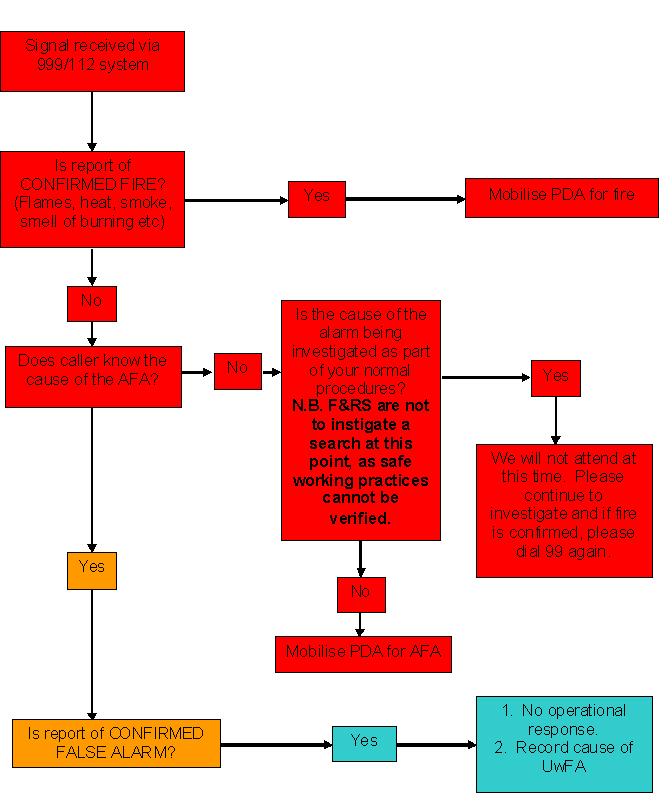
The Chief Fire Officers Association (CFOA) has recently published an AFA policy, that is largely based upon the current Hampshire Fire and Rescue Service policy, but with some notable exceptions. The most significant exception to our strategy and policy, is the explicit advice not to ask the caller to initiate an investigation, if they have not already done so as part of their normal procedures. |
| |
|
12.5 |
The CFOA policy recommends three different call filtering options and the preferred version for HFRS is shown in appendix A. Should HFRS decide to adopt the CFOA policy at Regional Control Centre (RCC) cut over, this is the call filtering approach that is recommended for use by HFRS Control staff. |
| |
|
13 |
Proposed AFA process |
| |
|
13.1 |
As of October 1st 2008, the responsibility for AFA reduction was adopted by the Business Education Team. |
| |
|
13.2 |
The current registration, management and reduction visits will continue utilising Business Education staff as appropriate. |
| |
|
13.3 |
The current AFA reduction strategy will continue unchanged, until it is reviewed, six months prior to cut over to Regional Control Centre (RCC). |
| |
|
14 |
Risk analysis |
| |
|
14.1 |
The absence of a robust procedure for ensuring information on acetylene is held within the Command and Control (C and C) database, was a significant risk for HFRS. |
| |
|
14.2 |
The newly introduced acetylene process has addressed this problem and ensures that whenever anyone within HFRS is notified of a premises containing acetylene, that there is a simple method to place this information on the C and C database. |
| |
|
14.3 |
A residual risk exists regarding appliances that are not on station when mobilised to incidents. They will not receive a mobilisation sheet and associated risk information as Control staff do not have the facility to access this information at the point of dispatch. It is understood that appliance Mobile Data Terminals (MDTs) will address this issue. It is also intended to send a monthly update to stations, with details of all Acetylene premises that HFRS are aware of on the respective station grounds. |
| |
|
14.5 |
If the charging mechanism for lift incidents is needed to be invoked, there is a perceived potential risk to the reputation of HFRS. |
| |
|
14.6 |
Full adoption of the CFOA policy for AFA's, would create a significant risk that HFRS appliances would be mobilised to AFA calls more frequently. It is unclear to what extent calls may increase, as the CFOA policy allows call filtering to take place, but explicitly recommends against asking the caller to carry out an investigation, if one is not already underway. HFRS currently do filter calls by encouraging this action. |
| |
|
14.7 |
This increase in AFA responses may potentially have the following detrimental impacts: · training and community risk reduction (Prevention) activities may be adversely affected; · there may be an additional burden on primary employers within RDS areas; · the increased incidence of emergency responses may create additional risks to Service personnel and members of the public; and · the carbon footprint of HFRS may increase. |
| |
|
14.10 |
Research by Departments for Communities and Local Government in 2008, concluded that the cost/benefit of these adverse effects was justified by a reduction in risk to property damage, which offset the reduction in time spent on community risk reduction (Prevention) activities and the associated risk reduction therein. |
| |
|
14.8 |
Delaying adoption of the CFOA policy will enable HFRS to continue with the reduction of responses to unwanted AFAs, whilst not exposing us to the effects mentioned in 14.7 above. |
| |
|
14.9 |
Non adoption of the CFOA AFA policy will place HFRS in the minority amongst British Fire and Rescue Services. |
| |
|
15 |
Resources |
| |
|
15.1 |
Human resources |
| |
|
15.2 |
The management of these processes will be undertaken by the Business Education Unit, using existing personnel. |
| |
|
15.3 |
There will be a workload increase for the Command and Control database team due to acetylene data inputting and this will require monitoring to assess the impact. |
| |
|
15.4 |
Station Managers in charge of stations would be responsible for visiting premises following the third lift incident. |
| |
|
15.5 |
Physical resources |
| |
|
15.6 |
No significant physical resources have been identified at this time. |
| |
|
15.7 |
Financial resources |
| |
|
15.8 |
By April 2011, the preventable incident strategy, in its entirety, will realise approximately £58,750 in financial savings and opportunity savings of £234,000. |
| |
|
16 16.1 17 |
6 People Impact AssessmentThe proposals within this report are considered compatible with the provisions of the European Convention on Human Rights, the Human Resources Act 1998, and the Race Relations (Amendment) Act 2000 Environmental Impact |
| |
|
17.1 |
Property fires involving acetylene generally tend to burn longer and more intensely due to the necessity to carry out defensive firefighting, thereby increasing the carbon footprint of the incident. Any reduction to the prevalence of these incidents, would therefore reduce the overall carbon output from fires. |
| |
|
17.2 |
Water usage at acetylene incidents is greater, and a subsequent reduction in firefighting water and associated run-off would result from any reduction in acetylene incidents. |
| |
|
17.3 |
Reduction in diesel usage from appliances attending and operating at preventable incidents, would realise a reduction in CO2 output of approximately 6,937kg. |
| |
|
18 |
Conclusion |
| |
|
18.1 |
The proposals within this report are designed to enable HFRS to achieve objective 01 within `Our Fire and Rescue Service Plan' for 2008-11 and are considered to be the most effective means of achieving that aim. |
| |
|
18.2 |
The opportunity savings created from non attendance at these incidents will enable resources to focus more effectively on reducing risk within the community. |
| |
|
18.3 |
Acetylene incidents present a risk to members of the public and our infrastructure; they also represent a financial risk to the economic wellbeing of Hampshire businesses; and a physical risk to operational response staff attending this type of incident. This strategy, along with the site specific risk information strategy, will significantly reduce this risk. |
| |
|
Background Information (Section 100D of Local Government Act 1972) |
| |
The following documents disclose the facts or matters on which this report, or an important part of it, is based and has been relied upon to a material extent in the preparation of the report: · CFOA Policy for the reduction of false alarms & unwanted fire signals; · CLG Fire Research Report 2/2008 - Costs and benefits of alternative responses to automatic fire alarms (http://www.communities.gov.uk/publications/fire/firealarmsresearch22008);CFOA Policy for the reduction of false alarms & unwanted fire signals; · CLG Fire Research Report 2/2008 - Costs and benefits of alternative responses to automatic fire alarms (http://www.communities.gov.uk/publications/fire/firealarmsresearch22008); · HFRS Guidance note GN 2/1/8 Note: The list excludes: (1) published works; and (2) documents that disclose, exempt, or contain confidential information defined in the Act. |