
Archived decisions
HAMPSHIRE COUNTY COUNCIL
Decision Report :
Decision Maker: |
Executive Lead Member for Children's Services (Education) | ||||
Date of Decision: |
12 March 2009 | ||||
Decision Title: |
Children and Young People's Plan 2009-12 | ||||
Decision Reference: |
591 | ||||
Report From: |
Director of Children's Services | ||||
Contact name: |
Deborah Harkin, Head of Performance and Planning | ||||
Tel: |
01962 846699 |
Email: |
|||
EXECUTIVE SUMMARY
1) Summary of decision area:
1.1. This report seeks approval for the new Children and Young People's Plan (CYPP) for Hampshire, covering the period 2009-2012 (Appendix E).
2) Issues covered in report:
2.1. The publication of a CYPP every three years, is a statutory requirement under the Children and Young People's Plan (England) Regulations 2005. The CYPP sets out Hampshire County Council's and partners' strategy for services for children and young people aged 0-19, young people aged 20 and over leaving care and young people up to the age of 25 with learning difficulties. The CYPP (2009-12) contains six new priorities and has extended the group of vulnerable children and young people since the first CYPP (2006-09).
2.2. Consultation on the development of the new CYPP took place between September 2008 and January 2009. A summary of responses is contained in Appendix D.
3) Recommendations:
3.1. That the Executive Lead Member for Children's Services (Education):
· notes the consultation findings of the Children and Young People's Plan (2009-12); and
· recommends to the County Council the approval of the Children and Young People's Plan (2009-12) and to its publication on 3 April 2009.
MAIN REPORT
1) Contextual information:
1.1. Since the first CYPP for Hampshire in 2006, there have been a number of national developments which have been taken into account in the drafting of the CYPP (2009-12). These include: the publication of the national Children's Plan which included a set of goals for achievement by 2020; introduction of the National Indicator Set (NIS); and the establishment of Local Area Agreement (LAA) targets for 2008-2011.
1.2. The Children and Young People's Plan Guidance 2009, issued by the Department for Children, Schools and Families in January this year, proposed the strengthening of Children's Trusts by providing a legal basis for the Children's Trusts Boards. Each Children's Trust will have a statutory duty to have a board, with specified partners setting out the strategic vision, responsible for the creation of the CYPP (see section 3 below).
1.3. The CYPP is the defining statement of strategic planning and priorities for all children, young people and families. The CYPP (2009-12) sets out how the Children's Trust for Hampshire will deliver improvements for all children and young people across all five of the Every Child Matters outcomes. The vision of the CYPP (2009-12) is that every child and young person in Hampshire, including those who are vulnerable or disadvantaged, has the best possible start in life and develops to their full potential.
2) Key issues:
2.1. The following areas have been taken into consideration in the development of the CYPP (2009-12): statutory requirements and outcomes from the Joint Strategic Needs Assessment and consultation process.
3) Statutory requirements:
3.1. Section 17 of the Children Act 2004 provides the statutory basis for CYPPs. The Children and Young People's Plan regulations (2005 and 2007) establish the essential requirements for preparing, consulting, publishing and reviewing Plans (for a summary of the regulations, see Appendix C ). The CYPP (2009-12) for Hampshire is fully compliant with these regulations.
3.2. The Children's Trust for Hampshire, also known as the Children and Young People's Partnership, was established as a result of the Children Act 2004. New legislation on Children's Trusts is due in 2009, with proposals including:
· extending the Children's Trust duty to co-operate, under section 10 of the Children Act 2004, to schools, sixth form and further education colleges and JobCentre Plus;
· putting the Children's Trust Board on a statutory footing; and
· extending the ownership of the CYPP to all statutory partners by giving the duty to produce the CYPP to the Children's Trust Board (also see section 8 below).
4) Needs assessment:
4.1. An underlying principle of the CYPP is to ensure that the right services are available and accessible to all children and young people. This is underpinned by a comprehensive needs assessment, drawing on data and trends relating to children and young people, including the recently published Hampshire Joint Strategic Needs Assessment (JSNA). The JSNA was compiled from contributions by statutory partners in the Local Strategic Partnership and providers from the public, private and voluntary and community sector. From this information, a profile of children and young people across the county was developed, identifying where outcomes need to be improved.
4.2. The profile of children and young people in Hampshire, shows considerable variations in outcomes across the county. Consequently, the CYPP (2009-12) outlines the Children's Trust's commitment to reduce the barriers faced by vulnerable children and young people (listed below in Table 1) and to narrow the gap between them and their peers.
Table 1: Vulnerable children and young people identified in the CYPP (2009-12)
1 |
Children and young people living in relative poverty |
2 |
Children in care |
3 |
Children and young people with learning difficulties and/or disabilities |
4 |
Young carers |
5 |
Children and young people at risk because of mental health problems |
6 |
Children and young people who are victims of neglect and abuse |
7 |
Children and young people facing barriers to participation or experiencing prejudice and discrimination because of their ethnic background |
8 |
Lesbian, gay, bisexual and transgender young people |
9 |
Young offenders |
5) Vision and priorities:
5.1. The CYPP (2009-12) promotes a shared vision and an agreed set of priorities, informed by:
· the United Nations Convention on the Rights of the Child;
· the Declaration on Child Well-being in the UK;
· the goals of the national Children's Plan;
· the findings of the 2007 Joint Area Review and the 2008 Annual Performance Assessment of Hampshire County Council's Children's Services;
· performance against national indicators and LAA targets; and
· the Joint Strategic Needs Assessment.
5.2. The six overarching priorities contained in the 2009-12 CYPP are listed in Table 2.
Table 2: CYPP (2009-12) priorities
1 |
Reducing the incidence and impact of poverty on the achievement and life chances of children and young people. |
2 |
Securing children and young people's physical, spiritual, social, emotional and mental health, promoting healthy lifestyles and reducing inequalities. |
3 |
Providing opportunities to learn that raise children and young people's aspirations, encourage excellence and enable them to achieve beyond their expectations. |
4 |
Ensuring that children and young people are safe and feel safe, enabling them to build resilience and personal confidence. |
5 |
Providing vocational, leisure and recreational activities that provide positive opportunities to experience success and build resilience. |
6 |
Removing barriers to access, participation and achievement and not tolerating discrimination and abuse. |
5.3. To ensure delivery against the priorities, a detailed improvement plan has been devised (Appendix 1 of the CYPP 2009-12). It sets out how performance against targets will be measured and maps the priorities against the national Children's Plan goals, the five Every Child Matters outcomes and the NIS.
6) Performance management:
6.1. The Children's Trust for Hampshire will monitor progress against the CYPP (2009-12) twice a year, with quarterly performance updates against key national indicators and the LAA targets. Reports will include summary feedback against key actions using a red/amber/green system and providing disaggregated data sets both at county and district level, where appropriate. The Children's Trust Board will be responsible for managing any risks to delivery.
6.2. As part of the monitoring cycle, there will be an annual refresh of the needs assessment and associated outcomes and actions to ensure that the plan remains relevant and appropriate.
7) Impact assessment:
7.1. A full equality impact assessment (EIA) has been completed and will be published online in conjunction with the CYPP (2009-12) in April this year. The EIA identifies a positive impact for targeted groups of children across a range of health, educational and safeguarding outcomes. No adverse impact has been identified with regard to age, faith, gender, race, sexual orientation or income. Further work is needed around the inclusion of disabled children and young people, to fully link the CYPP to the Aiming High for Disabled Children programme. Risks arising from geographical isolation will be addressed by monitoring selected targets at district as well as at county level.
8) Risk issues:
8.1. The CYPP is a work of partnership. The process brings together all those under the `duty to co-operate' in section 10 of the Children Act 2004 and other stakeholders across Hampshire, to share information, prioritise and make decisions about the range of services on offer for children and, young people and their families. Therefore, one of the key risks is the potential lack of partner engagement. The forthcoming legislation to strengthen children's trusts and to extend the duty to co-operate to schools, colleges and JobCentre Plus will help to mitigate this risk. In the short term, the Children's Services Department is currently undertaking a mapping of local partnership arrangements across Hampshire to prepare for the implementation of the above changes.
9) Financial and personnel issues:
9.1. A statement of how the use of the County Council's resources will contribute to the improvement of the outcomes is provided in Appendix 3 of the Plan, in line with the Children and Young People's Plan (England) regulations.
9.2. The establishment and embedding of effective commissioning processes is essential to the success of the CYPP (2009-12). Joint decision making and commissioning by the Children's Trust for Hampshire should lead to more effective use of resources.
9.3. The Children's Services Department's integrated service and budget planning processes align the CYPP (2009-12) priorities with the overall strategic direction, including the corporate improvement plan and LAA priorities. Value for money in relation to the CYPP and Departmental priorities will be assessed through a new set of value for money performance indicators and efficiency measures which will be monitored corporately.
9.4. Delivery of the CYPP will be supported by the development of an overall workforce strategy, covering all Children's Trust partners and promoting inter-agency working (as recommended by Building Brighter Futures: Next Steps for the Children's Workforce, DCSF 2008; and required by future Children's Trust legislation). The CYPP (2009-12) also commits members of the Children's Trust for Hampshire to providing professional development opportunities in order to build the skills, expertise and capacity of the workforce; and working with national workforce training and development agencies.
10) Consultation
10.1. Consultation to develop the CYPP (2009-12) comprised of two stages. Firstly, the overarching priorities were developed through a series of small focus group events with partners and key stakeholders, in September 2008. A dedicated focus group for children and young people was also held, consisting of Hampshire County Youth Council and Care Council members.
10.2. Secondly, the work of these focus groups was used to develop a wider draft document for full consultation which took place between November 2008 and January 2009. Consultation was largely web-based, with dedicated CYPP web pages, allowing on-line consultation with children, young people, their parents and carers, and partners and practitioners. As part of this process, specific events were held to facilitate the participation of schools and the voluntary sector.
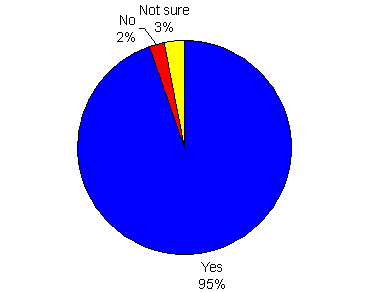
10.3. A summary of consultation responses is provided in Appendix D. The overall feedback was very positive, with respondents indicating that the purpose and vision of the CYPP (2009-12) was clear (95% felt the purpose was clear; 82% supported the commitment to the UN Convention on the Rights of the Child statement). Furthermore, 89% agreed with the six overarching priorities and 76% agreed with the strategies for delivery of the Plan. The key messages and resulting amendments are shown in Table 3.
Table 3: Key consultation messages and amendments to the CYPP (2009-12)
Key messages |
Amendments |
A children and young people's version should be produced |
· A summary version will be produced for children and young people. |
It would be really helpful to illustrate the document with case studies/examples |
· Case studies have been signposted in the CYPP (2009-12) and examples are provided in section 2 |
Agree with the concept of making pledges or commitments, but disagree with the use of the term `promise' |
· The term `promise' has been removed. Instead, the CYPP (2009-12) now contains a section translating the priorities into actions for children and young people (section 1, `making the priorities a reality'). |
The Plan doesn't flow very well - lose the thread between sections |
· The CYPP (2009-12) has been significantly restructured to improve cohesion between sections. The improvement plan is now provided as an appendix. |
Free/low cost transport is needed |
· The provision of safe, reliable and regular public transport has now been included under priority 6 in the improvement plan. |
The priorities need to refer more to disabled children and young people, particularly Aiming High for Disabled Children and Every Disabled Child Matters |
· The six priorities apply to all children and young people. · Section 1 outlines specifically what actions are required to deliver the priorities for disabled children and young people. · A number of activities included under priority 5 in the improvement plan support the implementation of the Aiming High for Disabled Children strategy. |
Too much/not enough detail |
· The CYPP (2009-12) aims to provide a framework for the improvement of outcomes for children and young people by the Children's Trust for Hampshire. The improvement plan has now become an appendix, allowing the main documents to be read separately from the more detailed activities · In addition, a `quick read' version will be produced. |
11) Outline of Options:
11.1. Publication of the CYPP is a statutory requirement and therefore, options to produce this plan were not considered. However, extensive consultation was undertaken to determine the priorities and actions (see section 10 above).
12) Option Analysis/Comparison:
12.1. Not applicable.
13) Conclusions:
13.1. The CYPP (2009-12) for Hampshire is fully compliant with the Children and Young People's Plan (England) Regulations 2005 and has been developed through a comprehensive needs assessment and consultation process. The resulting document contains six new priorities and identifies a targeted group of vulnerable children and young people. The CYPP (2009-12) is supported by the development of the Children's Trust and provides the strategic direction for improving outcomes for children and young people across Hampshire.
14) Recommendations:
14.1. That the Executive Lead Member for Children's Services (Education):
· notes the consultation findings of the Children and Young People's Plan (2009-12); and
· recommends to the County Council the approval of the Children and Young People's Plan (2009-12) and to its publication on 3 April 2009.
CORPORATE OR LEGAL INFORMATION:
LINKS TO THE CORPORATE STRATEGY | ||||
Yes |
No | |||
Hampshire safer and more secure for all |
||||
Corporate Business plan link no (if appropriate) |
||||
Maximising well-being |
||||
Corporate Business plan link no (if appropriate) |
||||
Enhancing our quality of place |
||||
Corporate Business plan link no (if appropriate) |
||||
OR |
||||
This proposal does not link to the Corporate Strategy but, nevertheless, requires a decision because: | ||||
OTHER SIGNIFICANT LINKS: | ||
Links to Previous member decisions: | ||
Title |
Ref |
Date |
Direct Links to Specific Legislation or Government Directives | ||
Title |
Date | |
The Children and Young People's Plan Regulations 2005 and 2007 |
2005 | |
The Children and Young People's Plan (Amendment) Regulations |
2007 | |
Section 100 D - Local Government Act 1972 - background documents | |
The following documents discuss facts or matters on which this report, or an important part of it, is based and have been relied upon to a material extent in the preparation of this report. (NB: the list excludes published works and any documents which disclose exempt or confidential information as defined in the Act.) | |
Document |
Location |
The Children and Young People's Plan Regulations 2005 and The Children and Young People's Plan (Amendment) Regulations 2007 - Summary |
Appendix C |
Children and Young People's Plan 2009-12 Consultation Summary |
Appendix D |
Hampshire Children and Young People's Plan 2009-12 |
Appendix E |
IMPACT ASSESSMENTS:
1. Equalities Impact Assessment:
The equalities impact assessment of the CYPP (2009-12) concluded that the Plan will have a very positive impact with regard to age; disability; faith; gender; race; and for children and young people who are gay, lesbian, bisexual, or transgender. The CYPP (2009-12) will also have a very positive impact on children and young people living in families on low or no income.
2. Impact on Crime and Disorder:
The CYPP (2009-12) has been assessed to have a very positive impact on the reduction of crime and disorder. Priorities for local communities include `protecting vulnerable people and tackling crime and anti-social behaviour to ensure that areas are safe and welcoming to people of all ages and backgrounds' (CYPP 2009-12, section 1).
3. Climate Change:
a) How does what is being proposed impact on our carbon footprint/ energy consumption?
The impact of the CYPP (2009-12) on the carbon footprint and on energy consumption is assessed as neutral.
b) How does what is being proposed consider the need to adapt to climate change, and be resilient to its longer term impacts?
The CYPP (2009-12) includes the following priority for local communities: `enhancing our quality of place, making Hampshire a good place to live by protecting local distinctiveness and diversity, providing excellent facilities, respecting Hampshire's heritage and proactively planning for the future'.
The Children and Young People's Plan Regulations 2005 and The Children and Young People's Plan (Amendment) Regulations 2007 - Summary
CYPP regulations require |
Each local authority to prepare a CYPP. |
Matters to be dealt with in the Plan |
Each Plan shall set out the improvements which the local authority intends to make during the period of the plan to the well-being of children and young persons in regard to the five Every Child Matters outcomes: a) physical and mental health and emotional well-being; b) protection from harm and neglect; c) education, training and recreation; d) the contribution made by them to society; e) social and economic well-being. Each Plan shall include a statement on how the local authority intends to achieve the improvements in the five outcomes referred to above with specific reference to the following: (i) the integration of services provided by the local authority and its relevant partners to improve the well-being of children and young persons; (ii) arrangements made by the local authority to safeguard and promote welfare of children; (iii) arrangements for early intervention and preventative action. Each Plan shall include: 14.1.1 a needs assessment against the outcomes; 14.1.2 an outline of the key actions planned to achieve the improvements; 14.1.3 a statement as to how the local authority's budget will be used to contribute to those improvements; 14.1.4 a statement as to how the Plan relates to the local authority's performance management and review of services for children and relevant young persons; 14.1.5 the arrangements under section 10 of the Children Act 2004 which the local authority propose to make for joint working with the local authority's relevant partners and other bodies the local authority consider appropriate. |
Timing of the publication of the Plan |
Following publication of the first Plan each subsequent Plan shall be published no later than six weeks after the end of the plan period for the previous Plan. |
Publishing the Plan |
The local authority shall publish the Plan by: a) placing it on the local authority's website; b) sending a copy of the Plan to each of the persons and bodies with whom the local authority have made arrangements under section 10; c) depositing sufficient copies of the Plan in public libraries and other places to which the public have access. |
Consultation during the preparation of the Plan |
During the preparation of the Plan the local authority shall consult: a) such children, young people, families and carers as the local authority consider appropriate; b) such persons or bodies representing children, young persons or families as the local authority consider appropriate; c) the appropriate diocesan authority for any foundation or voluntary school situated in the local authority's area which is a Church of England or Roman Catholic Church school; d) the school organisation committee for the local authority's area; e) schools; f) the schools forums; g) the schools admission forums; h) persons or bodies providing voluntary services relating to children and young persons on the local authority's area; i) such groups of persons representing local communities as the local authority consider appropriate; j) the Local Safeguarding Children Board for the local authority's area; k) each of the local authority's relevant partners under section 10. |
Review of the Plan |
The local authority shall review their Plan in each year in which the local authority is not required to publish a Plan: a) during the conduct of such a review the local authority shall consult such persons as they consider appropriate; b) the local authority shall publish the result of the review in a manner they consider appropriate. |
Hampshire Children and Young People's Plan 2009-12
Consultation summary
Consultation on Hampshire's draft Children and Young People's Plan (CYPP) 2009-12 took place between 9 September 2008 and 5 January 2009. Consultation was largely web-based, with dedicated CYPP web pages developed, allowing online consultation with children, young people, parents/carers, partners and practitioners. As part of this process, specific events were held to facilitate the participation of Children's Services staff and the voluntary and community sector.
The following groups were invited to take part in the consultation:
· Children, young people and their families
· Hampshire County Council staff
· Schools and colleges
· GP surgeries
· All school governing bodies in the county
· All Children's Services staff
· Learning and Skills Council
· Hampshire Primary Care Trust
· Home Start
· Hampshire Constabulary
· Ministry of Defence
· District and borough councils and Councillors
· National Childminding Association
· Jobcentre Plus
· Local probation boards
· Youth offending teams
· Sheltered housing
· Diocesan authorities
· Sure Start Children's Centres
· All County Council Members
A schools communication was sent to all schools, asking them to contribute to the consultation process and providing them with a letter to pass onto parents to encourage them to take part.
In December 2008, two dedicated events for the voluntary and community sector and workshops as part of the Children and Young People's Partnership Standing Conference were held. Consultation with Members was facilitated through the Children and Young People's Select Committee. The Hampshire launch of Aiming High for Disabled Children was also used as an opportunity to gain feedback on the draft plan.
Two consultation questionnaires were made available - one for parents/practitioners/ stakeholders and one for children and young people. These could be completed online or emailed/posted to Children's Services.
Parents and partners feedback
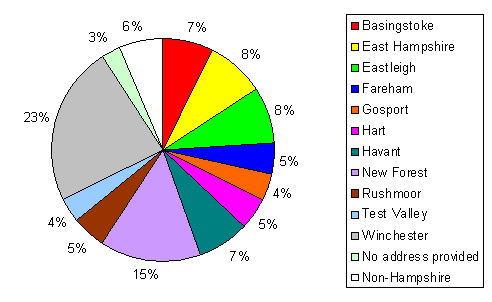
108 completed questionnaires were received, in addition to feedback from consultation events and workshops. Of the 108 questionnaires completed, 35 were filled in online; the remainder were submitted by email or post.
Characteristics of respondents - organisation:
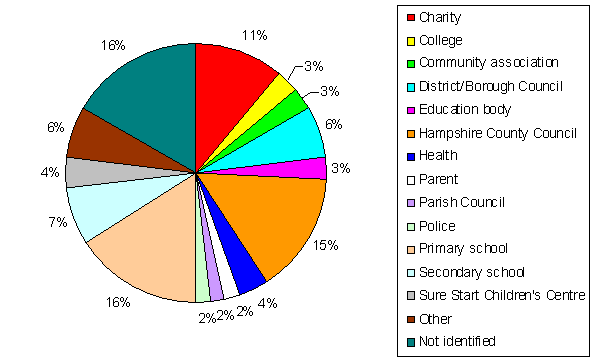
Other includes: Armed Forces, Child & Adolescent Mental Health Services, Diocesan Authorities, the Department for Children, Schools & Families/Government Office South East, Hampshire Fire & Rescue Service, New Forest National Park Authority and Hampshire County Youth Council.
Characteristics of respondents - district/borough:
Key messages
Comments repeated throughout the consultation responses: |
Resulting changes to Plan: |
Document often uses language that wouldn't be understood by the `lay' reader. |
· Care has been taken to remove any professional jargon. · A `quick read' version will also be produced. |
A children and young people's version should be produced. |
· A children and young people's version will be produced. |
The plan needs to explain what the Children's Trust is, who it involves, how it works etc. |
· Key partners are listed in the introduction to the Plan. · Links to national sources of information on Children's Trusts are provided where relevant. · Children's Trusts are explained in more detail in section 2 `Making it happen'. |
It would be really helpful to illustrate the document with case studies/examples. |
· Case studies have been signposted in the Plan, for example in section 1 where a link is provided to case studies on the Rights, Respect, Responsibilities programme. · Examples are also provided in section 2 `Making it happen'. · Quotes from children and young people will be included in the published version of the Plan. |
Agree with the concept of making pledges or commitments - but disagree with the use of the term `promise'. |
· The term `promise' has been removed. Instead, the Plan now contains a section translating the priorities into actions for children and young people to enable greater understanding. |
Children & Young People's Plan Introduction Question 1: Is the purpose of the Plan clear? |
Comments: |
Resulting changes to Plan: |
Sure Start Children's Centres are not included as partners in the Improvement Plan |
· Children's centres are included in the list of key partners in the introduction to the Plan. They are also included as partners throughout the Improvement Plan. |
Free/low cost transport is needed and the provision of services a `pram push' away |
· The provision of safe, reliable and regular public transport has been included under priority 6 in the Improvement Plan. |
Anti-social behaviour/gang culture |
· The implementation of district anti-social behaviour strategies is included in activity 5.5 in the Improvement Plan. |
Health checks for children |
· The importance of health checks for children is recognised, however as an overarching framework for improvement, the CYPP does not include any specific activities in this area. Securing the physical, emotional and mental health of all children and young people is priority 2 of the Plan. |
Some relevant statistics would be useful in the introduction |
· A new `key facts' section has been included as Appendix 2. |
Placing the `making the difference' section between the priorities/promises and Improvement Plan means a loss of flow - lose thread |
· The Plan has been significantly restructured to improve cohesion between sections. The Improvement Plan is now provided as an appendix. |
Not clear if all partners have signed up to implementing the plan |
· Forthcoming legislation will strengthen Children's Trusts, making the Children's Trust Board a statutory body and giving the Board legal responsibility for producing and securing the delivery of the CYPP. |
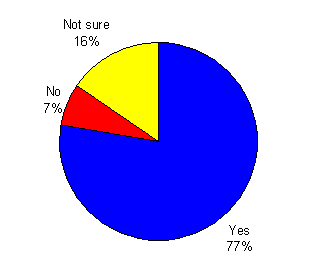
Question 2: Is the language accessible and clear to a wide audience? |
Comments: |
Resulting changes to Plan: |
The heading for the table on pages 9 - 11 doesn't work - needs a title for each column, e.g. first column: vulnerable group, second column: life experience, and third column: figures. |
· The tables detailing vulnerable groups and associated issues have been significantly amended for clarity. A number of charts have also been included to enable data comparison. |
Question 3: Are the right partners identified? |
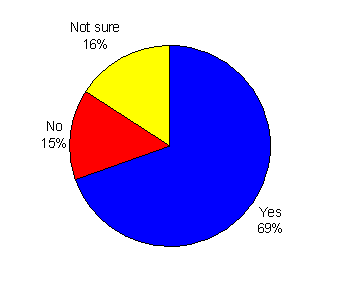
Some feedback indicated a lack of clarity about where the partners were listed. Respondents also suggested that the following partners were not included/clearly highlighted:
· Adult Services: included in Improvement Plan, where relevant
· Faith groups/church: included as a key partner in the introduction
· Hampshire Fire and Rescue Service: included as a key partner in the introduction and within the Improvement Plan where relevant
· Parish and town councils: included as a key partner in the introduction
· Hampshire and Isle of Wight Youth Clubs: included as a voluntary and community sector partner
· Counselling and support services such as RELATE: included as a voluntary and community sector partner
· Hampshire & Isle of Wight Domestic Abuse Forum: included in Improvement Plan, where relevant
· Youth Councils/youth groups: services for young people are included under `Children's Services'
· JobCentre Plus: included as a key partner in the introduction
· Probation service: included as a key partner in the introduction
· Healthcare providers who deliver in Hampshire - Southampton City PCT; Winchester & Eastleigh Healthcare Trust; Surrey and Hants Border Health Trust: included as a key partner in the introduction
· Local Health and Well-being Boards: included in Improvement Plan, where relevant
· Local Crime and Disorder Reduction Partnerships: included in Improvement Plan, where relevant
· National Childbirth Trust and local Parent Network: included as a voluntary and community sector partner
Other comments: |
Resulting changes to Plan: |
Only the music service is highlighted, why not all cultural services? |
· A variety of services providing opportunities for children and young people to make a positive contribution are included under priority 5 in the Improvement Plan. |
Integrating out of school activities into the plan (e.g. highlighting available funding) to provide access to these opportunities for children from more disadvantaged backgrounds. |
· The importance of opportunities for safe play and leisure are reflected in the Improvement Plan under priority 5. Appendix 3 outlines improvements for the commissioning of services. |
Section 1 - Where we are now Question 4: Is this section concise and clear in setting out the Hampshire picture? |
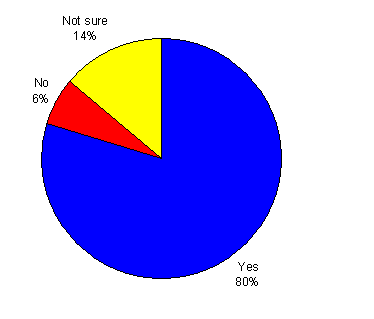
Comments: |
Resulting changes to Plan: |
This section doesn't describe the current situation of the average child - rather than vulnerable groups |
· The results of the 2009 Local Index of Child Well-Being is now included in Appendix 2. This provides a summary of the general picture for children and young people in county. `Key facts' about living in Hampshire have also been added. |
What about all children and those who are talented/gifted? · | |
It doesn't address the need for somewhere for young people to go - safe, social meeting places and facilities |
· The need for areas for safe play and socialising is reflected in the Plan, however it is not explicitly included in this section. Activities to improve the availability of facilities are provided in the Improvement Plan under priority 5. |
There is a danger that exam results become the only measure of a child's success. It is more important that the child has the right attitude and character for future success. |
· The purpose of the CYPP is to provide improvement across the five Every Child Matters outcomes - this views outcomes for children and young people in terms of health, safety, education, participation and economic well-being. The table of priorities in section 1 illustrates how Hampshire's priorities link to each of the Every Child Matters outcomes. |
Hampshire has not done a lot yet to consult and involve young people with profound disabilities. They often get left out. |
· The participation of children and young people with learning difficulties and/or disabilities is a key requirement of Aiming High for Disabled Children. The strategy for Aiming High is closely linked to the CYPP, with related activities included under priority 5 in the Improvement Plan. · In addition, Hampshire County Council's new participation strategy aims to include all children and young people in the design, delivery and review of services. |
May be useful to include the population of Hampshire and the population of under 18 year olds. |
· This is included under `key facts' in Appendix 2. |
The main problem is that it's very general - overall indicators and Hants averages, which doesn't give much focus at local/district level. It would be much clearer to have something like a map on which key challenges are marked - if that were possible. |
· This section has been amended for clarity and now has a number of sub-headings. As the CYPP is an overarching county plan, it does not provide a great level of detail at local/district level, however this will be included in local CYPPs. |
Somewhere you need a more detailed needs assessment to support this section. |
· A detailed needs assessment has been completed, the Joint Strategic Needs Assessment 2008, with a link provided in the Plan. |
Section 2 - Where we want to be Question 5: Is the UN Convention on the Rights of the Child an appropriate statement to commit to? |
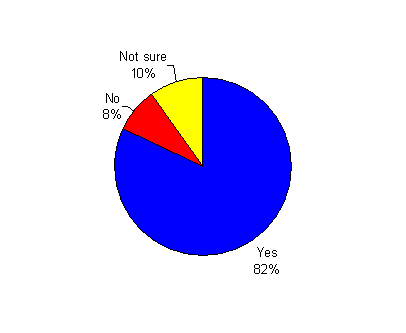
Key messages that are repeated: |
Resulting changes to Plan: |
Young people are given rights, but should the plan also highlight responsibilities? |
· The responsibilities of children and young people are included in section 1 following the commitment to the Declaration of Child Well-being in the UK. |
Some respondents commented on the fact that the Every Child Matters framework had not been used. |
· Links to the Every Child Matters outcomes are illustrated throughout the document, particularly in relation to the Declaration of Child Well-being in the UK and the six CYPP priorities. |
Positive media coverage will be difficult to achieve as Hampshire County Council cannot control the press. |
· While the Children's Trust cannot control the media, it is possible to ensure that all partners celebrate and publicise the positive achievements of children and young people. This aim is a key part of the Declaration of Child Well-being in the UK. |
There were mixed views on `love and `cherish' - some strongly approve, however more found it to be inappropriate. |
· These terms are included within the Declaration on Child Well-being in the UK. Hampshire's Children's Trust is committed to all the ambitions detailed in the declaration. |
Other comments: | |
"Our Vision" makes no mention of children with disabilities. |
· The vision and the Children's Trust commitment to the Declaration on Child Well-being in the UK covers all children and young people in Hampshire, including those with learning difficulties and/or disabilities. · Hampshire's Children's Trust is committed to the key ambitions of the declaration for all children and young people up to the age of 19. |
The UN Convention only relates to children up to the age of 17. The plan clearly states where Hampshire wants to be by 2012 in relation to young people up to and including those aged 19 years. · | |
Are UNESCO's 4 pillars of education embodied sufficiently? |
· Although not explicitly mentioned in the CYPP, the vision and priorities of the Plan do align with the four pillars - learning to know; learning to do; learning to live together; and learning to be. |
Question 6: Do you agree with the six overarching priorities? |
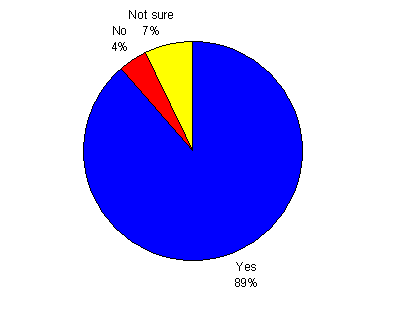
Comments: |
Resulting changes to Plan: |
The priorities need to refer more to disabled children and young people, particularly Aiming High for Disabled Children and Every Disabled Child Matters. |
· The six priorities apply equally to all children and young people in Hampshire, up to the age of 19. In addition, priority 6 has a focus on removing barriers to access, participation and achievement. · The Aiming High for Disabled Children Strategy is closely linked to the CYPP, with a number of activities included under priority 5 in the Improvement Plan. |
Mention 'building resilience' in priority 2, as that would not only help with mental health but a lot of other areas too. |
· This is now included in priority 4. |
Priority 4 should concede that this does not mean children and young people are locked away and protected from risk. Dealing with risk, in all its forms, is an important part of growing up and learning life-skills |
· This is acknowledged as `building resilience and personal confidence'. |
Priority 1: can we commit to reducing the incidence of poverty? Reducing the impact, yes. |
· Reducing the incidence of poverty is in line with the national Children's Plan goal `child poverty halved by 2010 and eradicated by 2020'. Hampshire's Children's Trust is committed to activities to reduce the incidence of poverty, including supporting parents to find work and childcare and narrowing the gap between children in poverty and their peers. |
Priority 6: looks "tagged on"; also, what about promoting diversity and individualness? What about statutory duties on promoting good relations (race, gender, disability)? |
· The activities in the Improvement Plan corresponding to priority 6 have been strengthened to reflect community cohesion, rural communities and activities to prevent bullying and discrimination. |
Need reordering - 5, 1, 2, 6, 3, 4. Priority 2 needs to include social and spiritual health. Priority 4 should read `to ensure that they are, feel and remain safe'. |
· Although numbered for reference purposes, the priorities are not in order of importance. · Social and spiritual health has now been included in priority 2. |
Since the five outcomes include "make a positive contribution" it would seem appropriate to add this outcome to priority 5 "Providing vocational, leisure and recreational activities that provide opportunities to experience success, build resilience and make a positive contribution". |
· Priority 5 now includes `make a positive contribution'. |
Need more explicit co-ownership shared with children. |
· The Plan now contains a section translating the priorities into actions for children and young people to enable greater understanding and co-ownership. |
Question 7: Does the Plan adequately identify the vulnerable groups? |
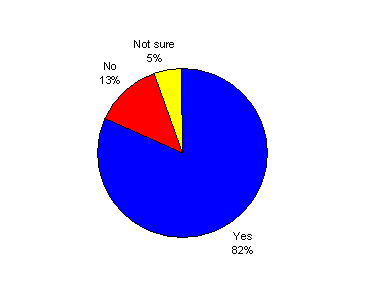
Comments: |
Resulting changes to Plan: |
The plan needs to ensure that the non-vulnerable groups don't miss out on service provision. |
· The purpose of the CYPP is to improve outcomes for all children and young people, however it has a necessary focus on addressing inequalities and narrowing gaps for those who face the greatest risks and barriers to success. |
The 2001 Census shows that there are 3300 young carers in Hampshire. Young carers are more likely to experience physical and mental health issues, bullying and behaviour problems. |
· Amended accordingly. |
Can we remove guilt as a separate emotion under lesbian and gay young people? |
· Amended accordingly. |
The placing of service families last in the table and below young offenders sends out a mixed (and possibly insulting) message. |
· Service families have been removed as a vulnerable group, however the CYPP still aims to address any issues around school admission and access to local services. Therefore, relevant activities have been including in the Improvement Plan under priority 6. |
Section 3 - What you can expect Question 8: Do you agree with the concept of promises to children and young people? |
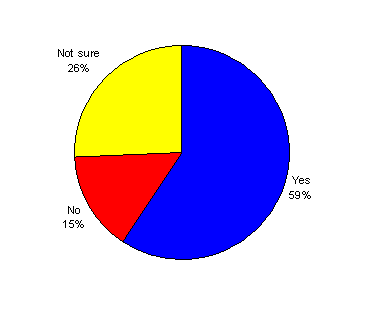
Comments: |
Resulting changes to Plan: |
A significant proportion of respondents were uncomfortable with the term `promise', generally because of fears that they would/could not be kept. The following alternatives were suggested: · Our commitment to you, or commitments · Aim · Pledges · Intentions / goals |
· The term `promise' has been removed. Instead, the Plan now contains a section translating the priorities into actions for children and young people to enable greater understanding. |
The plan needs to be more specific about who will be accountable for the fulfilment of these promises. |
· The Improvement Plan is clear about responsibility for activities to support delivery of the priorities. |
Promise to parents and carers - what about families? |
· The intention is that the term `parents and carers' is inclusive of families. |
Without success criteria the promises can appear too broad. |
· Success measures for activities supporting delivery of the priorities are included in the Improvement Plan. |
Question 9: Do you agree with the promise made to all children and young people? |
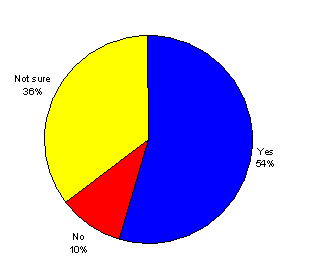
Concern around the use of the term `promise' was also mentioned a large number of times in response to this question.
Question 10: Do you agree with the promises made to vulnerable children and young people? |
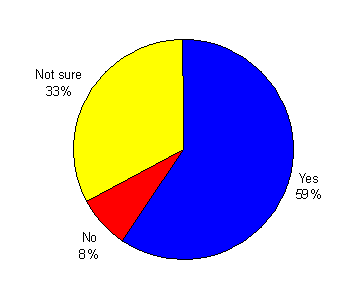
Comments: |
Resulting changes to Plan: |
This section misses links to Aiming High for Disabled Children, with reference to short breaks for carers (the term `respite' has been highlighted as out of date). |
· Amended to include reference to Aiming High for Disabled Children and remove the term `respite'. |
Why are you so insistent on getting parents and carers out to work? A child in poverty may actually prefer the emotional stability of having its parent at home and available to it at all hours, than having to depend on carers. Forcing parents to `juggle work and family' might be the kind of overload they can least cope with. Better to support them to support their family. |
· Hampshire Children's Trust will support parents to access employment and childcare, as appropriate to the individual. |
You could add `will endeavour to support young people suffering from bullying, discrimination etc', rather than `we will not tolerate'. |
· The Plan reflects a commitment to not tolerate bullying, discrimination and abuse and to provide support to those who do suffer from bullying or abuse. |
You should offer action as well as support for victims of neglect and abuse. |
· This sentence now reads `doing everything possible to keep you safe from harm and taking action to prevent and stop abuse'. |
Question 11: Do you agree with the promise to parents and carers? |
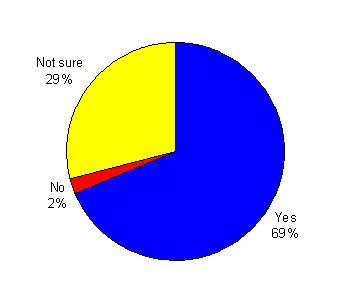
Comments: |
Resulting changes to Plan: |
Several comments suggest that the language is inappropriate and implies that parents are a problem and need support. |
· It is recognised that most parents and carers do a great job - and that they are a key partner in the delivery of the Plan. However, Hampshire's Children's Trust will offer information, advice and support, if and when needed. |
Responses around the statement `Government does not bring up children...' were mixed. Some found it very positive, others found it patronising and overused. |
· This statement has been removed. |
Statement for SEN children focuses on academic achievement and there is no emphasis on maximising opportunity for these children where academic achievement is irrelevant or impossible because of the severity of their disability. Need focus on realistic targets such as developing practical skills to aid independent living. |
· The commitment of the Children's Trust to delivering the Aiming High for Disabled Children offer recognises that opportunities for children and young people with learning difficulties and/or disabilities encompass play, leisure, respite and practical skills development in addition to educational achievement. |
Question 12: Do you agree with the promise to communities? |
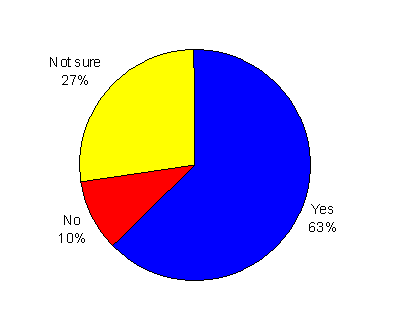
Key repeated messages: |
Resulting changes to the Plan: |
This promise/pledge needs to reflect, or influence, the Hampshire Safer Community Strategy. |
· Actions for communities include protecting vulnerable people and tackling crime and anti-social behaviour. The role of Crime and Disorder Partnerships is reflected in activities included under priority 5 in the Improvement Plan. |
Several respondents note that Hampshire County Council will need to rely heavily on the voluntary and community sector to fulfil this promise. |
· The Plan states that stronger, safer and healthier communities will require closer working with community and voluntary organisations, recognising their role and vital contribution to community engagement and well-being. |
This promise should focus on helping young people to have a positive role in their communities. |
· An action has been included to `develop children and young people's sense of belonging by encouraging them to contribute to, and take responsibility for, their local community'. |
Section 4 - Making a difference Question 13: Do you agree with the strategies for the delivery of the Plan? |
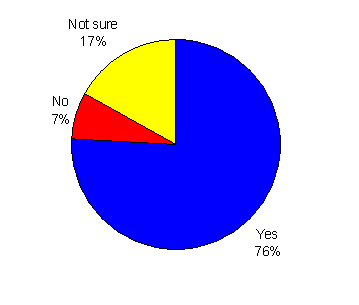
Comments: |
Resulting changes to Plan: |
Children and young people's voices and ideas need to be heard and included, not just in service delivery/development. |
· This is reflected in Hampshire Children's Trust commitment to the Declaration on Child Well-being in the UK and Hampshire County Council's new participation strategy. |
Would be good to see all schools achieving accredited status as UNICEF Rights Respecting Schools |
· Targets for the achievement of accredited UNICEF Rights Respecting School status have been included in the Improvement Plan under priority 6. |
Question 14: Are there other strategies that should be considered? |
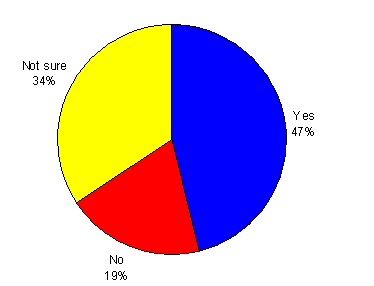
Identified strategies: |
Resulting changes to Plan: |
Financial strategies for pooled budgets. |
· A section on resources, commissioning and workforce is now provided as appendix 3. |
14-19 agenda as a policy driver for achieving outcomes for young people. |
· The 14-19 agenda is recognised as key mechanism for improving outcomes for young people, with appropriate activities included in the Improvement Plan under priority 5. A link to the 14-19 strategy has now been provided. |
A stronger emphasis on leadership development could be made. All of the plan rests on the quality and effectiveness of leadership at all levels, in particular head teachers and senior leaders. |
· This will be addressed through the development of a local workforce strategy as part of wider Children's Trust developments. |
Crime and Disorder Reduction Strategies |
· These are referenced in the Improvement Plan, where relevant. |
Hampshire Sustainable Community Strategy |
· A link to this has been provided in the Plan. |
Health and wellbeing strategies |
· These are referenced in the Improvement Plan, where relevant. |
Cultural and leisure strategies |
· These are referenced in the Improvement Plan, where relevant. |
Hampshire Local Area Agreement |
· This is referenced in appendix 4 `performance monitoring', with a link to the full agreement also provided. |
Question 15: Does the Plan provide sufficient strategic direction for partnership working? |
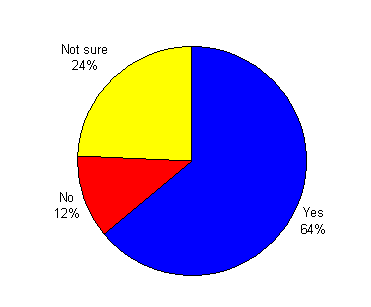
Observed gaps: |
Resulting changes to Plan: |
More emphasis on the voluntary sector contribution is needed |
· The vital contribution of the voluntary and community sector is recognised throughout the document, with the sector identified as partners in the Improvement Plan and activities from the Alliance draft business plan included in the Improvement Plan under `resources, commissioning and workforce'. |
Role of Antisocial Behaviour workforce |
· Activities to reduce anti-social behaviour are included in the Improvement Plan under priority 5. |
Reference to Community Cohesion |
· Community cohesion activities are included in the Improvement Plan under priority 6. |
References to information sharing |
· Information sharing and data are included in section 2 of the Plan `Making it happen'. |
Question 16: Does the Plan adequately explain the difference individuals/partners can make? |
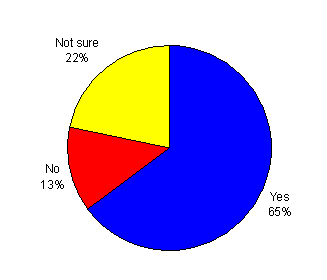
Question 17: Do you agree with the actions identified in the Improvement Plan? Is there anything missing? |
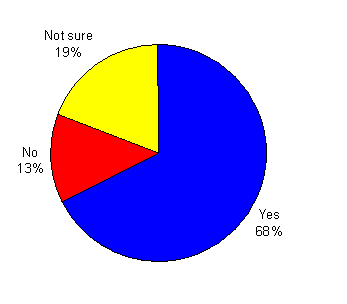
Comments: |
Resulting changes to Plan: |
Suggestions for additions to the Improvement Plan |
· These have been included in the Improvement Plan, where possible. |
The Improvement Plan doesn't recognise the social, recreational, leisure needs of young people. Would like to see a commitment to ensuring young people have access to safe social meeting places. |
· The need for safe opportunities for play and socialising is now included in the Improvement Plan under priority 5. |
This needs to recognise the contribution of District Councils around: · alcohol licensing · Crime and Disorder Reduction Partnerships · public health and Health & Well-being Boards · leisure centres · Anti-Social Behaviour Co-ordinators · Safer Neighbourhood Teams · Local Strategic Partnerships |
· The important role of district and borough councils in improving outcomes for children and young people has been recognised. District councils have been included as partners in the Improvement Plan and are named as a key partner in the introductory section. |
Activities around the prevention of domestic violence/support for victims are needed |
· Activities have now been included in the Improvement Plan under priority 4. |
Fire safety and work with the Fire and Rescue School Education Service needs to be included in the improvement plan |
· Relevant activities have been included in the Improvement Plan under priority 4. |
Refugee/asylum seeking families and children are not included |
· Relevant activities have now been included under priority 4 in the Improvement Plan. |
No mention of apprenticeships in the Improvement Plan |
· Targets for the numbers of young people completing apprenticeships have now been included under priority 5 in the Improvement Plan. |
A number of success measures don't have targets |
· The Improvement Plan has been updated to include targets for all success measures. |
What about staffing shortages e.g. social workers? |
· A section on resources, commissioning and workforce is provided in appendix 3. |
Question 18: Do you have any other comments on the Children and Young People's Plan? |
Summary of responses: |
Resulting changes to Plan: |
Challenging/comprehensive/good plan |
· N/A |
Hope it will be successful |
· N/A |
Layout is good/clear |
· N/A |
There was not enough time for consultation |
· Unfortunately tight timescales for completion of a new Plan did not allow for a longer consultation. However, over 100 individual responses were received from parents and practitioners, with a significant number of partners also taking part in workshops. |
Performance management is not included - who will monitor progress/how/who will they report to? |
· Performance monitoring is now included in appendix 4. |
The plan needs reference to the young carers strategy |
· Activities from the young carers' strategy have now been included in the Improvement Plan under priority 4. |
A priority for service families is improved school placement for their children |
· This is reflected in the addition of activities for service families under priority 6 in the Improvement Plan. |
Reference needed to the "Nation's Commitment: Cross-Government Support to our Armed Forces, their Families and Veterans" · | |
Addressing bullying needs to be a higher priority |
· New anti-bullying strategy activities have been included in the Improvement Plan under priority 6. |
Children and young people
25 completed questionnaires were received, of which 7 were completed on-line, meaning that less than 3% of the copies distributed to children and young people were filled in.
Summary of responses:
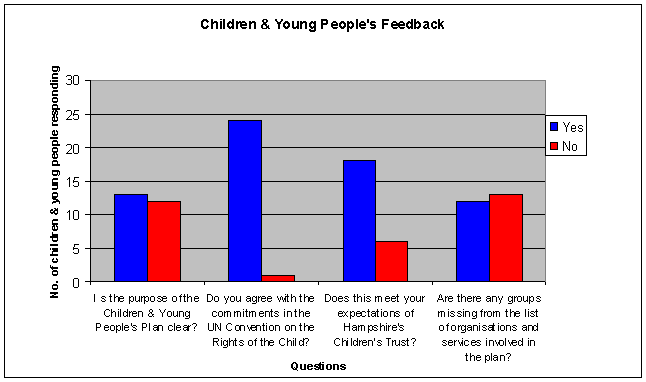
1. Hampshire's Children's Trust is committed to reducing the number of children and young people who grow up in `relative poverty' and to reducing the effect that poverty can have on the achievement and life chances of children and young people. What do you think should be done to make this happen?
Suggestion |
No. of children & young people |
Charity |
4 |
Extra support |
4 |
Free activities, travel and school meals |
4 |
Education about life e.g. money management |
2 |
Funding that goes straight to children and young people e.g. EMA |
2 |
Creating community projects/opportunities |
2 |
Comments: "Share the money and homes around to the poor people" "EDUCATION. In PSHE lessons I learn nothing useful or relevant to life! We need to learn from those with experience - like those who have suffered from debt when learning about money" |
How this feedback has been incorporated into the Plan:
Activity 2.6 - support all schools in using social, emotional, behavioural aspects of learning to encourage healthy lifestyles.
Activity 5.1 - targeted promotion of Education Maintenance Allowances (EMA).
2. Hampshire's Children's Trust aims to help children and young people to be physically, emotionally and mentally healthy and choose healthy lifestyles, regardless of their background. This includes increasing healthy eating, promoting sexual health, increasing physical activity and reducing substance misuse. What do you think should be done to make this happen?
Suggestion |
No. of children & young people |
More information/advertisements/publicity |
6 |
Counselling and support |
6 |
Teaching about healthy eating and cooking |
4 |
Free sport and activities |
3 |
Free fruit |
2 |
Comments: "Help people to be slimmer by showing them what to eat. I can only make sandwiches. They could help children to make salads and other things." "Giving out healthy food and posters. Teaching us how to cook healthy food. Free swimming. A place where you can go and take part in sport for free. Chances to make new friends. Youth clubs." |
How this feedback has been incorporated into the Plan:
Activity 2.6 - support all schools in using social, emotional, behavioural aspects of learning to encourage healthy lifestyles.
- targeted family health eating/cooking activities in areas with highest obesity rates, delivered in partnership with children's centres and schools.
Activity 5.2 - complete `Playbuilder' projects to increase inclusion in outdoor play.
- support district and town/parish councils to identify and address gaps in provision for children and young people.
3. Hampshire's Children's Trust is fully committed to supporting parents and carers and improving how well family members support each other. What do you think should be done to make this happen?
Suggestion |
No. of children & young people |
Counselling and support |
7 |
Parenting classes/workshops/kits |
4 |
Get parents more involved through school and helping with homework |
3 |
More things for families to do together e.g. free days out |
2 |
Information and publicity |
1 |
Nothing can help |
1 |
Comments: "Days when school children can take their parents to their friends parents" "Free family days out. National Children's Day - events could be free to get in. National Stay In Day - where families stay in and do nice things together. Give parents extra money to entertain children." "Love other people and respect your families" |
How this feedback has been incorporated into the Plan:
Activity 2.3 - sustain provision of parenting support through partnership working.
- provide high quality, impartial information through the Family Information Service `Hantsfish' and by the development of a new web-based service directory.
Activity 5.3 - develop a single point of contact for providing information to young people, parents, carers and partner agencies (as part of Aiming High for Disabled Children).
Activity 6.1 - provide high quality citizenship education in schools, including rights and respect.
4. Hampshire's Children's Trust wants all children and young people to have high expectations for themselves and to celebrate success. The Children's Trust is committed to helping children and young people to do better than they ever expected, both inside and outside of the classroom. What do you think should be done to make this happen?
Suggestion |
No. of children & young people |
Recognition/celebration of children and young people's achievements |
6 |
Extra classes for those who aren't doing well or aren't confident |
3 |
Classrooms with different things to do/making schools better |
3 |
Positive media attention |
3 |
Give children and young people the opportunity to be involved in decision making |
2 |
Comments: "Positive media attention - not just negative stories about young people. Give young people the opportunity to be involved in local decision making to help them feel part of something and a part of democracy" "Raise young people's aspirations by showing other young people who have done something amazing and achieved something they didn't think was possible" "Introduce a better reward system with rewards that young people really want...I want an Ipod, not a cup" |
How this feedback has been incorporated into the Plan:
Many of these ideas are included as part of the Declaration on Child Well-being in the UK, which Hampshire's Children's Trust is committed to as part of its vision for Hampshire's children and young people.
5. Hampshire's Children's Trust will work to develop stronger links between children, young people and their community. What do you should be done to make this happen? What can be done to support your community?
Suggestion |
No. of children & young people |
Raising awareness |
5 |
Clubs and groups for children and young people |
4 |
Letting children and young people work and play together/share what they do |
3 |
Sharing knowledge and equipment between schools |
3 |
Comments: "Spread the word! Have meetings, newsletters and MORE!" "Join clubs so you can meet different people from the community" |
How this feedback has been incorporated into the Plan:
Section 2 `Making it happen' - closer working between schools, early years settings, children's centres, colleges and partner organisations.
Section 1 actions for communities - developing children and young people's sense of belonging by encouraging them to contribute to, and take responsibility for, their local community.
Activity 6.1 - provide high quality citizenship education in schools, including rights and respect.
- rollout of community cohesion project into schools.
6. Hampshire's Children's Trust will work to ensure that all children and young people are safe, feel safe, and take measures to protect vulnerable children and young people. They are fully committed to tackling bullying, violence and abuse and making communities safer and more secure for all children and young people. How do you think this could be done?
Suggestion |
No. of children & young people |
More help for victims |
5 |
Raising awareness about bullying |
4 |
More police |
4 |
Better anti-bullying policies in schools |
3 |
Free security alarms and/or reflective jackets |
2 |
Promote young people being different and unique/equality and diversity |
2 |
Comments: "Give them free security alarms. Free lights and reflectors for bikes and walkers" "Help children feel that they can speak up and if they are the bully help them feel they don't need to do it and get to the root of the problem." |
How this feedback has been incorporated into the Plan:
Activity 6.1 - encourage and anti-bullying culture in schools through school policies and implementation of revised anti-bullying strategy.
- develop a framework to support schools in implementing a Single Equality Scheme.
Activity 4.3 - implement road safety education, training and publicity campaigns aimed at children and young people.
- strengthen personal, social and health education in schools to include safety education.
Activity 5.5 - implement district anti-social behaviour strategies.
7. Hampshire's Children's Trust aims to provide activities that will give positive opportunities to children and young people to experience success and build the skills base to cope in life and achieve their full potential. A focus will be put on leisure activities, skills and knowledge development through training and providing preventative and alternative activities. Also, work will be undertaken to promote positive images of children and young people and increase public confidence. How do you think this could be done?
Suggestion |
No. of children & young people |
More/cheaper/free activities at leisure centres |
7 |
Promoting good examples/advertising |
4 |
Youth groups |
3 |
Get children and young people involved in the community e.g. helping older people |
2 |
Giving children and young people the opportunity to speak out |
1 |
Better transport |
1 |
Comments: "Close bus routes because not everyone, every young person, can walk to leisure facilities due to health or due to issues regarding transport. i.e. living far from a bus stop and having NO parents who drive" "Teenagers do community work to promote positive images of children e.g. help old people do gardening" |
How this feedback has been incorporated into the Plan:
Activity 5.2 - promoting the importance of positive activities to improve children and young people's well-being.
- implement new strategy for the participation of children and young people.
Activity 6.3 - provide safe, reliable and regular public transport that enables children and young people to play a full part in educational and leisure opportunities (in line with Hampshire's Local Transport Plan 2006-11).
Activity 6.5 - provide accessible services and community/leisure opportunities for children and young people living in Hampshire's rural communities (supporting the implementation of the Hampshire Rural Strategy).
8. Hampshire's Children's Trust is fully committed to equal opportunities. All children and young people can use services, regardless of gender, ethnicity, disability and sexuality. The Children's Trust strongly believes that all children and young people have a right to access, participate and achieve. Discrimination and abuse will not be tolerated. How do you think this can be achieved?
Suggestion |
No. of children & young people |
Raising awareness |
3 |
Can't get rid of discrimination, you need to tell people the consequences and provide support |
2 |
Do something about discrimination on the basis of sexuality |
2 |
Role models in and out of school |
1 |
Comments: "Can only be achieved with energetic and positive youth workers - people who want to involve young people!" "Unfortunately everybody is prejudiced and it is not possible to achieve this." |
How this feedback has been incorporated into the Plan:
Activity 6.1 - develop a framework to support schools in implementing a Single Equality Framework.
- provide high quality citizenship education in schools, including rights and respect.
- roll-out of community cohesion project into schools.
- encourage an anti-bullying culture in schools through school policies and implementation of revised anti-bullying strategy.
9. The plan says that all organisations and services in Hampshire should be involved, including:
· Sure Start Children's Centres;
· schools and colleges;
· community and voluntary sector organisations;
· parents and carers;
· private sector providers;
· Hampshire County Council;
· district and borough councils;
· Hampshire Primary Care Trust and Strategic Health Authority;
· Hampshire Police;
· Wessex Youth Offending Team.
Are there any groups missing from this list? If yes, who? |
No. of children & young people |
Young people/youth groups/youth council |
5 |
Fire Service |
2 |
Outreach groups/youth service |
1 |
Counselling services in schools/colleges |
1 |
Local people |
1 |
ChildLine |
1 |
How this feedback has been incorporated into the Plan:
Hampshire Fire and Rescue Service has been added as a key partner.
The following are already incorporated within the Plan:
· services for young people are included as part of Hampshire County Council's Children's Services;
· young people.
10. Other comments
"Please give a simple copy to all young children so that we know that you care about us" |
How this feedback has been incorporated into the Plan:
A children and young people's version of the CYPP will be published.