
Archived decisions
Appendix 1 Existing Eligibility Criteria for access to specialist services for disabled children - March 2009
Mild |
Moderate |
Severe |
Profound | |
Physical Disability |
Able to walk and function independently, but with some limitation of function (e.g. walks more slowly, unable to run, able to get up off floor and climb stairs, but only with difficulty). Motor organisational difficulties (e.g. due to poor co-ordination). Young child mobility functioning at slightly behind the level expected for their age. |
Able to walk, but only with aids. May have wheelchair for intermittent use. Young child mobility functioning at around two thirds of the level expected for their age. |
Needs wheelchair or carer to get around or can steer chair themselves at least for some of the time. May need support to stand/transfer. Young child mobility functioning at around half the level expected for their age |
Needs wheelchair/buggy and/or help from carer all the time to get around. |
Hearing Impairment |
Hearing loss 20-40dB. Severe or profound loss in one ear only, other ear normal. Needs a clear voice. |
Hearing loss 41-70dB. Can hear sound, but does not distinguish speech. May have hearing aids |
Hearing loss: 71-95 dB. Does not hear speech May have hearing aids |
Hearing loss > 95 dB. Needs full support to make up for complete loss of sound awareness May have hearing aids or implants |
Visual Impairment |
VA 6/6 - 6/18 corrected in better eye (binocular acuity in cases of nystagmus) Able to function independently Severe or profound problem with one eye only, other eye normal. Partial (less than half) visual field loss; VA may be normal. |
VA 6/24 - 6/36 corrected in better eye (binocular acuity in cases of nystagmus). Enough awareness for normal mobility. Able to read print with simple aids and/or educational assistance. Defect of at least half visual field. (hemianopia); VA may be normal. May be eligible for registration as partially sighted. |
VA 6/60 - 3/60 corrected in better eye / severe visual field defect with impaired VA. Needs support to move around. Needs large print with technical aids and training. Could be registered as partially sighted or blind. |
VA < 3/60 corrected in better eye, e.g. counting fingers, hand movements, light perception or less. Needs extra support to move around Needs education using special methods suited to eyesight needs. Very little or no vision Could be registered as blind. |
Developmental Delay/Learning |
Educational assessment recommends differentiated curriculum, or individual or small group support to supplement core subjects of the National Curriculum. Pre-school child's performance slightly behind that which would be expected for age. |
Educational assessment show child scores two key stages below expected range of attainment. Shows a slower rate of learning. Pre-school child's general functioning is at two thirds of their chronological age. |
Child can operate within the P-levels in all areas of study for the majority of their school life. Pre-school child's general functioning is at half of their chronological age |
Child likely only to maintain early level of development throughout childhood. Pre-school child's general functioning is at one third of their chronological age |
Speech Language Communication |
Delayed language development only. Younger child functioning slightly behind the level expected for age. |
Delayed and/or disordered language development causing significant difficulty in communication outside the home. Speech supplemented by an alternative method of communication (e.g. signing or communication aid). Inability to use speech in a socially interactive manner. Younger child functioning at less than two thirds of the level expected for their age. |
Child can communicate basic needs using their chosen method, i.e. signing, communication aids. May have little speech. Younger child functioning at less than half of the level expected for their age |
Child needs special support and understanding from carer. Not able to communicate needs by any other method, including communication aids. |
Behavioural Emotional Interpersonal |
Some behaviour difficulties - mild, transient or infrequent. Can be managed without any special provision. |
Behaviour problems severe or frequent enough to require some specialist advice or provision, but not all the time. |
Needs support with behaviour over a long period of time, probably from more than one agency, to help them have safe relationships with family and friends. |
Needs ongoing professional support from different people with different expertise, with everyday behaviour which affects the safety of self and others. |
Health |
Known health condition, under control and only occasionally interfering with everyday activities in a minor way. |
Intermittent, but regular, limitations of normal activities (in most cases, additional medication frequently would be required, as well as the maintenance dosage). May interfere with development or education. |
Normal activities interrupted daily by frequent health needs, affecting progress in development or education. |
Total medical/nursing support to enable child to take part in any social or educational activities. |
Personal Care & Independence |
Slight difficulty but manages independently. Continence: 7+ and regularly wets the bed Young child functioning slightly behind the level expected for age. |
Supervision and/or assistance, with or without the use of aids, required for part of some activities. Continence: 11+ and regular night-time wetting 8+ and occasional day-time wetting 5+ and soils occasionally. Young child functioning at around two thirds of the level expected for their age. |
Needs support from carer/aids to be able to join in most activities most of time. Needs aids to help with going to the toilet. Continence: 8 + and needs support with day-time wetting, 5+ and needs regular help with bowel Young child functioning at around half of the level expected for their age |
Child 5 years + will need full ongoing support with daily activities such as: Continence Washing Feeding Teeth |
Manipulation Hand Function Fine Motor Skills |
Some difficulties in one or more of the following: play, writing, drawing. (e.g. tremor, unsteadiness, awkward release, lack of fine control). Young child functioning slightly behind the level expected for their age. |
Able to play, write, type or draw through hand movements, but only with considerable difficulty or requiring aid or assistance. Young child functioning at around two thirds of the level expected for their age. |
Needs or expected to need to use switch systems instead of hands, e.g. to operate toys/computer/ wheelchair/communication aid. Young child functioning at around half of the level expected for their age |
Needs total support from others, as unable to operate aids/switch systems. |
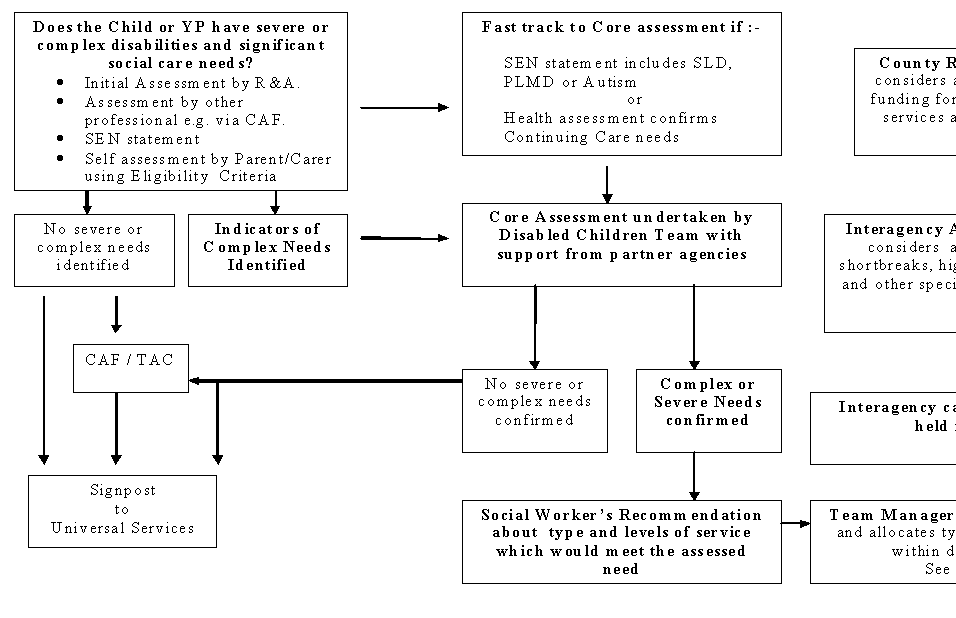
In assessing eligibility for specialist services multiple factors are likely to be present and decisions as to if the criteria are met remain a professional judgement
Outcome Categories |
Indicators of SEVERE or COMPLEX NEEDS | |||||
BE HEALTHY |
||||||
Medical/ Therapeutic Needs |
Child has unstable health, and needs regular nursing care and support and/or complex medical care (identified by Paediatrician) Normal activities interrupted daily by frequent health needs, affecting progress in development or education. Child has a planned programme of therapy |
Child has life limiting condition and requires daily nursing care and support and/or regular admissions to hospital -refer to Continuing Care criteria Total medical/nursing support to enable child to take part in any social or educational activities. Child requires intensive therapy programme. e.g. Physio therapy | ||||
Mobility and Equipment |
Child uses specialist equipment that needs operational assistance Needs wheelchair or carer to get around or can steer chair themselves at least for some of the time. May need support to stand/transfer. |
Daily use of specialist equipment by child that needs operational assistance Needs wheelchair/buggy and/or help from carer all the time to get around. | ||||
Personal Care, Self-Care skills and Independence. |
Child needs daily and regular support with basic self care functions e.g. eating, toileting, washing, dressing Needs support from carer/aids to be able to join in most activities most of time. Needs aids to help with going to the toilet. Child needs to be prepared in advance for a change in routine |
Child is totally dependent on others for all basic self care functions. Child becomes extremely distressed following any small change to daily routine | ||||
Awareness of Dangers |
Child has limited awareness of dangers and needs help to function in the environment |
Child has no awareness of dangers and is dependent on others to function in the environment | ||||
Carer's personal health |
Carer has some physical / mental health problems affecting ability to care |
Carer has severe physical / mental health problems which have major implications for caring role for whole family | ||||
Health & Safety to carer |
Significant level of risk to health/safety of carer |
High level of risk to health/safety of carer | ||||
Sensory Needs |
Does not hear speech and may have hearing aids Could be registered as partially sighted or blind. |
Needs full support to make up for complete loss of sound awareness and may have hearing aids or implants Very little or no vision. Registered Blind. | ||||
STAY SAFE |
||||||
Monitoring and Supervision |
Child requires continual supervision throughout the day and occasionally at night Child has difficulty sleeping and requires regular support from parent / carer during the night. May require sleep system. |
Child requires constant monitoring/supervision both during the day and at night Child has a disrupted sleep pattern and needs waking night support. | ||||
Behaviour |
Behaviour is a serious risk to self and others, including self harm, and requires structured behavioural management programme. Needs ongoing professional support from different people with different expertise, with everyday behaviour which affects the safety of self and other. Child has very limited understanding of risk situations and is extremely vulnerable. |
Behaviour of such intensity, frequency or duration that the physical safety of others is likely too be placed in serious jeopardy. Behaviours that create a barrier to intervention resulting in exclusion from all of the child or young person's existing environments. Sustained behaviours that demonstrate the impairment of a child's personal growth and development through an inability to access necessary resources. | ||||
Child Protection |
Child may be subject to Section 47 enquiries |
Child has been placed on Child Protection Register and has a Child Protection Plan | ||||
Sole Carer |
Sole carer but has a limited support network Significant physical and social isolation |
Sole carer with no support network. Physical isolation from communities. | ||||
Child's Placement stability |
There is risk of the child's placement breaking down at home or at school. |
There is a high risk of the child's placement breaking down at home or school. | ||||
ENJOY & ACHIEVE |
|||
Special Educational Need |
Child has been assessed as main category SLD, PMLD or Autism category on their SEN statement. |
Not attending school or maintaining school placement. | |
Care Support ratio to access activities |
Child needs 1 to 1 support to pursue inclusive interests and activities or requires specialised activities. Unable to access targeted extended services offer without a minimum of one to one support. |
Child can only pursue specialised activities with support and always requires a minimum of 1 to 1 support. Unable to access targeted extended services offer if attending special school or claiming higher rate care and / or mobility DLA without a minimum of one to one support. | |
Transition |
Parents or professionals advise that a specialist ling term care package to support education, training or employment will be required into adulthood. | ||
MAKE A POSITIVE CONTRIBUTION |
|||
Communication |
Child has considerable communication difficulties. Support is always required to facilitate communication e.g. use of choice boards, signing, communication aids. Child needs specialist support in order to express their views. |
Child needs a skilled person to interpret communication. Child needs special support and understanding from carer. Not able to communicate needs by any other method, including communication aids. Child has extremely limited ability to express views even with support. The child or young person demonstrates severe frustration around their communication. e.g. through challenging behaviour or withdrawal. | |
Appendix 3b
Eligibility Criteria - Indicators of needs , which may be met in universal services or by access to the targeted offer for those claiming higher rate care and / or mobility DLA or attending a special school
.
Outcome Categories |
Indicators of LOW or MODERATE NEEDS |
BE HEALTHY |
|
Medical/ Therapeutic Needs |
Child needs routine medical checks only and requires no or minimal nursing care/support/treatment. Known health condition, under control and only occasionally interfering with everyday activities in a minor way, and may interfere with development or education. Child has minimal therapy needs. |
Mobility and Equipment |
Child uses specialist equipment that does not require operational assistance. Able to walk and function independently, but with some limitation of function (e.g. walks more slowly, unable to run, able to get up off floor and climb stairs, but only with difficulty). Motor organisational difficulties (e.g. due to poor co-ordination). Able to walk, but only with aids. May have wheelchair for intermittent use. |
Personal Care, self- care skills/ independence, |
Child requires minimal help with personal care. Slight difficulty but manages self-care independently. Some Continence issues. Child can adapt to different situations with support. |
Awareness of Dangers |
Child has some awareness of dangers and is able to function independently in the environment. |
Carer's personal health |
Carer has no physical/mental health problems. |
Health & Safety to carer |
Low level of risk to health/safety of carer. |
Sensory Needs |
May only have Severe or profound loss in one ear only. May have hearing aids Severe or profound problem with one eye only, other eye normal. Enough awareness for normal mobility. Able to read print or distinguish pictures with simple aids and/or educational assistance. May be eligible for registration as partially sighted. |
STAY SAFE |
|
Monitoring and Supervision |
Child requires supervision in some circumstances. |
Behaviour |
Behaviour is not a risk to self or others (including self harm) and requires minimal management Some behaviour difficulties - mild, transient or infrequent. Can be managed without any special provision Behaviour problems severe or frequent enough to require some specialist advice or provision, but not all the time Child is confident and shows some understanding of risk situations |
Child Protection |
No child protection issues. |
Sole Carer |
More than one carer. |
Family Circumstances |
There are no pressures in the family other than caring for child. The family's accommodation is suitable and needs no adaptation |
Child's Placement stability |
There is no risk of the child's placement breaking down |
ENJOY and ACHIEVE |
|
Special Educational Need |
Child attends a mainstream school, or specialist resource unit within school in county, college or OLA (with Hampshire residency)
|
Care Support ratio to access activities |
Child needs support to pursue interests and activities. |
POSITIVE CONTRIBUTION |
|
Communication |
Child requires minimal support with communication Delayed and/or disordered language development causing significant difficulty in communication outside the home. Speech supplemented by an alternative method of communication (e.g. signing or communication aid). Inability to use speech in a socially interactive manner. Child able to express their views with support. There are no difficulties in relationships with peers or siblings. |
ECONOMIC WELLBEING |
The family are receiving all financial entitlements potentially including lower or medium rates of DLA benefit. |
Transition |
The child will need a low level of support to continue in education, employment or training, and may need an adult care package. |
Appendix 4
Eligibility Criteria for access by Disabled Children to Specialist Social Care services
Risk factors taken into account during assessment
| 1 .Carer has some physical or mental health problems affecting ability to care or Carer has severe physical / mental health problems which have major implications for caring role 2. Actual or potentially high level of risk to health/safety of carer 3. Child has severe sleeping difficulties requiring regular support through the night 4. The child or young persons behaviour is a serious risk to self or others and requires structured behaviour management programme. parents/carers may be unwilling/unable to implement programme and behaviours may result in the child being excluded from some situations 5. Child has been the subject of Section 47 enquiries/Child Protection Plan or if currently the subject of a Protection Plan 6. One other, or more than one other, person with disabilities in the household who needs some support 7. Sole carer and has a limited support network, which may include physical / and or social isolation of family. 8. There are some significant or complex pressures in the family e.g. domestic violence or substance misuse 9. There is risk to the child because of the physical environment 10. There is risk of the child's care breaking down.. 11. Without high levels of support the child or young person is likely to need a specialist residential / educational placement 12. There are stressful family relationships and/or some difficulties in relationships with peers which may be harmful 13. The family is experiencing difficulties in meeting financial commitments or is on a low income 14. The young person will need individual support through transition to continue in education, employment or training |
Appendix 5
Eligibility Criteria for Disabled Children accessing social care services - Summary of Model to show how needs may be met
LEVEL of NEED |
LOW |
MODERATE |
TARGETED (Special Schools & DLA offer) |
SEVERE COMPLEX | ||
|
| |||||
CHECKLIST |
Meets DDA definition of `disability`: Receipt of DLA Lower or Moderate rates |
· Receipt of DLA Higher care and or mobility rate; · Attends Hampshire Special School; |
· DLA Higher rate care and or mobility · SEN Statement ( SLD, PMLD, Autism, PD) plus social care concerns; · Continuing Health Care Needs identified | |||
SERVICE EXAMPLES |
Information about community facilities. |
Supported access to community facilities. |
Regular to frequent day, evening and overnight care support within the home or community. Short term to intensive social work input on specific issues newly diagnosed, transition. Basic to enhanced level direct payments. Occasional to regular overnight stays. |
Residential Care Residential Boarding School | ||
CASE EXAMPLE |
10yrs old MLD and partially sighted, independently mobile, self-care tasks some prompting ; Attends mainstream school and receives extra support (School Action Plus); Receives DLA Moderate rate care; Need for stimulating activities local to home or school but will need minimal supervision by staff; |
7 yr old PD, & MLS wheelchair user, carer needed for some personal care tasks; Attends Special School for PD; Wishes to attend playscheme at his local special school; Receives DLA Moderate care and Higher mobility rates; Interested in attending sports activities at local leisure centre on some weekends; |
13 yrd PMLD or SLD; 1:1 support needed daytime and nights; Parents with poor support networks; |
a) SLD, Autism severe challenging behaviour and very high risk of exclusion from local special school, with parents under chronic stress. b) Has very complex health needs i.e. life-limiting illness requires significant health practitioner care monitoring; | ||

