
Archived decisions
Project Integra
Action Plan
2009-2014
Approved by the
Project Integra Strategic Board
on 8 January 2009


Abbreviations
Abbreviation |
Definition or Explanation |
BVPIs |
Best Value Performance Indicators |
CAA |
Comprehensive Area Assessment |
CPA |
Comprehensive Performance Assessment |
CSR07 |
The Government's Comprehensive Spending Review 2007 |
EfW |
Energy from Waste |
HIOW |
Hampshire and Isle of Wight Local Government Association |
HWRC |
Household Waste Recycling Centre |
JMWMS |
Hampshire's Joint Municipal Waste Management Strategy |
LAA |
Local Area Agreement |
MAF |
Materials Analysis Facility |
MWDF |
Hampshire - Minerals & Waste Development Framework |
MFP |
Material Flow Planning |
MRF |
Materials Recycling Facility |
MRS |
Hampshire's Material Resources Strategy |
PUSH |
Partnership for Urban South Hampshire |
RPI |
Retail Price Index |
VFM |
Value for Money |
WCAs |
Waste Collection Authorities |
WDAs |
Waste Disposal Authorities |
WEEE Directive |
Waste Electrical and Electronic Equipment |
WRAP |
Waste and Resources Action Programme |
Executive Summary
Project Integra has delivered a world-class waste management infrastructure allied to effective collection services to 670,000 households - resulting in the highest landfill diversion rate in the UK. However, the partnership is now working in an increasingly complex strategic environment involving waste and materials management linked to economic growth and energy security. The partnership has to continue to adapt and move forward in order to deliver services to the public more sustainably as well as improving performance, efficiency and effectiveness under increasing financial pressures.
There are a large number of external factors and strategic drivers that impact on and affect the work of the partnership. A comprehensive list of these and the implications they may have for Project Integra are appended to the Action Plan.
Accordingly, the Project Integra Action Plan sets out the strategic outcomes which the partnership aims to deliver over the next 5 years in order to meet its long term objectives within this wider context. Each strategic outcome contains a number of specific work streams which the partnership will deliver over the next 12 months:
Strategic Outcome |
Work Streams |
Sustainable Recycling Project Integra aims to deliver high level performance at an acceptable level of cost and environmental impact whilst maintaining public support and participation. Waste avoidance is also included in this strategic outcome |
· Review the collection of different materials · Management of biowaste · Glass · Targeting Contamination and Process Efficiency · Review of Market Opportunities · New markets for materials |
Eliminating Landfill Project Integra is committed to the eventual elimination of landfill in the context of the sustainable resource management agenda, scarce local capacity and steeply rising costs |
· Options for waste streams currently sent to landfill · Minerals and Waste Plan - Infrastructure planning |
Commercial Materials Management Project Integra is seeking to provide or facilitate capacity to capture commercial recyclables in line with the national waste strategy and resource management agenda and to attract investment and achieve economies of scale. Action is dependent on Material Flow Planning to provide baseline data and infrastructure recommendations. |
· Delivering outcomes from the Material Flow Planning process and Waste Market Assessment -on current processing arrangements in Hampshire. · Examining opportunities for further facilities development and collection arrangements, including links to domestic waste collections. |
Efficiencies/Value for Money There is scope for joint working particularly in waste collection to achieve economies of scale such as optimising rounds and pooling resources |
· Sharing best practice and improving business processes · Joint working projects |
Leadership and Influence Project Integra has been successful in influencing the national agenda, securing external funding and delivering behavioural change locally. However, the partnership must continue to invest time and resources in this key strategic outcome in support of the other elements of the Action Plan |
· Effective communications · Maintaining Project Integra's profile |
Contents
3 The Role of Project Integra 33
3.1 Project Integra Core Values 33
4.1 Sustainable and Ethical Recycling 33
4.2 Elimination of Landfill 33
4.3 Commercial Materials Management 33
4.4 Efficiencies/Value for Money 33
4.5 Leadership and Influence 33
5.1 Sustainable and Ethical Recycling 33
5.3 Commercial Materials Management 33
5.4 Efficiencies/Value for Money 33
5.5 Leadership and Influence. 33
1 Introduction
Over the last 15 years, Project Integra has delivered an internationally recognised collection and processing infrastructure to ensure a more sustainable approach to the management of waste in Hampshire. Already, a 40% municipal waste recycling rate and an 85% landfill diversion rate are on target to be achieved by the end of the 2008/9 financial year. However, much work remains to be done if the partnership is to provide a sustainable materials resources system and to minimise current and future cost pressures. In addition, the partnership needs to take account of the ever changing strategic context in which it is working and ensure that it rises to the challenge of the climate change and efficiency agendas which are at the heart of government policy.
This Action Plan sits alongside the Project Integra Constitution and the Hampshire Joint Municipal Waste Management Strategy (JMWMS), which are the three core documents that underpin the Project Integra partnership.
The purpose of this Action Plan is to:
· Set out the strategic context in which Project Integra is working, at local, regional, national and international level and the links to the partnership's own strategic objectives;
· Provide a framework to assist in the delivery of Project Integra's key strategic objectives over the next 5 years, to March 2014; and
· Set out the key work streams to be delivered by the partnership over the 12 months to March 2010.
2 Strategic Overview
The Project Integra partnership is required to operate within a complex political, economic, social and environmental context. The objectives of the partnership are governed both by a multitude of external factors, including European and UK Government policy, and by local initiatives such as Hampshire's Material Resources Strategy. These strategic drivers are outlined in more detail in Appendix 2, together with a summary of the implications these have for Project Integra.
The Project Integra partnership can make a telling contribution to these agendas, the key drivers for our work are:
The Waste Strategy for England 2007, which introduces more ambitious national targets to exceed the Landfill Directive obligations and aims for 50% recycling and composting, 75% municipal waste recovery and to cut per capita levels of residual waste in half, all by 2020. The strategy also makes more explicit the Government's intention that local authorities should include commercial waste recycling in their activities,
The 2007 Comprehensive Spending Review which requires annual net efficiency savings of 3% until at least 2011 and the Local Government White Paper, which proposes a greater role for local authorities as place shapers and a duty to co-operate between councils and with other partners. In addition, the government's commitment to continuing increases in Landfill Tax provide a major incentive to further reduce landfilling of Hampshire's waste - both municipal and commercial.
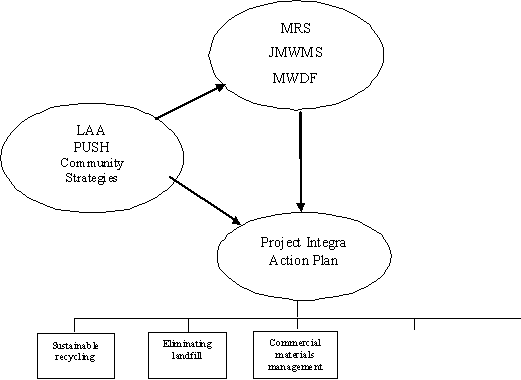
The recycling and sustainable development objectives of the Local Area Agreements for Hampshire, Portsmouth and Southampton and Partnership for Urban South Hampshire.
The Materials Resources Strategy (MRS) for Hampshire and Project Integra's Joint Municipal Waste Management Strategy (which aims to deliver the relevant municipal elements of the MRS). These strategies set ambitious targets and are helping to inform the Hampshire Minerals and Waste Development Framework which will set the planning context for the delivery of new infrastructure in the county.
The need for urgent action to mitigate the effects of climate change is an increasingly important context for our work.
These drivers establish the following strategic issues for Project Integra:
· to maintain and further develop services and infrastructure to meet recycling & waste reduction targets as well as future demand;
· to establish the extent to which commercial waste management can be supported by the partnership;
· to take into account impacts on climate change and carbon footprint; and
· to achieve these within a tight fiscal context.
3 The Role of Project Integra
The role of Project Integra is to provide a formal partnership approach and framework to deliver sustainable waste management in the context of Hampshire's Material Resources Strategy.
The key to Project Integra and its successes to date is the mutual support and co-operation that exists between all the partners and the delivery of sustainable management of municipal waste in Hampshire is dependent on the continuation of this close working.
In 2001 the partner authorities set up a Joint Committee (the Project Integra Management Board) in order to increase clarity, accountability and respond in a more effective and co-ordinated way to new challenges.
The effectiveness of the Board was reviewed during 2005/6 in parallel with the development of the Joint Municipal Waste Management Strategy (JMWMS). A number of important evolutions were agreed by the partner authorities and the Constitution of the Board was amended. To underline its strategic, rather than operational, role the Board became the Project Integra Strategic Board. The objectives of the Board mirror those in the JMWMS: to provide a long-term solution for dealing with Hampshire's household waste in an environmentally sound, cost effective and reliable way. Success in achieving this depends on joint working between all the parties in the best interests of the community at large.
To enable the partnership to address its strategic objectives in a coherent way, Project Integra needs to adopt a more corporate approach than it has done in the past and fully explore the benefits and added value that closer partnership working will bring in terms of streamlining decision making, reducing duplication and contributing to improved performance and efficiency.
3.1 Project Integra Core Values
Project Integra has agreed the following core values:
· We are a partnership founded on the principle of collaboration. This approach has served Hampshire residents well for over 10 years and continues to be essential in a complex and fast-changing environment.
· We are a partnership that encourages two-way communication and where everyone has a say in what we do and how we do it.
· We explain to people why we do things, particularly when difficult or counter-intuitive decisions are made.
· We strive to be consistent in the messages we give to each other and to the wider community.
· We want to be seen as a leading example and therefore actively seek out and promote best practice.
· We aim to make objective decisions based on high quality, up to date data and we support our own research programme to assist with this.
· We see, and encourage everyone else to see, the matter we deal with as material and energy resources, not rubbish, refuse or waste.
· We encourage the view that dealing with these resources effectively is an issue for the whole community not just for particular organisations or individuals.
· We recognise the waste hierarchy and the proximity principle. Above all, however, we seek to achieve the optimal use of material and energy resources through a balance of the appropriate environmental, social and economic factors.
· To this end, we strive to produce and supply high quality materials for ethical and sustainable markets, where possible, in the UK.
· As a partnership, we accept that these core values can be challenged and changed, but only after significant and inclusive debate. They should be seen as a framework for moving forward in a consensual manner, not a barrier to progress.
4 Strategic Outcomes
Project Integra has identified five strategic outcomes which will guide and focus the partnership's activities over the next 5 years. These are:
· Sustainable and Ethical Recycling
· Eliminating Landfill
· Commercial Materials Management
· Efficiencies/Value for Money
· Leadership and Influence.
These strategic outcomes have been developed to take into account the strategic context in which Project Integra is working and specifically to:
· Ensure progress towards meeting and exceeding the 40% recycling target in a sustainable and ethical way;
· Eliminate the landfilling of waste. This reflects the scarcity of municipal landfill sites in Hampshire and the need to control steeply rising costs resulting from the Landfill Tax Escalator;
· Focus more on dealing with commercial material alongside existing municipal waste in line with the Material Resources Strategy and the broader scope of the 2007 Waste Strategy for England;
· Deliver better value for money through greater efficiencies and partnership working in the context of the challenging 2007 Comprehensive Spending Review requirements;
· Focus effort on influencing behaviour in Hampshire through communication and education and at a national level through engagement with government and industry.
Achievement of these outcomes will also contribute to the broader strategic goals of waste minimisation and the mitigation of greenhouse gas emissions from waste management activities in Hampshire.
4.1 Sustainable and Ethical Recycling
In order to reach and exceed its target recycling level of 40% by 2010, it is essential that Project Integra continues to develop sustainable collection and processing methods, maintain public support and seek new market opportunities. This strategic outcome is not about target chasing or recycling for its own sake at any price. Rather, sustainable recycling is an approach that seeks to balance high level performance on the one hand with cost, public acceptance and environmental impact on the other. Close attention needs to be paid to markets for secondary materials which affect both cost/affordability and environmental impact, the latter particularly related to road transport if markets are remote from Hampshire.
The key focus during the plan period will be on:
1. Improving performance by:
· Maximising materials and market opportunities;
· Tackling contamination and ensuring efficient processing; and
· Communications with the public (see 4.5).
2. Improving systems by:
· Reviewing the collection of different materials;
· Reviewing input specifications for dry mixed recyclables and green waste;
· Assessing the impact on infrastructure;
· Assessing the impact on carbon emissions;
· Assessing the impact on costs;
· Seeking new markets for materials; and
· Assessing the role of procurement.
This strategic outcome also encompasses waste avoidance through home composting and food waste digestion.
4.2 Elimination of Landfill
Project Integra has the highest landfill diversion rate in the country and is committed to the eventual elimination of landfill as far as this can be practicably achieved.
Work towards this will include:
· Review of options for waste streams currently sent to landfill;
· Review of collection systems in order to increase recycling and composting (see 4.1);
· Consideration of opportunities for increasing reuse;
· Development of approaches to waste prevention particularly through communications (see 4.5).
Further measures will be considered in the context of the Material Flow Planning process which will provide detailed information regarding the different streams of material resources in Hampshire and put forward recommendations for the best way to manage those resources, integrating domestic, commercial and industrial waste. The MFP process will inform the delivery of targets and key requirements set out in the Hampshire Minerals & Waste Development Framework (MWDF) 'core' Planning Strategy and the Joint Municipal Waste Management Strategy for Hampshire (JMWMS).
4.3 Commercial Materials Management
Local authorities have a duty to collect, process and dispose of domestic waste. This waste however represents only 19% of the total waste produced in the UK. Of the remaining waste streams by far the biggest proportion comes from the commercial and industrial sector.
Although councils are not directly accountable for commercial and industrial waste they do have a responsibility to provide local leadership to effectively influence markets for the benefits of their communities. This includes facilitating collection and processing to optimise the capture of recyclables from the commercial sector. Although not a duty, there is an expectation through the Waste Strategy for England 2007 that local authorities will promote improved sustainable waste management services to small and medium enterprises across Hampshire.
The improved management of commercial and industrial waste will ensure a more environmentally sustainable economy. The certainties of supply from the municipal sector will also be attractive for private sector investors. Commercial material streams could also present opportunities for the delivery of the next generation of infrastructure through the release of private sector investment.
Accordingly, Project Integra is now seeking to provide or facilitate collection and processing capacity to optimise the capture of commercial/industrial recyclables. In addition, Project Integra is now seeking to facilitate and promote an improved sustainable waste management service to small and medium enterprises across Hampshire.
In order to deliver these objectives, a focus will be required on the following key areas during the lifetime of this Action Plan:
· Determining the waste volumes for the commercial and industrial sectors (Material Flow Planning and Waste Market Assessment);
· Assessing the feasibility of new services and infrastructure;
· Developing common policies for the collection and handling of materials;
· Producing marketing and information materials; and
· Infrastructure capacity planning.
During 2009/10 the focus will be on delivering outcomes from the Material Flow Plan and commercial market assessment processes and reviewing commercial collection arrangements.
4.4 Efficiencies/Value for Money
As part of the 2007 Comprehensive Spending Review, councils are collectively required to achieve 3% cash releasing efficiency gains each year between now and the end of 2010/11. Greater partnership working has been identified as a critical lever in the efficiency agenda and Project Integra has a long history of successful collaboration at countywide level. However, there is further scope for joint working particularly in waste collection arrangements through economies of scale such as optimising rounds and vehicle fleets and pooling management resources and expertise.
The purpose of this strategic objective is to ensure that Project Integra remains focused on the efficiency agenda in order to deliver more for customers in a challenging financial context.
There are 2 key elements to this strategic outcome:
· Sharing best practice and improving business processes; and
· Joint working on waste.
4.5 Leadership and Influence
Project Integra has been successful in the past in influencing both public behaviour locally and at a national policy level. Having been acknowledged as a best practice example of partnership working in waste management, Project Integra has, to date, secured over £12m in direct Government funding to develop collection and processing infrastructure. However, it is vital that the partnership continues to invest time and resources in this key strategic outcome in support of all the other elements of the Action Plan.
There are 2 key elements to this strategic outcome:
· Effective communication with the public, business community and other stakeholders locally, using a strategy founded on clear objectives and delivering consistent messages with one voice; and
· Maintaining Project Integra's profile nationally, influencing the national policy debate, securing external funding and promoting the sustainable production and consumption agenda.
5 Key Work Streams
A separate table is provided for each work stream, providing details of the high level priorities identified.
A detailed delivery plan incorporating timescales and responsibilities will be developed in conjunction with the Partner Implementation Plans (PIPs).
5.1 Sustainable and Ethical Recycling
Action |
Responsibility & Timescale |
Review of progress in 2008/9 |
|
Progress on the Action Plan for 2008/9 will be reported, including: · Home composting · Food waste digester trials · Food waste collection trials · Work of the MAF · Marketing of materials · Garden waste review. |
|
Review collection of different materials |
|
This review is to link in to the Material Flow Planning Process, data from which will allow analysis of collection systems. |
|
Management of biowaste |
|
Review of options for support & promotion of home composting. |
|
Actions following report of garden waste working group. |
|
Evaluation of options for food waste using the Materials Flow Planning and results from trials of digesters and the evaluation of doorstep collections (including the Eastleigh system). |
|
Glass |
|
Targeting contamination and process efficiency |
|
Reduce contamination levels in mixed dry recyclate: · Continued use of MAF data to monitor contamination trends and target resources accordingly · Use of the MAF to examine MRF residues and assess efficiency of processing · Linkage into communications plan which expects to set specific targets |
|
Review of market opportunities |
|
Secondary materials markets are ever changing. Project Integra will continue to monitor trends and changes and keep abreast of new developments. |
|
New markets for materials |
|
New legislation on batteries offers opportunities to increase the separate collection of these items. Results of trials carried out will be reviewed and opportunities for a co-ordinated approach explored. |
|
Additional opportunities for the collection of textiles and shoes will be explored. |
|
Collection of Tetrapaks using banks is being trialed in Test Valley. The results will be reviewed. |
5.2 Eliminating Landfill
Action |
Responsibility & Timescale |
Review of progress in 2008/9 |
|
Progress on the Action Plan for 2008/9 will be reported, including: · HWRC trade waste controls · Blue Haze transfer station · Shredding of non-recyclable waste from HWRCs · Processing of incinerator bottom ash. |
|
Waste streams currently sent to landfill |
|
Evaluate approaches for the treatment of wastes such as: · street cleansing · bulky household items · litter bin waste |
|
Minerals and Waste Plan - Infrastructure Planning |
|
The Minerals and Waste Core Strategy was adopted in the summer of 2007. The next stages of the project include consultation on the Site Allocation Process and preparation of the Hampshire Waste Management Plan. The Material Flow Planning work currently being undertaken will form part of the evidence base for the Hampshire Waste Management Plan which will identify sites and locations for managing Hampshire's resources in the future. |
5.3 Commercial Materials Management
Action |
Responsibility & Timescale |
Review of progress in 2008/9 |
|
Progress on the Action Plan for 2008/9 will be reported. |
|
Trade waste recycling |
|
A summary report will bring together the results of the C&I pilots in Hampshire, as well as any examples of district DSOs collecting, to outline best practice, problems encountered, and lessons learned; The report will suggest ways in which collection authorities could facilitate commercial collections, with implications on landfill, costs and processing facilities. |
|
Deliver data and market analysis outcomes |
|
Material Flow Planning data now provides information on overall volumes and material streams in Hampshire, estimates on levels of materials that can be recycled and potential scenarios for collection and processing of material; A Waste Market Assessment will provide information (spatial & operational) on current processing arrangements in Hampshire, landfill, recycling, energy recovery; Using the above information a Commercial and Industrial Gap Analysis will then be carried out to identify opportunities for further facilities development, including links to domestic waste, barriers for delivery etc; This information will also be used to update the Hampshire Minerals and Waste Development Framework and will, where appropriate, inform the further development of District Local Development Frameworks. |
5.4 Efficiencies/Value for Money
Action |
Responsibility & Timescale |
Review of progress in 2008/9 |
|
Progress on the Action Plan for 2008/9 will be reported. |
|
Sharing best practice and improving business processes |
|
A review of what Project Integra is will be carried out to ensure that its role remains clear and relevant to the partner authorities. |
|
A review and re-assessment of all Project Integra sub groups and working groups and their terms of reference will be completed in the light of the above to ensure clear accountability, communication and reporting, avoidance of duplication and best use of resources. |
|
Measures of performance used within Project Integra will be reviewed in order to ensure that these are appropriate to support the reviews and discussions that form part of this Action Plan. |
|
Joint working projects |
|
Joint working is being considered by two groups of authorities: · Joint working on core refuse and recycling services within Basingstoke and Deane, Hart, Test Valley, Havant, East Hampshire, Winchester and Portsmouth; · Joint working on peripheral services within New Forest, Southampton, Gosport and Eastleigh. Project Integra is not currently supporting these projects financially or overseeing their delivery, but expects lessons and opportunities to be shared with the rest of the partnership in due course. |
5.5 Leadership and Influence.
Action |
Responsibility & Timescale |
Review of progress in 2008/9 |
|
Progress on the Action Plan for 2008/9 will be reported, in particular: · The review of Recycle for Hampshire · Education and communications work · Awards entered · Speaking engagements |
|
Effective communication |
|
Development of a communications action plan (in line with the communications strategy). |
|
Further development of the 'Love Food, Hate Waste' national campaign on a Hampshire wide basis, as part of our waste minimisation and communication plan. |
|
Maintaining Project Integra's profile |
|
An audit of regional and national bodies dealing with waste issues to ascertain Project Integra's level of participation, and look for possibilities to increase our influence. |
|
Continuing to look for opportunities for Project Integra to enter National Awards and present at conferences. |
|
Continuing Project Integra's contribution to the debate on national waste issues and looking for opportunities to expand our role in this respect. |
6 Resources
Project Integra is funded by contributions from the partner authorities. Contributions are based on population and are divided into amounts for the costs of the Executive functions (which from this year includes Recycle for Hampshire) and a budget for projects.
The contributions for 2009/10 are shown in Table 1 the income received by partners from the sale of dry mixed recyclables in 2008/9 is shown in Table 2.
Figure 1: Project Integra Groups
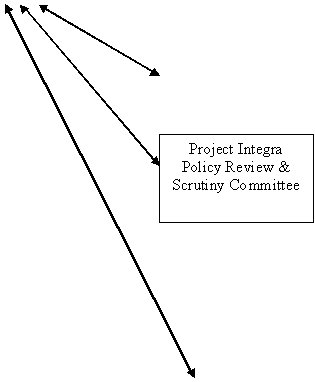

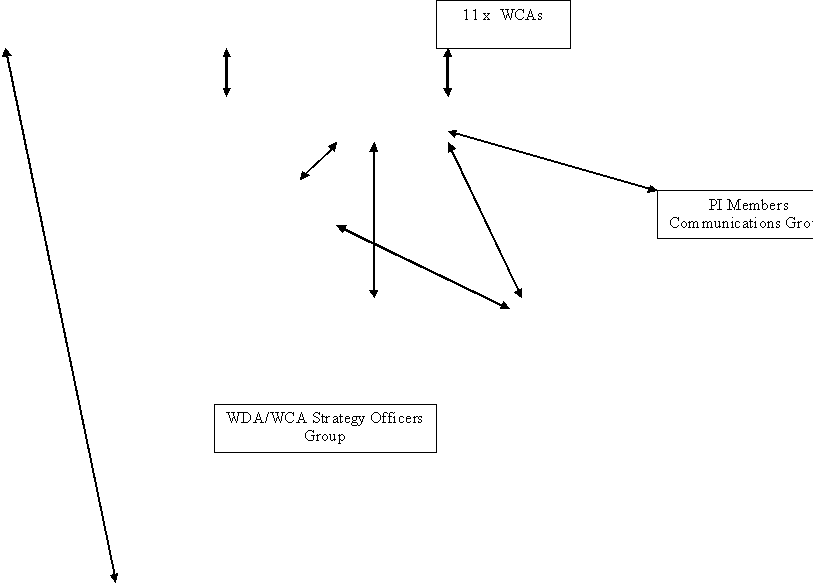
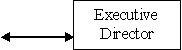
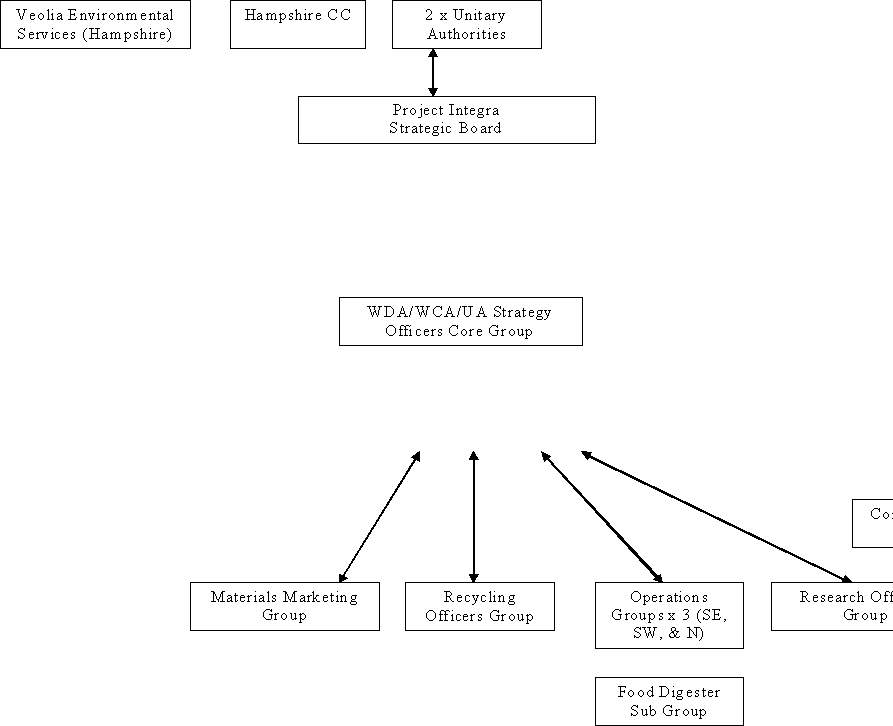
Table 1: Contributions from Project Integra Partners 2009/10
Project Integra Executive |
||||||||||||
Collection |
Disposal |
Project |
Recycle |
Total |
MAF |
Overall | ||||||
09/10 |
09/10 |
09/10 |
Funding |
for Hants |
Funding |
09/10 |
Total | |||||
Population |
£ 90.21 |
£ 20.71 |
Total |
£30.39 |
£91.16 |
|||||||
Basingstoke |
152,600 |
13,766.00 |
0.00 |
13,766.00 |
4,637.00 |
13,912.00 |
32,315.00 |
5,303.36 |
37,618.36 | |||
East Hampshire |
109,400 |
9,869.00 |
0.00 |
9,869.00 |
3,324.00 |
9,973.00 |
23,166.00 |
5,303.36 |
28,469.36 | |||
Eastleigh |
116,300 |
10,491.00 |
0.00 |
10,491.00 |
3,534.00 |
10,602.00 |
24,627.00 |
5,303.36 |
29,930.36 | |||
Fareham |
108,100 |
9,752.00 |
0.00 |
9,752.00 |
3,285.00 |
9,855.00 |
22,892.00 |
5,303.36 |
28,195.36 | |||
Gosport |
76,400 |
6,892.00 |
0.00 |
6,892.00 |
2,322.00 |
6,965.00 |
16,179.00 |
5,303.36 |
21,482.36 | |||
Hart |
83,600 |
7,542.00 |
0.00 |
7,542.00 |
2,540.00 |
7,621.00 |
17,703.00 |
5,303.36 |
23,006.36 | |||
Havant |
116,900 |
10,546.00 |
0.00 |
10,546.00 |
3,552.00 |
10,657.00 |
24,755.00 |
5,303.36 |
30,058.36 | |||
New Forest |
169,500 |
15,291.00 |
0.00 |
15,291.00 |
5,151.00 |
15,452.00 |
35,894.00 |
5,303.36 |
41,197.36 | |||
Portsmouth |
186,900 |
16,860.00 |
3,871.00 |
20,731.00 |
5,679.00 |
17,038.00 |
43,448.00 |
13,136.74 |
56,584.74 | |||
Rushmoor |
90,900 |
8,200.00 |
0.00 |
8,200.00 |
2,762.00 |
8,287.00 |
19,249.00 |
5,303.36 |
24,552.36 | |||
Southampton |
217,600 |
19,630.00 |
4,506.00 |
24,136.00 |
6,612.00 |
19,837.00 |
50,585.00 |
14,481.74 |
65,066.74 | |||
Test Valley |
109,900 |
9,914.00 |
0.00 |
9,914.00 |
3,340.00 |
10,019.00 |
23,273.00 |
5,303.36 |
28,576.36 | |||
Winchester |
107,300 |
9,680.00 |
0.00 |
9,680.00 |
3,261.00 |
9,782.00 |
22,723.00 |
5,303.36 |
28,026.36 | |||
HCC |
1,240,800 |
0.00 |
25,697.00 |
25,697.00 |
- |
- |
25,697.00 |
- |
25,697.00 | |||
HWS |
|
|
4,069.00 |
- |
- |
4,069.00 |
- |
4,069.00 | ||||
148,433.00 |
34,074.00 |
186,576.00 |
50,000.00 |
150,000.00 |
386,575.00 |
85,955.44 |
472,530.44 | |||||
Table 2: Income from Sale of Dry Mixed Recyclables 2008/9 (Estimated)
To be added at the end of the year when the detailed workplan is added.
7 Targets and Performance
Project Integra's performance, measured by the 2007/8 national Best Value Performance Indicators, is summarised in the table in Appendix 3.
A report on the partnership's progress and performance in delivering the work streams outlined in this Action Plan will be presented to each meeting of the Project Integra Strategic Board and Policy Review & Scrutiny Committee as the basis of a performance management framework to be implemented over the next 12 months.
Each Project Integra partner will be invited to produce their own Partner Implementation Plan for the 2009/10 financial year which will be added as appendices to the Action Plan once they have been completed and approved.
8 Risk Management
The table below sets out an initial assessment of the main risks to the delivery of the work streams in this Action Plan and the actions or processes in place to mitigate those risks.
Risk Description |
Likeli-hood |
Impact |
Actions Proposed/Taken to Reduce Risk |
1. There are inadequate resources to meet all priorities that have been identified. |
Medium |
High |
The Executive Director is to carry out a review of all Project Integra sub groups and working groups and their terms of reference to ensure clear accountability and delivery of objectives. |
2. Loss of influence and leadership in the national context. |
Medium |
High |
The success of Project Integra in this context is dependent on clear communications and education. The development of a clear and robust communications strategy will improve the prospects of delivering Project Integra's objectives in this arena. |
3. Poor internal communication, leading to reduced efficiency and effectiveness. |
Medium |
High |
The sharing best practice/ improving business processes work stream is designed to improve internal communications and ensure a consistent approach is delivered. |
9 Conclusion
Project Integra has been recognised as a model for partnership working to deliver more sustainable waste management. However, the partnership is working in an increasingly complex strategic context and must continue to adapt and move forward in order to deliver sustainable resource management and improve its performance, efficiency and effectiveness at a time when financial pressures are increasing.
The key drivers include the Waste Strategy for England 2007, Hampshire Materials Resources Strategy and Local Area Agreements, all of which set out ambitions for enhanced waste reduction, recycling and landfill avoidance and a broadening of action beyond Project Integra's initial focus on household waste. In addition financial pressures on authorities means that efficiency and partnership working are increasingly important and influencing the debate on funding for future infrastructure.
By setting out the complex strategic context in which Project Integra is working and outlining five resultant key strategic outcomes:
· Sustainable and ethical recycling;
· Eliminating landfill;
· Commercial materials management;
· Efficiencies/value for money; and
· Leadership and influence,
this Action Plan will help focus and direct the work of the partnership over the next five years.
Within each of the 5 key strategic outcomes, there are a series of work streams on which the partnership will focus its efforts during 2009-2010.
Delivery of these work streams will enable the partnership to further improve performance and efficiency; plan and develop infrastructure to meet the long-term objective of eliminating landfill and delivering sustainable resource management; and providing an effective approach to communications to deliver further behavioural change in Hampshire and influence wider policy making.
Further information is available from:
John Redmayne
Executive Director
Project Integra
c/o The Old College
College Street
Petersfield
GU31 4AG
Tel 01730 235806, mobile 07833 046509
E-mail: [email protected]
Appendix 1
Summary of Waste Collection Arrangements 2008/9
Residual waste |
Mixed dry recyclables |
Glass |
Garden waste |
Food waste |
Trade waste |
Trade recycling |
Contractual arrangements |
Demographics | |
Basingstoke & Deane |
W |
F |
F |
D |
Veolia 2011 |
||||
East Hampshire |
F |
F |
M |
F |
Veolia 2011 |
||||
Eastleigh |
F |
F |
M |
W |
W |
T |
In-house |
||
Fareham |
F |
F |
F |
In-house |
|||||
Gosport |
F |
F |
F |
Verdant 2009 |
|||||
Hart |
F |
F |
F |
F |
In-house |
||||
Havant |
F |
F |
F |
In-house |
|||||
New Forest |
W |
W |
F |
D |
D |
In-house |
|||
Portsmouth |
W |
F |
Veolia 2011 |
||||||
Rushmoor |
W |
F |
F |
F |
Veolia 2016 |
||||
Southampton |
W |
F |
F |
T |
In-house |
||||
Test Valley |
F |
F |
F |
In-house |
|||||
Winchester |
F |
F |
F |
Serco 2011 |
Included in council tax - bins or boxes |
W - weekly |
Mixed |
|||
Included in council tax - sacks |
F - fortnightly |
Majority rural |
|||
Chargeable service - sacks |
M - monthly |
Majority urban |
|||
Chargeable service |
T - on trial |
||||
Bring banks only |
D - with domestic |
Appendix 2
Strategic Context
The Waste Framework Directive
The European Council of Ministers adopted a revised version of the 1975 Waste Framework Directive in October 2008. The aim is to encourage the prevention, reuse and recycling of waste as well as simplifying existing legislation. The new Directive must be implemented in UK law within 2 years.
Key points include:
· 50% target for household waste recycling and reuse by 2020;
· 70% target for recycling and reuse of non-hazardous construction and demolition (C&D) waste by 2020;
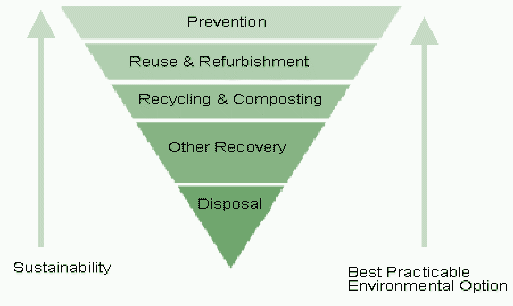
· The five-step hierarchy of waste management options, with waste prevention as the preferred option, and then reuse, recycling, recovery (including energy recovery) and safe disposal, in descending order (see Figure 2);
· Member States must design and implement waste prevention programmes, and the Commission is set to report periodically on progress concerning waste prevention
Implications for Project Integra
· The target recycling and reuse is the same as for England's Waste Strategy and less than that in the Joint Municipal Waste Management Strategy (JMWMS);
· The waste hierarchy is the same as that used in England's Waste Strategy; however, the Directive includes a definition of recovery such that only incineration facilities operating above a defined level can be classed as recovery facilities;
· There is likely to be an increased focus on waste prevention nationally. This is an identified priority in the JMWMS but is an area where relatively little activity has taken place.
Waste Strategy for England 2007
The Government's strategic approach to waste management continues to be driven by European policy and directives. However, Project Integra has been able to significantly influence the debate in the UK and the first national waste strategy in 2000 was largely based on the principles and approach adopted by the partnership. The new Waste Strategy for England 2007 builds on the previous strategy by introducing the following key objectives:
· To decouple waste growth (in all sectors) from economic growth and put more emphasis on waste prevention and re-use. (This objective is in line with the primary objective of the EU's Sixth Environment Action Programme);
· To meet and exceed the EU Landfill Directive diversion targets for biodegradable municipal waste;
· To increase diversion from landfill of non-municipal waste and secure better integration of treatment for municipal and non-municipal waste;
· To secure the investment in infrastructure needed to divert waste from landfill and for the management of hazardous waste;
· To get the most environmental benefit from that investment, through increased recycling of resources and recovery of energy from residual waste using a mix of technologies.
The waste strategy embraces the principles contained in the waste hierarchy which gives priority to waste avoidance, re-use and recycling or composting, followed by energy recovery from any remaining residual waste and landfilling only as a last resort. This is summarised in Figure 2.
Key targets within the Waste Strategy include:
· To reduce the amount of household waste not re-used, recycled or composted from over 22 million tonnes in 2000 to 16 million tonnes in 2010 with an aspiration to reduce it to 12 million tonnes in 2020 - a reduction of 45%. This is equivalent to a fall of 50% per person (from 450 kg per person in 2000 to 225 kg in 2020);
· New household waste recycling and composting national targets of at least:
o 40% by 2010
o 45% by 2015
o 50% by 2020
· New national targets for recovery of municipal waste:
o 53% by 2010
o 67% by 2015
o 75% by 2020.
Implications for Project Integra
· In most cases, Project Integra's ambitions already exceed the new national targets that have been set;
· An important exception to this is the target to reduce residual household waste arisings to 225kg per person in 2020 - this represents a significant challenge;
· The requirement for local authorities to take a wider role, including helping local businesses to secure effective and appropriate waste and recycling arrangements;
· Possible future powers to provide incentives to householders to reduce and recycle their waste (see Climate Change Bill below)
Household Waste Recycling Act
This Act requires English waste collection authorities to provide a collection service for at least two types of recyclable waste to all households by 31 December 2010 unless the cost of doing this would be unreasonably high or comparable alternative arrangements are available.
Implications for Project Integra
· The BVPI results for 2007/08 include performance against BV 91b (% of households with doorstep collections of two or more materials). All but one of the Project Integra authorities report performance of 95% or more and four report 100%;
· Although the gap from these to 100% may be small, achieving this requires concentrated work to provide services - or alternatives to `difficult' properties such as flats and households in multiple occupation.
Landfill
Landfill Allowances Trading Scheme
The Landfill Allowance Trading Scheme (LATS) is intended as a tool to enable the UK to meet European targets set by Article 5 of the Landfill Directive for the amounts of biodegradable waste sent to landfill. Each local Waste Disposal Authority (WDA) in England has been given an allocation for the amount of biodegradable waste they can send to landfill (a landfill allowance allows an authority to landfill one tonne of biodegradable waste). The individual allocations decrease annually so that collectively England will meet the targets set in the Landfill Directive.
Under the Waste and Emissions Trading (WET) Act, each WDA can trade allowances (by buying, selling or, in certain years, banking them or borrowing from future years) in order to stay within their allocation. Those failing to stay within their allocation face the possibility of incurring large fines.
Landfill Tax
The landfill tax is charged on each tonne of material sent to landfill, a lower rate applies to inert material (e.g. rubble). The current (2008/9) rate of tax is £32 per tonne and is set to rise to £40 per tonne in April 2009 and £48 per tonne in April 2010. The 2008 pre-budget report confirmed these increases and indicated the government expects the rate of tax to continue to increase beyond 20010/11.
Implications for Project Integra
· As a result of the investments in recycling and incineration facilities HCC, PCC and SCC, as the WDAs, have a surplus of landfill allowances and expect this position to continue;
· As a result of their policy of minimising landfill the WDAs have one of the lowest rates of landfill for municipal waste in the UK and so their exposure to these increases is less than most. The tax increases reinforce Project Integra's strategic priority of further reducing landfill;
· Waste disposal will become increasingly expensive for businesses - making implementation of waste reductions and recycling schemes more financially attractive.
Batteries Directive
The EU Batteries Directive is due to become UK law shortly. The Directive states that by 2012 at least 25% by weight of all portable batteries put on the market for the first time in the UK need to be collected for recycling and this target increases to 45% by 2016. These are very challenging targets as the current collection rate in the UK is estimated to be between 2 and 3% (2007).
WRAP has carried out trials of different approaches to the collection of portable batteries (kerbside collection, community drop-off, retail take-back, postal). Eastleigh participated in both the kerbside and retail take-back collection trials. The highest per capita collection rates were achieved by the kerbside schemes.
Implications for Project Integra
· The Batteries Directive is a producer responsibility directive. Local Authorities, though not in any way obligated under the Batteries Directive to participate in or finance battery collection schemes, may wish to be involved in collecting batteries;
· A mechanism will be needed to reimburse local authorities for their additional costs but at the same time local authorities will need an incentive to manage total costs effectively.
Climate Change
One of the key drivers for change is a requirement to deliver significant reductions in carbon emissions. This is at the heart of the Government's Waste Strategy for England 2007.
Intergovernmental Panel on Climate Change
In its Fourth Assessment Report released in 2007, the Intergovernmental Panel on Climate Change issued a stark warning that urgent action is needed to both adapt to the effects of climate change that are already inevitable and to mitigate greenhouse gas emissions. The panel notes that sustainable development can enhance both our capacity to adapt and mitigate climate change, reducing both our emissions and our vulnerability to climate change.
In addition, the panel notes that, while post consumer waste is a small contributor to global greenhouse gas emissions, the waste sector can positively contribute to greenhouse gas mitigation at low cost and promote sustainable development. The panel identifies a number of key mitigation practices and technologies currently commercially available, including:
· Landfill methane recovery;
· Incineration with energy recovery;
· Composting of organic waste; and
· Recycling and waste minimisation.
Stern Report
The Stern Report, commissioned by the UK Government and published in 2007, examines the economics of climate change and concludes that mitigation - taking strong action to reduce greenhouse gas emissions - must be viewed as an investment. In response, the Government has expressed a commitment to address both the causes and consequences of climate change in the Climate Change Bill.
Climate Change Bill
The Climate Change Bill, which was introduced to Parliament on 14 November 2007, will create a new approach to managing and responding to climate change in the UK.
This Bill puts into statute the UK's targets to reduce carbon dioxide emissions through domestic and international action by at least 60 per cent by 2050 and 26-32 per cent by 2020, against a 1990 baseline. The Bill will have a greater direct impact on the UK's emissions by, amongst other things, providing a power to pilot local authority incentives for household waste minimisation and recycling in five local authority areas.
Implications for Project Integra
· Nationally there has been little interest from authorities in operating one of the `incentives pilots'; Project Integra is no different;
· It is likely that we will increasingly need to consider our activities and future options in waste management with reference to climate change.
The Local Government Agenda
There is a strong focus in local government on reducing costs through efficiencies, economies of scale and joint working in the local government sector. In addition, the role of local authorities as place shapers and key contributors to the well-being of citizens, the development of sustainable communities and partnership working are recurring themes.
The Lyons Inquiry into local government identifies 4 areas where local government has a significant role to play:
· Providing safe and secure places to live;
· Helping to foster greater prosperity;
· Reducing our environmental impact by encouraging more sustainable lifestyles through engagement with citizens and performance of statutory functions; and
· Addressing levels of public trust and satisfaction.
The Local Government White Paper includes proposals for a new performance framework that will cut the number of national performance indicators to 200, and targets to around 50 and replace CPA with new assessment arrangements (see below). In addition, the White Paper proposes an enhanced role for councils as strategic leaders and place-shapers through stronger Local Strategic Partnerships and next-generation Local Area Agreements (LAAs) with wider scope and importance, and a duty to co-operate between councils and local partners.
In 2009 Comprehensive Area Assessment (CAA), which supersedes the Comprehensive Performance Assessment for local government continues to seek assurances from local authorities about how well-run local public services are and how effectively they use taxpayers' money. CAA also aims to be more relevant to local people by focusing on issues that are important to their community and the development of a shared view about the challenges facing an area, such as, for example, waste management, energy, climate change and sustainable environment.
This focus on outcomes for local people requires CAA to look across councils and others responsible for local public services, which are increasingly expected to work in partnership to tackle the challenges facing their communities.
The need for a greater partnership approach is also echoed in the Government's 2007 Comprehensive Spending Review (CSR07). The three year Government funding settlement requires all public services to achieve at least 3% net cash-releasing value for money gains per year between 2008 and 2011. Enhanced efficiency is essential to maintain and enhance service quality in the years ahead, while staying within the resources to be allocated for the CSR07 period.
Implications for Project Integra
· Increasing financial pressures on partner authorities will mean consideration of the cost benefits and efficiencies to be achieved when considering the development of additional recycling services;
· Projects relating to efficiency and the achievement of savings from waste services have particular relevance.
Local Area Agreements
Hampshire
A new Local Area Agreement (LAA) for Hampshire for 2008 - 2011 has been agreed. This forms the central performance monitoring basis for HCC and its partners through the new Comprehensive Area Assessment.
The LAA comprises 8 themes, one of which is Environment (priority G). Within this theme there are three improvement priorities:
· To use material resources more efficiently;
· Mitigate progress of Climate Change; and
· Adapt to consequences of Climate Change.
The first priority is most directly significant to Project Integra (who is listed as a delivery partner) which has one national target and one local target:
· NI 193: Percentage of municipal waste landfilled
to reduce performance progressively from a baseline of 15% progressively to 12% in 2011;
· Local Indicator G1: Household waste recycled and composted
Increasing performance in recycling and composting by the Hampshire Districts and aiming for a target linked to the overall Project Integra Plan of 35% performance in urban areas and 40% in rural areas.
Climate change mitigation is also an important consideration to be taken into account in partnership activities.
Portsmouth
Portsmouth's LAA runs from 2008/9 - 2010/11 and comprises 10 Priorities. Priority 5 is to `Make Portsmouth an attractive and sustainable city'.
The main targets relevant to Project Integra are:
· Increased recycling and composting (NB definition of this target is different to the NI as it includes additional materials recovered)
Progressively increasing performance up to 34% in 2010/11
· NI 193: Percentage of municipal waste landfilled
Progressively reducing to 12.4% in 2010/11.
Southampton
Southampton's LAA runs from 2007/8 - 2009/10 and comprises 4 themes, including Safer and Stronger Communities. Key Outcome 7 is `To improve the city's environment and people's views about the quality of life within their neighbourhoods'.
The main targets relevant to Project Integra are:
· Reduction in the percentage of municipal waste landfilled
Aiming for 22.10% by 2009/10 - this is now covered by NI 193
· Increase in the percentage of municipal waste recycled
Aiming for 27.28% by 2009/10.
Implications for Project Integra
· There is consensus on the priority measures for all Project Integra authorities:
· Reducing waste going to landfill; and
· Increasing reuse, recycling and composting,
these are consistent with the Joint Municipal Waste Management Strategy (see below)
· Consider the mitigation of climate change in all partner activities.
Partnership for Urban South Hampshire (PUSH)
PUSH is a formal partnership of eleven local authorities in South Hampshire. The main aim of PUSH is the delivery of a strategy for economic-led growth in the sub region between now and 2026, to make South Hampshire more prosperous, attractive and sustainable and offering a better quality of life.
PUSH aims to deliver a strategy for economic growth that is environmentally sustainable and the partnership has established a Sustainability Group to ensure that the principles of sustainability will inform and determine the nature of key development proposals during the lifetime of the strategy. These principles include, amongst others:
· stabilisation and reduction in the use of resources
· net self-sufficiency in resource recycling and waste handling
· joint decision making on targets for resource usage and planning for resource management infrastructure
· planning that takes into account necessary mitigation and adaptation measures with regard to climate change.
Implications for Project Integra
· The work of the Project Integra partnership supports the key PUSH objective of sustainable economic growth in the sub-region by ensuring the effective management of municipal and commercial materials.
Materials Resources Strategy (MRS)
At the beginning of 2005 Hampshire County Council, Portsmouth City Council, Southampton City Council and Project Integra jointly facilitated the development of the Hampshire Materials Resources Strategy (MRS). The development process resulted in the publication of `More from Less', a synopsis of seventeen months of stakeholder dialogue which articulates stakeholders' aspirations on issues related to natural resources, minerals and wastes. More From Less is intended as a primary reference point to guide and integrate 3 key work areas:
· Production of the statutory Joint Minerals and Waste Development Framework;
· Development of plans for managing municipal waste under Project Integra; and
· Implementation of societal change objectives via the Hampshire Natural Resources Initiative.
In effect the MRS represents an extension to the Community Strategies in Hampshire with a focus on natural resources. Key themes from these Community Strategies include: protecting and enhancing Hampshire's environment, supporting Hampshire's economy, preparing for global warming, reducing the causes of environmental damage, minimising waste production, maximising recycling, re-use and composting through new practices and education and publicity campaigns, disposing of residual waste locally by sustainable means, improving urban design and combating fly-tipping.
`More from Less' identifies a number of outcomes which stakeholders wished to see delivered:
· Achieving behaviour change that maximises reuse, recycling and recovery;
· Reducing overall year on year waste growth to 1% by 2010 and 0.5% by 2020;
· Achieving an overall recycling rate of 60% by 2020 for all Hampshire's waste (not just household);
· Optimising the cost of recycling to public and private sectors;
· Achieving net self-sufficiency in dealing with all waste arisings by 2016;
· Maximising materials and energy recovery from unavoidable waste;
· Reducing use of landfill for all waste materials to a minimum practicable level by 2020;
· Reducing demand for new minerals to minimum practicable levels, with extraction of sand and gravel from land reduced as far as practicable;
· New sites and facilities provided meeting needs in a sustainable efficient way;
· Providing a supportive policy framework and involving all sectors of the community in delivering solutions and change.
Dealing with construction waste more effectively and ensuring much higher levels of recycling and minimisation of waste is a key priority for Hampshire County Council. Working with partners such as WRAP and PUSH the County Council have been developing best practice and putting in place appropriate policies in the Minerals and Waste Development Framework, to assist in achieving a more sustainable approach to resource use related to development activity.
Implications for Project Integra
· More From Less identifies that a key issue for Project Integra is to maximise affordability and value for money for the council tax payers, including optimizing recycling performance across the Project Integra partnership, and maximising cost efficiencies through economies of scale and joint working.
Hampshire Joint Municipal Waste Management Strategy (JMWMS)
The JMWMS has been produced by Project Integra with the vision that by 2020, Hampshire will have a world class and sustainable material resources system that maximises efficient re-use and recycling and minimises the need for disposal. It has been developed in the context of Hampshire's Material Resources Strategy. It is also closely linked to the Minerals and Waste Core Strategy (see below), as both have been developed in parallel, using `More from Less' as a reference point and using similar sustainability objectives and appraisal techniques.
Aims of the JMWMS:
· To deliver the relevant municipal elements of the Material Resources Strategy;
· Win the support and understanding of the wider public;
· Make access to recycling and related facilities a positive experience for residents and businesses;
· Improve the understanding of, and contain the year on year growth in material resources generated by household consumption;
· Maximise value for money by considering the system as a whole;
· To provide suitable and sufficient processing facilities for existing and new material streams;
· Secure stable, sustainable and ethical markets for recovered materials and products;
· Ensure each partner clearly understands its roles and responsibility for delivery; and
· Meet statutory obligations and maintain Hampshire at the forefront of the waste to resources agenda.
JMWMS will deliver these aims using the following preferred approach:
Collection - Kerbside collection of dry mixed recyclables, glass and textiles; promote home composting and the use of food digesters; introduce chargeable kerbside green waste collections and facilitate the provision of enhanced waste electrical and electronic equipment (WEEE) `bring' facilities at household waste recycling centres (HWRCs).
Commercial Recycling - Provide / facilitate collection and processing capacity to optimise the capture of recyclables from the commercial sector (recyclables that are similar in nature to those arising from the municipal waste stream).
Waste Growth - MRS and Regional Waste Strategy targets - reduce growth to 1% per annum by 2010 and 0.5% pa by 2020.
Treatment of Residual - Thermal treatment (EfW) of at least 420,000 tonnes per annum with excess residual waste being sent to landfill in the short term and further treatment in the long term.
Landfill - Pre-process all household waste with residues only to landfill (and minimum organics to landfill).
Implications for Project Integra
· JMWMS states that the Project Integra partners will seek to positively contribute to the achievement of the following MRS recycling and composting targets for all waste:
o 50% by 2010
o 55% by 2015
o 60% by 2020.
· Whilst Hampshire is clearly `ahead of the game' in the UK waste management context, there are a number of important developments that dictate that we cannot rest on our laurels. In municipal waste management terms, the key challenges ahead can be summarised as follows:
o Waste volumes have increased significantly over the assumptions on which Project Integra was based. Population growth and new development will exacerbate this problem in the years ahead;
o The understanding of what can be achieved in recycling terms, together with community aspirations, has increased;
o Landfill costs have risen significantly and will continue to rise through increases in Landfill Tax, increasingly making landfill the option of `last resort' in both environmental and financial terms; and
o All of the above point to a trend of increasing revenue costs for waste management for the next decade and beyond, highlighting the need for innovative approaches to contain costs / generate revenue.
· In addition an important complementary agenda has opened which recognises that waste management should not be an end in itself, but considered as part of the much wider climate change and sustainability agenda. There is increasing recognition that waste management can act as a catalyst to achieve wider objectives such as sustainable communities if plans are developed in an innovative way and integrated with other services from the outset.
· The partnership has a potential opportunity to fully adopt the material resources philosophy in an integrated sustainability solution. The aim would be to maximise linkages with wider objectives and use the need for new waste systems as a catalyst for overcoming traditional barriers to implementing new approaches. In this context, it represents a step-change in relation to the current Project Integra approach:
o New infrastructure developed for recyclable/residual waste with provision for recyclable / residual waste (potentially including commercial and industrial (C&I));
o The integration of waste, local energy production and sustainable transport;
o Potential integration of some commercial and industrial waste streams and the creation of additional C&I waste capacity;
o The development of combined heat and power infrastructure, with an emphasis on new development; and
o The formation of new delivery structures to deliver these integrated solutions.
· The wide scope of this work would require high capital investment although there is scope for this to be shared with developers and other service providers. As this is a new approach, the revenue costs are uncertain at this stage although they would be expected to offer best value in the longer term as energy and raw material prices are predicted to increase in long-term global markets.
· The JMWMS was adopted in April 2006, there is a commitment to review the Strategy after five years.
Minerals and Waste Development Framework
The Core Strategy of the Minerals and Waste Development Framework (MWDF) sets out a long-term spatial vision for minerals and waste planning in Hampshire and will contain the primary policies and proposals to deliver that vision:
"By 2020, Hampshire will have a world class and sustainable material resources system that maximizes both the efficient use of primary materials and the reuse and recycling of wastes, and minimises the need for disposal."
The overall approach is based on principles of improving resource efficiency by improving the sustainable design of new building, progressively slowing the pace of waste growth and maximising the recovery of value from wastes prior to landfill.
As far as possible, waste will be managed near to where it is produced and in accordance with the waste hierarchy. Value will be recovered through technically advanced re-use, recycling and composting processes, or failing that, through the recovery of energy and / or materials from the waste. The amount of waste going to landfill will be very limited in quantity and biodegradable content.
Implications for Project Integra
· Both the MWDF (see above) and the JMWMS are significantly based on data and principles established in the MRS (see above), this ensures consistency between these two strategic approaches.
Local Public, Social and Market Pressures
There remains continued pressure from the public in Hampshire to continue to increase the range of materials that can be recovered for recycling. Tetrapak recycling is a good example of the difficulties that this presents in terms of ensuring that the financial and sustainability issues are well understood by both the public and the media.
The partnership benefits from the sale of recyclables, the value of which is dependent on changing market conditions both nationally and internationally. The rapid economic growth of countries like China and India has had a global effect on resource use and commodity prices - stimulating the market for secondary raw materials but also pushing up fuel prices. The recent economic downturn has seen demand and prices for many secondary materials drop dramatically.
Implications for Project Integra
· The recent reductions in secondary materials markets are likely to increase net costs of providing recycling services in 2009/10 compared to 2008/9, the implications of this will vary between authorities;
· If current market conditions persist then this issue is likely to achieve a high public profile - managing this positively will be important to ensure that there is a limited adverse affect on the significant public support for recycling that exists in Hampshire;
· The partnership will continue to monitor market activity and is committed to supplying high quality secondary materials in order to ensure sustainable markets and income.
Figure 3: Project Integra Action Plan: Summary of Strategic Context
International |
Landfill Directive EU 6th Environmental Action Programme Stern Report/ Climate Change Bill
|
Limiting landfill Waste reduction Increased recycling Decouple waste growth from economic growth Climate change |
National |
Efficiencies & VFM
|
Waste reduction Increased recycling Decouple waste growth from economic growth Climate change Commercial wastes Reducing costs through efficiencies & joint working Place shaping and influence Public well being |
Local |
|
Waste reduction Increased recycling Sustainable resource management Self sufficiency in waste Sustainable development Env protection Sustainable resource use |

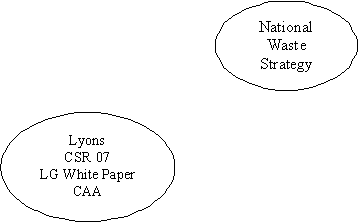


Leadership & influence
Appendix 3 Performance 2007/8
LOCAL AUTHORITY |
2005-06 BV82 a+b (Recycling+ composting rate %) |
2006/07 BV82 a+b (Recycling+ composting rate %) |
2007-08 BV82 a(i) (Recycling rate %) |
2007-08 BV82b(i) (composting rate %) |
2007/08 BV82 a+b (Recycling+ composting rate %) |
Statutory recycling target % |
Percentage point increase on year (0607 to 0708) on recycling rate |
2007/08 BV 86 Cost of waste collection per household |
2007-08 BV84a: kg of household waste collected per head of population |
BV 84b: percentage change from previous year in kg collected per head of population | |
Basingstoke & Deane |
17.3 |
19.91 |
22.03 |
0.95 |
22.98 |
30 |
3.07 |
£51.30 |
392 |
-2.84 | |
East Hampshire |
33.6 |
34.83 |
32.30 |
5.79 |
38.09 |
24 |
3.26 |
£56.86 |
345 |
1.10 | |
Eastleigh |
34.7 |
37.46 |
32.60 |
6.53 |
39.13 |
30 |
1.67 |
£54.53 |
343 |
-2.09 | |
Fareham |
28.4 |
38.37 |
28.65 |
13.40 |
42.05 |
30 |
3.68 |
£46.66 |
361 |
1.65 | |
Gosport |
23.6 |
24.10 |
24.44 |
1.42 |
25.86 |
27 |
1.76 |
£40.05 |
342 |
-0.75 | |
Hampshire |
31.8 |
36.74 |
27.11 |
12.73 |
39.84 |
30 |
3.1 |
N/A |
510 |
-1.30 | |
Hart |
25.4 |
30.85 |
34.06 |
5.55 |
39.61 |
30 |
8.76 |
£56.05 |
363 |
-3.51 | |
Havant |
24.0 |
30.31 |
31.68 |
0.49 |
32.17 |
30 |
1.86 |
£40.54 |
332 |
-0.52 | |
New Forest |
26.4 |
28.71 |
30.26 |
2.94 |
33.20 |
30 |
4.49 |
£45.88 |
364 |
-5.86 | |
Portsmouth |
20.5 |
23.03 |
20.48 |
4.00 |
24.48 |
30 |
1.45 |
£46.75 |
404 |
-5.14 | |
Rushmoor |
21.6 |
22.47 |
22.76 |
3.02 |
25.78 |
24 |
3.31 |
£59.53 |
362 |
-0.22 | |
Southampton |
25.7 |
25.51 |
19.28 |
7.86 |
27.14 |
24 |
1.63 |
£58.07 |
441 |
-4.84 | |
Test Valley |
27.2 |
27.01 |
28.87 |
6.22 |
35.09 |
30 |
8.08 |
£51.26 |
372 |
-3.34 | |
Winchester |
20.2 |
24.26 |
28.25 |
7.75 |
36.00 |
30 |
11.74 |
£63.95 |
374 |
-1.28 | |
All England Average |
34.50 |
£53.07 |
-8.22 | ||||||||
All England Top Quartile |
|||||||||||
English District Average |
|||||||||||
English District Top Quartile |
Appendix 4
Map of Project Integra's Waste Management Infrastructure
Map available on request