
Archived decisions
Decision Maker: |
Cabinet | ||||
Date of Decision: |
30 March 2009 | ||||
Decision Title: |
Corporate Reviews: A modern business providing public services | ||||
Decision Reference: |
659 | ||||
Report From: |
Chief Executive | ||||
Contact name: |
Andrew Smith | ||||
Tel: |
01962 847300 |
Email: |
|||
1.0 Introduction and purpose of report
1.1 The Cabinet at its meeting on 21 July 2008 discussed the future shape and structure of the Chief Executive's Department, the need for a review of corporate services and the need for an approach to managing efficiency so as to release further resources for redeployment to meet front line service pressures. The report also set out key lines of enquiry and functional areas for review together with the proposed process for reviews.
1.2 Cabinet at its meeting on 22nd December 2008 agreed the Terms of Reference for each review (the Terms of Reference have been included at the beginning of the summary sheet for each review at Appendix 1) covering:
_ Procurement
_ Economic Development
_ Democratic Services (Business Support and Advice to Members)
_ Property Business & Regulatory Services
_ IT Services
_ Shared Services
_ Legal Services
_ Hantsdirect
_ Human Resources
1.3 Corporate Management Team and Cabinet Sponsors for each review were also identified as follows
Review |
Cabinet Member |
CMT Sponsor |
Procurement |
Cllr R Ellis |
Alison Quant |
Economic Development |
Cllr R Perry |
Gavin Wright and Jon Pittam |
Democratic Services |
Cllr R Perry |
Karen Murray and Yinnon Ezra |
PBRS |
Cllr TK Thornber |
Karen Murray |
IT Services |
Cllr D Kirk |
Karen Murray |
Shared Services |
Cllr F Hindson |
Andrew Smith |
Legal Services |
Cllr D Kirk |
Gill Duncan and Jon Pittam |
Hantsdirect |
Cllr M Snaith |
Gill Duncan and John Coughlan |
HR |
Cllr P Banks |
Alison Quant |
1.3 The purpose of this report is to update Cabinet on progress on each review (specific progress is updated in the summary sheets in Appendix I), identifying specific cross cutting issues and recommending specific action in relation to each review. These are also summarised in the principal recommendations identified within the summary sheet for each review. While not all of these require Cabinet approval they have been included in the report for completeness.
1.4 Some of the recommendations can be implemented with immediate effect.
Some will require more work and represent `work in progress'. The `Direction of Travel' for each review is set out in section 2.0 below to allow Cabinet to adopt the strategic decisions for each review and for the Chief Executive to implement in day to day operations. Subject to approval by Cabinet of the Direction of Travel and specific recommendations a further report will be prepared for Cabinet on 27 April 2009 on the proposed management arrangements. The required approvals in relation to personnel issues will be reported to EHCC on 22 April 2009.
Recommendations
It is recommended that Cabinet:
1. Approve the report on the Corporate Services Reviews as the basis for further work on the revised management arrangements.
2. Adopt the strategic issues identified in Section 2 as the `direction of travel' for that activity with any consequential decisions requiring member approval being reported to the Executive Members for P&R in the normal way.
3. Approve the Corporate Services Review Outcomes in the Schedules in Appendix 1 for implementation, further work and/or research as appropriate.
4. Authorise the Chief Executive to implement the above and report to Cabinet on 27 April 2009 on the management arrangements to facilitate the decisions in 1, 2 and 3 above.
2.0 Corporate Reviews - Direction of Travel and Outcomes from Reviews
2.1 Procurement - see Sheet A in Appendix 1
2.1.1 The review has identified this activity as potentially providing future efficiencies. The scale of the `market' is enormous with the County Council `spending` about £640 million per annum on third party goods and services.
2.1.2 The principal recommendation is to develop a more corporate approach to procurement, based around a model of strategic sourcing for principal categories of spend (often, referred to as a `category management' approach. This model is based around:
_ a Corporate Procurement Board
_ central and departmental `category managers'
_ performance arrangements based on `Driving Success'
_ the development of a `Head of Profession` role
_ significant training and development of `licensed practitioners'
_ savings targets
2.1.3 The review has also looked at what needs to be done to develop effective compliance arrangements which would be developed through the Corporate Procurement Board. Considerable attention has also been focused on the benefits of centralisation of more of the function with the `category management' approach offering the best of services-based commissioning, with more aggregated contacts being developed centrally for more common goods and services. The strategic direction is more focus, stronger management and arrangements around `categories of spend'. One major thread that should be adopted is to centralise procurement functions within departments as a first step to category management. This review has also identified the targeting of efficiency savings in `purchase to pay' costs and significant savings in categories of spend (up to £10 million) which will be carried forward and implemented as part of the Efficiency Review.
2.2 Economic Development - see Sheet B in Appendix 1
2.2.1 The review has identified the need to strengthen and integrate the different functions that make up Economic Development. The need for a strategic approach, not solely because of the recession, but also to recognise the natural competitive advantages that the Council has in this field: land and asset management; skills development; apprenticeships; transport; education and learning, purchasing power and its size as an employer.
2.2.2 This new strategic function also sits alongside our place shaping role as an upper tier authority. Punching our weight in this activity would require a review of management arrangements. The principle recommendation is to approve the development of a new strategic function for economic development.
2.3 Democratic Services - see Sheet C in Appendix 1
2.3.1 The main focus of this review was to establish how to review Member support consistent with the different roles Members play and recognise existing levels of service and the impact of the `Leader and Cabinet model.'
2.3.2 The strategic objective of the review was to develop arrangements that put `Members at the centre of the service' as the principle customer. This requires an integration of activities (e.g. HATS, Scrutiny, Democratic Services and some support functions) to allow more focused support, efficient organisation and development of a more broadly based skill set for staff. There is also a cultural adaptation required to the customer ethos of the function. A significant number of `housekeeping` issues were reviewed which will be put into operation. Recognising that it is not proposed to add resources to this function it will be important that overlap and duplication are minimised and more structured business process are implemented, together with development and career opportunities for staff.
2.3.3 It is proposed to decouple the managerial relationship between this activity and the management of Legal Services.
2.3.4 It is recommended that a Head of Member Services features in the revised organisational arrangements. It is also recommended that the services be rebranded as Business Support and Advice to Members. It is also recognised that the central staff have to play a part with staff in departments to improve workload planning.
2.4 Property, Business and Regulatory Services - see Sheet D in Appendix 1
2.4.1 This was a `light touch' review focusing on two specific issues: the business model for Property Services and a strategic assessment of the future of HC3S, the County Council's successful catering operation.
2.4.2 The principle recommendation is to endorse the development of a `public-private' model to underpin the Property function's regional leadership. Building Capacity with private sector partner(s) would, subject to legal and other commercial considerations be the only practical way to cope with significant increase in the department's role with other local authorities. The department is the lead for the construction workstream for the Regional Improvement & Efficiency Partnership providing services to some 40 local authorities in the South East and London.
2.4.3 Further exploration of this approach is recommended and the proposal is to develop a shared service arrangement based on a wholly public-owned Trading Company. The Council's regional leadership could develop further as the national programme for BSF is rolled out and the Chief Executive is being asked to develop similar arrangements for the other regions in England.
2.4.4 The strategic issues relating to HC3S suggest that the objective of retaining and developing the business remains the most favoured on the basis that a financial strategy can be developed in line with any future withdrawal of central grant support. Continuing to run the Business units but refreshing them, where appropriate, is also the recommended strategy to 2011 when existing SLAs run out. Schools have in the past indicated strong support for this strategy. This review would also include the long-term future of the Hampshire Printing Service.
2.4.5 The management arrangements for Business Services and Regulatory Services are stable. Consideration will be given to endorsing the current interim management arrangements at EHCC on 22 April 2009.
2.5 IT Services - see Sheet E in Appendix 1
2.5.1 The review identified the strategic and operational importance attached to effective IT management and delivery. There were four key issues:
· Joining up the Council
· Improving access to the Council
· Driving transformation
· Supporting service delivery
2.5.2 The review developed several recommendations:
· create a single IT department
· improve programme and project delivery
· improve IT procurement (see separate Procurement section elsewhere on the agenda)
· develop new business models recognising the overlap with Shared Service developments
· develop new access channels as part of a wider customer services strategy (see Hantsdirect)
· improve information management and
· improve IT skills
2.5.3 However, IT needs to be thought about and implemented with other activity (e.g. Shared Services, Procurement etc), with other processes (e.g. Hantdirect), and with service developments (e.g. Personalisation). It was recognised that IT was an `end to end' activity needing to move beyond technical issues into ownership and service improvements. This suggests the need for a more integrated form of management and a different relationship with other services and corporate activity. These issues will be factored into future considerations on the management arrangements. The report also identified potential for headcount reductions which would be taken forward into the efficiency reviews.
2.6 Shared Services - see Sheet F in Appendix 1
2.6.1 Market Opportunities
The `Shared Services' market can be categorised into three markets:
1. internal to the County Council (e.g. departments and schools)
2. within Hampshire and other local authorities and public bodies (e.g. District Councils and Police & Fire Authorities)
3. external to Hampshire (e.g. other County Councils)
2.6.2 Within (1) above there already exists a mature locally based market between County Council departments and schools of some £35 million per annum. Critical to future success maintaining and developing a `product offering` to schools which is relevant, cost effective and reliable. This issue is one of service development and delivery. Departments are strongly placed to do this.
2.6.3 Within (2) above the potential market is about £30 million per annum for shared back office functions across eleven districts. Greatest interest may be in `Legal Services, IT Services and HR where arrangements exist to some extent. Procurement and Hampshire Workstyle may be other opportunities. Through the Senate, work is developing to map and shape this market and complete a business analysis of the opportunities. Early assessment suggests that improved two tier working `may be the relevant strategic objective rather than a significant cost benefit'. There are bound to be `trade offs' in this market between financial and other political benefits.
2.6.4 Within the county boundaries there have been some significant successes in developing shared services, most notable is the recruitment portal. The Senate has shared services and improved two tier working at the forefront of its agenda and there is a renewed interest in driving them forward based upon a recent mapping exercise. Current successful shared services include:-
· Hampshire Fire and Rescue Authority
· Hampshire Policy Authority
· Procurement
· Recruitment portal with district councils
· Project Integra
· PCT including Joint Director of Public Heath appointment and Integrated community equipment store
· Children's Centres with health, Jobcentre plus and district councils.
2.6.5 Within (3) above the critical mass of services in other authorities could be attractive for Hampshire and potential partners. Developing a `Regional model' would be the strategic step and the identification of partners - particularly if the national financial settlements worsen and maintaining specialist services becomes more difficult. Coming `first to market' would be by far the strategic advantage and bring you `head to head' with private sector parties in some areas. Political management and dialogue would be key. Future governments could however force the pace on this issue should sharing officers and services become topical.
2.6.6 Hampshire County Council
Within the County Council the Direction of Travel would suggest developing an integrated response to:
· the development of help desks
· web self service
· further development of FM, perhaps into administrative support functions
· adopting a management arrangement where more focused leadership would provide more momentum
· maintaining and improving existing market share with schools
· complete the work through the Senate and risk assess the business (and potential) opportunities that exist
· procurement delivery.
2.6.7 Regional Opportunities
Where the County Council has a natural competitive advantage (because of staff, scale, performance or outcomes) this could be helpful. This is bound to develop at a slower pace but potentially offers significant financial benefit. Management arrangements would need to develop to meet this opportunity.
Whatever the opportunity the critical factors would be:-
· political and managerial commitment to the strategic, management and operational implications of the opportunity
· clear understanding and ownership of risk and the approach to risk management and sharing
· a clear and robust business case
· sufficient investment funds
· appropriate capacity in the partner organisations to design, implement, manage and deliver the opportunity and the associated change
· realistic expectations of shared services and partnerships and acceptance of the necessary actions for example around consistent processes
· clear and agreed programme management arrangements including escalation and dispute resolution arrangements
2.6.8 The analysis suggests that it would be helpful to create management capacity to deliver this opportunity and provide leadership for this work. This could be added to the workload of existing managers. On a contrary note it is recognised that these developments should not be about `inheriting other people's problems' but based on sound business case analysis. In developing any new arrangements retention of existing shared services, future business with schools and an impact assessment on existing investments including IT and property emerged as the critical success factors.
2.7 Legal Services - see Sheet G in Appendix 1
2.7.1 The review has gone to the heart of what Legal Service is for. This review is about modernising a significant professional activity to service and support the business, to build its capacity and strengthen its relevance to the future performance of the Council. It envisages Legal Services becoming a contributor to the business beyond legal compliance.
2.7.2 Significantly it proposes Legal Relationship Managers working closely with departments. It is envisaged that these posts could in time be embedded within departments. This would happen at different timescales within different services. It is also proposed to explore a `public/private' partnership with one or more external suppliers giving greater access to specialised legal services. The development of services to members through a Members Liaison team is also recommended to strengthen corporate legal capacity.
2.8 Hantsdirect - see Sheet H in Appendix 1
2.8.1 Hantsdirect was included in the review process to consider how it develops for the future and its central role around customer access and service and the need for a corporate customer access strategy. It is recommended that the latter is prepared as part of our response to the CAA process.
2.8.2 Hantsdirect has begun a fundamental transformation in the way the organisation interacts with its customers. It is however only the first stage of a wider strategy. The Council needs to develop other access channels in an integrated way - often referred to as `channel management'. This should be part of the Customer Access Strategy mentioned above. This links directly to Hampshire Workstyle and the roll out of the social care models relating to Personalisation.
2.8.3 The strategic decision remaining relates to Hantsdirect's relationship to wider IT and services developments and to future decisions about how the Council develop new service models and their dependence of Hantsdirect. The recent `Health Check' of Hantsdirect has indicated significant progress with 500,000 calls being answered in 2008 and 92% of the calls in December 2008 being answered within 20 seconds.
2.9 Human Resources - see Sheet I in Appendix 1
2.9.1 The review looked at the strategic issues around HR and the need to create a new sense of direction. The activity has been largely bound by its activity in pay and benefits and job evaluation for many years. There is strong evidence of HR Business Partners creating a sound HR platform for departments.
2.9.2 It is recommended that the direction of travel is about a new focus ensuring the Council is an attractive employer and a role model for other employers, workforce planning and staff development, and contributing to the wider skills agenda in Hampshire. The Shared Service issues discussed elsewhere in the paper will be relevant to HR and its future organisational development. The analysis supports the existing integrated structure, but with a further focus on generating further efficiencies to in turn build capacity to meet the developing agenda for HR. The review identifies organisational development and its corporate leadership role as issues to be taken forward in the paper to Cabinet on management arrangements.
3. Corporate Services Reviews: Outcomes and Actions
3.1 The reviews have operated on the basis that the outcomes and actions should not add cost to the functions. The process is in three stages. First, identify the outcomes and key issues which are the subject of this report. Second, take the outcomes and use them as a basis to review the management arrangements (for Cabinet and EHCC in April). Third, take the efficiency outcomes into the wider efficiency work which Cabinet has already agreed will run over the next three years linked with our medium term financial planning and annual budgets.
3.2 The strategic direction of the reviews has opened up some significant new workstreams and activity (e.g. economic development). Similarly, the importance of certain activities (e.g. IT) to other functions has been identified as requiring further thought about how best to organise related functions. The financial climate continues to worsen so the final management activities need to be robust (i.e. long lasting) but cost effective and capable of being delivered with the least number of levels of management consistent with maintaining our capacity to move beyond `four stars and improving strongly'. This report is therefore the completion of the first phase of the task. The second phase will be the report on management arrangements to Cabinet on 27 April 2009.
Recommendations
It is recommended that Cabinet:
5. Approve the report on the Corporate Services Reviews as the basis for further work on the revised management arrangements.
6. Adopt the strategic issues identified in Section 2 as the `direction of travel' for that activity with any consequential decisions requiring member approval being reported to the Executive Members for P&R in the normal way.
7. Approve the Corporate Services Review Outcomes in the Schedules in Appendix 1 for implementation, further work and/or research as appropriate.
8. Authorise the Chief Executive to implement the above and report to Cabinet on 27 April 2009 on the management arrangements to facilitate the decisions in 1, 2 and 3 above.
CORPORATE OR LEGAL INFORMATION:
LINKS TO THE CORPORATE STRATEGY | ||||
Yes |
No | |||
Hampshire safer and more secure for all |
_ |
|||
Corporate Business plan link no (if appropriate) |
||||
Maximising well-being |
_ |
|||
Corporate Business plan link no (if appropriate) |
||||
Enhancing our quality of place |
_ |
|||
Corporate Business plan link no (if appropriate) |
||||
OR |
||||
This proposal does not link to the Corporate Strategy but, nevertheless, requires a decision because: | ||||
OTHER SIGNIFICANT LINKS: | ||
Links to Previous member decisions: | ||
Title |
Ref |
Date |
Efficiency and Corporate Reviews: A modern Business providing Public Services |
Cabinet |
21 July 2008 |
Final accounts 2007/8 |
Cabinet |
23 June 2008 |
Corporate Services Review - update |
Cabinet |
22 December 2008 |
Direct Links to Specific Legislation or Government Directives | ||
Title |
Date | |
Section 100 D - Local Government Act 1972 - background documents | |
The following documents discuss facts or matters on which this report, or an important part of it, is based and have been relied upon to a material extent in the preparation of this report. (NB: the list excludes published works and any documents which disclose exempt or confidential information as defined in the Act.) | |
Document |
Location |
None |
|
APPENDIX 1 SHEET A
CORPORATE SERVICES REVIEW OUTCOMES
Procurement
Terms of Reference
The objective of the review is to look at how best to develop the procurement function within the County Council and to provide best value and the lowest cost infrastructure for the different procurement functions.
In particular this review will:
· Look at the opportunities to further reduce the cost of procuring County Council goods and services
· Consider how best to organise the procurement function within the County Council to ensure compliance with European and County Council regulations
· Review and consider management and leadership of this function and how best to organise the relevant staff with a view to reducing the cost of the function and investigate its potential to generate income.
· Identify any behavioural or cultural issues that arise in relation to staff compliance of the above process
Background
Hampshire County Council's annual expenditure on third party goods and services features:
· £432million (departments only, excluding capital)
· £130million (typical capital programme)
· £643million (grand total including schools)
· Purchase-to-Pay (P2P) process costs of at least £16 million (including schools).
Direction of Travel
The County Council's procurement performance is central to the successful delivery of individual services, corporate objectives and resource management. The County Council's ambition is to be recognised as a leading exponent of modern procurement practice and to create a framework that will foster and support ongoing improvements in performance across the County Council.
Outcomes:
The outcomes of the review are recommendations that will deliver strategic and systematic approach to procurement, corporate management of performance and improvement priorities, cost reduction, enhance compliance with relevant policies and procedures and increase percentage of spend that is recorded against contracted and approved suppliers. Potential procurement and efficiency savings are set out in Table 1 overleaf.
The Procurement and efficiency gains will be achieved through four key work streams:
Common, corporate process of strategic sourcing (category management)
· Develop local process, identify key categories and `owners'
· Train procurement staff and implement
Organisation, leadership and people
· Corporate Procurement Board (CMT Member to chair) and revised Procurement Network
· Clear roles & responsibilities for Corporate Procurement, central and departmental category managers, contract management
· Model performance management arrangements on `Driving Success' and use of appropriate interventions
· Competency framework for procurement
Cost and process reductions
· New strategies and approaches to deliver the target reductions in procurement and process costs
· Increase capacity to deliver key projects
· Exploit `data' as `information'
· Extend collaboration with other public bodies locally, regionally and nationally
Enhance compliance
· Visibility of formal contracts and workload planning
· Review supplier relationships (high value) and sourcing/competition (low value)
· Licensed procurement practitioners and `super users'
· Training and regular communications
The fully centralised model is simply one point on a continuum - the steps proposed represent a hybrid with some areas driven centrally and certain areas of strategic spend e.g. social care by category managers based in departments (with a dotted line to the corporate centre).
Departmentally-managed categories would have a period of time to demonstrate adoption of the corporate process and deliver on the corporate savings targets - if not achieved under departmental management then arrangements would be reconsidered.
Although this is changing, the corporate culture has a strong element of departmental autonomy - a wholly centralised model is less likely to be fully effective and would be difficult to implement in the short term. The recommendations deliver the benefits of a more strategic approach, substantial savings and opens up the potential for further change over time
Procurement is currently undertaken by a wide range of service based staff who are often not procurement practitioners - this is a significant issue that is addressed by these proposals. Contract management will remain with service managers
Table One : Schedule of opportunities for procurement efficiency savings
Estimate of Spend |
Target Saving | |||
£000s |
% |
£000s | ||
Social Care & Housing-related Support |
fostering |
6,000 |
5% |
300 |
domiciliary care |
50,000 |
5% |
2,500 | |
learning disability svcs |
60,000 |
2% |
1,200 | |
children in transition |
2,000 |
2% |
40 | |
Passenger Transport |
home to school taxi svcs |
11,000 |
10% |
1,100 |
home to school buses/coaches |
5,000 |
5% |
250 | |
Specialist, Technical and Consultancy |
options appraisal |
21,000 |
10% |
2,100 |
Education, Training, Information & Conferences |
aggregate/review strategy |
8,000 |
5% |
400 |
IT equipment and services |
aggregate/review strategy |
16,000 |
2% |
320 |
Vehicles, Plant, Tools & Machinery Supplies & Svcs |
aggregate/review strategy |
6,000 |
5% |
300 |
Stationery & Office Supplies |
7,000 |
2% |
140 | |
Furniture & Fittings |
choice, standardisation |
4,000 |
2% |
80 |
Cleaning, Janitorial & Hardware Supplies |
choice |
3,000 |
2% |
60 |
Printed & Pre-Recorded Media |
aggregate |
4,000 |
2% |
80 |
P2P process savings |
Pcards; self-billing; low value order processes; centralisation of invoices /further automation |
16,000 |
6% |
1,000 |
Total |
|
|
|
9,870 |
Possible phasing (£000s):
YR 1 |
YR 2 |
YR 3 |
YR 4 |
YR 5 |
- |
1,000 |
3,500 |
6,500 |
10,000 |
Key recommendations from the Procurement Review
1. Agree the principle components of an improvement strategy based on a more corporate approach to procurement that is led from the centre. In particular, approve plans:
· to develop and adopt a common template for strategic sourcing for principal categories of spend
· to introduce stronger central leadership & performance management (based on `Driving Success' and with similar escalation arrangements) into a current model that relies on a departmental approach supported by a central advisory role (corporate reviews and influencing of departmental activity via a peer network)
2. Agree that a phased programme of improvement targets be established across all expenditure. Initial proposals for such targets are:
· efficiencies of £9million over 5 years from improved procurement (with an interim target of £5m over 3 years)
· ongoing efficiencies of £1million from Purchase-to-Pay processes
3. Agree that detailed resource plans should be developed based on initial estimates of one-off and ongoing requirements:
· develop and implement strategic sourcing (strategy and process documentation / templates)
· training / skills development for staff (3 year programme)
· additional capacity required: Senior Procurement Consultant; data analysis; eProcurement; category management; P2P project (2 years)
Estimates for additional capacity (staffing) are approx.£280,000 pa with a further £140,000 to be found within existing resources; plus £40,000 for 2 years for the P2P project. The range of potential commitment over 5 years is, therefore between £1.48m to £2.18m.
Other costs:
· Training & development - allocate c£50,000 pa for 3 years
· Mandatory sourcing process & materials - allocate £40,000
* Risk Management Board has established policies on `exceptions' for insurance
APPENDIX 1 SHEET B
CORPORATE SERVICES REVIEW OUTCOMES
Economic Development
Terms of Reference
The objective of this review is to consider how the economic development function should be organised within the County Council.
In particular the review will:
· Identify all the relevant functions and activities within the Council that contribute to the economic development of the county
· Assess the opportunities and benefits of creating an integrated economic development function covering (economic policy and research, skills and training, learning and apprenticeships, land use and business development, urban and rural regeneration and employment)
· Identify how this function could best be organised, managed and delivered and where it should sit in the Council's structure
· Ensure that the function can develop a skills base in a way that will meet the needs of partnerships currently working in this area and the likely developments arising in the wider economy and the economic opportunities to shape Hampshire as a place.
Direction of Travel
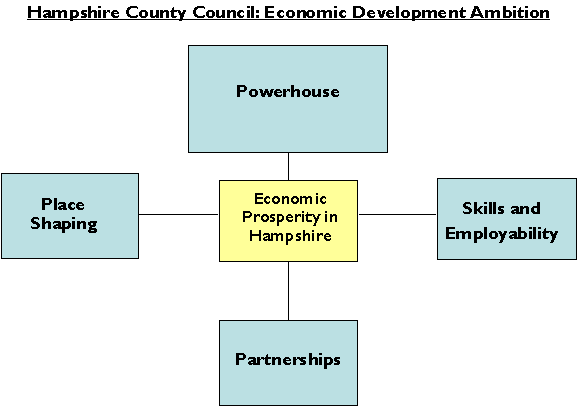
The County Council should drive economic development and prosperity in Hampshire. This is explained in the following paragraphs, and illustrated in the diagram overleaf.
Outcomes
Intended outcomes include sustained economic growth, skilled workforce, improved education attainment, reduced inequalities/disparities, increased business investment and reduced need for inward migration. These outcomes will be achieved through four key work strands:
Power House
In the immediate term, the Council needs to help communities and businesses respond to the recession and ensure that the County is well positioned to seize new opportunities once the economy starts to grow. In the medium to longer term, Hampshire County Council should use its size, capacity, leverage and public sector standing and influence to deliver economic prosperity in Hampshire.
· as the largest employer in Hampshire
· through the deployment of our strategic and operational assets and the procurement process
· optimising the use of our landholdings
· maximising the impact of our intellectual capital
· promoting our quality of place and distinctiveness
Place Shaping
In its leadership role, the Council needs to focus economic development effectively so that Hampshire's unique characteristics are maintained and where possible improved.
· delivering South East Plan growth without risk to the environment
· supporting the economy by optimising transport systems/infrastructure, including telecommunications, and reducing and minimising congestion
· regeneration of specific areas of deprivation and reducing disparities
· helping develop business start up, investment, entrepreneurship and innovation, working with our Universities and Further Education Institutes
· identifying, promoting and marketing the Hampshire 'product' to investors and visitors
Skills and Employability
Sustained economic growth will rely on businesses, the third sector, and the public sector, accessing people with the right skill sets. The Council will need to:
· reduce and eliminate education and training inequalities
· further improve education attainment levels including applied & vocational qualifications and apprenticeships
· reduce NEET (Not in Education Employment or Training) levels to the lowest practically possible
· improve employment opportunities and skills levels across the adult community
· be responsive to the changing skills needs of the economy
· promote more effectively the attainment of children in the care of the Council
Partnerships
Economic prosperity across Hampshire will rely on contributions and shared services with a range of stakeholders. Whilst the County Council can provide direction and vision and can directly contribute to the place shaping and skills agendas, it will need support from public sector partners, business and community groups, if economic prosperity is to be optimised and sustained. The Council will need to provide strong leadership for area-based partnerships across the County especially through the Hampshire Senate.
Key Recommendations from the Economic Development Review
1 Affirm the draft ambitions, goals and priorities for the County Council's role in "promoting economic prosperity without risk to the environment", including greater external focus beyond the organisation.
2 Endorse the key themes for economic development, and require these to be embedded in the Business Plans of relevant Service Departments in the shape of outcomes, targets and performance indicators;
3 Approve in principle the setting up of a new internal `Economic Development Board' to be accountable for overseeing and better marshalling the resources being deployed by the Council in support of the economy;
4 Require Service Departments to provide high level representation on the Board, by identifying a key senior officer to take the lead on behalf of his/her department in economic development matters, and to account to the proposed Board quarterly on the work stream for which they have responsibility.
APPENDIX 1 SHEET C
CORPORATE SERVICES REVIEW OUTCOMES
Business Support and Advice to Members
Terms of Reference
The objective of this review is to produce a fit for purpose model and structure for Democratic Services (within the Chief Executive's department) and to identify the relevant functions that make up modern Member support. The review will consider:
· How the decision-making processes of the Council should best be supported
· How the Leader and Cabinet model should best be supported through Democratic Services
· The identification of any new support functions and roles that should be developed for Members
· How Democratic Services should be organised and if Scrutiny should be integrated
· The successor arrangements for HATs or developments around locality management.
· Connections with Legal Services, the Policy Unit and Communications
· Future organisation of Education Appeals and Statutory Order work
This review will also look at the skills and composition of particular roles within the Scrutiny and Democratic functions to identify opportunities for increasing the contribution and skills of staff to the management and leadership of Democratic Services. This review would also look at the nature of specific roles and how they should be designed in terms of job content to allow wider and more influential roles to emerge.
Direction of Travel
The vision for Business Support and Advice to Members is to provide a modern, forward looking, integrated business support and advice service for Members of the County Council
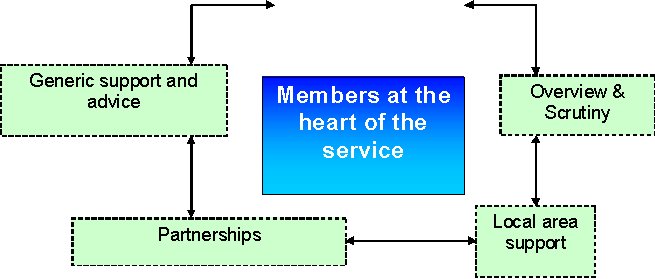
The Review has consulted with its primary customer, the Members, through interactive focus groups held during January 2009. Consultation with chief officers and staff has also been carried out. The Member Focus Groups gave a clear steer that a fresh look at the provision of support services to Members is needed. Members identified the following key areas in which support is required to assist them with an increasingly heavy and complex workload:
· support the Council, Leader and Cabinet in decision making, together with other committees with decision making powers, in the discharge of appropriate statutory roles and responsibilities
· support non-executive Members in the delivery of an effective, improvement focused overview and scrutiny function
· support for internal/external partnerships
· support for all Members in the delivery of their local area/neighbourhood role and any other responsibilities undertaken on behalf of the County Council
· generic support and advice to all Members to underpin the effective delivery of their democratic mandate (such as induction and continuous professional development, briefings, information and research, access to ICT together with flexible help/training and administrative support)
The way forward is illustrated in the diagram overleaf and is designed to:
· put Members firmly at the heart of the service
· develop a `can do' attitude to underpin the service
· provide an integrated service and move away from silo working
· provide professional and flexible support at all levels
· establish stronger channels of communication across and between departments
· support the efficiency agenda by avoiding duplication of effort, embracing the shared services agenda where practicable and building capacity
· immediately fix simple `hygiene' issues such as diary clashes, clarification of services available to all Members, efficient mail arrangements and improving general facilities in the Members' Rooms
· deliver and embed activities detailed in the action plan appended to this summary
Support and advice to members of the County Council
Executive
Potential improvements outside the Review's terms of reference are to:
· develop staff performance and opportunities for career development to achieve greater job satisfaction, retention of good staff and flexible deployment in relation to workload
· be creative in design, leadership and management
· champion officer partnerships for related functions to promote collaborative working practices across teams, sections and departments to provide richer work experience
· coach staff to feel confident in managing the officer/political interface
· embed the principle of subsidiarity - work being done at the lowest appropriate level to free senior staff time for complex issues
· re-design cumbersome procedures (ideally by cross-section task teams)
· ensure that performance management and objective setting is fit for purpose and stimulates the behaviours we want
Key recommendations from the Business Support and Advice to Members Review
1. The immediate implementation of a programme of tactical improvements to strengthen and support the decision making process, and to support the Leader and Cabinet.
2 That the following improvements be introduced:
a) establishment of Democratic Service Officers (DSOs) as `first point of contact' to commission the appropriate support for Members throughout the organisation
b) development of a new, interactive Induction Programme for Members to be completed by end of May 2009; design of an appropriate review mechanism; and development of continuous professional development for Members beyond the induction programme
c) improvement of the Members Half Day Briefing programme, co-designed with members
d) work with members to commission improvements to web based information, including the Members Portal
e) clarify the role of, and support provided by Members Secretariat and publish services available
f) Proactive support to individual Members to identify their own needs, particularly at the local level
g) Review facilities in the Members' Rooms in liaison with the Director of PBRS
h) Consult Members annually on service performance and improvements.
3 That options be developed for integrated Members services, to incorporate overview and scrutiny and local area arrangements.
4 Adopt collaborative ways of working between Democratic Services, Policy Unit, Legal Services and Corporate Communications to ensure that advice to Members is prompt, pro-active, consistent, joined-up, quality assured, and that working practices are regularly reviewed to underpin this activity.
5 In support of the corporate efficiency agenda and to re-focus capacity on a comprehensive support and advice service to Members:
a) education, school transport, pension and disciplinary appeals work together with appropriate resources be transferred to the Legal Practice to take effect from 1 September 2009
b) Statutory Order work relating to Environment and Recreation, Heritage and Communities departments together with appropriate resources be transferred to take effect from 1 April 2009
APPENDIX 1 SHEET D
CORPORATE SERVICES REVIEW OUTCOMES
Property Business and Regulatory Services
Terms of Reference
This review will look at strategic direction for the property function within the County Council and its impact on regional and national issues developing within the local government sector. Cabinet has already agreed that the property function should investigate the advantages of developing a "private public" partner capable of exploiting its regional and national roles but also bringing additional skills and talent to the County Council's work, including the research of appropriate legal frameworks and external expert advice.
In addition, the Acting Director of PBRS, with the Chief Executive, will review the opportunities to finalise the permanent management structure for the professional functions within Property with a view to rationalising the arrangements.
In relation to Business Services the review would consider the strategic issues surrounding the short, medium and long-term for the businesses which the County Council retains in-house. It would look at their financial viability for the medium to long-term, their customer base and the options for their future development. It would also consider whether other functions within the County Council should be included within the business function and run along formal business unit lines.
No significant changes are planned for Regulatory Services other than to consolidate its corporate leadership on community safety.
Direction of Travel
This light touch review has looked at the strategic direction for the property function within the County Council and its impact on regional and national issues developing within the local government sector. Cabinet has already agreed that the property function should investigate the advantages of developing a "private public" partner capable of exploiting its regional and national roles but also bringing additional skills and talent to the County Council's work, including the research of appropriate legal frameworks and external expert advice.
In addition, the Acting Director of PBRS, with the Chief Executive, has reviewed the opportunities to finalise the permanent management structure for the professional functions within Property with a view to rationalising the arrangements.
In relation to Business Services the review considered the strategic issues surrounding the short, medium and long-term for the businesses which the County Council retains in-house. It has looked at their financial viability for the medium to long-term, their customer base and the options for their future development. It has also considered whether other functions within the County Council should be included within the business function and run along formal business unit lines.
No significant changes are planned for Regulatory Services other than to consolidate its corporate leadership on community safety.
Key recommendations from the PBRS Review
1. Approve the principle of creating a new public sector trading company, the principal stakeholder being the County Council. This would enable services (principally those for property) to be provided to other local authorities and public sector partners. The trading company will establish strategic partners through competitive tendering arrangements to provide the skills and capacity to deliver construction and procurement workstreams jointly. This will enable the Council to continue to expand its local and regional leadership role in this field including potential involvement with Building Schools for the Future. Members are asked to endorse the work necessary to establish legal and financial governance to support this proposal and forming the proposed arrangements.
2. Endorse the revised Property Services Management Team to include four senior managers: an Assistant Director and three Strategic Managers. This represents a reduction from the current seven Heads of Profession posts.
3. Endorse the trading strategy for HC3S based on ongoing self-funding status.
4. Approve the periodic review of all business/trading units across the Council to ensure that fit and relevance are considered in addition to ongoing financial viability.
5. Support the proposal for departments to commit to participate in joint reviews of activity where a `market regulator' may yield efficiencies and explore opportunities for sharing back-office services across businesses.
6. Agree to explore potential for shared businesses/trading units.
APPENDIX 1 SHEET E
CORPORATE SERVICES REVIEW OUTCOMES
IT Services
Terms of Reference
The IT function will be reviewed with a view to considering:
· How best to organise departmental and corporate IT staff
· How well IT Services staff roles and capabilities are aligned with the major service and improvement functions planned for the County Council
· How to further improve the delivery of business solutions and major IT and change projects involving IT staff
· The extent to which current IT developments and plans will either reduce costs, improve services or generate potential efficiencies
· Assess the benefits and the applicability and relevance of the current governance arrangements for corporate IT within the Council
· Identify steps to improve project delivery
· Assess the benefits of developing public/private partnership arrangements
IT will develop, deliver and deploy technology solutions which drive business
transformation, efficiency and improved services for the public. This includes maximising the value of information, developing personalised and self-service applications internally and externally, and supporting partnership working. In so doing, IT must demonstrate benchmarked efficiency and value for money.
This vision will focus IT resources on:
· Joining up the Council: information sharing, collaboration, corporate systems and processes;
· Improving access to the Council: channel integration, increased self-service and personalisation;
· Driving transformation: step change in efficiency and performance improvement
· Supporting service delivery: service improvement and change.
The future vision is illustrated overleaf.
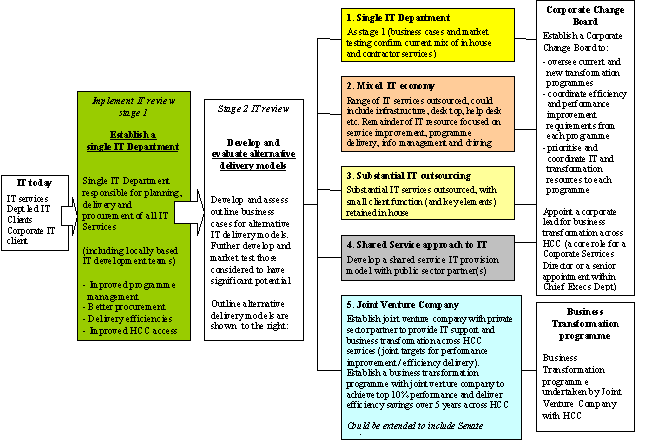
IT future options: Illustration
Key Recommendations from the IT Services Review
The review has identified 7 main recommendations to improve the impact of IT on delivering HCC's aims and objectives. Taken together, these recommendations will deliver significant savings in staff and revenue/expenditure. The recommendations also provide significant potential for further medium term efficiencies and performance improvements across HCC. The model would centralise technical functions and management, leaving business development applications to be developed and controlled by departments. The recommendations are:
1 Develop further the case for a single IT Department based on a smaller central IT management team and devolved IT development teams based in some departments
2 Improve programme and project delivery of major change programmes by creating a corporate change board to coordinate major transformation programmes across HCC and adopt a standard corporate approach to IT programme and project management.
3 Improve IT procurement: Centralise IT procurement expertise and rationalise IT contracts across HCC. Develop an IT procurement strategy and action plan to deliver procurement savings (this recommendation links to the procurement review)
4 Improve IT infrastructure and develop shared service, outsourcing & joint venture delivery models: Centralise department based IT helpdesks and streamline IT support functions. Develop proposals to market test a range of IT support functions for public/private partnerships or outsourcing (this recommendation links to the shared services review)
5 Develop web self service functions to improve access to services: Prioritise and develop implementation plans for high volume internal HCC transactions and external customer transactions to improve access and deliver service efficiencies (this recommendation links to the Hantsdirect review)
6 Improve how we store, access, report and share our information: Establish a clear corporate lead and prioritisation for information management and develop an action plan to improve the data quality, security, access and availability of information across HCC
7 Improve IT skills: Improve the skill levels of IT professional staff, and the IT skill level across HCC and consider broadband access and IT skills for Hampshire residents to enable the above recommendations (this recommendation links to the economic development and HR reviews)
Transforming IT and transforming HCC
Key questions remaining for the IT review are:
· How do we balance corporate standardisation and efficiency requirements with department's business knowledge requirements from IT?
· How do we embed IT as an enabler or a driver for business transformation, and how do we best align IT with business transformation programmes?
APPENDIX 1 SHEET F
CORPORATE SERVICES REVIEW OUTCOMES
Shared Services
Terms of Reference
This review will look in particular at the potential scale of the market for shared services within the County Council and at the same time opportunities to share services with and for other councils.
In particular, this review will look at:
· The extent and scope of these opportunities
· The scale and potential benefits of shared services arrangements within and external to the County Council
· How best to develop a strategy to enable Hampshire County Council to lead this within local government and other public services in the region
· The extent of any potential partnerships that the County Council should develop to strengthen its leadership role and the benefits that shared services would bring
· Those services such as procurement that exist in service departments.
Shared services should be defined to cover the bulk of the County Council's corporate and central services, professional services and also the opportunities that could exist for departments with other councils.
Direction of Travel
The review team has pursued the project as three streams
· Internal within the County Council
· Hampshire wide - with a focus on improved two tier working
· Regional
It is clear is that the County Council already has a strong base of shared services with key partners including schools, and retention of these shared services is an essential building block of any future strategy. Any further development of shared services with other partners will need to ensure these relationships are not disturbed and are, rather, enhanced. The County Council will need to be clear upfront that it has made significant investments in certain areas which there would not be business benefit in moving away from at this stage.
Hampshire County Council's shared services with schools cover a wide range and total direct income for 2007/08 was £34.5m, with £35m projected in 2008/09. Schools also contribute to and gain benefits from economies of scale which are not specifically tied to an SLA. Schools spent over £40m through shared procurement arranged by the County Council, taking advantage of the procurement framework and purchasing power.
Within the county boundaries there have been some significant successes in developing shared services, most notable here is the recruitment portal. The Senate has shared services and improved two tier working at the forefront of its agenda and there is a renewed interest in driving them forward. Current successful shared services include:-
· Hampshire Fire and Rescue Authority
· Hampshire Police Authority
· Procurement
· Recruitment portal with district councils
· Project Integra
· PCT including Joint Director of Public Health appointment and Integrated community equipment store
· Children's Centres with health, Jobcentre plus and district councils.
The critical success factors need to be set out for each partner including the County Council. These will include
· political and managerial commitment to the strategic, management and operational implications of the opportunity;
· clear understanding and ownership of risk and the approach to risk management and sharing;
· a clear and robust business case;
· sufficient investment funds;
· appropriate capacity in the partner organisations to design, implement, manage and deliver the opportunity and the associated change;
· realistic expectations of shared services and partnerships and acceptance of the necessary actions for example around consistent processes; and
· clear and agreed programme management arrangements including
escalation and dispute resolution arrangements
Key recommendations from the Shared Services Review
1. To recognise the scale and importance of existing shared services for the County Council and ensure that these are a key consideration in developing further proposals.
2 To bring schools into the communication, consultation and decision making process where review recommendations impact on services delivered to or for schools.
3 That in assessing the potential development of shared services the impact on, and limitations arising from, existing investments in infrastructure should be considered upfront.
4. To agree that work should proceed to develop the integrated direction of travel for internal shared services to set the scope and use of help desks, web self service and the scope of use over time of Facilities Management, Service Centres and Hantsdirect.
5. Following commitment from Senate members to agree the feasibility work developing a prospectus with District Council partners for shared services in each area, setting out critical success factors, non negotiable elements, risks and approaches to risk management and an approach for escalation and conflict resolution.
6. To approve the development of the strategy to enable Hampshire County Council to lead the development of shared services in the key areas highlighted by the review.
APPENDIX 1 SHEET G
CORPORATE SERVICES REVIEW OUTCOMES
Legal Services
Terms of Reference
This review will look at the organisation and management of Legal Services. In particular, the review should look at the following:
· What alternative models exist for the organisation of Legal Services within the Council and the costs, benefits and risks of such models
· The relationship of the Legal Services function with the Democratic Services, Scrutiny and the Policy Unit function
· Where Legal Service should be located within the central management infrastructure of the Council
· The potential to expand and enlarge the function for the County Council and other councils together with the opportunities for any potential income streams
· The opportunities that could exist by way of any "public private" partnership
Direction of Travel
Hampshire County Council Legal Services will work in a modern, proactive way to build capacity and make a vital contribution to the Council's vision of being a modern business providing public services. Legal Services leaders and managers will develop people's skills fully to realise the Council's strategy and potential, including those relating to commercial, service, business and partnership opportunities. Legal Services will develop policy, capacity and business practices that support improved performance and outcomes for Hampshire County Council and its partners.
Aims of Legal Services
Hampshire County Council Legal Services has three main aims:
· To work with the business to identify options for maximising outcomes and efficiency through relevant legal frameworks
· To support service development, improvement and innovation through a balanced approach to the management of risk
· To act as the corporate guardian and advisor, to identify and advise the business when actions are likely to cause the Council to act unlawfully
The role of a modern Corporate Solicitor
The proposed intended outcomes, new roles, and ways of working are illustrated below.
Outcomes
· Legal advice is not `stand alone' but engrained within the business and enables business objectives to be achieved within the relevant legal framework
· Clear access routes and support for key customers (Cabinet, CMT, Executive Members, Members, Officers)
· Advice being delivered from relevant specialists whether internally, or externally through public / private partnership
· Legal tasks delivered by people with the necessary skills and qualifications (i.e. not all tasks delivered by legal services need to be performed by lawyers). Ensuring the right resource is used for the right purpose would mean better value for money
· A longer term strategy for legal thinking and practices to be embedded across the organisation rather than delivered by a purely central legal team
· A career framework for the Corporate Solicitor in a role where business acumen and consultancy skills are recognised as of equal value as professional legal competency (the balance may vary in relation to the specific role)
Ways of working are illustrated below:
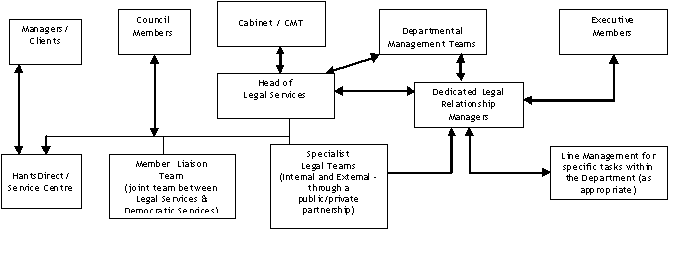
New Legal Roles
The Dedicated Legal Relationship Managers (under a head of profession model) will:
· have key skills in business management, consultancy and facilitation and understand at a strategic level the core business and service objectives
· make use of general or specialist legal knowledge to enable the delivery of better and more efficient outcomes
· provide support and challenge to the specialist legal teams to ensure deliverables are business and service focused
· work to deliver internal and external partnership opportunities
The Specialist Legal Teams will:
· provide legal knowledge and advice within a specialist field to enable better business outcomes to be achieved
· ensure that the organisation achieves its business objectives within the relevant legal framework.
Recommendations from the Legal Services Review:
1 Approve the new draft vision and purpose for the provision of legal services.
2 Approve the proposed joint approach to support for Members
3 Approve the development of a shared service model but that its implementation is considered once the new model is embedded to ensure core service delivery is maintained.
4 Approve the direction of a public / private partnership approach as opposed to wholly internalised or wholly externalised.
APPENDIX 1 SHEET H
CORPORATE SERVICES REVIEW OUTCOMES
Hantsdirect
Terms of Reference
The review of Hantsdirect has as its principal objective to look at how we might further exploit the capacity and investment in Hantsdirect and in particular to:
· Look at the potential to move "more business" to Hantsdirect (exploit our investment)
· Opportunities for further "channel shift" in relation to Council services
· Identify the benefits of developing a corporate Customer Services Strategy for the Council
· Exploit Hantsdirect's capacity to develop sources of income from other authorities (shared services)
This review will also look at the executive management arrangements for the future and the benefits of potentially merging this activity with other County Council activities. It would also be helpful to look at the next stage of Hantsdirect development to review whether or not the function should remain within the Chief Executive's department and what other models of management may be appropriate as Hantsdirect develops.
Aims and Direction of Travel
The aim of the Contact Centre is to:
· Deliver tangible and measurable improvements to customer service in relation to ease of access
· Establish a more corporate and customer focussed approach to doing business with the public (particularly a `one and done' approach.)
· Simplify access by shielding customers from the complexities of our internal structures and partnership arrangements
· Create an opportunity to establish the Contact Centre as a key enabler to business change and modernisation
· Provide capacity to deliver other public sector services and the means of delivering services and transactions with the public at the lowest possible cost.
Prior to the opening of Hantsdirect the Council had little information available about customer service across all departments. We were unable to say how many customer contacts were resolved immediately, how many telephone calls were answered and how effectively calls were dealt with. When building the business case for Hantsdirect a review was carried out of how well the County Council was handling customer contact. This revealed:
· Inefficient call handling
· Lack of customer care standards in many areas
· Lack of information available to answer customer queries
· Inconsistent service availability
· High degree of misplaced calls
· No overall performance management of how well the Council handles customer contacts
The Council has gained valuable experience in implementing Hanstdirect,
summarised below:
· Performance - The Contact Centre has now taken over 500,000 calls and is generally performing well against call handling targets - the average time to answer a call in January was 5 seconds. We now have a range of statistical information about callers e.g. we know how many people call Hantsdirect, how many calls are answered, how long it takes to answer a call, what is the longest time anyone has to wait for a call to be answered. In addition we are beginning to build a picture of the reasons why people call and how many calls are dealt with at first point of contact.
· Technology - Hantsdirect is supported by a technical infrastructure which has proved reliable and has delivered a consistent level of performance during a period when the Contact Centre has grown rapidly
· People - Having successfully integrated a number of services the call rate and associated workload for staff is now at the appropriate level and can be used to drive further performance improvement. There is a clear focus on performance and generating a professional contact centre culture.
· Processes - Hantsdirect has resulted in a number of other changes, it has driven:
· Transparency and consistency in customer services
· Discipline to ensure we have agreed processes and robust business rules
· Significant improvement in the quality of information on Hantsweb
Review Findings
The review of Hantsdirect and associated Healthcheck considered what has
worked well, what needs to be improved, how to increase the return on the investment in Hantsdirect and the next stages in building a customer-centric organisation. The key findings are:
· As more calls are now being answered this has increased work in certain areas
· More consideration is required of `end to end' processes - the focus has tended to be on the element delivered via Hantsdirect
· Difficulty in creating generic processes and managing the change to having a single process
· The need to ensure deliverable customer service standards are agreed
· There is a need to improve the feedback loop to customers
Hantsdirect - the future
The implementation of Hantsdirect is a major change programme which has started a fundamental transformation in the way in which the organisation interacts with its customers. Improvement in the management of call handling is resulting in a much better understanding of where we are doing things well and where we need to improve.
Hantsdirect is only the first stage in the development of a wider customer service strategy. The Council needs to develop the other access channels in an integrated way using customer insight to ensure we deliver customer choice whilst and maximising efficiency. This will link to other programmes such as Workstyle and will be a key element in the delivery of the outcomes of the Commission of Inquiry on Personalisation.
The Council is in a strong position to leverage the knowledge and experience it has gained in its journey so far. Future pressures and customer expectations mean that a high performing contact centre will be a key element of the Council's strategy.
Key recommendations from the Hantsdirect Review
1. An integrated customer access strategy be developed ensuring a `joined-up' approach to delivering customer services.
2. Customer service standards be agreed with all departments to help manage customer expectations and reduce avoidable contacts.
3. A business case is developed on the feasibility of a co-ordinated web front end underpinned by a common technology infrastructure.
4. The future positioning in the organisation and management of Hantsdirect be considered together with the outcome of other Corporate Service Reviews. A further report to be brought to Cabinet in due course.
5. Briefing and visits to Hantsdirect are arranged for all members following the election to explain the role of Hantsdirect and how Members can use it to support them in their work.
APPENDIX 1 SHEET I
CORPORATE SERVICES REVIEW OUTCOMES
Human Resources
Terms of Reference
· Confirm the strategic direction of the HR service
· Identify the capacity & skills gaps in developing the HR agenda
· Assess the opportunities for structural and/or other changes to drive further efficiencies
· Explore the potential for further shared services and/or public/private partnership arrangements
· Identify the longer term location for HR within the organisation and linkages between the transactional, operational and strategic agenda
Direction of Travel
The proposed future direction of Human Resources is based on the premise that it needs to deliver on five overarching priorities, to ensure the Council can achieve its aspirations through its workforce. These are:
· To ensure line managers develop `management skills'
· To attract and retain the highest quality staff.
· To develop staff skills, capability and capacity to facilitate the provision of high quality services.
· To drive efficiencies through creative use of the workforce and robust performance management.
· To serve as a role model for Hampshire employers, adopting best practice in all employment issues, as well as ensuring the Council influences wider employment strategies at national level.
Attracting and retaining the highest quality staff to the organisation
In order to attract and retain high calibre staff, the Council needs to ensure it has the reputation of being an excellent employer, where individuals feel engaged, valued and rewarded appropriately.
Developing staff skills, capability and capacity to facilitate the provision of high quality services
Although the recent economic downturn is significantly impacting on the situation, there remains a highly competitive recruitment market for certain skills, where employment is still low, skilled individuals continue to be in high demand and the age profile of the working population is rapidly changing. In response to this the council needs to develop the talent it already has to meet its future requirements.
Driving efficiencies through creative use of the workforce and robust performance management
As one of the largest employers in both Hampshire and nationally, the Council needs to ensure that it is managing its staff in the most effective and efficient way possible. Strategic workforce planning, linked to organisational priorities, strong performance management systems and the ability to influence how work, business processes and organisational capacity can be developed in a cost effective manner, across professional and technical service functions, are key roles for HR in this area.
To serve as a role model for Hampshire employers, adopting best practice in all employment issues, as well as ensuring the Council influences wider employment strategies at national level
A major role for the council is driving economic development and prosperity in Hampshire and one of the elements of this is ensuring Hampshire's employers are of the highest calibre. As the largest employer in Hampshire, Hampshire County Council should serve as a role model for innovative and responsible employment practices. This will include developing and implementing strategies to deal with local employment issues, as well as implementing and promoting national workforce strategies, such as the "Skills Pledge" and apprenticeships.
Human Resources and the Corporate Service Review
The HR service undertook a major review of its operations in 2007 and since then, has been implementing a number of significant operational changes to further develop the service, based on the needs of the business. Whilst the Corporate Services Review has therefore provided a further opportunity to scrutinise the service, this is aimed at enhancing the work that has been undertaken to date.
The main areas of note to arise from the Corporate Service Review for HR are:
· The benchmarking exercise undertaken as part of the review highlighted that the ratio of HR staff to employees is lower at Hampshire County Council than any of the four benchmark County Councils in a like for like comparison.
· The greatest capacity and skills gaps within the service are in developing the HR strategic contribution, organisational development and strategic workforce planning
· Greater use could be made of IT systems to make HR transactional services more streamlined and efficient and release capacity within HR.
· The current structural model for HR of centralised and specialist centres with an HR Business Partner in each department is one that has been or is being adopted by the benchmark authorities.
· There is significant scope within HR across Hampshire to develop the Shared Services Agenda.
· The need for the service to have an external focus, contributing to the wider skills and employment agenda in Hampshire, is increasing. Work has already begun in this area, linking with the Council's Economic Development department, SEEDA, the Learning and Skills Council and JobCentre Plus.
· Over the last three years, the HR service has generated efficiency savings of £2.5 million. In addition to this, further potential efficiencies have been identified in the following areas:
· Improved self service through further rollout of manager/employee self service
· Development of automated contracts from SAP (potential savings of £30k per annum)
· Development of SAP e-forms, enabling self entry by managers (potential savings £50k per annum)
· Further development of e-recruitment - use of talent banking to reduce advertising ((potential savings £25 - £50k per annum)
· Implementation of `Hantsfile' to centrally store all employee records in electronic form - (potential savings £30k per annum)
· Development of Shared Services Agenda in line with corporate direction
· Integration of external customer points across HR (i.e. contact with candidates through the recruitment process into Hants Direct)
· Potential outsourcing of appropriate transactional/operational activity e.g. Service Centre, Resourcing, Occupational Health, ESL
· Rationalisation of current Remuneration & Benefits activity into mainstream HR services ((potential savings 100-150k per annum)
Further work is required to quantify these areas and also, to consider where reinvestment may be needed within HR to fully realise its proposed strategic direction. Bullet points one and two are being progressed on an Invest to Save basis working with County Treasurers.
Key Recommendations from the HR Review
1 Cabinet to agree the overall strategic direction for Human Resources and the vision for the service
2 Cabinet to endorse the development of the required work streams to achieve greater efficiencies within the service
3 Cabinet to approve the development of a shared service model but that its implementation is considered once this work is completed
4 Cabinet to approve that the HR service remains integrated and that this will be further reviewed as the wider HR agenda develops