Archived decisions
Hampshire County Council Health Overview and Scrutiny Committee Item 5 31 March 2009 Inquiries Received and Action Taken Report of the Chief Executive |
Contact: Denise Holden ext. 7338
e-mail: [email protected]
1. Summary and Purpose
1.1. This report provides Members with information about the issues brought to the attention of the Committee and the response to these referrals. It sets out the inquiries received, the source of this inquiry and any action taken. Where appropriate comments have been included and copies of briefings or other information attached.
1.2. The approach adopted provides the route through which Local Involvement Networks (LINks) and other partner organisations (Hampshire district councils, NHS organisations, voluntary and independent sector providers and organisations that are representative of social care service users and carers) can raise issues with the Committee.
1.3. Where inquiries raised with the Committee are already subject to monitoring or other performance management activities the action taken will be focused on the local resolution of inquiries through appropriate sign-posting to the agency best placed to respond.
1.4. Where an issue cannot be satisfactorily resolved between the parties concerned then the Committee can consider options for further action.
1.5. New issues raised with the Committee, and those that are subject to on-going reporting are set out in Table One of this report.
1.6. The recommendations included in this report support the Corporate Strategy aim of maximising wellbeing through the overview and scrutiny of health services in the Hampshire County Council area.
Table One: Inquiries Received and Action Taken
Topic/inquiry |
Source |
Action Taken |
Comment |
Mental health services at Andover War Memorial Hospital |
HCC members |
Cllrs Mrs West and Mrs Kerley to provide an up-date on progress. The Trust is continuing to work with staff and key stakeholders to develop a way forward and will be reporting progress at the May meeting. |
|
Recommendation: Lead members continue to act as the link with Hampshire Partnership in taking this work forward. | |||
Access to health services for people who are homeless |
HCC members |
An update from the PCT on progress with developing a strategy for commissioning services fro people who are homeless is attached at Appendix One. |
|
Recommendation: Any additional information requested by members is provided by the PCT. | |||
South Central Ambulance Trust Performance |
HOSC Chairman |
SCAT presented a report to the recent meeting of South Central HOSCs which was favourably received. A copy of the report provided is attached as Appendix Two |
|
Recommendation: The HOSC continues to monitor closely ambulance performance in Hampshire. | |||
Closure of the Minor Injuries Unit at Havant War Memorial Hospital |
Hampshire PCT |
The nurse led minor injuries unit at this facility has been temporarily closed due to high levels of staff sickness. It is expected that this will affect two to three patients a week. |
|
Recommendation: The PCT confirms that this services has resumed. | |||
Transfer of Vascular Surgery |
WEHT |
WEHT and SUHT have agreed new arrangements for managing patients requiring vascular surgery . Only the actual surgery is affected, all other care will continue to be provided locally. It is anticipated that this will affect approximately 110 patients per annum and will greatly enhance the team working of the specialists providing this care. The views of GPs and service users are currently being invited and access to services will be carefully considered. |
|
Recommendation: Members note the planned changes to vascular surgery. | |||
Contraceptive and Sexual Health Services |
SCPCT |
The PCT has notified the HOSC of plans to relocate these services from the Quays Health Centre to the Royal South Hants Hospital. A briefing paper outlining the reasons for the move and the service user involvement that has taken place is available from the Scrutiny Office. |
|
Healthcare Commission Assurance |
HOSC Chairman |
Letters have gone to each NHS Trust providing services to Hampshire residents setting out the issues subject to review by the Healthcare Commission that have been considered by the HOSC in the last year. |
Copies of the letters are available from the Scrutiny Office. |
Aldershot Centre for Health - Car parking problems. |
HOSC members |
Two members have raised concerns about car parking problems at this Health Centre. |
|
Recommendation: The PCT provides confirmation of the action in hand to address this matter | |||
Section 100 D - Local Government Act 1972 - background papers
The following documents disclose facts or matters on which this report, or an important part of it, is based and has been relied upon to a material extent in the preparation of this report.
NB the list excludes:
1. Published works
2. Documents that disclose exempt or confidential information as defined in the Act.
Update on provision of primary care services to the Homeless in Hampshire
1. Background
1.1. Since the paper provided to the Overview and Scrutiny Committee in November 2008, NHS Hampshire has refined the focus of this project and decided to do further background work before (re)designing this service.
1.2. This update will complement the paper presented to the Primary Care Commissioning Group in January 2009 (Appendix 1) and highlight the different actions undertaken by the NHS Hampshire so far.
1. Baseline assessment
1.1. Data on homeless people is notoriously difficult to obtain and may not always be very reliable as it is often incomplete. The paper presented to the Commissioning Group established a baseline of currently commissioned services and tried to provide some background information on this population group.
1.2. The first point was that the provision of primary care services to the homeless population of Hampshire is very scarce and possibly not necessarily available in the areas of most need. To address this, NHS Hampshire has been working with voluntary organisations and the housing departments of most local authorities to try and gather as much information as possible.
1.3. Secondly, the paper identified the different groups of homeless people, highlighting some of their characteristics in relation to healthcare and presenting an assessment of the situation in Hampshire in terms of numbers and service provision. What this shows is that:
a. homelessness is a multi-faceted phenomenon, which does not seem to be a significant issue in Hampshire (with the exception of Gosport in terms of statutory homelessness);
b. while numbers are decreasing, it is almost impossible to access accurate information, especially where hidden homelessness is concerned;
c. homeless people have varying degrees of needs and access to healthcare: a majority seem to be registered with a GP, but may have difficulties maintaining registration or attending appointments; hence a tendency of the homeless to resort to emergency services (ambulances and A&E);
d. in line with Government policy, NHS Hampshire should essentially target its efforts towards designing/improving services aimed primarily at rough sleepers, who are the least likely to engage with traditional services.
1.4. An internal workgroup has been set up with representatives of the Primary Care Commissioning Group, Public Health, System Reform, Communications and Equality and Diversity teams. The Group comprises two clinicians and the Lead for Mental Health.
2. Current actions
2.1. The current service providers have been asked to complete a survey for every clinic (Appendix 2) held during the month of March to collect quantitative and qualitative data to understand better the population served and reasons for attendance.
2.2. A short questionnaire will go to all GP practices in Hampshire to ascertain whether they routinely provide services to homeless people and, if so, to get an indication of numbers concerned.
2.3. South Central Ambulance Service was contacted to gauge the number of call-outs made to homeless people in Hampshire. However, while they may collect this information, they do not report on it and were therefore unable to produce any figures.
2.4. Some outline data analysis has been done on use of emergency services by people with no fixed abode (Appendix 3). Again it shows that the data may be incomplete as A&E departments may not use approved codes or it may be that patients give the postcode of a hostel or a friend and would therefore not be identified as homeless. The number of inappropriate attendances at A&E departments over the last five years seem very low (one to two a month on average in total). Three individuals had attended respectively 10, 11 and 17 times between 2004/05 and 2008/09. Over half of these patients were already registered with a GP. The main GP practices concerned (with registered patients in double figures) were St Paul's, Friarsgate and St Clements in Winchester, and Shepherd Springs in Andover. Similarly most of these attendances were at Winchester and Eastleigh Healthcare Trust in Winchester.
2.5. The concentration of homeless people in Winchester is explained by the fact that there is a night shelter in the city. Therefore, homeless (i.e. rough sleepers) from Basingstoke or Aldershot would be directed to the closest night shelter, either in Winchester or Guildford.
3. Next steps
3.1. The Workgroup is due to meet again in April to analyse the data obtained from the survey, audit and analysis of A&E attendances.
3.2. This data will help shape an engagement and consultation plan to gather the views of current and potential future users of services. This will commence in June 2009.
3.3. In parallel, further networking will take place will local authorities, independent or charitable organisations to ensure joined-up partnership working.



Date: 5th February 2009
Report written by: John Divall, Director of Corporate Affairs
Report title: Stakeholder Performance Briefing

Introduction
Over the past few months the health service both locally and nationally has faced enormous pressures. SCAS performance like that of all other ambulance services has suffered as a result. This paper sets out the Trusts current performance position and seeks to provide assurance to our stakeholders that the Trust is actively developing a programme of recovery.
Emergency Performance and winter pressures
Since April 2008, the Trust has made steady progress against the new `Call Connect' standards which we achieved for the first time in September and again in October.
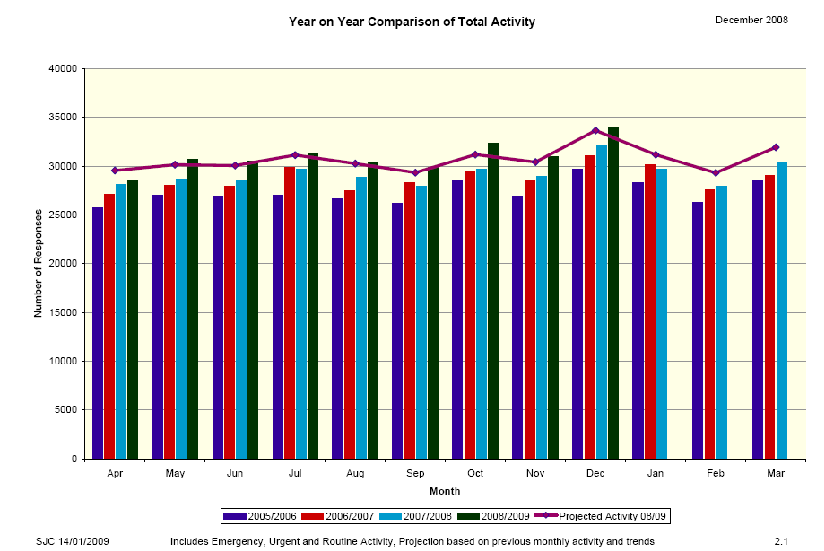
The table below demonstrates performance improvement by SCAS and by PCT showing a 19% improvement in A8 performance over last year despite an increase in overall workload of 6%.
Year to January 2009 | ||||
Performance A8 |
2007/08 A8 |
% Change |
Total Activity Growth % | |
SCAS |
72.44 % |
60.99 % |
18.8 % |
5.84 % |
Berkshire East PCT |
82.04 % |
77.77 % |
5.5 % |
9.76 % |
Berkshire West PCT |
79.86 % |
72.70 % |
9.8 % |
5.39 % |
Buckinghamshire PCT |
61.32 % |
55.83 % |
9.8 % |
8.78 % |
Hampshire PCT |
65.44 % |
49.26 % |
32.9 % |
3.86 % |
Milton Keynes PCT |
83.61 % |
71.05 % |
17.7 % |
- 0.49 % |
Oxfordshire PCT |
70.73 % |
66.51 % |
6.3 % |
10.04 % |
Portsmouth PCT |
83.55 % |
66.15 % |
26.3 % |
4.29 % |
Southampton City PCT |
81.21 % |
61.17 % |
32.8 % |
3.91 % |
Despite our best efforts, progress was suddenly thwarted by the early onset of Winter Pressures and the introduction of our new CAD in Hampshire. The CAD is now settling in and its benefits are now beginning to be seen.
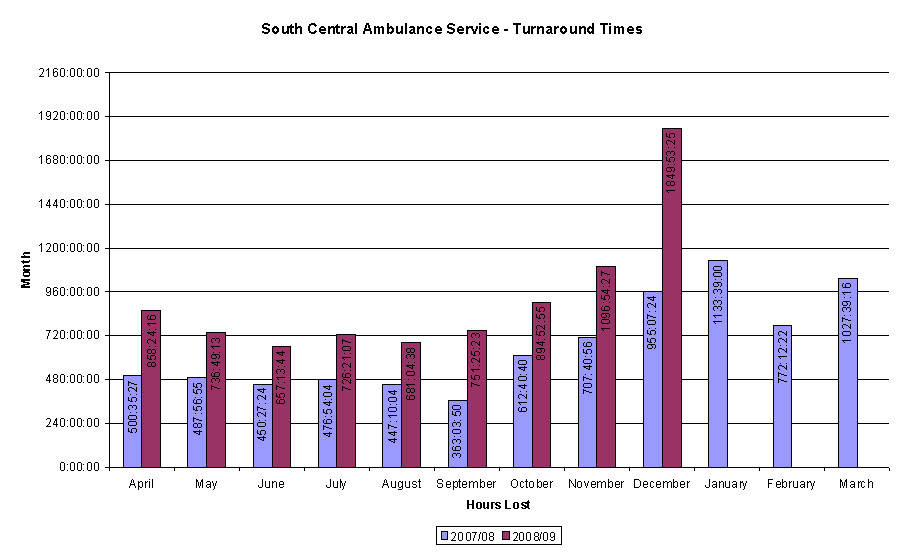
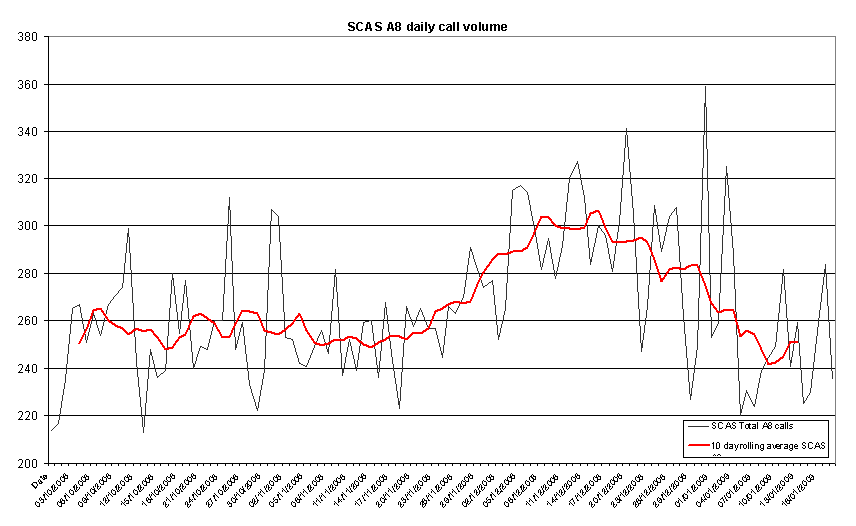
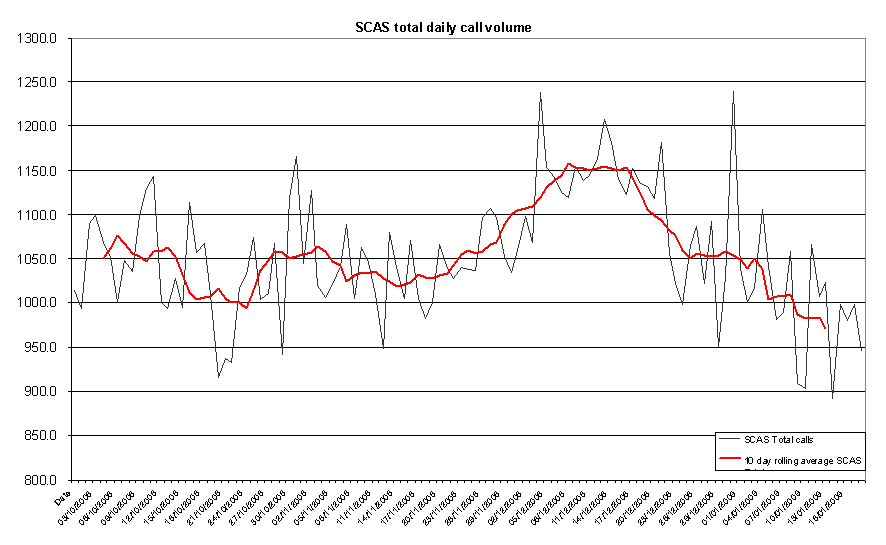
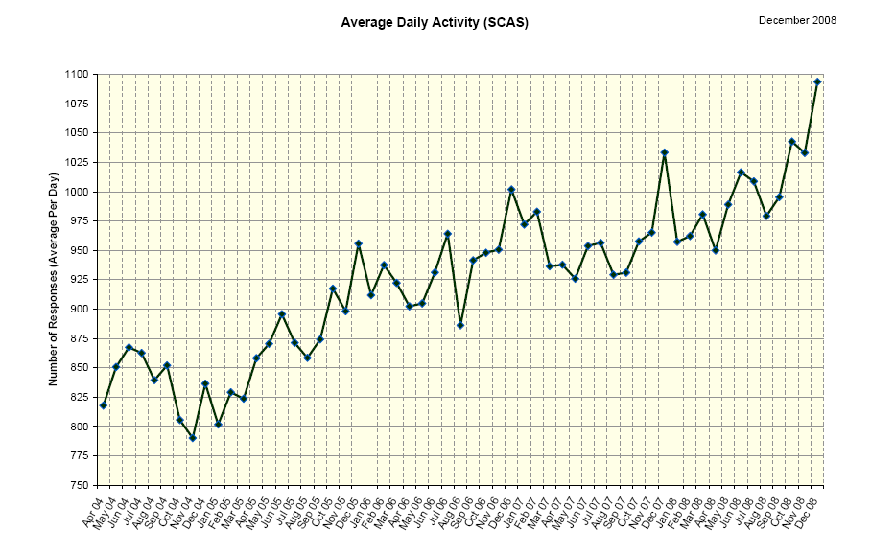
Regrettably the same cannot be said for the operational pressures we have seen over the last few months. We have seen an unprecedented increase in call volumes which has been further exacerbated by a significant increase in the number of ambulance delays at hospitals. (Please see attached appendices).
Emergency A8 performance fell to 69.14% in November and 67.5% in December which now makes it unlikely that the Trust will achieve its key national emergency performance targets. At the end of December the year to date A8 performance stood at 72.2% against a national target of 75%.
There has been close collaboration with our other health partners in attempting to minimise the impact of winter pressures. On the raw performance data it would be easy to assume that this has not been a success, however at another level performance was positive over the Christmas and New Year period, and would have been undoubtedly much worse had this joint planning not taken place.
January results have significantly improved with the Trust narrowly missing the national targets for A8 (74.9%) and A19 (94.6%). Week ending 1st February we recorded our best ever A8 performance out turning at 79.5%. Some exceptional daily results were achieved during the month with several in excess of 80% reflecting the return of call volumes to more normal levels.
February has started badly with the heavy snow fall across many southern counties seriously impacting on performance. The trust received good intelligence from the Met Office of extreme weather prediction enabling contingency measures to be put into place in readiness. Nonetheless driving conditions were treacherous and some patients experienced significant delays in receiving an ambulance attendance.
During late December and early January SCAS operated REAP Level 4 (critical), a high level of escalation which is one step short of major incident. This level of escalation has meant that managers with clinical training have been operationally deployed, all training, meetings and short notice leave has been cancelled, along with a range of other measures. The whole service, including the non-emergency service, has responded with enormous team effort.
Notwithstanding, at times the Trust has not been able to maintain the basic service levels that are required and a small number of patients have had to wait far too long for an ambulance. There has been a small number of reports relating to long ambulance attendance delays in the local media, these have been investigated and a number reported as SUI's. The Trust has taken action to ensure that patient safety and the reduction of clinical risk takes precedence at these times through the enhanced use of clinical advice within the emergency operations centres. It is clear that on a significant number of occasions patients experience has been adversely affected by the health systems inability to manage these pressures.
Towards Excellence Programme
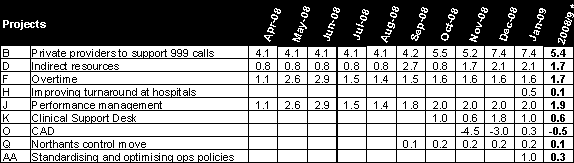
The Towards Excellence programme continues with the majority of projects on target and we are beginning to see some early performance gains
A&E Delays and the Turnaround Project
SCAS has and will continue to work closely with our other health partners to modernise the service and to improve the patient experience both in terms of timeliness of response and in clinical care. Our `Towards Excellence' programme which has been supported by our commissioners and the SHA will be the main conduit for this journey.
Our immediate focus is on emergency performance and it is in this area where we are asking for your support. Appendix A charts the increase in Emergency Dept and Assessment Unit delays since 1st April 2008 from which it will be seen that December results were the worst on record with more than 1873 hours being lost. These figures represent the cumulative total time lost in excess of 30 minutes in ambulance turnaround at Emergency Departments.
SCAS has recently undertaken Lean projects at the John Radcliffe Hospital and the Southampton University Hospital to improve ambulance turnaround processes. Data collected from these projects produced almost identical results that approximate 70% of turnaround delays were as a result of hospital pressures which delayed handover eg `no beds' or `no staff' to receive the patient. Handover delays accounted for 100% of the delays over an hour, some of these have been as long as 2.5 hours.
The Trust has begun to implement the recommendations from the Turnaround projects by:-
· Rostering operational supervisors into the A&E Departments at John Radcliffe, Royal Berkshire and Wexham Park Hospitals during peak demand hours to act as a liaison point with the hospital and to facilitate the speedy turnaround of ambulances.
· Providing a CAD terminal at John Radcliffe which enables advance notice of incoming patients
· CAD terminals have been ordered and will be installed at the RBH and Wexham Park within the next few weeks. Technical solutions for similar facilities at the QAH and SUHT are currently being investigated.
From a hospital perspective the major recommendation is the provision of a `buffer' within the Emergency Department to cope with peaks in demand eg spare trolleys and designated queue nurses that can be deployed to care for patients waiting in queues as they develop.
Whilst several hospitals have adopted this approach, most notably the Queen Alexandra Hospital, a number of others continue to rely on SCAS to provide this cover, which is an unacceptable position.
The Trust has reviewed and simplified its SCAS wide escalation policy a copy of which is attached for consultation. Stakeholders are requested to provide feedback to John Divall, Director of Corporate Affairs.
Other performance measures
We are undertaking a number of measures designed to bring performance back to target levels for A8 and A19. These are:-
· Performance management - we have been working closely with 2 companies to develop and deploy a systematic approach to performance management in our operational department. This has already yielded significant benefits in performance and we are confident that there is still more to come as we review our processes
· Computer Aided Dispatch system - we have installed a new CAD in our Hampshire EOC. Although we have been more successful than other ambulance trusts, we have still experienced some initial problems as our staff get used to the new system. We have yet to realise the benefits from this state of the art piece of equipment and we have robust plans in place to deliver the full potential as we roll out across SCAS.
· Indirect resources - a key part of our strategy to improve performance in rural areas is to build the capacity of our "indirect resources" - that all non uniformed responses such as Community First Responders, Staff Responders and Basics Doctors. We are delighted with the progress we have made recently with Hampshire Fire & Rescue where an extra 6 schemes have come on stream in the last month, bringing the total to 12 with 4 more to come before the end of the year. We have also been successful in launching a number of other community schemes and have introduced dedicated CFR desks in all our control rooms.
SCAS is in the process of producing a list of the top frequent callers by each PCT. To date this information has been shared with the two Berkshire PCT's and meetings have been held with responsible Directors with a view of seeking alternative planned care pathways for such patients.
Clinical Support Desks, staffed by nurses or Emergency Medical Practitioners (ECP's) have been introduced or strengthened in all three divisional Emergency Operation Centres (EOC's). These measures have contributed to a further reduction of around 10% in the number of patients conveyed to hospitals.
Clinical Developments and performance
The Trust has been actively involved in discussions regarding the development of future strategies for the management of Myocardial Infarction (MI) and Stroke.
Thrombolysis
The move towards regional centres and primary PCI has had some performance impact on the Trusts Thrombolysis target. At the end of December SCAS's Thrombolysis performance stood at 67%, just below the national target of 68%. Fewer pre hospital Thrombolysis are now being undertaken in favour of conveyance to centres providing PCI, this approach whilst being beneficial in terms of patient care has its downside in terms of the current national performance measures. This target is discontinued in areas such as London where PCI is widely available.
As the Thrombolysis target is time based eg 1 hour call to needle time there is a likely correlation between increased A&E delays and call volumes. Likewise pre hospital Thrombolysis is often undertaken within 30-35 minutes hence the lower numbers being undertaken impact on performance.
SCAS has developed a recovery plan to focus on this target. We have recently reinforced with our clinical staff the importance of speedy conveyance of MI patients to specialist care and we will be closely monitoring the situation.
Conclusion
Whilst performance during November and December was disappointing, the Trust has performed in line with other Ambulance Trusts despite introducing the new CAD in Hampshire.
The Trust narrowly missed the A8 & A19 targets in January but showed a significant improvement over the preceding two months. Overall there is a 19% improvement against last year.
The number of patients conveyed to hospital has been reduced by around 10%. SCAS believes that further reductions can be achieved with the development of further alternative care pathways particularly in relation to the management of falls.
The Trust remains focused and committed to delivering the national performance standards and in particular building a platform for sustained performance for the future.

John Divall
Director of Corporate Affairs