
Archived decisions
HAMPSHIRE COUNTY COUNCIL
Decision Report
Decision Maker |
Executive Member for Policy and Resources | ||||
Date of Decision |
9 April 2009 | ||||
Decision Title |
Response to recession - use of LABGI funds | ||||
Decision Reference |
660 | ||||
Report From: |
Chief Executive | ||||
Contact name |
John Rees-Evans, Head of Economic Development | ||||
Tel |
01962846381 |
||||
EXECUTIVE SUMMARY
1) Summary of Decision Area
1.1. To consider the allocation of Local Authority Business Growth Incentive (LABGI) funds to a range of initiatives aimed at addressing the impacts of the recession in Hampshire
1.2. To consider four specific proposals: Support for the independent retail sector, developing a network of `smarter working centres', supporting opportunities for volunteering and work experience, supporting the provision of places for business apprenticeships
2) Issues Covered in Report
2.1. The impacts of the recession in Hampshire
2.2. The range of responses available to the Council
2.3. The recession response proposals being put forward
2.4. The source of funding available to finance initiatives
3) Recommendations
It is recommended that:
3.1. the Executive Member for Policy and Resources approves the allocation of LABGI funding as set out in the supporting report and that the proposals being put forward are reviewed in one year's time to assess what, if any, further action should be taken and whether any further provision from the new economic prosperity reserve should be made.
3.2. four specific projects are supported as set out in the report: support for the independent retail sector (£80K); Smarter Working Centres (£100K); Promoting volunteering and work experience (£50K); supporting apprenticeships ((£195K).
REPORT
1) Economic Downturn
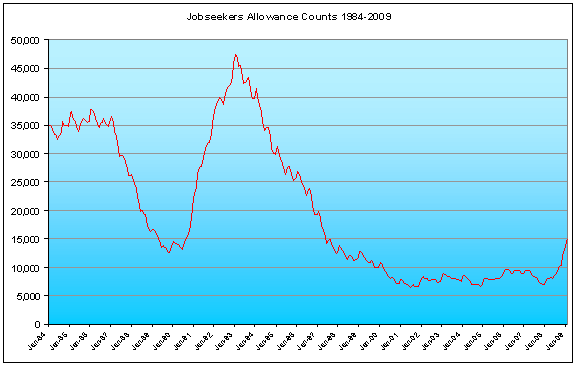
1.1. The economic situation in Hampshire is deteriorating rapidly with another 3000 people registering for Job Seekers' Allowance last month (double the previous month) bringing the total to 15000 in the County Council area. The graph attached at Appendix 5 illustrates the inexorable rise and compares the situation with long term trends. It would seem likely that on the experience of previous recessions the total will at least treble over the coming months.
1.2. The effects on individuals are increased insecurity, if they still have jobs and, if they have lost their jobs, inability to service debt. The recession has affected all businesses to some extent as demand falls across all supply chains.
1.3. Impacts are being felt across Hampshire and in particular on the retail sector where footfall is down and profits especially amongst the smaller retailers are declining. This is threatening the economic viability of our smaller retail centres.
2) Possible Local Authority responses
2.1. The Hampshire Senate has set up an Economic Action Group to consider a range of actions which could be taken by the Hampshire Local Authorities and to help co-ordinate across the County
The Senate group discussed a no. of possible initiatives including:
General eg gathering key intelligence to guide policy; extra support to other agencies which support businesses and/or residents; recession summit/conference; revised strategies for Employment and Economic Development
Residents eg promoting the uptake of benefits including campaigns to raise awareness of benefit entitlement; advice days for residents (benefits, fuel efficiency, debt counselling, etc.); supporting housing need; helping with loans/finance etc
Employment including increasing the number of Hampshire County Council/district apprenticeships; setting up employment workshops; redundancy support - rapid response service; re-training support - particularly for long-term unemployed and the promotion of business start-ups to those facing redundancy, returners, retirees affected by savings shortfall, etc.
Businesses eg Business advice; development of a recession website; recession seminars for businesses; promotion of Business Link healthchecks and grants etc.; help with business finance such as 10-day payment terms for SMEs; business rate relief for SMEs; grants to businesses; provision of credit to Hampshire businesses in partnership with Finance South East or possibly setting up a `Hampshire Bank'; and using procurement processes to help local businesses tender for council contracts.
2.2. Actions Underway - Local Authorities in Hampshire have initiated a no. of support measures to help residents and businesses including additional support for debt advice agencies, business advice workshops etc. The County Council has encouraged discussion on the development of a Hampshire Bank and is endeavouring to ensure all its service provision recognises the very real difficulties being faced by our businesses and residents in the current economic climate.
2.3. WWW.hants.gov.uk/recession - in addition, the Council's Economic Development Office has set up a dedicated website, which links to the initiatives being undertaken by other Agencies and Authorities as well as the Council itself.
3) New proposals
3.1. Hampshire Senate - the Economic Action Group tasked the Council with responding to a number of areas of challenge and leading a co-ordinated response:
_ supporting the independent retail sector and small & medium sized towns
_ support for self-employed, small businesses and unemployed senior executives
_ help for work experience volunteering and the agencies which recruit and develop volunteers
_ development of apprenticeship opportunities
Set out below are four proposals aimed at alleviating the impacts in these areas.
3.2. Proposal 1 Support package for independent retailers (see also Appendix 1):
This proposal puts forward a no. of measures aimed at supporting independent retailers through training, marketing support and workshops. It is aimed at addressing the difficulties faced by those who have no corporate support or large scale marketing organisation behind them. It uses the opportunity of peer to peer support and specialist business training facilities to help squeeze costs out of smaller businesses and boost turnover. It will also show how effective use of the Internet can reach new markets building on the expertise of eHampshire.
The programme will be undertaken with the collaboration of other Councils and local town centre managers.
Estimated cost: £80000
3.3. Proposal 2 - Network of Smarter Working Centres (SWCs) (see also Appendix 2):
This proposal addresses three issues: the needs of smaller local businesses to have a business club type venue where they can support each other and exchange best practice in the recession; the need to support those who are working at a distance from their normal workplace, who have no/limited home access or facilities, and thirdly those groups of executives who have been made redundant and face social as well as work challenges. This latter group, when brought together at venues on an `executive club' type basis, has been shown to be effective in alleviating some of the personal and social issues faced by those made redundant maybe for the first time. They are also often able to collaborate to identify new business opportunities as Associates or as Social Enterprises.
The proposal would aim to set up approx 10-12 SWCs across the County working with at least three District Councils who have also expressed an interest and using some of the piloted models e.g. Whitchurch/Fordingbridge.
Estimated Cost: £100000
3.4. Proposal 3 - Support for work experience and volunteering opportunities
Experience of earlier recessions, and indeed early indications from the current recession, show that those people who can keep some form of work outlet, despite being unemployed, are more likely to get back into the labour market, when the upturn comes. This could involve short breaks of work experience in willing host organisations to help broaden or diversify their skills. It could also involve various forms of volunteering. This is commonly regarded as an excellent interface between no work and fully paid work. It helps alleviate the potential isolation and de-socialisation that can arise through spells at home without contact with the world of work and can also help with the development of new skills. For that reason, it is commonly called the `intermediate labour market'.
The difficulty with the rapid rise in unemployment is that those organisations which could make good use of new volunteers are swamped with interest, but lack the means to recruit and train. In some particular areas, where there is an effective support infrastructure in place, the help that is needed is simply financial support for delivering the training. The proposal aims to enable such areas and organisations to make proposals for additional grant aid from the Council specifically targeted at offering work experience and volunteering places.
Estimated cost £50000
3.5. Proposal 4 - support for business apprenticeships
It has been demonstrated that businesses which continue to invest in skills and training through a recession are far more likely to survive through to the upturn than those who don't. Nevertheless, there is a strong temptation to cut back on this area of expenditure. This proposal would encourage a positive approach amongst businesses, by offering a grant of £5000 per apprentice taken on, to help defray the on the job costs. It would work alongside the National Apprenticeship Service and the Learning and Skills Council, which help pay for the off the job training costs with the training provider. It would also send out a powerful signal from the Council, that it supports training investment and apprenticeships in particular. The administrative costs could be matched by the LSC and enable an administrator to be taken on for two years, to oversee the initiative and work alongside the apprentices and host companies.
Estimated Cost: £195000 over two years
4) Resources
4.1. In recent years, the Council has been in receipt of grants made under the `Local Authority Business Growth Incentive' scheme (LABGI). The Council has also agreed that 30% of any receipts should be allocated to economic development.
4.2. In 2008/09, the Council has received a grant of £1417753 which would provide resources of £425000 approx for economic development based on a 30% allocation. This would meet the funding requirements of the above proposals as follows:
Retail support package: £80000
Smarter Working Centres £100000
Work Experience/Volunteering £50000
Apprenticeships £195000
TOTAL £425000
4.3. Follow up resources:
After one year, a review should be undertaken to examine whether any of the additional LABGI funds placed in the Council's fund for `long term contributions towards economic prosperity, wellbeing and regeneration and other capital investment projects' could be used to follow up the above proposals, or to support new responses tailored to the needs which emerge.
4.4. Leverage
All of the above schemes have been discussed with other local authorities and agencies in Hampshire and it is likely that partner support approaching up to £100K will be forthcoming. Indeed, the LSC has already committed to match funding apprenticeship development to the tune of £35K, allowing a two year contract to be offered for the scheme administrator. Several Councils have already committed partnership funding for the retail proposal and Smarter Working Centres.
5) Options analysis/considerations
5.1. Option 1 - `Do nothing'
This option has been rejected on the grounds that it would not be right for the Council to stand by and not offer special measures for key target groups of businesses and unemployed when the County is facing such a severe downturn.
5.2. Option 2 - Adopt an alternative set of measures:
The Council has consulted widely on the above proposals both in the Senate and with other partners. It has underway a series of service measures listed in Appendix 6 which the above schemes are designed to supplement. The proposals also take account of the need to avoid duplicating what is already being done both regionally and nationally. For example, direct and general financial aid for businesses has not been proposed as this is available through the Government's Enterprise Finance Guarantee Scheme (see http://www.realhelpnow.gov.uk/). Both Business Link in Hampshire and SEEDA are active in their areas of economic support.
5.3. Option 3 - adopt the measures proposed above.
The package of measures proposed above gives an effective mix of support for business, employment and individuals. The proposals are relatively inexpensive to administer and build on existing experience with the sectors involved. They will be reviewed in a further report to the Leader after six months' operation.
6) Conclusions
The measures proposed should be supported with the deployment of LABGI reserves held for economic development purposes and implementation should start as soon as possible to help address the critical situation facing the County as the economic situation continues to deteriorate.
7) Recommendations
Please see Executive Summary for recommendations.
CORPORATE OR LEGAL INFORMATION:
LINKS TO THE CORPORATE STRATEGY | ||||
Yes |
No | |||
Hampshire safer and more secure for all |
_ |
|||
Corporate Business plan link no (if appropriate) |
||||
Maximising well-being |
_ |
|||
Corporate Business plan link no (if appropriate) |
||||
Enhancing our quality of place |
||||
Corporate Business plan link no (if appropriate) |
||||
OR |
||||
This proposal does not link to the Corporate Strategy but, nevertheless, requires a decision because: | ||||
OTHER SIGNIFICANT LINKS: | ||
Links to Previous member decisions: | ||
Title |
Ref |
Date |
Allocation of Local Authority Business Growth Incentive funding; Executive Member for Policy and Resources |
7th December 2007 | |
Direct Links to Specific Legislation or Government Directives | ||
Title |
Date | |
Section 100 D - Local Government Act 1972 - background documents | |
The following documents discuss facts or matters on which this report, or an important part of it, is based and have been relied upon to a material extent in the preparation of this report. (NB: the list excludes published works and any documents which disclose exempt or confidential information as defined in the Act.) | |
Document |
Location |
IMPACT ASSESSMENTS:
1. Equalities Impact Assessment:
a) Supports equalities and diversity through providing opportunities for work experience and volunteering.
2. Impact on Crime and Disorder:
a) Alleviating the impacts of the recession can help reduce the impacts on crime and social disorder
3. Climate Change:
a) How does what is being proposed impact on our carbon footprint / energy consumption?
· Smarter Working Centres cut down on the need to travel by providing opportunities for flexible working and distance learning; support for local retail centres and independent retailers helps reduce the need for consumers to travel and promotes the use of local products
b) How does what is being proposed consider the need to adapt to climate change, and be resilient to its longer term impacts?
· By encouraging local initiatives on labour, product consumption and work and travel patterns
Retail Sector Support Package (Proposal 1) Appendix 1
1) Supporting redundant shop workers
Offering re-training programmes and workshops in IT skills to improve redundant sales staff employability in a range of sectors. The training will offer basic IT for those without any previous IT knowledge, through to advanced training workshops for those with some basic IT experience. This will improve the County's workforce flexibility and employment prospects.
Costs - 200 places @ £150 per person = £30,000
2) Supporting Independent Traders
New project to support small independent retailers across Hampshire. This will take the form of:-
a) new web site - www.shopinhampshire.co.uk to promote retailers, giving them an on line presence, offering access to a growing consumer market place. To be heavily promoted in local media and via HCC website.
"High street retailers with a web store got 68% more internet traffic than their online-only rivals during the Christmas period, according to Experian."
Costs - Web site set up costs, web management and developments £10,000
b) Retailer Workshops - training programme aimed at helping small retailers develop e-commerce and improve productivity, including workshops on enhancing company visibility, search engine optimisation, e-mail marketing, increasing customer loyalty and promoting repeat business.
Costs - 200 shops @ £150 per shop = £ 30,000
c) Working with Town Centre Managers to increase promotion of town centre events i.e. late night openings, food festivals and other special events aimed at getting more shoppers into town centres. Grants scheme to individual Towns for publicity. There is already a formal Hampshire Town Centre Managers Network established through which we can channel this support.
Costs - based on 20 towns at £500 each = £10,000
TOTAL Costs for Retail Support Package £80,000
NB - no additional staff resource required. Can be implemented immediately.
Smarter Working Centres (Proposal 2) Appendix 2
What is a Smarter Working Centre (SWC)?
· Five days per week access 9 to 5 (with possibility of extended hour e.g. evening opening)
· Pre-bookable and/or stand-by (drop-in) by the hour/day/week desk or facility usage
· SLA backed ICT infrastructure (e.g. ADSL Broadband/VOIP, plus high end printing).
· Optional virtual reception, secretarial and meeting room facilities for micro and start-up businesses
· Hireable low cost audio and web-conferencing facilities
· A venue for mentoring, Business Link/or specialist advice sessions, collaborative working and shared-resource potential for start-ups and micro SMEs
· A venue for training - especially Train to Gain courses - including Business Leader - which may be grant subsidised or assisted
· Business/postal and parcel delivery collection address
The Aim (Who is it for?)
An SWC has a business oriented `atmosphere of industry' designed to bring together individuals and businesses to cooperate and collaborate in terms of new business ideas, work opportunities; ideas identification, self-support, mentoring and skills development.
An SWC, also helps to reduce peak-time congestion, travel-costs, carbon emissions, encourages local economy spend and helps improve well-being/quality of life.
Targeted Market Segments
· Business Professionals
· Prospective (especially women) would-be entrepreneurs
· Recently redundant professionals, managers and directors
· Out-commuters in rural towns and villages,
· Contract and free-lance staff
· Local micro and start-up businesses
· Rural knowledge transfer, start-up businesses and community groups
Possible Additional Channels to Market:
· Business Groups (like FSB, Chambers, NFBP and AMBG)
Why Now?
· Redundant professionals, senior managers especially, report they are not fully served by such as the current Job Centre Plus service portfolio
· Reduced costs/improved business survivability - Actium Consult 2008 research showed TCO for each workspace p.a. in Hampshire cost between £5,000 to £6,000 per annum with utilisation at circa 50%.
· Many rural centres/market towns are dormitory towns (e.g. 33,000 out-commute from the New Forest daily/62% of Whitchurch working population works out of the town). The local day-time economy/high street footfall suffers accordingly.
· Employees, a number now working reduced hours, can avoid the cost, inconvenience (and stress) of high carbon emission, peak-time commuting.
· Smaller and start up businesses can share specialist resources e.g. Financial, HR, Marketing/PR staff.
· SWCs can provide a local venue for meetings, training (including grant assisted Train to Gain Business Leader training), advice clinics, peer-group and collaborative working/learning.
· According to CIPD, 38% of individuals who would like to work from home or locally, cannot as their home environment is not suitable or conducive to work
· SWCs help overcome permanent home based worker `isolation' (cabin fever/lack of peer interaction)
· SWCs will help to encourage female entrepreneur business start-ups
· SWCs offer greater survivability prospects for micro and start-up businesses
· SWCs help businesses reduce their accommodation costs/overheads
· Increased local amenity and high street footfall spend
· Convenient -reduced commute costs and CO2 emissions
· Flexible low-cost, low-commit accommodation that can be geared to `order book' levels
· Better work/life balance
· Provides access to supported, secure, reliable and affordable ICT infrastructure
How Much Will it Cost?
It is suggested that there is an opportunity for Hampshire County Council to demonstrate its commitment to helping citizens and especially smaller businesses impacted by the recession in the following way:
· Initial match funding to encourage the early establishment - within a twelve month period - of an initial network of up to ten locally enabled and managed Smarter Working Centres.
· Match funds to assist with the promotion and initial year operation of each Smarter Working Centre
The funding amounts, payable against agreed claims would be limited to:
a. £4,000 per Smarter Working Centre to match agreed set up costs
b. £6,000 per Smarter Working Centre to match agreed year one costs
There may also be the opportunity for HCC to offer similar facilities in any under-utilised HCC accommodation. Initial approaches made to existing Business Centres have also received an enthusiastic response. It is not envisaged that such commercially operated centres would qualify for the same level of funding contribution.
Possible SWC locations include:
· New Forest - New Milton, Lyndhurst, Lymington
· South Hampshire - Whitely/Segensworth, Warsash/Tichfield, Langstone/Waterlooville
· North Hampshire - Tadley, Fleet, Alton
Overall cost contribution from Hampshire County Council
To set up a network of ten centres at £10000 subsidy per centre
TOTAL COST = £100000
Work Experience and volunteering (Proposal 3) Appendix 3
1. The issue:
Unemployment is rising rapidly and is set to increase for at least another 2 years judging by previous recessions. It is unlikely to return to current activity levels for possibly 4 - 6 years. Partticularly vulnerable groups of people include:
¬ Young school leavers - the `not in employment education or training' (NEETS) category
¬ Those who have been on benefit for some time who tend to find it even more difficult to get a job, as the recently unemployed tend to have better chances of re-entering the labour market immediately
¬ Older workers made redundant, who have maybe worked in the same company for some time and have specialist but not transferable skills
2. The response:
Work experience and volunteering can offer an opportunity to those who have lost their jobs or are seeking to r-enter the job market from a period outside the labour market to :
¬ Maintain work skills
¬ Give something back to the community
¬ Develop new skills
¬ Learn about work relationships in a more formal context
¬ Launch a new career
3. The Council's support:
The Council already supports the Councils of Voluntary and Community Service and the Volunteer Bureaux as part of mainstream grant aid. Voluntary organisations in general are under great pressure both through reduced `giving' and increased demand for their services. They are also receiving increased demand for the placement of volunteers which is stretching their training capacity.
Some areas of need in the County have effective partnerships established, which link a number of support organisations in a common social and employment development programme
4. The Proposal
The Council set up a grant scheme open to relevant organisations to be defined by careful criteria (eg CABs, Environmental Organisations, CVSs, etc), which supports the provision of induction and training of volunteers, which makes a demonstrable contribution to the potential of a volunteer both to develop new skills and in so doing to help their local communities.
5. Costs
It is proposed that a total amount of £50000 be made available with grants being offered in the range of up to £2500 each. The Economic Development Office would administer the scheme to ensure employment and economic benefits are paramount in the assessment criteria.
Business Apprenticeships (Proposal 4) Appendix 4
1. The issue
With the increasing pressure on budgets, companies, and especially smaller ones, look to cut training budgets despite clear evidence that those which continue to invest in training are three times more likely to survive the recession than those which don't. The Government is providing substantial funding for Young Apprenticeships (administered by the County Council in Hampshire) and for the training costs of apprenticeships. However, there is another cost besides that of the training provider and that is the `hidden' cost of on the job training for the apprentice.
2. The response
Set up a scheme which shows clearly the Council's advocacy of investment in training as one of the most effective ways out of the recession, and encourages smaller businesses to make room for a trainee apprentice, whose training will be funded by government and whose `on the job costs' will receive a grant in aid from the Council.
3. The Council's support
The County Council has shown the way with innovative approaches to encouraging its suppliers to support apprenticeships eg in the construction industry by providing equipment. It is also working closely with the Learning and Skills Council to improve the marketing and promotion of apprenticeships as part of the Skills Pledge commitment. The Government has also set up the National Apprenticeship Scheme to help encourage employers to get more involved supported by a major national advertising campaign. For younger people, there are Young Apprenticeships (approx 1500) and the Council itself offers formalised work experience opportunities to school children.
4. The Proposal
Establish a fund which grants £5000 per apprenticeship provided (length can be variable depending on the trade, and open to all ages). This grant to be paid to the host business 50% up-front, and 50% on successful completion of the training. Employ an apprenticeship development worker funded 50% by the Council and 50% by the LSC, who will work initially with business organisations to find the best `route to market'. As the scheme rolls out, the post would be responsible for working alongside both the apprentice and the host business, in collaboration with Business Link, to ensure a successful development. The benefits would extend beyond the scheme itself as it would raise the whole image of apprenticeships in Hampshire through the Council's endorsement.
5. The costs
Aim to support 32 apprenticeships over two years max at £5000 each together with a development worker on a two year contract at gross costs per annum of £35K, jointly funded by the Council and the LSC
TOTAL COST: £195000 over 2 years
Appendix 5
Long term unemployment trends in Hampshire County area
Appendix 6
Actions being taken by Service Departments of the Council in response to the recession
1. Responding to proposals discussed at the Senate Action Group:
¬ Finance: discussions underway re the setting up of a bank for Hampshire -`Hants Bank'; Working with the Hampshire Credit Union to make facilities available across Hampshire in partnership with Hampshire Local Authorities
¬ Business Sector support: retail support package to assist independent retailers with marketing and boost `footfall' - working with Districts
¬ Tourism: working with tourism South East to boost visitor numbers and capitalise on the weak £ with overseas visitors - Hampshire Tourism officers
¬ Recruitment: linking Hampshire Recruitment Portal with Job Centre Plus to ensure unemployed get access to public sector jobs
¬ Smarter Working Centres: considering a proposal to roll out a network of IT centre with drop in facilities for self-employed, home workers and job clubs for redundant executives
¬ Increased support for advice agencies e.g. Citizens' Advice Bureau
¬ Volunteering: scheme being set up to help training of voluntary sector workers to engage volunteers as a possibly route back to the jobs market
¬ Communications: Hampshire Web Portal - www.hants.gov.uk/recession set up with cross Local Authority links to web-based information provided by other Authorities and Agencies
2. Hampshire County Council services:
Business support:-
¬ Help on business continuity issues
¬ Promoting use of flexible working methods as means of reducing costs
¬ Promoting Sustainable Business approaches
¬ Advice on diversification, new products and routes to markets
¬ Flexible approach to tenants on rental payments
¬ Promoting opportunities to tender for business with the Council
¬ Marketing support through `Buy with Confidence' scheme
¬ Reducing payment times as much as possible to support SME cash flow
¬ Independent retailers support package
¬ Grants to village shops
¬ Grants to businesses to take on apprentices (proposed)
¬ Helping supply chain efficiency and work planning for SME suppliers
¬ Boosting the delivery of key projects to stimulate the construction industry
¬ Communicating latest HMG measures etc through recession web pages
Support for residents:-
¬ Assisting with payment terms for debts owing to the Council
¬ Promoting benefits take up (e.g. with the elderly)
¬ Info on debt & money management for parents in receipt of childcare support from HCC
¬ Grants to debt advice and support agencies
¬ Using Childrens' Centres as a location for informal training support and employment advice
¬ Support to `NEETS' with, for example, interview skills
¬ Publicising the terms for free school meals, take-up is currently only 80%
¬ Operating Apprenticeship schemes, work experience and other placements
¬ Providing `first step' training opportunities for individuals and learners who find themselves out of work or wanting to change career
¬ Free and discounted activities in leisure and community centres
