
Archived decisions
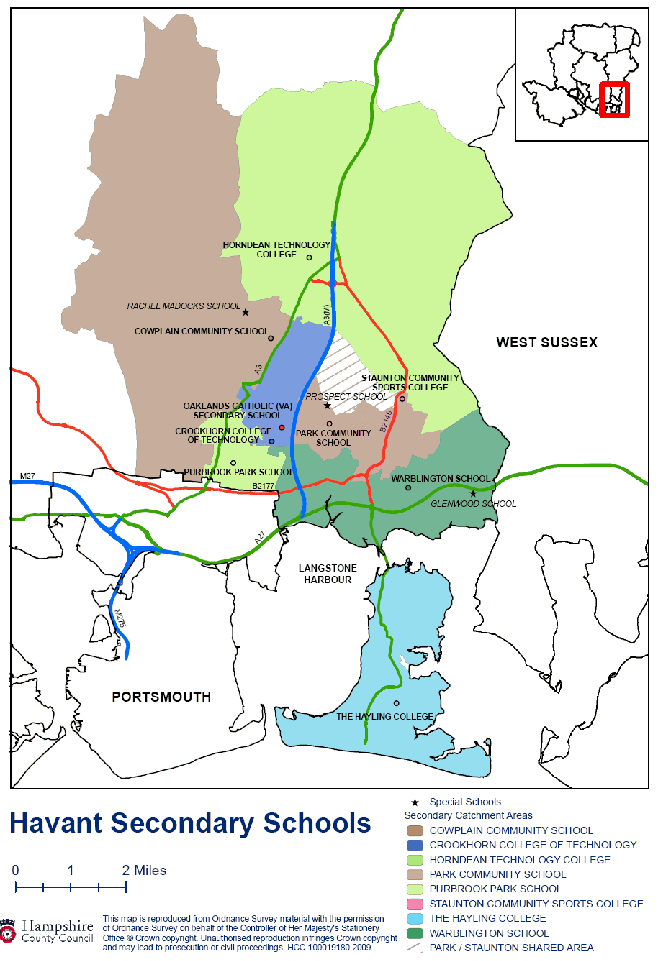
Consultation document : February - March 2009
Over 23,000 copies of this document were distributed throughout the Havant/Horndean area.
Building Schools for the Future
Consultations on a "preferred option" for the Havant and Horndean area
This document summarises comments made in the first round
of consultations on the school organisation implications of
the County Council's proposals for implementing Building
Schools for the Future (BSF) in the Havant/Horndean area.
Comments are invited on the `preferred option' which is now
recommended. More detailed information including a version of this document is available on the County Council's website:
www.hants.gov.uk/education/bsf
Anyone may comment on the proposals. Responses are
particularly welcome from parents of primary school pupils.
Why are more consultations taking place about BSF?
On 24 July 2008, Councillor David Kirk, Executive Lead Member for Children's
Services (Education) approved consultations on proposals for the future pattern
of secondary education within the Havant/Horndean area. The full July report
and decision sheet can be accessed at:
www.hants.gov.uk/decisions/decisions-index/index-docs-6903
Consultations were carried out in September - November and over 1,200
responses were received to the questionnaire.
On 21 January 2009, Councillor Kirk approved further consultations on
new proposals which now represent the local authority's `preferred option',
based on a careful study of all comments received and further analysis of
future pupil demand. This new consultation document proposes that Staunton
Community Sports College should close and be replaced by an 11 - 16 academy,
linked to a range of capacity reductions throughout the Havant/Horndean area.
These measures will reduce the original forecast of 22.7% surplus places by 2018
to 5.4%, well within the government's preferred 5% - 8% range.
The report considered by Councillor Kirk on 21 January can be found at:
www.hants.gov.uk/decisions/decisions-index/index-docs-6985
This second round of consultations will run from Monday 9 February until
Monday 30 March 2009. Responses may be made on the attached reply form or,
alternatively, on-line at:
www.hants.gov.uk/education/bsf
Changes to the original BSF proposals
The Government's Building Schools for the Future programme is designed
to transform secondary education throughout the country by releasing funds
to rebuild completely or substantially remodel every secondary school.
This represents an exceptional opportunity to match school buildings to future
curriculum demands and the wider community needs of future generations.
When the programme for BSF in the Havant/Horndean area was first considered,
it was expected that £120m would be available for investment. On this basis it
was proposed that projects at all schools in the area would be carried out as
one phase.
However, during the consultation period, the Department for Children,
Schools and Families (DCSF) informed authorities that the funding available
for the first wave of each authority's new BSF projects would be capped at
£80m. This means that it will no longer be possible to implement BSF in the
Havant/Horndean area as a single project. Instead, it is now proposed that
implementation will be in two phases, the second phase linked to the three
secondary schools in the Gosport area.
Expression of Interest
As part of the County Council's bid for future BSF funding, an Expression of
Interest was submitted to the DCSF on 1 December 2008, setting out proposals
for the development of BSF throughout the county. The full report considered
by Councillor Kirk on 26 November, which forms the basis of the Expression of
Interest, can be read at:
www.hants.gov.uk/decisions/decisions-docs/081126-excsed-R1119085113
Ministers are now considering all Expressions of Interest submitted by
authorities before drawing up a national priority list in early 2009. This will
tell us when the County Council will be able to go ahead with its first phase
project in Havant/Horndean.
Main views expressed during the consultations
1,233 responses were received to the consultation document. 84% were
against any school closures. The consultation document suggested that
an academy might replace both Staunton and Warblington. About half of
respondents commented on this with more than a two-to-one majority against.
A similar number commented on the possibility of establishing an "all-age"
school, with a three-to-one majority against.
Responses were also received from ten mainstream and special secondary
schools within the area, the Leigh Park Community Improvement Partnership
(representing schools and community groups in the area), the Havant Federation
of Secondary Schools, Havant Borough Council, Portsmouth City Council,
East Hampshire District Council and teachers' representatives.
Taking all responses together, the following key themes have emerged:
1) There was strong support for the retention of Staunton Community
Sports College and a view that the local authority had put too much
emphasis on the need to reduce surplus places.
2) A clear message emerged that the Leigh Park community requires
two schools capable of providing a variety of relevant courses and,
equally important, a level of pastoral care and guidance that is
particularly needed by many Leigh Park pupils.
3) There is a strong local belief that small schools are better than larger
schools at catering for the wide range of pupils' needs within the area.
4) Schools on the eastern side of the area in particular feel that the local
authority could do more to stem the loss of pupils to schools on the
western side of the A3(M) and to West Sussex schools.
5) Concerns were expressed about travel to alternative schools if
Staunton were to close.
6) Pupils were consulted at Park, Staunton and Warblington. They all spoke
highly of their schools, particularly of the expertise and approachability
of staff.
7) Schools within the Havant Federation emphasised the key role of this
partnership in enhancing the curriculum, widening social opportunities
for young people and enabling professional development of staff.
What is proposed now?
Although the consultation revealed strong support for the retention of Staunton,
the DCSF is unlikely to agree that the present school can deliver the required
improvements in performance. The government's preferred way forward in
circumstances where a school is performing significantly below the National
Challenge standard is to establish an academy, bringing in new sponsors to set up
and lead the new school.
The DCSF website states that academies are all-ability, state funded schools
established and managed by sponsors from a wide range of backgrounds,
including high performing schools and colleges, universities, individuals, businesses,
the voluntary sector and the faith communities. The website stresses that
academies are not maintained by the local authority but must work closely with it.
Sponsors appoint the headteacher and, in order to determine the ethos and
leadership of the academy and to ensure clear responsibility and accountability,
the main sponsor always appoints the majority of the governing body.
The governors employ all members of staff, determine their pay structure and set
their conditions of service. They also determine the length of the school day and
pattern of holidays.
Academies must follow the School Admissions Code and Special Educational
Needs Code of Practice. New academies are required to follow the National
Curriculum programmes of study in English, mathematics, science and ICT.
The `preferred option' therefore recommends the establishment of a 700
place academy to replace Staunton Community Sports College, with the aim of
opening the new school from September 2010. Sponsorship would be sought
from locally based further and higher education providers with emphasis on the
provision and development of a skills-based curriculum. This is seen as the only
realistic way both to maintain educational provision on the Staunton site and
attract BSF funding.
All-through Provision
The possibility of establishing an `all-through' school featured in the consultation
process and received some support. Consultees felt that a structure in which
schools worked together more formally could be a powerful influence in
ensuring coherent educational and social support for some of the county's
most disadvantaged children, with minimal disruption from school transfers.
This will continue to be pursued locally.
Formal Federation or collaboration
Despite the government's expectation that academies will help to raise
standards throughout the surrounding area, regulations do not currently allow
for federation or formal collaboration between academies and local authority
maintained schools. However, given strong support from the local community
for the retention of a school on the Staunton site, including from the Leigh
Park Community Improvement Partnership (CIP) and the Havant Federation of the Future - Secondary Schools, which sits outside the Government's more formal structure,
there is nevertheless substantial scope for continuing local partnership.
In particular, the CIP's work on the concept of the Leigh Park Learning Village
could be further developed.
Proposed future capacities and numbers on roll
The following table shows what is currently proposed, not only in relation to
Staunton but all schools in the review area.
School |
Capacity |
Forecast number on roll 2018 |
Surplus places 2018 | |
2008 |
2018 | |||
Cowplain |
1,098 |
1,050 |
996 |
5.1% |
Crookhorn |
973 |
1,050 |
979 |
6.8% |
Horndean |
1,500 |
1,100 |
1,010 |
8.2% |
Purbrook Park |
840 |
810 |
758 |
6.4% |
Sub-total |
4,411 |
4,010 |
3,743 |
6.7% |
Park |
900 |
900 |
889 |
1.2% |
Staunton |
903 |
700 |
655 |
6.4% |
Warblington |
977 |
750 |
699 |
6.8% |
Sub-total |
2,780 |
2,350 |
2,243 |
4.6% |
Hayling |
744 |
600 |
555 |
7.5% |
Oaklands |
1,453 |
1,300 |
1,270 |
2.3% |
Totals |
9,388 |
8,260 |
7,811 |
5.4% |
1) The number on roll estimates for 2018 have been revised to take into
account numbers on roll in October rather than January 2008, further
analysis of the likely demand from the West of Waterlooville Major
Development Area (MDA) and housing developments proposed in the
South East Plan.
Initial projects
2) No change is now suggested to the capacity of Park Community School
which would remain at 900. A higher capacity could affect the viability of
any school on the Staunton site.
3) An academy is now proposed for the Staunton site with a capacity of 700
places to reflect the forecast demand, with the aim of opening the new
school in September 2010.
4) A reduction from 977 to 750 places at Warblington is proposed which is
considered the maximum possible capacity following careful review of
numbers on roll projections and the recommendation that a school should be
retained on the Staunton site. The remodelled building could, however, include
flexibility to return to 1,000 places should demand emerge in the future.
5) The proposed reduction in capacity from 1,098 to 1,050 at Cowplain
Community School reflects projected demand, including from the West of
Waterlooville MDA, and remains unchanged from the previous consultation.
6) The proposed reduction in capacity from 744 to 600 places at
Hayling College reflects projected demand and remains unchanged.
7) The proposed reduction in capacity from 1,500 to 1,100 places at Horndean
Technology College reflects projected demand and remains unchanged.
Follow-on projects
8) Projected numbers on roll at Crookhorn for 2018 include an additional
320 pupils to take account of the West of Waterlooville MDA. The proposed
1,050 place capacity remains unchanged.
Building Schools for the Future - Consultation document
9) The proposed reduction from 840 to 810 places at Purbrook Park reflects
likely demand and is less than originally proposed.
10) The proposed reduction in capacity at Oaklands Catholic Voluntary Aided
School from 1,453 to 1,300, including the 6th form, to link to its current
admission number remains unchanged.
What happens next?
Many of those consulted, expressed concerns about the length of time it would
take to reach final decisions. However, the DCSF requires extensive consultations
to take place to ensure that all interested parties have been given the chance to
comment and that all options have been considered.
As far as the Havant/Horndean area is concerned, the first round of
consultations has proved particularly valuable because it has allowed open
discussion about surplus places in the eastern sector of the review area and
the effects of pupil movement to West Sussex and to Hampshire schools to the
west of the A3(M).
Although the `preferred option' responds to the key issues raised during the
earlier consultation, it is still very important for as many people as possible to
take part in this second consultation round.
It is proposed that the consultation period will run from seven weeks starting
on Monday 9 February and finishing on Monday 30 March. A report will then
be presented to Cabinet, after which a public notice setting out in detail exactly
what is proposed will be published for a further six weeks, allowing further time
for representations.
The County Council would then consider any objections to the proposals,
after which the DCSF would decide whether an academy should be established.
How to comment on the proposals
As in the previous consultation, comments can be made on-line or on the
attached pre-paid response sheet. The online response form can be found at:
www.hants.gov.uk/education/bsf
The website will contain details of consultation meetings once they have been
agreed. We are particularly keen to hear from parents of primary school pupils
and meetings for these parents will be arranged.
Contact Details
Building Schools for the Future
Hampshire County Council
Children's Services Department
Winchester, Hampshire
SO23 8UG
Tel: 01962 846343
Email: [email protected]
Building Schools for the Future (BSF): implementation in the Havant/Horndean area
List of formal correspondence received:
Name |
Date sent or rec'd | |
1 |
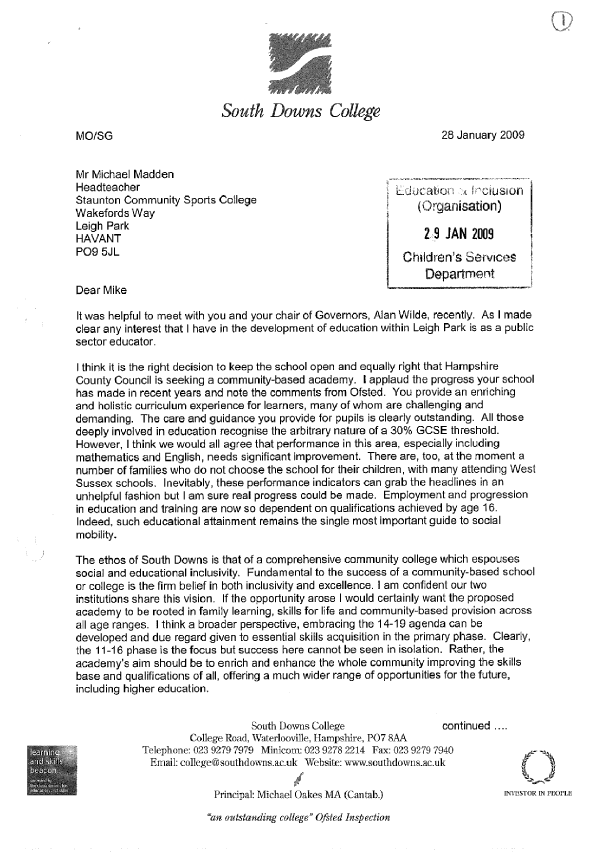
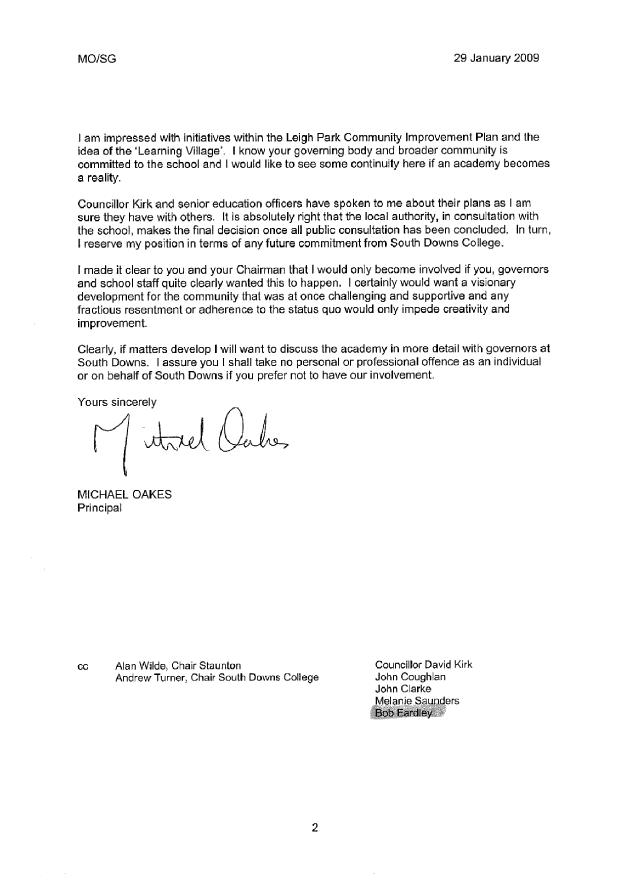
Michael Oakes - Principal, South Downs College |
28/01/09 |
2 |
Lynda Strodder - headteacher, Lord Wilson School |
05/02/09 |
3 |
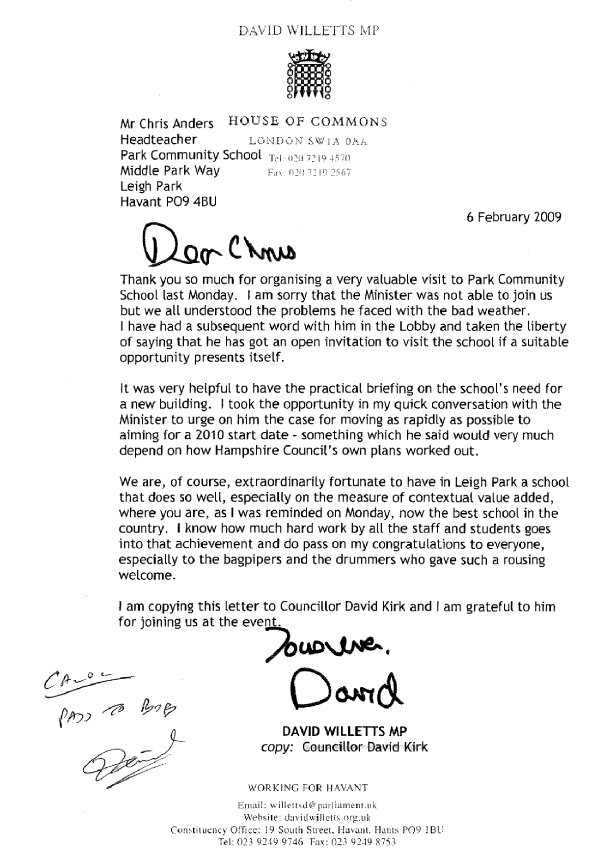
David Willetts MP, House of Commons |
06/02/09 |
4 |
Park Community Governing Body |
26/03/09 |
5 |
Tony Briggs, Leader - Havant Borough Council |
27/03/09 |
6 |
Leigh Park CIP Headteachers - Mike Madden |
30/03/09 |
7 |
Cowplain Community School - Governors |
01/04/09 |
8 |
East Hampshire District Council - Chief Executive |
01/04/09 |
9 |
Sharps Copse Primary and Nursery School - Governors |
01/04/09 |
10 |
Trosnant Infant School - Governors |
02/04/09 |
11 |
Front Lawn Junior School Governors |
Undated |
12 |
The FLASH Group |
23/03/09 |
13 |
Alan Wilde - Chair of Governors, Staunton Community Sports College |
08/04/09 |


Park Community School Governors
Middle Park Way
Leigh Park
Havant
Hampshire PO9 4BU
T: 023 9248 9800
F: 023 9248 1012
W: www.pcs.hants.sch.uk
24 March 2009
Response to Building Schools for the Future Consultation
Park Community School Governors accept, in principle, the preferred option of the County Council proposals for implementation of BSF in the Havant/Horndean area.
However we would like to make some comments on the issues surrounding Park Community School.
1. Park is a school where first preferences for Year 7 are over-subscribed by 50 this year. Should our levels of attainment continue and our vision of raising academic attainment as well as vocational be achieved, we will continue to be over-subscribed. The school has every reason to believe we will achieve our goals and the school will be in the position of turning away pupils of first choice in future years. This is not in the best interests of either the pupils or the Local Authority.
2. Governors do not agree that the reason for limiting Park to 900 is the impact on Staunton Community Sports College. It is our contention that any additional pupils of first choice tend to come from the western end of the Warblington catchment, from where pupils currently attend Crookhorn, rather than the Staunton catchment area.
Why, therefore, is it the Local Authority's proposal to increase Crookhorn's capacity to 1050, resulting in 6.8% surplus in 2018, when Park will have a predicted surplus of only 1.2%? Of all schools in the area only Purbrook, Oaklands and Park are currently full. It is difficult to understand why in that case Crookhorn's capacity is increased at the expense of others.
The forecast surplus capacity for all schools other than Park and Oaklands is in excess of 5%, whereas Park at 1.2% leaves a very small margin for error. The consultation document states that Crookhorn has an expectation of 320 pupils from the MDA. Therefore, without the MDA, a nominal NOR of 659 for 2018 could be expected.
3. The MDA calculation is flawed as we suspect a significant proportion of the families in the North Western area of Plant Farm will opt for Cowplain which is nearer and does not involve crossing the busy London Road. It is therefore quite likely that Crookhorn will not receive all 320 pupils as predicted.
4. Governors accept the need to partially rebuild Park for economic reasons.
However we are passionate that we must have facilities that enable us to reach out into the community to provide support to parents who need to access education opportunities in facilities and with resources that meet their particular needs in accordance with our Community Cohesion plan. Our work with feeder schools, in particular Barncroft, to de-stress the trauma of moving to secondary education for children and improve links in curriculum, literacy and numeracy, MFL and other subjects, has played no small part in increasing the popularity of Park as a school of 1st choice. This, we believe, will ensure a future full to capacity Park Community School.
Here at Park we have placed great emphasis on involving parents in the learning process. Unless we can ensure that parents from under-achieving families are supporting their children in education we are likely to fail to achieve as well as we ought, despite BSF. We believe that in most cases of under-achievement at KS3 and KS4 we find some parental issues. Therefore to tackle the last few percentage points you need greater family input.
We are also of the opinion that any BSF investment in Leigh Park must enable schools in this area to offer a welcoming environment for adults as well as youth to engage in learning. By this we do not mean Adult Education Courses, but resources where parents can learn basic literacy, numeracy and indeed parenting skills if necessary.
5. To do this we may need to include in the facility some space to provide services considered as non-educational, but nevertheless supportive to the community. By doing this it will encourage parents to come into school, see what is on offer in the learning environment, and hopefully take advantage of it.
6. Currently we have to use the Library as a classroom and have no spare resource for any extended community learning. With a 1000 pupil school there is every possibility that we will have sufficient resource to enable this fundamental requirement of bringing the wider community as well as parents into our school.
Governors believe that to break the perceived culture of poor education in the area we need to involve parents and families in school to a greater extent. We can only do this if we have a large number on role and adequate resources in which to give adults some experiences during the school day. A 1000 pupil school meets our expectation of being able to deliver this.
F. H. Deeks
Chair of Governors
On behalf of the Governing Body








Our ref: SCPN BSF Response 270309
27th March 2009
Mr B. Eardley - Project Director
Building Schools for the Future
HCC
Children's Services Department
WINCHESTER
Hants
SO23 8UG
Dear Bob,
The governors of Sharps Copse Primary and Nursery school wish to express our support for the proposal that Staunton Community Sports College remains open as an academy.
The majority of our parents feel that this is a good school and have expressed strong feelings that they wish it to remain open.
We feel that a partnership with a FE college would offer children further opportunities and encouragement to go into further education.
The last year has caused considerable anxiety for our parents who have worried about the continuity of their children's education. There are, however, concerns that once opened as an Academy, the future of the school will not be secure.
Yours sincerely
Richard Setford
Chair of Governors
Front Lawn Junior School - Governing Body and Head Teacher Response to the `Building Schools for the Future' Consultation
Front Lawn Junior School, Broadmere Ave, Leigh Park, Havant, Tel: 02392 482092
As a Governing Body we strongly support the need for schooling provision on the Staunton Site, essentially from 11 to 16 (see later comments), but more crucially as an Academy which is rooted in the Community Regeneration work of the `Community Improvement Partnership', which is already functioning, in all but name, as a `Local Children's Partnership'. It is essential that a golden opportunity is not missed to accelerate and grow the existing partnerships in the CIP with the Academy at the heart of this process, and indeed, as a driver of it .As a key feeder Junior School we currently have an `All Through School' philosophy with SCSC with Joint Staff meetings, CPD opportunities, cross-phase teaching, KS2/KS3 co-led workshops, peer support and mentoring from older students, embedded transition and inclusion practice. This is of course, within the context of the CIP `Learning Village' and the extensive `Transition' programme and Community Improvement work across all sixteen schools, involving an interagency approach, and engaging our partners as an integral part of this work. It is essential then, that it is not just 0-19 learning and `ALL through Schooling' that continues to be at the heart an Academy within the CIP, but a 0-90 philosophy which builds on our inter-agency collaboration with services and extended 'Partner' providers.
An Academy must, as does every school within the CIP, have as its core business, the raising of aspirations for their students, `Can do' becoming `I want to'. This means unlocking the talents of all students, developing the Gifts and Talents of all Students, not just 10% G&T of a school population. This means the highest expectations for achievement and academic attainment ( GCSE, A Level, Degree) to improve the life chances and opportunities for economic well-being (good qualifications, give you a better chance to get a job and opens the doors to key professions, which would otherwise be closed). Unlocking the talents of all students, also means an Academy within the CIP having the highest expectations, in breadth and depth, to develop vocational, pre and post 16 training opportunities in providing the skills, NVQ qualifications, apprenticeship, job and career training that employers are looking for.
Put simply, we need to be thinking bigger and bolder towards the wider `Economic regeneration' within the Leigh Park Community. No-one in Hampshire or within the CIP believes it is acceptable for approximately 278 young people to be in neither, Education, Employment or Training. The Staunton Academy needs to have strong representation and partnership from the Local Authority in ensuring that the setting up, shaping and future direction of the Academy, delivers on all fronts, within the Community Improvement Partnership. Too much has been gained, there is too much at stake, for this to be lost. The CIP has an excellent partnership with Havant Children's Services and the Director. We share a vision for Local Children's Partnerships. Now, is not the time for the LA to take a back seat and `See what happens'. It is a time when we must all, not just `Seize the Day', but `Seize our Future'. Together, we must take and shape the `Statutory Rules' in setting up an Academy, to fit our purpose, so that an Academy within the CIP is, FIT FOR PURPOSE at a Local Partnership level. As a step in this direction, Brian Pope could become the first `Community Improvement Partner' within the County, to perform a role alongside the CIP- Local Children's Partnership, in assessing the impact and outcomes of the aligned CIP Shared Plan within the ECM/Hampshire Children's and Young People's Plan. The Academy, within the CIP, would be at the heart of this support and challenge. Both John Coughlan and Brian Pope were at the CIP Heads meeting when this suggestion/proposal was raised by Joy Waelend on behalf of the CIP. As a Community Improvement Partnership (and Governing Body within the CIP). we would want to be a partner in this process of `Setting up and shaping' the Academy and have a role in Governance alongside the LA, within the composition of the Governing Body).
As a Governing Body we raise the question quite seriously, that whilst the excellent South Downs College is a local and well placed Sponsor, because of its expertise in raising academic aspiration and vocational choice, there needs to be a drive to gain additional `Relevant Economic Sponsors' who can become Community Partners in a way that serves, builds capacity and expands horizons. We are aware of Academies in which economic sponsorship has effectively served to DICTATE, IMPOSE AND NARROW provision, we would be looking for additional sponsors (probably over time, due to the tight time-frame) who can significantly enhance the core offer and entitlement to young people, within the Partnership for Children and Young People within the CIP. In conclusion we care desperately about the `present', `past' and `futures' of 4000 students who make up our community, not just the Students within our walls. There is a generational dimension to the re-generation of this Community, it involves all people of all ages and abilities, Families, Parents, Carers and Grandparents alike. An Academy within the CIP would understand and play its part confidently side by side with the 15 schools, Multiple Partners and Interagencies, to impact on the families of our 4000 children and young people.
Please accept these views and appendices of views, as a range of perspectives from the Governing Body of Front Lawn Junior School which SUPPORT the establishment of an Academy, within the collaborative framework of The Leigh Park Learning Village -Community Improvement Partnership.
Yours Sincerely,
Tina Newman Mike Seddon
Head Teacher Chair of Governors
(On behalf of Front Lawn Junior School Governing Body and Front Lawn Junior School Staff, including representations made to us from Parents)
Apendix 1 - Views and thoughts expressed by David Chiswell, Chair of Finance at Front Lawn Junior School
Formation of an Academy at Staunton Park
The decision has clearly been made to go for Academy status; there is no back-up plan.
The timescale appears to be very aggressive and if the intention is to stick to September 2010 for opening an academy steps need to be taken to ensure the future success of project:
· A separate organising body should be set in place with responsibility for all stages of the implementation; this body should include potential future governors, prospective Head Teacher and key advisers.
· The body should remain in place for, at least, the first 12 months of existence of the academy with clear guidelines on division of responsibility between it and the new Governing Body.
· The Academy should have in place, from the day it opens its doors, rigorous assessment routines for pupils
· The Academy should also consider how it creates the right environment for young people coming up from Junior/Primary schools to ensure their integration into academy life while protecting their learning in earlier years; there should be drop-off in the achievement in the first two years of academy life.
· More work should be done to establish the community's needs from an academy; this should include an assessment of qualifications and skills needs of the `employment community' in the South East Hampshire and West Sussex area.
· Very careful thought must be given to the role that any potential funders or collaborators will play in the life of the academy. There is a danger that funders/collaborators would want to steer the academy in directions that might be counter-productive when viewed against the needs of the community (e.g. if driven by a government target of 50% university qualification).
· The Academy should avoid specialisation as this will offer a narrower view of 11-16 education in the Havant/Leigh Park area.
Appendix 2 - Views and thoughts expressed by Mike Seddon , Chair of Governors, Front Lawn Junior School
1. I guess overall I am a believer in Academies as they were defined originally by the Government (fully supported by a group of sponsors who were local employers and who helped define the type of courses and education required to support their specific industries and businesses)
2. When I listened today however I got the distinct impression that the Sponsorship model has drifted away from the original model to a significant extent. Therefore I do have a concern that the new (intended) model is untried/tested for the Leigh Park student recipients. Academies need to address the requirements of business but must be fully cognisant of the type and level of students they are trying to attract with their courses.
3. We were told that the main sponsors would be further education establishments but of course they have an expectation that students will fill the courses offered whether or not they are aligned to the student capabilities and abilities and to my understanding have a more generalised set of offerings rather than local business/industry specifics.
4. We know that a proportion of students within our community are generally unable to meet high educational standards and therefore any Academy that doesn't recognise this within their curriculum, will not benefit the community and I think FE sponsors of other educational facilities, may well not address this key factor and may not even want to accept it.
5. So given the above I believe it is incumbent on the Hampshire CC to ensure the correct penetration and level of sponsorship is sought for the Staunton Park Academy to ensure courses and their curriculum are aligned to both sponsor's requirements and to be commensurate with student faculties
Appendix 3 - Views expressed collaboratively by our CIP as a unified contribution to the BSF Consultation Process from all schools and partners. Front Lawn Junior School is an integral part of this CIP contribution.
(Please see full CIP Submission)
Firstly we see the Academy as an opportunity to further develop and accelerate the progress of the CIP. We strongly believe that the Academy should have a key role within the CIP if we are to develop a strong local partnership in the Hampshire Children's Trust. If we are to develop a local partnership within a children's trust we feel that Hampshire County Council should take on a partnership role in the establishment of an academy to ensure coherent provision across Leigh Park and that the academy is routed in this partnership.
With regards other sponsors we would strongly support South Downs College as a lead sponsor for the following reasons:
· It has always taken a lead on parenting and family learning in the area
· Its students complete their work experience across a wide number of schools within the CIP.
· Currently the majority of our student's post 16 go to South Downs College.
· There is already strong links post 14 through the Havant Consortium and other courses.
· The South Downs family learning team will present to the school network group and therefore continue to have an influence within the partnership.
· South Downs would provide an opportunity to develop the vocational aspects of an academy with coherent and continuous progression routes which could also benefit primary schools.
· We believe the philosophy of South Downs as a comprehensive and inclusive FE college is complementary to our own aims as a CIP.
As we identified in our previous consultation we would welcome the co-location of special school provision on a main stream school site to the benefit of both. This would be a real opportunity to develop a more inclusive system where special school students have access to the resources and programmes in secondary schools and secondary schools benefit from the expertise from special schools to improve teaching and learning of our students with SEN. We also believe that this would be an opportunity to establish specialist services / provision to support young people for example those who have autistic spectrum disorder within mainstream provision.
There are still issues with regard primary building and this would be an opportunity to link primary capital into the overall BSF plans for the area which may allow co-location or services and provision and further support although schooling (process not place). This would also be an opportunity where we could reassess and redefine our preschool provision and further develop parent and family learning which underpins all that we do in narrowing the achievement gap. This is a real opportunity to create a coherent education system from 0 - 90.
We would ask that you consider our views and hope that you will assimilate them into your thinking in the establishment of an academy.
Decision Reference No: 625
Appendix 3
 26 Lovedean Lane
Waterlooville
Hampshire
PO8 8HJ
Councillor David Kirk
5 Belmont Road
Andover
SP10 2DD
23rd March 2009
Dear Councillor Kirk
Re Building Schools for the Future (BSF): Havant and Horndean area
Response to the published "preferred option"
Thank you for meeting with us on Wednesday, 18th February, and with your colleagues, Felicity Dickinson and Bob Eardley.
We are pleased that Jane Vaughan was able to attend on behalf of the National Autistic Society (NAS), and accompany our FLASH representatives, Mrs Margaret White, Chairperson, Mrs Helen Hall, Secretary, Mrs Lorraine Grieve, committee member and retired health visitor with special interest in children and families with autism, and Dr Michael White, general medical practitioner.
Outline of the main points discussed
There is a gap in the secondary provision for children with autistic spectrum disorder (ASD) in this part of south-east Hampshire.
Funds are not available to build a new ASD school
A specialist ASD unit or centre could be incorporated into one of the existing secondary schools, under the Building Schools for the Future plans.
Some schools in the BSF consortium area will have space for such a development, due to the planned reduction in capacity.
There are children who clearly have special educational needs because of an underlying diagnosis such as autism. The parents may have declined a formal assessment, as they are reluctant to ascribe a "label" to their child's condition. Such children could benefit from being placed in the mainstream part of a school where there is an autism unit, as the unit could provide a pastoral contribution albeit indirectly, working alongside those colleagues who are more directly involved.
Good practice exists for ASD provision both within Hampshire and elsewhere. Hampshire establishments include The Romsey School, Robert May's School, Odiham, and Oak Lodge/Oak More Schools, Dibden Purlieu. Jane Vaughan (NAS) gave examples of successful ASD secondary provision elsewhere including Mossbourne Community Academy, Hackney.
Two units may be necessary, in order to accommodate the potentially increasing number of children with ASD, and to avoid such a unit becoming disproportionately too large for the size of the school.
There are two options for determination of which school would be most suitable.
_ The first option is to write to the existing schools inviting "expressions of interest".
_ The second option is to include the specification for such a unit within the "invitations to tender" for an academy.
You recommended that parents write a personal letter highlighting the need for an ASD unit/centre in the Havant and Horndean Consortium area.
You asked if we could
_ Find out the numbers of children with autism, or who could benefit from such a unit
_ Suggest what the bidders should include in their tender, if the academy option is pursued
Subsequent progress
Parents' response to BSF "preferred option" We have contacted our membership regarding writing their own personal letters to you and some of these letters will be sent to you via your email address, as part of the response to the BSF proposed option.
Prevalence of autism
There are no registers for the diagnosis of autism, either within the education or health sectors. The coding of ASD and related disorders within general practice records is too inconsistent, and confidentiality restrictions would prevent such data being available.
Not all children with ASD have either necessarily been clearly diagnosed as such or have a "statement of special needs". Teachers and other colleagues may suspect or know that a student has ASD for practical purposes, though it may be inappropriate or impossible to share their suspicions with the student's parents.
As a minimum, it would not take long to write to the nine secondary schools and ask how many are identified on their records. This is unreliable as many children with ASD are at school outside the area of Havant and Horndean. Possible means of identification include:
_ Formal diagnosis of ASD with or without statement of special educational needs
_ Possible diagnosis of ASD, though no formal diagnosis
_ Checking all lists of students whose names are on "Action" or "Action Plus" lists, and applying an informal ASD assessment
The National Autistic Society prevalence
Estimated prevalence rate in the UK
The indication from recent studies is that the figures cannot be precisely fixed, but it appears that a prevalence rate of around 1 in 100 is a best estimate of the prevalence in children. No prevalence studies have ever been carried out on adults.
http://www.nas.org.uk/nas/jsp/polopoly.jsp?d=235&a=3527 accessed 8th March 2009
Autism Research Centre, Cambridge, prevalence
Prevalence of autism spectrum conditions in primary schools (CAST)
Carrie Allison, Jo Williams, Fiona Scott, Carol Brayne, Patrick Bolton, Simon Baron-Cohen, Fiona Matthews, Angelica Ronald, Robert Plomin
We developed the CAST, formerly known as the Childhood Asperger Screening Test but renamed as the Childhood Autism Spectrum Test. The change of name reflects that it was originally designed for a prevalence study of Asperger Syndrome in childhood but is useful for low-functioning children too. We found that the CAST discriminates cases from controls well, and that CAST scores show strong heritability in a twin study. We have recently used the CAST as an instrument in a large population study in which 20,000 primary school age children in Cambridgeshire were sent the screen. Results will be available during 2008 but broadly confirm recent studies from other prevalence studies that autism spectrum conditions are found in about 1% of the population.
http://www.autismresearchcentre.com/research/project.asp?id=8 accessed 8th March 2009
Professor Baron-Cohen quoted prevalence of 1/58 (1.7%)
i. The suggested prevalence of 1/58 depends on where the line is drawn as there will be those on the borderline, and who may or may not require SEN provision or intervention. Any required SEN intervention may work best if such borderline students are managed as would the more severely affected children with a formal diagnosis of ASD.
Unit size estimate methodology
Baron-Cohen 1.7% (1/58) Havant 138 pupils |
0.7% 57 pupils |
57 pupils |
1) May be very bright socially awkward children 2) Special needs can probably be met from routine provision 3) Nevertheless may benefit from indirect pastoral overview |
Cambridge (CAST) 1% 81 pupils |
Assume 2/3rd 54 pupils |
1) These are the children whom are most likely to benefit from a dedicated autism unit 2) Average per year (year 7-11) is 11 pupils | |
Assume 1/3rd 27 pupils |
1) Primary diagnosis may be another diagnosis 2) May attend school for Mild Learning Difficulties 3) May not have formal diagnosis or are coded for statement purposes as not having autism |
ii. Petersfield School has 1200 pupils of whom a significant number reside in the Horndean catchment area and as far as Denmead (12 miles), giving a number with ASD in the range 12 to 20 pupils (1-1.7%). Given that pupils with ASD already travel from Petersfield to Baycroft School at Stubbington, the size of an intended unit in Havant and Horndean area should take Petersfield numbers into consideration.
Conclusion about prevalence of autism
iii. For planning purposes, we suggest that the prevalence of autism in children of secondary school age be considered to be in the range of 1% to 1.7%
iv. Other considerations:
_ The number of students with a formal diagnosis of ASD is increasing, due to greater awareness and wider application of formal methods of assessment
_ The number of children surviving very premature births is increasing due to increased multiple births, IVF (in-vitro fertilisation), and improved neonatal care; these children have above-average levels of disability including ASD
_ The increase in school leaving age to 18 years will require more student places
Locality
Children benefit from not having to travel outside the home area for several reasons including:
_ Children do not waste valuable educational time in travelling. Often the travelling means that they have a higher level of stress on arrival at school, which impairs their ability to concentrate and interact with others
_ Able to attend extra-curricular activities including extended services
_ Able to mix with school peer group outside school as would live locally
_ Parents can take part in activities, such as parents' evenings, and consultations
_ Parents are able to take a fuller role in supporting their child's education
_ Parents are better able to support the school in other non-academic ways such as involvement with fundraising or "Friends of the School"
Specification for an autism unit
We have proposed some criteria in the document that we presented at the meeting as an "aide memoire" (appended).
Jane Vaughan from the National Autistic Society has an excellent knowledge of schools where an ASD unit/centre has been incorporated into a mainstream setting and has been extremely successful.
We append a sample specification as kindly sent to us by the National Autistic Society.
Building Bulletin BB102 "Designing for disabled children and special educational needs" sets out more information.
Expression of interest -v- academy specification
We see advantages to both these options. If there is enthusiasm within an existing school, it is always a good starting point.
This is a complex technical decision about which we do not currently have enough information to provide a considered opinion
Autism Bill, second reading, Friday 27th February 2009
The Autism Bill was passed by the House of Commons, and will be going to committee stage.
The intended legislation proposes further obligations for local authorities:
1 Duty to record number of disabled children
(1) Children Act 1989 is amended as follows:
(2) In Schedule 2, after paragraph 2, insert -
(3) Every local authority shall take reasonable steps to ensure that the register is an accurate record of disabled children within their area
(4) Every local authority shall ensure the register contains sufficient information to effectively plan services for disabled children
4 Duty to promote support services for persons with autism
(1) It shall be the duty of the Secretary of State to promote and support the provision of services by local authorities and NHS bodies to persons with autism.
We believe that it is now appropriate to start to fulfil anticipated obligations of a future Act of Parliament, in order to reduce further expenditure of time and cost at a future date.
Conclusion
We are grateful for the interest that you and your colleagues are taking in the provision of secondary education for children with ASD.
We hope that our meeting with you has helped to clarify some of the issues that need to be considered both in the provision of the education for ASD children, and as part of the BSF process in the Havant and Horndean area.
We propose a further meeting in late June or early July to review the situation and discuss developments.
We look forward to further positive developments.
Yours sincerely
Mrs H Hall Mrs M White
F.L.A.S.H. Secretary F.L.A.S.H. Chairperson
Mrs L Grieve MJ White
F.L.A.S.H. Committee member F.L.A.S.H. member
Enclosures:
1) "Proposed Points of Discussion" document 18th February 2009
2) "Secondary school education for pupils with ASD in South-east Hampshire", submitted on behalf of FLASH, SPACE and PAAS 24th November 2008
3) Guidelines for autism education provision, as supplied by the National Autistic Society to Bradford Local Authority in September 2007
E-mail response from Alan Wilde - Chair of Governors, Staunton Community Sports College

From: Munro, Alex
Sent: 08 April 2009 13:49
To: Reid, Heather
Subject: FW: Cabinet paper
Thanks.
Alex Munro (School Organisation Officer)
Tel: 01962 846462; e-mail: [email protected]
-----Original Message-----
From: Alan Wilde [mailto:[email protected]]
Sent: 08 April 2009 13:33
To: Eardley, Bob
Cc: Munro, Alex
Subject: Cabinet paper
The governors at Staunton Community Sports College support its transition from College to Academy status.
The governors strongly advocate the need for a local secondary school to provide care for local children and to provide much needed cohesion for an area of social deprivation. To this end they are working closely with the Local Authority to provide a seamless transition.
Building Schools for the Future (BSF): implementation in the Havant/Horndean area
List of consultation meetings
1 |
East Hampshire District Council Community Forum |
10 February 2009 |
2 |
Front Lawn Infant & Junior Schools Parents |
18 March 2009 |
3 |
Front Lawn Infant School Governors |
18 March 2009 |
4 |
Front Lawn Junior School Governors |
16 March 2009 |
5 |
Sharps Copse Primary School Governors |
17 March 2009 |
6 |
Sharps Copse Primary School Parents |
03 March 2009 |
7 |
Staunton Community Sports College Governors |
26 March 2009 |
8 |
Staunton Community Sports College Parents |
26 March 2009 |
9 |
Staunton Community Sports College Pupils |
26 March 2009 |
10 |
Staunton Community Sports College Staff |
26 March 2009 |
11 |
Trosnant Infant School Governors |
31 March 2009 |
12 |
Trosnant Infant & Junior Schools Parents |
24 March 2009 |
13 |
Trosnant Junior School Governors |
25 February 2009 |
14 |
Warren Park Primary School Parents |
17 March 2009 |
15 |
Warren Park Primary School Governors |
17 March 2009 |
Extract (Minute 60) from the minutes of the East Hampshire District Council Community Forum Minutes, 10 February 2009

EAST HAMPSHIRE DISTRICT COUNCIL
COMMUNITY FORUM MINUTES
(CLANFIELD, HORNDEAN & ROWLANDS CASTLE)
The SF Block, Horndean Technology College,
Barton Cross, Horndean, PO8 9PQ.
Tuesday 10th February 2009 at 6.30 pm.
-: Present :-
Cllr Mrs Dorothy Denston (Chairman),
Cllr Michael Ashton, Cllr Ken Graham, Cllr Mrs Marge Harvey (Vice-Chairman), Cllr Mrs Julia Marshall,
Cllr Ken Moon, Cllr Sam Payne and Cllr Mrs Sara Schillemore.
-: Also present:-
Parish Cllr Dave Harvey, Rowlands Castle Parish Council, Parish Cllr Brian Foster, Clanfield Parish Council, and Parish Cllr Mrs Susan Langham, Horndean Parish Council.
-: Officers:-
Community and Youth Democracy Worker and Assistant Committee Services Co-ordinator.
Minute 60:
60. PRESENTATION - BUILDING SCHOOLS FOR THE FUTURE (BSF).
The Chairman introduced Mr Alex Munro and Mr Bob Eardley from Hampshire County Council (HCC), who gave a presentation on BSF (attached as Appendix 1 to these minutes)
Mr Eardley had been leading on the BSF project for Hampshire and explained that the initiative had been announced by the Government in 2003. It had originally been intended that the programme would be completed after 15 years, but a more likely date would be after 2020.
The project had started purely as a building programme, but had now evolved into a lever for educational change.
Due to the fact that Hampshire, as a whole, had good GCSE results and low levels of
deprivation, it had not been a high priority county for the roll out of BSF. Hampshire was due to start BSF in 2011, with Horndean included in the first phase.
BSF would be a massive programme, with £1 billion to be invested in the 71 secondary and 16 special schools in Hampshire.
One of the key aims of BSF was to see an improvement in the attainment and wellbeing of children, by tailoring each child's curriculum to their needs.
Other aims included: more young people continuing at school after 16 and the use of
school facilities by the wider community. The first round of consultation had been carried out during September to November 2008, with over 1,200 responses having been received. Mr Eardley made particular reference to Staunton Community Sports College and said that there had been a very strong view in favour of the retention of a school on the site.
A number of options had been explored for keeping a school open and HCC had proposed that a 700 place academy be built.
Academies were schools, but were run independently by a sponsor. As such, they were not answerable to the governing authority and Governors were not obliged to follow national pay scales. However, a host of legislation existed to protect the staff's conditions of service and their pension scheme would be carried over.
The second round of consultation had started on 9 February 2009 and would continue until 30 March 2009.
Mr Munro invited responses, which could either be made by sending in a completed hard copy consultation form or by completing the form online at:
www.hants.gov.uk/education/bsf
Councillors and members of the public asked a number of questions, including: (answers in italics)
Could it be explained how the population had been increasing, but the number of secondary school age children over the next 15 years had been predicted to decrease.
Mr Eardley replied that this anomaly could be accounted for because people were living longer and the birth rate had fallen during the late 1990s and early 2000s.
How could District Councillors have input into, or get information on, BSF?
Mr Eardley informed the meeting that EHDC had responded to the first round of consultation and invited EHDC to respond to the second round.
How much choice would HCC have over who would sponsor the proposed Staunton
Academy?
If an academy were to proceed at the Staunton site, HCC would prefer a public sector sponsor. Ideally one of the local, high achieving, further education colleges.
With regard to offering school facilities for community use, would this be during school hours?
Mr Munro replied that if a school's layout had been designed with this in mind and if it was carefully managed, then yes. However, he did acknowledge that there would be a number of issues that would need to be `ironed out' before a school's facilities were opened up for community use.
If the first round of consultation had already finished and the second round had just started, why had a number of District Councillors only just found out about it?
Mr Munro reiterated that EHDC had been consulted during the first round of consultation, that a reply had been received and the response reported. Mr Bob Coleman, EHDC Community and Youth Democracy Worker, informed the meeting that Mr Mike O'Mahony, Community Manager, had recently been invited to and had attended a preliminary meeting on BSF.
The Chairman requested that the Community Manager attend the next meeting to address the Forum on the outcomes of this BSF meeting.
Cllr Mrs Marshall said that she had been on the Management Committee for Horndean Technology College and had not been informed of any BSF consultation.
She felt that Officers at EHDC should always notify the relevant Councillors when an
important issue arose which affected their ward.
There had been a Government initiative to improve STEM (Science, Technology,
Engineering and Maths) subjects in schools.
How would BSF incorporate or take these subjects into consideration?
Mr Munro replied that BSF would be an ideal opportunity to ensure that schools were well equipped to cover these subjects in the future.
Mrs Goodwin, a Governor at Horndean Technology College, said that HCC had
consulted with the College. The BSF scheme had developed organically and had undergone a number of changes and she asked whether there would be any further changes.
Mr Eardley could not say what further changes might take place, as some could come from central Government. He said that BSF had been continually evolving and would probably change following further consultation.
The Forum discussed school funding matters. Mr Munro explained that schools received two funding strands, Revenue funding and Capital funding.
He explained that Revenue funding was allocated to a school based upon the number of pupils and was used for running costs. Capital funding was allocated for investment in the fabric of the school and could not be used for a school's running costs.
Following the discussion, it was RESOLVED that
(i) the presentation and the Forum's comments be NOTED; and
(ii) the Community Manager be invited to attend the next meeting of this Forum to update Councillors on the outcomes of the BSF meeting which he had attended.
End of Minute 60.
BSF - Front Lawn Infant and Junior Schools - ParentsConsultations on "preferred option" | ||
Date |
||
Time |
||
Location |
||
Tina Newman |
Headteacher | |
Representatives of the Governing Body | ||
1 parent |
||
Brian Pope |
Area Director (Education & Inclusion) | |
Bob Eardley |
Lead Officer - BSF | |
Gemma Wigman |
Strategic Planning Assistant (notes) | |
The headteacher reiterated that the governors are concerned that not every child is academic and shouldn't be treated as such. The governors also felt that should there be an academy on the Staunton site, there needs to be a business sponsor, specifically a local one.
The governors wanted it confirmed whether it was the local authority's view that secondary schools have a lot to gain in learning from the diverse curriculum of KS2. For example, sensory learning. It was confirmed that the authority agrees that KS3 could be more interesting.
The school enquired as to whether someone from the Leigh Park CIP could be on the interview panel for the academy principal?
BSF - Front Lawn Infant School - GovernorsConsultations on "preferred option" | ||
Date |
Monday 18 March 2009 | |
Time |
16:00 17:00 | |
Location |
Front Lawn Infant School, Havant | |
Present |
Brian Pope |
Area Director |
Bob Eardley Gemma Wigman (notes) |
Project Director - BSF Strategic Planning Team | |
Brenda Johnson |
Headteacher - Front Lawn Infant School | |
David Rosser Vicky Koerner Rosemary Harper Stephanie Francis DebbiePalmer Alison Corcoran Rebecca Tolfree Helen Sanders |
School Governor School Governor School Governor School Governor School Governor School Governor School Governor School Governor |
After a brief introduction by Bob Eardley, the following issues were raised by governors:
1. Have you already approached the local FE colleges?
2. Are sponsors tied in for a certain amount of time?
3. Would the academy keep its sports college status?
4. What effect would a change to an academy have on pupils at Staunton?
5. What will happen to Park and Warblington?
6. What will be the capacity of the academy?
7. Would BSF continue if another party came into power?
8. Would the current Staunton headteacher stay on? And would the rest of the staff?
BSF Front Lawn Junior - GovernorsConsultations on "preferred option" | ||
Date |
Monday 16 March 2009 | |
Time |
09:30 11:00 | |
Location |
Front Lawn Junior School, Havant | |
Present |
Brian Pope |
Area Director |
Bob Eardley Gemma Wigman (notes) |
Project Director - BSF Strategic Planning Team | |
Tina Newman |
Headteacher - Front Lawn Junior School | |
Barbara Batey Julie Culbert David Chiswell Chris Kettle Joan Miles Mike Seddon Sue Lewcock |
School Governor School Governor School Governor School Governor School Governor School Governor School Governor |
After a brief introduction by Bob Eardley, the following issues were raised:
1. Do we need to prove `need' for BSF funding at a county level or area or national level?
2. Is it a rigorous bid process because of experiences of the DCSF with academies?
3. Is it a question as to `when' Hampshire gets the funding rather than `if'?
4. Will the school leaving age be 17?
5. If further education colleges move to be the responsibility of the local authority, will this be taken into account with BSF?
6. Why do 400 pupils choose to go to West Sussex schools?
7. How do academies actually achieve higher results?
8. Could links between the secondary staff at Staunton Park and the Front Lawn staff be lost?
9. Is it reasonable to accept that every child is capable of obtaining 5 A* - C?
10. Why wouldn't Hampshire County Council be an academy sponsor?
11. What will be the transition period for delivery of the academy?
12. Why is Hampshire's demography decreasing when there are increasing birth rates nationally?
13. Is there a downside to the introduction of the academy?
14. Can't central government still dictate policy for academies?
15. What is Hampshire County Council's strategy for getting those sponsors on board?
16. Could a services sponsor such as the Navy be an option, as it has very strong links in the area?
17. What will happen if there is no local support of an academy?
18. Have Portsmouth or Chichester Universities been approached to be sponsors?
BSF Sharps Copse Primary - GovernorsConsultations on "preferred option" | ||
Date |
Tuesday 17 March | |
Time |
18:30 - 20:00 | |
Location |
Sharps Copse Primary School, Havant | |
Present |
Bob Eardley |
Project Director - BSF |
Julie Wilding |
District Manager - Havant | |
Carol Koerner |
Headteacher - Sharps Copse | |
Alison Porter (notes) |
Support Team Manager | |
Ann King |
School Governor | |
Janet Groom |
School Governor | |
Melanie Ferre |
School Governor | |
Annette Jones |
School Governor | |
Lorraine |
School Governor | |
Becky |
School Governor |
After a brief introduction by officers, the following questions were asked and comments made
1 |
Is the Academy option for all secondary schools or just Staunton? |
2 |
Is the only difference with an Academy that it is sponsored outside the LA? |
3 |
If so, how does that benefit the school and pupils? |
4 |
How secure is the funding from the sponsor? |
5 |
Could sponsors pull out in 3-4 years, placing Staunton in a vulnerable position again? |
6 |
Parental support for Staunton is low. It will be a leap of faith to change schools on the assumption grades will improve. |
7 |
If Staunton can cater for pupils' individual needs, other schools in the area can do so too and need to learn from Staunton. Also need to be sure other schools do not turn pupils away. |
8 |
Is the future of Staunton safe or not? |
9 |
People living in the area are wary of change. |
10 |
Is proposal for transition at 16 into colleges or for pupils to remain on school sites until they are 18? If so, this would impact on colleges? |
11 |
An academy has a lot of exciting prospects. |
12 |
College take-up in the area is low;. The academy is an opportunity to improve this. |
13 |
Is there any impact on us as a primary school? |
14 |
There is a lot of local anxiety about the future of children's education. |
15 |
The uncertainty has had an impact on Sharps Copse's intake over the past year. |
BSF Sharps Copse Primary - ParentsConsultations on "preferred option" | ||
Date |
Tuesday 3 March 2009 | |
Time |
15:15 16:15 | |
Location |
Sharps Copse Primary School, Havant | |
Present |
Brian Pope |
Area Director |
Alex Munro |
School Organisation Officer | |
Carol Koerner |
Headteacher - Sharps Copse Primary | |
Alison Porter (notes) |
Support Team Manager | |
7 parents and 6 pupils |
After a brief introduction by officers, the following questions were asked and comments made:
1 |
What happens to this school? |
2 |
Does it stay or close? |
3 |
Why is Staunton closing? (pupil) |
4 |
Will the new school still open in 2010? |
5 |
Are we going to have new teachers? |
6 |
How do you expect the GCSE results to improve if the same teachers are staying at the school? |
7 |
Will the `Staunton Park' remain in the title of the new school? |
8 |
Will the uniform stay the same? |
9 |
Will they have the same swimming pool etc? (pupil) |
10 |
The sports college specialism has attracted my child to attend Staunton, even though Warblington is closer. |
11 |
What will happen when pupils are required to remain in education until they are 18? |
12 |
Is this being taken into consideration? |
13 |
Will the new school offer post-16 facilities? |
14 |
Staunton to be refurbished and not rebuilt as the building is ok - is that right? |
15 |
What will happen to Park - will that be shut down and rebuilt? |
16 |
How will the grades improve as a number of teachers have already left? |
17 |
Will Mr Madden's job be safe, or does it depend on the new sponsor? |
18 |
Could you please explain how a sponsor will work? |
19 |
Will the Governing body at Staunton break down/dissolve when the Academy is formed? |
20 |
Parents still believe Staunton is closing and therefore not putting their children in the school. |
21 |
If the number of pupils does not increase, could the school still close? |
22 |
Could all of this still change as nothing has been decided? |
23 |
With the proposals still be decided upon - what will happen to our Yr 6 children who are due to attend Staunton from September 2009? If it does not go forward, is it possible they will have to change schools part way through their secondary education? |
23 |
I am concerned for pupils that do not cope well with change. |
24 |
Is there a back-up plan, a plan B, if the Academy option is not chosen? |
25 |
Was Staunton picked to close due to the low numbers and grades? |
26 |
Why didn't you choose to close Park if the building is going to fall down? |
27 |
We do not mind what the new school is called, providing it is a good school. |
28 |
Parents have filled in more than one response form to the consultation to ensure our voice is heard. |
29 |
How many responses to the consultation have you had so far? |
30 |
I attended a taster day at Staunton and attended English and science classes - the science facilities were really good. (pupil) |
31 |
Can my child do anything at the local youth council to help support Staunton? |
32 |
Have they not got plans for the Staunton site to include a hairdresser's and garage for mechanics? |
33 |
Pupils have transferred from other local secondary schools and have done very well at Staunton. |
34 |
Pupils from Park and Warblington use the facilities on the Staunton site. |
BSF - Staunton Community Sports College - Governors | |
Consultations on "preferred option" | |
Date |
Thursday 26 March 2009 |
Time |
18:35 |
Location |
Staunton Community Sports College, Havant |
Present |
Mike Madden |
Headteacher |
The Governing Body | ||
John Clarke |
Deputy Director Children's Services (Education & Inclusion) | |
Bob Eardley |
Project Director - BSF | |
Brian Pope |
Area Director - South East (Education & Inclusion) | |
Julie Wilding |
District Manager - Havant (Education & Inclusion) | |
Fiona Watton |
Senior Personnel Adviser | |
Alex Munro |
School Organisation Officer | |
BE outlined the current position and summarised developments since the first round of BSF consultations. He said that the Office for the Schools Commissioner (OSC) was assessing possible sponsors and would then make a recommendation to the local authority. Both local colleges are still interested in sponsorship. The local authority might wish to become a co-sponsor. | |
A report would be presented to the County Council Cabinet on 27 April. Responses so far had been substantially in favour of the proposals. | |
Q |
Is there likely to be any co-sponsorship between the two colleges? |
A |
Unlikely. |
Comment |
JC said that local authority co-sponsorship would be a way in which staff could be supported through the process of change. BE emphasised the importance of building on existing local cooperation. JC gave a brief résumé of the academy programme. |
Q |
Can you give assurances to teachers? |
A |
It is important for the sponsor to be known as soon as possible, at which stage staffing issues can be clarified. BP suggested that it might be possible to offer staff retention payments. |
BE said that the sponsor had to set out its vision for the new academy, following which there would be further consultations. The Secretary of State would sign off the proposal and a funding arrangement would be agreed. | |
BP emphasised the need for secondary schools to work together and also link closely with the primary sector. JC emphasised that the new Apprenticeships, Skills, Children and Learning bill required academies to cooperate to promote children's well-being within the Children's Trust framework. Similarly, academies through their funding agreements would be required to be part of the behaviour and attendance improvement partnership. | |
Q |
Can the current governing body express a preference? |
A |
You have already expressed a preference in favour of South Downs College as sponsor. The CIP has expressed a similar preference. |
BE referred to the Expression of Interest submitted to the DCSF last December. The position was still uncertain but the authority has been invited to submit a Readiness to Deliver statement by 8 May 2009. This would be assessed by a DCSF appointed panel and it was hoped that a final announcement about the authority's entry into the BSF programme would be made in July. | |
Q |
What changes will be made at Park Community School? |
A |
The details are still to be determined but financial remodelling will be required. The position is similar at Warblington. |
Q |
Where does academy money come from? |
A |
From the same funding allocation as other schools. Money is allocated in the same way as for all community and foundation schools. |
Q |
Is the establishment of an academy dependent upon BSF funding? |
A |
No. The academy proposal would still proceed. The government's current view is that it wishes to continue the BSF programme because of the impetus it gives to the building industry. |
Q |
What is the position of the skills centre now that there is a question mark over FE funding? |
A |
The authority and Staunton governors always supported the skills centre being located at Staunton but the current position is unclear. |
Q |
Does space used for community provision count towards the school's capacity? |
A |
It does not count as part of the Net Capacity Assessment (NCA) because it is discounted before the teaching capacity is then calculated. |
Comment |
JC emphasised that this proposal did not constitute a take-over by a college. The governors would be independent of the college governors and funding would be managed at school level. |
Q |
Could the school ever be closed? |
A |
There would have to be a great downturn in the availability of pupils> The quality of the education offered by the new school would be crucial. |
Q |
Is there any proposal to co-locate provision for pupils with Autistic Spectrum Disorder (ASD)? |
A |
There is no proposal to establish provision on the Staunton site. |
The consultation element of the meeting ended at 19.15 hrs. | |
BSF - Staunton Community Sports College - Parents | |
Consultations on "preferred option" | |
Date |
Thursday 26 March 2009 |
Time |
17:10 |
Location |
Staunton Community Sports College, Havant |
Present |
Mike Madden |
Headteacher, Staunton Community Sports College |
John Clarke |
Deputy Director Children's Services (Education & Inclusion) | |
Bob Eardley |
Project Director - BSF | |
Brian Pope |
Area Director - South East (Education & Inclusion) | |
Julie Wilding |
District Manager - Havant (Education & Inclusion) | |
Fiona Watton |
Senior Personnel Adviser | |
Alex Munro |
School Organisation Officer | |
17 parents, staff and members of the public | ||
3 pupils | ||
2 representatives of professional associations | ||
After a brief presentation by Alex Munro, bringing parents up to date with what has happened since the first round of consultations, the following comments were made and questions asked: | |
Q |
If an Academy is so good, why are so many staff leaving? |
A |
It was acknowledged that uncertainty does cause concern but this is always the case when the future of a school is discussed. |
Q |
Are jobs guaranteed? |
A |
We would expect staff to transfer to the new school in accordance with national regulations. Certain issues are still being clarified with staff and professional associations. |
Q |
My child is currently in Year 9. He will be significantly affected by the change which will come in the middle of his GCSE course. |
A |
We will try to ensure continuity of teaching throughout any changeover period. |
Comment |
BP commented that it was very rare for an existing headteacher to transfer to a new school. The headteacher spoke of his decision to seek an alternative post. |
Comment |
BP referred to the exceptionally low level of exclusions at Staunton Community Sports College. He also drew attention to the current headteacher's significant role in the Community Improvement Partnership (CIP). |
Q |
Have you already got sponsors? |
A |
Both the local colleges have been approached because it is hoped that any new academy will be community based. The local authority may also be a co-sponsor; representation from high education is also being sought. |
Comment |
JC referred to the forthcoming report to the County Council Cabinet on 27 April. A lot of work has gone on behind the scenes to check political support, both at local and national level. |
JC also emphasised that the school's existing foundation status already gave it significant control over its own affairs but added that the governors of any academy would have to implement the national Admissions Code and SEN legislation. | |
Q |
Why has our MP not attended meetings? |
A |
He has been very interested in the proposals and has been involved in discussions both locally and nationally. |
Q |
The Learning and Skills Council (LSC) funding for Havant College and the proposed Skills Centre has been stopped. Will this change the colleges' attitude to these proposals? |
A |
It is hoped that the current block on FE funding, currently administered through the LSC, will be temporary and that funding will be released once the overall national position is clearer. BE emphasised that there was no link between FE funding and BSF. |
Q |
Will the sponsor contribute £2m to this project? |
A |
Public sector sponsors are not required to contribute financially but there is an expectation that they will set up an "endowment fund" and encourage contributions to it. This is no longer an essential feature of academy programmes, however. |
Q |
How will these proposals affect sports and community provision? |
A |
The first report, presented to Councillor Kirk in July 2008, emphasised the authority's determination to preserve sports, health and other community facilities. Discussions were continuing with Sport England on how current responsibilities in relation to the lottery grant would be transferred if an academy was established. |
Q |
Why change the present situation? |
A |
BP referred to the need to reduce the level of young people not in education, employment or training (NEETS). A parent commented that it was up to the schools to improve the GCSE performance locally. |
Comment |
BP reminded the meeting that, from 2013, young people would have to remain in educational training until the age of 17 and, two years later, to 18. It was essential, therefore, that everyone worked closely together. |
A parent said that some pupils either will not or cannot learn. | |
Comment |
BP referred to the work of the CIP, emphasising the importance of parenting strategies. Many of the difficulties were not the fault of individual schools. |
Q |
What would happen if there was no sponsor? |
A |
We have considered this carefully with central government and it appears that local sponsorship is very likely. |
Q |
How will things change if an academy is set up? |
A |
JC said that he would anticipate a rise in GCSE performance with an academy, given the new management focus and both national and local support for the school. Eventually, he foresaw movement towards all-through provision but this was not a priority at the present time. |
Comment |
A member of staff commented that smaller teaching groups and more one-to-one opportunities would produce results. Fresh blood amongst the teaching staff would also help. |
Q |
Are we the victims of our own success in terms of our provision for SEN, where the school is seen to be the best provider locally? |
A |
Increasingly, schools are being assessed on their levels of inclusivity, through which these issues will be addressed. It is more than ever necessary to focus on the work of Children's Centres and primary schools. |
Q |
What effect will new buildings have on the schools? |
A |
Both Warblington and Park will need to be substantially re-built because of the nature of much of the current building design. At Staunton, it will be possible to refurbish and remodel the school buildings to cater for a new capacity of 700 pupils. |
Q |
Why has this school been chosen to become an Academy? |
A |
BP referred to the government's National Challenge programme in which all secondary schools currently below the 30% threshold of 5 A* - C GCSE passes, including English and mathematics, were expected to reach this target by 2011. A "structural solution" was expected by government in many cases and setting up an academy, with strong local support, was seen as the best way of working towards improved GCSE standards. |
Q |
Will there be a school uniform? |
A |
It is very likely that there will be a school uniform but we would expect the governors to consult the local community before deciding on the details. Uniform grants would continue to be available. |
The meeting ended at 18.20 hrs. | |
BSF - Staunton Community Sports College - pupils | |
Consultations on "preferred option" | |
Date |
Thursday 26 March 2009 |
Time |
14.00 |
Location |
Staunton Community Sports College, Havant |
Present |
Mike Madden |
Headteacher (attended at pupils' request) |
16 members of the School Council (predominantly years 7 - 9) | ||
John Clarke |
Deputy Director Children's Services (Education & Inclusion) | |
Alex Munro |
School Organisation Officer | |
After a brief introduction by Alex Munro, bringing pupils up to date with developments since the first round of consultations at which the closure of Staunton had been proposed, the following comments were made and questions asked by pupils: | |
1. |
How will the new headteacher and any new staff be appointed? |
2. |
Who will decide the name of the new school? |
3. |
Will there still be an award system? |
4. |
Will there still be uniforms? |
5. |
Will vertical grouping for tutor groups be continued? |
6. |
This is a very good system because it allows younger pupils to seek help from older pupils. |
7. |
Will we still have to study the national curriculum? |
8. |
Will the times of the school day change? |
9. |
Will we still have our sports facilities? |
10. |
Will the new school still be for 11 - 16 year olds? |
11. |
Will the nursery continue? |
12. |
Will the school still be part of the Federation of Havant Schools? |
13. |
We need good new staff. |
14. |
What will be the size of the new buildings? |
15. |
Will there be music facilities? |
16. |
Will there still be school rules? |
17. |
What will be the length of lessons? |
18. |
Will the building take place in the school holidays? |
19. |
Will there still be homework? |
20. |
Will the school still be a community school? |
21. |
Why are you proposing an Academy? |
22. |
We are concerned about the effect of possible changes on our studies. |
23. |
What if the new system doesn't work? |
24. |
Will there still be school counsellors? They are very valuable to many pupils with problems. |
25. |
Will learning support continue? |
26. |
Will we still have a swimming pool? |
27. |
Will there be a new theatre? We have a drama hall at present. |
28. |
Where will the new headteacher come from? |
29. |
Can the Local Authority move pupils to other schools if it wishes to do so? |
30. |
Ideally, we would want no changes at this school. |
31. |
Will food still be available? |
The meeting lasted 50 minutes. | |
BSF - Staunton Community Sports College - Staff | |
Consultations on "preferred option" | |
Date |
Thursday 26 March 2009 |
Time |
15:15 |
Location |
Staunton Community Sports College, Havant |
Present |
Mike Madden |
Headteacher |
Teaching and Support staff | ||
John Clarke |
Deputy Director Children's Services (Education & Inclusion) | |
Bob Eardley |
Project Director - BSF | |
Brian Pope |
Area Director - South East (Education & Inclusion) | |
Julie Wilding |
District Manager - Havant (Education & Inclusion) | |
Fiona Watton |
Senior Personnel Adviser | |
Alex Munro |
School Organisation Officer | |
SC - staff comment
LAC - local authority comment
Q - question
A - answer
SC |
We have sent you six questions and we would like to clear answers to these. We need some reassurance about what is involved in setting up an Academy. If we are not certain about job security, staff will move on. |
LAC |
JC commented on the Academy programme in general, stressing that, as far as any new Academy on the Staunton site was concerned, there was no proposal for there to be a competition. The County Council can choose the main sponsor. A community solution was being sought and discussions had already taken place with the two local colleges, both of whom had expressed interest in the proposals. There might also be a local HE provider. The local authority wished to become a co-sponsor because it wanted a continuing relationship with the Academy. JC emphasised that, under new legislative proposals, all schools had to co-operate with Children's Trusts and this would mean that the school remained at the heart of the community. It was important to note that it would be the County Council Cabinet who would approve any proposals, including the principle of setting up an Academy. |
Answers to the six questions submitted by staff were then given: | |
Q1 |
Will the staff action group, school council and parent support group be invited regularly to attend meetings? |
A1 |
Each of these groups is important, including pupils (not mentioned in the question), and we would expect all groups to be fully involved in discussions leading up to any decision to establish an Academy. |
Q2 |
Our children need stability and people who like and understand them, and the culture of the Leigh Park Community. The loss of key staff will upset the balance and stability of the school and set us back years. SCSC in 2009 is so different from SCSC in 2000. If we are going to be an academy we need to be led by someone we know and trust! What assurances can HCC provide to allay the fears outlined above? |
A2 |
BP said that stability was crucial. The main sponsor and the governors would appoint the new principal. As part of this procedure we would expect emphasis on the need to continue close partnership with the CIP, the Federation of Havant secondary schools and the 14-19 consortium. The post would be advertised nationally. |
Q3 |
Before obtaining sponsorship is it possible for county to insist on a period of unchanged pay and conditions for at least two years in order to keep some staff and can this position be made public soon as this may pre-empt a staff exodus?. |
A3 |
FW emphasised that the new Academy management could not change conditions of service without formal consultation. In response to a suggestion that there might be a formal two year moratorium on any changes, FW said that this would be further researched. BP said that some Academies had paid higher salaries for staff. It was acknowledged that not knowing what was happening was potentially unsettling. JC said that the local authority would raise this issue with potential sponsors. If the local authority were a co-sponsor, there would be two local authority appointed governors. |
Q4 |
Until a sponsor is known and a future ethos of an academy determined, we are being asked to take a decision on the unknown. What information can be provided about this? |
A4 |
A range of issues relating to this question were discussed at the meeting and are recorded in these minutes. |
Q4 |
If we become an academy will TUPE be applied to support staff? |
A5 |
If TUPE applies, it would be applied to decisions about the future of any staff at the school. |
Q6 |
Pay and conditions: Will academy status have an impact on pensionable service? Does working for an academy count as a break in service? |
A6 |
It is anticipated that there will be no break in pensionable service for staff who move from one institution to another, via the TUPE arrangements. For teachers, it is currently understood that if TUPE applies their pension arrangements would remain the same. Under TUPE the governors running the Academy must provide a like pension structure for support staff which could well be a continuation of the current arrangements with Hampshire County Council. FW said that if Academy employees later moved back into employment with Hampshire County Council this could affect their continuity of service in matters affecting, for example, maternity leave or sick pay. However, as with Q3 above, FW will confirm the position as soon as possible. |
Q |
You have said "if TUPE applies...". How definite is it that TUPE will apply? |
A |
This depends on the type of organisation that is going forward but, if the proposal (ie: to set up an 11-16 school) is essentially the same as the previous provision, TUPE may apply. |
Q |
Can we speak with the sponsor? What is the timescale for the appointment of sponsors? |
A |
BE explained how sponsors were selected. The Office for the Schools Commissioner (OSC) would review proposed sponsors and make a recommendation to the County Council. Assuming that the decision making process went smoothly, a final decision on sponsorship should be known by the end of the summer term. |
Q |
What would happen to catering contracts? Would the Academy have to honour the existing arrangements? |
A |
The governors of SCSC are responsible for the current contracts. The local authority would need to know full details before being able to comment. |
LAC |
Brian Pope said that staff were in a strong bargaining position. To ensure a measure of stability, the governors of the new Academy would need to ensure that substantial numbers of Staunton staff remained available for transfer to the new school. |
Q |
If one of the colleges is the new sponsors, will staff be paid on FE conditions of service? |
A |
No. It is important to recognise that any college sponsor would not be taking over the new Academy but acting as a sponsor. All matters dealing with pay and conditions would be handled by the Academy governors. JC added that the Academy governors would, like wise, be responsible for the school budget and that it would not be managed by any college. |
LAC |
BE said that the default position with regard to ICT was that this would be a managed service as part of the national BSF arrangements. There are ongoing discussions between the local authority and Headteachers but nothing specific has yet been decided. |
LAC |
JC commented that the proposal for an all-through provision had featured in consultations and discussions and that, eventually, this might be taken further but there were no current proposals to move this forward at the present time. |
Q |
To whom is the Academy answerable? |
A |
JC said that a SIP would be appointed by the DCSF but that it would still be a Hampshire School in the sense that it would be required, for example, to work with the local authority in relation to Children's Trusts and expected to continue to take part in the existing partnership arrangements. Indeed, this need for existing local partnership was deemed to be an essential element of the proposal. Any new Academy could not work as an "independent" school even though this might have been the assumption when Academies were first proposed. A model whereby local authorities were very much involved in the setting up of an Academy structure was now becoming more wide-spread. |
Q |
If a college were to become a sponsor, could they back out at a later date? |
A |
There are no arrangements for fixed term sponsorship. The commitment would be long term. |
Q |
Will there be anyone to fight our corner? |
A |
Your professional association and trade unions, but the local authority will continue to work with the OSC during the sponsorship identification procedure and will ensure that the views of the community, expressed in the consultations, will be emphasised. |
LAC |
JC referred to recent discussions on the concept of 21st century school, emphasising that such schools shared the responsibility for all children in this area, not just those attending. |
Q |
What would be the relationship between the sponsor and governors? |
A |
AM replied that it is obviously important that the relationship between the sponsor and governors was clearly set out as part of the establishment of the Academy. He drew attention to a recent (November 2008) report by PricewaterhouseCoopers which had emphasised the importance of securing high quality sponsors and suitable expertise for governing bodies but the report had not identified any concerns about sponsor / governor relationship. More generally, the report was commended for the range of information Academies it contained. |
Q |
When will we know about Academy status? |
A |
BE referred to the forthcoming Cabinet meeting on the 27 April 2009, at which decisions on BSF will be taken. The vast majority of responses to the consultation had been supportive of the Academy proposal. If the Cabinet approved the setting up of an Academy in principle, there would then be a feasibility study, as part of which there would be further consultations. |
SC |
The headteacher said it would be important for the staff to know who the sponsor would be as soon as possible. |
A |
BE said that this would be by the end of the summer term 2009. |
SC |
We are losing our headteacher because of these proposals. |
Q |
What has happened to the discussions about surplus places? |
A |
BE explained that the authority was proposing to reduce the capacity at Warblington, to maintain the current the capacity at Park, with a range of complementary adjustments to some of the capacities in the western part of the area. |
Q |
Why is so much time being spent concentrating on GCSE standards? What is so special about Academies? |
A |
JC referred to original concerns about numbers on roll at Staunton, emphasising that the authority has to act decisively to convince the OSC that any school continuing on the Staunton site would be viable. The local authority's proposal for an Academy is seen as the strategy which is most likely to raise current GCSE standards, which remain a concern both locally and nationally, whilst preserving a school to serve the local community. There have been many discussions with OSC officials and at government level. We are confident, that if the proposal is ratified by the County Council Cabinet and a suitable sponsor is found, the proposal will receive formal government approval. BE said that the authority have been asked to submit another Readiness to Deliver document by the beginning of May and that we expected to hear before the end of the summer term whether Hampshire had been accepted into the next wave of BSF. JC said that details of the future budget were still uncertain and of course would depend very much upon the proposals in the forthcoming government budget. |
SC |
We trusted Mike Madden. Our figure-head has gone. There will be a knock-on effect. |
SC |
We have a lot of IT within the school. We could not be doing anything better. |
SC |
Six of our staff are already leaving the school. We are being decimated. |
LAC |
BE said that the next wave of BSF seemed secure but we could not afford any delay. |
SC |
Everyone has made a lot of assumptions. You have let us down. We are on a rollercoaster ride. We need assurances. I feel that we are no further forward as a result of this meeting. |
SC |
We have to think about ourselves. I am disappointed. The position seems to be worse than was thought. You have been unable to give us the answers we wanted. When you came to meet us last time, you had pound signs in your eyes and the position does not seem to have changed. |
Q |
Why can we not insist about some protection of pay and conditions in the new arrangements? |
A |
We are committed to checking the suggestion that a two year moratorium might be possible. Ultimately, pay and conditions will be the responsibility of any new Academy governors. |
SC |
The headteacher emphasised the important continuity and the importance of the continuing role of the existing governing body of the school. The staff view was important and had to be taken into account. |
LAC |
BP explained how headteachers were usually appointed, stressing that the detailed arrangements were the responsibility of individual governing bodies. Usual practice was for there to be a number of panels interviewing candidates, with the expectation that staff and, increasingly, pupils would be involved. |
SC |
We know our present governors, but we will not know the governors of the new school. |
LAC |
JC said that if the local authority was co-sponsor, this would give it the opportunity to represent staff views. We will ensure continuing dialogue between all parties. |
The meeting ended at 5pm. | |
(It should be noted that this meeting was brought forward from 31 March at comparatively short notice.) | |
Alex Munro briefly outlined developments since the first round of consultations, emphasising that, for this second round, it had been decided to consult the governing bodies of the primary schools within the Staunton Community Sports College catchment area and parents. | |
During discussions, the following comments were made and questions asked by the governors: | |
1. |
We need a local community school in this area of Leigh Park. |
2. |
Park and Staunton are seen as offering two different styles of education. |
3. |
Staunton's strength in vocational courses is particularly helpful to children in this area. |
4. |
Although Park's Contextual Value Added (CVA) score is exceptional, they are still this year very close to the National Challenge level of 30% A* - C GCSEs including English and mathematics. |
5. |
We need to improve the infrastructure both at Park and Staunton. Investment is vital. |
6. |
We do not think that all-through provision is appropriate at the present time. |
7. |
What would be the difference in management between the existing school and an Academy? |
8. |
It is vital that the huge investment in sports facilities is preserved. |
This part of the meeting lasted 45 minutes. | |
BSF - Trosnant Infant School - ParentsConsultations on "preferred option" | ||
Date |
Tuesday 24 March 2009 | |
Time |
14:30 - 16:00 | |
Location |
Trosnant Infant School, Havant | |
Present |
Alex Munro |
School Organisation Officer |
Julie Wilding |
District Manager - Havant | |
Jim Hartley |
Headteacher - Trosnant Infant School | |
Alison Porter (notes) |
Support Team Manager | |
7 Parents |
||
Bethany, 6yrs old |
School Council | |
Bobby, 6yrs old |
School Journalist |
After a brief introduction by Alex Munro & Julie Wilding, bringing parents up to date with developments since the first round of consultations at which the closure of Staunton had been proposed, the following comments were made and questions asked:
1 |
Do the Governors decide what the school will be called? (Pupil) |
2 |
Do they have a vote? (Pupil) |
3 |
Will the emphasis on sport continue when Staunton changes to an Academy? |
4 |
Do the Government decide what sort of children will go to the Academy? (Pupil) |
5 |
Will the number of classes/options be reduced, if the capacities of the schools change? |
6 |
If the capacity at Park is restricted, will the other schools increase the Arts provision? |
7 |
Will catchment areas be reviewed, as an increasing number of pupils are not getting into catchment schools? |
8 |
How will Staunton make itself more attractive and appealing to future students? Will it be the buildings and staff? |
9 |
Taster days provided by Staunton and Park for year 6 pupils have been well received. |
10 |
If capacities are reduced, will school transport be provided to enable pupils to travel to schools further away? |
11 |
Staunton currently provides support to vulnerable students - will this continue in the Academy? |
BSF - Trosnant Junior School - GovernorsConsultations on "preferred option" | ||
Date |
25 February 2009 | |
Time |
18.30 hrs | |
Location |
Trosnant Junior School | |
Present |
Brian Pope |
Area Director (Education & Inclusion |
Bob Eardley |
Lead Officer - BSF | |
Alex Munro |
School Organisation Officer | |
Barry Harwood |
Headteacher | |
10 Governors |
Bob Eardley outlined the key issues in relation to this second phase of public consultation, adding that a Primary Capital Programme (PCP) was running in parallel but without the high level of funding available for secondary schools.
During the ensuing discussion, the following points were made and questions raised:
1. BE said that, if approved, the proposals to establish an academy on the site of Staunton Community Sports College would proceed regardless of progress with the BSF Programme.
2. The proposal to appoint a community sponsor for the new academy indicated the importance of local collaboration between the new academy and surrounding educational establishments and groups such as the Community Improvement Partnership and the Havant Federation of Schools. There were already good links with both the Havant colleges.
3. BE said that the DCSF were in principle supportive of the academy proposal.
4. As far as all-through provision was concerned, a gradual approach was being adopted but there were no proposals to change the current pattern of primary schools in the area.
5. The Havant area was the first priority for the PCP Programme and governing bodies would be invited to submit project proposals. A specific national fund (£200m) had been set up to support the co-location of community facilities.
6. In relation to the timescale for the implementation of BSF, it was possible that, if the current proposals were approved by the County Council's Cabinet, the Staunton Academy proposal might be the subject of a separate, and possibly later, public notice.
7. In response to a question about the future arrangements for FE colleges, BE emphasised that they would not be taken back into local authority control but that some of the responsibilities currently held by the Learning and Skills Council would be assumed by local authorities. However, details of the proposed new arrangements were still unclear. The proposal to seek an FE sponsor would not be affected by any future changes in the national framework for college management.
8. A governor asked whether any council finance cutbacks might affect the future funding of FE colleges. In reply, it was stated that local authorities were very unlikely to have much say in how FE funds would be allocated.
9. The Headteacher referred to a situation in West Sussex where colleges had withdrawn from sponsoring a proposed academy but had been ready to work with an outside major sponsor. BE said that FE sponsorship was a developing model and that the Havant / Horndean area was fortunate in having two colleges of excellent quality.
10. BP emphasised that, quite apart from BSF proposals, action was required to move Staunton out of the National Challenge category (schools with fewer than 30% of pupils attaining 5 A* - C GCSE passes, including English and mathematics).
11. There was a detailed discussion about the potential relationship between sponsors, governors and the professional management of an academy. Governors expressed a concern that this was a potentially unwieldy structure. It was acknowledged that, as in all educational institutions, the duties and responsibilities of all partners involved in the governance and management of the school needed to be clearly defined
12. It was emphasised that academies were independent of their host local authority but still subject to oversight from the DCSF which, for example, was responsible for the allocation of funds.
13. BP emphasised the important role of the Community Improvement Partnership (CIP), and the need for all elements of the community to support the new school.
14. In response to a question about catchment areas, it was emphasised that, unless a school was oversubscribed, they had no formal role in the admission process although, in terms of partnership between the schools, they did provide a supportive framework.
15. The Chair of Governors referred to Staunton's excellent reputation for working with pupils with special educational needs.
16. BP referred to Staunton's Contextual Value Added (CVA) score, comparing it to that of Park Community School, serving a similar area, which was the highest in the country as far as 2008 GCSE results were concerned.
17. Concern was raised about the potential disruption to the education of pupils at Park Community School during what would be a major building programme. BE said that, although no specific plans had yet been drawn up, it was hoped to concentrate initial work at one end of the site without the need to move pupils into a concentration of temporary classrooms. He said that work on all schools in the area would be undertaken concurrently in the interests of fairness and to avoid a school or schools being seen to have a potential recruitment advantage if only on a temporary basis.
The governors were invited to make a formal response to the local authority which would be considered as part of the drafting of the next report which it was hoped to present to the Cabinet in late April.
BSF Warren Park Primary School - ParentsConsultations on "preferred option" | ||
Date |
Tuesday 17 March 2009 | |
Time |
15:30 - 16:30 | |
Location |
Warren Park Primary School, Havant | |
Present |
Bob Eardley |
Project Director - BSF |
Julie Wilding |
District Manager - Havant | |
Alison Porter (Notes) |
Support Team Manager | |
2 Parents |
After a brief introduction by officers, the following questions were asked and comments made:
1 |
We have heard rumours that Staunton will close and that Staunton would become a 4-16yrs school. |
2 |
Who has the most students, Staunton or Park? |
3 |
There were discussions about Park and Staunton becoming one school |
4 |
Where would Staunton students go if capacity is reduced? |
5 |
Will Park be completely rebuilt? |
6 |
When would the investment happen? |
7 |
We believe the proposed academy is a good idea. |
8 |
Warblington school is very handy for transport as it is located near the train station. |
9 |
Is Oaklands still a Catholic school? |
10 |
Horndean and Warblington have large catchment areas. |
BSF Warren Park Primary - GovernorsConsultations on "preferred option" | ||
Date |
Tuesday 17 March 2009 | |
Time |
16:30 - 17:45 | |
Location |
Warren Park Primary School, Havant | |
Present |
Bob Eardley |
Project Director - BSF |
Julie Wilding |
District Manager - Havant | |
Alison Porter (notes) |
Support Team Manager | |
Colin Harris |
Headteacher - Warren Park Primary | |
Helen Fisk |
Chair of Governors | |
Nigel Brown |
Vice Chair of Governors | |
Steve Jenkins |
School Governor | |
Andrew Worsfold |
School Governor | |
Sara Barron |
School Governor | |
Sabrina Langley |
School Governor | |
Marcia Port |
School Governor | |
Helen Baker-Nel |
School Governor | |
Tracey Allen |
School Governor | |
Anna Hele |
School Governor |
After a brief introduction by officers, the following questions were asked and comments made:
1 |
Does the County Council have to provide matched funding for the academy? |
2 |
How would the academy governing body work, as the LA could be sponsors and the LA would have seats on the governing body? |
3 |
Would there be a complete re-build of Park School? |
4 |
Would the Academy open in September 2010? |
5 |
The uncertainty in the area is reflected in the numbers applying for Staunton places. |
6 |
Is Staunton a foundation school? Does that affect anything that is currently happening? |
7 |
Staunton needs substantial refurbishment and Park requires significant rebuilding - have you considered moving schools/pupils? |
8 |
Is it correct an Academy sits separately from the LA in legal terms? |
9 |
Funding provided by central government is very different for secondary schools, compared to primary schools. The balance is not even. |
10 |
Pleased HCC are looking at wider demographics and realistic forecasting. |
11 |
The current design of Warblington School is poor and needs a lot of work. |
12 |
Although we need to encourage pupils living near the border with West Sussex to remain in Hampshire, it needs to be noted there is still parental preference for cross-border schooling. |
13 |
From the £80m, has a disproportionate amount been earmarked for those schools that require a lot of investment? |
14 |
A 0-18 school may be possible with the right thinking and ethos. |
End of all appendices