Archived decisions
HAMPSHIRE COUNTY COUNCIL
Decision Report
Decision Maker |
Cabinet | ||||
Date of Decision |
27 April 2009 | ||||
Decision Title |
Adult Services Strategic Update | ||||
Decision Reference |
658 | ||||
Report From: |
Director of Adult Services | ||||
Contact name |
Gill Duncan | ||||
Tel |
01962 847200 |
||||
EXECUTIVE SUMMARY
1) Summary of Decision Area
1.1 The purpose of this paper is to give a strategic update on Adult Services.
2) Issues Covered in Report
2.1. Transformation
2.2. Care Governance and Safeguarding
2.3. Finance and efficiency
2.4. Risks and Challenges
3) Recommendations
It is recommended that:
3.1. Cabinet endorse the direction of travel for the implementation of the Hampshire model and the other transformation projects highlighted in the report
3.2. Cabinet support the strengthened cross departmental working which will support delivery of the universal offer and the strengthened outcomes for individuals and communities
3.3. Cabinet endorse the corporate approach to safeguarding adults and the revised arrangements for Executive Member involvement and scrutiny.
MAIN REPORT
1 Contextual Information
1.1 There is a substantial programme of change underway within Adult Services which is part of a long term national strategy to reform Adult Social Care. Good progress is being made with transformation projects many of these are aligned with the Hampshire Model.
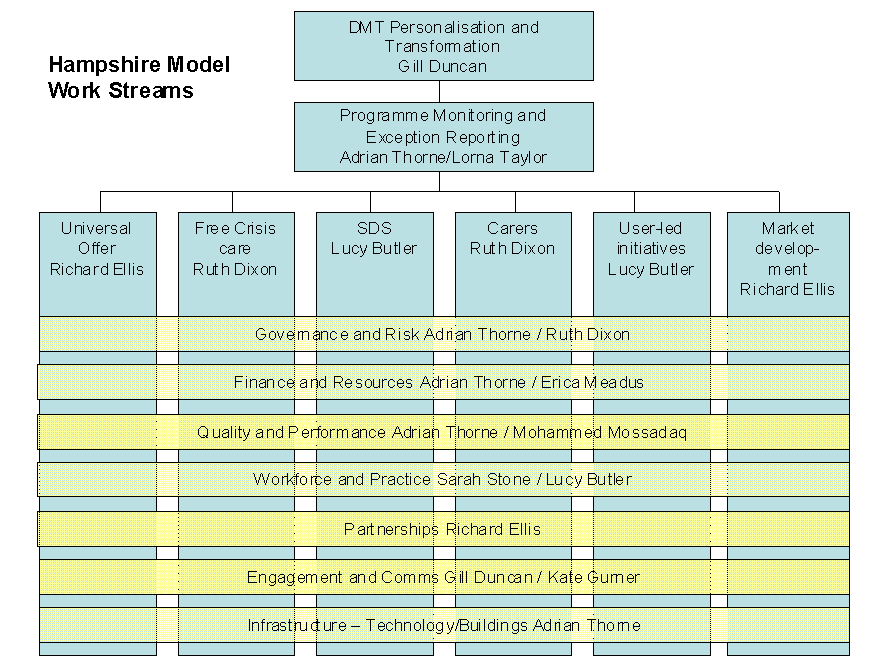
1.2 The priorities outlined in the Hampshire model, as highlighted in the report to Cabinet are:
_ The Universal Offer
_ Free crisis care
_ Self-Directed Support
_ Improvements for Carers
_ User-led Initiatives
_ Market Development
1.3 In addition to the transformation of Adult Social Care are other significant infrastructure projects including HantsDirect, Learning Disabilities integration and Extra Care Housing development.
1.4 Appendix 1 illustrates the departmental approach to integrating Transformation through the Hampshire model with `business as usual'.
2 Transformation
2.1 The Hampshire Model
2.1.1 The Hampshire model builds on the report and recommendation of the Hampshire Commission on Personalisation. Some workstreams, such as Self Direct Support, are already in progress and further roll out of workstreams that can be implemented without changes to national legislation will commence from April 2009, with staggered implementation throughout 09/10 and future years. Implementation will be influenced by the national funding settlement in future years, the outcome from the green paper on the future funding of social care and changes in legislation and statutory guidance.
2.1.2 The budget strategy for 2009/10 takes account of in year implementation of many of the model's proposals, including for example; self directed support, elements of Free Crisis Care, early intervention and prevention, and the further development of business processes linked to Hantsdirect to support the Universal Offer.
2.1.3 A long term implementation plan with detailed transition activities, longer term changes, timescales, and implementation dates and communications plan is being formulated. This will enable successful delivery of the proposed model over an agreed timescale, within agreed budgets and meeting performance standards as required. Experience from other major projects, including the Phase 1 work in Basingstoke has shown that the roll out of change that impacts on service users and the market, need a longer implementation timescale for them to have sustainable outcomes.
2.2 Place shaping for personalisation
2.2.1 Agencies involved in health and social care need to work in a cross-organisational and cross-departmental way to provide a joined-up service to people. Personalisation is not just about social care. People want to make choices about their lifestyle and to feel in control of their lives. This means agencies need to develop ways of working together including social care, recreation & heritage, children's services health, district and parish councils, to support individuals and communities.
2.3 Social inclusion and sustainable communities
2.3.1 Local authorities and other statutory agencies need to work together to help create communities in which social inclusion is the norm. This means community groups and local amenities such as shops and pubs being supported to overcome barriers to social inclusion. This can help people to keep living independently, be active in the community, and can help prevent extensive reliance on health and social care intervention.
2.4 Supporting rural areas
2.4.1 Systems, policies and programmes designed to assist with personalisation will have to take account of rural circumstances and promote equity and equality. Existing resources in rural areas will need to be used more effectively, and all tiers of local government will need to work together and include the voluntary sector.
2.4.2 There are six work streams for implementation that can be progressed without national policy changes these are described below
2.5 Universal offer
2.5.1 The Universal Offer aims to ensure that we have something to offer everyone who has, or supports someone who has, a social care need. It is a significant shift from the increasing focus on working with those with the highest needs and least means, even though most resources will continue to be focussed with these clients. It is about ensuring that everyone has a stake in social care and that we provide the "little bit of help" that people often need that can avert a crisis later on.
2.5.2 The key dimensions to the Universal Offer are that we provide access to information and advice and help with assessing care and support needs, this includes self assessment tools which will be part of the development of web based self service and supported self assessment through HantsDirect. Signposting to community support and the further development of a community infrastructure that ensures Public services are planned for and targeted at vulnerable & disabled people.
2.5.3 Making the `universal offer' a reality will mean Adult Services working closely with other departments of Hampshire County Council, the Cross Departmental Group is developing a local plan to support the Self directed Support phase 1 work in Basingstoke. One aspect is to ensure that, once service users have more choice, that they have services to choose from, including those provided by other parts of the County Council. We are for example, working closely with Recreation & Heritage to improve their service provision to vulnerable and disabled people. Adult Services are also involved in the corporate initiative to develop the customer access strategy across the County Council
2.5.4 The Hantsdirect contact centre and web self-service are fundamental building blocks of the information and advice part of the Universal Offer. We are examining how we can utilise existing County Council resources, such as libraries, mobile libraries and information centres, as well as working with district and parish councils to improve the availability of information and advice in communities. This is particularly important as part of our response to the Rural Strategy. This could potentially include having a local face to face version of Hantsdirect based in libraries and information centres, as well as building on the Community Information Points, many of which are based in parish councils.
2.5.5 In addition we are working with district councils, health and the voluntary sector, to provide a variety of ways in which people can access this advice and information.
2.5.6 It is essential that the universal offer is seen as one of the building blocks for community involvement supported by a robust third sector strategy which addresses Personalisation and the wider place shaping agenda.
2.5.7 Included in this developing approach will be proposals to strengthen our engagement with Parish councils and other local groups. This links with the Community Access Points and work undertaken through Recreation & Heritage and economic development to support local community initiatives. There is also scope to re focus the operational community development and engagement work across departments to support the universal offer.
2.5.8 Joint working will continue to build on the Older person Well being strategy. In 2008/9 additional investment has been made to support Older people's forums, the Older People's Area Links (OPAL) and the Out of Town projects across the county, these again are operational building blocks for community involvement.
2.6 Free crisis care
2.6.1 Free crisis care, prevention and early intervention. The ambition of this workstream is to offer free crisis care for those at risk of hospitalisation or at point of hospital discharge. The aim is to deliver this through integrated community care teams with health to provide short term rehabilitation and re-ablement. This sits alongside the Community innovations teams who deliver early intervention and prevention to support older people to remain in their own homes.
2.6.2 Financial and legal constraints mean that we will need to restrict the access to free care. It will be mostly targeted at older people needing care at home or using Time to Think beds after a period of hospitalisation or at risk of hospitalisation. The detailed criteria are under consideration. It will also initially be restricted to 6 weeks, rather than 8 as set out in the Commission report in line with financial and legal advice and this will be subject to wider consultation on the charging policy. The benefit of free crisis care is that we can work more easily with health to get people back to independence or near-independence.
2.6.3 The integrated community care teams will be a major step forward for Hampshire because it will combine social care staff with health staff located in Practice Based Commissioning Clusters.
2.7 Self Directed Support (SDS)
2.7.1 Phase 1 of the SDS project, has been successfully started in Basingstoke; a detailed plan is in place to support the project implementation which will be completed by 2010. In 2009 the re-engineering of business and system processes and staff training and development will be completed.
2.7.2 People want support that meets their individual needs. Self Directed Support will change the way services are delivered, to meet people's individual needs rather than fitting people in to services.
2.7.3 People will:
_ Have information about services.
_ Have control of the money allocated to them if they are eligible (for many people this could be through a Direct Payment).
_ Have a support plan of how to meet their care needs.
_ Be able to choose the traditional services or other forms of community support they want.
_ Make choices about how they want to live their life and the social care they want to have to help them to do that.
_ Be able to take reasonable risks.
2.8 Carers
2.8.1 There are more than 100,000 unpaid carers in Hampshire, of which about 20,000 provide more than 50 hours care a week. Information and advice services for carers and families will be put in place. Carers' needs will be taken into account in support plans, care givers will have support to get on with their lives and will be respected and valued as partners in care. The development of respite services and training for carers will be progressed as a priority in 2009/2010.
2.8.2 Carers will be able to have resources allocated for their own support alongside other possibilities for how carers could be helped financially, such as voucher schemes and client payments for carers.
2.9 User led initiatives
2.9.1 Involving people who use services in shaping future services is a key element of the Hampshire model. For example, developing an Older Peoples Forum, and involving an expert user panel in the development of strategies will enable users to directly influence how social care will be provided to them.
2.9.2 To ensure services are personalised to people's needs, it is vital that service users and carers are involved in shaping future services. Hampshire County Council will develop ways in which service users and carers can have a greater input into planning and decision making. This could include focus groups and pre-existing networks building on the spirit of engagement and debate generated through the Commission.
2.10 Market Development
2.10.1 Another key element is helping to stimulate the care market so that services are developed which reflect people's choices, and making sure services are of good quality. Shaping the market will take time due to the immaturity of current providers in terms of their ability to respond quickly to the changing expectation and outcomes of Personalisation.
2.10.2 This workstream includes quality assurance, joined up services, sustainable communities, support for rural areas, commissioning of services and shaping the market.
2.10.3 Personalisation and SDS (Self Directed Support) will change the way services are commissioned in future. The types of support people want to access will also change and people will need to be able to choose from three types of support. These are; Traditional care such as residential care, nursing care, domiciliary agency care at home, Informal care - a person can directly employ someone they already know such as a family member or friend to be their personal assistant. and Non-traditional support, this could be services such as gym membership, or taxis.
2.10.4 The role of the local authority needs to change from `managing the care market' to `shaping the market'. This will involve supporting the development of new and flexible types of service. This will include finding out from service users and other interested people what sort of services they would like to have and what they would like to do differently, and then using these ideas to help plan future services.
The market will need to respond to people who want to commission their own services. Working with education and training providers will be essential to develop a range of vocational training and accreditation opportunities and career pathways in social care. The role of In house services will need to change and will continue to be used to help manage the market as well as focusing on niche services that support the wider Hampshire Model.
2.11 Managing Transformation
2.11.1 Across all the workstreams, the way in which existing services are delivered and ways of working will need to be developed to extend the personalisation of services across all aspects of social care. Work programmes reaching across all areas of service delivery are focussing on governance and risk, finance and resources, quality and performance, workforce and practice, partnerships, engagement and communications, and Infrastructure.
3. Other significant modernisation projects
In addition to the Hampshire Model there are a number of other significant projects being undertaken which are driven nationally and locally.
3.1 Learning Disability Integration
3.1.1 The integrated learning disability service now has jointly appointed managers across health and social care staff. Work is underway to enable co-location of the integrated teams and integrated care pathways to provide a seamless service for users and their carers.
3.2 NHS Transfer of Learning Disability Services
3.2.1 The Department of Health (DoH) has instructed PCTs to transfer commissioning responsibility and budgets for learning disability services, other than those that are predominantly health related, to local authorities from April 2009. Guidance from DoH, however, has been unclear. In principle agreement has been reached in relation to core funding of £19m. Further work is ongoing in relation to further revenue sums and the potential transfer of assets.
3.2.2 There will remain outstanding a potential transfer of capital assets or, more likely, an interest in capital assets. Thus far the Department of Health have failed to provide any guidance on this beyond a single sentence in the revenue transfer guidance. The PCT list of the properties involved and the nature of their interest in them has not been received yet. This work is being well supported by legal services and property services.
3.2.3 The Department of Health has stated that this arrangement will operate for two years and thereafter LD funding will be subject to a national funding formula. No details have been given about how this might operate nor the relationship between the transfer sum agreed with the PCT and the formula allocation. This represents a very significant risk to the County Council, which generally is disadvantaged by national distribution formula.
3.3 Extra care
3.3.1 In December 2006 cabinet approved the adult services strategy to increase the availability of Extra care housing where the department has sole nomination rights. This will enable the department to provide care at home for the physically frail who might previously have had little choice but to enter residential care.
3.3.2 The development of new build Extra Care schemes is progressing well, with new build projects progressing in Gosport, Basingstoke (Brighton Hill), Fleet and Andover. We are also progressing 7 enhanced sheltered housing schemes in Fareham, Andover, Basingstoke, Aldershot, Eastleigh, Lymington and Denmead. This is a key programme in the development of the market to meet future aspirations to support people to remain independent in their own homes..
3.3.3 In 2009 we will be providing 1,436 OP "beds", comprising 692 residential and 500 nursing in-house beds, and 244 enhanced scheme units. By 2013 we would have added 240 new build extra care units. This compares to 942 beds in 2003 and 1,316 beds in 2006.
3.4 HantsDirect
3.4.1 Adults Services has completed the roll out of Hantsdirect Basic and is undertaking a Business Process Redesign to develop the customer journey, which will help shape the next phase. Adult Services are also working with colleagues across the County council to develop the overall Customer Service Strategy, which will drive our future approach to local access and is fundamental to the Universal Offer (see para 2.5.4 above).
3.4.2 Customer Access, and how we will need to structure our teams to make sense of the customer journey, is obviously closely linked to Hampshire Workstyle.
3.5 Common Assessment Framework
3.5.1 The Department was successful in its bid to the Department of Health to be demonstrator site for the Common Assessment Framework (CAF), which required proposals for more integrated working between health and social care.
3.5.2 The objective of the Hampshire CAF project is to put the individual at the heart of all we do by: utilising technology to ensure that information has to be provided once only and is available to appropriate health and care professionals, to allow users and carers to record and access their own support plans.
3.5.3 We were the only successful bid in the South and have secured £2.8 funding.
4. Care Governance & Safeguarding
4.1 Care Governance
4.1.1 In order to ensure we have an integrated approach to quality and risk the department has put in place a Care Governance Framework.
4.1.2 This brings together all key elements of risk and quality and reinforces
the need for an open learning culture. One of the key elements within this is ensuring quality outcomes which is actively managed through the Quality outcomes framework, Adult Services staff have been working with providers to ensure quality of provision of the independent residential nursing and domiciliary services. is integral to our approach to safeguarding adults and to the performance management regime in the department.
4.2 Safeguarding
4.2.1 Adult Services continues to take its responsibilities in safeguarding adults from abuse very seriously. This year has seen a £600,000 increase in investment in this area of work with increases in the number of posts to ensure consistency and effectiveness in practice across the County. This has included the recruitment of a Head of Safeguarding and Care Governance post as well as appointment of seven Safeguarding co-ordinators and ten administrators to administer the process, ensure accurate recording and promote best practice and monitor performance at a local level.
4.2.2 The leadership and co-ordination of safeguarding is fully recognised as a corporate responsibility by the Council. Executive Member involvement and scrutiny in relation to safeguarding has been reviewed and regular monthly reporting to the Executive Member via DMT/Executive member meeting will take place. This will commence in May 2009 when the revised reporting arrangements are in place. The agenda and minutes of the Safeguarding Board will be sent to the Executive Member who will reserve the right to refer issues to the Safeguarding Board and Scrutiny Committee. The Safeguarding annual report will also be received by the Executive Member at a Decision day in 2009, this will include the outcome of the baseline assessment and any associated recommendations.
4.2.3 The multi-agency Safeguarding Board is establishing an executive body of key statutory members. The terms of reference for the member led joint Adults and Children's Services Transitions Board have been revised to broaden its scope to include safeguarding. In addition to this it has been agreed that there will be representation from Adult services and Children's' services across both safeguarding boards and we strongly support proposals to have a safeguarding champion within each department of the County council.
4.2.4 Added to this, Adult Services are ensuring that Safeguarding practices are in line with Personalisation. This has included the adoption of family group conferences as an approach which has led to successful outcomes for people at risk of abuse. Adult Services are also empowering service users to protect themselves through the establishment of a bi-annual service users forum and committee of service users who are receiving support, information and funding from the department.
5. Performance monitoring and priorities for 2009/10
5.1 From May 2009 DMT will be initiating a new Performance Framework to oversee Adult Safeguarding. This will include a monthly report which will monitor the outcomes and timeliness of referrals , strategy planning meetings, case conferences and reviews.
5.2 In addition a priority for early 2009/10 is to complete a base line assessment of Safeguarding Processes and Procedures. This work will include a case file audit and a self assessment.
6. Performance and Efficiency
6.1 Adult Services has sustained three star top performance and will continue to managed both its current business transformation process which has successfully delivered efficiency of improvements to the value £19.7m in the last two financial years, plus £8.5m forecast in 2008/09 and £ 8.3m planned in 2009/10. All of these efficiency savings have been reinvested back into transforming social care services. The Department has also made a significant contribution to the Corporate Services procurement efficiency review.
6.2 Adult Social Care will be subject to a new inspection regime. The Care Quality Commission (CQC) which will replace the Commission of Social Care Inspection from 1 April 2009. CQC are currently out to consultation as to how the inspection process (which will link social care with health and mental health) will work in practice but for 2009/10 the overall approach will be similar to the current CSCI inspection. Areas where they are likely to concentrate include: building on existing good practice, a new registration system from 01/04/2010, focussing on a person centred approach, role in assessing commissioning jointly across social care and health.
6.3 Adult Services are planning for the new inspection regime led by the Care Quality Commission. This will build on our existing successful approach and will link to the corporate performance framework. Adult Services have established a working relationship with the PCT performance team to ensure that we have a coordinated approach to LAA priorities and NIS targets.
7. CAA-Partnership working
7.1 The relationship between CQC and the Audit Commission will be key so that the roll out of the Hampshire Model will be included in the assessment of our services within CAA. As partnership working is a key element of the Hampshire Model the department will be seeking to show performance improvements in delivering partnership.
8. Risks and Challenges
8.1 The departmental management team have recently undertaken a strategic view of risks in relation to the Hampshire model, the wider transformation programme and ensuring `business as usual' is safe and secure.
8.2 It has identified the following key risks triggers which will be used to manage and mitigate risks across the department
8.3 Key Risk Triggers:
_ Governance - stewardship
_ Finance
_ Performance
_ Safeguarding / duty of care
_ Reputation
_ Social Care Workforce
_ Skills and capacity to deliver transformation
_ Infrastructure and IT
_ Partnerships
9. Conclusions
9.1 Cabinet are asked to note the report and to support the ongoing transformation of Adult Services including the cross department work that will deliver Personalisation and the Hampshire Model.
10. Recommendations
10.1 Please see Executive Summary for recommendations.
11. Appendices
Appendix 1 Hampshire Model
CORPORATE OR LEGAL INFORMATION:
LINKS TO THE CORPORATE STRATEGY | ||||
Yes |
No | |||
Hampshire safer and more secure for all |
||||
Corporate Business plan link no (if appropriate) |
||||
Maximising well-being |
||||
Corporate Business plan link no (if appropriate) |
||||
Enhancing our quality of place |
||||
Corporate Business plan link no (if appropriate) |
||||
OTHER SIGNIFICANT LINKS: | ||
Links to Previous member decisions: | ||
Title |
Ref |
Date |
Direct Links to Specific Legislation or Government Directives | ||
Title |
Date | |
Section 100 D - Local Government Act 1972 - background documents | |
The following documents discuss facts or matters on which this report, or an important part of it, is based and have been relied upon to a material extent in the preparation of this report. (NB: the list excludes published works and any documents which disclose exempt or confidential information as defined in the Act.) | |
Document |
Location |
None |
|
IMPACT ASSESSMENTS:
1. Equalities Impact Assessment:
a) An overall Equalities impact assessment has been carried out. This highlights elements of the Personalisation agenda such as the rollout of self directed support which offers benefits across a wide range of groups in terms of increased transparency, choice and control. This includes older people, people with a physical disability and those with mental health issues. The assessment highlighted the need for individual work streams to also carry out assessments to ensure that all current and potential service users are communicated with effectively. These assessments will be carried out as the detailed work stream plans are developed.
2. Impact on Crime and Disorder:
A) The County Council has a legal obligation under Section 17 of the Crime and Disorder Act 1998 to consider the impact of all the decisions it makes on the prevention of crime. The proposals in this report have no proven impact on the prevention of crime.
3. Climate Change:
a) How does what is being proposed impact on our carbon footprint / energy consumption?
· No impact has been identified, however an increase in local purchasing due to personalisation may reduce carbon footprint through reduced travel.
b) How does what is being proposed consider the need to adapt to climate change, and be resilient to its longer term impacts?
· As the work streams of the Hampshire Model are developed this will be taken into account in the detailed planning.