
Archived decisions
Hampshire Fire and Rescue Service (HFRS) Engagement and Participation Strategy
1 Introduction
1.1 This strategy has been developed in line with our organisational values, key documents and policies such as the Corporate Equality Policy and Action Plan, Equality Schemes, other Statutory Duties, Marketing and Communications Strategy, Partnership Policy and the Integrated Risk Management Plan now known as the Hampshire Fire and Rescue Service Plan.
1.2 We want to embrace the contribution of diverse and representative groups through effective engagement arrangements at local, regional and national levels to deliver a `customer focussed service', which we believe will deliver better outcomes. And ultimately towards our organisational aim of making life safer for our community.
1.3 We will exploit the knowledge and networks of our democratically elected members on the Hampshire Fire and Rescue Authority (HFRA) to access and communicate with our communities and help guide the implementation of this strategy.
1.4 This strategy sets out our approach to working with our diverse communities, (including those who are vulnerable and at high risk from fire and other hazards such as road traffic collisions), partners and stakeholders and how we will engage with them at all levels of the service. Our strategy has also taken into account the advice from the Audit Commission following its analysis of corporate assessments, where they identified five critical success factors for successful community engagement and participation. They are:
· Commitment to user focus and citizen engagement
· Understanding your communities
· Clarity of purpose
· Communicating in appropriate ways
· Delivering change and improved outcomes
1.5 Our objectives and the methods of engagement identified below have been designed and constructed to reflect and deliver these five critical success factors.
2 Context
2.1 As a Fire and Rescue Authority we have a duty to engage and consult effectively with our communities. Although the main focus of this strategy is on our service delivery activities, the service is also required to consult and engage on policies, strategies and actions around equality issues and their impact on sections of our diverse communities. This means that all parts of the service has to engage in the delivery of this strategy. The main drivers are set out overleaf:
· Equality legislation- Race, Gender, Disability, Age, Sexual Orientation, Religion or Belief and Transgender
· Equality Standard for Local Government
· National Equality Strategy for the Fire and Rescue Service
· Local Area Agreements (LAAs)
· Fire and Rescue Services Act 2004
· Fire and Rescue Services National Framework Document
· Civil Contingencies Act 2004
· Corporate Performance Assessment and the newly emerging Comprehensive Area Assessment
· The New Place Survey
2.2 It follows therefore, that we listen to and actively engage with our communities and stakeholders locally. We need also to ensure that our local communities, stakeholders and partners are easily able to help inform our work and direction. Therefore the structures and systems we set up to make this happen need to be robust and formalised within the management and governance arrangements for the service.
3 Our strategic aim
Our aim is to move from just consulting with service users, partners and stakeholders to genuine engagement and participation in a transparent way. It supports our key policies, statutory duties and our three year plan,(and future plans) which are geared to responding to the changing needs of a modern and dynamic society. This means informing and involving our diverse communities in decision making processes where possible, which we believe will enable us to improve our services still further, and thereby enhancing the quality of life and making life safer for all our communities.
4 Our objectives
We have identified a number of key objectives to ensure that our engagement and participation strategy delivers an effective and co-ordinated approach. These are:
· To strengthen, develop and sustain opportunities for local people and groups to influence what happens in their communities (community cohesion/inclusion issues, partnerships, access to facilities, services and premises, etc)
· To provide opportunities for communities to shape and influence the development and delivery of quality fire safety and response services and policies that reflect their needs and priorities
· To manage and co-ordinate engagement and participation activities to ensure quality and consistency
· To ensure that engagement and participation activities provide opportunities for participation for all sections of the community
· To listen to communities and ensure feedback is given in appropriate and relevant formats about outcomes of engagement and consultation
· To provide variety, flexibility and choice in engagement and participation activities
· To share our learning and engagement skills with our partners locally, regionally and nationally
5 What do we mean by engagement and participation?
5.1 Although the idea of `community engagement' has been around for many years, it is hard to find a common or widely agreed definition. There are different levels of engagement for different people. It can range from being consulted over a planned course of action, to establishing the allocation of resources for a project or being involved in the delivery of a service. Depending on the objectives, issue(s) and the community involved, some approaches might be more appropriate than others.
5.2 For our purposes, Community Engagement is the process of involving people, either as individuals or as a community, in shaping policies, actions and decisions that affect them. Community engagement provides people with opportunities to have a greater say in what happens in their city/ town/locality and to play an active part in the decision making process.
5.3 Community consultation, involvement and participation are terms that are regularly used, often interchangeably to describe engagement activities. However, each term refers to intrinsically different forms of engagement, the use of which is dependent on the type of activity planned. Therefore in the context of this strategy, it is important to remember that a community consists of a number `communities'- be they based on ethnicity, disability, gender, age, location etc. Each community will have different needs and wants that have to be balanced.
5.4 We have designed our strategy to provide the most appropriate ways for our communities, stakeholders and partners to be involved and give feedback. To give a perspective of what this might involve, we have used the following model of community engagement to illustrate the different levels of engagement. They are:
· Informing - The least you can do is tell people what is planned. Good quality, appropriate, accessible information underpins all involvement. Providing information alone is a one way process. It implies that there are no alternatives and that no contribution is required from the community/service users.
This method may be appropriate when:
There is no possibility of negotiation- you are responding to a legal requirement
You want to get a message across but don't need feedback or comment
You are initiating a process, and people need information to get involved at a later stage.
You are at the end of a process that people have had an opportunity to influence or you are giving feedback. (leaflets, posters, displays etc)
· Consultation - allows choice between pre-determined options but not an opportunity to propose alternatives or take part in putting plans into action.
Consultation (only) may be appropriate when the range of options is genuinely limited or there is a need to get community views on options to inform the decision making process.
· Deciding together - Members of the community and the service work together on a policy or service issue. Participants are encouraged to share new ideas and options and are a party in deciding best way forward.
This method is appropriate when:
There is a possibility of negotiation
An agreed position needs to be reached amongst the different interests
Implementation requires the co-operation of other people
· Acting together - working with others to make decisions and carry through the action agreed
· Supporting local initiatives - supporting groups to develop and implement their own solutions
5.5 A visual demonstration of our commitment from informing, through consulting and towards involving, collaborating and where appropriate empowering our communities is shown in the Community Engagement and Participation Spectrum in Annexe 1(This is an adaptation of the International Association of Public Participation's Spectrum). The process for ensuring the engagement methods outlined in the Spectrum are implemented is set out in the 7 Step Model in section 9 below.
5.6 This strategy requires all engagement activities whether it is simply informing or consulting or a higher level of engagement to follow the 7 Step Model. Applying the model will also ensure that the Service meets the Engagement Standards set out in Annexe 2.
6 Realising the benefits of engagement
We believe that proper engagement will provide a number of benefits, both to our service and the people that use the services we provide. The benefits include:
· Help improve the trust and confidence of our stakeholders in the service as one that is transparent, accountable and influenced as far as possible by their views and contributions.
· Fostering community ownership and commitment to making our community safer
· Creating a structure that promotes joint working
· Service decisions are more likely to be regarded positively by those who Contributed to them
· Providing a platform for generating new ideas/different ways of thinking and for exploring all options
· Giving employees an opportunity to understand service users experience and perceptions of the services we provide
· Help make services, policies and decisions to focus on providing what communities need and avoiding those they don't need
· Helping in identifying any problems/difficulties arising from proposed changes and initiatives in advance
· Help strengthen the role of both community and internal leadership
· Help cement joint and partnership working and enhance future joint working arrangements
· Promote equality, fairness and respect for all
7 Ensuring access and inclusion
This strategy is about reaching out to all sections of our diverse community. Therefore, to ensure that this happens, all engagement activities must reflect the diversity of the population or the particular community to be engaged. The reference to `stakeholders' is used as a common term for all people who have an interest in a particular issue or likely to be affected by a policy or decision. This usually includes the following:
· Citizens, residents
· Customers or service users
· Non-users and potential users
· Elected members
· Employees, staff forums/representative groups
· Local businesses and people who work in the area
· Partner agencies and other key organisations
· Voluntary organisations (Community organisations, charities such as Age Concern, Help the Aged, Hampshire Coalition of Disabled People, etc)
· Interest or pressure groups (tenants associations, resident groups, race equality organisations etc)
· Groups of people defined by a common factor such as age, disability, gender, ethnicity, sexuality etc
· Stakeholder groups referred to as hard-to-reach groups. They include:
- Children and young people
- Older people - with varying degrees of mobility, sight, hearing etc
- Black and minority ethnic groups, particularly those who do not speak English
- Gypsy and Traveller communities
- Refugees and asylum seekers
- Disabled people
- Gay and lesbian people
- Transgender community
- People with addiction problems
- Homeless
- Parents/single parents
- Non- users of services
8 Our engagement and participation standards
We have adopted the National Standards for Community Engagement, which we believe will help us to develop and enable effective engagement between communities and our Service including promoting equality, fairness and inclusion. We will adhere to the 10 standards and their principles in all our engagement and participation activities. These standards are set out in Annexe 2.
9 The engagement and participation process (The 7 step model)
9.1 The HFRS strategy requires all members of staff responsible for organising and delivering engagement and participation activities to follow the steps of the engagement process outlined below. Directors of each area are responsible for ensuring the implementation of this strategy and the sharing of best practice.
9.2 Each directorate needs to ensure that the engagement principles set out in this strategy are firmly embedded within their respective planning processes to ensure the engagement steps are followed.
9.3 As soon as a need for engagement is identified, you are directed to consider the steps of the Engagement Process and the explanations for each of the steps outlined below as well as referring to the Participation Spectrum in Annexe1. It is vital that you follow these steps carefully in order to enable you to decide which form of engagement is the most suitable and what else you have to do to achieve the aims and objectives for the chosen engagement method.
9.4 The 7 Step Engagement Process
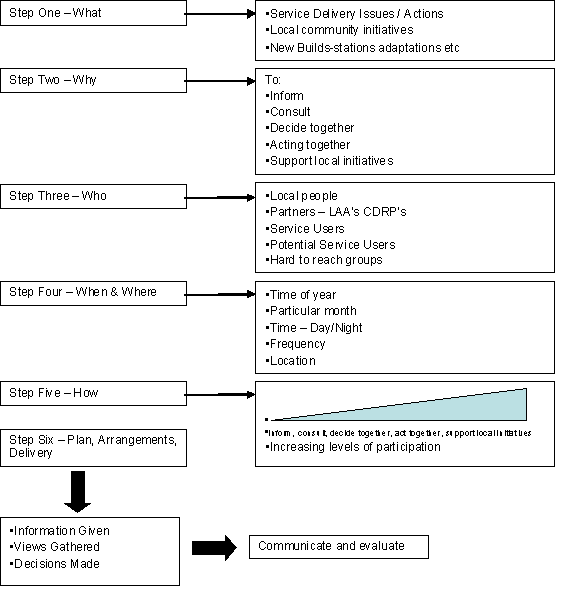
9.6 What do we want to engage about? (Step 1)
· This is the stage where you need to carefully identify the policy, project, service or issue around which engagement is to happen. For example you might want to engage our stakeholders about:
· Service delivery issues; home fire safety campaigns, arson reduction, evidence gathering following a PIA, fire safety requirements for business premises etc.
· New buildings/adaptations to existing facilities
· Local community activities; festivals- Eastleigh and Southampton Mela's, religious celebrations which includes lighting candles etc
· It will also be useful to consider at this stage about any previous engagement and if so, is there anything that can be used to inform the current planned engagement exercise
Checklist:
· Has the engagement issue/action/policy been clearly identified?
· Learning from any previous engagement exercises?
· Has a genuine need for engagement been identified? Eg, risk analysis, PIA, etc
· Set time line for the engagement exercise?
· Identified the appropriate resources for the process?
· Allocation of responsibility for the exercise?
9.7 Reason for the engagement (Step 2)
· At this stage you need to clearly identify the purpose of the engagement exercise and establish clear aims and objectives and reasons for the exercise. Careful consideration must also be given to what you are expecting from the participants and how their contribution will be used. Use the list below in conjunction with the levels of engagement outlined in sections 5.3 and the community engagement and participation spectrum set out in 5.4 (table 1) above to help you establish the purpose of the engagement.
To inform - this is about sharing ideas and intentions, ensuring relevant information in appropriate formats reaches the community, to keep them informed of what is happening.
To consult - This means involving our diverse communities in a two way dialogue in getting their views and advice on services, policies and plans and taking them into consideration when taking a decision. This approach does not provide participants an opportunity to propose alternatives or take part in putting plans into action.
To decide together - Members of the community and the Service work together to on a policy or service issue. Participants provide additional ideas and options. Views are shared, options are considered jointly and a course of action decided upon.
To act together - This engagement option allows different interests to decide together what is best and form a partnership to carry out the agreed plan/actions.
To support local initiatives ( to Empower/Delegate control) - This is about giving authority and money to local groups to plan, provide and manage services. This option makes it possible to place the final decision making in the hands of the community.
Checklist:
· Has the purpose for engaging with people been identified?
· Have you set clear aims and objectives for the engagement exercise?
· Are you clear about what will be asked of the participants?
· Are you clear about how the contribution of the participants will be used in making decisions/deciding change?
9.8 Who should we engage with? (Step 3)
This is the stage where you need to give proper consideration to who are the people, groups, organisations etc likely to be affected by the activity/project/action you are intending to engage about. A completed People Impact Assessment (PIA) should provide you with the necessary information. All the affected stakeholders need to be involved in the process. Please see section 8. for list of stakeholders
It is important that we actively encourage all relevant stakeholders to participate and also identify and remove any barriers to participation. This is consistent with our core value of embracing and valuing diversity including the requirements under current equality legislation and the equality standard for local government. Therefore it is vital that we involve those groups and individuals who have traditionally not participated because of reasons such as language, mobility, other impairments, sexual orientation, age, etc.
Checklist:
· Have you identified all those likely to be affected?
· Have you considered the barriers to engagement and ways to tackle them?
· Have you given consideration to the hard to reach within the community?
· Do you know the number of people/groups you are aiming to involve?
· Are there any organisations/agencies in the locality or information from previous engagement exercises that could help you draw people into the process?
9.9 When and where should we engage? (Step 4)
Staff responsible for initiating and carrying out engagement exercises need to clearly set out at what stages in the decision making process they want to involve the community. All engagement must be timed to enable the information collected to be fed into our planning, policy and decision making processes. It is recommended that we should aim to engage at earliest stage of the process. Engagement should happen at the point where issues are identified rather than just on the final decision. Doing it this way should ensure that participants feel confident that decisions have not already been taken and they are not been consulted as part of a `tick box' exercise.
At this step you need to consider how to engage:
· Any existing engagement structures and resources available in the organisation and locality
· The events calendar ( under construction by Marketing and Communications- available from April 2009)
Once you decided on the engagement activity consideration needs to be given to the location and timing of the exercise. The pointers are:
Location
· Is it easy to find and reach?
· Is it near to where the service is to be delivered?
· Access to parking?
· Do the identified participants know the location?
· Does it have disabled access/facilities?
· Does it meet the requirements for all faiths? -venues serving alcohol may exclude some communities from attending
· Is it large enough for the intended audience?
· Availability of child care facilities?
· Is transport available for those with mobility issues?
· Does it have facilities for providing refreshments including for those with special dietary needs?
Timing
· Will the planned timing for the engagement exercise allow all the identified participants to attend?
· Is being held at the right time of the year? Eg, meetings during the period of Ramadan would prevent members of the Muslim faith from attending.
· Does the planned event coincide with other events organised by other agencies It is important to check this out as we are chasing the same audience as the other agencies
· Is the timing of the exercise suitable for the information gathered to be fed into the policy, planning and decision making?
9.10 How are we intending to engage with our communities? (Step 5)
At this stage you need to carefully assess which engagement exercises will be the most effective around the issue you want the communities input. This about establishing which engagement method(s) and tools are the most appropriate. There are many different ways of engaging. Each has its pluses and minuses. It may well be that there is no one way that is sufficient and you may need to use a combination of methods to get the best result. The following list, although not exhaustive, gives examples of engagement methods. You are advised to use any other helpful method you are familiar with. Further help and advice is available from Performance Review, HR and Marcomms.
Methods
· Questionnaire
· Interviews
· Focus groups
· Community panels
· E- Consultation/email/website
· Exhibitions
· Seminars and conferences
· Street consultation
· Citizens juries
· Community radio
Additionally there are a number of other tools that can be used in conjunction with the engagement methods chosen. Examples are; comment boxes, tick box forms, ideas/suggestion boxes.
Example: At the Fire Show/ Eastleigh and Southampton Mela's/ New Forrest Show people may be asked to fill in questionnaires about home fire safety, their awareness of job opportunities etc.
However when selecting engagement methods and tools you must ensure that they are consistent with the aim and objectives, reason for engagement and the target audience as set out in the steps above.
Checklist
· Are the chosen methods and tools relevant and appropriate for engagement with all the identified stakeholders?
· Will these achieve the aims and objectives set for the exercise?
· What's in place to meet the needs of certain hard to reach groups?
· Can the engagement exercise, methods and tools selected meet the timescale?
9.11 Plan, engagement arrangements and delivery (Step 6)
This is the stage where you set out the details of the engagement exercise(s) and process. This includes considering resources and administrative tasks such as;
Costs such as staffing, materials, catering, venues and other expenses
Engagement team- Identify team leader and individuals involved in carrying out the engagement event including any volunteers, community groups, agencies.
Planning of tasks and timetable - advertising event- transport, catering, preparation of materials, collation of information, event planning meetings, review, feedback and evaluation
Equality monitoring and attendance recording - for assessing whether the expected target audience was achieved
Photo consent forms and child protection issues
Health and safety issues - risk assessments re personal safety, working with children and vulnerable adults
Delivery of event - It is important to ensure that the purpose, aims and objectives of the engagement are clearly set out and communicated to the participants and that we use a variety of methods and tools to achieve the engagement goals. And finally we also need to ensure that the information we provide during and after the event is clear, accurate and accessible.
9.12 Feedback and evaluation (Step 7)
Feedback
In signing up to the National Engagement and Participation Standards (Section 6 - table 2), we have made a commitment to provide open and honest feedback to those who participated in the engagement and to the wider public. This is an essential part of the engagement process. Good feedback tell the community what the overall findings were and how they were taken into account. In the event of the Service taking a decision that differs from their views and expectations, the reasons for this must be explained fully. Maintaining high standards of engagement practice will help build community confidence, promote user satisfaction and sustain long-term relationships.
The consequences of not giving good feedback may make the participants feel that they have wasted their time and would have an adverse impact on our future engagement activities, weaken partnership working and damage relationships with our stakeholders.
Evaluation
Evaluation will help us in measuring the effectiveness of our engagement activities. In particular it will enable us to:
· Know whether we are genuinely listening to our community
· Assess whether we reached our target audience
· Assess the effectiveness of the engagement methods and tool used
· Improve future engagement exercises
· Ensure we use our resources better
· Quantify improvements in the services we provide
Checklist
· Do you have a mechanism for providing feedback to the participants?
· Does it include a format for getting feedback on the event from the participants?
· Have you timetabled an evaluation session with the engagement team?
· Have the results of the engagement been communicated to other relevant stakeholders?
10 Engagement resources
10.1 The Service has available a number of resources and contact points that can be accessed to help with the planning and delivery of engagement activities. The following is a list of what is currently available including those that are expected to be added in the near future. Please note that the list of resources kept internally will be updated as and when known and reviewed annually to ensure accuracy and validity.
· HFRA members as elected councillors and as members of the various sub-committees and groups operating within the Service
· Equalities Team - People Impact assessments, Population data, Equality legislation, Policies and Equality Standard for Local Government
· Performance Review Team
· Community Risk Intelligence Team
· Marketing and Communications
· Diversity Liaison Officers
· Community Advisors
· Service Volunteers (due to be in place for 2010)
· Guide for Black and Minority Ethnic Communities publication - This is updated annually and provides information about the minority communities in Hampshire.
· HFRS External Equality and Diversity Advisory, Consultative and Scrutiny Group
· The Hampshire Inter Faith Network
· Local Strategic Partnerships
· Crime and Disorder Reduction Partnerships
· HFRS Local Diversity Group
· Portsmouth Race Equality Network Organisation
· Unity 101 Community Radio Southampton
10.2 Details of how to access these resources will be placed on the HFRS Intranet and updated as and when and reviewed annually.
11 Co-ordination of Engagement Activities
11.1 Marketing and Communications (MARCOMS) department will be responsible for co-ordinating all engagement activities. This will be managed through the maintenance of an annual engagement programme/timetable. This will be available for viewing and populating electronically via the HFRS intranet. All members of staff responsible for carrying out engagement activities are required to inform MARCOMS through the agreed channels with full details of the activity including the planned date, time and location, proposed engagement method, nature of the engagement or issue and the section of the community/group to be engaged.
11.2 The availability of a centrally co-ordinated programme will ensure effective use of our resources, avoidance of unnecessary duplication of activities and consultation fatigue in respect of members of our communities.
11.3 Marcoms will also assist in the production of engagement marketing materials, publicising events both internally and externally and publicising the outcomes of the engagement events.
12 Responsibility for the Engagement and Participation Strategy
The Chief Officer will be responsible for ensuring the development and implementation of this strategy through the Directors. The HR Director will also ensure that an evaluation of this strategy is carried out after 2 years from the date of implementation and annually thereafter. The criteria for evaluation will be based on the strategy objectives using the PIN model.
13 Implementation of the Strategy
The plan for the implementation of this strategy is set out in Annexe 3
HFRS Community Engagement and Participation Spectrum Annexe1

Inform |
Consult |
Deciding together |
Acting together |
Supporting the local community |
Participation Goal |
Participation Goal |
Participation Goal |
Participation Goal |
Participation Goal |
To provide service users, stakeholders and partners with balanced and objective information to assist them in understanding the problems, alternatives and /or solutions |
To obtain service users, stakeholders and partners feedback on analysis, alternatives and/or decisions |
To work directly with service users, stakeholders and partners throughout the process to ensure that public concerns, views and aspirations are consistently understood and considered |
To work in partnership with service users and stakeholders in each aspect of the decision including the development of alternatives and the identification of the preferred course of action , direction or solution |
To positively develop the skills of service users to take an active part in decision making |
Our Promise |
Our Promise |
Our Promise |
Our Promise |
Our Promise |
We will keep you informed through the use of communication tools appropriate to particular needs |
We will keep you informed, listen to and acknowledge concerns and provide feedback on how your input influenced the decision |
We will work with you to ensure that your concerns, views and aspirations are directly reflected in the actions, strategies or alternatives developed and provide feedback on how your input influenced the decision. |
We will seek your direct advice, expertise and innovation in formulating policy, solutions and actions and incorporate your advice and recommendations into the decisions to the maximum possible |
Joint decision making |
HFRS Resources |
HFRS Resources |
HFRS Resources |
HFRS Resources |
HFRS Resources |
· Leaflets · Website · Outreach workers · Diversity liaison officers · Advisors/advocates · Exchange magazine · Local Radio · TV · Seminars and conferences · Leadership forum · Open days · Eastleigh and Southampton Mela's · Exhibitions |
· Service user focus groups · Surveys and questionnaires · Diversity liaison officers and advisors · External Advisory, Consultative and Scrutiny Group · Public meetings · Networking Women in the Fires Service · Leadership forum · Local Diversity Group · Citizens panels · Volunteers · Open days, road shows and exhibitions · Eastleigh and Southampton Mela's · Advisors/Advocates · IRMP consultation Strategy |
· Local workshops and liaison through our diversity liaison and advisor teams · Open Service Management Team meetings · Committee meetings · Reference Groups · External Advisory, consultative and Scrutiny Group · Service delivery planning cycle · Local Strategic Partnerships (LSP'S) and Crime and Disorder Reduction Partnerships(CDRP's) · Local Fire Safety Forums |
· Working groups- policy development, positive action, action planning · Recruitment and selection panels · HFRS planning cycle · Co-options to committees LSP's and CDRP's |
· Provision of training and development opportunities · Secondments · Structured placements and senior manager shadowing opportunities · Volunteering opportunities across the Service · Provision of funding/procurement opportunities |
| HFRA Members Involvement _ | ||||
HFRS Engagement and Participation Standards Annexe 2
Standard |
Principle |
Involvement |
We will identify and involve people, groups and organisations who have an interest in the focus of the engagement including those who might be affected by a proposal, policy or action |
Support |
We will identify and overcome any barriers to involvement. |
Planning |
We will gather evidence of the needs and available resources and use this evidence to agree the purpose, scope and timescale of the engagement and the actions to be taken |
Methods |
We will agree and use methods of engagement that are fit for purpose |
Working together |
We will agree and use clear procedures that enable the participants to work with one another effectively and efficiently |
Sharing information |
We will ensure that necessary information is communicated between all the participants including ensuring that the information is available in different formats-(disabilities, other languages etc) |
Working with others |
We will work effectively with others with an interest in the engagement- honesty , integrity and transparency |
Improvement |
We will develop actively the skills, knowledge and confidence of all the participants |
Feedback |
We will feed back the results of the engagement to the wider community and organisations affected |
Monitoring and Evaluation |
We will monitor and evaluate the effectiveness of the engagement activities and whether they met our standards for engagement and participation |