
Archived decisions
HAMPSHIRE COUNTY COUNCIL
Decision Report :
Decision Maker: |
Executive Member for Adult Social Care | ||||
Date of Decision: |
1 May 2009 | ||||
Decision Title: |
Implementation of the Hampshire Model Work Streams - Free Crisis Care | ||||
Decision Reference: |
639 | ||||
Report From: |
Director of Adult Services | ||||
Contact name: |
Ruth Dixon | ||||
Tel: |
01962 847260 |
Email: |
|||
EXECUTIVE SUMMARY
1) Summary of Decision Area:
1.1. On 22 December 2008 Cabinet approved the Hampshire Model for Adult Services social care as set out in the report of the Hampshire Commission of Inquiry `Getting Personal: a fair deal for better care and support'. This report sets out the recommended strategic approach for the implementation of the `Free Crisis Care' work stream and seeks approval for individual parts of this work stream which are at different stages of development.
2) Issues Covered in Report:
2.1. This report sets out the recommended strategic approach for the implementation of free crisis care.
2.2. The report recommends a stepped approach to the delivery of free crisis care as it is difficult to quantify the total demand at this stage and there are service and resource constraints that require effective management.
2.3. The approach will concentrate on setting up particular services which will enable people to access elements of free care at specified times of crisis.
2.4. This report also describes the evaluation of early intervention work that has been piloted through the LAA Flagship Community Innovations Project and outlines the planning in place to deliver this service across the county.
3) Recommendations:
3.1. That support is given for the recommended approach to this element of the Hampshire Model and the proposals for the delivery of aspects of Free Crisis Care, as well as for the extension of the Community Innovations Teams across the County.
3.2. That approval is given to review the current respite and short term residential contracts with a view to ensuring there is the correct balance of traditional respite care and short term intensive re-ablement resources particularly for those people who are physically frail
3.3. That approval is given to commence detailed planning for the delivery of "Time to Think" beds across the County, during 2009/10; to be achieved via a mixture of in-house and independent sector provision and subject to a detailed financial analysis of costs and savings.
3.4. That approval is given to invite tenders for a countywide Welcome Home contract with an implementation date in April 2010.
MAIN REPORT
1) Contextual Information
1.1 The report of Hampshire County Council's Commission of Inquiry into personalisation and the future of adult social care, `Getting Personal: a fair deal for better care and support,' published in November 2008, included a recommendation that free care is available `for all those at risk of admission to hospital and in need of urgent social care.' This recommendation, along with measures to support people on discharge from hospital, has been included in the development of the Hampshire Model for adult social care.
1.2 This report sets out the recommended strategic approach, within the existing eligibility criteria, for the implementation of the `Free Crisis Care' work stream.
1.3 This report also includes proposals for the county wide delivery of Community Innovations Teams.
2) Key Issues
2.1 This report describes the recommended strategic approach for the implementation of free crisis care with individual elements to be implemented over the next 18 months.
2.2 The report recommends a stepped approach to the delivery of free crisis care as it is difficult to quantify the total demand for free crisis care at this stage and there are service and resource constraints that require effective management.
2.3 The initial phase of this approach will concentrate primarily on setting up particular services which will enable people to access elements of free care at specified times of crisis. This will make the financial impacts of service development more controllable.
2.4 This incremental approach is based on the development of key elements of a social care re-ablement framework that can meet most urgent need; that can form the basis of further development and holds the potential for integration with NHS led services. This framework will include the following:
o Extension of `step down' beds across the county following the evaluation of the `'Time to Think' pilot in South East Hampshire.
o A county wide contract for the provision of Welcome Home from Hospital Support for vulnerable people needing help on discharge from hospital
o One off Direct payments for vulnerable people needing help on discharge hospital
o Assertive intervention and re-ablement social care teams with potential to integrate with Hampshire Community Health Services (HCHS) and mental health services to provide short term intensive support at home, rehabilitation and re-ablement for people in a crisis. These teams will be a major step forward for Hampshire in aligning social care staff with GP led Practice Based Commissioning Clusters
2.5 This report also describes the evaluation of early intervention work that has been piloted through the LAA Flagship Community Innovations Project and outlines the planning in place to deliver this service across the county.
3) Step Down Beds - "Time to Think"
3.1 The level of block contracted residential and nursing care to support short term intensive re-ablement varies across the county. The South East Area, covering Havant, Fareham and Gosport, has 6 beds and Basingstoke and East Hampshire in the North Area have 11 and 10 beds respectively; however, there are areas in the West of the county such as the New Forest and Test Valley where there is little or no provision.
3.2 In addition, there is also some investment in respite care beds. At Executive
Member Decision Meeting on 31 October 2008 approval was given to extend the contracts of 3 separate respite care providers who are based in East Hampshire and who have block contracts in place to provide respite care. The contracts were extended to 31 July 2009 to enable a review of current traditional respite care arrangements. The total value of the contract is £757,000 which provides for 32 respite beds.
3.3 This review will be part of countywide work to ensure that there is the correct balance of traditional respite care and short term intensive re-ablement resources particularly for those people who are physically frail. Dependent upon the out come of this review, it may be possible to reduce or shift the number of traditional short term residential block contracting arrangements in favour of the new step down model. The financial implications of this review will be appraised.
3.4 It is proposed that the outcome of this review of the short term respite beds will be reported back to the Executive Member in conjunction with a further report on the "Time to Think" Beds with recommendations regarding the potential for realigning investment to support Time to Think.
3.5 "Time to Think" Pilot
3.5.1 The "Time to Think" pilot aimed to provide a short term intensive re-ablement service, based in a residential home, in order to restore optimum physical and psychological health to a person so that they may make an informed decision as to whether to return to living in their own home in the community. The pilot took place at Green Meadows Residential Home in Denmead, from April to September 2008 (The initial specification for the service is attached at Appendix C)
3.5.2 The pilot linked directly to PAF Indicator C72 (Older People being admitted into residential and nursing care on a permanent basis) which needed attention, particularly in the South East Area of Hampshire, where a higher than expected number of elderly people were going straight from a hospital episode into long term residential care. Many of these people had not previously had significant contact with Adult Services and it was hypothesised that, given more time to recover, many of them may have made a choice to return home.
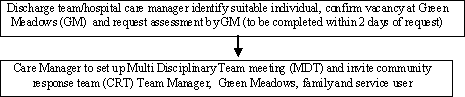
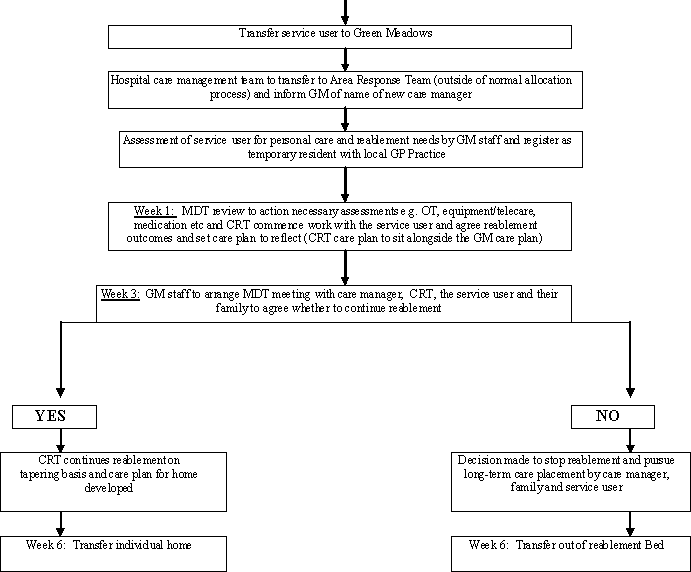
3.5.3 The pilot at Green Meadows residential home has demonstrated the success of short term intensive re-ablement services for those people who are physically frail and who needed that short term intensive support to allow them to return to their own homes. The service provides re-ablement for a maximum of 6 weeks within a residential home setting, followed by - if required - a further period of 6 weeks at home, supported by a tapering package of care from the Community Response Teams (CRT). During this period there is ongoing multi-disciplinary assessment with the individual and his or her carers, to enable full consideration of options for the future. (Service User Journey Appendix D)
3.5.4 Of the people who have used the service during the pilot period 50% chose to return to living in their own home. All of the individuals - 15 in total - were given time to make informed decisions for their future and will be able to continue their lives in the knowledge that, whatever the outcome, they have made the best choice for themselves.
3.5.5 An agreement was reached at the beginning of the process not to charge people for the bed based element (first 6 weeks)of the pilot. This decision was made on the basis that the service needed to be tested and that individuals, who were under pressure to leave the hospital and who may have lost confidence, would be reluctant to pay for what might be perceived as an unnecessary delay in their inevitable journey into long term care. Additionally the service design met the definition of `intermediate care' which is required to be free for up to 6 weeks as defined by regulation. The costs of the re-ablement beds consist of three elements:
· Occupancy levels for re-ablement beds are typically far lower than standard residential beds. This potentially results in residential placements being purchased from external providers for clients who could otherwise have been placed in these beds.
· The cost of re-ablement care provided to clients by CRT in the
residential setting.
· The lost income as a result of the decision not to charge for the re-
ablement beds.
These costs should be offset by:
· A reduction in Delayed Discharges fines (as the delay in placing a
client in a re-ablement bed is typically far shorter than the delay in placing a client in a permanent residential placement). The daily fine for a delayed discharge is £100; in 2004/5 the annual fine amounted to £848,500, this has reduced year on year and in 2008/9 it was £262,000.
· Long term savings from re-abled clients returning home with a
domiciliary care package, instead of a more expensive residential placement. ( Appendix E)
3.5.6 As the pilot has only been running for a relatively short period of time and on a relatively small scale, very limited data is available on which to base the financial implications, however, the results to date suggest that the scheme will result in some financial savings, particularly by replacing residential care with domiciliary care.
3.5.7 Evidence from the Green Meadows pilot has been supported by an evaluation of a separate project in Basingstoke. Here 11 nursing and residential care beds have been purchased from two independent providers to provide re-ablement beds. The service commenced in December 2008 as part of the very successful winter plan. The beds have been well used with an occupancy level of 90% and early information suggests good outcomes with approximately 60% of people requiring residential or nursing care at the point of discharge from hospital returning home with a package of care or stepping down from nursing care to residential care after 6 weeks intensive re-ablement. This work with the independent sector will inform the development of wider commissioning for this model of service.
3.5.8 It is proposed that an implementation plan is developed to begin county wide roll out of this model of service in 2009/10. It is anticipated that additional beds will be available from September 2009 onwards with a significant growth in provision distributed equitably across the county by April 2010. This is likely to be achieved via a mixture of in-house and independent sector provision. Planning will include a detailed financial analysis of costs and savings and the planned provision will be done within budget.
4) Welcome Home Contract
4.1 There are currently two Welcome Home Schemes within the County and these are located within West and South East Hampshire (Havant, Fareham and Gosport), the total annual value of the contracts is £463,040 per annum. Both contracts are currently with Southampton Care Association (SCA) and are due to expire on 31 March 2010.
4.2 Under current arrangements the service can be offered for a period of up to 6-8 weeks to provide time limited domestic, personal care and support to service users who are being discharged from hospital and who need fairly short term rehabilitative assistance to re-establish themselves in their own homes.
4.3 The schemes are described as `'time limited, flexible, quality service, enabling a speedy, efficient and safe discharge of users to their own homes, in partnership with hospital staff." However, there are gaps in service provision across the county: in Andover and Winchester in the West Area and in Hart, Rushmoor and East Hants in the North and East Area.
4.4 As a result of this inequity, a strategic review of the Welcome Home Scheme is underway. This will enable partnership working with users, carers and providers to identify and develop new ways of providing services that meet the individual outcomes of those people needing the services.
4.5 The review will also enable the department to address the charging anomalies that exist with the current Welcome Home Care provider meaning that those people eligible for the service will no longer be required to make a financial contribution.
4.6 Whilst the outcome of the review is not yet complete it is estimated that the cost of providing the additional services, based on 250 hours service per week will be £172,000. It is proposed to invite tenders for a countywide contract with an implementation date of April 2010. Funding for this scheme will be included within the budget for the next financial year and will be identified from within current resources.
5) One Off Direct Payments
5.1 In line with Self Directed Support and enabling choice and control, it is proposed to develop a standard one off Direct Payment to support people for six to eight weeks on hospital discharge as an alternative to the Welcome Home Service or possibly in combination with this service. This work is being developed in conjunction with the Self Directed Support work stream which is looking generally at Direct Payment development. It is planned to implement this later in 2009/10 when the financial implications, systems and process issues have been appraised.
6) Assertive Intervention and Re-ablement Teams
6.1 There has been a significant body of national policy published over the last 2- 3 years for both the NHS and Local Authorities giving an increasing emphasis to joint working and outcomes. The Current Darzi review of the NHS has recognised that `the relationship between health, social care and wider community services will be integral to the creation of a truly personalised care system.` ( Putting People First.) Hampshire Primary Care Trust (HPCT) Care Services has made the transition to Hampshire Community Health Care (HCHC) a Direct Provision Organisation (DPO). The aim of HCHC is to deliver the `right care for the right patient in the right place at the right time' ensuring customer satisfaction. Both HCHC and Adult Services agree that to deliver timely, efficient and good quality responses for crisis care there is a need for ;
· a consistent model across the county
· an integrated response by NHS community care, primary care and
local authority services
· a review of existing resources against changing need, expectations and demography in order to focus care to those most in need
· delivery of a comprehensive menu of crisis services across the county
6.2 An Integrated Care Systems Board has been established to have oversight of the development and delivery of the assertive intervention and re-ablement model and the delivery of Community Innovations Teams. At a recent review it was agreed that Hampshire Partnership NHS Trust be invited to join the project to ensure that mental health issues are fully addressed in the new services in line with the Older Persons Mental Health Strategy and the recent National Dementia Strategy. Project management support will be provided by both HCHC and Adult Services. Detailed planning and resource mapping is currently underway for both of these work streams.
6.3 The Board has agreed a broad vision for crisis intervention which includes the following aspirations:
· rapid response ( 4hr max)
· 24/7 access
· Free at the point of delivery ( time limited for social care provision)
· Single point of access
· Safety and quality
· Professional intervention
6.4 To achieve the vision it is intended that we learn from the implementation of the Community Innovations Teams and establish the social care element of the Model . It is intended that new provision will be developed around the Practice Based Commissioning clusters which will mirror Community Innovations and will include realignment of the Community Response Teams, occupational therapy services and some social work resources. Intensive work is taking place between Adult Services and Hampshire Community Health Care (HCHC) to explore potential joint models. Evidence of what works is being drawn from national good practice examples including models of service established in Devon and West Sussex, along with local experience of existing rapid response services in parts of the County.
7) Early Intervention and Prevention -Community Innovations Teams
7.1 This is a key element of free care and is being developed by the Board to focus on targeted intervention to prevent crisis. This early intervention work has already been piloted through the LAA Flagship Community Innovations Project. The teams are multi-disciplinary and multi-agency in nature and include staff from Adults Services, health and the voluntary sector. The teams explore ways of promoting the well-being of older people at risk of losing their independence but who are not yet in crisis. They strengthen people's links with local communities, and aim to reduce their need for emergency and other services such as unplanned hospital admission as well as for services such as care at home, by intervening when problems first start to emerge rather than waiting for a crisis to occur. These teams also help strengthen the capacity of the community to respond, and provide opportunities for older people to stay active and independent. Evaluation of this service has shown real benefits in terms of older people's wellbeing, with excellent feedback from people supported by the service, carers, local health services, and the community and voluntary sector.
7.2 A major event was hosted in January 2009 to disseminate the findings of the pilot sites and considerable multi-agency support was given to the rollout of the service across the county.
7.3 The aim is to embed a Community Innovations Team within each of the 16
Practice Based Commissioning (PBC) localities by April 2010. Seven teams already in place a further nine are planned. Detailed planning is underway for further roll-out and the budget includes the roll out of the further nine teams.
8) Financial Implications (Please see table on page 11)
8.1 In 2009/10 there is additional investment of £250,000 to support the free crisis care model. The financial implications of these proposals are shown below
8.2 Costings are at a preliminary stage and will develop as the approaches take shape in practice. However, the following table indicates that the expected costs in 2009/10 can be constrained to the budget available. Clearly this will be closely monitored in the context of the overall budget position, and adjustments made to ensure that a broad balance remains in place between costs and funding identified. Lessons learned can then feed into the 2010/11 budget-setting process.
9) Legal Implications
9.1 Implementation of the proposals contained in this report will need to be considered in relation to the existing eligibility criteria and charging policy. The Council provides services based on an individuals needs being critical or substantial.
10) Recommendations
10.1 That support is given for the recommended approach to this element of the Hampshire Model and the proposals for the delivery of aspects of Free Crisis Care, as well as for the extension of the Community Innovations Teams across the County.
10.2 That approval is given to review the current respite and short term residential contracts with a view to ensuring there is the correct balance of traditional respite care and short term intensive re-ablement resources particularly for those people who are physically frail
10.3 That approval is given to commence detailed planning for the delivery of "Time to Think" beds across the County, during 2009/10; to be achieved via a mixture of in-house and independent sector provision and subject to a detailed financial analysis of costs and savings.
10.4 That approval is given to invite tenders for a countywide Welcome Home contract with an implementation date in April 2010.
Financial Implications of Free Crisis Care
Free Crisis Care Element |
Basis for Costing £ |
Expected 2009/10 cost £ |
Expected Ongoing Annual Cost £ |
Identified 2009/10 Funding £ |
Funding Source |
Countywide roll out of step down/ Time2Think beds |
c£10,000 per annum for each in-house bed allocated as a reablement bed. c£300,000 to extend existing block contracts for 10 step down beds in the North (set up as part of the Winter Pressures plan). Further purchased reablement beds. Based on average annual costs for residential and domiciliary care, annual savings of c£9,000 could be made for each client able to return to living in the community. |
To be identified 300,000 To be identified |
To be identified 300,000 To be identified |
250,000 To be identified |
£250,000 earmarked from existing budgets. Savings on residential budgets for people reabled. |
Countywide provision of Welcome Home from Hospital Support |
£463,040 for 2 schemes in the West and South East. £172,000 to extend the schemes in the West and to the North in 2010/11. |
463,040 |
463,040 172,000 |
463,040 |
£463,040 existing budgets. £172,000 yet to be identified. |
One-off Direct Payments for vulnerable people needing help on discharge from hospital |
Not yet known. |
To be identified |
To be identified |
To be identified |
Anticipated to be met within existing Direct Payment budgets (currently under spent). |
Community Innovations Teams |
c£908,000 for 7 Innovations teams, increasing (part year for some) to 16 teams by the year end (£1,142,000 fye). c£220,000 for 16 Community Development Workers to be recruited in year (£320,000 fye) |
908,000 220,000 |
1,142,000 320,000 |
1,129,000 |
£1,129,000 existing budget (mainly £960,000 budget bid OPPD-P25). £12,918 future shortfall on Innovations teams to be met through 2010/11 budget bid. £320,000 for CDWs tbc. |
TOTAL |
1,891,040 |
2,397,040 |
1,842,040 |
Integral Appendix A
CORPORATE OR LEGAL INFORMATION:
LINKS TO THE CORPORATE STRATEGY | ||||
Yes |
No | |||
Hampshire safer and more secure for all |
||||
Corporate Business plan link no (if appropriate) |
||||
Maximising well-being |
||||
Corporate Business plan link no (if appropriate) |
||||
Enhancing our quality of place |
||||
Corporate Business plan link no (if appropriate) |
||||

OTHER SIGNIFICANT LINKS: | ||
Links to Previous member decisions: | ||
Title |
Ref |
Date |
Cabinet Report on Commission of Inquiry into Personalisation and the proposed model for adult social care in Hampshire |
458 |
22 December 2008 |
Direct Links to Specific Legislation or Government Directives | ||
Title |
Date | |
Putting People First |
December 2007 | |
Section 100 D - Local Government Act 1972 - background documents | |
The following documents discuss facts or matters on which this report, or an important part of it, is based and have been relied upon to a material extent in the preparation of this report. (NB: the list excludes published works and any documents which disclose exempt or confidential information as defined in the Act.) | |
Document |
Location |
None |
|
Integral Appendix B
IMPACT ASSESSMENTS:
1. Equalities Impact Assessment:
An overall Equalities impact assessment has been carried out. This highlights that the rollout of free crisis care offers benefits across a wide range of groups in terms of increased equity, choice and control, specific measures will have to be in place to meet the needs of younger vulnerable adults and to ensure that people with dementia are not excluded on the basis of diagnosis alone. The assessment highlighted the need for individual work streams to also carry out assessments to ensure that all current and potential service users are communicated with effectively. These assessments will be carried out as the detailed work stream plans are developed.
2. Impact on Crime and Disorder:
The County Council has a legal obligation under Section 17 of the Crime and Disorder Act 1998 to consider the impact of all the decisions it makes on the prevention of crime. The proposals in this report have no proven impact on the prevention of crime.
3. Climate Change:
a) How does what is being proposed impact on our carbon footprint / energy consumption?
No impact has been identified, however an increase in local purchasing due to personalisation may reduce carbon footprint through reduced travel.
b) How does what is being proposed consider the need to adapt to climate change, and be resilient to its longer term impacts?
The approach to roll out has not considered the need to adapt to climate change in detail, however as the work streams are developed this will be taken into account in detailed planning.
Appendix C
`TIME TO THINK'
RESIDENTIAL SERVICES FOR OLDER PEOPLE
WHO REQUIRE SPECIALIST REABLEMENT
SPECIFICATION
1. REABLEMENT SERVICE AIM
The service offers a stepping stone of assessment and intensive re-ablement for people with the motivation or potential to further develop their daily living skills to enable them to live as independently in their own homes as is possible.
The expectation of the service is that there will be an overall re-ablement period in the residential care environment of a maximum of six weeks, with a further period of up to 6 weeks of supporting the individual in their own home through the community re-ablement service where appropriate.
2. REABLEMENT OBJECTIVES
2.1 To provide a short term intensive residential re-ablement service to
restore optimum physical, social and psychological function, to a level which the older person, their family and their carers are able and are motivated to maintain.
2.2 To provide and / or co-ordinate the provision of social, therapeutic and medical care services.
2.3 To improve the quality of life for older people, their families and carers, to a realistic degree.
2.4 To enable older people to recover or establish daily living skills,
communication, mobility and confidence, which will allow them to achieve a return to living within the community.
2.5 To work in partnership with the service users, their families and carers in assessing problems and needs, goal setting, planning and implementing re-ablement programmes.
2.6 To work collaboratively with the multi-disciplinary team to bridge the gap between the intensive physical care and therapy of a hospital setting and that of their own home.
2.7 To provide an alternative or permanent residential or home care, where the identified need is for re-ablement in a non-hospital setting.
2.8 To assess each individual for a range of support services in the community, in addition to a package of care. (E.g.home adaptations and Telecare.)
2.9 To ensure that appropriate, necessary adaptations can and have been made.
2.10 Re-ablement is defined in literature from the Kings Fund as " a service for people with poor physical or mental health, to help them accommodate their illness by learning or re-learning the skills necessary for daily living".
3. ELIGIBILITY CRITERIA
To be eligible for the service the following must apply:
· The service will be used by older persons with a predominant physical frailty, but who might have an additional degree of early onset dementia, who could benefit from active reablement, advice and support, who do not have acute medical needs and who are willing to participate in this form of reablement
· Aged at least 65 years
· Have experienced a major change of circumstance in their lives which prevents them from functioning independently in their own home.
· Have received the necessary acute treatment and been medically stable for 48 hours
· Have potential to develop, or benefit from, a period of specialist residential, transitional or re-enabling care.
· People with dementia would be considered according to their individual circumstances. They could be assessed as appropriate where dementia is a secondary diagnosis and their degree of confusion did not compromise their reablement potential or their carer's personal safety.
The service shall not be available to people who:
· Are waiting for a longer term service or facility including specialist
housing or adaptations to their own home, or permanent residential or
nursing home care.
· Have not been fully assessed as likely to benefit from the service
· Require an emergency placement
· Require only respite care
Appendix D
Hampshire County Council
Adult Services
Patient/Service User Journey through reablement bed pilot scheme
FLOW CHART
APPENDIX E
Detailed Costings of Time to Think Pilot to 30 September 2008
| |||||||
Period under review |
|||||||
1st April 2008 - 30th September 2008 |
183 |
days | |||||
Interim beds available |
6 |
beds | |||||
Total maximum bed nights in period under review |
1,098 |
||||||
Using beds as standard residential beds: |
|||||||
Assuming maximum occupancy of 95%: |
|||||||
Bed nights available |
1,043 |
||||||
Gross cost based on £59 per night |
£61,543 |
||||||
Expected income based on £21.50 per night |
(£22,427) |
||||||
Net cost |
£39,116 |
||||||
Interim beds pilot |
|||||||
Total bed nights |
537 |
||||||
No. of clients |
14 |
||||||
Average length of stay |
38 |
||||||
Effective occupancy level |
49% |
||||||
Cost of reduced occupancy: |
|||||||
Additional vacant bed nights |
506 |
||||||
Cost to purchase external placements at £58 per night |
£29,354 |
||||||
Less expected income at, say, 30% |
(£8,806) |
||||||
Net additional cost |
£20,548 |
||||||
Cost of reablement care received during the interim stay: |
|||||||
Total number of CRT hours |
366 |
||||||
Cost at £14 per hour (per 2007/08 PSSEX1) |
£5,121 |
||||||
Cost of income foregone due to the decision not to charge: |
|||||||
Income based on notional income rate of £21.50 per night |
£11,546 |
||||||
Actual income foregone based on client assessments |
£3,663 |
||||||
Savings on Delayed Discharges fines: |
|||||||
No. of clients falling within reimbursement policy |
7 |
||||||
Average delay for permanent placement |
10 |
days | |||||
Average delay for reablement bed placement |
3 |
days | |||||
Total saved at £100 per day |
£4,900 |
||||||
Average gross annual cost of a residential placement |
£21,535 |
||||||
Less expected income at, say, 30% |
(£6,461) |
||||||
Net annual cost of a residential placement |
£15,075 |
||||||
Average gross annual cost of a domiciliary care package |
£6,916 |
||||||
Less expected income at, say, 20% |
(£1,383) |
||||||
Net annual cost of a residential placement |
£5,533 |
||||||
Average unit cost for purchased residential care in SE (August 2008) |
58 |
per day | |||||
Average unit cost for purchased domiciliary care in SE (August 2008) |
19 |
per day | |||||
Average annual unit cost of a domiciliary care package in SE (August 2008) |
6,916 |
||||||
.