Archived decisions
HAMPSHIRE COUNTY COUNCIL
Decision Report
Decision Maker: |
Executive Member - Policy and Resources | ||
Date of Decision: |
19 May 2009 | ||
Decision Title: |
Civil Engineering Professional Services Contract Strategy | ||
Decision Reference: |
698 | ||
Report From: |
Director of Environment | ||
Contact Name: |
Phil Samms | ||
Telephone: |
01962 874795 |
E-mail: |
|
EXECUTIVE SUMMARY
1) Summary of Decision Area:
1.1. This report seeks support for a contract strategy to procure highways, transport and wider civil engineering related professional services for the Environment Department, including collaborative working with other Hampshire County Council Departments and Local Authorities within the South-East region to gain potential procurement efficiencies.
2) Issues Covered in Report:
2.1. The existing Professional Services Contract supporting the Environment Department comes to an end on 31 March 2010. It takes approximately 12 months to procure a new contract, therefore replacement options are currently being considered. In addition, discussions are ongoing with other Departments at Hampshire County Council and other Local Authorities through Improvement and Efficiency South East to seek opportunities to collaborate on the delivery of these services, thereby gaining procurement and operational efficiencies.
2.2. This paper outlines some of the key issues under consideration and sets out the procurement timescales to be met. In addition, it identifies a number of options available for the support of professional services beyond 1 April 2010 and seeks views on the preferred way forward.
3) Recommendation:
3.1. That approval be given to the proposed contract strategy for a Framework including a Term Civil Engineering Professional Services Contract and Major Schemes Framework together with continued engagement with Improvement and Efficiency South East.
MAIN REPORT
1) Contextual Information
1.1. The existing Professional Services Contract operated by the Environment Department was based around engineering design and transport planning services, aimed at supporting the delivery of the Local Transport Plan and associated Capital Improvement Programme as a top-up to in-house capabilities. However, the scope of the contract was written to be broader than this and more specialist services are also now delivered through the contract, such as transport modelling, inspections, ecology, biodiversity, Section 278 inspection, Construction (Design and Management) Regulations 2007, etc.
1.2. The contract commenced on 1 April 2006 for an initial period of two years, with an option to extend by a further two years, subject to satisfactory performance. Mott Gifford, a joint venture between Mott MacDonald and Gifford, was successful in its initial bid and also in securing the two year extensions, bringing the contract end date up to 31 March 2010. There are no legally acceptable opportunities to extend the existing contract beyond this date.
1.3. A 360 degree review of the current contract is being undertaken as part of the replacement programme, to ensure whether any contract management or other procedural issues could be enhanced within any replacement arrangement. Initial indications are that the contract has operated more successfully than the previous one with Atkins, but there remain some areas of opportunity, as follows:
(i) more extensive forward programming of work to facilitate improved resource management;
(ii) greater consistency of communication across professional disciplines; and
(iii) a need for more flexible resources to be available to deliver larger scale schemes. Existing arrangements are adequate at the moment, but will not support the transport infrastructure aspirations of the county in the future.
2) Key Issues
Scope of the Contract
2.1. In addition to the core services of engineering design and transport planning, it is suggested that some additional areas be considered under any new contract, such as Asset Management, Major Scheme development/bidding support, Landscape Planning, Waste, Passenger Transport and possibly even support for Property, Business and Regulatory Services (PBRS). Discussions with colleagues from PBRS have proved useful in developing a strategy that would enable professional service support to be provided from the Engineering Consultancy and any future professional service provider, potentially including shared service arrangements currently operated in this area.
2.2. In addition, work has been progressing through Improvement and Efficiency South East (IESE) to investigate whether any other local authorities in the region are seeking similar services from the private sector. Initial indications are that they are, and that they would be interested in considering some form of regional support in the above areas. Further details are provided in paragraphs 2.7 to 2.9 below.
Form of Contract
2.3. The existing Professional Services Contract is a single supplier term contract with a certain amount of workload expected to be delivered (£1.5 million to £2.5 million). An indication of core activities was provided within the contract document for engineering design. Alternative models involving more than one supplier through a framework contract could be considered, which would add additional flexibility for supporting larger scale items of work, without the need to guarantee any workload at the time of tendering.
2.4. Any new contract(s) could follow either of these models or even use a combination of the two. In the event that a term contract is preferred, helping to benefit from closer working relationships, the duration should be carefully considered to balance time to achieve operational effectiveness, ongoing development, performance, the supplier's profitability and client's value for money. In addition, some mechanism to link duration, or rather contract extensions, to performance should be considered through the use of key performance indicators.
Type of Supplier
2.5. In combination with thoughts on the form of contract preferred, the type of supplier also needs to be considered:
(i) Would a locally based company/office be preferred, or would a more remote location be equally acceptable? Hampshire County Council has tended to prefer a locally based office in the past, to encourage a closer working relationship to be developed.
(ii) Should there be more co-location opportunities? This may become more important with the flexible nature of work being implemented for County Council staff under Hampshire Workstyle.
(iii) The breadth of suppliers' ability to meet County Council needs directly and the specialisms that they may offer.
(iv) How their core/specialists are split and located, as it is likely that the larger scale consultants will be considered.
Governance Arrangements
2.6. Depending upon a number of the above factors, the governance of any contract needs careful consideration:
(i) Any regional arrangements through the IESE would almost certainly require regional governance, with the potential reduction in overall influence that the County Council may have on the supplier.
(ii) Conversely, if a County Council specific contract were to be progressed, similar to the existing Professional Services Contract, how would this be best managed?
(iii) Currently Engineering Consultancy has a significant role in the management of the contract, due to its experience in this area, however this does not always ensure that all disciplines are adequately managed from a technical viewpoint.
Regional Agenda
2.7. As described above, opportunities for regional collaboration on professional services have been identified through IESE. At present, discussions are well progressed, with particular interest being shown by West Sussex County Council, East Sussex County Council, Dorset County Council and the Isle of Wight for some form of shared service arrangement, both in terms of private sector involvement, but also potentially any under utilised in-house resources.
2.8. Four key options are being considered and are being market tested with other local authorities and the private sector. These are:
(i) single term supplier for core services across the region, with a major schemes design framework of three or more suppliers;
(ii) single regional framework of three or more suppliers (potentially allowing each authority to continue with any term supply arrangement that they may have or need);
(iii) single term contract for the whole region and all services; or
(iv) single term supplier for core services across the region, with a major schemes design and build framework of three or more suppliers.
2.9. Opportunities may also exist to collaborate with the Highways Agency (HA) for the delivery of professional services, as the HA's two existing framework contracts offered through the Highways Efficiency Liaison Group are due for replacement in summer 2010.
Other Factors
2.10. In addition to the key factors highlighted above, a number of less wide-reaching issues also need to be considered:
(i) A replacement contract would be an ideal opportunity to review forward programming of workload and resource management, particularly between in-house and external resources. Robust mechanisms to manage this could be included for the future.
(ii) Integration of quality management systems is essential to ensure consistency.
(iii) Control of project expenditure and deliverables through the Gateway Process and variation control mechanisms has evolved since the last contract was written, and needs to be more comprehensively reflected in any new arrangement.
(iv) Increased flexibility in the payment arrangements for commissioned work (currently hourly rate, but could be expanded to include fixed fee, fee percentage, salary multiplier, etc).
3) Procurement Timescales:
3.1. The following key dates are required to be met for the procurement of any replacement term professional services contract:
· Publication of Contract Notice in the Official Journal of the European Union - April 2009
· Authority to Tender Report to Executive Member for Policy and Resources - June 2009
· Tenders Invited - August 2009
· Tenders Returned - October 2009
· Selection of Successful Bidder(s) - November/December 2009
· Mobilisation Period - January to March 2010
· Contract Start Date - 1 April 2010
3.2. Depending upon the final option chosen, particularly in relation to the involvement of other departments within Hampshire County Council and/or other local authorities through IESE, these dates may have to vary slightly.
4) Outline of Options:
4.1. It is clear that there is a range of potential solutions to the ongoing provision of professional service to the Environment Department, including collaboration internally with other departments, such as PBRS, but also with other local authorities through IESE. These offer excellent opportunities to provide efficiencies of service for Hampshire County Council and the public sector as a whole; however the governance of these arrangements may see some level of control over the service being diluted.
4.2. Three basic contract options have been considered, with a number of sub-options. Details are set out in Appendix 1 and described in brief below:
Option 1a
· Framework with a Term Professional Services Contract for Local Transport Plan (LTP) schemes and other core activities with three or more suppliers
· Design only Framework Contract for Major Schemes with three or more suppliers (Note: framework contracts are not permitted to have two suppliers under the EU Procurement Directives)
Option 1b
· Term Professional Services Contract for LTP schemes and other core activities with a single supplier
· Design and Build Framework Contract for Major Schemes with three or more suppliers
Option 1c
· Term Professional Services Contract for LTP schemes and other core activities with a single supplier
· Design only Framework Contract for Major Schemes with a single supplier
Option 2
· Design only Framework Contract for LTP schemes, other core activities and Major Schemes with three or more suppliers
Option 3
· Term Professional Services Contract for LTP schemes, other core activities and Major Schemes with a single supplier
4.3. Each of these options could be implemented as Hampshire County Council only or Regional, or a combination of the two in the case of Options 1a, 1b and 1c. Notwithstanding this, it would also be possible to advertise any County Council only contract with the option for other South-East authorities to join it in the future, should they so wish.
4.4. It would be intended that the contracts would complement existing in-house resources within Hampshire County Council and any other South-East local authority, as set out in the diagram below:
Workload · · · |
LTP Schemes |
Major Schemes | |
In-House Resources |
Framework Contract | ||
Term Professional Services Supplier |
|||
4.5. Appendix 2 contains a brief summary of the relative merits and concerns for each of the options listed, and also considers their suitability for being Hampshire County Council only or regionally operated.
5) Option Analysis / Comparison
5.1. There are a number of viable options for the delivery of professional services to the Environment Department from 1 April 2010. Opportunities also exist to broaden the scope of the contract to include other departments within Hampshire County Council, and also other local authorities within the South-East through IESE and the Highways Agency.
5.2. Whilst the introduction of regional contracts has potentially significant efficiency benefits for all authorities involved, there are uncertainties around the detailed governance arrangements. Hampshire County Council has always benefited from a close working relationship with its professional services supplier, and this may be diluted by the introduction of other client authorities. This is a resolvable situation, however, particularly with improved programme management practices employed by all participating authorities, enabling greater resource management controls to be implemented.
5.3. The provision of a term professional services contract is important for Hampshire County Council, as workload demands are generally higher than other neighbouring authorities. The proximity of the supplier is also considered important, together with the ability to build a long-term collaborative working arrangement. As such, options favouring this approach are preferred, suggesting that Option 2 is not ideal.
5.4. Current arrangements of professional services provision are not dissimilar to Option 3, which have not always been best suited for the delivery of larger scale schemes. Whilst provision for these types of scheme could be better accommodated within a newly drafted contract, there remains a concern that resources could become stretched if several larger schemes were to require progressing at the same time. It is therefore suggested that this option be discounted.
5.5. Options 1a, 1b and 1c all offer variations of a single supplier Term Professional Services Contract with a Framework Contract of some kind. This arrangement provides a useful flexibility over the other options, both in terms of Hampshire County Council/regional split, but also for potentially large variations in workload. The relative merits of the various sub-options are quite subtle and may well be influenced by considerations currently underway through IESE (ie market testing or local authorities and private sector consultants).
5.6. Option 1a potentially offers a more traditional and lower risk approach to the situation, however Option 1b has significant potential to assist in the actual delivery of major schemes on the ground within tight time constraints. If funding bid opportunities are to be optimised in the future, it may well be that this approach is the most likely to succeed.
6) Conclusions
6.1. There are a range of options available to progress, either by Hampshire County Council itself or through the region, however timescales are tight. The options involving a combination of Term Professional Service Contract for core LTP activities and a framework for Major Scheme development and design appear to offer the best overall potential for Hampshire County Council and the region as a whole.
6.2. Discussions are ongoing through IESE regarding possible options, however Hampshire County Council needs to make a decision on the preferred strategy and move forward quickly. It is therefore proposed to progress with the following:
Term Professional Service Contract
· Procured by Hampshire County Council for its immediate requirements, but structured in such a way as to allow other local authorities to use it in the future
· Seek a consultant with a base local to Hampshire
· Contract duration of five years minimum, with performance related extensions
Design and Build Framework Contract
· Procured through IESE to provide regional facilities for the South-East
· Seek three or more suppliers (most likely joint ventures or service contractors)
· Contract duration of four years, as required by EU Procurement Directives
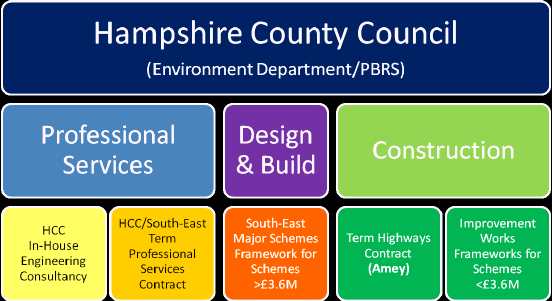
6.3. A representation of how the proposed new arrangements compare with existing ones for professional services and construction are contained within Appendix 3.
7) Recommendations
Please see Executive Summary for recommendations.
2026Rpt/698/PS
CORPORATE OR LEGAL INFORMATION:
LINKS TO THE CORPORATE STRATEGY | |||
Yes |
No | ||
Hampshire safer and more secure for all |
|||
Corporate Business plan link no (if appropriate) |
|
||
Maximising well-being |
|||
Corporate Business plan link no (if appropriate) |
|
||
Enhancing our quality of place |
|||
Corporate Business plan link no (if appropriate) |
|
||
OTHER SIGNIFICANT LINKS: | ||
Links to Previous member decisions: | ||
Title |
Ref |
Date |
Civil Engineering Professional Services Contract Strategy paper to Buildings Land and Procurement Panel |
|
31 March 2009 |
Direct Links to Specific Legislation or Government Directives | ||
Title |
Date | |
|
| |
Section 100 D - Local Government Act 1972 - background documents | |
The following documents discuss facts or matters on which this report, or an important part of it, is based and have been relied upon to a material extent in the preparation of this report. (NB: the list excludes published works and any documents which disclose exempt or confidential information as defined in the Act.) | |
Document |
Location |
None |
|
COMPREHENSIVE RISK & IMPACT ASSESSMENT:
1) Equalities Impact Assessment:
a) There is not considered to be any impact. The Council's Equalities policies will be a fundamental requirement of any contract with suppliers.
3 Impact on Crime and Disorder:
b) None.
4 Climate Change:
c) How does what is being proposed impact on our carbon footprint / energy consumption?
· Efficiency requirements of the contract strategies will reduce energy consumption and performance of the carbon footprint of suppliers will be monitored.
d) How does what is being proposed consider the need to adapt to climate change, and be resilient to its longer term impacts?
· The need to adapt to climate change is considered by the efficient procurement of services and the design solutions proposed by suppliers.
Option |
Local Transport Plan (<£5M schemes) |
Major Schemes | ||||
Engineering Design |
Transport Planning |
Specialisms |
Engineering Design (Feas. To Detailed) |
Transport Planning/ Evidence Base |
Specialisms | |
£1.5 - 3M fees p.a. (County Council only) £3 - 5M fees p.a. (Regional) |
£0 - 4M fees p.a. (County Council only) £0 - 7.5M fees p.a. (Regional) | |||||
1a |
Framework with Term Professional Service Contract (3 or more suppliers) Duration 4 years |
|||||
Design only Framework Contract (3 or more suppliers) Duration 4 years | ||||||
1b |
Term Professional Service Contract (Single Supplier) Duration 5+ years |
|||||
Design and Build Framework Contract (3 or more suppliers) Duration 4 years | ||||||
1c |
Term Professional Service Contract (Single Supplier) Duration 5+ years |
|||||
Design only Framework Contract (Single supplier) Duration 4 years | ||||||
2 |
Design Only Framework Contract (3 or more suppliers) Duration 4 years (possibly longer, if justifiable under OJEU rules) | |||||
3 |
Term Professional Service Contract (Single Supplier) Duration 5+ years | |||||
Analysis of Contract Strategy Options
Advantages |
Disadvantages |
Option 1a - Framework with a Term Contract plus Major Schemes Design Framework | |
· Close working on LTP and other core activities through partnering approach · Potential for co-location of teams/resources · Scalable solution from County Council only to regional over time · Longer term relationship possible with term contract (but limited to 4 years within framework) · Framework called upon when required, with no minimum workload required |
· Two contracts, and potentially 4 or more suppliers to administer · Requires well developed future plan of workload and resources · Volume of work offered through Framework may not be sustainable for suppliers · Loss of local resources/knowledge through use of framework · Need for robust quality control systems to ensure consistency and compliance with County Council rules and regulations |
Option 1b - Term Contract plus Major Schemes Design and Build Framework with Multiple Suppliers | |
· Close working on LTP and other core activities through partnering approach · Potential for co-location of teams/resources, including contractor for major schemes · Scalable solution from County Council only to regional over time · Longer term relationship possible with term contract (framework limited to 4 years) · Framework called upon when required, with no minimum workload required · Works for major schemes can be efficiently procured, with potential for early contractor involvement in scheme development |
· Two contracts, and potentially 4 or more suppliers to administer, including joint ventures between consultants and contractors · Requires well developed future plan of workload and resources · Volume of work offered through Framework may not be sustainable for suppliers, particularly JVs · Loss of local resources/knowledge through use of framework (likely national companies) · Need for robust quality control systems to ensure consistency and compliance with County Council rules and regulations |
Option 1c - Term Contract plus Major Schemes Design Framework with Single Supplier | |
· Close working on LTP and other core activities through partnering approach · Potential for co-location of teams/resources · Scalable solution from County Council only to regional over time · Good relationships possible with term contract and framework, as only two suppliers. |
· Requires well developed future plan of workload and resources at tendering stage · Volume of work offered through Framework may not be sustainable for supplier or, conversely, may be too great · Loss of local resources/knowledge through use of framework, as volume of work likely to be too great for local suppliers · Need for robust quality control systems to ensure consistency and compliance with County Council rules and regulations |
Option 2 - Design Framework with Multiple Suppliers | |
· Flexibility to call upon resources only when required, with no requirement to guarantee any workload · Scope and volume of work commissions could be spread around various suppliers to obtain best technical ability/specialism's · Scalable solution from County Council only to regional over time |
· Loss of single supplier relationship for core services, including restriction to a maximum contract period of 4 years · Likelihood that suppliers would not be local to Hampshire, thereby making regular contact difficult · Loss of local resources/knowledge · Scope of framework would have to be very broad to encompass all services that might be required. This could limit the market of available suppliers with all skills or require sub-consultants for specialist work · Need for robust quality control systems to ensure consistency and compliance with County Council rules and regulations. |
Option 3 - Term Contract with Single Supplier | |
· Similar to existing arrangements, so less change for County Council staff to deal with · Close working on all schemes through partnering approach · Strong potential for co-location of teams/resources · Single contract to administer · Longer term relationship can be established and developed · Opportunity to develop local resources/knowledge over time |
· Requires well developed future plan of workload and resources at tendering stage · Volume of work offered may be subject to large fluctuations, making resource planning particularly problematic · County Council governance would need to be broad to ensure that all technical disciplines were managed effectively · Not scalable from County Council only without significant governance issues arising · Need for combined quality control systems to ensure consistency and compliance with County Council rules and regulations |
Existing Arrangements
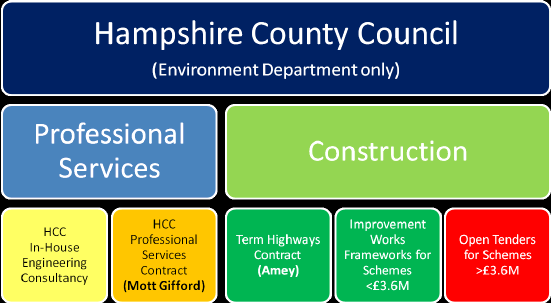
Proposed Arrangements