
Archived decisions
Hampshire County Council Health Overview and Scrutiny Committee Item 5 26 May 2009 Proposals to Develop or Vary NHS Services Report of the Chief Executive |
Contact: Denise Holden ex 7338
e-mail: [email protected]
1. Summary and Purpose
1.1. The purpose of this report is to alert Members to proposals from the NHS to vary or develop health services provided to people living in the area of the Committee.
1.2. Proposals that are considered to be substantial in nature will be subject to formal public consultation. The nature and scope of this consultation should be discussed with the Committee at the earliest opportunity.
1.3. The response of the Committee will take account of the Framework for Assessing Substantial Change and Variation in Health Services agreed by the Hampshire, Isle of Wight, Portsmouth and Southampton Joint Committee in March 2005. This places particular emphasis on the duties imposed on the NHS by Section 11 of the Health and Social Care Act 2001.
1.4. This Report is presented to the Committee in 2 parts:
_ Items for information: these alert the Committee to forthcoming proposals from the NHS to vary or change services. This provides the Committee with an opportunity to determine if the proposal would be considered substantial and assess the need to establish formal joint arrangements
_ Items for action: these set out the actions required by the Committee to respond to proposals from the NHS to substantially change or vary NHS services.
1.5. This report and recommendations provide members with an opportunity to influence and improve the delivery of health services in Hampshire and therefore support the delivery of the Corporate Strategy aim of maximising well being.
Items for Information
2. Winchester and Eastleigh Healthcare NHS Trust: Outpatients Department relocation
2.1. No further information has been received in relation to this proposal.
2.2. Issues to be addressed previously identified by the HOSC include:
_ Access, including car parking and access for people with a disability or using public transport
_ The supporting diagnostic and other services to be provided on the site (e.g.. phlebotomy, x-ray) and the logistics to relocations these to a distant site
_ Clear patients pathways to ensure that patient flows are easily planned and managed. Not all out-patient consultations would be suitable for a remote site
Recommendations
2.3. That WEHT provides the HOSC with an update on progress on 28 July 2009.
Items for Action
3. Surrey and Borders Partnership NHS Trust: Proposals to reconfigure 24 hour assessment and treatment (inpatient mental health services)
3.1. At its meeting on 31 March members expressed a number of continuing concerns about proposals from Surrey and Borders NHS Foundation Trust to reconfigure inpatient mental health services to three sites based in Surrey.
3.2. Key stakeholders, including local district councils and patient groups also expressed concerns about the proposals.
3.3. Hampshire PCT and Adult Services supportive of the broad direction of travel proposed by the Trust but there remained a lack of clarity about the impact that the proposed changes would have on Hampshire residents.
3.4. The Chairman has written formally to the Trust setting out the views of the HOSC. This is attached at Appendix One. The response of the Trust is attached at Appendix Two.
Recommendations
3.5. The PCT proposals for next steps are presented to the HOSC on 28 July.
4. West Sussex Primary Care Trust - Acute Service Reconfiguration
4.1. West Sussex PCT has confirmed that it is looking at its commissioning intentions for maternity services, in patients paediatrics and emergency surgery with a view to having an agreed position by the end of July.
4.2. It is not yet clear how much stakeholder input is informing this process. There is an intention to have some public engagement in August.
4.3. The PCT Board will decide how it wishes to proceed in September and this is likely to be the trigger for reconvening the Joint HOSC.
4.4. It is not clear what the impact of this work will be for Hampshire services.
Recommendations
4.5. That the Committee be kept appraised of the situation.
4.6. Representatives for the Hampshire HOSC (currently Cllrs Mrs Buckley and Cllr Wright) are agreed on 28 July.
5. South Central SHA: Consultation on proposals to fluoridate drinking water in Southampton and South West Hampshire
5.1. The response of the SHA to the HOSC is attached at Appendix Three. The Chairman's response was circulated to members electronically but is attached at Appendix Four for ease of reference.
5.2. It has been confirmed by the SHA that the press report that a significant population in south west Hampshire were not consulted was inaccurate.
Recommendations
5.3. Members are advised of the response of the SHA.
6. South Central Specialist Commissioning Group: Establishing a Burns Centre for south west England.
6.1. The Specialist Commissioning Team has advised the Hampshire, Portsmouth Southampton and Isle of Wight HOSC of potential changes to the location of burns services for the most seriously burnt patients. The evidence base supporting this change is attached at Appendix Five.
6.2. As part of the work to identify a suitable Burns Centre for the Network the Joint HOSC members were invited to a series of visits across the South West Area. Cllrs McNair Scott and Chapman went to Fenchay Hospital on 28 April, and Cllr McNair Scott visited Salisbury NHS Foundation Trust on 29 April. The Chairman of the Isle of Wight HOSC and Portsmouth HOSC visited Bristol Children's Hospital and Swansea Hospital.
6.3. It is anticipated that the establishment of a Burns Centre in Swansea will affect 1-2 patients per year from across Hampshire and will increase the chance of survival of the most seriously burnt patients.
6.4. The vast majority of burns patients will continue to be treated as Salisbury NHS Foundation Trust.
6.5. Further work needs to be undertaken to ensure community and other local services are supported to enable the repatriation of patients at the earliest opportunity.
Recommendations
6.6. The HOSC agrees that the changes proposed do not constitute a substantial variation in service.
6.7. The Hampshire , Southampton, Portsmouth and Isle of Wight Health Scrutiny Joint Committee continues to monitor progress with the setting up of the Burns network to ensure any the outstanding issues identified by members are acted on.
Section 100 D - Local Government Act 1972 - background papers
The following documents disclose facts or matters on which this report, or an important part of it, is based and has been relied upon to a material extent in the preparation of this report.
NB the list excludes:
1. Published works
2. Documents that disclose exempt or confidential information as defined in the Act.
File Location
None
Appendix One: Surrey and Borders NHS Trust: Proposals to re-provide 24 Hour Assessment and Treatment. Hampshire HOSC response to extended consultation. 31 March 2009
Many thanks to you and your team for attending our meeting earlier this week. It was helpful to have an opportunity to discuss the additional information you kindly provided and hear the views of a number of the Hampshire based stakeholders about the changes you are proposing to make to adult inpatient mental health services.
It was clear from the discussion that there was support for the modernisation of inpatient mental health services but a number of concerns remain in the Hampshire community affected by these changes. Issues relating to access and community support are particularly important in this respect and require further consideration before any action is taken. Whilst it was helpful to have confirmation that mitigation plans would be developed we would need to see these and be confident that there was sufficient community support available to provide care as locally as possible and accessible services for those people requiring more intensive inpatient care. Your confirmation that changes would not take place until these issues have been addressed is welcome. However it will be important that local stakeholders are involved in this work from the outset. It was very disappointing to that despite the feedback provided at our last meeting many of the issues relating to engagement and involvement had not been addressed, as demonstrated in the submissions provided for our meeting. The scope for the Ridgewood Centre to be retained as a fourth facility also needs to be fully explored.
On the basis of the evidence received the Health Overview and Scrutiny Committee (HOSC) is not convinced that:
· there has been sufficient engagement and involvement of key local stakeholders in developing the proposals
· the changes proposed will result in better mental health services for local people and are therefore in the interests of the Hampshire population affected
The position of the HOSC has not therefore changed since our letter of 28 November and we do not support this proposal as it currently stands. We are however mindful that of your commitment to further work and engagement, this being the `first step of the journey' and remain keen to see a local resolution of this matter. It would be helpful to hear how you intend to engage effectively with local patients groups, GPs and Local Authorities to build consensus on the way forward. We have stressed this latter point throughout our correspondence but despite the three month extension to the consultation period the same issues of concern continue to be raised by local stakeholders.
In addition to your plans for further engagement and involvement I would appreciate confirmation of the timings of the decision making process that will be followed by the Trust, together with the documents produced analysing the responses to the consultation process.
Appendix Two: Surrey and Borders NHS Foundation Trust response the Hampshire HOSC-12 May 2009
Re: Hospital Services Consultation: Our Future, Your Say
Thank you for your letter following our attendance at your Committee's meeting on 31st March 2009 to update you on the discussions as part of the above consultation. I should like to express my formal thanks again to you and your Committee for your time and interest in the development of our services. I believe that, through your work with us, we have been able to improve our connections with colleagues across Hampshire Boroughs in particular.
We are disappointed that the Committee continues to feel that there has been insufficient engagement and continue to be unable to support fully the proposed changes. We welcome your support for the modernisation of our inpatient services and for our continued work with local stakeholders to achieve local resolution to the concerns raised. We are committed to continuing to build upon our engagement and involvement of our Hampshire stakeholders as we move through to the future phases of our service changes. For example we are looking forward to attending Hart District Council's Health Board in the near future.
I apologise that I have not been able to write to you before in answer to your letter. We are still awaiting the final documents collating all the feedback we received during the consultation and preparing responses to this. I expect this work to be completed during this month and will forward copies of the documents to you once this is achieved.
All the views we have received will then be considered by both our own Board and NHS Surrey to inform our decision making with regard to our next steps, including our future engagement and involvement of stakeholders. Our expectation is that this consideration will take place in June after which I will provide you with an update on our progress and intentions for continuing our work to achieve this much needed development of our hospital services.
Appendix Three: Proposals to Fluoridate Water in South West Hampshire: SHA response to the HOSC. 26 April 2009.
Appendix Four: Proposals to add fluoride to drinking water in Southampton and south west Hampshire. HOSC letter to South Central SHA- 8 May 2009.
Thank you for your very full response to my letter of 27 March 2009. It was helpful to have your comments but I'm afraid we are going to have to agree to disagree - it may be something about the nature of fluoride as neutrality on the subject is extremely rare!
We stand by our view about the bias of the consultation document. For example, I cannot believe that anyone who has studied the York Review would feel satisfied that their findings about the poor quality of research, although mentioned in passing, are given the weight they deserve. You may remember that we shared our concerns with you in a letter of 13th October, and our conclusions were unanimously endorsed by Hampshire County Council.
Given a topic on which such strong views are sincerely held, the lack of account that was taken of the views expressed by local people is disturbing. We are continuing to receive issues of concern raised by the Hampshire population affected and I understand this is also the case in Southampton. We are particularly perplexed by the reference in the third paragraph of your letter, i.e. only where responses to the consultation included full texts of the reference were these considered in the analysis undertaken. At no time was it made clear to us that this was an expectation and we do not consider it fair or reasonable that the public responses received should be expected to provide this level of detail. This fuels public suspicions that the evidence has been selectively interpreted by the SHA in order to support a centrally driven policy, regardless of the views of local people.
There are two issues that do need to be taken forward:
1. We support the point that you make about the need for publically accountable bodies to ensure that funding is directed to greatest effect. Given that Southern Water raised significant concerns about the practicality and feasibility of the Rownhams scheme, and the lack of information about the final costs should this proposal proceed we do not understand how the SHA can be of the view that the proposal is cost effective. Could you please provide us with details of the most recent estimates of the capital and revenue costs of implementing both schemes and an indication of the threshold at which the SHA would come to a view that the scheme ceases to be cost effective. If this is currently subject to further work with Southern Water it would be helpful to have an indication of when this information can be made available to us.
2. There is not sufficient information about how the population affected by these proposals will be monitored. At the very least we would expect your Board to have in place arrangements to ensure that the desired benefit was being achieved and that people were not experiencing adverse effects (including monitoring the incidence and severity of fluorosis) together with mechanisms to evaluate the impact of new schemes (such as that described by Portsmouth University). This is not currently part of Public Health Observatory monitoring and we believe that, having made its decision, the SHA should actively engage with communities to monitor the effect on the population. We would therefore appreciate further information about the work that will take place to address this point.
We will continue to take an active interest in this matter and look forward to receiving your response to the two issues raised above.
BURNS CARE
Briefing to Hampshire, Southampton, Portsmouth and Isle of Wight Health Scrutiny Joint Health Overview and Scrutiny Committee
BACKGROUND
1. Burns injuries are experienced by about 250,000 people in the UK each year. There are many causes, such as contact with hot fluids and surfaces, flames, chemicals and electrical sources. About 175,000 people visit A&E departments with burn injuries each year and some 13,000 of them are admitted to hospital. By no means are all admitted to burns and plastic surgery units, with between 30-40% admitted to non-specialist units. Approximately 1,000 patients are admitted with severe burns requiring fluid resuscitation, about half of whom will be children aged 16 years or under.
2. The traditional (and much criticised) approach of using the size of the skin injury (total burn surface area or TBSA) is being replaced by a new approach which recognises the complexity of the injury, including the patient's age, the injury site and mechanism (see table).
Table Classification of Burn Injury The extent of the skin injury is quantified in terms of the extent of the body surface area (total burn surface area; TBSA) involved in the injury, expressed as a percentage of the whole. Using this figure and the depth of skin damaged by that injury is the most commonly used method of grouping burn injury severity. However the site on the body and the patient's age are also relevant (from statistical analyses the age of the individual becomes crucial in the under one year and over 56 years age groups). The overly simplistic nature of assessment can be illustrated by considering the variability of a 4% TBSA burn: · A burn of this size on the back of a fit adult might, if superficial, be treated as an outpatient safely and appropriately. A deeper injury that needed skin grafting would require a short hospital stay and minimal morbidity. · A deep 4% injury to both hands is a complex reconstruction and rehabilitation problem; it makes any patient entirely dependent on nursing and therapy staff. Such injuries can result in multiple finger amputation with the major morbidity this represents. · A superficial injury to the face causes intense swelling, closing of the eyes and again dependent on nursing staff for activities of daily living, eye care and labour-intensive wound management. · Should a 4% facial injury be associated with any risk of smoke or vapour inhalation injury, the patient would require an HDU environment with close monitoring to pick up any deterioration in airway patency or mechanical ventilation in an ICU environment to allow airway protection and care. Such injuries carry a significant risk of death. |
3. The expert view (the National Burn Care Review) which commissioners are seeking to implement recognises that all burns injuries requiring hospitalisation should only be admitted under the care of specifically trained specialist staff. Uncomplicated injuries do not require separate wards with high staffing levels and expensive monitoring equipment. Burns units and centres, however, will be equipped and staffed to provide the highest levels of care for the most seriously injured.
4. Nationally England and Wales has been divided into four quadrants to plan for the organisational development and designation of burns care provision to meet the burn care review. NHS South Central is unusual in playing into two different networks: PCTs in Thames Valley are covered by the London and South East network; PCTs in Hampshire & Isle of Wight are covered by South West UK Burn Care Network which also includes PCTs in NHS South West and south Wales.
5. Additional information on the key findings of the National Survey and the resultant recommendations are attached at Annexes One and Two respectively.
SOUTH WEST UK
6. There are three locations of burns providers: Bristol, Salisbury and Swansea; each provides care to the standard of burn unit for adults and children. Commissioners now wish to designate which services should be recognised as capable of providing care for the very few number of patients that require care at a burns centre. It is generally (if reluctantly in some quarters) accepted that Morriston Hospital, Swansea (Abertawe & Bro-Morgannwg NHS Trust) meets burns centre standards for adults. Similarly, but with less discontent, Bristol Children's Hospital (United Healthcare Bristol FT) will meet burns centre standards for children when it moves to its new facilities in 2010.
7. The next steps in the designation process for burn care services within the South West UK Burn Care Network require that all our data and information is up to date and that we can provide evidence for the factors that influenced our decision making. There are three main steps to achieve this:
· Step 1 - validation of Burn Care Service against the 2006 self-assessment questionnaire for adults and children's burns services for Salisbury Healthcare NHS Foundation Trust, North Bristol NHS Trust and Abertawe Bro Morgannwg University NHS Trust.
· Step 2 - Gathering the evidence
· Step 3 - Burn Care Validation visits
8. For the third step, service visits will be undertaken to both the current and prospective providers so that each member of the visiting team meets the providers' teams and has a view of the layout and content of the service. The visiting team will:
· formally receive the evidence against each standard
· discuss any areas requiring further work or development within the Network as part of the work programme.
9. Lay representatives are being sought for these visits and HOSCs in Hampshire, Southampton, Portsmouth and Isle of Wight are invited to make nominations. One suggestion is that an officer and representative from each HOSC visits one of the four burns providers (adults and children's units in Bristol are separate) as we have had no formal patient or public involvement to date.
10. As there has been no formal patient or public involvement to date it is intended that patient and lay representatives participate in the schedule of visits.
11. Other members of the visiting teams will include the following: chair of SWUK Burns Care Network, a SWUK clinical network director, and a nominee from each specialised commissioning group.
12. The visits will provide an opportunity to look at the different facilities and validate the assessment process that has taken place to date. The lay perspective that members and other stakeholders bring to this process will ensure that there is a strong focus on the way in which the proposals will impact on patients and their families.
13. HOSC interest in the proposals will be as follows:
· Is the proposal substantial in nature (if so what is required by way of formal consultation and how will a joint committee be managed if more than one HOSC is of this view).
· Is the conduct and content of the consultation satisfactory
· Is the change in the interest of the population affected
14. Key areas of to explore may include:
· A clear understanding of the number of patients from each area that are likely to be treated at a burns facility, a burns unit and a burns centre
· The facilities available for visitors and relatives, including overnight, longer term accommodation
· Confirmation that patients will be transferred to more local facilities at the earliest possible opportunity
· Any issues relating to the transfer of patients by emergency services- including repatriation where required.
· Travel times to different facilities and costs
· The availability of specialist rehabilitation and other support services across the area of the network
· The existence of robust and appropriately funded clinical networks to support continuity in clinical care
· Options if no bed is available in a centre
· The financial implications for each provider of the proposed designations- are these likely to impact adversely on other services within the Trust.
· Timeframes within which the designation will be reviewed and by whom
· Confirmation of clinical sign up to the proposals across the network, regardless of the outcome
Annexe One: National Burns Report: Key Points from the Executive Summary
Burn Injury
· Burn injury has a devastating potential and requires multi-professional team working to achieve optimal results
· Overall burn injury is common, with hospital admission necessary for 25/100,000 * whole population and is commonest in children under 3 years of age, but there is marked geographical variation
Service Provision
· Current provision is ad hoc, disorganised and inequitable from the patient's perspective, particularly where critical care is needed
· Many injuries are admitted to general hospitals under the care of nonspecialists
· There are too many units admitting major injuries on an occasional basis, especially paediatric injuries
· Urgent problems exist with critical care provision, especially for children with severe burn injuries
· No intensive rehabilitation beds exist to optimise functional and psychosocial recovery
· No national Major Incident plan exists for an event involving large numbers of burn injuries
· There is no detailed data available on which to base injury prevention, service planning or service audit and monitoring
Recommendations
· National, clinical management and referral guidelines be used by all, and where necessary developed
· In-patient burn injury care should only be provided by specialists trained in burn care
· Burn services require stratification and definition according to clear standards that are monitored by a burn service accreditation system
· Critical care provision for those with burn injury must be delivered in a way that provides optimal patient benefit
· Rehabilitation services be developed which integrate with the acute care service
· Clinical networks be developed across the stratified service to provide care as near the patient's home as possible, at each stage of their care
· A R&D programme be instigated to develop the tools necessary to develop the evidence base for burn care
· Better information gathering, by improving NHS systems and creating a specialty-based report and audit system
· A structured implement process and timetable outlined in the Report be used and monitored by the NBCRC over the next 5 years
Implementation
· Urgent designation and support of services to care for severe burn injuries in children
· Urgent development of a national Major Incident Plan for burn injury, civil or military, paediatric or adult
· Develop plans for rehabilitation services in both the hospital and community settings
· Commence Regional Commissioning of burn services dependant upon the participation of that service in national external audit and accreditation
* Addendum to printed version (15:100,000)
On the basis of this analysis, the NBCRC has agreed a number of recommendations for future services to move towards care being seamlessly delivered by a network of specialised, accredited and progressive services. The Committee believes the recommendations, which can be grouped and summarised in the following way, will gain a wide and strong level of agreement within the burn care community and the health services as a whole.
1. Uniform national clinical management and referral guidelines
The traditional and much-criticised approach of using the size of skin injury (total burn surface area or TBSA) as the single criterion to guide referral should be replaced by an approach which assesses the complexity of the injury. This new approach recognises the importance of the patient's age, the injury site and mechanism plus co-existing medical problems. A new injury stratification format has been developed in consultation with relevant professionals and the NBCRC recommend that it should form the future basis of referral policy at all levels of health care.
Minor burn injuries are commonly assessed by a range of health care professionals. The quality of care for children and adults with burn injuries will be significantly improved by the development of clear clinical guidelines and educational programmes such as the Emergency Management of Severe Burns (EMSB) course. The same advice and guidelines must be used by the Ambulance Service and NHS Direct, and by paramedics in all the Emergency and Armed Services.
It is necessary to have agreement about what types of injury need referral to which type of burn service. As required by Information for Health, and as suggested by the recent experiences of the Armed Forces, consideration is being given to the role of telemedicine in referring injuries. This, and the need for a National Burn Bed Bureau, to advise as to bed availability, further necessitate the introduction of the new National Burn Injury Referral Guidelines.
2. In-patient provision for burn injuries to be provided by specialists
The Committee considers that the present practice in some hospitals of admitting patients with burn injuries under the care of hospital specialties with no specific burn injury training is unacceptable. All burn injuries requiring hospitalisation should only be admitted under the care of specifically trained specialist staff.
3. A new structure of burn care services
Differing levels of injury complexity require certain types of in-patient accommodation for the provision of optimal care. Uncomplicated injuries do not need separate burn wards with high staffing levels and expensive monitoring equipment to receive high quality care. The most complex injuries on the other hand are small in number yet are currently being admitted to burn wards with very variable facilities and staffing levels, many of them falling short of current guidelines.
The Committee has considered the key elements of a burn care area (nurse and care specialisation / ward accommodation and theatre provision) and have suggested a stratification which along with new National Burn Injury Referral Guidelines describes `who needs what'. The stratification is into Burn Facility (BF), Burn Unit (BU) and for the most complex injuries, Burn Centre (BC).
The Committee recommends that each stratified burn care area should be designated either paediatric or adult, never both. It is quite possible that two burn wards, one paediatric, one adult might co-exist on one hospital site. In many ways this is an efficient model, but all such accommodation must comply with the relevant NHS recommendations.
A Burn Facility equates to a surgical ward within a plastic surgery unit. There are some 60 such plastic surgery units across the British Isles.
A Burn Unit and Burn Centre are both wards created purely for the care of burn injury, each able to deal with complex injuries. The Burn Centre being equipped and staffed to provide the highest levels of care for the most severely injured, with 24 hour immediate access to a designated burn operating theatre.
Designation or reorganisation of any UK burn service will involve the identification of the best site by identifying the `at-risk' population. If done correctly, the resulting reduction in the number of hospitals providing burn services should not significantly increase the length of journey time required for initial transfer or family visiting.
Consideration of the available information about burn injury incidence at differing levels of complexity suggests each BU or BC should be required to admit at least 50 complex injuries per year, as a minimum. The NBCRC estimate therefore that of the existing 60 BFs, a maximum of 3 would be designated to be adult BUs and a further 9 would act as BCs. For children 2 would be BUs and 6 would be BCs.
Each type of in-patient burn care area should be staffed for capacity, rather than average occupancy, by a well-trained team of professionals. A core team should consist of burn nurses, burn surgeon, burn anaesthetist and in Burn Centres, burn intensivists, supported by physical therapists, dietician, psychologist and social worker. For paediatric wards, paediatric specialists are needed plus play specialist and teacher.
4. Critical Care Provision
This is one of the most difficult areas in which to make practical, sustainable and supportable recommendations. The major issues are the skill retention of staff and bed availability.
The recommendation therefore is that Burn Centres provide dedicated intensive care within the confines of the Burn Centre with full intensivist support from an adjacent, preferably conjoined, Intensive Care Unit (ICU). The centralisation of complex injuries and experience gained by burns staff may be sufficient to maintain the necessary intensive care skills, but in any case, the juxtaposition of services in this way allows greater flexibility in staff rotation and team building. It also helps avoid the difficulties the excessively high occupancy rates of most ICUs cause, and would allow the prompt and reliable admission of 98% of complex burn injuries into a staffed, suitable bed.
Other models of intensive care provision may work, but only some of the time, and the principle of assuring access to the highest level of expertise, when the patient most needs it, is a goal which must not be compromised.
The provision of intensive care on a stand alone burn ward with insufficient workload to meet the recommendations of the Intensive Care Society and the Paediatric Intensive Care Society, and inadequate to maintain the skills of the staff therein, cannot be recommended as a sustainable, safe, arrangement.
5. Continuing care of patients with burn injury as part of a burn service
To ensure that children and adults with burn injuries receive specialist functional, aesthetic and psychological rehabilitation, burn care services should plan for this from the day of admission. A continuing care model is recommended to provide rehabilitation services throughout acute, subacute, early post-discharge and community stages. In particular, three new aspects should be put in place:
· an intensive (multi-specialty) rehabilitation ward for patients with a range of traumatic injuries, including burns.
· outreach teams from each BU and BC to ensure ongoing care for patients in their own home, in spoke hospital out-patient departments, and by supporting and educating health care professionals in the Community, District General Hospitals (DGH) or Plastic Surgery Units (PSU).
· psychological rehabilitation of patient and family should be co-ordinated by the designation of a named co-ordinator in each BU and BC.
NBCR Continuing Care Model for Burn Injury
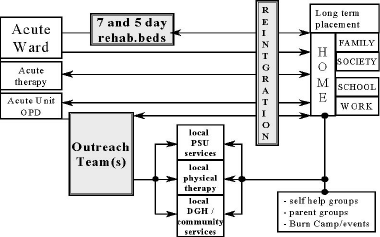
Further research is urgently required to identify how best to promote psychological adjustment after burn injury and the quantification of clinical outcomes. In addition, the Committee recommends that locally-based self-help groups and bum camps are actively developed with NHS supportive funding.
6. A network of burn injury services across the UK
The Committee envisages a network of services that can provide seamless care from the time of injury to complete recovery for all levels of injury severity.
The network envisaged can be briefly described as follows:
· For non-complex injuries, patients would be treated by GPs, Practice and District Nurses.
· For the next level of severity, patients would receive treatment at A&E Departments, from which they would be referred to higher tiers if assessment indicated a more complex injury.
· For in-patient care, BCs would be established at the centre of an `at-risk' population receiving patients with the most complex injuries from a wide catchment area, as well as patients requiring treatment for BU and BF level injuries from smaller geographical areas. A network of BUs and BFs would support, and be supported by, the BC using outreach teams and telemedicine links via the NHSnet.
It is the intention that a Burn Centre would not only admit all complex injuries with severe skin burns from a large geographical area but less complex injuries from a smaller area around itself. Admitting more straightforward injuries from the immediately local population would help even out the peaks and troughs of workload and ensure that nursing staff in particular have a range of injury types to deal with.
Thus a Network of Care is developed by Burn Centres, Burn Units and Burn Facilities, all communicating regularly and working to provide a balance between easy access and patients having to travel for greater expertise. Placing services within the `at risk' population will minimise how far the majority of patients have to travel to reach an appropriate level of care.
National planning should ensure that patients travel as short a distance as possible to receive the level of expertise required for their particular injury at whatever level of recovery they have reached.
The exact configuration, for a given area and population would depend on the need for burn care within that population. It is obvious that the appropriate service population for a paediatric Burn Centre may cross Regional Health Authority and even National boundaries.
7. Research and Development
Work must to be commissioned on vitally important areas of burn care in order to create the tools needed to develop the evidence base for burn care that is demonstrably lacking.
8. Improved data gathering and information analysis
Existing systems for gathering information are inadequate for the tasks of contracting and monitoring the delivery of burn care, or for the planning of future services. They are also inadequate for clinical audit, research or informing injury prevention programmes.