
Archived decisions
HAMPSHIRE COUNTY COUNCIL
Decision Report
Decision Maker: |
Cabinet | |
Date of Decision: |
29 June 2009 | |
Decision Title: |
Comprehensive Area Assessment Plan - Hampshire County Council | |
Decision Reference: |
750 | |
Report From: |
Chief Executive | |
Contact name: |
Gary Smith | |
Tel: |
01962 847402 Email: [email protected] | |
1. Executive Summary
1.1. This paper sets out the County Council's plan in relation to the new CAA (Comprehensive Area Assessment) performance framework following discussions at Policy Briefing and the Corporate Management Team.
1.2. The Council is very clear that CAA should not distract the authority from Driving Success and delivering improvements in priority services, achieving greater value for money and taking action on key issues such as climate change. Local priorities and a community outcome focus must have primacy and the Council will look to see how CAA and the inspectorates will support this.
1.3. It is clear that the issues the Council has greater control over are likely to be the elements of CAA that the Council performs more strongly in, namely the Organisational Assessment.
1.4. It is recognised that the areas which relate to Hampshire wide, partnership issues and are less within the Council's control may take longer to improve and are likely to result in areas of weaker performance being highlighted by the inspectorates. That said, Hampshire is extremely well placed relatively with a strong track record of improvement and strong prospects for future improvement.
1.5. The County Council prides itself in its commitment to drive continuous improvement in the things that are important locally and takes seriously its partnership community leadership role. The plan below draws together this improvement and partnership activity which in the majority of cases is already underway. This will provide strong evidence for CAA.
2. Contextual information
2.1 CAA is made up of two main assessments: Organisational Assessment and Area Assessment. The former is a scored report led by the Audit Commission and will focus on the County Council (partners will experience similar assessments separately). The latter is a joint inspectorate judgement on Hampshire as an area, focussing on partnership working and community outcomes, and will be a narrative based report with Red and Green Flags, by exception.
2.2 A key message nationally and locally is that CAA is different, harder and nationally it will be unlikely for organisations or areas to score highly in the first round. This presents resource implications and questions around the appropriate focus and balance for the County Council to take in the level and nature of its response.
2.3 This briefing paper is based on the best information available but it should be noted that details of the final CAA framework are still emerging, particularly the relationship with the developing Ofsted and the new Care Quality Commission inspection regimes for Children's and Adult Services.
3. Organisational Assessment
3.1. The Organisational Assessment is split into two main sections: Use of Resources and Managing Performance. Whilst there are significant similarities with the old CPA (Comprehensive Performance Assessment) Use of Resources block and Direction of Travel assessment, there are also significant differences. For this reason it would not be appropriate to directly compare these with previous assessments.
3.2. The headline Organisational Assessment questions are:
Organisational Assessment | |
Use of Resources |
How effectively does the organisation manage its finances to deliver value for money? |
How well does the organisation govern itself and commission services that provide value for money and deliver better outcomes for local people? | |
How well does the organisation manage its people, natural resources and physical assets, to meet current and future needs and deliver value for money? | |
Managing Performance |
How well does the organisation manage and improve its services and contribute to wider community outcomes? |
3.3. CPEG (Corporate Performance and Efficiency Group) has been self-assessing and gathering evidence against these main themes and the underpinning key lines of enquiry.
3.4. This work has been undertaken jointly by the Policy Unit and the Treasurer's Department and facilitated by Treasurer's Consultancy. Work is well advanced in relation to the Use of Resources section and, whilst evidence collation continues in a few specific areas, no areas of particular concern have emerged.
3.5. It should be noted that evidence is not required for Human Resources or workforce issues as this is excluded from the 2009 assessment. However, it will be critical to ensure that workforce planning links into other activity during 2008/09, as that is known to be an area on which the Audit Commission in likely to focus in 2010.
3.6. At the same time evidence is now being collated in relation to the Managing Performance section which the inspectorates scheduled to assess after the Use of Resources work and alongside the wider Area Assessment.
3.7. This work is progressing well and no particular areas of concern have emerged. Subject to following up a few areas, the Council should be a long way forward to achieving a good result in the Organisational Assessment.
3.8. However, it should be noted that further evidence may be required following review by the Audit Commission of the information submitted to them. With this in mind, departments will want to continue to ensure appropriate and robust plans are in place for any known areas of weaker performance or potential Red Flag areas.
3.9. In addition to the evidence gathering against the key lines of enquiry it is important to highlight wider areas of particularly good practice or innovation - these may go well beyond the criteria set out in the assessment. The Council can build on and update some of the case study examples submitted as part of CPA but it will be important to identify any new areas.
4. Area Assessment
4.1. The Area Assessment is the biggest area of change from the previous CPA regime and is likely to be the more challenging element of CAA. The Area Assessment judges the Hampshire area (and the quality of life of local residents) as a whole rather than judging separately the services provided by the relevant local organisations.
4.2. The Area Assessment is made up of three main questions, 11 sub-sections and four underpinning themes1:
Area Assessment | |
Q1. How well do local priorities express community needs and aspirations? |
|
Q2. How well are outcomes and improvements needed being delivered? |
· How safe is the area? · How healthy and well supported are people? · How well is adult social care meeting people's needs and choices? · How well kept is the area? · How environmentally sustainable is the area? · How strong is the local economy? · How strong and cohesive are the local communities? · How well is housing need being met? · How well are families supported? · How good is the wellbeing of children and young people? · How good is the wellbeing of older people? |
Q3. What are the prospects for future improvement? (main focus) |
By exception: · Red Flags (significant concerns) · Green Flags (exceptional success) |
Underpinning themes: | |
· Sustainability · Inequality |
· Vulnerable groups · Value for money |
4.3. At the strategic level the County Council and partners can be relatively confident about responding to and providing evidence against the three main questions. The greatest risk is the sheer scope of the Area Assessment which will focus on the SCS/LAA (Sustainable Community Strategy/Local Area Agreement) initially. It will then be informed by the wider National Indicator Set (NIS) and partnership working.
4.4. By the very nature of the Area Assessment it covers all and everything: the quality of life of old people, young people and vulnerable groups; community safety; the physical environment; the economy; health issues; local transport; community access; community engagement and involvement; equality and diversity; and sustainability, among many others.
4.5. It is this comprehensive overview of life in Hampshire which means it is inevitable that there will always be issues to highlight and areas of weaker performance.
4.6. It is important to keep this in mind, therefore, when considering the County Council's and partners' response to CAA and the relative return and benefits of the resources committed to this.
4.7. The County Council is clear that where CAA can support the Council improve in core priority services and delivering what is important to people locally this is welcome. But the Council will not allow CAA to drive the improvement and delivery of local priorities off course.
Self-assessment approach
4.8. Hampshire and the County Council have a huge amount to be proud about in terms of the distinctiveness and quality of life that local residents enjoy. It will be important to collate and present how the County Council and partners support and shape this to the inspectorates as part of their CAA work.
4.9. The diagram below outlines the proposed, proportionate response to the Area Assessment - paragraphs 5 .9 to 5.14 explain the diagram:
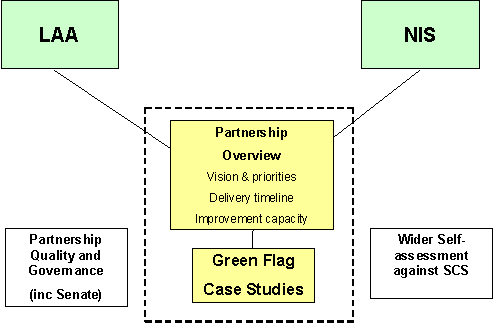
4.10. The first two (green) boxes at the top represent two key pieces of evidence that would be completed as part of the normal performance and partnership management. The 2008/09 year-end NIS and LAA performance report will provide key pieces of improvement evidence and how the partnership is tackling areas which are not yet hitting stretching milestone targets.
4.11. The two (yellow) boxes in the middle set out a proportionate response to the CAA Area Assessment and include:
1. Partnership Overview: This should be a short, concise overview2 of the partnership effectiveness and direction of travel which picks up on some of the main themes of the Area Assessment. This will present a robust case of the areas' strengths, with links to substantiating evidence, whilst recognising areas of further improvement and the capacity and plans to address these. As part of this, it will be important to clearly set out the key local priorities.
2. Green Flag Case Studies: A proactive collation of areas of strong performance, improvement and innovation - experience has shown that if not highlighted areas of notable good practice can be overlooked. A simple template to capture these has already been developed, shared with partners and suggestions invited3.
4.12. The partnership overview and Green Flag case studies will need to be done in partnership and cover Hampshire as an area and partnership working as a whole. Initially, the Policy Unit will take the lead on this work in consultation with departments and partners.
4.13. This has been preliminarily raised with the LAA Executive and they have indicated that they are happy with this approach. In addition, Green Flag Case Studies have already been invited from them and the LAA theme leads.
4.14. The two other (white) boxes at the bottom highlight the wider development issues and direction of travel. Work is planned for these later in the year and the wider Hampshire Senate Annual Conference will involve a wider partnership assessment against the longer-term ambitions in the Hampshire Sustainable Community Strategy, especially in view of the economic recession.
4.15. Whilst the results of these discussions will not inform CAA in the first year, they reflect that this is a `living' process which is not fixed in time but rather a continuing journey. The results and improvements following these discussions will inform CAA in future years.
4.16. Whatever happens it will be important to recognise that any response, evidence collation or summary overview would need to be done jointly in partnership rather than by the County Council alone. The Area Assessment is a judgement on Hampshire as an area and how partners are working together to improve the quality of life for local residents.
Department role
4.17. Hampshire County Council departments have a crucial role to play and contribution to make to the Area Assessment. There are two main areas that departments can help with:
· Green Flag Case Studies: identify and begin to assemble areas of particular innovation, outstanding performance or good partnership/community work4.
· Improvement Plans: ensure robust improvement plans are in place around areas of known poorer performance and potential Red Flag areas.
4.18. More broadly, the authority will need to be able to demonstrate how Council priorities and plans reflect community needs and aspirations; that arrangements in place are effective at delivering outcome performance improvement; and that organisational and partnership capacity is being built to sustain this and improve further. Departments have a key role with this and providing the evidence.
Potential areas of inspectorate interest
4.19. The scope of the Area Assessment - everything - poses a huge challenge and it is guaranteed that areas of concern, risk and weaker performance will be highlighted. Some of these may be reported as Red Flags.
4.20. The Area Assessment will tend towards partnership working and cross-cutting issues. It is likely to have a bias towards a partnership mode of delivery which may or may not be suitable over a range of issues.
4.21. Either way, the inspectorates will seek to judge the effectiveness of partnership working from the Hampshire Senate, LAA Executive and various thematic partnerships to other geographic or interest partnerships.
4.22. The Council's relationship with key partners and sectors, including the voluntary and community sector will be explored.
4.23. Given the scale and complexity of partnership arrangements in Hampshire this provides a challenge. It is difficult to predict how CAA will interpret the inherent tensions presented by the County Council's community and partner leadership role in some areas whilst operating independently as an effective service delivery organisation in other areas.
5. Children's Services Assessment
5.1. Ofsted's contribution to the CAA will be based on a local authority `performance profile', a quarterly summary of strengths and weaknesses in outcomes and services for children and young people.
5.2. Ofsted will provide an annual performance rating in November, based on the quarterly profile, self-assessment and inspection.
5.3. The inspection cycle has been strengthened to include three yearly `proportionate' inspections of safeguarding and outcomes for children in care and an annual unannounced safeguarding `visit'. These will be carried out by inspectors from Ofsted and the new Care Quality Commission.
5.4. Poor performance in the annual safeguarding visit or performance profile can trigger more frequent inspection and could limit overall assessment ratings. In addition, there will be a greater emphasis on the views of children, young people and their families, as well as Children's Services staff and key partners.
5.5. Publication of the final details of the Ofsted framework have been delayed by two months. Although self-assessment is likely to be completed between June and August, the timetable for inspection is currently unclear.
6. Adult Social Care Assessment
6.1. .The Care Quality Commission (CQC) has a statutory responsibility to regulate and performance assess NHS and adult social care services. The assessment for Adult Services feeds directly into the CAA Organisational Assessment for the County Council and the Area Assessment of Hampshire. A joint NHS/Adult Services performance assessment is currently being developed by CQC for consultation.
6.2. The key themes for 2009 with the councils 2008 gradings, where available, are:
· Commissioning and Use of Resources: Excellent
· Personalisation and Transformation: New theme
· Safeguarding Good
· Partnership Working New theme
· User/Carer Engagement New theme
6.3. Evidence and data is required to be submitted twice a year in May and September to the CQC to enable a cross-inspectorate judgement to feed into the CAA. The process continues to involve the Self Assessment Survey, Annual Review Meeting, submission of several data sets and up to four business meetings (proportionate to the councils performance) with the CQC Area Manager.
6.4. In addition Adult Services departments may be subject to an in-depth `Independence, Wellbeing and Choice' service inspection, with Safeguarding as a mandatory component. The department has not received notification of any intention by CQC to inspect, but is nevertheless currently carrying out a baseline assessment of its performance using learning from councils who have been inspected.
6.5. For the 2009 adult social care assessment, the Self Assessment Survey will be submitted to CQC on 14 May and the Annual Review Meeting, attended by the Leader and the Chief Executive of the County Council, will be held on 18 June. To assist the CQC to meet the CAA timetable, in March the department submitted a `Performance Statement' and reviewed the Commission's draft Performance Assessment Notebook on Hampshire for accuracy.
6.6. The department's analysis of its evidence and CQC opinion is that it will achieve the following:
· Commissioning and Use of Resources: Excellent
· Personalisation and Transformation: Good
· Safeguarding Good
· Partnership Working Good
· User/Carer Engagement Excellent
6.7. Whilst the actual performance may be higher than this, it is viewed that the CQC are unlikely to award the highest gradings in the first year.
7. Conclusion
7.1. Whilst CPEG will continue to take the lead on CAA and the evidence gathering, Cabinet and CMT will retain overall ownership of CAA and will continue to receive regular updates.
7.2. Adult Services and Children's Services will lead on the Care Quality Commission and Ofsted assessments respectively.
7.3. In order to ensure the awareness and appropriate understanding, Corporate Communications are planning a CAA Communications Strategy for staff and the public.
7.4. Progress against preparing and responding to the Organisational Assessment is well advanced and the Council is cautiously optimistic of a good result.
7.5. In regard to the Area Assessment it is clear that some areas of weaker performance are likely to be highlighted - this is expected for all areas across the country.
7.6. For the Area Assessment, departments will need to provide evidence of how the Council is responding to areas of weaker performance as well as areas of notable excellent performance. Across the partnership it is proposed that a high-level self-assessment and Green Flag Case Studies are drawn together.
7.7. Overall, whilst CAA will pose a challenge, it is clear that Hampshire and the County Council have a positive story to tell, a huge amount of evidence that can be brought together and certainly compare favourable nationally.
7.8. Ultimately, consolidating, embedding and building on Driving Success positions the Council extremely well for performance improvement and CAA.
8. Recommendation(s)
1. That support for Driving Success is reaffirmed and recognised as central to drive improvement and provide the Council's self-determined, self-destined response to CAA.
2. That the proposed proportionate top-level partnership overview self-assessment and evidence gathering approach be endorsed and any feedback given to the Head of Improvement.
3. That departments and partners are asked to:
i. Prepare and forward to the Head of Improvement Green Flag Case studies5.
ii. Ensure appropriate and robust improvement plans are in place to respond to areas of known weaker performance and potential Red Flag areas.
CORPORATE OR LEGAL INFORMATION:
Links to the Corporate Strategy
Hampshire safer and more secure for all: |
yes |
Corporate Business plan link number (if appropriate): | |
Maximising well-being: |
yes |
Corporate Business plan link number (if appropriate): | |
Enhancing our quality of place: |
yes |
Corporate Business plan link number (if appropriate): | |
OR | |
This proposal does not link to the Corporate Strategy but, nevertheless, requires a decision because: | |
Section 100 D - Local Government Act 1972 - background documents | |
The following documents discuss facts or matters on which this report, or an important part of it, is based and have been relied upon to a material extent in the preparation of this report. (NB: the list excludes published works and any documents which disclose exempt or confidential information as defined in the Act.) | |
Document |
Location |
Appendix One: Demonstrating Success - flying the `Green Flag'
We are all aware that we will be increasingly judged together on how we make a difference to the lives of the people of Hampshire. We agreed at a Hampshire Performance Managers event on 19 March 09, that it would be to all our benefit for all partners to contribute to a body of evidence to demonstrate our exceptional performance. We have decided to call this evidence `Green Flag Case Studies', which mimics the terminology used on the Comprehensive Area Assessment (CAA).
`Green Flag Case Studies' are a means of sharing success between Hampshire partner organisations, highlighting areas of exceptional achievement or improvement that has led to better outcomes for the people of Hampshire.
They should only be used to highlight `green flag' areas, which , in accordance with the Joint Inspectorates definition (Comprehensive Area Assessment - Framework Document 2009) are `areas of exceptional performance or outstanding improvement which is resulting in the proven delivery of better outcomes for local people, that are sustainable and which others could learn from. Good or very good practice in itself is not sufficient to merit being a `green flag cases study'. Nor is rapid improvement that we are not confident can be sustained. They can, however, be used to highlight innovative practices that have promising prospects of improving outcomes for local people that others can learn from.'
These case studies will be made available to all partners, both to learn from and to use in their communications. They will help to inform regulators' views when undertaking assessments and will support LAA evaluation. They may also be shared with external agencies such as the Audit Commission, IDeA and Government Office of the South East.
In compiling a Case Study, you will need to ensure that any necessary permission forms are signed, so that partners have permission to use the case studies in a variety of communications media for at least two years or the life of the project or campaign. (Hampshire County Council has corporate guidance for the use of images, that we can supply on request). Further advice and guidance can be obtained from Sue Sylvester at Hampshire County Council ([email protected] 01962 847493)
The `Green Flag Case Study Template' uses the six headings below to capture the `story' from the start of a project, through to demonstrating the difference it has made to people's lives.
Case studies are often more powerful when they refer to actual people. They should be clearly written, short - no more than one side of A4 - and avoid the use of jargon. They should be accompanied by contact telephone numbers for both officers and the people referred to, should we need to get back in touch.
Title of Project
1. What were the issues? Where possible, refer to research undertaken to set the scene and supply the context for this work/problem/issue. Was there a specific target group? How does it link to our priorities and vision for improvement?
2. What did we do? Give an outline of the project/event/change to service delivery/new service/change to procedure. Focus on the action taken and include details of the planning, resources (staff/cost), partners involved and how they were involved, publicity etc What were the issues / risks and opportunities addressed.
3. What have we achieved? Describe the impact on the quality of life of residents/users of what we have now put in place. Explain how it is working by using your `real person' example. Show how it is making a difference to people's lives and the community and it's relevance to Hampshire in general. Consider value for money, equality and sustainability issues as well.
4. And the future? What are the prospects for further improvement? How are we taking this forward? Do you plan to develop or repeat this event/project? How will this now benefit more people in Hampshire? What did you learn? What worked particularly well, what would we do differently in future?
5. What people tell us. Personal testimony including a brief quote from a local resident/service user who has directly benefited, as appropriate.
6. Key Contacts / Further Information. Contact details if someone requires further information on this issue.
Email your completed case study to your organisation or department's performance manager andmailto: [email protected]
Appendix Two: Partnership Overview - Skeleton Draft

Hampshire Partnership Overview



May 2009
Partnership Overview - Skeleton Draft
Introduction
· Overview
· Robust statement on the effectiveness of the separate Hampshire organisations and partnership working
Vision & priorities
· Sustainable Community Strategy
· Local Area Agreement
· Hampshire Senate workstreams
Performance & improvement planning
· Performance and improvement overview
· Key achievements against LAA priorities
· 2008/09 LAA performance achievements and action taking to address areas of risk
· 2008/09 NIS performance achievements and action taking to address areas of risk, where these align with local priorities
· Separate external assessment and inspection judgements for key partners
Partnership & improvement capacity
· Hampshire Senate
· LAA performance arrangements
· Thematic partnerships - improving capacity and performance progress
· Hampshire Senate Annual Conference - self-assessment and review against the longer-term ambitions in the Hampshire Sustainable Community Strategy
· Hampshire Senate Task and Finish Groups (eg responding to the economic recession)
Responding to the Area Assessment questions
· Robust self-assessment against the main Area Assessment criteria:
Area Assessment Questions |
Our Record |
1, How well do local priorities express community needs and aspirations? |
|
2, How well are outcomes and improvements needed being delivered? |
|
3, What are the prospects for future improvement? |
|
Sustainability |
|
Inequality |
|
Vulnerable people |
|
Value for money |
Beyond external assessment
· Aspiration, evidence and direction of travel in how partnership working goes beyond CAA requirements
· Innovation
· Excellence
· Value for money
· Outcome improvement
Green Flag Case Studies
· LAA Executive's business is improving people's quality of life and making a difference
· List the Green Flag Case Studies in the appendices from across the partnership (depending how many and the range, these can be categorised against LAA priorities or CAA themes)
· Personal testimonies
IMPACT ASSESSMENTS:
1. Equalities Impact Assessment:
a. There are no equality impacts emanating from this paper.
a. Impact on Crime and Disorder:
a. There are no crime and disorder impacts emanating from this paper.
b. Climate Change:
a. How does what is being proposed impact on our carbon footprint / energy consumption? - Negligible
b. How does what is being proposed consider the need to adapt to climate change, and be resilient to its longer term impacts? - Not applicable