
Archived decisions

PUSH Business Plan Update 2009-11
"South Hampshire Means Business"
Foreword
PUSH continues to make significant progress and our clear goal remains to improve the economic performance of the sub-region and to narrow the gap of disadvantage that holds us back. This is all the more important in the current economic climate.
This update of our Business Plan incorporates significant developments since the first Business Plan was published in 2008. A further £16.682m (capital) and £1.422m (revenue) of New Growth Point funding has been secured and the first multi-area agreement for South Hampshire has been signed by local and national partners to support an increased focus on delivery by all who have a part to play in ensuring our ambitious plans are met. Many of the actions from that agreement are complete or well underway including the establishment of a multi-agency Employment and Skills Board. Furthermore, PUSH's governance structures have been overhauled to ensure a relentless focus on delivery including providing a voice for businesses across the sub-region through the PUSH Business Group. So PUSH continues to be a force to be reckoned with.
However, circumstances have changed significantly since the original South Hampshire Strategy was incorporated into the draft South East Plan in 2006 and even since the MAA was signed last summer. It is now clear, as spelt out in the Plan, that some targets are simply unachievable on the original timetables as a result of the recession. PUSH accepts the need to adapt to those changes. Therefore, this business plan outlines how PUSH is responding to both the immediate impacts of the recession, and also to the changed circumstances affecting the longer term delivery programme; Government too has a role to play in recognising and responding to changed economic circumstances affecting its partnership with PUSH. We intend to commission a refresh of the evidence base and strategy to inform a more comprehensive overhaul of our Business Plan in 2010, including developing revised targets based on a firm evidence. This review will also feed into the forthcoming development of the first Integrated Regional Strategy, which will emerge from the reviews of the Regional Spatial and Regional Economic Strategies.
We are proud of what PUSH has already achieved for the sub-region in such a short period of time and we are committed to ensuring that we achieve ever more for the benefit of people living, working and visiting in South Hampshire.
PURPOSE OF PLAN
This refresh of the PUSH business plan updates the previous plan (2008-11) incorporating the targets and actions arising from the South Hampshire Multi-Area Agreement (MAA) signed in July 2008 and taking into account progress made and significant changes in circumstances over the last 12 months. It does not seek to be a comprehensive review of the previous plan (which will be undertaken for the plan to be adopted in 2010). Prior to that review PUSH has not sought to revise its short term targets preferring instead to develop a sound evidence base for doing so. Nevertheless, we and the Government both recognise that the current economic crisis will mean that a number of the current short term targets are simply no longer valid or achievable (including a number set out in the South Hampshire Agreement). Those targets considered to be unachievable as a result of the recession are highlighted in the Plan.
Each PUSH Delivery Panel is responsible for producing and maintaining a detailed delivery plan for its theme which should include detailed actions and projects, timescales/milestones and responsibilities for each action. The lead Member and Chief Executive for each Delivery Panel is accountable to the PUSH Joint Committee for implementation of those delivery plans.
It retains the three main purposes of the previous plan, i.e. to:
· demonstrate the ambitious vision that PUSH has for South Hampshire and the steps being taken to deliver it in challenging circumstance;
· demonstrate how PUSH is working with partners such as Government Agencies, the business community and others to delivery this vision; and
· encourage investment in South Hampshire.
The Plan does not repeat the background material included in the previous plan (unless there have been significant changes in the last 12 months). It sets out the key actions to deliver the South Hampshire Strategy to be undertaken over the next two years by PUSH, its constituent local authorities and it partners both individually and collaboratively. It does not set out to detail existing "mainstream activities" of partner organisations, such as the Learning and Skills Council, Jobcentre Plus, Business Link and local authorities which would take place regardless. Rather, it sets out the transformational, additional actions and opportunities to "re-shape" existing plans and programmes to support PUSH aims and deliver the step change. The high level action plans set out in this business plan stem from, and should be read in the context of, separate strategies for specific themes such as the Sub-Regional Housing Strategy and the South Hampshire Transport Strategy developed by Transport for South Hampshire (TfSH).
This plan also outlines the resources required to deliver the plan, whether or not those resources have yet been secured, how further resources are to be secured and the ways in which PUSH conducts its business to support delivery of the plan. It is clear that the current level of resources committed to PUSH projects is substantially less than that which is required to deliver the strategy and therefore the plan also sets out the innovative mechanisms PUSH is exploring to secure additional resources.
In particular, it also addressed the key challenges and risks posed to delivery of the South Hampshire Strategy, including those arising from the economic recession, and details PUSH's approach to adapting to those changes and mitigating/responding to those risks. Given the current economic uncertainty, now is not considered the right time for a comprehensive review of PUSH long term plans. Initial study work to inform a more comprehensive review will be initiated later in the year to inform next year's business plan and to feed into statutory processes such as the development of the first Integrated Regional Strategy.
CONTENTS
Volume I | ||
Chapter |
Page | |
1 |
Context and Strategy |
7 |
2 |
Economic Development |
16 |
3 |
Transport |
25 |
4 |
Community infrastructure And Sustainability |
29 |
5 |
Housing and Planning |
35 |
6 |
39 | |
7 |
Supporting delivery and Partnership Development |
43 |
8 |
Financing the Strategy |
45 |
Appendix 1: Indicative Map of Development Proposals |
49 | |
1
Adapting to changing circumstances
Market conditions
1.1 PUSH recognises that the context in which this plan, and the South Hampshire Strategy that underpins it, are being delivered is ever-changing. This is particularly case with the current upheaval in the economy which brings uncertainty, makes long term planning difficult and requires flexibility and responsiveness.
1.2 PUSH remains completely committed to its long term economic and regeneration goals and to the delivery of the housing, infrastructure, facilities and services necessary to achieve them. We also recognise that the current economic crisis will inevitably make some of our short term targets unachievable (including a number of targets in the South Hampshire Agreement) and will therefore substantially alter the likely trajectory of progression towards our long term goals. For example, the slowdown in the housing market inevitably means that targets for the delivery of new housing will not be achieved in the short term..
1.3 It has not been possible in the period of review of this Plan to undertake the fundamental review of the evidence base that would be required to revise and re-profile the targets. Nor would it be sensible or feasible to do so while the economic climate is so volatile. Therefore, we have highlighted throughout this plan those short term targets that are considered to be unachievable in the current economic climate.
1.4 PUSH remains committed to its long term goals and, therefore, recognises that while there will be a severe short term impact on delivery against targets, deficits in performance in the short term are likely to be recovered in later years through prudent investments and enabling of projects that will delivery substantial longer term outcomes.
1.5 Furthermore, recognising that the context (economic or otherwise) is likely to be significantly different as the economy emerges from recession, PUSH will commission during 2009 a review and update of the evidence base that underpins the South Hampshire Strategy. The results of that work will be incorporated into a full review and three-year roll-forward of this business plan in 2010 (including revised short-term targets) and will provide the basis for PUSH's input to the forthcoming development of the Integrated Regional Strategy.
1.6 This does not, mean that PUSH is complacent about delivery in the short term. Rather the current challenging economic circumstances mean that we are strengthening our efforts to support the economy and people of South Hampshire and to ensuring the necessary infrastructure and investment is made to support the sub-regional economy now and as the recovery begins. To that end we have adapted our short term strategy and delivery focus to respond to rapidly changing market conditions. In summary, this means that PUSH will:
· Prioritise projects that are less sensitive to market fluctuations, such as estate renewal projects where a substantial proposition of the housing to be delivered is social or subsidised housing, or projects that are public sector led. This will include identifying opportunities to invest in projects where the funding gap reduces during a down-turn, such as those that involve significant land acquisitions. Conversely PUSH will be cautious about investing in projects where poor market conditions lead to higher funding deficits.
· Take this opportunity to enable longer-term projects that, while not viable in the current market, will become so as the economy recovers. This may involve investing in enabling infrastructure, early land assembly to take account of favourable market conditions or forward funding feasibility or design projects. We will also look to take advantage of the promised additional Government investment in public infrastructure to ensure that South Hampshire is well placed to deliver quickly and effectively once the recover starts to take effect.
· Where it is appropriate to do so at a sub-regional level, invest in projects that aim to protect the people of South Hampshire from the effects of the recession particularly through investment in employment and skills projects. We will also be working with partners to ensure that South Hampshire is in the best possible position to take advantage of the upturn when it comes.
· As described in the previous chapters, explore with partners options for innovative funding of projects, particularly where early public sector investment can be recouped through income later in the life of a projects when the economy is in better shape, whether that return comes through land values, developer contributions or other forms of income generation.
The South Hampshire Strategy
1.7 The South Hampshire Strategy sets out an ambitious 20-year vision for securing prosperity and a high quality of life for people who live in the sub-region. It aims to build on the character and strengths of the two cities of Southampton and Portsmouth and their associated travel to work areas as drivers for economic growth and physical renewal, strengthen existing communities and extend the range of housing available to meet the needs of all people who live in the sub-region. By conserving and enriching our natural and historic environment it aims to enhance the quality of life of anyone who lives in, works in or visits the sub-region.
1.8 The sub-regional strategy that has been developed and adopted by shared by the 11 local authorities1 that make up the Partnership for Urban South Hampshire (PUSH), working with other public agencies and partners from all sectors. Our objectives can be summarised as follows:
· promoting economic success by seeking to create a diverse economy where business, enterprise and individuals can flourish, underpinned by modern skills;
· providing the homes we need in sustainable communities;
· building more cohesive communities and reducing inequalities, closing the gap between deprived areas and the economic performance of PUSH sub-region;
· investing in infrastructure and sustainable solutions;
· promoting a better quality of life by safeguarding our environment and investing in our urban areas.
1.9 Our approach is one of managed, conditional growth. To be sustainable, housing and economic growth need to move in step, underpinned by the timely provision of the necessary infrastructure. This approach is woven into these objectives and underpins this business plan. This is a long-term endeavour, which requires a sustained focus over at least the next 20 years. Therefore, this plan's main aim is to set out what we will do in the next couple of years to lay the foundations for delivery.
Promoting economic success
1.10 Sustained and increased economic growth is the main driver for the sub-regional strategy, in particular bringing growth rates up to and above the Regional average. The sub-region has a sound economy but it is, and has historically, lagged behind the South East and under-performed in relation to its potential. Our strategy is therefore to support the sub-regional economy during the current economic crisis and, over the medium to long term, to strengthen and enhance the South Hampshire economy; improve our skills base and tackle barriers to employment and enterprise; promote business sectors with the potential to perform well and address under-performance in others including through increase inward investment. A PUSH Business Group has been established to advise and support the Joint Committee, the Economic Development Delivery and the Programme Board. Its role will be particularly important in the forthcoming review of the economic development strategy as well as in advising on business priorities for responding to the recession.
Economic outcomes 2006-26 |
· Raise the annual growth rate in the sub-regional GVA (Gross Value Added) from 2.75% pa to 3.5% pa including closing the gap between those areas which are lagging behind the sub regional average growth rate and those areas performing more strongly. |
· Create 59,000 net new jobs, particularly in key knowledge based sectors. |
· Provide 2 million square metres of new employment space fit for modern business needs, including a new location at Eastleigh Riverside. |
· Increase innovation and business start ups, provide effective support to growing companies and support improved productivity more generally. |
· Improve skills levels throughout the workforce particularly in those sectors where skills deficits are most acute. |
· Increase economic activity by improving the skills and employability of people currently outside the labour market. |
· Increased inward investment from both domestic and international companies. |
· A stronger support sector to underpin the attractiveness of the sub-region to new and expanding businesses. |
Transport
1.11 Effective transport is one of the preconditions for economic growth in South Hampshire. Transport for South Hampshire (TfSH) is the lead organisation for delivering transport improvements2 and a key partner for PUSH. TfSH's strategy seeks to reduce the demand for car travel, manage existing transport provision better, and invest in a targeted way in those projects that deliver most in support of the sub regional objectives and priorities.
Transport outcomes 2006-26 |
· Reduced travel demand and dependence on the car. |
· Improved management of the road network to optimise its effectiveness. |
· New and improved junction capacity on strategic highways to access major housing, employment and mixed use development and regeneration sites. |
· New and improved public transport networks, including a bus rapid transit system, to link new and existing communities. |
· Better rail links within the sub-region and increased use of rail to deliver fast and efficient services both for passengers and commercial traffic. |
· Better information systems to allow travellers to make more informed choices. |
· Greater inter-modal transport integration to provide more efficient transport networks and greater travel choice |
· A freight strategy to support economic development in a sustainable manner. |
Sustainability and Community Infrastructure
1.12 One of the constraints on the economy of South Hampshire is that infrastructure improvements have not kept pace with development in South Hampshire and there is a consequent backlog of investment and a need for substantial urban regeneration. Getting the right community infrastructure in place, both in regeneration and new communities, is crucial. Furthermore, climate change is a major challenge to the resilience of infrastructure for both existing and new communities.
Sustainability and community infrastructure outcomes 2006-26 |
· Sustainability will be at the heart of our agenda. We will develop a strategy to mitigate and adapt to the potential effects of climate change. |
· Community infrastructure - schools, healthcare, law and order etc - that meets the needs of the community and enhances quality of life and opportunity. |
· Green infrastructure that is accessible to users and enhances biodiversity. |
· Reduced abstraction and consumption of water and a water management infrastructure operating to European standards. |
· Improved flood defences to the appropriate standards that will provide better protection to existing, growing communities. |
· 100MW of energy to be provided from renewable resources by 2016. |
· Waste recycling and recovery facilities to minimise impact on the environment. |
· Regeneration of brownfield sites, many a legacy of past industrial activity. |
Providing homes to support economic growth
1.13 Providing the homes we need is not just about building more homes in the area. It is also about getting the most out of the existing stock and ensuring that it is in good condition. We are committed to the delivery of 80,000 additional homes in the period 2006-2026 to facilitate the economic expansion of the area.
Housing and planning outcomes 2006-26 |
· A balanced housing supply with the right kinds of homes in the right numbers in the right places including homes for families. |
· Greater opportunity for people to buy their own homes including up to 40% of new homes to be affordable housing, of which 65% to be for rent. |
· Delivery of an average 4,000 new homes each year in line with the PUSH housing trajectory (recognising there will be significant short term dip in housing delivery). |
· Renewal of major estates, notably in Southampton and Portsmouth, to improve and diversify the stock, provide additional dwellings and help reduce concentrations of deprivation. |
· Two new mixed communities of sustainable homes in our Strategic Development Areas to be completed by 2026. |
· Delivery of major housing and mixed development schemes including urban extensions that will start to deliver new homes as the economy emerges from recession. |
· The existing housing stock to be decent and fit for purpose, including all social housing to meet the decent homes standards by 2010; and reducing numbers in temporary accommodation by 50% by 2010 with no more than 1,054 households in temporary accommodation. |
· New homes built sustainably, initially to at least level 3 of the Code for Sustainable Homes. Government policy is to move to level 6 by 2016. |
· A coherent set of up-to-date Local Development Frameworks to enable PUSH to be planned in an integrated way. |
Quality Places
1.14 We aspire to make South Hampshire an exciting and rewarding place to live and work by ensuring: the availability of the right facilities; that people feel safe; and that they live in a pleasant, well-designed environment that has adequate provision to meet the leisure and recreation needs of residents. This includes communities having a feeling of `place', shaped by the facilities and services on offer, by the local character, culture and heritage, and by the local environment. Building on our sub-region's superb natural and historic assets, and strong heritage and cultural base, our strategy is to plan for the sub-region in a way that recognises the relationships between the urban fabric and the natural environment, and retains a sense of place.
Quality Places Outcomes 2006-26 |
· Promotion of excellent cultural facilities which are of national, international or regional repute. These provide a building block not only for the successful integration of culture into our communities, but also for South Hampshire's worldwide `brand'. · Good design. This will be at the top of our agenda to create a sense of place in every new development and regenerated community. |
· Ensuring we do all we can to encourage involvement and participation in culture, sport and recreation. |
· Enhanced quality of life through a diverse and vibrant cultural and sporting offer, using culture and heritage to create a sense of identity and distinctiveness. |
· A thriving creative businesses sector and a healthy visitor economy. |
Priorities
1.15 PUSH works with partners in the public and private sectors to deliver shared objectives. Our spending priorities through the business plan period will be:
· developing the economic agenda and in particular supporting the sub-regional economy during the current challenging economic conditions. With partners, we will prioritise the Eastleigh River Side, and initiatives affecting learning and skills and employability;
· providing the conditions to facilitate and encourage housing delivery. This means bringing forward urban sites and regeneration initiatives, resourcing preparatory work on urban extensions and the two Strategic Development Areas, and meeting milestones in the preparation of Local Development Documents;
· enabling transport projects that support the above in line with the TfSH strategy;
· preparing non-transport infrastructure projects for the longer term;
· measures to ensure quality places for new and existing communities; and
· exploring innovative ways to secure substantial further resources to ensure the strategy can be delivered in the short, medium and long term.
1.16 The subsequent chapters of this Business Plan sets out priority actions for each of these delivery themes together with a summary of the resources required to deliver them.
The South Hampshire Agreement
1.17 The early phase of delivery of the sub-regional strategy which this business plan addresses, is underpinned by the South Hampshire Agreement. The South Hampshire Agreement is a Multi-Area Agreement (MAA) between PUSH, TfSH, and the Government and its agencies (specifically The South East England Development Agency (SEEDA), Job Centre Plus (JCP), the Learning and Skill Council LSC) and Business Link. It sets out a range of agreed targets for delivery by 2010-11 (in areas such as employment, economic development, skills, housing and transport) underpinned by a number of enabling measures (often called freedoms and flexibilities) which provide for new ways of working between the signatories to the agreement. As stated above, PUSH and the Government recognises that a number of these targets are now unachievable in the prevailing economic conditions. Nevertheless we remain committed to action to deliver the best possible outcomes in challenging circumstances.
1.18 The targets and enabling measure for each delivery theme are included in the relevant chapter of this plan. In addition, there is one enabling measure that applies to all themes which is set out below.
Enabling measure |
Timescale/ Progress |
Direct implementation responsibility |
Other interested partners |
Government departments and their agencies agree to an informal duty to cooperate (pending any legal duty) with the partnership an its stakeholders to examine barriers to delivery and potential solutions and to align priorities and resources with those of the partnership, recognising that it will not always be possible for Government and its agencies to agree to solutions and alignments that the partnership would like. |
Immediate and ongoing Progress has been patchy with varied interpretations and levels of awareness across different Government Departments and Agencies |
All Government departments and their agencies |
None |
1.19 The MAA is due to be refreshed in 2009 and PUSH's approach to the MAA refresh will be informed by this business plan. We intend that this process will review some existing priorities in the light of changing circumstances, and will seek to broaden the MAA to encompass additional themes such as the natural environment and green infrastructure. PUSH has prioritised the MAA as its preferred mechanism to develop new and innovative approaches with Government and its Agencies to secure greater funding certainty and levels of investment and devolution of decision making, in particular through the development of a Joint Investment Frameworks with SEEDA, HCA and other key Government agencies. In effect, therefore, the MAA underpins the delivery of this business plan.
Risk management
Delivery capacity
1.20 In addition to the risks posed by the current economic crisis, the second headline risk to delivery of this plan is lack of capacity within PUSH, its member local authorities and partners. This is particularly the case of major projects such as the SDAs and Eastleigh Riverside and for delivery of LDFs and an effective and coordinated package of economic development measures. To that end PUSH has recently or will shortly be investing in additional capacity to support those areas of work. In addition, through prudent use of its revenue and capital resources, PUSH will support local authorities and other partners where appropriate and necessary, including by facilitating greater coordination and sharing of information to realise efficiencies of scale and/or reduce duplication of effort. Nonetheless, this risk already appears to be an issue in many authorities and, as part of the wider review of the South Hampshire Strategy PUSH will need to consider the implications of such delays.
Other external factors
1.21 There are various other external factors or risks that have the potential to impede delivery of this plan and these are summarised in the table below:
Risk |
Consequences |
Level |
Response |
Inability to secure funding from other sources. |
Insufficient or late infrastructure, social housing or other facilities to underpin or enable development or insufficient investment in economic development both leading to non-achievement of objectives. |
H |
The PUSH programme is a long-term programme and therefore delivery trajectories may need to be adjusted to recognise the profile of availability of resources: We will work with partners and with a range of funding programmes so as to spread the risk and to develop innovative funding mechanisms as outlined in previous chapters. |
Poor collaboration from partners. |
Inability to realise some objectives or late delivery of some targets. (Already an issue in respect of late achievement of MAA enabling measure to PPS25.) |
M |
We will use the South Hampshire Agreement as a tool to lever collaboration form central government agencies. Other local mechanisms such as the new PUSH governance structure, the Business Forum and the Employment and Skills Board will provide forums in which such difficulties can be resolved. |
Late objections to the SE Plan leading to SE plan being adopted with a strategy that differs significantly from the PUSH strategy. |
PUSH and its members are not able to deliver the economic and social benefits that will derive from implementation of the South Hampshire Strategy. (Already a potential issue in respect of objections from the environmental agencies.) |
M |
Work with partners and government agencies to resolve objections and/or secure additional investment (e.g. in flood defences to other infrastructure) to negate the objection. |
Economic indicators, infrastructure or housing programmes get out of alignment. |
Various including greater levels of in-migration, economic increasing disparities within the sub-region, more congestion, high levels of pressures on public services and over- or under-supply of housing leading to a distorted housing market |
L |
PUSH will continuously monitor the sub-region's performance across a wide range of indicators and respond appropriately, e.g. by redirecting investment to correct a disparity or through accelerating or decelerating the release of land for development. |
.
Strategy summary
1.1 In common with other delivery theme chapters, this chapter draws upon a separate long term strategy for the sub-region, in this case the Economic Development Strategy3. It summaries our economic aspirations as follows:
2006-2011 |
2011-2016 |
2016-2021 |
2021-2026 | |
GVA growth rate |
2.75% |
3.0% |
3.25% |
3.5% |
Productivity growth rate |
2.0% |
2.4% |
2.6% |
2.7% |
Employment |
+18,000 |
+14,000 |
+13,000 |
+14,000 |
1.2 As stated in chapter 1, these targets are unlikely to be achieved in the short term (2006-11).
1.3 The current economic downturn makes it even more imperative that the economy of the sub region is strengthened so as to match the rest of the South East by 2026. Our economic goals remain inextricably linked and can only be reached by achieving our regeneration goals, particularly by raising levels of economic activity and the skills of the residents, both those who are employed and those currently outside the jobs market. The current downturn in employment provides additional challenges both to retaining those newly unemployed people within the sub region and increases the competition for the jobs available in the market place providing additional barriers to employment for people living the most deprived communities. Over the period of this business plan, PUSH must prepare itself for the economic upturn in order to maximise the opportunities to the sub regional economy in the long term.
MAA targets and enabling measures
1.4 The South Hampshire Agreement currently includes the following targets and enabling measures in respect of economic development. Those targets considered to be unachievable or at risk in the current economic climate are shaded red/prink in the table below. Through the MAA refresh PUSH will in particular be seeking to agree through that process a Joint Investment Framework with SEEDA and other Government agencies such as the LSC and Jobcentre Plus.
Key Performance indicator |
2010-11 outcome (absolute) |
2010-11 outcome (stretch) |
Impact of recession |
GVA per resident |
£41,100 |
N/A |
Unachievable in the current economic climate |
Total employment |
606, 958 |
4000 above combined LAA targets4 |
Unachievable in the current economic climate |
Employment rate |
79.8% |
0.5 % above combined LAA targets |
Unachievable in the current economic climate |
Working age residents qualified to level 2 and above |
386,000 |
25,200 above combined LAA targets |
|
Working age residents qualified to level 3 and above |
273,800 |
16,300 above combined LAA targets |
|
Residents claiming out of work benefits |
N/A |
Reduction of 1,000 beyond combined LAA targets |
Unachievable in the current economic climate |
Hybrid market penetration |
11,100 businesses |
N/A |
At risk in the current economic climate |
Businesses supported with intensive assistance by Business Link |
1,680 |
N/A |
|
Total GVA change per annum in businesses supported |
£178 million |
N/A |
At risk in the current economic climate |
Enabling measure5 |
Timescale/ progress |
Direct implementation responsibility |
Other interested parties |
To review jointly with the partnership how to use Train to Gain funding to support level 3 qualifications so that it provides an attractive package to employers which encourages them to support provision of level 3 qualifications whilst recognising the principle of the employer contribution and no additional public sector contributions. |
Achieved |
DIUS |
DWP, CLG, BERR, JCP, LSC |
To review the partnership's proposals for extension and additions to the integrated Employment and Skills pilot. |
Progressing |
DWP |
DIUS, CLG, BERR, JCP, LSC |
Within the integrated Employment and Skills pilot, review options for JCP clients to benefit from pre-work NVQ training through Train to Gain whilst not preventing them entering employment at the earliest opportunity. |
Progressing |
DWP |
DIUS, DWP, CLG, BERR, JCP, LSC |
Establish the technical barrier that prevents part funded level 4 qualifications for those with a level 3 qualification with the presumption of removing it if there is no strong justification for it. |
Progressing |
DIUS |
LSC |
To provide support, advice and periodic reviews to the partnership to support the development and introduction of an Employment and Skills Board (ESB) which, subject to sufficient evidence of its effectiveness, robustness and traction, can assume powers to set the binding strategy for adult employment and skills in the partnership's area. |
Achieved |
DIUS, DWP |
CLG, JCP, LSC, SEEDA |
Refocusing of nations Business Link performance targets within the pilot area, specifically in relation to a reduction in market penetration and an increase in intensive business support, allowing BL on a pilot basis to re-allocate resources with the objective of increasing GVA and productivity. |
Achieved |
BERR |
BL, SEEDA |
Key themes and priority actions
1.5 Recognising the current economic climate we will be focusing on the following strategic areas for economic development. Within these the Economic Development Panel will develop specific projects and initiatives to meet the outcomes outlined in the remainder of this chapter.
· implementing the skills and employability strategy and in particular supporting the establishment of the Employment and Skills Board;
· inward investment and business retention;
· key sites strategy;
· innovation and greater engagement of the Higher Education sector and specifically supporting the Innovation and Growth Team (IGT);
· focussing on support to growth sectors; and
· responding to the conditions created by the recession and creating the conditions to secure long term and sustainable recovery.
1.6 Skills & Labour Market: Developing the workforce is vital to underpinning our growth aspirations whilst improving the quality of life for all our residents. In the current economic recession, it is particularly important that we extend our work on supporting those who are out of work, upskilling our resident population and building on the higher level skills in the workforce to support new growth sectors. Our strategy is to raise the numbers of residents attaining higher level skills (NVQ2, 3 and 4+); better coordination amongst public sector agencies to engage with those in our communities currently excluded from the workforce; and looking for ways to support initiatives to tackle low achievement in schools so as to ensure that our future workforce is given full opportunity to access relevant learning and develop skills important to the sub-region in the future.
Priority Actions |
SLM1 Implement an `employment & skills board' to provide coordinated leadership across all sectors |
· We will continue to support the establishment of the South Hampshire Employment and Skills Board. Once established, the Board will investigate the possibility of applying for delegated powers in order to control local funding for skills and employment support to provide sub-regional flexibility based on models across the country. |
SLM2 Implement the PUSH Employability & Skills Strategy |
· The ESB will lead on developing a clear, responsive and focused action plan to further develop and take forward actions based on the Employability and Skills Strategy. |
· Within the Strategy, we will develop specific sector focused skills strategies and interventions following on from the refresh of the economic baseline data |
SLM3 Engage and up-skill the resident working age population |
· Investigate the potential for a greater multi-agency collaboration covering health, employment, skills, etc. |
· Public sector bodies to sign up to Skills Pledges to demonstrate the benefits to private sector. |
· Improve skills infrastructure and provision through: o supporting the college building programme o support the Education Authorities and their partners in the development of school infrastructure through the Building Schools for the Future initiative · |
SLM4 Increase graduate retention |
· Promote effective and targeted marketing of South Hampshire and its quality of life offer to new graduates, including appropriate housing and leisure facilities as well as good employment opportunities. |
· Improve the links between our universities and businesses. This will enable businesses to influence the skills graduates develop making them more employable, and provide a clearer route for businesses to make known employment opportunities to students/graduates. |
1.7 Enterprise, Innovation & Business Support. Enterprise and innovation are key drivers of productivity and economic growth. We have some excellent growth sectors, such as marine and advanced engineering, and the presence of a strong HE sector, a high level skills and knowledge base, good networks and key sites for new developments, means that we are in a superb position to build these sectors, particularly in relation to innovation and new growth areas. There are clear links with the IOW in terms of innovation and representatives from the IOW have been invited to join the ED Panel for our mutual advantage, as well as being part of the IGT. We want to: ensure we understand the business needs of our key sectors; target support in the way they need it; promote specific initiatives that will strengthen knowledge transfer from PUSH's four universities and encourage spin-off enterprise, building on the work of Solent Synergy as it becomes part of the new Innovation and Growth Team (IGT);; ensure South Hampshire is one of the best connected parts of the UK in terms of access to ICT, wireless and broadband infrastructure; and unlock the potential for South Hampshire to be at the cutting edge of the environmental technologies sector, contributing both to the economy and supporting sustainability objectives (see also chapter 4).
1.8 Business retention and Inward investment. To deliver economic growth it is vital that investment in businesses grows, and that we retain and support local businesses. PUSH and its partners are committed to raising the game on Inward Investment, including greater alignment and streamlining across South Hampshire and a clearer strategic approach, more dedicated development capacity, better support and after-care services to encourage relocating companies to grow, and exploring branding and marketing potential.
Priority Actions |
II1 Create a sub-regional inward investment body. |
· Create a sub regional body to raise the profile of inward investment in South Hampshire and develop strong links with SEEDA and the sub region's businesses and universities to capitalise on mechanisms to attract inward investment and indigenous investment activity in our key sectors and clusters. |
· Promote international trade to broaden the markets of South Hampshire businesses through both encouraging first time exporters and supporting the development of existing exporters to grow their markets. |
· Build stronger relationships with intermediaries (e.g. sector consortia, banks, accountants and lawyers) to ensure joined up support to potential inward investors). |
· Develop a South Hampshire ambassadors programme to use existing business leaders to promote the sub-region externally. |
1.9 Sites and premises. Delivery of a new employment hub at Eastleigh Riverside is of the highest priority. We will also support the bringing forward of suitable employment sites and premises across the sub-region (for example at Tipner in Portsmouth), including within the proposed two new strategic development areas, urban extensions and key regeneration sites.
Priority Actions |
SP1 Understand future demand and how it should be met. |
· Investigate further: the link between economic development and planning; the demand for start-up and move on space; the demand for B8/logistics space; the implications of institutional demand (i.e. non traditional employment uses); and research into demand by typology (waterfront, city centre, motorway) rather than Use Class. |
SP2 Ensure the delivery of key employment sites (see also HP3). |
· Clearly define and agree the key employment sites from all partners' perspectives to secure joint investment planning for the delivery of those sites. This links to the inward investment work |
· Facilitate the delivery of Eastleigh River Side (formerly the South Hampshire Strategic Employment Zone), |
SP3 Create sustainable SDAs. |
· Research the economic development role of SDAs in order that they make a valuable contribution to sustainable economic growth. |
· Include leading edge ICT infrastructure within SDAs (refer to EIBS3). |
SP4 Support the key sectors and clusters through provision of appropriate sites and premises. (This will be delivered through SP1 and SP2). |
1.10 We will also invest to support work in cross-cutting areas of economic development such as: supporting key sectors and clusters; engaging the business community through the PUSH Business Group (see chapter 7, PUSH1); improving coordination of public sector activity; ensuring capacity to deliver (PUSH now has a dedicated Economic Development Director); sustainability not economic growth cannot be at all costs (see chapter 6); equality & targeting to ensure our aspirations are delivered in a way that is inclusive and provides opportunity for all including maximising the contribution of our existing resident population.
Resources
1.11 For the most part, the actions identified - many of which will continue over the longer term - will be resourced by PUSH partners from their own resources. Currently secured and further required resources are summarised in the tables below:
Summary of secured resources |
£000 | |
Activity |
Funding Source |
2009-11 |
NGP (revenue) |
NGP |
600 |
Enabling Infrastructure, studies and delivery capacity at Eastleigh Riverside |
NGP (capital) |
1,646 plus some funding from the Environment Agency for Ashtrim Nurseries rehabilitation. |
LSC investment in Advanced Network Prototype and various other PUSH skills initiatives |
LSC |
625 |
Summary of further resources required |
£000 | |
Activity |
Funding Source |
2009-11 |
Skills & labour market |
SEEDA, JCP, LSC, LAs |
Currently being quantified |
Enterprise, innovation & business support |
SEEDA, LAs, Business Links, LSC |
2,884 |
Inward investment & business retention |
LAs |
Currently being quantified |
Sites & Premises |
LAs, SEEDA |
1,210 |
2 TRANSPORT
Transport for South Hampshire Strategy summary
2.1 Transport for South Hampshire (TfSH) is PUSH's partner in delivering economic and housing growth in the sub-region and leads on addressing existing and future transport requirements. It is the over-arching strategy, bidding and delivery agent for sub-regional transport projects, programmes, policies and strategic operational matters. The transport partnership has its own business plan which includes a number of key proposals on which TfSH will be working with PUSH in order to implement the South Hampshire vision. Its overall approach is to emphasise the need for a reduction in the need to travel, better public transport options and improved management to optimise use of the network (road and rail), as well as selective and targeted investment in additional road capacity particularly on the strategic corridors (incl. M27, M3 and A3(M)).
MAA targets and enabling measures
2.2 The South Hampshire Agreement currently includes the following targets and enabling measures in respect of transport:
Key Performance Indicator |
2010-11 outcome |
Transport: sustainable highways |
147,000 AAWT6 (M27 J5-7) |
Enabling measure7 |
Timescale/ progress |
Direct implementation responsibility |
Other interested partners |
DfT, HA and TfSH will develop a formal Memorandum of Understanding as a framework within which the parties will operate and develop their approaches with South Hampshire. |
Complete |
DfT |
HA, TfSH |
DfT, HA and TfSH will work together on a pilot to improve the operation of the of the local and national highways network including Active Traffic Management on the M3 and M27. |
Progress on track |
DfT |
HA. TfSH |
DfT, HA and TfSH will work together to establish a robust and comprehensive sub-regional transport evidence base for South Hampshire. |
Progress on track |
DfT |
HA. TfSH |
Priority actions
2.3 The implementation of the South East Plan requires commitment to and investment in a wide range of transport interventions and schemes across South Hampshire. TfSH has prioritised the funding of transport packages (using the regional prioritisation methodology). This has led to a number of actions being prioritised as follows (a fuller description of both the strategy and the outcomes, including work required in the longer term, is contained in the TfSH Statement `Towards Delivery')8:
Priority Actions - Effective Transport |
· Develop Active Traffic Management measures in partnership with the Highways Agency, to assist in relieving congestion pinch-points on the primary access to the sub-region (the M3 and M27) and the international gateways of Southampton's port and airport; |
· Develop a bus rapid transit system (BRT), linking Fareham, Gosport and Portsmouth, together with Port Solent and the Queen Alexandra Hospital (a major trip destination), to build upon the recently completed A3 Zip corridor and to serve the new SDA at North Fareham; |
· Address existing congestion at the following locations: The Eastern access to Southampton. Public transport and road links will be required to access new developments proposed north of the M27. Access to Eastleigh Riverside requires improvements at junction 5 of the M27 and other junction improvements are likely to be required to provide access to the two proposed SDAs and development at Tipner. These development areas will require linkage and design to support the use of sustainable transport connections; |
· The port of Southampton is a major generator of traffic and there are unresolved issues about how to improve access. TfSH is developing a new freight strategy in consultation with the logistics industry to help meet operators' needs; |
· There is scope to improve traffic management on the local road network, including the approaches to the M3 and M27 motorways, deploying Intelligent Traffic Systems. TfSH is looking at integrating the three existing urban traffic control rooms to manage the highway networks more effectively and efficiently. |
· A multi-modal transport model is being developed for the sub-region that can forecast capacities of the existing strategic and local transport networks and be used to justify future major scheme appraisal. This is being developed in partnership with other agencies, through data sharing, to minimise public expenditure; · Support the transport elements of the Local Development Frameworks; · Develop a `Reduce' strategy; · Park and Ride can make a positive contribution around Portsmouth and Southampton if long term parking capacity in the city centres is managed. Five potential sites have been identified; · Continue stakeholder engagement with public transport operators. |
Resources
2.4 Funding to achieve the transport objectives of growth in the area will therefore be sought from a number of sources:
· Public: Regional Funding Allocation (RFA); Local Transport Plans; the Community Infrastructure Fund (CIF); Growth Area funding; and other emerging sources;
· Private (Local): Developers' contributions; Community Infrastructure Levy; Partnership arrangements with local transport operators;
· Private (National): Funding through City institutions; private sector operators; rail freight grants.
2.5 Although no funding was approved for South Hampshire in the first round of RFA (from 2006/07), two packages have been earmarked for Programme Entry in RFA2 from 2015/16 (and both are candidates for accelerated starts). These two packages are the first of a series of investments required to address access to strategic development in the Portsmouth and Southampton. Whilst welcome, this represents only a small part of the overall requirement for South Hampshire. In addition, the first phase of the Bus Rapid Transit network, as £20million bus-way between Fareham and Gosport is currently awaiting confirmation of a £20million allocation from CIF in March 2009. PUSH funding (capital and revenue) for transport in the life of this business plan are summarised in the table below:
Summary |
£000 | |
Activity |
Funding Source |
2009-11 |
Access to Tipner |
NGP (Capital) |
£600 (with further funding from RFA, developer, SEEDA, PCC and other sources) |
M27 J 5 Improvements (Phase 1 & 2) |
NGP (Capital) |
£3,829 (Phase 1 & 2 only) (with further funding from HCC and developers) |
Strategic Access Studies and Feasibility |
NGP (Capital/Revenue) |
£500 |
2.6 Further details of all TfSH funding and activity are available in the TfSH business plan 2009-11 which will be considered by the TfSH Joint Committee in April 2009 and recommended for adopted by the three transport authorities at their 2009 annual Council meetings.
3
4 SUSTAINABILITY AND COMMUNITY INFRASTRUCTURE
Strategy summary
4.1 Sustainability and quality of life are at the heart of the PUSH vision. To ensure both these objectives are met and that action is taken to mitigate and adapt to the effects of climate change and deliver the community infrastructure needed for existing and growing communities, we will:
· safeguard the environment by protecting and enhancing treasured landscapes, heritage, designated sites and habitats, by creating new assets such as accessible green spaces, and securing the highest design and environmental standards in new developments;
· work to ensure that existing and new developments are resilient to climate change and that wherever possible investment in new development and improved community infrastructure mitigates the impacts of climate change and contributes towards reducing our carbon footprint;
· ensure that South Hampshire communities whether in existing or new developments are well served in terms of education and learning facilities, healthcare, public and community services and facilities, shops, access to employment and green infrastructure; and
· aim to ensure that the economic benefits of developing new (environmental) technologies are retained in the sub-region including through creation of new jobs.
MAA targets and enabling measures
4.2 The South Hampshire Agreement currently includes the following enabling measures in respect of infrastructure. These will be reviewed through the MAA refresh and PUSH will be seeking to include additional areas such as the natural environment and green infrastructure.
Enabling measure9 |
Timescale/ progress |
Direct implementation responsibility |
Other interested parties |
Comments |
Exploratory dialogue to see how section 106 might be used to develop a scheme to attract developer contributions in support of infrastructure development. |
By end Sept 2008 No progress to date |
CLG |
HMT, BERR, SEEDA |
On hold. Uncertainty over Govt changes to developer funding arrangements and market standstill for development. |
Exploratory dialogue to see what scope there might be in the Community Infrastructure Levy to support developer contributions being used sub-regionally to enable sub-regional infrastructure development. |
By end Sept 2008 No progress to date |
CLG |
HMT, BERR, SEEDA |
No progress yet - (see also previous entry). PUSH still seeking dialogue with CLG/HMT in MAA refresh. |
Exploratory dialogue to understand the constraints and potential for prudential borrowing to support sub-regional infrastructure development. |
By end Sept 2008 No progress to date |
CLG |
HMT, BERR, SEEDA |
4.3 In addition we will be seeking additional enabling measures/targets in the forthcoming refresh of the South Hampshire Agreement:
Enabling measure/targets |
Partners |
To develop a Memorandum of Understanding with Natural England and the EA and possible changes to national targets and/or funding mechanisms, and an agreed framework and approach to addressing environmental assessments, to manage environmental impacts of development and secure delivery of green infrastructure |
DEFRA, EA, Natural England |
Priority actions
Social Infrastructure
4.4 We are committed to developing new homes in South Hampshire only if the economy and infrastructure can support them, and to ensuring that new development delivers resilient, sustainable communities, not soulless housing estates or fragmented pockets of development that do nothing to enhance their neighbourhood. We will engage effectively with partners in public, private and third sectors to develop with them the right level of community infrastructure requirements and prepare a programme of investment that can be funded by developer contributions (including via a community infrastructure levy or development tariff) and mainstream service investment or other sources of funding that may be identified over the business plan period.
SSI1 Social Infrastructure |
· Draw up an overview of community infrastructure requirements over the medium and long term to inform discussion with the local and national providers. |
· Prepare a prioritised programme of investment in community infrastructure. |
Climate Change
4.5 Preparing a Climate Change Strategy for the Sub Region, building on strategic wide ranging studies and initiatives already undertaken by PUSH, is essential both to establish principles for long-term planning beyond 2026 and providing a basis for managing growth effectively over the next 20 years. We will also be seeking to exploit the business opportunities created by reducing carbon emissions and waste generation, as part of our ambition for South Hampshire to be a centre of excellence in environmental technologies.
SSI2 Strategy |
· Prepare a climate change strategy for the sub-region that will set out targets for mitigation and adaptation, reducing carbon emissions across new and existing developments, targeting reductions in water consumption and increased waste recycling. |
· Work in partnership with SEEDA and other appropriate partners to develop renewable energy initiatives and other environmental technologies to exploit the potential for economic development benefits. |
Green Infrastructure
4.6 The evidence base for a Green Infrastructure Strategy has been developed by PUSH and this will shortly be followed by the preparation of the strategy statement and a high level implementation plan to drive investment and to inform Local Development Frameworks. Pending completion of this work our approach is to concentrate initially on: urban fringe projects that support existing neighbouring populations in areas likely to be subject to significant growth; and maintaining separation between settlements and preserving wildlife corridors.
SSI3 Green Infrastructure |
· Establish wider stakeholder group to develop the next stage of our Green Infrastructure Strategy and develop an additional focus on urban greening projects to support the regeneration of urban areas. |
· Complete a Green Infrastructure Strategy for South Hampshire and develop an implementation plan based upon it. |
· Identify and prioritise green infrastructure projects in which to invest in the future which will make a contribution to improving the quality of place, enhance biodiversity and assist in the mitigation of the impact of new development. |
· Secure coordination for Green Infrastructure implementation. |
· Take an overview of LDFs to ensure a consistent approach to green infrastructure. |
· Advise on natural environment aspects of all major development masterplans. |
Flood protection
4.7 PUSH has undertaken a Strategic Flood Risk Assessment (SFRA) for the sub-region. This shows that some areas, particularly in Portsmouth and Southampton, may be prone to unacceptable risk without further investment in flood protection. PUSH is working with the Environment Agency, on ways to improve flood protection including in areas that are already defended but to a standard that should be improved and where new development is proposed as part of urban regeneration. A flood risk protocol is being developed collaboratively with the EA to inform decision making in Local Development Frameworks. If necessary, we will redirect development to less flood-prone locations on the basis of the approach in the protocol.
SSI4 Flood Protection |
· Work with the Environment Agency to develop a flood risk protocol to inform decision making within Local Development Frameworks · Commission detailed SFRA for major development areas. |
· Work with partners including Environment Agency to establish standards of flood protection and priorities for investment in additional flood protection. |
· Work with partners to establish financing options for priority flood protection projects. |
Water management: supply and waste water disposal
4.8 PUSH, working with the Environment Agency has completed an Integrated Water Management study into the requirements for water supply, water quality, drainage and disposal of waste water, and for designated conservation sites, on a sub-regional basis. Together with other work done by the Agency and the water companies this will guide investment in water related infrastructure over the next 25 years, including addressing existing inadequacies in such infrastructure such as severe capacity constraints in drainage and surface run-off infrastructure. A pilot project will be undertaken in Portsmouth to test ways of separating foul drainage and surface run-off infrastructure to increase capacity. We will also be adopting sustainable drainage where possible to assist in our biodiversity objectives as well as minimising flood risk. Further actions on water management are set out in chapter 5 (Housing and Planning).
SSI5 Water management |
· Implement the key actions identified in the Integrated Water Management Study |
· Work with partners to agree water consumption reduction strategy in the light of water abstraction targets |
· Establish water `retrofit programme' with RSLs and local housing authorities to reduce consumption in social housing |
· Work with partners to support investment in Havant Thicket reservoir and consider new water supply options |
· Work with partners to establish waste water strategy in conformity with Habitats Regulations |
· Undertake Portsmouth Spice Island storm water separation pilot project |
· Work with partners to identify sewage treatment options and new investment needs |
Sustainable construction
4.9 A PUSH policy framework on sustainable construction has been adopted and will be implemented through local development frameworks. Developers will be required to build all new housing developments to the standards of at least level 3 of the Code for Sustainable Homes and moving progressively to level 6 by 2016 in line with Government policy. Particular attention will be given to the two Strategic Development Areas and urban extensions. A similar approach will apply towards non-residential development.
SSI6 Sustainable Construction |
· Oversee adoption of PUSH sustainable construction policies in all LDFs, supported by guidance |
· Plan the Fareham SDA, the N/NE Hedge End SDA and urban extensions to the highest environmental standards. |
· Undertake a pilot project to build to level 6 of the Code for Sustainable Homes at the development west of Waterlooville. |
· Use the experience from the pilot project to inform our approach to sustainable development in the SDAs and other major development projects. |
· Develop initiatives to reduce the arisings of construction waste from new developments. |
Energy
4.10 PUSH is contributing to regional targets to secure an increasing supply of renewable and low carbon energy over the business plan period. A study has been completed which provides a comprehensive review of energy needs across the sub-region and a stock-take of the current baseline supply position. The study also provides a strategic action plan to inform the PUSH Climate Change Strategy and secure a reduction in the carbon footprint of the sub region.
SSI7 Energy |
· Explore the creation of local energy supply networks (ESCo) to provide renewable and low carbon energy sources. Over the business plan period we will be developing proposals and putting them to tender. |
· Invest in an extension to a geothermal energy project already running in central Southampton as a pilot to test the technology and feasibility of wider expansion of the network. |
· Develop a Combined Heat and Power installation at Millbrook, Southampton and use this as a pilot scheme to promote CHP in appropriate locations across the PUSH area within major development schemes. · Working in collaboration with SEEDA and relevant partners assess the feasibility of securing new investment in renewable and low carbon energy generation in South Hampshire. · Working in collaboration with SEEDA and Energy Companies develop a programme of investment in energy efficiency retrofitting of domestic and non domestic property using CERT Obligation funds. |
Waste and Resource Recovery
4.11 Through the collaborative partnership that operates in Hampshire known as Project Integra, together with on minerals and waste planning South Hampshire authorities already have demonstrable achievement in the recycling of domestic waste. Work is currently taking place to build on the success of these partnerships by the development of an integrated approach towards the total waste stream. The overall aim to minimise waste arisings but also to secure energy from residual waste incineration. PUSH will also be working with developers to minimise construction waste from new development schemes.
SSI8 Waste and resource recovery |
· Prepare effective waste flow mapping and develop initiatives for the reuse of materials and generation of energy from incineration of residual waste. |
· Establish strategy and targets and investment needs for waste recovery and recycling in new developments. |
Resources
4.12 Resources to invest in sustainability and community infrastructure are largely provided by central Government working through local agencies such as the Primary Care Trusts, the Environment Agency and county/unitary authorities. In addition, much investment comes from utility companies through the regulatory process and pricing. Our role is to help ensure the relevant organisations are engaged with local development framework processes and able to plan provision accurately for the future to ensure that funding and investment matches the progress of development. Developer contributions will make a major contribution to providing relevant infrastructure on development sites. There is a continuing need for revenue funding to finance studies to plan infrastructure requirements and provision. The source of all of this has not yet been identified. We will be using New Growth Point funding to invest in projects at Spice Island Portsmouth and the energy network in Southampton. These projects will act as pilots for future projects. The tables below summarise the secured and required resources for this theme.
Summary of secured resources |
£000 | |
Activity |
Funding Source |
2009-11 |
Water management: Spice Island drainage project |
NGP (cap) |
1,100 |
Energy: Southampton local energy network |
NGP (cap) |
440 |
Portsmouth drainage |
NGP (Capital) |
120 |
Forest park for Southern Test Valley |
NGP (Capital) |
50 |
Renewable Energy evaluation pilot |
NGP (Capital |
20 |
Studies including green infrastructure Strategy and implementation planning |
NGP (Revenue) |
220 |
Summary of further funding required |
£000 | ||
Activity |
Funding Source |
2009-11 | |
Investment in social infrastructure |
Government programmes/developers |
To be quantified | |
Investment in Havant Thicket reservoir |
Water utilities |
To be quantified | |
Investment in energy supply |
Energy companies/ developers |
To be quantified | |
Investment in waste recycling and energy generation |
Waste utility |
To be quantified |
|
Investment in flood protection |
Environment Agency/developers |
To be quantified | |
5 HOUSING AND PLANNING
Strategy summary
5.1 PUSH's prime objective is to improve South Hampshire's economic performance. This in turn requires a balanced housing market, responsive to the need for economic growth. Achieving this will require additional housing, making best use of existing housing and tackling pockets of deprivation and mono-tenure housing where there are concentrations of economic inactivity, and a ready supply of appropriate employment land. PUSH will continue to act as a facilitator, working with developers, the Homes and Communities Agency (HCA) to maximise potential investment to deliver these goals.
5.2 Successful delivery of housing and employment sites will depend particularly upon effective and coordinated local planning, including timely progress on their local development frameworks by planning authorities across South Hampshire. PUSH will support local planning authorities using New Growth Point funding in relation to strategic projects or where common or coordinated approaches are critical to delivery of PUSH objectives. Where appropriate it will also provide supportive representations on key draft Local Development Documents and may provide a witness at the ensuing public inquiry.
5.3 PUSH has established a comprehensive picture of housing need through an independent Housing Market Assessment (HMA) commissioned in 2005/6 with and updated Housing Market Study in 2008 which shows in particular:
· Residential property prices across the PUSH sub-region have fallen by up to 8% over the year ending in quarter three 2008 and property sales have fallen by 52%, consistent with a fall in mortgage approvals nationally. In Portsmouth and Southampton County Court areas, repossession orders are up 13% and 12% respectively in 2008 compared to 2007. Therefore, PUSH's short term new housing targets are now considered to be undeliverable in the light of the economic context.
· Demand for affordable housing remains high. It is estimated PUSH will require 28,500 affordable homes over the period 2006-2026.
· The private rented market remains active and has expanded with the supply of rented properties is increasing (the Buy to Let market is still active)
5.4 A multi-tenure Sub-Regional Housing Strategy, Homes for Growth, has also been prepared for 2007-2011 that sets out priorities for addressing housing needs across the 10 participating housing authorities10. There will also be a programme of estate renewal principally in Southampton and Portsmouth to diversify tenure, particularly large concentrations of social rented housing with high levels of economic inactivity.
5.5 Considerable work has been done to quantify and determine a distribution of different categories of employment land across South Hampshire. This culminated in PUSH adopting a Policy Framework on Employment Floorspace in 2008 which informs LDDs and sets the amount and time period for employment floorspace provision for offices, manufacturing and warehousing11.
5.6 PUSH is also considering special purpose vehicles to facilitate investment into employment sites and premises and will provide funding for addition staff capacity to take forward work on the SDAs and Eastleigh Riverside.
MAA targets and enabling measures
5.7 The South Hampshire Agreement currently includes the following target (now considered to be unachievable in the current economic climate and therefore shaded red in the table below). and enabling measures in respect of housing and local planning. Through the MAA refresh PUSH will in particular be seeking to agree a Joint Investment Framework with HCA, SEEDA and other Government agencies through that process.
Key Performance Indicator |
2010-11 outcome |
Impact of recession |
Net additional homes (annual) |
4,000 (12,000 over the MAA period) |
Unachievable in the current economic climate |
Enabling measure12 |
Timescale/ progress |
Direct implementation responsibility |
Other interested parties |
Assistance of CLG, EP and HC in the development of SPVs appropriate for the sub-region including a dialogue about the pros, cons and complexities of establishing a network of SPVs rather a single SPV for the whole sub-region. |
On-going - progress on track |
CLG |
EP, HC, HCA, HMT |
A commitment to explore the alignment of funds and investment to support estates regeneration with resources identified in the Regional Housing Strategy. |
On-going - progress on track |
CLG |
EP, HC, HCA |
Negotiation and agreement of a protocol between the partnership, CLG, DEFRA and EA on the application of PPS2513, based on the partnership's Strategic Flood Risk Assessment, to facilitate development in regeneration areas defended against flooding by covering the application of the sequential test, the exception test, windfall sites and design criteria that need to apply. |
Behind schedule but some progress made |
CLG |
DEFRA, EA |
Priority actions
5.8 All planning authorities that are partners in PUSH are currently engaged in putting their Local Development Frameworks in place. PUSH and its partners will implement the following actions:
HP1 Planning and Local Development Frameworks |
· Monitor progress against project milestones for developing strategic sites (detailed in Appendices 6 and 7 of the PUSH Programme of Development of October 2007, that will be continually updated); |
· Ensure a PPS3-compliant supply of land with planning permission or allocated for house building, working with landowners, developers and other stakeholders to facilitate their development. |
· Deliver 4,000 new homes a year on average across the three years of the business plan. |
· Prepare and adopt Local Development Documents which allocate sites, including urban extensions where relevant, to meet the housing targets in the South East Plan. |
· Take an overview of the core strategies to ensure that they deliver a consistent, joined up planning vision for South Hampshire and make appropriate representations on key draft Local Development Documents. |
HP2 Strategic Developments |
· Establish structures and local working arrangements to progress initial planning work on the proposed strategic development areas at Fareham and N/NE of Hedge End and to support work on urban extensions and other major developments including the procurement of RSL partners. |
· Ensure that the planning policy framework for the strategic development areas can be progressed through the relevant authorities' local development frameworks and that capacity and action plans are in place for delivery of these sites. |
· Support the resourcing of local delivery teams to implement strategic development schemes (including the SDAs, Eastleigh Riverside and Tipner). |
· Develop proposals for the establishment of management arrangements and delivery agencies for strategic developments (including the SDAs, Eastleigh Riverside and Tipner). |
HP3 Employment Land (see also SP1 & SP2) |
· Ensure the inclusion in LDFs of appropriate land allocations which can be developed in the required timeframe together with an effective framework for monitoring and reviewing take-up (related to SP1 & SP2). |
· Identify the constraints to development of key employment sites and secure the commitment of the relevant agencies and landowners to the timely removal of those constraints. |
HP4 Housing policy and strategy |
· Develop a PUSH response to the economic downturn. |
· Implement a single unified Housing Strategy for the sub-region by 2012. |
· Encourage developers to adopt policies to support the use of local labour in construction. |
HP5 Affordable Housing |
· Include policies in Local Development Documents on affordable housing including appropriate site thresholds and site percentages, in order to ensure delivery of affordable housing targets. |
· Work with the HCA and private developers to deliver at least 1,425 affordable homes a year on average of which 65% will be social rented. |
HP6 Housing conditions |
· All 6 stock holding LAs to have made all of their stock decent by 2010. |
· As set out in the South Hampshire Agreement, promote estate renewal in areas of mono-tenure and investigate with HCA setting up SPVs to deliver new homes of diverse tenure. |
· Implement a sub-regional Private Sector Renewal project funded by the Regional Housing Board to tackle poor conditions in the private sector and promote energy efficiency. |
· Undertake work to improve water efficiency in existing social housing. |
· Promote energy efficiency and tackle fuel poverty by working to attract additional financial resources for PUSH. |
HP7 Meeting housing need |
· Work with Housing Associations to encourage RSLs to fund adaptations to encourage those living in their housing stock to live independently. |
· Promote greater choice in housing options; seeking to develop cross border letting across the PUSH area and investigating cross boundary nominations. |
· Tackle under-occupation and make better use of the housing stock by developing initiatives to encourage housing solutions to be developed for older people. |
Resources
5.9 PUSH and local planning authorities will be agreeing developer contributions towards the provision of affordable homes and will also be developing proposals for joint ventures with developers and landowners. Resources required to put Local Development Frameworks in place will be the responsibility of each local authority. The table below summarises the resources (secured and required) to deliver PUSH activities over the life of this business plan.
£000 | ||
Activity |
Funding Source |
2009-11 |
Revenue projects including establishing project teams and boards to deliver SDAs and MDAs |
NGP (revenue) |
600 |
Estate Renewal: Portsmouth, Gosport and Southampton |
NGP (capital) |
6,685 |
Develop Drivers Wharf/Meridian Southampton |
NGP (capital) |
70 |
Gosport Waterfront |
NGP (capital) |
75 |
Summary of further resources required |
£000 | |
Activity |
Funding Source |
2009-11 |
Affordable housing Intermediate housing |
Housing Corporation (bids) |
50,000 13,000 |
Decent homes: private sector |
RHB (assumed) |
17,200 |
Decent homes: social sector |
RHB (assumed) |
3,532 |
6 QUALITY PLACES
Strategy summary
6.1 PUSH attaches the highest importance to creating quality places. To maintain and enhance what is already a good quality of life we will set high quality standards in regenerating existing places and creating new ones. One of our key objectives is to create greater consciousness of place-shaping by raising the knowledge, skills and aspirations of all those involved in delivering PUSH's objectives. In creating new places or modernising existing communities we need to address the provision of community and cultural facilities, safety and the quality of urban design. Access to recreational space is critical, as are thriving retail and commercial centres. We also need to harness the power of culture and creativity to foster and celebrate the diversity of our communities, and to be a driver for regeneration.
6.2 Extensive work has already been undertaken on mapping cultural provision. PUSH has also commissioned a cultural strategy which has provided the framework for the seven themes outlined in the action plan below. That strategy sets an agenda which ranges from supporting the excellent, international standard cultural facilities in the sub-region through promotion of tourism based on the Solent to ensuring that we adopt the highest standards of design in creating new and refurbishing old urban spaces.
6.3 The Quality Places Delivery Panel is closely with colleagues on the Economic Delivery Panel to ensure we recognise and support the contribution cultural and creative industries can make to the sub-region's economic success. The Panel also works with planning and other colleagues to promote design and maximise the cultural gain from development.
Priority Actions
6.4 In the business plan period, PUSH will implement the following key actions:
QP1 Developing Excellence |
· Explore with the Historic Dockyard, Mary Rose Trust, Portsmouth City Council, Gosport Borough Council and other partners opportunities to develop and promote Portsmouth, Gosport and the Eastern Solent as the `Home of the Royal Navy' |
· Work with Southampton City Council and partners to support the planned Arts Complex at Northern Above Bar |
· Consider opportunities to promote South Hampshire through the planned DCMS `City of Culture' programme and the Arts Council England's `Urban Culture' programme |
· Support The Point Creation Centre in developing new productions and creative skills · Promote the PUSH Cultural Strategy |
QP2 Promoting Access for All |
· Develop web-based information tool to provide information on events and activities · Review the equalities impact of the PUSH Cultural Strategy |
QP3 Promoting Participation for All |
· Continue to support the "Finding Your Talent" programme |
· Develop and deliver a pilot "community culture" project to engage urban communities in culture-led regeneration · Develop a programme to increase participation in sport and leisure activities |
QP4 Advocacy |
· Prepare sub-regional "Cultural Planning Toolkit" (building on national examples to support planning for cultural provision |
· Commission work to examine best mechanisms for securing developer contributions to support cultural provision |
QP5 Supporting the Creative and Cultural Economy |
· Business support: develop the CIBAS model to provide specialist business support across the sub-region · Skills: work with University of Portsmouth, New Theatre Royal and partners to create a sub-regional skills academy for creative industries · Space: develop a model for provision of workshop and studio space through the CINA project · Work with University of Southampton postgraduate students to understand factors affecting graduate retention in creative disciplines · Commission a promotional film for creative industries in South Hampshire |
QP6 Supporting the Visitor Economy |
· Review opportunities for sub-regional visitor promotion · Develop a web-based `major events' portal (linked to QP2: Promoting Access for All) · Promote the Solent Corridor as a centre for sailing · Develop a programme of activity to play a part in the UK Cultural Olympiad (linked to QP2 & 3) |
QP7 Creating Quality Places |
· Preparation of guidelines on design and other matters to secure a consistent approach to the development of `Quality Places' · Support for training in design skills in all PUSH authorities · Promotion of PUSH design awards to encourage best practice · Working with CABE to secure a step change in design awareness and quality across the sub-region |
Resources
6.5 PUSH's designation as a Priority Place under the Living Places initiative will enable us to advise on funding priorities of the partner agencies and we will be recommending particular projects to them. Living Places partners are also committing resources to support aspects of the Delivery panel's work programme, as are other organisations supporting the Government's growth programme, notably CABE.
6.6 The Delivery Panel's work programme seeks to influence how PUSH authorities spend existing resources, for example through training budgets. A key role of the Quality Places Group will be to consider how developers' contributions, including under the planned Community Infrastructure Levy, can best be used to fund cultural and other components of place. Finally, a key source of master planning and design funding for individual developments will be developers. The tables below summarise the resources secured and required for this theme:
Summary of secured resources |
£000 | |
Activity |
Funding Source |
2009-11 |
Developing Excellence |
SEEDA |
5 |
Promoting Access for All |
NGP (revenue) |
27 |
Promoting Participation for All |
NGP (revenue) |
- |
Advocacy |
NGP (revenue) |
10 |
Supporting the Creative and Cultural Economy |
NGP (revenue) NGP (capital) |
75 700 |
Supporting the visitor economy |
NGP (revenue) |
35 |
Creating Quality Places |
NGP/CABE (revenue) |
65 |
Other revenue funding |
NGP (revenue) |
136 |
Summary of further resources required |
£000 | |
Activity |
Funding Source |
2009-11 |
Supporting the visitor economy |
TSE |
40 bid |
8 Supporting Delivery and Partnership Development
8.1 The eleven local authorities participating in PUSH have formed a Joint Committee under section 101 of the Local Government Act 1972 to direct and monitor the initiative. The Joint Committee comprises the eleven Council leaders or their representatives, who have been delegated powers and functions to exercise on behalf of their Councils in the Joint Committee. The scope of the Joint Committee's activities is determined by the Joint Agreement (its constitution) and this business plan which is approved annually by each of the constituent authorities. Representatives from SEEDA, SEERA the Government Office for the South East, and the PUSH Business Forum are co-opted (non-voting) members.
8.2 The Joint Committee is supported by a Programme Board of officers from local authorities and partners. In addition, there are five member-led delivery panels involving representatives from across stakeholders. Their role is to take ownership, and drive delivery of the relevant part of the PUSH strategy. The panel themes are:
· economic development;
· housing and local planning;
· community infrastructure and sustainability;
· quality places;
· external funding and resources;
· in addition, Transport for South Hampshire has its own Joint Committee and governance arrangements (as a separate organisation) but works in partnership with PUSH on the strategic transport aspects of the sub-regional strategy.
8.3 A business group has been established as an advisory and consultative forum, to engage business and the HFE sector in shaping policy and approaches to implementation, to build wider ownership of PUSH strategic objectives, to bring business perspectives and expertise to bear wherever it can make a contribution and to grow effective networks. Furthermore an Employment and Skills Board is being established in accordance with the provisions of the South Hampshire Agreement.
8.4 These governance arrangements are represented diagrammatically in the appendix.
Strategic role of PUSH
8.5 The key roles of PUSH continue to be:
· promote, commission, monitor and account for activities to deliver the vision. Actions may be delivered directly by PUSH, by one of its constituent local authorities, by a partner agency or commissioned from third parties (whether public, private or third sector organisations);
· lead and coordinate strategic infrastructure issues and services, in conjunction with partners where appropriate, such as Transport for South Hampshire (TfSH) for strategic transport;
· lead on sub-regional policy issues and strategy preparation, working with and mobilising the relevant partners;
· agree and coordinate common objectives, principles and policy frameworks for the PUSH area, such as the provision of affordable housing or climate change;
· coordinate and broker external funding, including central Government and regional funding streams;
· build relationships with central Government, the Government Office and Regional Agencies such as SEEDA;
· ensure that there is the capacity and a pool of expertise to deliver development on the ground.
Priority governance and management actions
8.6 During this Business Plan period, PUSH will implement the following actions:
PUSH1 - Core Capacity and Partnership Development |
· Continue to develop mechanisms for wider stakeholder engagement |
· Continue to develop PUSH core staffing and administration arrangements. |
PUSH2 - Supporting Local Delivery |
· Ensure sufficient capacity to work with and in support of local project teams. |
PUSH3 - Business Planning and Outcome Frameworks |
· Refresh South Hampshire Agreement. |
· Further develop programme & performance management, monitoring and evaluation arrangements; |
· Review PUSH Business Plan and underpinning evidence base |
PUSH team resources
8.7 The PUSH central team and corporate activities will continue to be financed by a combination of partner local authority contributions, New Growth Point funding and SEEDA allocations.
£000 | ||
Activity |
Funding Source |
2009-11 |
PUSH Central Activities |
PUSH LAs, NGP (revenue), SEEDA |
1,153 |
9
10.1 Most of the public spending in South Hampshire will come from mainstream programmes relating to, for example, education, employment, skills, health, transport, housing, social care and law and order Some of these programmes are funded by central Government on a formulaic basis: in effect, per head of population. Therefore, it remains important for PUSH to signal in advance to public service funders and providers where the rate of population change is likely to increase substantially so that they can negotiate their forward funding appropriately.
10.2 In addition, PUSH will have available to it a number of further sources of funding including:
· Government funding programmes such as New Growth Point funding (see below), Housing Delivery Grant and the Community Infrastructure Fund (for transport funding.
· contributions from each of the 11 authorities participating in PUSH;
· developer contributions and in the future, the prospect of a Community Infrastructure Levy or strategic tariff;;
· funding from public sector partners including SEEDA, HCA, the LSC and arts and cultural agencies. Through the MAA PUSH will be seeking to agree Joint Investment Frameworks with key Government agencies;
· private sector partners, including utilities; and
· In addition, there may be options such as joint management companies with developers to manage new developments to a high standard over the longer term allowing infrastructure spending to be incurred ahead of an income stream from the site, possibly through prudential borrowing. There may also be the potential for joint ventures with partners to enable site development (such as the one already in place at Tipner in Portsmouth).
10.3 The South Hampshire provides an important mechanism for linking the level of Government funding to performance targets and additional flexibility in the way we implement the sub-regional strategy.
New Growth Point (NGP) funding
10.4 The Government has recently confirmed PUSH's NGP funding allocation for 2009-11 as set out in the table below. All projects are subject to appraisal compliant with HM Treasury Green Book standards.
£000 2009-10 |
£000 2010-11 | |
NGP Capital |
7,818 |
9.429 |
NGP Revenue |
844 |
578 |
Total |
8,097 |
10,007 |
Total secured funding
10.5 Taken together with other sources of funding available to PUSH including contributions from member local authorities and partners, the total resources currently available to PUSH are summarised in the table below.
Funding source |
£000 2009-10 |
£000 2010-11 |
Revenue |
||
Core funding (local authorities) |
308 |
315 |
NGP (revenue) |
844 |
578 |
SEEDA core contribution |
165 |
165 |
Interest on balances |
220 |
50 |
Other local authority funding |
30 |
30 |
Cultural Coordinator contributions |
55 |
55 |
IESE |
50 |
0 |
Previous years underspends |
698 |
0 |
Planned carry forward |
-466 |
466 |
1,904 |
1,659 | |
Capital |
||
NGP capital |
7,818 |
9,429 |
Planned underspend from 08/09 |
784 |
0 |
Carry forward from 08/09 |
509 |
|
9,111 |
9,429 | |
Total resources |
11,015 |
11,088 |
Allocated funding
10.6 These resources have been allocated by the PUSH Joint Committee as follows
Theme/delivery panel |
£000 2009-10 |
£000 2010-11 |
Revenue |
||
Economic Development |
350 |
300 |
Sustainability and Community Infrastructure |
120 |
100 |
Housing and Planning |
300 |
300 |
Quality Places |
183 |
170 |
TfSH |
250 |
250 |
External Funding and Resources |
50 |
0 |
PUSH Programme Management and Operational Contingency |
614 |
539 |
Balance |
37 |
0 |
Total revenue resources |
1,904 |
1,659 |
Capital |
||
Economic Development |
1,556 |
90 |
Sustainability and Community Infrastructure |
480 |
1,250 |
Housing and Planning |
3,613 |
3,217 |
Quality Places |
700 |
0 |
TfSH |
2,514 |
1,915 |
Balance |
248 |
2,957 |
Total capital resources |
9,111 |
9,429 |
Further sources of funding
10.7 It is abundantly clear that the current resources available to PUSH and its partners are substantially less than required to ensure the South Hampshire Strategy is delivered in the short. Medium and long term. PUSH has therefore recently established an additional delivery panel (with £50k of revenue resources) to explore and secure further sources of funding for delivery of the PUSH strategy and this business plan. This Delivery Panel will explore innovative ways of funding and delivering the strategy, working closely in partnership with HCA, SEEDA, CLG and other partners. It will also identify, and agreed with strategic partners, the key strategic projects on which PUSH will focus capacity and resources over the medium term.
Priority actions |
PUSH 4 |
· Establish some common policies on developer contributions |
· Develop an infrastructure delivery plan |
· Develop proposals for a Community Infrastructure Levy / tariff to finance strategic infrastructure |
· Develop proposals for alternative funding arrangements for development sites needing infrastructure investment ahead of developers making contributions |
· Submission of a CIF bid for transport investment |
· Coordinate bid for Housing Corporation funding |
· Support bids by the utilities to their regulators to enhance investment in the PUSH area |
· Develop and establish a strategic project delivery fund to resource essential studies |
· Consider joint ventures with development partners and explore options and feasibility of SPVs |
· Develop a delivery plan and targets for the External Funding Delivery Panel including identifying key strategic projects. |
11
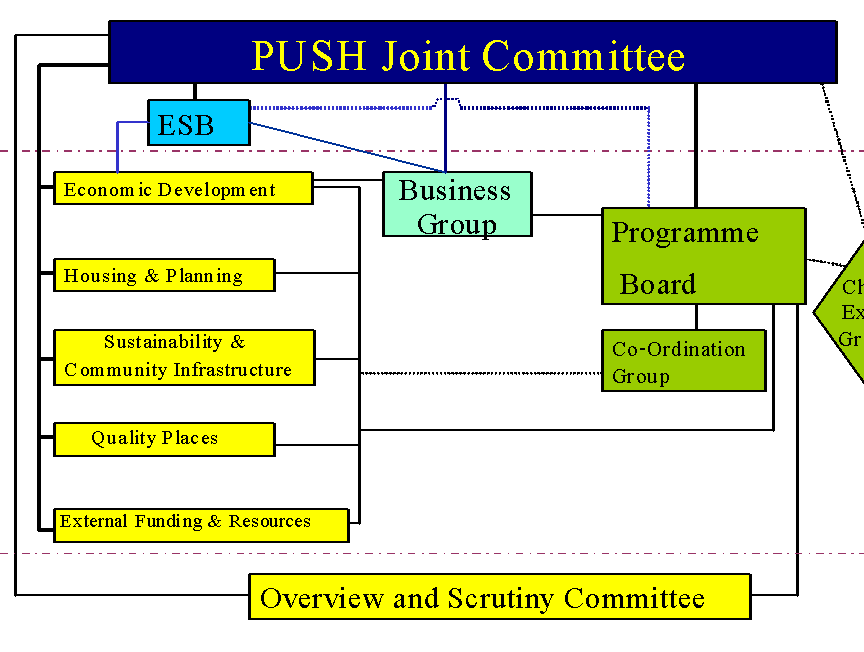

A
D
V
I
S
O
R
Y