
Archived decisions
HAMPSHIRE COUNTY COUNCIL
Decision Report :
Decision Maker: |
Buildings, Land and Procurement Panel | ||||
Date of Decision: |
30 June 2009 | ||||
Decision Title: |
Procurement Initiatives, Performance Assessment, Building Cost Trends and Approvals to Capital Repairs Programme and other miscellaneous approvals | ||||
Decision Reference: |
682 | ||||
Report From: |
Director of Property, Business and Regulatory Services | ||||
Contact name: |
Rebecca Thompson | ||||
Tel: |
6328 |
Email: |
|||
1. Executive Summary
1.1. The purpose of this report is to seek approval to a number of new procurement initiatives and provide Members with a summary of the performance analysis carried out for projects completed during 2008/9 and examples of the construction costs for a range of projects and programmes of work.
1.2. In addition, further to the acceleration of New Deal for Schools (NDS) funding earmarked for 2010/11 approved by the Department for Children, Schools and Families (DCSF) to support the local economy in time of recession, Appendix E sets out additional accelerated NDS and Corporate Risk Assessment schemes along with other miscellaneous approvals.
1.3. Issues Covered in Report
a) |
Allocation of funding for and procurement of survey work to provide CAD drawings, suitability and sufficiency data for schools and procurement of an asset management system (AMS) to store and provide access to a range of asset data. |
b) |
Selection and appointment of contractors through the Improvement and Efficiency South East (IESE) Tier 1 and Tier 2 frameworks to provide pre-construction services for: · the Early Years and Childcare projects in private, voluntary and independent (PVI) settings; · a programme of projects under phase 3 of the Children's Centres programme; · the proposed theatre project at Wildern School; · the proposed improvements to Basingstoke Library; and · the proposed improvements to the swimming pool area at Brune Park Community College. |
c) |
Negotiation of Phase 2 of the works to replace air handling units and associated lighting and fire alarm works at Winchester Combined Courts with Raymond Brown Construction Limited |
d) |
Various additional accelerated New Deals for Schools (NDS) and Corporate Risk Assessment schemes along with other miscellaneous approvals. |
e) |
Performance analysis for construction projects completed during 2008/9. |
f) |
Examples of construction costs for projects undertaken during 2008/9. |
2. Contextual Information:
2.1. The Executive Member for Policy and Resources approved on 9 April 2009 the annual review of construction related procurement for 2008/9 and a number of new initiatives to be implemented over the current financial year and beyond.
2.2. The completion of projects and programmes of work through framework and term contract arrangements ensures that schemes and programmes of work are delivered in a cost-effective way, involving closer working and collaboration with the construction industry which ensures continuous improvement in the County Council's services and enhances the quality of place in Hampshire.
3. Computer Aided Design (CAD), Suitability, Sufficiency and Asset Management and Planning System
3.1. On 16 October 2008, the Executive Member for Policy and Resources approved a proposal to procure an external supplier to undertake surveys to complete data collection (embedded into CAD files) inclusive of suitability and sufficiency data for all school sites where this is not yet available. Since October, these proposals have been developed and expanded to meet the anticipated requirements for improved data to support Building Schools for the Future (BSF) which will include collection of suitability and sufficiency data on secondary school sites. It is also now proposed to maximise the accessibility and efficient use of the collected data by procuring an Asset Management System (AMS).
3.2. These proposals are in line with central Government's agenda for improved asset management and planning and will allow the County Council to maximise the utilisation of the estate to support the objectives of Hampshire Workstyle and the BSF programme. The following paragraphs explain how investment now in improving data capture and management for the estate will facilitate significant revenue savings in the future and support effective prioritisation of capital expenditure.
3.3. Under the current Service Level Agreement with schools, the County Council made a commitment to provide CAD drawings of all schools by 2012. Provision of accurate CAD drawings will provide core base data on the school estate to support all future capital investment decisions and in particular, the major investment anticipated through BSF and the Primary Capital Programme (PCP). CAD survey drawings can now be more accurately described as a vehicle to contain data and make it more accessible via a graphical representation. This is an important distinction as it opens opportunities to add increased efficiency and accessibility to core data on our estate, across departments and schools.
3.4. In addition, a 2006 audit by the Department for Children, Families and Schools (DCFS) highlighted a lack of consistency in the suitability and sufficiency data collated for schools. This was attributed to schools undertaking these surveys themselves. To ensure that appropriate and consistent data is captured in the future to meet both the County Council's and DCSF requirements, Children's Services wish to implement a cyclical programme of suitability and sufficiency assessments. Suitability and sufficiency data can now be collected and embedded into CAD files and is one key example of how improved data collection and management can be achieved using CAD as a vehicle.
3.5. Property Services, in conjunction with Children's Services has explored a number of options for procurement of the survey work, including the use of existing consultant arrangements. However, due to the specific nature of the data requirements, it is considered that consultants who have experience in this particular field will provide the most effective service. It is therefore proposed to procure a single supplier framework arrangement to undertake the necessary surveys and data collection and to provide this data in a format which meets the County Council's requirements.
3.6. Data relating to the County Council's building assets is currently held on a number of different databases which have been developed over a period of time to meet data capture and reporting requirements. This has led to asset data being fragmented across a number of systems, making searching and reporting of the data complex and time consuming.
3.7. Market research has demonstrated that it is possible to procure an Asset Management System (AMS) which covers the range of operational areas of Property Services' business. An integrated AMS would allow the range of data collected on the built estate to be stored in a single location and accessed through a graphical (CAD drawing) format, providing a holistic view and improved search and reporting functions. The modular nature of these systems makes progressive development and adoption of a fully integrated AMS possible, ensuring that benefits are realised before moving onto the next stage.
3.8. Alternative solutions, including in-house development of a bespoke system and extension of SAP have been considered. However feasibility work has indicated that both of these approaches would be more costly and take longer to implement than procurement of an available AMS.
3.9. It is therefore proposed to procure a modular AMS through an OJEU tender process which allows progressive purchase, development and implementation of modules to meet the County Council's requirements. The first phase would include a tool for viewing the data captured from the suitability and sufficiency survey work identified above, allowing searching and reporting on data by Property Services, Children's Services and school staff.
3.10. Typically, AMS systems offer the option of integrated condition and structural inspection and recording regimes, which would be of benefits to the County Council. It is therefore proposed to procure this alongside the suitability and sufficiency module. Further requirements are currently being assessed to determine the scope for further development of the AMS and may include a central maintenance helpdesk.
3.11. In summary, these proposals for improved data capture and management systems will generate significant benefits and savings in the future and it is therefore appropriate to make the investment while the funding is available. Further detail on the expected benefits is provided in Appendix C.
3.12. It is estimated that procurement and implementation of the survey work and the supporting AMS modules for the suitability and sufficiency data will cost in the region of £1 million over a period of 3 years. This will be jointly funded by Property Services and Children's Services, with £500k of Policy and Resources Condition NDS funding identified and £500k to be allocated from the Children's Services Capital programme (subject to funding decisions in future years). The Executive Lead Member for Children's Services (Education) will approve £150k at his meeting in July for the first tranche of data capture work. A further £200k of capital repairs funding has been identified for procurement and implementation of further AMS modules to deliver integrated condition and structural inspections and exploration of other benefits an AMS could bring.
3.13. Other departments, including the Director of Culture, Community and Rural Affairs, have expressed an interest in taking part and contributing to this new system. There will be considerable benefits if a collective and co-ordinated line is taken to this initiative across our built estate. Progress on the procurement of the AMS will be presented to a future Panel meeting.
3. Early Years and Childcare Grant Funded projects in Private, Voluntary and Independent (PVI) settings
3.1. The Children's Services capital programme identified a total grant of £15.135 million for 2008/9 to 2010/11 to improve the quality of accommodation in early years and childcare settings, mainly those operated by private, voluntary and independent providers, to support the delivery of the Early Years Foundation Stage.
3.2. Property Services in consultation with Children's Services, is currently undertaking site assessment and feasibility work for up to 20 building projects to be funded under this workstream with a total construction value of approximately £7.5 million. A range of options for a cost effective solution are being considered, including the use off site fabrication as well as more traditional new build approaches.
3.3. It is now proposed to engage a contractor through the IESE Tier 1 or Tier 2 framework to work with the project team across a number of these schemes to further explore and market test these options and to provide pre-construction advice on buildability, risk management and programming for a pre-construction fee of up to £100,000.
3.4. Where a more traditional construction approach is required, it is anticipated that projects will be procured through the Tier 3 framework or competitive tender.
4. Children's Centres Phase 3
4.1. As detailed in the project appraisal found elsewhere on this agenda, work has been ongoing to develop the schemes identified under Phase 3 of the Children's Centres programme. A number of the schemes will be based on a common design approach with the aim of achieving efficiencies in design and procurement. To support the development of these schemes, it is proposed to engage a contractor through the IESE Tier 2 framework to work with the project team to provide pre-construction advice on buildability, risk management and programming and to lead the development of supply chains to maximise the benefits of the common design approach. It is anticipated that the pre-construction fee will be up to £75,000.
4.2. Of the remaining Children's Centre schemes, it is proposed to group a number of schemes into packages of work and procure these through the Tier 3 framework to achieve the benefits of a collaborative approach. A small number of schemes may be competitively tendered.
5. Wildern Theatre
5.1. As detailed in the project appraisal found elsewhere on this agenda, Property Services has been working with Children's Services and Eastleigh Borough Council to develop a scheme for a new theatre facility with associated support accommodation at Wildern School in Hedge End, with an estimated construction value of £3.3 million. Eastleigh Borough Council are due to approve the majority of the funding for the scheme in mid-June, following which it is proposed to appoint a contractor under the IESE Tier 1 framework to develop the scheme and undertake procurement prior to award of the construction contract. The anticipated pre-construction fee for this scheme is £30,000.
6. Basingstoke Library
6.1. Property Services is working with the Director of Culture, Communities and Rural Affairs to develop a scheme for improvements to Basingstoke Library. It is anticipated that this project will be procured through the IESE Tier 2 or Tier 3 framework, to enable pre-construction input to the project planning and programming by the contractor. The anticipated pre-construction fee for this scheme is £20,000.
7. Brune Park Community School - Swimming pool improvements
7.1. As part of the swimming pool strategy programme, a scheme is currently being developed at Brune Park Community School to provide new male and female changing facilities, viewing area, refreshments bar and office under a new feature roof construction.
7.2. The anticipated construction cost is £640,000 with a proposed contract commencement date of January 2010. Due to the anticipated contract value and possible complexity of the scheme, it is anticipated that the project will be procured through the IESE Tier 2 framework with an estimated pre-construction fee of £20,000.
8. Winchester Combined Court
8.1. In June 2008, Raymond Brown Construction Ltd, an IESE Tier 2 framework contractor, won a competitive tender for a £2.3 million contract to undertake work to replace air handling units and associated lighting and fire alarm works within courts 5 to 8 of Winchester Combined Courts. As part of the contract, Raymond Brown accommodated significant out of hours working, court closures and liaison with the Courts Service and Judiciary to successfully complete the works in January 2009.
8.2. It is now proposed to undertake the same works within courts 1 to 4 at an estimated cost of £2.2 million. As Landlord for the building, Hampshire County Council will contribute 7.5% of the cost of the works (£200,000) from the Policy and Resources Capital repairs budget, with Her Majesties Court Service contributing the remaining 92.5% (£2 million), which has been confirmed in writing. The Court Service and Judiciary have requested that Raymond Brown Construction undertake the Phase 2 works as they performed very well on the Phase 1 works, demonstrating an excellent understanding of the sensitive environment and working requirements of the courts. The contractor would retain the same personnel and sub-contractors who have all had the required security and Criminal Records Bureau (CRB) checks. This approach would also ensure that warranties of the services installations are maintained.
8.3. It is therefore proposed to negotiate the Phase 2 works with Raymond Brown Construction. This will allow the works to commence in August 2009 when court closures are possible due to planned holidays. The competitively tendered rates for the Phase 1 works, which included costs for the air handling units to courts 1 to 4, will be used as the basis for the negotiation.
9. Accelerated New Deals for Schools (NDS) Funding
9.1. As reported to the Panel in March, in December the Government, as part of their strategy to counteract the impact of the recession on the construction industry, asked local authorities whether any capital spending plans relating to schools could be brought forward from 2010/11 to 2009/10. Hampshire's response included a proposal to bring forward NDS Condition schemes of value £2.484m from 2010/11, which was approved. The County Council was also asked if it could accelerate further funds. A total of £5.131M accelerated NDS condition funding has now been confirmed. This is not additional funding, but reprofiled from 2010/11 to 2009/10. The Director of PBRS over 2009/10 will identify a strategy to manage the impact of a reduction in fee income for 2010/11 by adjusting local resources or increasing external income.
9.2. Appendix E identifies a number of accelerated NDS and Corporate Risk Assessment schemes in addition to those approved by the Executive Member for Policy and Resources in April.
10. Performance Assessment
10.1. Property Services operates a comprehensive system of performance management for all construction activities. This includes measurement of contractor, consultant and project team performance, client feedback and project performance, including cost and time predictability. Below is a summary of the performance results for a range of construction projects undertaken during 2008/9.
10.2. Major Projects
11.2.1 |
A total of 45 major projects with a construction value greater than £500,000 were completed by the department during the financial year 2008/9. 26 of these were procured through a framework arrangement, 7 were negotiated with preferred contractors and 12 schemes were procured through competitive tender. |
11.2.2 |
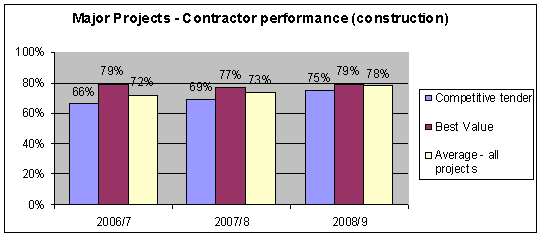
Key performance indicators (KPIs) are recorded for contractor performance during the construction phase for all major projects. The average KPI results for projects completed during 2008/9 compared with those for projects completed during 2006/7 and 2007/8 are shown below: |
| |
11.2.3 |
The KPI results for contractor performance on all major projects has improved slightly from last year's results, with a noticeable improvement in the results for the competitive tender sample and a slight increase in the best value results. |
11.3 |
Framework Projects |
11.3.1 |
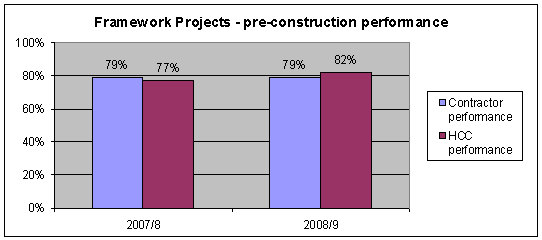
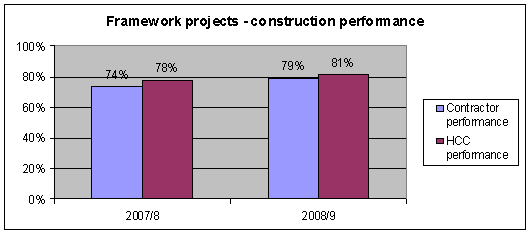
For framework projects, two way reviews are undertaken for both the pre-construction and construction phases, allowing the contractor to score the department's project team, in addition to the project team scoring the contractor's performance. These two way performance reviews facilitate an open and honest assessment of the project and identify areas where project processes can be improved in order to drive continuous improvement in both design and construction performance. |
11.3.2 |
Results for projects completed during 2008/9 compared with those for 2007/8 are shown below. |
| |
| |
11.3.3 |
The pre-construction KPIs for framework projects shows contractor performance consistent with 2007/8 and an improvement in the performance of the HCC project team. The construction phase KPIs results also show an improvement in the performance of Hampshire County Council's project teams and an improved contractor performance. |
11.4 |
Cost and Time predictability |
11.4.1 |
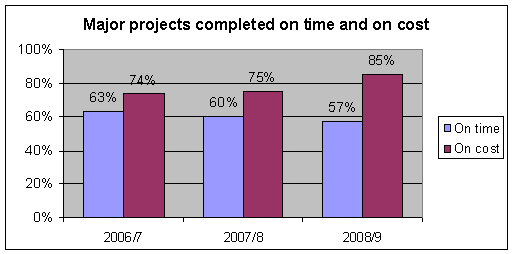
Cost and time predictability is assessed for all major projects. The chart below shows the percentage of major projects completed on time and on cost, allowing for extensions of time and cost variations, for the last three financial years. |
| |
11.4.2 |
Post contract reviews have highlighted than many of the delays on projects completed during 2008/9 were caused by issues with major subcontractors or poor subcontractor management by the main contractor. On the programme of Children's Centre projects which comprise 16 projects, delays occurred on the first 7 projects due to performance issues with the modular building sub-contractor. These issues were addressed by the project team in collaboration with the framework contractor and subsequent projects were delivered within the agreed programmes (or earlier). |
11.4.3 |
On the remainder of the projects procured through best value routes the delivery of projects within agreed programmes is generally much better than for competitively tenderer projects. This can be attributed to the early involvement of the framework contractor and key members of their supply chain, which allows them to contribute to the development of the project to mitigate potential programme risks and facilitates more detailed planning of the construction phase leading to realistic and achievable programmes. |
11.4.4 |
Risk management and supply chain development are areas which are being further developed under the IESE framework arrangements in consultation with the framework contractors. |
11.5 |
Medium and small value projects |
11.5.1 |
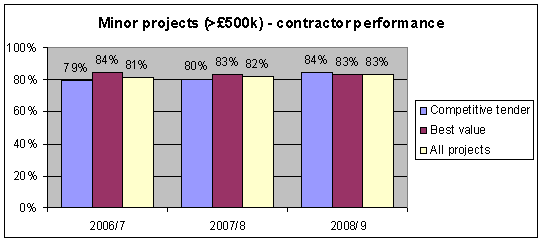
KPI scores for contractor performance are captured on all projects with a construction value less than £500,000. 340 KPI records were captured for projects completed during 2008/9, including 273 projects procured through competitive tender and 67 projects procured through best value routes. |
11.5.2 |
The competitively tendered sample comprises a wide range of projects, including those of low value and specialist works such as external decorations and roofing. The best value projects tend to be the higher value or more complex projects, which benefit from the early involvement of a contractor. The average KPI scores for projects completed during 2008/9, compared to those for projects completed during 2007/8 and 2006/7 are shown in the following chart |
| |
11.5.3 |
These scores indicate a very good level of performance from the department's contractors which is generally consistent with performance in previous years. Contractor performance is managed through the department's monthly Health and Safety Group meetings when any performance or health and safety issues are addressed and appropriate actions taken with the contractor concerned. In the case of a serious health and safety incident or very poor performance, this may include suspension from the Register of Contractors. |
11.6 |
IESE Tier 3 framework |
11.6.1 |
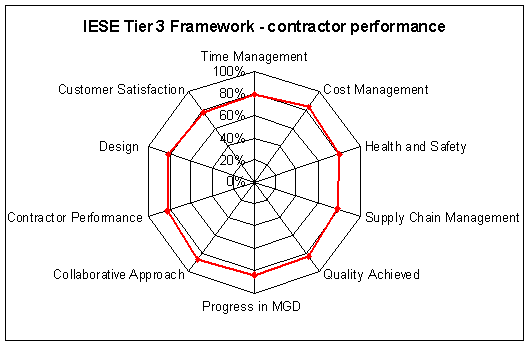
During 2008/9, 38 projects have been completed and assessed through the Tier 3 framework. 86% of these projects were completed on cost and 91% were completed on time allowing for additional funding approvals and agreed extensions of time. |
11.6.2 |
The average contractor KPI score for these projects is 82% which is similar to the scores for projects procured through the pilot framework in previous years. The average scores against the individual KPIs are shown in the radar chart below.
|
11.6.3 |
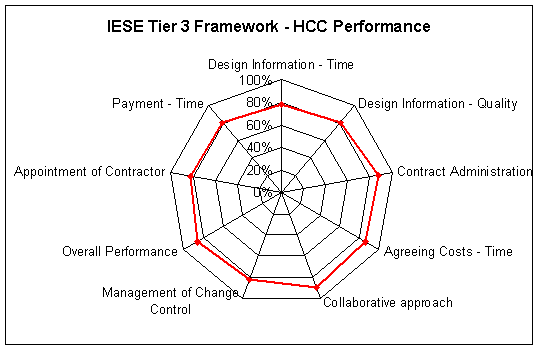
As part of the framework arrangement, the Tier 3 contractors are invited to provide KPI scores for the HCC project team. The average score for projects completed during 2008/9 is 84%, with the scores against each performance indicator shown on the radar chart below:
|
11.7 |
Client Satisfaction |
11.7.1 |
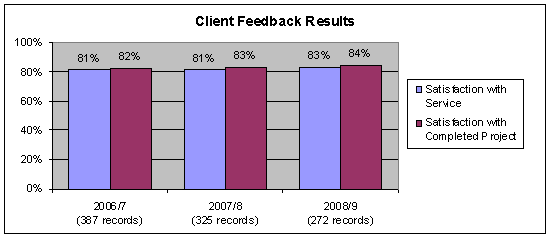
Client feedback is requested on all completed projects from the building occupier, end user or client department representative. The feedback includes an assessment of the satisfaction with the service received from the department and the satisfaction with the completed project. |
11.7.2 |
The results for feedback received during 2008/9 are slightly improved on the results for 2006/7 and 2007/8 and show a high level of satisfaction with the service received and the completed project. |
|
12. Benefits and Efficiencies
12.1 |
As reported to the Panel in March, the construction and asset management workstream of Improvement and Efficiency South East (IESE) is now delivering benefits through its construction frameworks to participating authorities across the south east of England. |
12.2 |
Analysis of the benefits achieved through the regional construction (Tier 1) framework has identified a total efficiency benefit of approximately £7.2 million delivered across all participating authorities during 2008/9. This includes over £5 million of added value savings to the contract sum achieved through early involvement of the contractor and procurement savings achieved through not having to follow a full OJEU procurement process for each project (where necessary). Further details of the benefits analysis is provided in Appendix D. |
13. Accruing Benefits and Efficiencies to Hampshire County Council
13.1 |
Participating in the IESE frameworks secures benefit for the County Council. The set up and management of the IESE frameworks was funded by IESE and by participating in the framework arrangement the County Council avoided the cost of replacing and managing its own major project framework arrangement. This equates to a saving of several tens of thousands of pounds in procurement costs and 0.5 FTE for a senior officer in ongoing management costs. |
13.2 |
In addition to the procurement and performance benefits derived from participating in the IESE framework arrangements, Property Services continues to seek efficiencies in the delivery of the County Council's capital programme by aggregating projects into programmes of work. For example, 16 of the projects delivered under Phase 2 of the Children's Centres programme used a modular building solution procured through a main contractor under the Hampshire Major Projects Framework. |
13.3 |
As noted in paragraph 11.4 there were clear improvements in project performance over this programme of Children's Centres, as lessons learned from the earlier projects were applied to the benefit of the later projects. This improvement was also reflected in the professional fees with a 12% reduction in the percentage of the target fee spent for the last nine projects when compared with the percentage of the target fee spent for the first seven projects. |
14. Building Cost Trends
14.1 Building cost inflation
14.1.1 |
The general trend of costs for the County Council's building projects are regularly monitored and benchmarked to demonstrate that they are delivering good value. Detailed building cost information is recorded for all significant capital projects and referenced to relevant comparators. One of the key comparators relates to construction inflation as identified through the indices published by the Department for Business Enterprise and Regulatory Reform (BERR) and the Royal Institution of Chartered Surveyors Building Cost Information Service (BCIS). The comparison of the County Council's projects is based on analysis of actual costs per square metre of floor area. It has been previously reported that there are increasing pressures on building costs in meeting the ever more stringent requirements of new legislation. This will continue particularly in the area of reduced carbon emissions where there is an increasing priority placed on the incorporation of sustainable technologies into the design and construction of the County Council's buildings to help mitigate the effects of climate change. These factors are adding to building costs but the benchmarking continues to show that inflation for the County Council's schemes has generally remained in line with reported inflation from BERR and BCIS, taking into account the additional requirements mentioned above. |
14.2 |
Schools Building Programme |
14.2.1 |
The Procurement Initiatives previously reported to the Panel identified the relationship between the cost benchmarks for school buildings identified by the DCSF (their publication entitled `Education Building Projects: Information on Costs and Performance Data' of April 2003) and County Council school building projects. |
14.2.2 |
It should be noted that the benchmark/guideline figures from the DCSF have not been revised since publication in 2003 and therefore do not fully reflect the changes in legislation which have impacted on building costs. There are also a number of exclusions in their costs and this makes it increasingly difficult for a like-for-like comparison to be made until such time as the DCSF updates the guideline figures. |
14.2.3 |
To overcome this difficulty a detailed analysis has been undertaken to enable a meaningful comparison to be made between the DCFS guideline costs and the costs of the most recently constructed new primary and secondary schools for HCC and shows the following outcome: |
_ DCFS guideline net cost (updated for new regs @ 4Q07 base) = £1,848/m² | |
_ HCC New Primary School net cost @ 4Q07 = £2,020/m² | |
_ HCC New Secondary School net cost @ 4Q07 = £1,933/m² | |
14.2.4 |
This exercise indicates that recently completed County Council projects complying with (and exceeding) the requirements of latest legislation, are on average within 5 -10% of the guideline costs. |
14.2.5 |
It should be noted that the DCSF Benchmark draws on real data from recent and past completed Schools. There is usually a `time lag' before the index catches up with the latest legislative requirements for school building design. In addition Hampshire's core brief for schools exceeds the minimum requirement of the DCSF benchmark, therefore additional specialist facilities such as IT Suites and Music/Drama spaces are included as standard. Both of these factors would go some way to explaining the small premium that the County Council experiences over the DCSF benchmark. |
14.2.6 |
A recent building cost benchmarking exercise has been undertaken. This work has enabled Hampshire County Council's building costs to be compared on a like for like basis with other authorities. The work is ongoing but current indications are that the County Council's building costs sit at the mid level of the benchmark data for schools projects |
14.3 |
Future Cost Trends |
14.3.1 |
The economy is currently in recession and the economic climate is having an impact on building costs. The downturn in the construction industry has generated a competitive market. The County Council is obtaining the benefits of the favourable market through both traditional competitive tendering and arrangements in place through the IESE frameworks. |
14.3.2 |
The current economic climate is generating mixed forecasts on the likely movement in Tender Price Inflation over the next five years. BCIS is forecasting a reduction during 2009 and 2010 with tender prices then increasing from 2011 onwards. |
14.3.3 |
BERR is forecasting a slowdown but not a reduction in Tender Price Inflation from 2009 - 2013. The likely outcome is that there will be very little movement over the next two years but with construction output and tender prices increasing from 2011 onwards. On top of this further additions to the Building Regulations, particularly in terms of carbon reductions and meeting sustainability expectations, will put additional pressure on costs over and above general inflation. The additional load on the construction industry in preparation for the Olympic Games in 2012 is still expected to increase construction costs by 1-2% over and above normal inflation in this region. |
15. Conclusions
15.1 The procurement decisions set out in this report comply with the Public Procurement Regulations 2006 and the Council's Contract Standing Orders. The proposals are also in line with the procurement model and strategy for building construction work approved by the Executive Member for Policy and Resources on 9 April 2009.
16 Recommendations:
That the Panel advises the Executive Member for Policy and Resources that:
1. The following proposals in relation to the procurement of suitability and sufficiency survey work and a modular Asset Management System be approved, subject to confirmation of additional funding by the Executive Lead Member for Children's Services (Education):
2. Allocation of £500,000 of Policy and Resources Condition NDS funding and £200,000 of Capital Repairs funding for the procurement of Computer Aided Design (CAD), Suitability and Sufficiency survey work and a modular Asset Management System (AMS), with a third of this funding to be committed during 2009/10.
3. Procurement of a single supplier framework to undertake Computer Aided Design (CAD), Suitability and Sufficiency survey work across the school estate over a three year period, at a total estimated cost of £850,000.
4. Procurement of a modular Asset Management System (AMS) with a current estimated cost of £350,000 be approved.
5. Selection and appointment of an IESE framework contractor to provide pre-construction services up to a maximum of £100,000 in connection with the early years and childcare grant funded schemes in PVI settings be approved.
6. Selection and appointment of an IESE Tier 2 framework contractor to provide pre-construction services up to a maximum of £75,000 in connection with up to six generic design projects under phase 3 of the Children's Centres programme be approved.
7. Subject to confirmation of funding from Eastleigh Borough Council, the selection and appointment of a contractor under the IESE Tier 1 framework to provide pre-construction services up to a maximum value of £30,000 in connection with the proposed theatre at Wildern School be approved.
8. Selection and appointment of an IESE Tier 2 framework contractor to provide pre-construction services up to a maximum fee of £20,000 in connection with the improvements to Basingstoke Library be approved.
9. Selection and appointment of an IESE Tier 2 or Tier 3 framework contractor to provide pre-construction services up to a maximum fee of £20,000 in connection with the improvements to the swimming pool area at Brune Park Community School be approved.
10. That the proposal to negotiate Phase 2 of the works to replace air handling units and associated lighting and fire alarm works at Winchester Combined Courts with Raymond Brown Construction Limited be approved.
11. The various additional accelerated New Deal for Schools (NDS) and Corporate Risk Assessment schemes along with other miscellaneous approvals as set out in Appendix E be approved.
CORPORATE OR LEGAL INFORMATION:
Links to the Corporate Strategy
Hampshire safer and more secure for all: |
no |
Corporate Business plan link number (if appropriate): | |
Maximising well-being: |
no |
Corporate Business plan link number (if appropriate): | |
Enhancing our quality of place: |
yes |
Corporate Business plan link number (if appropriate): | |
OR | |
This proposal does not link to the Corporate Strategy but, nevertheless, requires a decision because: | |
Other Significant Links
Links to previous Member decisions: |
|||
Title |
Reference |
Date | |
Procurement Initiatives, Performance Assessment, Building Cost Trends |
Item 3f |
23 July 2008 | |
Procurement Initiatives |
Item 3c |
16 October 2008 | |
Procurement Initiatives |
Item 1a |
29 January 2009 | |
Procurement Initiatives |
Item 1h |
9 April 2009 | |
Direct links to specific legislation or Government Directives |
|||
Title |
Date | ||
Section 100 D - Local Government Act 1972 - background documents | |
The following documents disclose facts or matters on which this report, or an important part of it, is based and have been relied upon to a material extent in the preparation of this report. (NB: the list excludes published works and any documents which disclose exempt or confidential information as defined in the Act.) | |
Document |
Location |
COMPREHENSIVE RISK & IMPACT ASSESSMENT: Appendix B
Race and Equality Impact assessment
Race and equality impact assessment has been considered in the development of this report and no adverse impact has been identified.
Crime prevention issues
The County Council has a legal obligation under Section 17 of the Crime and Disorder Act 1998 to consider the impact of all the decisions it makes on the prevention of crime. The proposals in this report have no impact on the prevention of crime.
Climate Change:
How does what is being proposed impact on our carbon footprint / energy
consumption?
No impact identified
How does what is being proposed consider the need to adapt to climate
change, and be resilient to its longer term impacts?
No impact identified
CAD, Suitability and Sufficiency and integrated Asset Management System (AMS) - Expected Benefits
Ref. |
Benefit |
1 |
Outputs from this project will allow PBRS to meet their SLA commitments with schools. The SLA is worth £6M over the period of the SLA, and failure to meet it would be a major loss of reputation for PBRS. |
2 |
Sufficiency data is a key aspect of determining a school's capacity and therefore that a school is fit for purpose both physically and for their budget allocation. Further, greater confidence in the sufficiency data will assist in robustly addressing expensive admission appeals. |
3 |
The reputation of the Children's Services and Property departments with the DCSF has been important in the past for becoming a path finder authority regarding the Primary Capital Programme (PCP) which is worth £9.44M in 2009/10. Similarly, the reputation and demonstration of accurate up to date data will assist with application for Building Schools for the Future (BSF) funding worth £100m a year for the next 10 years. Accurate data will allow demonstration of value for money by targeting money where it is most needed for any grants given. |
4 |
Setting up cyclic sufficiency and suitability assessments, linked to CAD drawings, appropriately using the processes used by the AMP surveys, will aid day-to-day management. Specifically: · Streamline data entry so data is updated once for all users by one person (currently data is entered 4 times into various databases and spreadsheets) · Negate the need for temporary staff to enter a backlog of data · Contributions from developers of housing projects within school catchment areas can be more confidently defined · Revenue budget allocations based on floor areas will be more accurate · Head teachers will sign off sufficiency and suitability assessments leading to acceptance of the data and less disputes |
When the outputs of this project are delivered there is substantial scope both by PBRS and Children's Services to exploit these facilities. Subsequent projects will realise further benefits and it will constitute a programme of work in the following areas where CAD drawings are used:
_ Caretaking and Cleaning Planning and Billing
_ Fire Surveys
_ Health and Safety Surveys
_ Condition Surveys
_ Projects - refurbishment, extensions and new build
_ Term Maintenance
_ Legionella Surveys
_ Feasibility studies.
_ Asbestos register production and maintenance
_ Reactive maintenance team
_ The provision of CAD drawings linked to an integrated database would provide us the opportunity to use the area information from the drawings to inform SAP/PALMS floor areas. This would be much more accurate than the current system where areas are manually updated by a paper update sheet provided by Caretaking and Cleaning.
As well as many other uses.
CAD drawings are well appreciated and heavily used by the Children's Services Department and by schools and are used for:
_ Asbestos surveys and Registers
_ Schools Appeals
_ Fire Risk Assessment
_ General Health and Safety Use
_ Space Planning
_ Fire Extinguisher Plans
As well as many other uses.
Appendix D
Benefits of the IESE Construction and Asset Management Framework (March 2009)
IESE has achieved some impressive benefits to date and has exceeded its efficiency targets for 2008/09.
Following the successful implementation of a regional construction framework in August 2007, substantial benefits have been identified and analysed.
To capture project benefits information, the framework contractors were issued with a `Cost, Time and Benefits Template' to record the costs and time information at four key project stages.
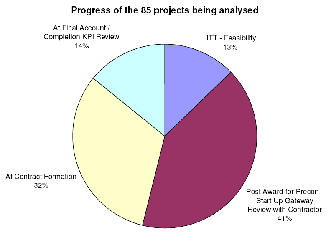 In addition, the template records the efficiency benefits that the framework contractors have brought to each project under two headings: `Best practice' and `added value'. Best practice represents benefits that the contractors would be expected to bring to a project fully complying with industry best practice. Added Value represents additional benefits that the contractor has directly brought to the project as a result of the collaborative two stage IESE process.
The Cost, Time and Benefits Reports have been received for 80 of the 85 projects.
Improvement
Improvement benchmarking is at an early stage, given the limited scale of completed projects. Results to date are impressive however and are given overleaf.
Firstly, analysis of the data has been carried out to identify cost and time predictability. This is based on the percentage change of cost and time between construction formation and final account including additional project / client change orders. This analysis is illustrated by the diagrams overleaf.
Cost
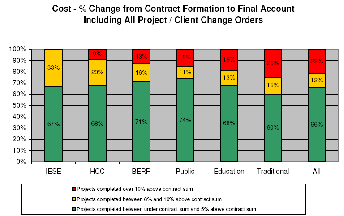 The data identified that all IESE projects have been completed within 8% of the contract sum. This compares against the other data sets which identify between 9% and 25% of projects are completed over 10% above the contract sum.
The data received has been compared against Hampshire County Council's projects procured through a traditional competitive tender data, BERR all public projects (non-housing) data and industry data sourced by Davis Langdon.
Time
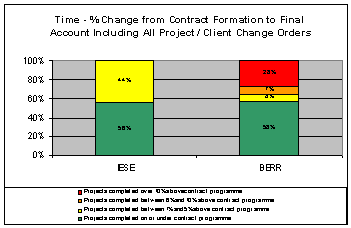 The data identified that all IESE projects have been completed within 5% of the contract programme. This compares against BERR data set which identifies 35% of projects are completed over 5% above the contract programme.
Critically, the above data includes the effect of all project / client change orders. Whilst data is at an emergent stage, the above figures support the assertion that the IESE process delivers improved project certainty and reduces the cost of project change.
Quality
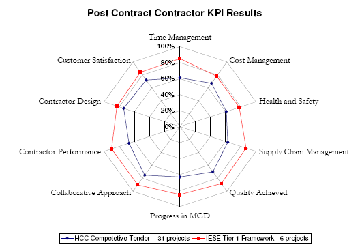 In addition, Key Performance Indicator (KPI) scores have been collected for contractors' performance on completed IESE projects.
The IESE projects data identifies a 28% improvement over scores received for completed Hampshire County Council projects which were procured through a traditional competitive tender.
The Hampshire projects comparator represents lower value and risk projects. It is anticipated that inclusion in the future of more relevant comparators may indicate lower scores and therefore a higher improvement for IESE delivered projects.
Efficiency
An analysis has also been carried out on the Efficiency Benefits section of the reports issued from each project. The analysis is currently at project verification stage.
In terms of reporting benefits realised to date, a confidence rating of 50% has been applied to the Added Value benefits total. Best Practice benefits have not been considered at this stage, although some may be included following project verification. This produces an estimated benefits realised figure of £5.2M.
In addition to the project benefits recorded, procurement process savings have been achieved though not having to follow the OJEU procurement process for each project. This has been calculated as an average project process saving of £75,000. This is applied to the 20 projects procured to date this year and produces a total process saving of £1.5M.
The total efficiency benefit delivered to date in 2008/09 is the sum of the project and process benefit figures given above - a total sum of £6.7M. This is expected to steadily grow to approximately £7.2M by the end of the 2008/09 reporting period.
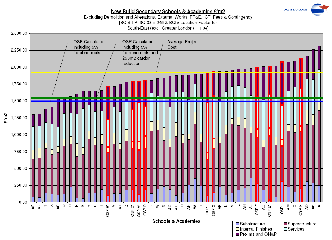
IESE is currently undertaking a Cost Benchmarking Review to research and measure IESE project cost efficiency against industry norms. This will focus on primary schools, secondary schools and civic offices. The chart below illustrates secondary school benchmark data that has been produced to demonstrate that IESE One School Pathfinder (OSP) schools are at the same cost level as comparative secondary schools whist including the quality and cost/time predictability benefits highlighted overleaf.
 IESE was assisted in the compilation of the above benefits and benchmarking exercises by Davis Langdon and Currie and Brown.
Finally, the supply chain team has completed the first phase of the SAVE Initiative. This is a procurement aggregation project, promoting design commonality and exploiting volume leverage across project programmes for key construction commodities.
This has focused on IESE's One School Pathfinder programme of 10 schools. This will itself act as a pathfinder for IESE wide application of the SAVE procurement initiative.
Phase One of the SAVE Initiative has now been completed which involved an initial approach to potential suppliers. Potential savings have been calculated at approximately £3.5M. Phase Two will aim to develop these approaches and maximise the volume benefit of wider IESE potential workload.
Examples of opportunities already identified include:
_ Floor coverings - 25% saving
_ Multi Service Light Rafts - 25% saving
_ FF&E - Up to 10% saving by utilising Hampshire / Kent CC's purchasing power.
Appendix E
Additional Accelerated New Deal for Schools (NDS) and Corporate Risk Assessment (CRA) schemes
School |
Works |
Value £000 |
Schemes £50k-£100k |
|
|
Hardley School |
Main Block - windows |
90 |
Cranbourne Secondary |
Replace lighting |
50 |
Robert Mays |
Replace lighting |
50 |
Peterfield Secondary |
Replace calorifier & water service pipe work |
55 |
Brookfield School |
Boiler Replacement |
60 |
Various Secondary Schools |
Various minor mechanical replacements / upgrades |
62 |
Anstey Junior |
Boiler Replacement |
80 |
|
|
|
Schemes £100k-£250k |
|
|
Ropley Primary School |
Replace sewage treatment plant * |
75 |
Winklebury Infant |
Re-roofing |
125 |
Various Primary and Special schools |
Re-roofing |
100 |
Various schools |
Contributions to Capital schemes |
100 |
Ringwood School |
Main Block - Reroofing |
200 |
Hayling College |
Main Block - Reroofing |
200 |
Romsey School |
Main Block - Reroofing |
200 |
Hardley |
External repairs and decorations |
175 |
Testbourne |
External repairs and decorations |
110 |
Westgate |
External repairs and decorations |
110 |
Brune Park |
Mechanical services |
200 |
Amery Hill Secondary |
Boiler Replacement |
130 |
Neville Lovett |
Boiler Replacement |
100 |
Various Primary Schools |
Various minor mechanical & electrical replacements / upgrades |
195 |
|
|
|
Schemes £250k-£500k |
|
|
Various Primary and Special schools |
External redecoration |
370 |
|
|
Portchester Library - Additions to the previously reported scheme
The re-roofing of Portchester Library was included in the landlord's capital repairs programme for 2008/09 and reported to the Panel in April 2008 under the £250,000 category. It was tendered in November 2008 but on receipt of tenders there was an issue with the amount of time required on site to undertake the works, and Library Services also indicated a desire to undertake a refurbishment. As both would require a library closure, it was decided to amalgamate and re-tender the roofing works with the refurbishment works. At that point the opportunity was also taken to include some 2009/10 landlords capital repairs funding in the refurbishment so that maintenance items could be addressed at the same time.
The refurbishment involves decoration, new floor finishes, new fire alarm, staff kitchen area and alterations to form a learning room from an existing office. No significant alterations or structural work is required. A new counter and furniture will be provided direct by Library Services from their funding at an additional cost of £20,000.
The roofing work requires some structural strengthening not originally anticipated and the estimated cost of this additional work (£28,814) will be met from savings in the landlords 2009/10 capital repairs programme already achieved .
The scheme went out to tender the week commencing 1 June 2009 with a planned start on site date of 10 August, completing on 6 November. The library will be closed from 3 August to allow for strip out and reopening in mid November.
The breakdown of funding and current estimate is as follows:
Estimate |
Funding |
||
Roofing |
£213,314 |
£184,500 |
P&R Capital Repairs 2008/09 |
£28,814 |
P&R Capital Repairs 2009/10 | ||
Refurbishment |
£93,634 |
£43,000 |
CCRA 2008/09 Capital Programme |
Library refurbishments (excludes16.5% fees) |
£25,000 |
P&R Capital Repairs 2009/10 | |
£2,500 |
CCRA Hampshire Learning | ||
Total |
£307,448 |
£283,814 |
The Director of Culture, Community and Rural Affairs would prefer the lighting to be replaced. However, the current estimate of cost would indicate that funding would be insufficient to cover this. The proposal is therefore to obtain tender prices on the basis that a good tender may allow this work to be included. If the result is successful, the replacement lighting will be included in the contract.