Hampshire Fire and Rescue Authority Human Resources Committee Item 8 3 July 2009 Project & Programme Management (PPM) |
|
|
1 |
Summary |
|
|
1.1 |
Hampshire Fire & Rescue Service (HFRS) is in the midst of a great deal of change. Some of this is generated through external mechanism (such as the Regional Control Centre (RCC) Project) whilst other innovations are the result of internally generated change projects (such as Efficient and Flexible Crewing (EFC) and the Workforce Strategy Management Information (WSMI) Projects). Additionally, there are significant numbers of activities, meeting and boards that sit within the 4 Directorates to manage both `business as usual' and transformational activities. The result is a complex set of meetings and management arrangements, which are primarily Directorate based and with little or no means of cross referencing across boundaries. There is an inherent risk of both duplication of effort and of failure to make essential connections across development areas. |
|
|
2 |
RecommendationError! Bookmark not defined.s |
|
|
2.1 |
That the Human Resources (HR) Committee endorse the introduction of Project & Programme Management (PPM) as the primary methodology of managing transformational change activities. |
|
|
2.2 |
That the HR Committee endorse the proposal to set up a Programme Office to oversee programme activities and provide specialist support, guidance and advice on change management, organisational development (OD) and PPM. |
|
|
2.3 |
That the HR Committee endorse the proposal to employ a Programme Manager and Programme Facilitator/Administrator from April 2010. |
|
|
2.4 |
That the HR Committee endorse the proposal to establish a virtual OD Network to support transformation activity and to best utilise specialist skills, knowledge and experience in successfully managing change. |
|
|
3 |
Introduction Error! Bookmark not defined.and Background |
|
|
3.1 3.1.1 |
Current Processes The Service currently uses project management methodology. This is primarily aligned to the `PRINCE 2' methodology and provides and effective mechanism for managing single projects. Many of these projects also have multiple work streams, and again the methodology does provide a suitable mechanism for the management of these activities. The service has a number of staff who are formally trained in the PRINCE 2 methodology with varying degrees of experience. Many other managers have experience of operating in a Project Environment, but do not have any formally recognised qualifications. |
3.1.2 |
Over recent years, systems for managing increasing complexity have been established. These were well considered and were fit for purpose at the time of introduction. A brief analysis of these would indicate that they are almost exclusively Directorate based. Even where this is not the case, the identity of the project Executive/Senior Responsible Owner (SRO) quite often dictates how the project is seen by the organisation (ie; Operational if Dave Curry is SRO, a HR initiative if Geoff Howsego is SRO, etc). |
3.1.3 |
A list of some of the key projects being undertaken by the service at present are listed at Appendix A. This list is not exhaustive, but provides a indication of the number and variety of current development activities and the different methodologies being used to manage them. |
4 |
The Proposal to move to a PPM Approach |
|
|
4.1 |
In broad terms, the concept behind PPM, is that all development work aligned to deliver or contribute to a desired outcome is managed under a single governance system - normally through a Programme Board. This Programme will typically consist of a number of projects, each normally with its own inputs/output/deliverables, but with a goal that was common to the programme. This differs from a `portfolio approach' which seeks to group similar projects together for administrative ease, but each having it's own desired outcome which may differ from the others. |
|
|
4.2 |
Given the size, complexity and number of projects that are currently underway and planned for the future, a more effective way of managing our development would appear to be needed. There is evidence that our current management processes do result in duplication with meetings taking place with similar membership and similar agendas (these include a number of meetings that currently support the previous Workforce Strategy). There is also evidence of similar projects being commissioned but with no formal mechanisms to tie the areas where cooperation might be beneficial together (these include the Duty Systems Board and the Part-time Working Project). Finally, there is a real risk that work conducted in separate projects will either affect each other or rely on each other but with no formal relationship between them (these include the WSMI, Retained Duty System and Efficient & Flexible Crewing Projects). |
|
|
5 |
Benefits |
|
|
5.1 |
The potential benefits of moving to a PPM methodology should include the following: a. Clearer governance arrangements. b. Reduced numbers of meetings. c. Standardised systems, language, paperwork and ways of working held provide consistency of approach. d. Risk registers, issues logs, timelines, inter-dependencies, benefits realisation and evaluation applied more effectively across transformational change activities. e. Reduced risk of duplication, conflicting agenda's and lost opportunities. f. Improved resource management. g. Improved strategic oversight. h. General improvement in change management.
|
|
|
5.2 |
There will clearly be some issues and costs to resolve. The setting up of an organisational wide PPM structure will require a considerable amount of effort, clear ownership and direction from the top, a well constructed development programme and supported cultural change. The development programme should ideally be structure to provide role focused learning aimed at administrator/facilitator, manager and SRO functions. The cultural change will be manifested a changing of emphasis around leadership and management. The SRO will take executive authority to deliver the programme outcomes, and this may, and is perhaps probable, cross over existing organisational boundaries. This matrix management approach exists to some extent within the organisation, but PPM would embed this in a more fundamental way. |
|
|
5.3 |
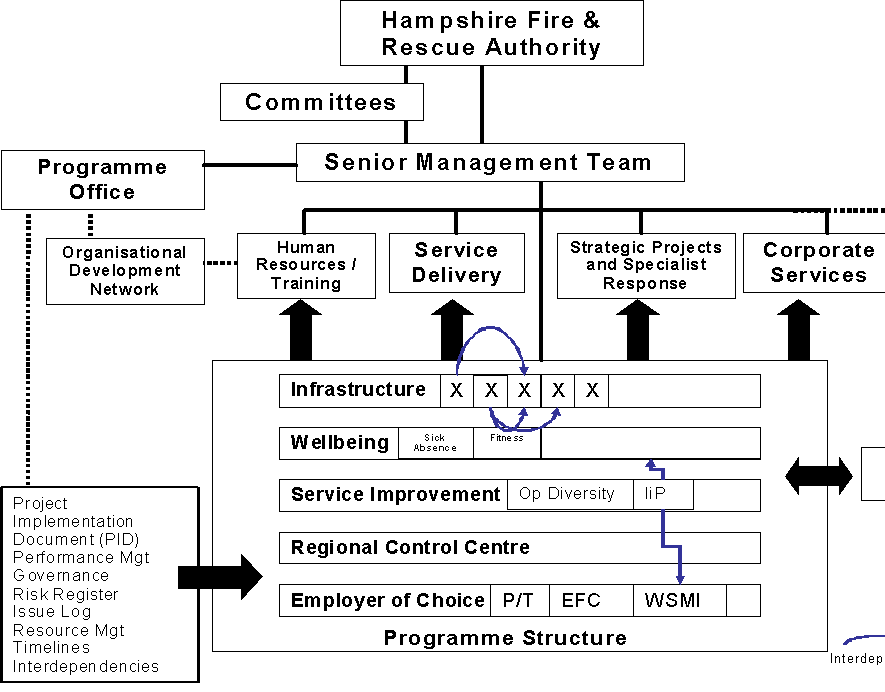
In order to contextualise what a PPM structure might look like, a schematic has been produced at Appendix B. It must be stressed that this is for illustrative purposes only, and is not intended to propose programme themes. However, structure is a reasonable proposal and if adopted, it is likely that we would be looking to use such an approach. |
|
|
5.4 |
If agreed, the first key milestone would be the appointment of a Programme Manager who would head up the Programme Office. Given the need to buy in this level of expertise, we would ideally expect to appoint the post holder before making any detailed plans to implement PPM. This in effect would be the main role of the post holder and we would be looking for someone with key skills and experience in introducing PPM to organisations. This person would essentially be a change agent. However, the budget position for this year is very tight, with a lot of competing demands being placed upon it. It was therefore agreed by Directors that funding for these posts would be put back to April 2010. Whilst this is clearly not ideal and will delay us significantly, it will give us time to make preparations for this significant piece of work. |
|
|
6 |
Contribution to Corporate Aims and Objectives |
|
|
6.1 |
The move to PPM would be aligned to the Fire & Rescue Service Plan. The PPM structure would be fed by the organisational objectives that it produces. One of the roles of the Programme Manager would be to work with the Senior Management Team (SMT) to explore where and how each new objective can best be delivered. Depending on the nature and scale of these objectives, they may form a programme of their own, be combined with each other or existing projects to form a new programme or fit into an existing Programme as a project. |
|
|
7 |
Risk Analysis |
|
|
7.1 |
There are risks associated with maintaining our existing system of change management. These were explored in para 4.2. In brief these are: a. Our current management processes can result in duplication of effort. b. Similar projects may be commissioned but with no formal mechanisms to cooperation where this might be beneficial. c. Work conducted in separate projects that will either affect each other or rely on each other may be commissioned but have no formal relationship between each other.
As a result there is a risk that resource management may be sub-optimal. |
|
|
8 |
Resource Implications |
|
|
8.1 |
Human Resources |
|
|
|
There will be additional staff required to support this initiative. At present the staffing requirement is assessed as follows: The plan would be to initiate a recruitment exercise to enable the successful applicant to take up post on, or around, 1 April 2010. The expectation would be for the post holder to then design and implement a change plan to introduce PPM. A key part of that would be for them define the role of the and Programme Administrator/Facilitator and be the key player in their recruitment. |
|
|
8.2 |
Physical Resources |
|
|
|
There will be some physical resources required. Primarily these will be office space, desks/chairs & relevant equipment. |
|
|
8.3 |
Information and Communications Technology Resources |
|
|
|
Both members of staff will need full access to the HFRS intranet, with suitable computers. It would also be a reasonable expectation that the Programme manager would require a mobile phone or `Blackberry'. The Service currently has access to `Microsoft Project', which is a common and well used piece of software designed to support effective project management. It is anticipated that this would be the prime software to be utilised to support PPM. However, once in post, we would expect the Programme Manager to evaluate it's effectiveness and advise the Service accordingly. |
|
|
8.4 |
Financial Implications |
|
|
|
The costs of the additional staff required to support this initiative are assessed as follows: a. Programme Manager - £65,000 b. Programme Administrator/Facilitator - £22,000
The total cost of £87,000 is based on current salary levels (including on costs) and the market availability for these type of skilled individual, and have been subject to the Services formal job evaluation process. It should be noted that the above allocation would need to be reviewed in setting next years budget. We anticipate that these costs will be drawn from the contingency funds. The cost of IT equipment is estimated as follows (based on current costs): c. Initial purchase: £800 d. Ongoing annual maintenance: £1800
The costs of ICT will be delivered from efficiency savings. |
|
|
9 |
People Impact Assessment |
|
|
9.1 |
If approved, a PIA will be completed. |
|
|
10 |
Conclusion |
|
|
10.1 |
There is evidence from research that over 70% of change initiatives fail. HFRS is engaged in a wide variety of transformational activity, some of which could have significant benefits for our delivery of services. Whilst our current systems and processes have in the past met our needs, it is becoming increasingly clear that with the increase in quantity, size and complexity, the risks to the success of these activities is increasing. The use of PPM as a methodology to better manage the complexity of change has been tried and tested in a variety of organisations such as Ordnance Survey and most Government Departments. This approach has the potential to bring significant benefits to HFRS. |
|
|
Background Information (Section 100D of Local Government Act 1972) |
|
|
The following documents disclose the facts or matters on which this report, or an important part of it, is based and has been relied upon to a material extent in the preparation of the report: None Note: The list excludes: (1) published works; and (2) documents that disclose exempt or confidential information defined in the Act. |
Development Activities
Development Activity Management Lead/SRO
Efficient & Flexible Crewing Project Board Dan Tasker/Dave Curry
Workforce Strategy
Management Information Project Board Neil Moore/Geoff Howsego
Part-Time Working Project Board Lorraine Hearnden/Steve Hamm
Workforce Wellbeing Strategy Board Various/Geoff Howsego
Regional Control Centre Project Board Ingrid Leonard/Alan House
Stand-by Allowances Project Board Lorraine Hearnden
Retained Duty System Strategy
(including Retained Management
System) Project Board Shaun Rowlatt/Geoff Howsego
Engagement & Participation Direct Management Shanti Waas/Geoff Howsego
Volunteers Direct management Steve Hamm
`Hydra' (Hydrants) Direct management Andy Kettle
Road Risk Group Working Group Andy Bowers
Co-responder Scheme Working Group Rob Cole/Bob Ratcliffe
Introduction of Hornbill (IT) Direct Management Neil Moore
Introduction of Hornbill (HR) Direct Management Peter Walsh
Talent Management Direct Management mark Rayner/Geoff Howsego
Rank to Role (Control) Working Group Lorraine Hearnden/Andy Kettle
Regional Investigation Team Direct Management Steve Quinn/Steve Hamm
Regional HazMat/DIM* Team Direct Management Pete Crook/Steve Hamm
Equality Standard for Local
Government Level 4 Direct Management Kathy Bowden-Ellis/Geoff Howsego
Diversity Liaison Officers Direct Management Ami Sidhu/Steve Pegler
National Animal Rescue Forum Direct Management Bob Ratcliffe
Review of Vacant Office Space Direct Management Bob Ratcliffe/Alan House
Review of Occupational Health
& Welfare Direct Management Keely Stafford/Geoff Howsego
Review of Fleet Management Project Board Elected Members
New Front Line Vehicles Project Team Andy Kettle/Dave Curry
Introducing Mobile Community
Contact Point Direct Management Mick Crennell
New Winchester Fire Station Project Board Bob Ratcliffe/David Howells
Community Self Help Programme Board Bob Ratcliffe/Dave Curry
Review of Delivery (Botley, etc) Programme Board Steve Hamm/Dave Curry
Water Safety Strategy Project Team Bob Ratcliffe
Equal Pay Working Group Lorraine Hearnden/Geoff Howsego
Social Media Direct Management Charlotte Woodward/Emma Apter
Directorate Review External Consultancy John Bonney
Operational Risk Information Direct Management Kev Butcher/Dave Curry
ICS Training Direct Management Mark Raven/Mark Rayner
New Fitness Standards Direct Management Jess Andrews/Keely Stafford
Devolved Budget Holding Trial Steve Pegler/ Wendy Lambert
* HazMat/DIM - Hazardous Materials/Detection, Identification and Monitoring
APPENDIX B