Archived decisions
Agenda item: 7
HAMPSHIRE COUNTY COUNCIL
Decision Report
Decision Maker: |
Pension Fund Panel | ||||
Date of Decision: |
8 July 2009 | ||||
Decision Title: |
Economic and Financial background | ||||
Decision Reference: |
811 | ||||
Report From: |
Independent Adviser | ||||
Contact name: |
Harvey Cole | ||||
Tel: |
01962 865930 |
Email: |
|||
1. Executive Summary
1.1. The following are the thoughts of the Independent Adviser on what can be discerned of the economic and financial scene as 28 October 2008.
2. Background
2.1. In preparing this report, my starting point was to look at the analysis I made for the Panel meeting of 3 March 2009 so as to pick up the threads and pointers of what is a continuous process rather than making a static analysis starting from today.
2.2. At the risk of overloading members' reading time, I suggest that the scene may best be set by looking through that report, particularly pages 1 - 4 as the conclusions put forward there act as a suitable introduction today.
3. Green overshooting
3.1. Almost every ancient society had ways of trying to explain unusual natural events and to forecast the future. The rituals varied from analysing heavenly happenings such as eclipses and the appearance of comets, to assessing the mood of the gods from thunderstorms and earthquakes and investigating the entrails of sacrificed animals to decide whether the auspices were favourable to a planned undertaking such as an armed attack on a neighbouring tribe or state. Oracles were consulted - and attempts to understand the ambivalent nature of the two-tongued answers to questions about the future led to many a disaster.
3.2. Today we have the belief in green shoots. These are of course not actually visible: if they were they would continually be dragged up by the roots to assess their progress. Their presence is inferred or assumed - or denied.
3.3. In the present crisis their appearance has been detected by some since the early spring and their claims have been spreading like an economic pandemic as more and more people have been persuaded that they can see them too.
3.4. However, it is still too soon to be sure we are not dealing with yet another version of the emperor's non-existent new clothes.
3.5. When an economy or a financial system goes into virtual free-fall, the downward momentum almost always takes it temporarily below a potential stabilising point. So a `bounce' will occur, and it can be quite sharp. The process is easy to understand. If you are a car dealer and demand from your customers dries up, you will prudently reduce orders placed with your suppliers. After the effect of this works its way back to the factories, manufacturers will find stocks piling up, and you get all those photographs of hundreds of acres covered with unsold cars at the docks and in fields. Output of new cars falls to a trickle.
3.6. Indeed, a given fall in sales will tend to reduce production by a substantially larger proportion: a 50 per cent drop in UK sales led to some factories closing their entire capacity for several weeks.
3.7. Eventually, stocks fall to a level which is too low even to support a much reduced volume of sales. Production then has to respond by turning up. The statistical impact can be dramatic. If Honda goes from turning out 1,000 cars a week to 10,000, the percentage effect is a rise of 900 per cent. With the growing fad to report changes in economic statistics on the basis of the effect `month-on-month' or `year-on-year' (instead of by showing a continuous trend - something I deal with in an Appendix - there is then an apparent very sharp boost in activity.
3.8. This easily becomes self-reinforcing. Another piece of conventional wisdom is that the stock market has an instinctive ability to forecast the end of a downturn (or an upturn) six months or so before it actually occurs. Seizing on this, commentators then conclude that if share indices are rising recovery must be round the next corner. The faster shares then rise, the more this is taken as confirming that the bad times are virtually over. Hence the widespread assumption increasingly heard over the past few weeks (some from surprisingly cautious quarters) that the recession is virtually over.
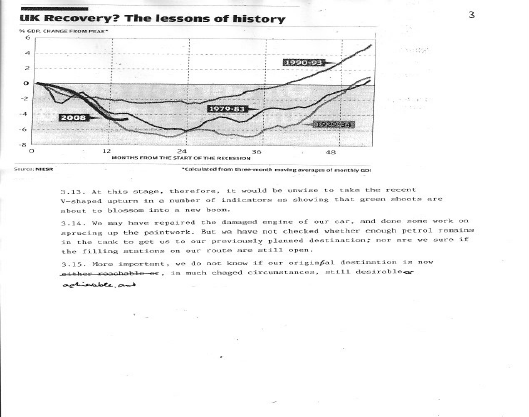
3.9. This has been yet further compounded by commentators (who normally remind their readers that `past performance is not necessarily a guide to the future') analysing the pattern of past recessions to determine the length of this one. By taking an average of the pace and length of declines in 1979-83 and 1990-93 they have been able to proclaim that the very small upturn in output provisionally calculated for the first quarter of this year marked the bottom.
3.10. While this may possibly turn out to be correct, it does ignore the fact that this recession is different from any predecessor since 1929. It is a combination of a financial collapse and an economic slowdown, which normally takes much longer to reverse than either taken separately: it has been virtually world-wide instead of concentrated in one country or a group, and, whatever is currently happening, the construction of a firm new set of foundations for the international banking system is neither completed nor assured.
3.11. If the past is indeed to be taken as some sort of guide to the future, analysts would do well to note that the recent upturn shown in the accompanying chart is precisely matched by a similar apparent blip at exactly the same stage of the 1979-83 recession - which then resumed its descent for 12 more months, dropping by a further 2 per cent of GDP in the process.
3.12. More ominously perhaps, in the Great Depression of 1929, the Dow Jones index rallied four times by 20 per cent or more between then and 1932 - subsequently falling to a new low on each occasion.
3.13. At this stage, therefore, it would be unwise to take the recent V-shaped upturn in a number of indicators as showing that green shoots are about to blossom into a new boom.
3.14. We may have repaired the damaged engine of our car, and done some work on sprucing up the paintwork, but we have not checked whether enough petrol remains in the tank to get us to our previously planned destination; nor are we sure if the filling stations on our route are still open
3.15. More important, we do not know if our original destination is now achievable and in much changed circumstances, still desirable.
4. Inflation, deflation - or just flation?
4.1. In these highly uncertain times it is probably wise not to stick one's neck out very far. But I am tempted to make one unqualified assertion. Given the sheer quantity of money that has been flung into the yawning chasm of bank deficits and what have been, in effect, overgenerous loans against what are still highly toxic impaired assets, the danger of the kind of deflation that ensured the length and depth of the 1929-37 depression is virtually ruled out. (A virtual qualification after all!)
4.2. This means that policymakers, walking on a tightrope between deflation on their left and inflation on their right, are more likely to topple off to the right.
4.3. Some of the fears that the huge sums of money being raised by governments all over the world could lead to a dramatic rise in inflation as these debts have to be repaid may actually be exaggerated.
4.4. Certainly, the repayment of these loans (which on average will raise the national debt of the main developed countries by around 40 per cent of GDP by 2012) will absorb an increase of around 4 per cent of the share of output allocated to debt redemption to reduce it to more sustainable levels. That creates the temptation to meet at least part of the cost by inflating it away, cutting the real cost.
4.5. Given that most of these economies will also be trying to raise savings and investment; and increase exports (with the exception of Germany and Japan) the outlook for private consumption growth is bleak.
4.6. At the same time, governments still have to grapple with the Keynesian paradox: in a situation where consumption has been outrunning capacity, it is to the advantage of each individual (indeed they may have little choice in the matter) to cut back on spending. But if this becomes the universal response, the resulting drop in demand will not simply reduce it to match capacity, but force it down to the point where cumulative effects set in and unemployment starts to rise exponentially.
4.7. It is the role of the state in those circumstances to sustain general demand, which is why the stimulus needs to be directed to such things as improving the national infrastructures rather than just putting extra spending power directly into people's pockets. But inflation, even if deliberately induced, can get out of control.
4.8. As the great Ogden Nash put it:
When getting ketchup out of a bottle
First you get a little; then you get a lottle.
4.9. Alarm has been expressed about the sharp rise in interest rates on government bonds, notably in the US and the UK. It is suggested that this indicates that the market was afflicted by fears that finance for private industry would be `crowded out' and that prospects of sharply rising inflation further ahead were gaining ground.
4.10. In fact, interest rate movements are pointing to expectations of inflation remaining at moderate levels. In December, when apprehension of significant deflation was at its height, the differential between US 10-year bond yields and those on US Treasury inflation-protected bonds fell to a level projecting inflation at virtually zero. Although the 10-year issue has since risen from just over 2 per cent to touch 3.9 per cent, TIPS have come off the floor to show 1.8 per cent. Implied inflation is therefore now within a 1.5 - 2 per cent range, which is both normal and healthy: it indicates a returning appetite for risk in the private sector; reduces the spectre of deflation, and looks ahead to eventual resumption of growth.
4.11. Similar trends have been affecting interest rates in the UK. It might also be noted that, in spite of frequent suggestions in the early days of the crisis that Britain was entering it in worse shape than any other major country, the gross national debt was lower than in the US, Japan, Germany, France, Italy and Spain, while the current budget deficit was below that of almost all EU countries. And, in spite of the very sharp increase expected in the ratio of national debt to GDP in 2014, Britain's figure will still be 18 per cent below that for the US and lower than in France, Germany, Italy and Japan.
4.12. At the more mundane level, retail prices in this country remain muted. The recent relative strength of sterling (often overlooked, but it has risen over 20 per cent against the dollar since early this year) has offset a large part of the resumed upward trend in commodity prices, including oil, while enormous cuts in mortgage interest rates have substantially cushioned the remaining impact of inflation for those with the `right' type of loan.
4.13. The much derided temporary cut in VAT has also played a useful part in sustaining retail sales. The proof is that those who dismissed this two per cent drop in prices as trivial are now complaining that its withdrawal at the end of the year will have seriously damaging effects.
4.14. However, a placid outlook for inflation neither guarantees the resumption of steady growth in GDP any time soon, nor rules out the longer-term resort to the printing press to help pay off recent borrowing if stagnation persists long enough to cause political frustration.
4.15. Much will also depend on whether or not the apparent outbreak of calm after the initial storm will trigger moves to go slow on initiatives to restructure the banking system at both national and international level, and to secure a final solution for the continuing but increasingly overlooked problem of the massive accumulation of toxic assets still on the banks' books. These are the skeletons at any new feast.
4.16. The eagerness of the leading US banks to repay their share of the emergency TARP funding so as to secure their freedom from much of the planned new regulation of the sector presents a serious risk of a renewed spree of over-leveraged schemes and maldistributed risk. Chuck Prince of Citi said that if the music kept playing you had to get up and dance. The danger of the next set being a danse macabre cannot yet be ruled out.
5. Don't bank on it
5.1. Throughout most of last year, there was an instinctive desire to treat the emerging problems of banks and sub-prime mortgages, together with the impenetrable intricacies of a myriad of new-fangled credit derivatives as having no relationship to what was called the `real economy'. Eventually, reality had to break in as the impact of financial chaos on everyday work and life became impossible to ignore.
5.2. Now there is a danger of an opposite, but equally damaging, illusion taking hold. Because enormous amounts of money have been poured in virtually every country to support the banking systems, it is all too widely assumed that this is done and dusted. Consequently, renewed expansion of national and international economies and a return to the previous pattern of steady growth in GDP and personal incomes is assured: the only doubt seems to be whether this will happen later this year or be deferred to 2010.
5.3. True, emergency repairs have been made. But it is far from certain whether these are yet sufficient to stand up to the strains to come - not least to those which will emerge as it becomes clear that the whole balance of the world economy has undergone permanent, and traumatic, change. It may well be that the world will achieve something like the previous rate of GDP growth, but its distribution will be irreversibly different.
5.4. I consider some of the elements of this in a later section, but for the moment concentrate on the question of whether the banking system has so far adapted, or can adapt, to the way its operations will have to change to make the new patterns sustainable.
5.5. The last 18 months have seen a forced reduction in the capacity of the banks to provide sufficient finance to support trade, commerce and industry at previous levels. To some extent this is because of having to write off large amounts of capital which they have been unable to fully replace without having to resort to public finding or, indeed, having such funding forced upon them to ensure their own survival. They have also had to provide against expected higher losses on their normal business.
5.6. Part of the problem, however, has been the disappearance of part of total lending capacity as a lot of borrowing had been provided by non-bank sources such as hedge funds, who are no longer in a position to carry out such activities - even if they were not part of mainstream banking.
5.7. In the case of the UK there has also been the loss of virtually a third of previous lending capacity as foreign-owned institutions withdrew funding to concentrate on domestic business. (The same collapse of cross-border loans has also occurred much more widely, putting in particular jeopardy the financial health of smaller countries, particularly in Eastern Europe and parts of Asia where large or dominant share of banking facilities had been provided by foreign-based banks).
5.8. Hence, part of the continual complaint that `the banks have stopped lending' which seem obviously to be part of some conspiracy to accept funding from the taxpayers and sit on the resulting cash. (At the same time, of course, the banks were being urged to lend more cautiously in order to avoid running up further losses by over-optimistic risk-taking).
5.9. In 2007, experienced observers began to be alarmed at the size of the leverage which many hedge funds were managing to apply to their equity capital. Some of them were geared up 15 to 20 times, they noted in hushed voices. It must have come as quite a surprise when it emerged that some of the longest established and respectable major banks were operating (when account was taken of the surreptitious off-balance sheet and `special investment vehicles' they had set up) that they were actually geared up as much as 50-fold.
5.10. There are in fact cases (outside the traditional magic circle) of ventures which were geared up as high as 95 per cent. That means that, with a vastly expanded balance sheet, so-called assets were included at 19 times the equity capital, so that a drop of a mere 4 per cent in their value meant immediate technical bankruptcy.
5.11. A large proportion of new capital, subscribed by so far unfortunate shareholders or the government has already evaporated. An exception is the Middle Eastern sheik who drove a hard bargain with Barclays (when they were reluctant to take Government money and the conditions attached) and then made a $1.4 billion profit on a `long-term investment' within seven months.
5.12. Further very large sums representing banks' assets are also immobilised and cannot be redeployed. These are loans which are in actual or impending default but which the banks cannot call in because this would mean having to write off the consequential losses once they were acknowledged. Much of this overhang consists of the so-called toxic assets, where the initial risk was so widely spread as to be unidentifiable and there is no current market.
5.13. More serious is the banking system's commitment to the property industry. As always in a boom, each new generation of bankers who seem to learn nothing from the problems of their predecessors (or who think they are cleverer, if not wiser) rushed in to finance hundreds of ambitious new developments without considering whether they were all viable even in a continuing boom. Commercial property prices have dropped by nearly 40 per cent, and expert opinion expects a further fall of 15 - 20 per cent before the bottom is reached. That puts the total value of the sector about £400 billion. Against that the banks have lent £300 billion. As long as interest (or even some interest) is being paid, it now makes sense to keep the assets rather than force a sale.1
5.14. Given the need to rebuild their balance sheets and strengthen their capital, it is clear that the flood of money that has poured into the system is mainly to replace losses and to help insure against future losses. Add to this that the build up of bad debts of a more conventional kind has still to make its impact, together with an increasing level of defaults on credit cards and car purchase schemes, and it emerges that the banks are far from brimming over with funds they are eager to lend.
5.15. Signs that the pressure is still on are provided by the steady increases in rates charged for new mortgages even in the face of a seriously weakened housing market, and a steady decline in the rate of growth of lending to business.
5.16. The latest figures show a persistent month-to-month fall in new lending: whereas in January it was up 8 per cent on 2008, successive months have shown increases of 5.7 per cent, 4 per cent and 1.3 per cent.
5.17. Against all this gloomy backdrop, it may come as a surprise to find that most banks produced a very sharp recovery to large profits in the first quarter of the year. The top five US banks booked a combined profit of $12 billion, which should have at least filled a few holes in the leaking boats. But the underlying explanation removes much of the gilt from the gingerbread. First, they gained a great deal from the unusually high volatility in currency markets. Secondly, they benefited from a partial relaxation of the `mark to market' rule for valuing (depressed) assets for which there was no effective market operating. Instead, they were able to value these by reference to their own models of what they ought to be worth. Finally, there was the exploitation of a new form of `carry' trade.
5.18. This emerged originally as a means of arbitrating between currencies in countries where interest rates were low and those where they were higher. By borrowing in the former and investing in the latter a positive return was virtually assured. The classic manoeuvre was to borrow in Japan and lend to New Zealand. As long as the interest differential persisted and currency movements were not too great, or too sudden, money was made. The new game in town is to borrow short-term from the US or UK government at or below one per cent (in response to the authorities wanting to provide cheap finance to support offers of credit to business) but to reinvest the borrowing in long-term debt of the same government, with margins of 3 per cent or so. As long as that margin persists and the price of long bonds does not fall sharply, you can just sit back and let the money go round and round - always coming out where you want it, and with no bothersome risk of your borrowers being unable to pay you back, and of any currency upset.
5.19. Beyond immediate profitability, it is sobering to look at the extent to which the banks are likely to find themselves deeper into the woods before they manage to find an exit.
5.20. The IMF estimates writedowns of assets as at the end of 2008 together with additions in 2009 and 2010 as totalling some $6,000 billion. After crediting retained earnings of an estimated $1.075 billion in 2009-10, this leaves the extra funding required to produce equity capital at 6 per cent of assets at almost $1,500 billion, on top of what has already been raised.
5.21. This may prove over-pessimistic - partly because it has yet to be shown how the final writedowns on the notorious toxic assets will be split between the revelation that a proportion were indeed worthless and those that emerge with a positive value. These will have suffered from risk aversion until easing of pressure and the passage of time reveals some fair residual value - particularly for securities that are held to maturity.
5.22. Even so, there is little prospect of sufficient funds being channelled into the world economy to support previous growth levels.
Regulation
5.23. This underlines the importance, already referred to, of ensuring that changes in regulatory arrangements for the financial sector are persisted with and properly thought out.
5.24. Divisions of opinion are already appearing, and they are significant as between the main regulatory bodies both internationally and within the main countries concerned.
5.25. While agreeing that one problem to be tackled is that of the financial institutions that are `too big to be allowed to fail', proposed remedies vary.
5.26. For the Bank of England, the solution is to stop this happening by ensuring that banks are prevented from becoming too big to fail, preferably by splitting up their operations between plain vanilla lending to customers and investment banking and the whole gamut of proprietary trading. The objective would be to prevent the financing of the latter out of the resources of the former - in effect reintroducing the Glass-Steagall Act which was passed in the US in the `thirties. The main obstacle to this is how the activities of banks operating in several countries would be controlled. A clear separation of the two activities - with it clearing the way for those who take too many large risks to go bankrupt without knock-on consequences - could only be achieved by a common system of overriding international control and regulation. With Europe finding it difficult to agree even on a common approach to stress-testing the solvency of its own banks, the practical chances of such wider authority being achieved is minimal.
5.27. The British Government, still hopeful of maintaining a significant contribution to the country's trade balance from the City of London, seems to have set its face against any non-domestic body having authority over British institutions, including offshoots of US and European banks operating in the UK.
5.28. But the alternative would presumably have to rely on setting very high capital margins to reduce the risk of failure, and closer monitoring of bankers' risk levels. Not merely could that set off a turf war between the bank and the FSA to oversee this process, but it is also likely to lead, ironically, to the very kind of loss of status for the City which the Government wishes to avoid.
5.29. On the other side of the Atlantic, the Obama administration is clear on the principle of trying to avoid the risk of failure by banks so large as to drag others down with them, but the multiplicity of regulatory agencies in Washington and New York means that a clear and coherent plan is unlikely to emerge any time soon. The influence of the largest players now that they have shed their TARP chains will not help. Already they are flexing their muscles and arguing that the apparently sharp rebound from near disaster last autumn means that there is no need for any tightening of the rules. They ignore that this miraculous escape was only made possible by the provision of huge public funds, and the offer of as much more as might be needed, if only on a temporary basis
5.30. One suggestion that seems both practicable and capable of being applied internationally is for banks selling off securitised parcels of securities should have to retain on their own books a proportion (5 to 10 per cent perhaps) until maturity.
5.31. Another factor is the growing suspicion that the stress-testing earlier this year of the ability of some 39 leading banks in the US to withstand further deterioration in economic conditions came to conclusions that were pre-determined so as to be reassuring. It was rather like an examination where the pass-mark is set in advance. It would have defied credibility to announce that no further capital was required to underpin solvency. On the other hand, revealing a large shortfall persisting after all the previous injections could well have caused a new panic. So a need for $75 billion was chosen as the answer. The danger now is that, if it proves insufficient, disappointment could well lead to a new wave of panic. A straw in the wind is that one of the built-in factors was a level of unemployment that already seems likely to be exceeded: a feature of the US unemployment statistics is that those who claim benefit but subsequently do not actively seek work over any four-week period are taken off the register.
5.32. Many of these `ghost' unemployed are now claiming again, and their prospects are not necessarily bright because many employers have put a high proportion of their workers on short time and will not need to recruit actively until any recovery is well advanced. This means that while a jump in those officially jobless may soon breach the significant 10 per cent level, it will not necessarily be an alarm signal for the economy, but could seem to confirm suspicions about the realism of the stress-testing of the banks.
6. Clutching at BRIC's without straws
6.1. A widely held article of faith as the recession began to loom was that its impact would be very much milder on the economies of the larger emerging countries than on the developed world. Growth in China and India, and, to a lesser extent, Brazil and Russia, would be sustained at levels that would prevent global activity from declining. Another way of putting this is that the extent of globalisation that had been achieved would prove to be less than had been widely generally claimed
6.2. At first, this appeared to be justified - but it showed itself in an unexpected way, with emerging markets more affected by financial retrenchment and more infected with toxic assets than anticipated. The Chinese stock market led the precipitate decline in prices. This was largely due to the reaction of apprehensive investors across the world in moving their money into dollars as likely to prove the best safe haven in the coming storm - and being prepared to accept little more than nominal returns on their capital as the price of preserving its value.
6.3. More recently, the tide has turned. Chinese shares have soared faster than Wall Street and Europe. The Chinese stimulus programme of pumping money into the economy seems to be producing results more rapidly than similar efforts elsewhere. China looks like achieving growth of around 6.5 per cent this year - although there are some puzzling elements in the statistics with, for example, electricity consumption apparently falling sharply in spite of the claimed growth in output.
6.4. Even if the trend of the Chinese economy and that of the other three so-called BRIC's - India, Russia and Brazil is more favourable than in the US, Japan and Europe, it will not suffice to reverse the global downturn.
6.5. The BRIC's account for about 14 per cent of world GDP - up from 7.5 per cent 10 years ago - but even 7 per cent growth this year would add just 1 per cent to world output.
6.6. This would be outweighed by the forecast drop of 2.5 per cent across the 57 per cent of world GDP accounted for by the main developed countries.
6.7. Patterns of international trade are set to alter substantially. In total, the value of such trade is expected to fall by as much as 9 per cent this year. This will be the first time in 20 years when world exports and imports have not risen faster (or fallen less) than the combined output of all individual countries.
6.8. A key factor will be the extent to which the Chinese will be able to sustain growth in the face of the expected fall in exports, notably to the US, while importing more themselves and expanding consumption at home.
6.9. There are two problems here. First, a large share of China's imports consist of raw materials and semi-finished manufactured goods which are subsequently re-exported. So reduced exports will cause a fall in imports as well.
6.10. Secondly, it is far from a simple matter to divert export activity into increased domestic consumption. Such potential as there is for such a shift lies in increasing investment in the infrastructure of the economy as a whole rather than in stimulating private consumption. That means that Chinese imports will grow mainly in raw materials and capital equipment rather than through a flood of consumer goods, and the benefit to the industrial nations may be less and those for primary producers. The renewed rise in commodities seems to be a forerunner of this. (As an aside I would point out that the net result of the oil price first falling 75 per cent, and then recovering 75 per cent, is a price still over 50 per cent below its peak. Similarly with other reviving commodities).
6.11. There is thus the irony that some cushion is being provided for the world economy by the very fact that the proclaimed objective of global integration has not been attained. The consequent decoupling of the developed and emerging countries' performance is sustaining a higher level of activity. The other side of the coin is that most of the comfort will accrue to the second group as part of what must turn out to be a major realignment of the global economy as a whole.
7. Three men in a boat
7.1. Britain, the US and Europe confront futures that, in spite of some differences, have striking similarities. Each will have to cope with the pre-emption of a large proportion of annual output for the next five or six years to repay the debt run up to avert financial and economic collapse. They also face (with the notable exception of Germany) the need to improve their international trade balance by exporting more. (The Germans have the opposite problem - of finding ways of redeploying resources that have been devoted to exports as foreign markets dry up).
7.2. This adds up to a combination of stagnant or very slow GDP growth; higher taxation (the extent of which will depend on how far the temptation to accept an increase in the rate of inflation is resisted); and a shift in the balance of the economy to offset a decline in the relative importance of the financial sector. This last will require both an increase in investment and a change of emphasis in its direction. Quite a lot of pints to get out of a quart pot.
7.3. In some ways the US faces more difficult conditions than the others. Its economy has weaker `automatic stabilisers' than the UK or Europe, in that the level and availability of unemployment pay and other welfare benefits is lower, and not inversely linked to the state of the economy. In contrast, a decline in the British and European economies triggers an increase in such payments (at the expense of central government) and thus pumps more spending power into circulation.
7.4. At the same time, it has been calculated that Americans will need to raise their savings rate from near zero to close to 10 per cent in order to reduce their levels of indebtedness to the more normal levels of seven or eight years ago in the face of the sharp drop in house prices. The outlook is for growth in personal incomes of no more than 1.3 per cent a year until 2014 - the lowest rate since the `thirties, and one which will see the proportion of incomes spent on personal consumption forced below 2007's record and unsustainable rate of 76 per cent.
7.5. The strains and stresses facing Britain are similar. The national debt is likely to peak, at around 100 per cent of national income in 2012. To reduce it by half (leaving it still higher than in 2008) works out at £12,500 a head. A combination of higher taxes and lower government spending will have to work hard to bring borrowing down that much.
7.6. This will be made harder by the fact that cuts in government spending also have negative knock-on impacts. Reduced services will mean some loss of jobs, and therefore a loss of tax revenue on the incomes and spending of those affected (which will exceed the cost of unemployment pay). People will also have to pay out of their own pockets to replace some of the services that maybe cut or withdrawn - such as higher prescription charges, reduced `bus subsidies and support to local authorities.
7.7. Europe faces much the same, with the additional headache of managing to keep the Eurozone within it intact and functioning. Unless the tension between institutions like the European bank and individual governments can be resolved on matters like banking regulation there will be a continuing possibility of disruption.
7.8. All in all, a bleak picture which suggests that blithe talk of a recovery to previous patterns of growth by next year fails to take account of the underlying reality. Indeed, it is more likely that, looking back in twenty years time, it will then be clear that this was a period during which some of the biggest shifts in economic history were taking place under our noses.
8. A trailer
8.1. I propose to defer my comments on the fund's investment performance and related matters to the next meeting of the Panel on July 21st so that they can be more immediately topical and have the benefit of being able to consider the reports from fund managers which will have become available.
9. Recommendation
9.1. That the Panel notes the independent adviser's comments and uses them as background to discussions with the investment managers.
CORPORATE OR LEGAL INFORMATION:
Links to the Corporate Strategy
Hampshire safer and more secure for all: |
yes/no |
Corporate Business plan link number (if appropriate): | |
Maximising well-being: |
yes/no |
Corporate Business plan link number (if appropriate): | |
Enhancing our quality of place: |
yes/no |
Corporate Business plan link number (if appropriate): | |
OR | |
This proposal does not link to the Corporate Strategy but, nevertheless, requires a decision to accept the comments of the Independent Adviser. | |
Other Significant Links
Links to previous Member decisions: |
|||
Title |
Reference |
Date | |
Direct links to specific legislation or Government Directives |
|||
Title |
Date | ||
Section 100 D - Local Government Act 1972 - background documents | |
The following documents discuss facts or matters on which this report, or an important part of it, is based and have been relied upon to a material extent in the preparation of this report. (NB: the list excludes published works and any documents which disclose exempt or confidential information as defined in the Act.) | |
Document |
Location |
IMPACT ASSESSMENTS:
10. Equalities Impact Assessment:
10.1. Equality objectives are not considered to be adversely affected by the proposals in this report.
11. Impact on Crime and Disorder:
11.1. The proposals in this report are not considered to have any direct impact on the prevention of crime.
12. Climate Change:
a) How does what is being proposed impact on our carbon footprint / energy consumption?
No specific impact.
b) How does what is being proposed consider the need to adapt to climate change, and be resilient to its longer term impacts?
No specific impact.
What we have lost
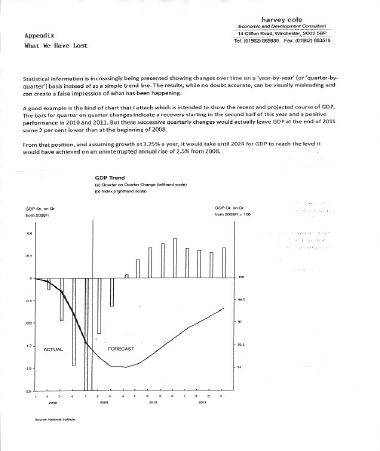
Statistical information is increasingly being presented showing changes over time on a `year-by-year (or `quarter-by-quarter') basis instead of as a simple trend line. The results, while no doubt accurate, can be visually misleading and can create a false impression of what has been happening.
A good example is the kind of chart that I attach which is intended to show the recent and projected course of GDP. The bars for quarter-on-quarter changes indicate a recovery starting in the second half of this year and a positive performance in 2010 and 2011. But these successive quarterly changes would actually leave GDP at the end of 2011 some two per cent lower than at the beginning of 2008.
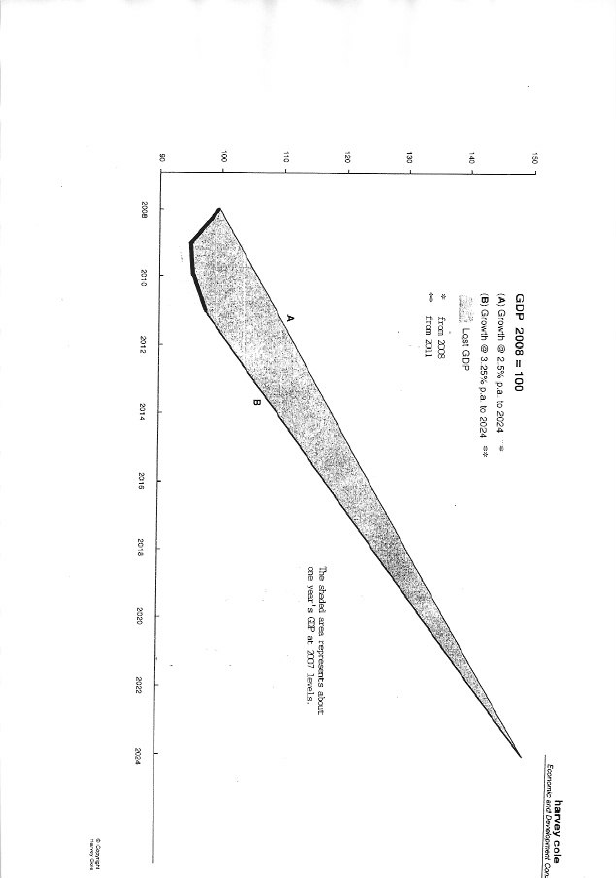
From that position, and assuming growth at 3.25 per cent a year, it would take until 2024 for GDP to reach the level it would have achieved on an uninterrupted annual rise of 2.5 per cent from 2008