
Archived decisions
HAMPSHIRE COUNTY COUNCIL
Report
Committee: |
Culture and Communities Select Committee | ||||
Date of meeting: |
9 July 2009 | ||||
Report Title: |
Rural Delivery Action Plan | ||||
Report From: |
The Director of Culture, Communities and Rural Affairs | ||||
Contact name |
John Tickle | ||||
Tel |
01962 846000 |
||||
1. Executive Summary
1.1 This report provides elected members with an overview of the work undertaken in relation to service delivery in rural communities since July 2008. As such it sets out: the approach taken to securing the views of partner organisations: developing our evidence base: and producing a rural service delivery action plan across the whole organisation. It also identifies some of the early interventions made in response to the consultation together with the performance and partnership issues relating to this area of work.
2. Contextual Information
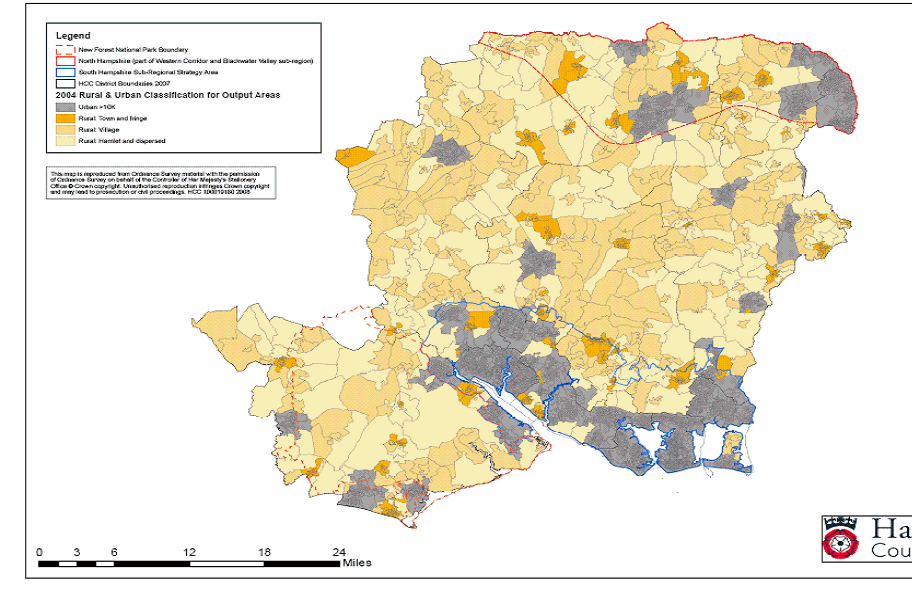
2.1. With over 85% of Hampshire's land area described as rural, it is crucial for Hampshire County Council to consider how it can best support its rural communities. These communities comprise 23% of Hampshire's population and using government definitions can be mapped as shown in appendix 1. The County Council delivers a number of significant statutory and discretionary services in rural areas, ranging from schools, adult social care, libraries and rights of way, to waste management and strategic transport planning. Hampshire County Council wishes to ensure that in delivering a wide range of services for rural communities, both directly and in partnership with others, the essential issues are tackled in the right way.
2.2. Hampshire's rural areas are experiencing significant levels of change, and the need to support rural communities is now greater than ever. The recession is having a significant impact right across Hampshire, and the County Council wishes to do what it can to minimise those adverse consequences. These issues need action to ensure that rural Hampshire continues to thrive economically, socially and environmentally: this is the vision adopted by Cabinet in July 2008.
2.3. It is also important to recognise the interdependence of our rural and urban areas across the whole county in supporting the quality of life and place that makes Hampshire such a special county in which to live, work and visit. This work and challenge has been at the forefront of efforts made to respond to stakeholder consultation by developing an appropriate action plan.
2.4. This action plan also draws strongly from the 2005-2007 Rural Pathfinder for the South East region, which was led by Hampshire County Council. This programme was sponsored by Defra, and tested innovative ways of delivering services in rural areas. A copy of this document is available in the Member's Room or online at http://www3.hants.gov.uk/planning/ruralpathfinder/environment-rural_pathfinder-archive.htm .
3. Aims and Objectives
3.1. In July 2008 Cabinet agreed the following aims for its delivery of services to rural areas:
To demonstrate commitment in supporting rural communities by:
· adopting a clear vision underlying the County Council's work in rural communities.
· recognising the crucial role played by rural areas and communities in the social, economic and environmental vitality of the county.
To work effectively both within the County Council and with partner organisations by:
· securing more effective engagement with rural communities and partner organisations.
· providing improved accessibility to services in rural areas.
· strengthening the role for Hampshire County Council at regional and national level by building on the lessons of the Rural Pathfinder.
Developing a Rural Delivery Strategy focused upon the needs of rural communities by:
· working with others, particularly borough, district and parish councils, in developing a new approach to rural spatial planning, recognising the importance of appropriate managed development to support employment, local housing and provision of services in rural areas.
· developing an effective evidence base to inform future action and service development - the Rural Profile of Hampshire.
· achieving more effective corporate collaboration and co-ordination when delivering and developing services within rural communities through "rural proofing" of our work.
Communicating more effectively with the rural communities:
· to identify and publicise sources of information and support, both within and outside the County Council, that could help build capacity within rural communities.
· to provide greater recognition and understanding of the contribution that Hampshire County Council makes to rural communities.
The overall vision underpinning the role of the County Council in supporting rural Hampshire is to work to achieve:
"Rural communities that are resilient and sustainable socially, economically and environmentally".
4. Consultation and Evidence Base
4.1. In the summer of 2008 the County Council identified all the key work it was undertaking in rural areas. This exercise also considered the strategic context and the key issues and priorities driving that work which was shared through a stakeholder consultation process during autumn 2008. That process was complemented by a series of seminars and facilitated workshops for external consultees to seek their views on priority areas of work. The findings of the workshops, together with the helpful and detailed responses to the consultation by nearly 60 organisations and individuals, have been used to prepare Hampshire County Council's Rural Delivery Strategy. The action plan at the heart of this has been heavily influenced by statistical data for Hampshire and the emerging Rural Profile. This forms an important and developing evidence base which can be viewed at www.hants.gov.uk/rural.
4.2. The consultation responses were summarised and presented to Cabinet in March 2009 and have been used as a crucial part of the process of selecting options for action. In parallel with this exercise, and in support of the key themes identified in the consultation process, the County Council identified 11 changes to service delivery that could be implemented immediately with no new resources. Cabinet approved these early interventions (appendix 2) in July 2008, and was updated on progress in March 2009. All early interventions are now underway or complete, and as such represent a first and significant step to achieving action on the ground.
4.3. Since the consultation process the country has entered what is forecast to be a deep recession. Commodity prices have plunged, reducing farmers' income and the Commission for Rural Communities (CRC) has forecast that rural areas will be hardest hit by the impact of the downturn. Hampshire County Council is actively working to reduce the impact of the economic downturn for its residents, and the action plan reflects this along with the inevitable anxiety and concerns felt by many in this sector. In addition, the establishment of the South Downs National Park will have an impact on rural parts of Hampshire and the County Council will be working closely with the National Park Authority.
5. Action Plan
5.1. The focus of this delivery strategy is on Hampshire County Council's role and responsibility for delivering services in rural communities. Much of the County Council's work is undertaken in partnership with other organisations, and partner organisations have been directly involved in the development of this work. This approach has been taken to secure the `rural proofing' of services and to focus upon those areas where the County Council has direct influence and impact within rural communities. Rural proofing is a mechanism used to ensure that rural needs and circumstances are taken into account in policy development and delivery.
5.2 The action plan and work surrounding it has involved many organisations and a crucial next step will be to develop improved partnership approaches that also focus upon the key issues identified through this process. A crucial part of the County Council's operation is to work closely with its many partners to improve the quality of service delivery and increase value for money.
5.3 Actions, by theme and time-scale are set out in summarised form in Appendix 3. Action Plans have been prepared on a themed basis to make them more relevant to delivery, rather than relying on the convention of current departmental arrangements. Theme leads' full Action Plans, which provide background context, have been placed in Members' Rooms (due to the size of these documents they have not been individually copied). The themes are Adult Social Care; Children's Services, Community, Leisure and Culture; Environment; Food, Farming and Forestry; Rural Economy, Employment and Skills; and Rural Transport and Accessibility.
6. Regional and Local Developments Affecting Rural Policy:
6.1. The South East England Development Agency (SEEDA) and the Government Office for the South East (GO-SE) have now revised their mechanisms for dealing with rural issues and have set up both a new regional Rural Forum and Board. Hampshire is well represented with the Executive Member now sitting on both bodies. There are a further two Board members representing the interests of Hampshire and both bodies play an important regional role so far as rural policy and delivery is concerned.
6.2. The Commission for Rural Communities (CRC), the Government body responsible for acting as the advocate for rural communities, has highlighted the need for better rural proofing of public services and has welcomed Hampshire's initiative. Following a presentation at the Personalisation Commission and subsequent discussions, the CRC has offered to partner the County Council, with the involvement of the Improvement and Development Agency for Local Government (IdEA), in using the exercise as an example of good practice in this area. The CRC are spending a day with the County Council in July to assess the impact of the work undertaken. This link with the CRC resulted in a request for the County Council to present its work to an Organisation for Economic Co-operation and Development (OECD) conference in London. This was accepted with all associated expenses paid by the CRC.
6.3. The County's recently developed Corporate Improvement Plan (CIP), presented to Cabinet in November 2008, identifies as one of its priorities the need to tackle inequalities of access to local services in rural areas, particularly for older and younger people and strengthen rural sustainability. A number of other priorities in the plan will also include a rural dimension. Progress against CIP priorities will be monitored by the Corporate Performance and Efficiency Group.
6.4. The Local Area Agreement (LAA) identifies the key priorities for Hampshire, many of which have a strong rural dimension, as well as a small number of targets specific to rural areas (see appendix 4). We need to ensure that delivery plans have considered the rural dimension where appropriate. Work is now underway to analyse how this can be taken forward.
6.5. Governance of the LAA is now focussed upon the Hampshire Senate, and it may be helpful for the LAA Executive and Senate to consider the rural dimension of key LAA issues in due course. Such a move would need to consider the linked proposals, previously considered by Cabinet, on the creation and roles of the Hampshire Rural Forum and Central Hampshire Conference. We can also expect the Comprehensive Area Assessment (CAA) to focus on access to local services, including equality of access in rural areas, particularly for disadvantaged groups.
6.6. In terms of the current economic downturn the SEEDA is currently mapping the impact upon the Region, including the rural economy, and that impact will be significant. This coupled with the results of the Sub-National Review, including the new duty for the County Council to undertake an economic assessment, and co-operation at a local and regional level, will require appropriate levels of focus upon the rural economy.
7. Partnership, Innovation and Performance
7.1. The key areas for action emerging from the consultation focussed upon:
_ Supporting sustainable rural communities, including affordable housing, rural broadband, access to services, supporting volunteering, and community engagement.
_ Providing effective rural transport
_ Farming, food and access
_ Economic development
_ Climate change, including renewable energy, and making better use of the county's wood-fuel resource.
These priorities are also supported by the Hampshire Rural Forum, the advisory body set up to act as a focal point for rural matters in Hampshire. This group engages all the key stakeholder organisations in a county wide forum and is supported directly by Hampshire County Council.
7.2. In terms of achieving the best value for rural areas the County Council has now looked hard at rural proofing its current service delivery and this is reflected in the action plan. It also needs to develop new partnership initiatives and projects that tackle these issues. Work is currently underway to identify further specific options which will do this in an innovative and collaborative way. While this effort will need to be focussed, and cannot hope to tackle all the issues, it must deliver positive outcomes in line with what people in rural communities have told us.
7.3. The £200,000 of pump priming investment identified in the budget for this year will include funding to support new initiatives within this context. A key focus for the use of that investment will be to deliver specific outcomes and to maximise the levering of partnership funding and involvement. Current proposals under discussion relate to:
· Access to broadband
· Educational attainment in rural areas
· Local food distribution
· Piloting a mobile service delivery model in isolated rural areas
· Matched funding for improvements to community buildings in rural areas
· Dedicated small community challenge fund for small scale improvements in rural communities
A number of these projects are currently subject to detailed feasibility consideration with the intention of finalising project proposals by the end of July 2009.
7.4. Discussion with District and Parish Council representatives has highlighted the need and willingness to work more collaboratively in tackling some of these issues. Clearly the harnessing of joint resources will be a key requirement to achieving success and this will be brought into sharper focus with both the emerging CAA framework and the achievement of LAA targets.
7. Conclusions
7.1. Work undertaken to date has sought to actively pursue the objectives set by Cabinet in July 2008. It is focussed upon securing the views of key organisations: seeking to develop our evidence base: and to develop an organisation-wide commitment to tackling service delivery issues in rural communities.
7.2. The action plan developed, and early interventions implemented, seek to "rural proof" County Council service delivery in rural areas and to respond directly to available evidence including consultation responses.
7.3. The report also identifies the need to utilise resources to develop new projects which target priority issues with an emphasis upon cross departmental and partnership approaches. This will be crucial in supporting our performance within the LAA and CAA context and it will also ensure that our collective resources work harder in relation to the overall financial climate. Ongoing work will focus upon the drive to develop such approaches.
CORPORATE OR LEGAL INFORMATION:
Links to the Corporate Strategy
Hampshire safer and more secure for all: |
yes |
Corporate Business plan link number (if appropriate): | |
Maximising well-being: |
yes |
Corporate Business plan link number (if appropriate): | |
Enhancing our quality of place: |
yes |
Corporate Business plan link number (if appropriate): | |
Section 100 D - Local Government Act 1972 - background documents | |
The following documents discuss facts or matters on which this report, or an important part of it, is based and have been relied upon to a material extent in the preparation of this report. (NB: the list excludes published works and any documents which disclose exempt or confidential information as defined in the Act.) | |
Document |
Location |
Theme Leads' Action Plans |
Mottisfont Court, Winchester |
IMPACT ASSESSMENTS:
1. Equalities Impact Assessment:
a) Successful implementation will reduce inequalities by improving service delivery in rural areas and increase access to services. Please refer to full Equalities Impact Assessment.
2. Impact on Crime and Disorder:
a) Early interventions work included an increase in patrols by Accredited Community Safety Officers in rural areas.
3. Climate Change:
a) How does what is being proposed impact on our carbon footprint / energy consumption?
More effective and efficient service delivery is expected to reduce the County Council's carbon footprint and energy consumption.
b) How does what is being proposed consider the need to adapt to climate change, and be resilient to its longer term impacts?
Adaptation to climate change is a key theme in this strategy.
Rural Profile - Map of Rural/Urban Hampshire I:\Shared\Rural Delivery Task Group\Rural Profile APPENDIX 1
(a full text version of the Rural Profile of Hampshire )
Appendix 2
HAMPSHIRE RURAL DELIVERY STRATEGY
EARLY INTERVENTIONS UPDATE
This Appendix updates Members on progress with implementing the Early Interventions as set out in Appendix 3 of the report to Cabinet on 7 July 2008. The early interventions are shown in bold and were achievable within available resources and by placing additional focus on the specific issues in relation to rural areas.
All Early Interventions are currently underway, or have been achieved.
1) Utilise the forthcoming Rural Transport Pilot initiatives to develop models for cost-effective access to key services in rural areas.
Update: Two areas selected for the pilots: Denmead; plus Wickham, Shedfield and Swanmore. `Before' surveys undertaken to establish baseline for public's awareness of existing services and information sources. Information leaflets have been produced in conjunction with parish councils and circulated to each household. Follow-up public surveys have been undertaken to determine the effectiveness of each leaflet. Denmead data currently being analysed. Planning a similar programme in the Basingstoke area. Further details are in the Report to the Environment and Transportation Select Committee dated 20 Jan 09.
2) Utilise the forthcoming Review of Community Transport and Demand Responsive Services to inform future service delivery arrangements to maximise the effectiveness of service delivery in rural areas.
Update: Report to Environment and Transportation Select Committee 20 Jan 09 recommended options for consultants to take forward. These include:
· Using taxis or a `taxi-card' scheme to fill gaps in existing service coverage and address inequality.
· Establishing a volunteer champion to recruit, train and deploy volunteers for community transport schemes.
· Set up a non-profit company to tender for public transport contracts, reinvesting profits into other community transport services.
· Develop a toolkit for monitoring, managing and developing different types of transport services.
· Using other HCC staff, e.g. Adult Services to provide transport information.
Longer term options are:
· Single booking point for all demand responsive services.
· Re-design service provision in a pilot area to make use of options including taxis, taxi shares, dial-a-ride, car schemes.
· Increase scope of community transport schemes
· Provide a `one stop' shop for transport information.
3) Use the current Putting People First Commission to develop flexible approaches to the personalisation of care in rural areas.
Update: The report (Nov 08) of the Leader's Commission on Personalisation contains four recommendations in relation to supporting rural communities:
· Systems, policies and programmes will take account of rural circumstance and promote equity and equality.
· Use existing rural resources better to ensure information and advice are accessible.
· Work with voluntary sector to promote volunteering, community capacity building and to stimulate social enterprise in rural communities.
· Work across all tiers of local government to promote building to the Lifetime Homes Standard for all new developments, particularly in rural areas.
Also, the Out of Town project will be rolled out to two further rural areas during 2009/10, linked to the Older People's Wellbeing Strategy.
4) Evaluate the Community Innovations Flagship Pilot Project, (helping people with low and moderate needs in rural areas) with a view to expanding provision.
Update: This project provides support to older people who are at risk of losing their independence. A review of progress has already demonstrated benefits. Further evaluation taking place Feb-April 09 to refine the model. Phased county wide implementation will take place April 09 - April 2010.
5) Roll out another geographical area for the Out of Town Project (increasing social and support services for older people).
Update: This will be rolled out in East Hants in March 2009, and will operate for 6-9 months. The current work in rural parishes around Andover is being evaluated. Subject to evaluation, the project will continue to move around the county over the next three years.
6) Funding for the parish Small Grants Scheme has increased by a further £10k for 2009/2010.
Update: An additional £15k has now been made available for 2009/2010, making a total of £25k new funding.
7) Developing the Hog the Limelight programme providing Arts, performance and activities in rural villages.
Update: Rural Touring Support Officer appointed Nov 2008. Interim report and recommendations Jan 09. New pilot programme of new / summer / outdoor activities. New marketing scheme to raise awareness and increase participation.
8) Supporting a Village Hall Adviser post, for which Central Government funding has been withdrawn.
Update: Hampshire County Council is providing one year's funding to Community Action Hampshire for this post. Appointment made Feb 09, ready to start April 09.
9) Develop mobile service delivery as part of the Children's Centre Partnership with the NHS (bringing specialist services to rural areas).
Update: £408,000 Sure Start capital funding obtained to purchase two vehicles to deliver services in support of Children's Centres. Delivery expected March 09. Recruitment of driver underway. These vehicles will ensure that excluded and vulnerable families in rural areas can access services.
10) Apply rural weighting as part of the Early Years Service.
Update: Funding is being provided to maintain playgroup and nursery provision for 3-4yr olds even if small numbers of children attend, as is particularly the case in rural areas. Additional funding is also available to enable groups to find new locations if sites used for nurseries and playgroups - often village halls, are unable to support the Government's requirement to increase nursery provision from 12.5 to 15 hours per week. Further funding is available to upgrade settings.
11) Develop the successful Community Safety Officer parish response deployments and recording of incidents in support of tackling community safety in rural and rural fringe areas.
Update: ACSOs have added 21 villages and small towns to their patrol patterns since June 08.
RURAL DELIVERY ACTION PLAN APRIL 2009: "MAKING IT HAPPEN" | ||
Proposed actions | ||
Immediate |
July 2009 onwards: actions |
July 2009 onwards: planning |
1. RURAL TRANSPORT AND ACCESSIBILITY (Summary of key themes. Please see Appendix 2 for full action plan.) | ||
Complete background work into `brokerage' rural transport pilot for Test Valley by May 09. Outcome: Will enable residents to access local retail and local health services at least weekly, and travel to Winchester and Andover hospitals. NI175 - to enable access to a hospital by walking or public transport within 60 minutes journey time for an additional 7000 people by 2010/11 from a 2006/07 baseline of 1,188,302. Complete review of community transport and demand responsive services. Publish final report Autumn 09. Outcome: Will ensure that the services are providing best value and responding to need. Use options developed to extend the reach and role of community transport. Complete the competitive tendering of Dial-a Ride services in Autumn 2009. Use this to benchmark and share best practice to improve capacity and efficiency to better meet user needs. Continue car free tourism pilot in New Forest. Outcome: Providing free bus or subsided taxi travel from railway stations to Lyndhurst. Publish findings of pilot testing improved ways of providing local transport information by June 09. Pilot operating in Denmead & Wickham, Shedfield and Swanmore. Complete pilot to identify ways of increasing efficiency of public and community transport providers in East Hampshire. Complete Bus Subsidy Criteria work Summer 2009. Use process to better match network and delivery method to demand through area passenger transport reviews and tendering of local bus services. Obtain funding to maintain Andover - Winchester hospital shuttle bus beyond June 09. To maintain the improvement in accessibility levels brought about by this service. NI175. Complete `Village 30' programme by Spring 09, bringing improved safety levels to villages across the County. Outcome: Reduction in average speed in villages where a new 30mph limit is introduced (2008-09 = 10%, 2009-10 = 10%, 2010-11 = 10%) and Reduction in average speed in villages which already have a 30mph restriction (2008-09 = 1%, 2009-10 = 3%, 2010-11 = 5%). |
Implement `brokerage' rural transport pilot in stages to Dec 09. Outcome: Will enable residents to access local retail and local health services at least weekly, and travel to Winchester and Andover hospitals. NI175 (see opposite). Extend `wheels to work' (moped loan so young people can travel to work or training) to East Hampshire and Winchester districts by Oct 09. Outcome: This will improve life opportunities for the young in rural areas. Seek to overcome duplication and overlap in public and community transport providers in East Hampshire. Work with partners in health and other stakeholders to identify opportunities to re-plan transport, identify efficiency savings. Publish final report Oct 09. Implement new ways of supporting and developing voluntary car schemes in New Forest. To overcome barriers to volunteering. By Dec 09. Identify new approaches to enable rural communities to better meet their transport challenges in their communities. Pilot a self-help toolkit with 1 or 2 villages. Explore links with community-led planning. Outcome: improved knowledge of available transport provision. Complete by March 2010. Establish a database holding locations and contacts in rural communities to which relevant transport services information is provided on a regular basis. Operative by end 2009. This will improve targeting of transport services information. Work with Adult and Children's Services to improve sharing of information about inequality, access. Ongoing from Spring 2009. This will improve liaison between departments leading to better use of resources and expertise to improve service delivery and better respond to need. Launch pilot with secondary schools to better enable children to resolve their own transport issues. Work also with Hampshire Youth Parliament. Complete by Dec 09. This will improve the County Council's understanding of the transport and accessibility issues of the young in rural areas. Continued promotion and enforcement of Village 30 programme. Explore the possibility of improved liaison with parish council through a form of Parish Lengthsman. |
Improving the tools and techniques used to Identify accessibility problems and the transport and service delivery options to address these. This will help to improve future targeting of resources and best meet access needs. Use the findings of the HCC Personalisation Commission and work with the cross departmental personalisation group to inform the future delivery of transport and other services and improve access to services. Research and consideration of the future (50 year horizon) policy action that the County Council may need to take with regards to transport and accessibility in rural areas in response to potential future scenarios (e.g. Climate change, alternative vehicle fuel technologies, etc...). Building on the work to innovate and integrate transport and service delivery, this will improve the ability of the Council to adapt and introduce policies to better equip rural communities to deal with future challenges. Preparation of Development Control Transport Policies for inclusion in District Council Local Development Frameworks. A focus here will be to promote an improvement in accessibility levels through the local planning process and in particular to major new public service facilities (such as hospitals). NI175. |
2. RURAL ECONOMY, EMPLOYMENT AND SKILLS (Summary of key themes. Please see Appendix 3 for full action plan.) | ||
Consider issues for rural businesses in Hampshire Employment and Skills Strategy. Include migrant labour, access to skills and training, and the poor perception of land based careers.
Increased promotion of business support and advice in rural areas, including HCC's services to help businesses through the recession, from April 09. Via HEP and HIPOG, engage with district planners to look at rural business needs, to encourage more flexible planning policies for rural businesses. From April 09. Scope the value of equestrian and horticulture sectors to the rural economy. By July 09. Increase support available to rural towns and villages through expansions of Village Community Grant Scheme and Market Town Project. An additional 10 market towns and 5 more village shops to be helped through additional grant funding by March 2010. Funding required from HCC £100K. |
Develop a pilot study to explore the use of current labour market through redundancies for agriculture/horticulture work-force shortages by October 2009. e-hampshire to identify opportunities for rural areas without broadband to link into HPSN 2 cables to schools. Undertake trial to broadband-enable rural communities currently without broadband access, using HPSN 2. Pilot site identified Little London, Andover. Estimated £25K required to fund equipment. Start target date October 2009, completion March 2010. Through Matisse initiative identify additional locations for Smarter Working Centres. 6 Rural Smarter working centres to be set up by March 2010. Funding required from HCC: £10K each set up costs = £60K total plus partner contributions. |
Investigate how HCC and partners can offer support to equestrian and horticulture sectors. Identify sector champions and identify areas of joint working or ways HCC can further support the sectors. |
3. ENVIRONMENT (Summary of key themes. Please see Appendix 4 for full action plan.) | ||
Support habitat management and restoration in Biodiversity Opportunity Areas, to enable adaptation to climate change. (Continuing activity). Influence partnership bids on funding such as Leader, Interreg funding and other external funding contributions and support delivery of actions. (e.g. North Wessex Downs Leader 2008-2013) |
Develop the evidence base for understanding the landscape impacts of climate change, adaptation to it, and its mitigation. (Underway, end date tba). Review the priorities for Environmental Service Provider grant funding to the voluntary sector for 10-11. (By October 2009) Build a stronger partnership with land managers to support delivery of environmental benefits, initially through the interim Rural Forum. (April 2009 onwards) Work with partners on the urban fringe in south Hampshire to roll out green infrastructure, including large scale habitat restoration. (From May 2009 onwards) Assess the Environmental impacts of increased use of inappropriate rural roads by traffic including HGVs and the potential for mitigation. |
Work with partners to determine how to extend green infrastructure planning beyond south Hampshire. Develop opportunities to support small rural businesses to secure environmental benefits. Identify opportunities with external partners to secure additional funding, e.g Interreg, Leader, and other external funding contributions. Develop an understanding of the environmental implications of new renewable energy opportunities for Hampshire. Identify opportunities to deliver greater environmental benefits from management of HCC estate. Includes access. |
4. FOOD, FARMING AND FORESTRY (Summary of key themes. Please see Appendix 5 for full action plan.) | ||
Prepare an Agricultural and Food Strategy for Hampshire by July 09. Complete feasibility study for a local food distribution service by April 09. Hold annual Hampshire Farming Conference June 09. Raise profile of agriculture and horticulture using Hampshire Now by July 09. Improve take up of agri-environment schemes and educational visits on County Farms, and other farms, e.g. Laverstoke Park Farm, by July 09. Develop links with private landowners to enable county farm tenants to progress beyond County Farms. Review options for biofuels on County Farms. Link with wood-fuel. By July 09. Enhance Hantsweb rural pages with links to all rural services agencies and providers by May 09. |
Introduce mobile demonstration unit to promote local food in disadvantaged areas April 2010-Mar 2012. Subject to Big Lottery bid. Update Hampshire Farming Study 2009 on current state of farming in Hampshire. Address workforce crisis in agriculture and horticulture in Hampshire Employment and Skills Strategy. Undertake study into impact on farming and rural communities of changing patterns of migrant workers Identify how to provide more support to small scale farmers, and fragile livestock and dairy sectors. Set up a single `rural support' web portal by Mar 2010. Further develop the Woodland Forum and identify barriers and solutions for developing a wood-fuel market in Hampshire. |
Identify further measures to increase access to local food. Identify opportunities for Hampshire Fare once existing SEEDA funding expires end March 2010. To increase spend on local food by public sector, supermarkets and major buyers i.e. cruise industry; expanding local access to slaughter facilities. Develop business plan and submit £160k funding bid to SEEDA (through RDPE) for a local food distribution service. Bid for £45k HCC match funding. By July 09. Project to start Jan 2010. Plan next update of Hampshire Farming Study in 2011. |
5. COMMUNITY, LEISURE AND CULTURE (Summary of key themes. Please see Appendix 6 for full action plan.) | ||
£18k grant to Community Action Hampshire to fund Village Halls Adviser post to March 2010. £41k grant fund for Countryside Service Small Grants Scheme for 09/10, up from £20k 08/09. Funding provisionally agreed to 2012 _ Parishes at least match fund _ Achieve 50% increase in volunteer hours _ 8-10 more parishes supported £17-20K `Animating Hog' rural arts funding to extend `Hog the Limelight' to Sept 09. Interim report Jan 09 _ Pilot new summer/outdoor activities offered to 6 experienced Hog promoters _ Find 3 new communities without traditional halls to stage events _ New marketing scheme to raise awareness Continue £80k per annum funding for Community Buildings capital projects for next 3 years _ Generate match funding of at least 50%(25-33%) _ Support around 40 projects per annum Develop concept of a rural toolkit to create a sector wide offer to rural communities. Explore potential partnership approach with East Hants DC at 24 April meeting. |
With CAH review role, function and local needs from Village Halls Adviser post Dec 09 to inform delivery of service and resourcing in 2010 and beyond. Final report July 2009 to inform development of Hog programme beyond 2010
|
Seek funding to improve access to services for disadvantaged young people through the R&H Youth Offer Group. Working with other HCC Depts and external partners, explore potential for expanding services provided by mobile libraries. Identify options for increasing volunteering and access to learning in rural areas. Development plan for Hog programme in 2010 and beyond. Identify possible sources of funding to enhance annual allocation of 80K to offset £20k shortfall in Community Buildings Fund for capital projects. (Total applications funded in 07/08 £203k and 08/09 £188k.) HCC to adopt a new approach for engaging with community led planning, including Market Town Healthchecks and parish plans. |
6. CHILDREN'S SERVICES (Summary of key themes. Please see Appendix 7 for full action plan.) | ||
Implement new strategy for supporting young carers in rural areas, and measuring numbers of young carers. Mobile Children's Centres for rural areas will be in use from April 09. [Early Interventions target.] Collect evidence that development of Phase 3 Children's Centres has included needs of rural communities. Ensure that children in small rural schools attract sufficient resource to enjoy excellent educational opportunities Services for Gypsies and Travellers. Many live in rural areas. Increase number of parents participating in the Positive Parenting Programme. Improve school attendance by 2010/11. Increase proportion educated at school. Provide learning materials for those educated at home. Employ classroom assistant to ensure Gypsy/Traveller children are settled at school. Expand programme beyond Hart. |
All rural schools to have designated teacher to support young carers from 2010/11. Include young carer issues in PSHE lessons in rural schools from 2009/10. Information packs for young carers available in a variety of formats from 2010/11. All children under 5 able to access a Children's Centre by March 2010. 100% of rural schools providing access to all extended services by Sept 2010. Establish a Funding and Transport Group to resolve transport for secondary school children in rural areas studying 14-19 Diplomas. By Sept 09. Complete needs analysis of level of youth provision in rural areas against need by Dec 2009. Continue the subsidy to small schools under the school funding formula. Services for Gypsies and Travellers: Reduce the gap between the proportion of BME/Traveller children achieving at least 78 points in Early Years Foundation Stage and their peers by 5% in 2010/11. From 2009/10 use national `E-Learning and Mobility Project' to provide laptops for young Gypsy/Traveller people. `Aiming High' disabled children strategy information hub available by Dec 2010. |
Develop targets via Children's Trust arrangements for School Improvement Partners to work with schools in rural areas to focus on children with the greatest need. Confirm timeframe for delivering fully integrated services for young people in rural areas. Complete integration of the services provided by Connexions and the former youth service. Establish measures to track ability of 14-19 consortia to meet students' travel needs. This is key for rural areas. Confirm targets to 2010/11 for reducing proportion of 16-18 yr old NEETs. Develop targets for measuring action to address gaps in youth provision in rural areas against need. Confirm targets for 2010/1 for increased % of children and families reached by rural Children's Centres. Continue the subsidy to small schools under the school funding formula. Confirm target for 2009/10 for Increasing the proportion of BME/Traveller children achieving Level 4 in English and Maths at KS2. Additional numbers of rural young people accessing extended services by March 2011. Rural support will be included in total of 2,400 children county-wide. Additional children and young people accessing universal short break provision by March 2011. A total of 1,300 people in rural and urban areas county-wide. Implement revised eligibility criteria for short breaks by Dec 2010 to better meet needs of children with disabilities in rural areas. |
7. ADULT SOCIAL CARE (Summary of key themes. Please see Appendix 8 for full action plan.) | ||
Outcome: by 2011 all service users will receive a person-centred or `personalised' service (called `self directed support'), where they have choice, control and power over the support they receive. Action: Phase 1 'self-directed support' is underway in Basingstoke and lessons are being learnt and systems put in place for countywide roll-out. |
Action: `Self directed support' (SDS) will be rolled out county wide from April 2010 (Phase 2) and completed by March 2011. The SDS budget of £4.2m includes rural support |
|
Outcome: Everyone will be able to access information, advice and supported self-assessment, regardless of level of need or financial situation. Action: Launch the self-funders self-service website Oct 09, which will enhance access to services in rural areas, where there is less direct access to information. Rural support to be included in the budget figure of £348k. |
Workstream activities on access to information, advice and advocacy to continue e.g. through developing a customer access strategy. Access points to include community access points, many of which are based in parishes. Take forward plans to pilot new approach to face-to-face access in Basingstoke and Deane borough, including its extensive rural areas, using libraries and mobile libraries. | |
Outcome: early intervention services will be available countywide by April 2010 to help people stay independent in their own homes and linked into their local community for as long as possible. Access to early intervention services is patchy, particularly in rural areas. |
||
Action: Continue roll out of Community Innovations Project county-wide. £960k growth funding across county. |
Community Innovations Teams to be rolled out county wide by Apr 2010. |
|
Outcome: Older People's wellbeing is enhanced through community development projects and schemes that offer `a little bit of help', eg to manage the garden. Action: Support the Older People's Wellbeing Strategy, through funding for Gardening Service [through Supporting People] (£180k), which is particularly important in rural areas; Neighbourcare (£100k); OPAL project (£20k); Out of Town Project (£10k); Sing for Your Life (£10k). All ongoing. |
Support the development of HCC's Third Sector strategy, ensuring that it recognises the importance of the voluntary sector in shaping Hampshire communities, particularly at the very local level. | |
Outcome: Vulnerable and disabled people will have significantly greater opportunities to access universal county council services, which are often poorest in rural areas. Action: Establish a cross departmental Personalisation Group and work programme for the Group. Underway. |
Establish joint programme with Recreation and Heritage Dept to widen access to universal services. |
|
Outcome: more vulnerable people will be supported to help alleviate increased financial difficulties being faced because of the `credit crunch'. Action: put additional investment into supported employment projects. Rural support will be included in figure of £302k. This is particularly significant for disabled and older people living in rural areas. Complete by Mar 2010. |
Outcome: Older people on low incomes will have better information on a range of ways to secure `a little bit of help' to enable them to stay in their own home for longer. Action: Work with the Joseph Rowntree Foundation, private sector and local partners to scope a pilot to facilitate information and advice for low-income older households, with the option of equity release where appropriate. |
|
Appendix 4
HAMPSHIRE RURAL DELIVERY STRATEGY
LOCAL AREA AGREEMENT NATIONAL INDICATORS
The action plan assists the County Council in meeting its Local Area Agreement targets under the following National Indicators. Those partially met are denoted with (P):
· NI 4 % of people who feel they can influence decisions locally
· NI 6 Participation in regular volunteering
· NI 72, 73, 74, 75, 93, 94, 95, 96, 97, 98 Achievement in education (P).
· NI 73 Achievement at level 4 or above in English and Maths at KS2.
· NI 79 Achievement of a level 2 qualification by age 19.
· NI 87 Secondary school persistent absence rate.
· NI 102 Achievement gap between pupils eligible for free school meals and their peers.
· NI 117 16-18 year olds not in education, training or employment.
· NI 142 No. of vulnerable people supported to maintain independent living.
· NI 148 Care leavers in employment, education or training. (P)
· NI 163, 164, 165 on improving basis skills, and developing new skills.
· NI 188 Planning to adapt to climate change.
It also assists the County Council to meet targets set under the following local indicators:
· LI B1 Business start ups (P)
· LI B2 Businesses per 1000 population. (P)
· LI C1 Speed in villages
· LI C3 Local accessibility
· LI F1 Supporting older people to live independently
· LI H1 A sustainable Third Sector