
Archived decisions
HAMPSHIRE COUNTY COUNCIL
Decision Report
Decision Maker: |
Pension Fund Panel | ||||
Date of Decision: |
21 July 2009 | ||||
Decision Title: |
Admission Bodies Risk Model | ||||
Decision Reference: |
844 | ||||
Report From: |
County Treasurer | ||||
Contact name: |
Nick Weaver, Pensions Services | ||||
Tel: |
01962 847587 |
Email: |
|||
1. Executive summary
1.1. The purpose of this report is to provide the Pension Fund Panel with the results of the `admissions agreements risk assessment model' and identify possible options for managing the risk of admission bodies leaving the Fund without being able to pay their deficit.
2. Contextual Issues
2.1. There are three types of organisations who are eligible to join the Local Government Pension Scheme (LGPS). These are known as scheduled, designating and admission bodies.
2.2. Scheduled bodies are defined in the LGPS Regulations and include:
· County, city, borough and district councils
· fire and rescue authorities
· police authorities
· further education and higher education colleges
· academies
· National Park Authorities
2.3. Eligible employees of a scheduled body have an automatic right to join the LGPS.
2.4. Designating bodies include:
· town or parish councils
· trust schools
· voluntary schools, foundation schools or foundation special schools
2.5. The eligible employees of a designating body can only join the Scheme if the employer (and the local education authority, in the case of a school) designates the specified employee or group of employees as being eligible to join.
2.6. Admission bodies are organisations which have applied to participate in the Scheme through an admission agreement. They are mainly public sector bodies but can include charitable organisations and also private sector employers who provide outsourced services for a local authority. Their employees cannot join the Scheme unless nominated by their employer for membership.
2.7. There are two types of admission body; community and transferee. Community admission bodies are organisations who have chosen to join the LGPS, usually performing functions previously carried out by local authorities. Transferee admission bodies are those created when services are outsourced to a private contractor under Best Value arrangements.
2.8. The only admission bodies who have joined the Fund in recent years have been transferee admission bodies (as authorities increasingly look at outsourcing functions). The community admission bodies still in the Fund have been employers in the Scheme for many years.
3. Admission bodies
3.1. A report to the Panel in November 2008, noted that there has been a noticeable growth in enquiries from existing admission bodies seeking an exit from the Fund. This reflects concerns over the increasing cost of membership to these employers who are invariably small charitable or voluntary bodies.
3.2. When an admission body withdraws from the Fund or ceases to have any active members, a closure valuation is triggered. This valuation assesses the current funding position and calculates whether the admission body is in surplus or deficit. If there is a deficit, the admission body is expected to pay the liability. The Fund is at risk if the admission body cannot afford to make the deficit payment.
3.3. Some admission bodies entered into the Fund with a guarantor, (usually the district or borough council who previously would have performed the work of the admission body). If these admission bodies are unable to pay the deficit, the amount due would then fall on the guaranteeing employer. If there is no guarantor or the guarantor themselves cannot afford to pay, the liabilities will be subsumed into the Fund as a whole and the remaining employers will bear the resulting costs.
3.4. This risk only applies to community admission bodies. Transferee admission bodies pose no additional risk to the Fund as at the end of the contract, all liabilities are subsumed into the letting authority's pool of liabilities and the letting authority will be responsible for any deficit (as if the service had never been outsourced).
3.5. The risk exposure needed to be evaluated and quantified so that an appropriate action plan could be drawn up.
4. Admissions agreements risk assessment framework
4.1. The Fund Actuary was asked to prepare an `admissions agreements risk assessment model'. The purpose of this framework is to assist the Administering Authority in establishing the extent of risk of unfunded pension liabilities for community admission bodies that have no guarantee arrangements in place.
4.2. The model uses information held about the admission bodies to assess the strength of existing covenant and therefore the extent to which the Fund is exposed in the event of any closure.
4.3. The risk model was populated with data already held by Pensions Services and information that could be easily established from other sources (for example, the Charity Commission website). This data gathering exercise highlighted that for many community admission bodies, who have been in the Fund for over 20 years, little of the information requested by the Actuary was known.
4.4. The risk only relates to the exit of existing community admission bodies. It is unlikely that any new community admission bodies will be set up (as the current costs tend to deter new entrants) but any new employer would have to have a guarantor as part of the agreement.
5. Risk assessment results
5.1. The model can be used to establish the types of risk that the Fund is exposed to as well as to estimate the potential costs of admission bodies withdrawing without paying their deficit. The costs have been assessed both in monetary terms as well as the additional percentage contributions that would have to be paid by the other employers in the Fund.
5.2. The risks identified by the model can be categorised into three main groups:
· documentation
· affordability
· investment
5.3. These categories of risk are discussed in more detail below.
6. Documentation
6.1. During the data gathering exercise, it has become apparent that documentation for many of the older admission agreements is inadequate. This makes it difficult to assess the risk these admission bodies pose to the Fund.
6.2. The Actuary is going to identify those admission bodies for whom it is important to finish the data gathering exercise and those bodies where there is unlikely to be material benefit in doing so.
6.3. In addition, there are nine old agreements where the data gathering exercise has revealed that the employer has ceased to exist at some point in the past or has ceased to have active members without a closure valuation being made. The Actuary will be asked to identify any actions that now need to be taken in relation to these employers.
6.4. Any new agreements established in the last few years have been fully documented so the documentation risk only exists in relation to the older admission bodies.
7. Affordability
7.1. The table below sets the likelihood of failure against the likelihood of the subsequent deficit being picked up by the Fund to create different scenarios. It should be noted that the table uses data as at 31 March 2009 and the figures will change in line with changes in economic conditions.
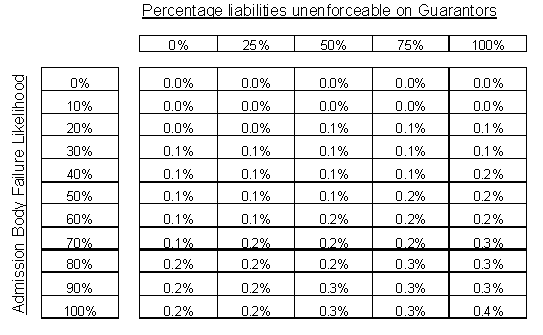
7.2. The worst case scenario would be for 100% of the admitted bodies to leave the Fund with 100% of the deficit falling onto the remaining employers. The model calculates that in this situation, the total cost to the Fund would be £68m (based on the funding position at 31 March 2009). This is the equivalent of a 0.4% increase in contributions for the remaining employers.
7.3. Although this is a relatively small cost in relation to the size of the Fund, the political outcome of this situation could potentially be serious. Many of the admission bodies are care or community based organisations and the public perception of their failure being caused by rising pension costs could be very negative.
8. Investment
8.1. Investment regulations state that the Administering Authority has a responsibility to invest in appropriate assets for the Fund. In the past this has always been taken to mean an appropriate mix of asset classes. However, the Fund Actuary has advised that the regulations could be read as meaning appropriate to the needs of individual employers.
8.2. On this understanding, the admission bodies could be said to require a different investment strategy to the scheduled bodies in the Fund. This is because whilst scheduled bodies can take the risk on volatile returns because they are in the scheme for the long term, the admission bodies tend to join the Fund for a limited period and will need a closure valuation at some point. If the valuation attributes a surplus to the admission body, no action is taken. If it attributes a deficit then the admission body is instructed to pay.
8.3. There is a risk that the Fund is vulnerable to criticism or even legal action from an admission body who is in this situation. Employers receive a copy of the triennial valuation report but this does not specifically identify the potential closure positions for individual bodies. The case can be made for admission bodies having the same investment strategy as the scheduled bodies but only if they are fully aware of the potential consequences of this.
8.4. A decision needs to be made as to whether the investment strategy is altered to take into consideration the needs of different employers in the scheme or whether the community admission bodies simply need to be informed of the potential costs of leaving the Fund.
8.5. If it is decided to allow admission bodies a different investment strategy from the scheduled bodies in the Fund, this change can be made without altering the actual investment strategy. Admission bodies can instead be offered a notional investment strategy with exit costs being computed on this notional basis.
8.6. However, the Treasurer and the Fund Actuary are seeking solutions to mitigate these risks whilst at the same time avoiding unaffordable increases in the employers' contribution rate at the next valuation.
9. Actions arising from the risk model
9.1. An action plan now needs to be developed to mitigate or plan for the risks that have been identified. This will need to cover both communication with scheme employers as well as establishing an exit strategy for community admission bodies who wish to leave the Fund.
9.2. The risk model identified four main groups of admission bodies with similar risks of closure: housing associations, bodies with no active members, bodies with few active members and bodies still operating open agreements. The action plan will need to develop suitable arrangements for these different groups.
9.3. The scheduled bodies will also need to be informed of the outcomes of the risk model.
9.4. The Treasurer and the Fund Actuary raised this issue with members of the Hampshire and Isle of Wight Chief Financial Officers Association on 10 July 2009. The possible solution agreed at the meeting was for all employers in the Fund (primarily the scheduled bodies) to underwrite the risk of underfunding by amending the definition of solvency for admission bodies in the Funding Strategy Statement. This is justified in that without underwriting, the increase in employers' contribution rates otherwise necessary, could precipitate failure for admission bodies causing a higher level of loss than without the underwriting as set out in the table in paragraph 7.1. At the same time, the employers' contribution rate could be progressively increased over, say, six years to the correct funding target in line with a notional investment strategy for admission bodies as indicated in paragraph 8.5. The potential risks of default would then be reduced from about £2m in year 1 to about £0.4m at year 6.
9.5. The action plan will be developed with the Fund Actuary and shared with the Panel in a report in November 2009.
10. Conclusions
10.1. The Fund is exposed to the risk of community admission bodies leaving the Scheme without being able to pay any associated deficit costs.
10.2. The risk model has quantified this risk and can now be used to develop an action plan to mitigate this risk., and a possible solution is available.
10.3. A more detailed action plan will be brought to the Panel in November 2009, but it is also suggested that the problems and possible solutions could be added to the presentations for employers at the Fund's Annual General Meeting on 30 September 2009.
11. Recommendation
11.1. That the Treasurer continues to work with the Fund Actuary to develop an action plan to cover deficits that could arise with admission bodies on withdrawing from the Fund, together with an agreed underwriting plan to reduce the risks of default and to smooth contribution rates at the next actuarial valuation.
CORPORATE OR LEGAL INFORMATION:
Links to the Corporate Strategy
Hampshire safer and more secure for all: |
yes/no |
Corporate Business plan link number (if appropriate): | |
Maximising well-being: |
yes/no |
Corporate Business plan link number (if appropriate): | |
Enhancing our quality of place: |
yes/no |
Corporate Business plan link number (if appropriate): | |
OR | |
This proposal does not link to the Corporate Strategy but, nevertheless, requires a decision because the arrangements for managing the risks of admission bodies leaving the Pension Fund need to be decided. | |
Other Significant Links
Links to previous Member decisions: |
|||
Title |
Reference |
Date | |
Direct links to specific legislation or Government Directives |
|||
Title |
Date | ||
Section 100 D - Local Government Act 1972 - background documents | |
The following documents discuss facts or matters on which this report, or an important part of it, is based and have been relied upon to a material extent in the preparation of this report. (NB: the list excludes published works and any documents which disclose exempt or confidential information as defined in the Act.) | |
Document |
Location |
IMPACT ASSESSMENTS:
1. Equalities Impact Assessment:
1.1. Equality objectives are not considered to be adversely affected by the proposals in this report.
2. Impact on Crime and Disorder:
2.1. The proposals in this report are not considered to have any direct impact on the prevention of crime.
3. Climate Change:
a) How does what is being proposed impact on our carbon footprint / energy consumption?
No specific impact.
b) How does what is being proposed consider the need to adapt to climate change, and be resilient to its longer term impacts?
No specific impact.