
Archived decisions
HAMPSHIRE COUNTY COUNCIL
Decision Report
Decision Maker: |
Executive Lead Member for Children's Services | ||||
Date of Decision: |
22 July 2009 | ||||
Decision Title: |
Children's Services Department 2008/09 Revenue Budget final position, and 2009/10 Budget Monitoring - Period 2 (end of May 2009) | ||||
Decision Reference: |
776 | ||||
Report From: |
County Treasurer and Director of Children's Services | ||||
Contact name: |
Gordon Shinn | ||||
Tel: |
01962 847545 |
Email: |
|||
1. Executive Summary
1.1. The purpose of this paper is to set out for the Executive Lead Member for Children's Services the final position for the 2008/09 Revenue Budget and the use of the planned underspend of £1.3m in 2009/10. The report also sets out the key emerging financial pressures faced by the department in 2009/10.
1.2. For 2008/09, the service achieved a balanced budget, taking account of the planned underspend of £1.3m against the non-schools budget which has been carried forward to 2009/10. This is in line with the report to the Executive Lead Member for Children's Services (Education) in January 2009 and agreed by the County Council in February 2009. This one-off resource will be used by the department primarily to meet the cost of implementing various IT development priorities.
1.3. Details of the variations against both the Schools Budget and the non-schools budget will be provided in the report to Cabinet on 27 July 2009, setting out the County Council's overall 2008/09 outturn.
1.4. Within the Schools Budget there is an overall carry-forward of £9.345m of Dedicated Schools Grant (DSG). Of this amount, £6.248m was committed as part of the carry forward, leaving £3.097m available to meet new and emerging pressures. Proposals for use of this, together with additional funding which will now be available during 2009/10, were considered by Schools Forum on 10 July 2009. A remaining balance of £2.4m is currently intended to be carried forward in full to 2010/11.
1.5. School balances at March 2009 have reduced by £6.5m (14%) when compared to March 2008. Eight schools were subject to clawback of excessive balances totalling £0.4m.
1.6. The final 2008/09 revenue outturn provides some flexibility for dealing with emerging pressures in 2009/10. This paper examines some of these issues and how the department intends to address them.
1.7. At this stage it is too early to provide a detailed forecast outturn position for 2009/10. However, based on information received to date there are a number of emerging budget pressures which have been highlighted, including Children Looked After, Home to School Transport and Interest received on School Balances. These will require on-going monitoring, and a more detailed analysis will be prepared by managers as part of the June reporting cycle.
2. Contextual information
2.1. The 2008/09 final outturn will be presented to Cabinet on 27 July 2009.
2.2. The 2009/10 budget was agreed by the County Council on 19 February 2009.
2.3. Appendices are listed at paragraph 13.1.
3. Final Accounts 2008/09
3.1. The County Council's final accounts will be considered by Cabinet on 27 July 2009. This report will include an overall summary and an appendix detailing the main variations within the Children's Services department. This appendix is attached for information (Appendix 1).
3.2. The outturn position for 2008/09 shows an underspend against non-schools budget in line with the projected outturn at revised budget, as summarised in the table below.
Period 8 |
Period 10 |
Final Variance* |
Change Period 10 to Final | |
£000 |
£000 |
£000 |
£000 | |
Schools Budget |
-500 |
-1,491 |
-4,367 |
-2,876 |
Non-Schools Budget |
-1,300 |
-1,385 |
-1,300 |
+85 |
Total |
-1,800 |
-2,876 |
-5,667 |
-2,791 |
* The Schools Budget figures shows as `Nil' variance at the year end in appendix 1. This is because Dedicated Schools Grant (DSG) is automatically carried forward. The non-schools budget also reflects a `Nil' variance as the planned underspend of £1.3m has been carried forward to 2009/10. The variances above are shown for comparison purposes.
3.3. Cash limits are adjusted during the financial year to reflect adjustments to grants, including any allowed `carry-forward' arrangements. It has been possible to carry forward specific government grants to the value of £20.2m, made up of £9.3m DSG and £10.9m of other grants (primarily Standards Fund grants that carry forward automatically as they are given until the end of the following school year to spend these). The cash limit for 2008/09 was adjusted to reflect these carry-forward arrangements and, therefore, they are not shown in the accounts as underspends. Further information on these are provided later in the report.
3.4. The non-schools budget underspend of £1.3m is in line with the planned underspend reported to the Executive Lead Member for Children's Services (Education) in January 2009. This has been carried forward in full to 2009/10 and will be available to meet the cost of emerging pressures on a one-off basis during the current financial year. As previously reported, it is intended to use this to meet the cost of deferred and emerging IT priorities which are fundamental to the service priorities of the department.
Schools Budget - Dedicated Schools Grant (DSG)
3.5. The total underspend against the 2008/09 DSG is £6.161m. This includes Children's Services and Policy and Resources elements of the Schools Budget and is made up of:
£000 |
£000 | ||
Capital Expenditure met from Revenue |
1,794 | ||
2008/09 DSG underspend: |
|||
Service underspend already identified to Schools Forum |
1,270 |
||
Other net underspends (see appendix 1) |
3,097 |
||
4,367 | |||
Total |
6,161 | ||
3.6. The total carry-forward to 2009/10 is £9.345m. This includes £2.386m agreed as part of the original budget strategy (when the 2008/09 budget was set) and a further £0.798m agreed by Schools Forum arising from technical adjustments (£0.500m equal pay, £0.082m additional DSG and £0.216m 2007/08 clawback of excessive surplus school balances). This, therefore, leaves £6.161m as shown above.
3.7. The underspend on capital is as a result of significant delays in work, planned to be undertaken earlier this year, as a result of poor weather conditions plus other minor delays. This will be carried forward and added to the central spending limit in 2009/10.
3.8. The County Council has now received confirmation that its final DSG allocation for 2009/10 will be approximately £0.4m higher then originally anticipated. This increase is as a result of a number of changes including fewer duplicate pupil numbers eliminated between February and the final agreed and validated figure (£0.210m), as well as adjustments to the number of two year olds (£0.107m) and four year olds (£0.087m).
3.9. In addition, the costs relating to the Independent Safeguarding Authority vetting in schools which had been expected to be incurred during 2009/10 will now be deferred by a year. This will result in a further £0.150m becoming available during 2009/10. However, this cost will need to be met from available headroom in 2010/11.
3.10. These changes have resulted in an additional amount of £6.715m being available during 2009/10. At its meeting on the 10 July 2009, Schools Forum agreed the following proposals for use of these available funds:
£000 |
£000 | |
Available Funds (including £0.400m increase in DSG and £0.150m budget for Independent Safeguarding Authority vetting) |
6,715 | |
Less: |
||
Capital expenditure met from Revenue |
-1,794 |
|
Carry forwards agreed by Schools Forum in February 2009 (Budget strategy - £0.500m, Combined Budget - £0.040m, Teachers pay Reform - £0.100m, Payments for 3 & 4 year olds - £0.630m) |
-1,270 |
|
Further proposals agreed - |
||
Extra teachers pay reform |
-150 |
|
14-19 underspend for diploma transport |
-205 |
|
Extra secondary school real term protection in 2009/10 budget shares |
-400 |
|
Frogmore Sixth Form closure (real term protection) |
-45 |
|
Secondary Schools SEN data change transition |
-161 |
|
Portage - staff costs |
-100 |
|
Trade Union duties |
-57 |
|
2012 Olympics Legacy Co-ordinator |
-15 |
|
Building Schools for the Future |
-100 |
|
Sub-total of agreements |
4,297 | |
Balance to be agreed by Schools Forum as part of budget strategy for 2009/10 |
2,418 |
3.11. The remaining balance of £2.4m is currently intended to be carried forward in full to 2010/11. Of this, Schools Forum have agreed to fund on-going financial commitments in 2010/11 in respect of Portage, Trade Union duties, 2012 Olympics Legacy Co-ordinator and the Independent Safeguarding Authority vetting, which amount to approximately £0.4m. The remaining £2.0m is intended to be used to address other emerging financial pressures.
School Balances
3.12. Schools balances have reduced by £6.5m overall since 31 March 2008, to £40.3m. The detailed breakdown together with the average balance, across each sector, is summarised in the table below:
Balance 31 March 2008 |
Average balance |
Balance 31 March 2009 |
Average Balance |
Change in Balance as at 31 March |
Change in Average Balance | |
£000 |
£000 |
£000 |
£000 |
£000 |
£000 | |
Nursery |
556 |
185 |
472 |
157 |
-84 |
-28 |
Primary |
22,226 |
51 |
19,009 |
44 |
-3,217 |
-7 |
Secondary |
19,670 |
282 |
17,177 |
246 |
-2,493 |
-36 |
Special |
4,365 |
168 |
3,686 |
142 |
-679 |
-26 |
46,817 |
88 |
40,344 |
76 |
-6,473 |
-12 |
3.13. This reflects the official net book figure which will be presented in the County Council's accounts. This reflects all school balances including adult and community funds. However, due to various technical adjustments (primarily relating to cheque book schools where transactions cross the year end), the actual balances held in schools' accounts is £40.636m.
3.14. Within this position 24 primary schools are in deficit (compared to 14 as at 31 March 2008), seven secondary schools (no change from the previous year), and one special school (down from two). The total deficit balance (within the above figures) has increased by £0.5m to £1.3m.
3.15. The Hampshire Scheme for Financial Management (SfFM) was revised in July 2008 to include a number of changes in criteria for clawback, which re-inforced that current budgets should be spent on today's pupils. The provision for any clawback only applies to uncommitted surplus balances as set out in section 6 of the SfFM. Having declared all amounts assigned for specific purposes, the clawback provision only applies to any uncommitted sums above:
· a sum greater than 4% of the current year's budget share (secondary schools)
· whichever is the greater of 5% of the current year's budget share or £25,000 (primary, special and nursery schools).
3.16. Any clawback has to be re-distributed to schools and Schools Forum determines how that is done. The 2007/08 clawback of £216,000 was re-distributed to schools based on low attainment factors.
3.17. During 2008/09 an extensive programme of communication was delivered, which included:
· briefings across the county to Head Teacher and Governor groups by finance staff
· schools communications at key points highlighting changes to the policy and reminding schools of upcoming deadlines
· a letter from the Director of Children's Services to every school outlining the intention of the clawback policy and the implications of non-compliance
· support by Education Financial Services through school visits and responding to queries etc.
3.18. The resultant reduction in balances of £6.5m, whilst seen as a positive outcome, was still some £19m less than the reduction that schools had forecast in their December returns. In accordance with the revised clawback policy, 19 schools (12 Primary, four Secondary, three Special) were issued with letters advising of clawback of their excess surplus balances. 18 schools appealed against these decisions (one Primary school did not appeal) and, at its meeting on 10 July 2009, Schools Forum confirmed the following outcomes:
· 11 appeals were upheld
· seven appeals were partially upheld, resulting in reduced clawback
· total clawback from eight schools of £399,981.
3.19. In addition to the sub-committee that considered these appeals, Schools Forum has also set up a working group to consider outcomes from the 2008/09 clawback policy and to identify improvements for 2009/10. Some initial findings were reported to Schools Forum on 10 July 2009 and further outcomes and recommendations will be considered its next meeting on 20 October 2009.
Other Grants
3.20. Other grants which have been carried forward in 2009/10 total approximately £10.9m, of which £9.555m relates to Standards Fund. These have been achieved through the flexibility to spend over 17 months for Standards Fund grants, and slippage in relation to actual commitments being delayed beyond 31 March 2009.
4. 2009/10 Budget Strategy
4.1. The 2009/10 Children's Services Budget strategy was agreed by the Executive Lead Member for Children's Services (Education) in January 2009 and approved by the County Council in February 2009.The key areas which need to be considered by the Executive Member are set out below.
Schools Budget:
4.2. A number of pressures have been identified in 2009/10, including the provision of financial support to secondary schools to enable them to engage in the Building Schools for the Future programme, Portage staffing pressures, Secondary Schools SEN data change transition, 2012 Olympics legacy co-ordinator, as well as equal pay.
4.3. Out-County Placements also continue to represent a pressure, with an overspend of £0.408m reported in 2008/09. This is an activity led budget which is often dependent upon the outcome of tribunal decisions.
4.4. Notification has also recently been received from the DCSF confirming that the allocation of Extended Flexible Entitlement Standards Fund grant will reduce by approximately £2.5m in 2009/10 from the indicative allocation previously advised. An initial analysis of the potential impact of this reduction has indicated that as a result of settings joining the pathfinder more slowly then originally anticipated, this grant reduction can be managed without changing existing headroom assumptions in the context of lower costs now envisaged for 2009/10 and 2010/11.
Non-schools Budget:
4.5. The planned carry-forward of £1.3m will be used to target deferred and emerging IT priorities. This funding will help to support the cost of IT developments which are fundamental to the continued service provided by the department, and to achieve national and statutory targets (e.g. the rollout of ContactPoint).
4.6. A number of budget pressures identified as part of the 2009/10 budget setting strategy are anticipated to increase. In particular these relate to Children Looked After, Home to School Transport and Interest on School balances budgets. The number of Children Looked After by the County Council has increased considerably over the previous financial year (from 1,023 as at 31 March 2008 to 1,084 as at 31 March 2009), and this increase has mainly arisen over the last few months of the 2008/09 financial year and was not therefore captured in the budget setting. This increase is considered to partly reflect the impact on child protection work in the aftermath of the `Baby P' case. In addition, increased activity in Home to School Transport and the current low Bank of England base rate of 0.5% contribute further to the department's anticipated pressures.
4.7. The achievability of savings targets set in the 2009/10 budget is outlined in section 7 of the paper.
4.8. The monitoring and treatment of specific grants continues to be important in the context of maximising funding opportunities.
5. Revenue Budget Monitoring 2009/10 as at 31 May 2009 (period 2)
5.1. As part of the 2009/10 budget setting process a number of growth pressures and opportunities for budget redeployment were outlined within the Revenue Budget 2009/10 to 2011/12 report to the Executive Lead Member for Children's Services (Education) on 21 January 2009. Appendix 2 summarises these.
5.2. The most significant areas of investment included the in-house fostering service, Home to School Transport and Interest on School Balances. Further information on these areas is provided below.
5.3. For period 2, detailed budget monitoring has not been prepared for a number of reasons including:
· Some allocations of growth and savings were dependent upon the final outturn for 2008/09 and final work to determine detailed allocations is currently underway
· the carry-forward proposals on grants are also subject to approval of the final accounts and, therefore, these are not yet reflected in the 2009/10 cash limit (other than those reported as part of the revised budget)
· allocation of the agreed £1.3m planned carry-forward was not completed until the final accounts position was finalised.
5.4. Attention has therefore focused around the higher risk, activity-led budget areas, in particular Special Educational Needs (SEN), Home to School transport, Interest on School Balances and Children Looked After.
SEN (Schools Budget)
5.5. Pressures on SEN related services are anticipated though not yet quantified. The number of pupils as at January 2009 was 234 compared with 221 as at January 2008, representing an increase of 5.9%, leading to a budget overspend of approximately £0.4m in 2008/09. Activity information for 2009/10 is not yet available but this will be monitored closely and further information around anticipated pressures will be reported to the Executive Lead Member in October.
Home to School Transport (Non-schools budget)
5.6. As outlined above, there are early indications of growth in demand against the Home to School Transport budget as a result of increasing secondary and Higher Education entitlement. Whilst the position is not yet fully clear it has been estimated that a budget pressure in the region of £1.0m could emerge during 2009/10. This includes the financial cost of Criminal Record Bureau re-checks that will be undertaken for School Escorts during 2009/10.
5.7. Above inflation price increases also contribute to this position, although these are expected (to an extent) to be offset by planned transport reviews and invest to save initiatives which have been implemented.
Interest on School Balances (Non-schools budget)
5.8. Interest on Schools balances also presents the department with a potential budget shortfall.
5.9. Interest received on school balances (excluding secondary schools) is retained by the County Council within the non-schools budget. Typically, interest is received at approximately 0.5% below the Bank of England base rate. However, in view of the base rate currently being held at 0.5%, a worst case scenario would be that no interest would be received during 2009/10. As the budget had assumed a base rate of 2.0% this would result in a budget pressure in the region of £0.5m.
Children Looked After (Non-schools budget)
5.10. Activity levels for Children Looked After steadily increased over the later part of 2008/09 increasing from 1,023 as at 31 March 2008 to 1,084 at 31 March 2009 (an increase of 6.0%). Since then the number of children reported to be in the care of the County Council reduced by 19 to 1,065 at the end of May 2009.
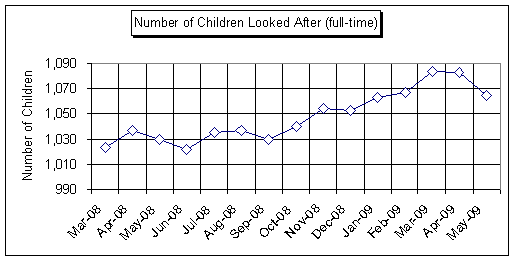
5.11. Despite this recent reduction in the overall number of Children Looked After, present activity numbers indicate that the department continues to face a significant budget pressure during the 2009/10 financial year. Children Looked After budgets will continue to be scrutinised and monitored closely throughout the year.
5.12. These children are in a number of different placement arrangements including fostering and residential care, as well as other arrangements such as supported lodgings, secure welfare accommodation (secure remand accommodation arrangements are not reflected within Children Looked After activity or expenditure), children placed for adoption (subject to final approval), as well as in some circumstances living at home with their parent(s) on care order. It excludes children with a disability who receive short programmed breaks.
Number of children in full-time care by children with a disability (CwD) and non-disabled children) |
March 2008 |
% |
March 2009 |
% |
May 2009 |
% | |
Non-county placements |
Non-disabled |
14 |
1.4 |
14 |
1.3 |
17 |
1.6 |
CWD |
40 |
3.9 |
37 |
3.4 |
37 |
3.5 | |
Total |
54 |
5.3 |
51 |
4.7 |
54 |
5.1 | |
HCC residential children's homes [1] |
Non-disabled |
31 |
3.0 |
35 |
3.2 |
33 |
3.1 |
Independent Fostering Providers (IFP) |
Non-disabled |
131 |
12.8 |
163 |
15.0 |
163 |
15.3 |
CWD |
12 |
1.2 |
12 |
1.1 |
12 |
1.1 | |
Total |
143 |
14.0 |
175 |
16.1 |
175 |
16.4 | |
HCC Fostering |
Non-disabled and CwD |
592 |
57.9 |
630 |
58.1 |
623 |
58.5 |
Other |
Non-disabled and CwD |
203 |
19.8 |
193 |
17.8 |
180 |
16.9 |
1,023 |
1,084 |
1,065 |
|||||
[1] excludes programmed short-breaks for CWD
5.13. This table demonstrates that whilst the overall number of children has reduced, a greater proportion of these children are being placed in either a foster care or residential placement whilst other less costly arrangements (e.g. those placed at home on care orders and in supported lodgings) have reduced.
Number of Children Looked After in either a residential or foster care placement |
Proportion of total number of Children Looked After (%) | |
March 2008 |
820 |
80.2 |
March 2009 |
891 |
82.2 |
May 2009 |
885 |
83.1 |
5.14. Most of this increase has resulted in the need for additional foster care placements. The number of children placed within the in-house foster care service has continued to increase over the previous financial year (from 592 as at the end of March 2008 to 623 at the end of May 2009) as a result of increase capacity generated from the fostering investment strategy. However, demand for fostering placements has increased beyond the additional capacity built within the in-house service, resulting in the continued need for more costly Independent Fostering Provider (IFP) placements.
5.15. During April and May, 14 children were placed in new IFP placements and 14 were recorded as ceasing. This demonstrates that whilst the overall net number of IFPs has not changed since the end of March 2009, the demand for this type of placement is still very high, despite the increased capacity generated within the in-house service.
5.16. The number of in-house foster care placements has slightly reduced from 630 at March 2009 to 623 at the end of May 2009. However, it should be noted that it is not always possible to access a suitable placement within the in-house service. Foster carers are often registered to accommodate only children within a specific age range, and for a maximum number of children. However, the needs of an individual child for whom a placement is being sought may not fit with these criteria (e.g. a child needing to placed on their own or as part of a wider sibling group), and this can therefore result in the need for an IFP or residential placement to be sought.
5.17. The need to ensure placement stability for those children in care remains an important factor in the decision making process in securing a suitable placement for the child. Performance on placement stability is gradually improving.
5.18. It is too early to say with any certainty what the potential financial impact of increased levels of activity could be, although initial work undertaken suggests that this could be in the region of between £1.0m and £4.5m depending upon whether activity levels continue to reduce over the coming months or begin to grow again.
5.19. Further work is underway within the Department to further analyse and monitor all of these potential pressures to determine the anticipated impact they will have in 2009/10 and in future years. Where necessary, alternative savings will be identified to enable the department to achieve a balanced budget within 2009/10.
6. Additional Safeguarding Funding
6.1. As outlined in the report to the Executive Lead Member in March 2009, an additional £1.2m was provided to Children's Services in 2009/10 towards meeting the cost of reducing risk in the practice of safeguarding through maximising the time available for qualified social workers to work directly with clients and focus on high quality social work practice. This additional resource focuses on increases in service provision to support to front-line social workers and includes:
· recruitment of additional social care support staff and family support workers
· recruitment of additional Independent Reviewing Officers
· establishing a new on-site Hantsdirect children's social work team.
6.2. Progress recruiting to vacancies has been extremely successful with all 18 additional social care support staff and 16 family support worker posts now recruited to. Four of the five Independent Reviewing Officers posts have also been appointed to and five social workers have been appointed to the new Hantsdirect team. The few remaining vacancies are in the process of being advertised or considered as part of the Hantsdirect restructure following creation of the new on-site children's team, and it is anticipated that most of these posts will be fully appointed to by September 2009.
6.3. It is envisaged that there will be some one-off budget savings achieved during this year against the £1.2m funding provided, and this will be deployed by the department to mitigate some of the other emerging pressures outlined within section 5 of this report.
7. Efficiencies
7.1. The 2009/10 budget strategy requires the achievement of £3.216m of cashable efficiency improvements. The individual targets are outlined below:
£000 |
£000 | |
Cashable efficiency improvements producing a budget saving: |
||
Intensive Support Service |
450 |
|
Home to School Transport re-tender |
200 |
|
Hampshire Inspection and Advisory Service |
315 |
|
Children's Services IT efficiencies |
44 |
|
Service targeted efficiency savings |
1,562 |
|
Sub-total |
2,571 | |
Cashable efficiency improvements not producing a budget saving: |
||
Independent Fostering Providers |
300 |
|
Increments and re-grading |
328 |
|
Supporting extra 3 year olds |
17 |
|
Sub-total |
645 | |
Total |
3,216 |
7.2. The department is confident at this stage that these targets will be achieved. However, the £1.562m of service targeted efficiency savings will need to be carefully monitored through out the year as this achievement of this target will be key to the department achieving a balanced budget at the end of the financial year.
8. Children's Centres
8.1. Children's Centres are a Government initiative intended to provide better outcomes for children, families and local communities, acting as a local hub for a wide range of integrated services.
8.2. The total funding for Children's Centres in 2008/09 was £12.5m, of which £6.2m related to the Children's Centres service budget. The remaining £6.3m represented funding provided to the business unit which is considered separately in paragraph 9.1. This overall funding is made up of Sure Start, Early Year and Childcare grant funding, as well as a carried forward contribution of £1.4m Dedicated Schools Grant agreed by Schools Forum.
8.3. For 2008/09 the Children's Centres Service reported an underspend of £94,000 against the available budget of £6.212m in respect of school managed and third party centres, support related expenditure, and centrally allocated budgets. This is summarised in the table below:
Budget |
2008/09 Variance | |
£000 |
£000 | |
School managed and third party children's centres |
3,762 |
52 |
Children's Centres support costs |
1,200 |
-156 |
Children's Centres Service central expenditure |
1,250 |
10 |
Total |
6,212 |
-94 |
8.4. The budget allocation for Children's Centres in 2009/10 is currently estimated at £14.6m. Of this, £8.0m relates to the Children's Centre service, and £6.6m is in respect of funding contributed to the business unit.
8.5. Further information about the Children's Centres business unit is provided in paragraph 9.1.
9. Business Units
Children's Centres Business Unit
9.1. An in-year surplus of £0.3m was achieved by the business unit resulting in an overall reserve balance of approximately £1.4m as at 31 March 2009. This includes a carry-forward of £0.4m Dedicated Schools Grant to 2009/10 as agreed with Schools Forum.
9.2. The most significant reason for the surplus balance is due to additional income secured by centres during the latter part of the financial year for them to undertake activities which will happen during 2009/10 (approximately £0.2m). A small increase in income received from fees and charges for nursery fees previously not accounted for (£20,000) also contributes to this final position.
9.3. A number of large projects which had been planned for 2008/09 (against the overall reserves available) did not happen. However, plans are in place to ensure that these reserves are used during 2009/10 to improve facilities and services in communities where Children's Centres are based.
Other Business Units
9.4. Appendix 3 shows the education business unit balances as at the 31 March 2009 compared with the original budget. This shows that an overall in-year surplus balance of £1.453m has been achieved against the original budget. Reserves as at 31 March 2009 stood at £4.7m.
9.5. This is an increase of £0.876m in the estimated reserves reported to the Executive Lead Member for Children's Services (Education) on 12 March 2009. The most significant changes relate to:
· Hampshire Inspection and Advisory Service (HIAS); and
· Education Information and Communication Technology (EdICT).
9.6. The HIAS surplus has increased by £0.507m since the last report, resulting in the overall reserves for the business unit increasing to approximately £2.974m as at 31 March 2009. This increase has mainly arisen as a result of additional income generated by both the inspection and advisory service and Hampshire Teaching and Leadership College which was not previously anticipated.
9.7. EdICT's surplus is £0.350m higher than previously forecast. Efficiency measures introduced through the year have led to a reduction in expenditure. In addition more income was generated by EdICT in the last quarter of 2008/09 than has been anticipated. EdICT's reserves now stand at approximately £0.549m.
9.8. Other significant surpluses include Stubbington Study Centre whose reserves were £0.438m as at 31 March 2009. It is intended that these will be used towards meeting the cost of replacement dormitories in the future.
9.9. All Business Units are in the process of finalising their business plans for 2009/10. However, the key issues which are emerging from these plans include:
· overall, an in-year deficit of £1.426m is forecast which would result in a reduction in cumulative reserves to £3.279m as at 31 March 2010
· HIAS is projecting a deficit for the year of £0.948m. The business unit will be meeting the expected shortfall in funding for the National Strategies Consultants' posts in 2009/10, as well as for the following two years. HIAS will also fund the continuation of market supplement payments and the shortfall on core funding as no inflation allocation has been given for 2009/10. The Unit's reserves are therefore forecast to reduce to £2.026m as at 31 March 2010, and these are anticipated to be used over the following two years towards further school improvement.
· EdICT is currently forecasting a deficit for 2009/10 of £0.381m which would reduce the Unit's reserves to £0.168m as at 31 March 2010. However, as there is still uncertainty regarding the value of a number of EdICT's income streams, this projection should be treated with some caution at this stage
· Education Financial Services, Hampshire Governor Services and Minstead Study Centre are also projecting smaller in-year deficits, totalling £97,000.
9.10. A further update on these issues will be presented to the Executive Lead Member in the next report.
9.11. Appendix 4 outlines the Business Units anticipated financial position for 2009/10, based on their draft business plans.
10. Partnerships
10.1. Within Children's Services there are two significant partnerships - Wessex Youth Offending Team (YOT) and the Comprehensive CAMHS Commissioning Trust. A partnership is considered to be significant where the County Council has a net financial impact estimated to be in excess of £0.250m over the life of partnership.
Wessex Youth Offending Team
10.2. The Wessex Youth Offending Team (YOT) is funded primarily by the Youth Justice Board (YJB) and partner organisations (whose contributions may be in cash and/or in kind). For 2008/09 the Children's Services contribution was approximately £2.9m.
10.3. The final outturn for 2008/09 was an overspend of £11,092, which was funded from reserves.
10.4. At its meeting on 10 June 2009, the Management Board considered a gross budget proposal for 2009/10 of £10.4m, in accordance with the Wessex YOT funding agreement with partner agencies for 2008/09 to 2010/11. However, the Board agreed to review the contributions of two of the partners:
· Hampshire Probation. A paper set out the national requirement for Probation Areas and Trusts to reduce budgets by 12.7% over the next three years. The proposal for 2009/10 is to maintain the contribution at the 2008/09 level of £0.750m (a reduction of £14,000 compared with the previously agreed figure), with further reductions in 2010/11 and 2011/12 (to £0.655m). It was considered that the 2009/10 figure could be met by changes to staff profiling. Further consideration would be made regarding the longer term impact, at a future meeting
· Hampshire Police. A proposal to agree reduced funding based on changes to the staff profile (mix of police officers, case workers and admin staff) was considered and agreed, subject to finalising figures. A reduction of about £60,000 per annum is envisaged.
Comprehensive CAMHS Commissioning Trust
10.5. The Comprehensive CAMHS Commissioning Trust provides services focused on promoting and restoring the emotional well-being of children and young people. The Trust is a partnership between Hampshire County Council and the Hampshire Primary Care Trust, who provide some of the services. Most services are commissioned through contract arrangements. These include NHS providers and other organisations who provide support for children and young people with emotional, social, and mental health needs.
10.6. The final outturn for 2008/09 was an underspend of £0.511m, of which £64,862 was returned to partners. The remaining £0.446m has been carried forward to 2009/10 towards meeting the cost of a number of identified projects.
10.7. At its meeting on 9 June 2009, the Management Board agreed a budget of £10.1m for 2009/10 (including the carry-forward from 2008/09). This represents Phase 2 of the pooled budget arrangement for which there is a formal agreement in place.
10.8. Some contractual arrangements and funding issues are still being finalised and will be agreed at the Board's next meeting in September.
11. Performance
11.1. The department will provide a separate update to the Executive Lead Member for Children's Services on current performance issues and achievements. Any key issues impacting on the financial position reported by the department will also be identified within future revenue budget reports.
12. Future direction
12.1. The department will monitor its forecast outturn against the available cash limit throughout 2009/10 using a risk based approach to reporting variances. A regular update report will be presented to the Executive Lead Member for Children's Services outlining any key or high risk issues.
12.2. This information will be used as part of a wider integrated service planning approach by the department to inform the proposed budget for 2010/11 to 2012/13.
13. Appendices
13.1. The following appendices are attached:
Appendix |
|
1 |
Final Accounts report to Cabinet - appendix summarising 2008/09 main variations within the service |
2 |
Summary of growth and redeployment proposals outlined in 2009/10 budget setting strategy |
3 |
Business Units - summary of reserves as at 31.03.09 |
4 |
Business Units - summary of anticipated position for 2009/10 |
14. Recommendations
14.1. Note the final outturn position for 2008/09 for the department and the potential impact on 2009/10.
14.2. Agree the current financial issues that are being addressed within the 2009/10 budget and the management action required in the areas of particular pressure.
14.3. Note the latest financial position of the Wessex Youth Offending Team and the Comprehensive CAMHS Commissioning Trust.
14.4. Approve the use of an additional £6.715m Dedicated Schools Grant available in 2009/10, as agreed by Schools Forum on 10 July 2009 and set out in paragraph 3.10.
14.5. Note the position of School Balances as at 31 March 2009.
14.6.
CORPORATE OR LEGAL INFORMATION:
Links to the Corporate Strategy
Hampshire safer and more secure for all: |
Yes |
Corporate Business plan link number (if appropriate): | |
Maximising well-being: |
Yes |
Corporate Business plan link number (if appropriate): | |
Enhancing our quality of place: |
No |
Corporate Business plan link number (if appropriate): | |
Other Significant Links
Links to previous Member decisions: |
|||
Title |
Reference |
Date | |
Children's Services Revenue Budget 2009/10, 2010/11 , 2011/12 |
Item 2 |
21 January 2009 | |
Budget Monitoring 2008/09 - Children's Services Department - Period 10 (January 2009) |
Item 1 |
12 March 2009 | |
Direct links to specific legislation or Government Directives |
|||
Title |
Date | ||
Section 100 D - Local Government Act 1972 - background documents | |
The following documents discuss facts or matters on which this report, or an important part of it, is based and have been relied upon to a material extent in the preparation of this report. (NB: the list excludes published works and any documents which disclose exempt or confidential information as defined in the Act.) | |
Document |
Location |
IMPACT ASSESSMENTS:
1. Equalities Impact Assessment:
1.1. Equality and diversity objectives are not considered to be adversely affected by the proposals of this report.
2. Impact on Crime and Disorder:
2.1. Crime and disorder objectives are not considered to be adversely affected by the proposals of this report.
3. Climate Change:
a) How does what is being proposed impact on our carbon footprint / energy consumption?
· No impact
b) How does what is being proposed consider the need to adapt to climate change, and be resilient to its longer term impacts?
· No impact