
Archived decisions
HAMPSHIRE COUNTY COUNCIL
Decision Report
Decision Maker: |
Executive Lead Member for Children's Services | ||||
Date of Decision: |
22 July 2009 | ||||
Decision Title: |
Departmental Workforce Plan for Children's Services 2009/10 | ||||
Decision Reference: |
712 | ||||
Report From: |
Director Of Children's Services | ||||
Contact name: |
Joanna White | ||||
Tel: |
01962 847229 |
Email: |
|||
1. Executive Summary
1.1. This report outlines a departmental workforce plan for Children's Services for 2009/10 in line with corporate reporting requirements. The report contains a number of Appendices that are referred to in the report. A summary of proposed changes is shown as Appendix 1. During the year, in order to respond effectively to needs identified there will be further changes in the deployment and focus of staff within the overall funding available. The major factors are identified within the report.
2. Departmental Review of 2008/2009 - Key issues from last year's plan:
Departmental and corporate
2.1 Services for Young People (SFYP)
· The TUPE transfer of former South Central Connexions staff took place on 1 April 2009. The service continued to operate effectively thanks to the efforts of all staff to work through the transitional phase and to minimise any adverse impact on the young people. Adjustments were made to the proposed structure in order to ensure we retained the capacity to deliver the integrated service.
· The planned recruitment exercise of a number of practitioners (personal advisers) took place in October and was very successful. Induction and on going training continues to be a priority to embed good practice and assist staff to operate effectively.
· New posts were offered on EHCC 2007 terms and conditions and a number of staff who transferred under TUPE accepted the offer of a transfer to these pay and conditions.
2.2 Pay framework
_ Post pay and benefits implementation staff in the Residential units moved from inclusive pay to claims for hours worked at weekends and at night. This has resulted in an increase in attendance management issues that are being addressed.
2.3 Flexible working
_ Further development of Ashburton Court East as a flexible working environment and increased use of flexible working in other offices has continued.
2.4 Hantsdirect
_ Hantsdirect took responsibility for first contact calls for Children and families and some aspects of admissions during the year.
2.5 Safeguarding
_ Safeguarding, in its widest sense remains a priority and the Director has led a number of events, open to partners and departmental staff to learn from the events in Haringey and to constructively review how we are operating.
Education and Inclusion
2.6 The planned changes to the senior management team have taken place with Melanie Saunders taking on a wider range of responsibilities as County Manager, Educational Improvement that includes leading HIAS as well as the Services for Young People teams that are delivered via the 9 Consortia teams.
2.7 The new role of Business and Administration Manager, held by Janet Barrow, is working as part of the Branch Management team, and advises on a range of business strategy issues.
2.8 There have been some difficulties in recruiting to Senior Inspector adviser posts and Primary Phase Inspector posts that have only been partially resolved by the addition of a market supplement. This situation will be kept under review.
2.9 The way that the Education and Inclusion Service delivers education through its Education Centres has been reviewed in the light of the government white paper Back on Track. This builds on and revisits the work started last year on the restructure of the Team for Education Children in Care (TECiC) and is still work in progress. This is being led by Derek Myers, in his new role as strategic lead for the provision of education for vulnerable children and the Area Directors. The proposal is for the education of vulnerable children to be more fully integrated under a single management committee. Country wide focus and support will be provided via a small central team reporting to the County strategic lead. Brian Pope will provide an update nearer the report deadline.
2.10 Building Schools for the future (BSF) is a major initiative and the departments has realigned its senior structure in order to lead this work in a way that ensures integration across the County. The programme is led by Bob Eardley as Project Director, Building Schools for the future.
2.11 The final phase of the Children's Centres project is now rolling out.
Children and Families
2.12 Early in 2009 the Deputy Director retired. After a national campaign Steve Crocker was appointed as the successor and took up the post in mid April.
2.13 The restructure of the social care teams has been completed to realign and refocus resources and better provide for the delivery of integrated services. In tandem with this realignment of teams the roll out of Swift and the significant training required has been managed on a phased area by area basis.
Performance and Resources
2.14 The performance and planning team have done much to develop and improve the performance management framework to ensure that local leaders and managers have access to qualitative data and information to inform local multi agency decision making.
2.15 Data and information needs are becoming ever more complex in terms of both the requirement to make statutory returns and to use information at a local level to inform strategy and decision making. During the year the way the individual teams work has been reviewed to form the Data and Information team for Children's Services. This change has brought together the various parts of the overarching data process (e.g. collection, validation, maintenance, analysis and reporting) so that there is a much clearer focus and clearer overall leadership of the various work areas.
2.16 As part of the overall governance of data and information within the department, a greater focus is required in ensuring that the quality of data is kept at the highest possible level. A new role of Data Protection and Quality Advisor (DPQA) has been developed in order to act as the Children's Services departmental Data Quality Lead, to advise senior managers on data quality issues (relating to data held on children), including all processes and activities required to enhance data quality within the department. The DPQA will also act as the Children's Services Departmental Data Protection and Information Sharing lead ensuring compliance with relevant legislation and appropriate advice and guidance to staff at all times.
2.17 The department is required to respond to a number of government driven national data and information streams including three significant areas:
_ Schools Workforce Census
_ National minimum Data set
_ Contactpoint
Currently the implementation phases are being managed through a project framework. The on going resourcing requirements are identified as part of the workforce plan.
2.18 Early in 2009, the dedicated training and development team for Children's Services was formed. This team, with a new Head of Organisation and Staff Development will have a key role to play in driving cultural change and the integration of service delivery across the whole department and in developing the Children's workforce.
2.19 The administrative support service, managed through Local Area Administrative managers continues to develop.
Wessex YOT
2.20 The 3 year plan is now in its second year with partners contributing to the pooled budget as anticipated.
3. Finance
3.1. The posts in the Summary of Workforce Changes 2009/10 have been reflected in the development of the Children's Services Department budget for 2009/10 and the planning of the use of specific government grant and all are funded as shown.
4. Performance
Workforce Profile and commentary 2008/2009
Workforce Profile
|
|
As at 31.03.08 |
As at 31/03/2009 |
Difference |
|
|
|
||
|
Employees |
3,092 |
3,527 |
+435 |
|
FTE - Actual |
2,435 |
2,802 |
+367 |
|
Part Time Employees |
1,269 |
1,475 |
+206 |
|
Part time FTE - Actual |
612 |
750 |
+138 |
|
Temp Employees |
270 |
284 |
+14 |
|
Temp staff FTE |
205.2 |
215.5 |
+10.3 |
|
PT / FT staff ratio 1: |
1.4 |
1.4 |
- |
|
Overtime Hours |
5,175 |
4,044.1 |
-1131 |
Headcount and FTE
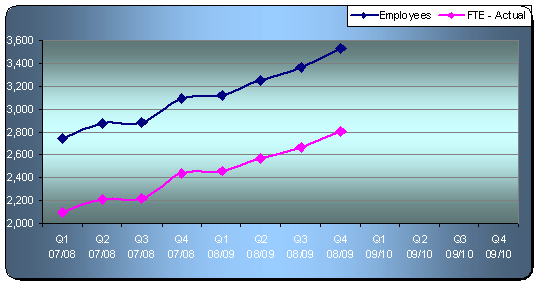
4.1 The increase in employees was predicted and is primarily as a result of the TUPE transfer of South Central Connexions staff in April and the additional posts as Children's Centres have become fully operational.
4.2 The department is increasingly needing to work in a responsive and reactive way as funding streams are identified and we are successful in our bids that enable us to recruit staff, often on temporary contracts initially.
4.3 The overall ratio of part time to full time staff has remained generally consistent during 08/09 having decreased at the end of 2007. The department actively supports a range of part time and flexible working options and this will continue.
4.4 In some areas of specialist work we need to use consultants to carry out specific, often specialised work either on an assignment basis or a short term contract. During the year 09/10 the commissioning team will be exploring how this type of activity can be better coordinated.
4.5 The age profile is broadly in line with that of the County with significant numbers of staff in the range 45 - 59. Further work is required to ensure succession planning and the structure of the department takes this into account.
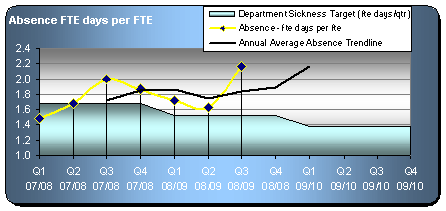
4.6 Overall the level of sickness absence across the department has increased slightly. This may be in part due to better recording but is a concern. The anticipated outturn for the current year to date at 6.6 days per FTE is 0.3 days per FTE higher than the previous full financial year.
4.7 Proactive attendance management is a priority for the department. In support of this a number of workshops have been rolled out with the emphasis being on managers of teams where there are aspects of attendance that need to be addressed. The HR team is currently reviewing the impact of these sessions on actual attendance levels. The Occupation Health team has supported the workshops and the greater use of this service and case conferences has been well received by managers and enabled earlier intervention.
4.8 Through Managers Self Service managers are able to access up to date information on an employees absence levels. Managers will soon be receiving an automated "trigger report" that will highlight staff who, have or are about to, reach a level of absence that needs to trigger some further action. Additionally the senior manager will receive a consolidated report to enable informed discussions to take place to monitor activity.
Absence Days per FTE
5. Other key issues
5.1 The Children's Trust will work to enable children and young people with additional needs, to have easier access to support, by improved integration of services. This will include services delivered through Building Schools for the Future, Extended Schools, children's centres and strategies for CAMHS, behaviour and attendance and special educational needs (SEN).
5.2 Providers of services for children and young people have a duty to ensure that
services are accessible and to encourage engagement with the Common Assessment Framework (CAF a standardised approach for assessing a child's additional needs and deciding how they should be met).
Services will work together in local groups to deliver a partnership approach based on identified need. This will be supported and facilitated by integrated service planning through:
o a comprehensive approach to prevention and early intervention by the establishment of local cluster partnerships of services
o local access to advice and support services, based on the identified needs of individual children and families
o the engagement of vulnerable children and families in the planning and delivery of services
o preparing and training all agencies to use the Common Assessment Framework; and promotion of the lead professional role in co-ordinating services for individual children and families
o ensuring all professional services work together in providing support, preventing any unnecessary referral of families
o development of local service directories to signpost provision against identified needs
o ongoing evaluation of service provision against need to inform the commissioning cycle.
6.0 Key Departmental Workforce Issues for 2009/10
Safeguarding
6.1 The importance and high priority of safeguarding children in Hampshire has never been in doubt and has always been robustly supported by politicians and officers alike. However, the national profile, high risks and political significance of child protection and safeguarding have been highlighted by the events in Haringey and will now be subject to even greater scrutiny in the years ahead.
6.2 There are ways to reduce some of these pressures, and therefore reduce risk. Additional funding from 2009/10 has been identified to increase social care support staff in a number of areas. The details are shown in Appendix.1. These staff will:
o Redress the balance of time that qualified social workers spend on non-contact and `back-office' functions to ensure that they can spend more than half their time in direct client casework contact. Strengthen the permanent professional social work input and [presence in Hantsdirect to ensure that the end to end process of safeguarding in Hampshire is as robust as possible.
o Increase the effectiveness of the Independent Reviewing Service by reviewing the current combined functions of the child protection and children in care and increasing the staff resource within the service. This will enable more robust monitoring and reporting against statutory requirements and ensure that the ongoing internal evaluation of the performance of our safeguarding function has levels of caseload and responsibility in line with the best performing comparator authorities.
Recruitment to the new posts has been actioned and staff began to take up posts from April 2009. During the year progress will be measure by:
o The increase in time available to qualified social workers to devote to direct client contact
o The quality of social work practice as reported through regular file auditing.
o The establishment of a high quality file auditing programme managed and resourced by the Independent Reviewing Service.
Recruitment and Retention
6.3 Social care. The new pay framework, together with the greater numbers of qualified graduates entering the profession has significantly improved our ability to recruit qualified social workers particularly those with less experience. However, the retention of qualified social workers and difficulty in recruiting those with the level of experience needed to take on the more challenging cases is more difficult. There is also some concern over the quality of some of the newly qualified applicants for front line roles.
There is some evidence of an increasing level of turnover amongst professionally qualified staff. These issues will be tackled within the Department level by a concerted and integrated effort including:
o Better support and induction for staff
o On-going support and development when in employment
o Talent management and succession planning
o Better embedding of performance management skills across the department
o Monitoring of exit information
o More focussed recruitment campaigns
6.4 We are actively involved in a range of initiatives stemming from the Laming Report. A number of national initiatives are in the early stages but link to much of our local work touching on:
o Return to work and fast track entry possibilities
o Team structures and potential for workforce remodelling
o Improving the profile of children's and families social workers as a valued and challenging career choice
o Tackling issues linked to the use of recruitment agencies and improving our ability to manage this interface effectively without driving up costs.
6.5 There is a national shortage of skills in some sectors many of them schools based (Section 10 highlights these in more detail). These shortages, coupled with comparative pay levels in schools, are impacting on some central staff posts that require significant, recent education based experience. This has been most recently seen in difficulty in recruiting to Education Officer roles in the SEN service and in filling primary Phase Inspector posts. To some extent the addition of market supplements has helped. Activity on a number of fronts will need to continue to mitigate the impacts.
Workforce Development
6.6 The new post of Head of Organisation and Staff Development was filled in Dec 08 and the framework of a new Learning and Development (L&D) team was established in January 2009. This new team will become the single focus for all L&D activities across the Children's Services Department; it will address areas of known duplication and the attendant risk that key messages and best practice are not applied uniformly to all learners. Further organisation change is currently taking place and will continue in order to ensure that the new team is properly structured and resourced to deliver its three-fold remit:
o To ensure the delivery of effective organisation and staff development across the breadth of Children's Services.
o To liaise with multi-agency partners in ensuring that appropriate training is provided for, and attended by all members of the Children's and Young People's Workforce; and
o To use L&D activities as a driver to help bring about the change in culture required to build an integrated workforce with a singular identity.
6.7 The establishment of the new L&D team is a significant step towards making CSD a "learning organisation". A number of management initiatives and changes will be necessary in order to make real this intention, and will be developed by the new L&D team. Drawing heavily on the direction contained in the "2020 Children and Young People's Workforce Strategy" (DCSF - December 2008) and other reports which highlight the need for more focussed and universally accessible training (including that of Lord Laming - March 2009), measures will include:
o Recognising that in support of business outcomes some training/development activities are absolute pre-requisites and thus need to be mandated, not offered as "opportunities"
o Introduction of a department-wide recording system for all work based personal training
o Introducing a programme of organised personnel exchanges across the department to aid integration and career development
o Reviewing current local arrangements for granting support for attendance on courses (e.g. OU) and establishing common selection criteria in line with business needs
o Review and further development of the Workforce Development Strategy to reflect the new L&D operating context.
HantsDirect
6.8 Hantsdirect began to take social care calls during 2008/09. Building on the experience gained to date during 2009/10 it is planned to create a Children's Services team embedded within Hantsdirect. The operational issues to achieve this new structure and transfer staff from HantsDirect with the right skill mix have been determined. As an initial step appointments have been made to 3 qualified social worker posts and a team leader post all of which are part of the embedded Children's Services team in HantsDirect. This embedded team will result in a number of posts transferring from HantsDirect to the department as well as some recruitment of staff.
Learning and Skills Council (LSC)
6.9 The County Council will assume responsibility for some functions previously undertaken by the LSC. Shadow arrangements are due to be in place by September 2009 and the full transfer will be effective from April 2010. Up to 16 posts will transfer with their associated accountabilities.
Services for Young People
6.10 A year since the transfer of responsibility to Hampshire County Council has seen significant progress and at an operational level, within districts and areas, the advantages of working ever more closely together are increasingly apparent. In the light of the LSC work, the further development of Children's Trusts and the need to focus efforts through integrated activity both strategically and operationally further incremental changes are likely during the year.
6.11 As the service develops the opportunity will be taken to adjust structures and the work covered by specific posts in order to deliver the service more effectively. Such changes will be contained within current budgets. A new post will on take on specific responsibility for coordinating a range of SfYP premises related work, including health and safety aspects.
Wessex Youth Offending Team (WYOT)
6.12 Following the appointment of the Head of Wessex YOT to a new post within the Children Services department the process to appoint a replacement began in April. The new Head of Wessex YOT took up post in June.
6.13 An additional £25,000 will be invested in front line staff in 2009/10 in addition to the £100,00 in 2008/09. Overall the focus will be on consolidation of the workforce and in training staff in the implementation of the new court order (YRO).
6.14 The management teams are considering ways in which the service can respond to achieve a saving target of 12.7% over 3 years from the Probation Service. These are likely to be achieved by changing the skills mix of the staff as opportunities arise.
Education and Inclusion
6.15 Initial funding is due to conclude in 2010/2011 for Extended Schools and parenting support and work will need to begin in the current year on the core team needed to support the front line activity.
6.16 There are approximately 25 posts within HIAS that are funded from external sources linked to specific national strategies. Funding is contained within the Central Coordination Grant this has budget guidelines up to 2010/11 however, if there were to be major shift in direction from the DCSF, as seems likely, a number of fixed term posts would need to end
6.17 Following the HIAS review in 2008/09 lead responsibility for development and advice on Physical Education related issues transferred to the Outdoor Education, Physical Education and Sport Service. A new post of Physical Education consultant will work as part of this team and support schools in developing practice in this area.
6.18 Government initiatives including Gaining Ground Schools and Back on Track will have implications for staff that will need to be developed during the year.
6.19 The work to realign the work of the inclusion service and the education centres and ensure a better focus and integration of support for the education of vulnerable children including those in care will be concluded during the first half of the year. This is the final stage in the TeCiC reorganisation. This may result in some redundancies where redeployment cannot be achieved. Consultation with unions and affected staff has begun.
6.20 The Building Schools for the Future (BSF) team is now in place and in order to achieve a fully integrated approach some changes are being made to the structure of the strategic planning unit. These changes are reflected in Appendix 1. The opportunity has been taken to align home to school transport with the Admissions team as there are some clear synergies between these areas of work.
Early education and Childcare Unit
6.21 In 2009/10 and 2010/11 the Sure-Start Early years childcare grant will increase and this enables the section to realign its resources to better deliver area based support. The area based service will align better with the overall structure of the Department and opportunities will be taken to exploit areas where fuller integration can be achieved. A number of new posts will be needed to provide greater capacity to deliver support across the County. The details are shown in Appendix 1. As the Centres develop their work opportunities will be taken to increase staffing where there is increased demand and funding can be identified.
6.22 Children's Centres
Following the commissioning process the decision has been made to manage six of the final phase of Children's Centres in house. The proposed staffing impact is shown as Appendix 2.
Performance and Resources
6.23 The scale of change needing to be supported by the Children's Services IT and data teams is enormous encompassing building Schools for the Future and strategic technologies for schools, e-CAF (common assessment framework), ICS, Contact Point and schools workforce census. Data analysis and collection is becoming increasingly important and complicated and there is ever increasing demand for web development and maintenance.
6.24 Within the department work will continue to define roles and accountabliti3es more clearly and to ensure data can collected, analysed and presented in a way that aids strategic and operation decision making. At the same time a planned approach to knowledge transfer is taking place so that there is great flexibility in the ability of staff to mange and interpret the various data returns. 5 additional posts are required to manage the new data systems (Appendix 1).
6.25 In the coming year the Commissioning and Contracts teams will develop in order to effectively manage the very significant procurement and commissioning activity within the department. The increase in activity is largely as a result of procurement needs that will be triggered by significant government programmes, (Aiming High, Care Matters) and the change in the Learning and Skills Council (LSC) funding arrangements.
6.26 The post of Head of Business Services (HoBS) is currently vacant and the opportunity has been taken to review this post. Home to school transport, mentioned in Section 6.2 is now in the Education and Inclusion branch whilst the remaining accountabilities have been retained within Performance and Resources with some changes to line management arrangements. The post will be advertised with a realigned set of responsibilities to support work around the efficiencies agenda and other major change programmes.
Field Study Centres
6.27 Work will continue on exploring the management and operation of the Field Study Centres' in order to maximise their use. This may result in some increase in staffing levels in order to extend the hours that the Centres are able to operate. Any increase will be based on a business case.
6.28 If the Field Study Centres become successful in attracting substantial weekend and school holiday groups it will be necessary to move towards a staffing structure that enables this. It is likely there will be implications for the terms and conditions for some staff currently employed within the Study Centres.
7 Key Schools Workforce Issues
7.1 The key workforce data for schools is outlined in the table below. Comparative data is not currently available in all areas but is being collected for comparison in future years.
Schools Workforce Profile - 2008/09
Data |
Autumn Term 2008 |
Employee Headcount |
26,156 |
FTE |
16,927 |
Part-time employees |
17,719 |
Part-time FTE |
8,490 |
FT/PT ratio |
1 : 2.1 |
Temp staff headcount |
4,222 |
Temp/Perm ratio |
1 : 5.2 |
Male to Female ratio |
1 : 5.0 |
7.2 Of these 26,000 staff working in schools, the majority (61%) are in support roles with 34% in teaching roles. The remaining 5% are in senior leadership roles (i.e. Assistant Heads, Deputy Heads and Headteachers).
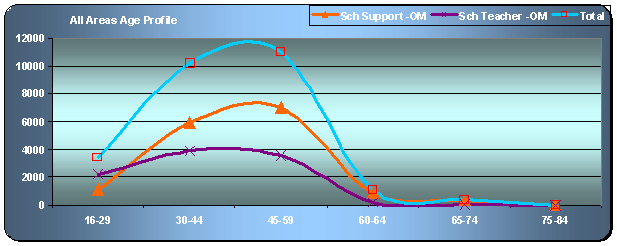
7.3 The age distribution (below) shows a peak in the 45 - 59 bracket for both support and teaching staff, with a sharp drop-off in the 60 plus brackets. Work is currently being undertaken on flexible models of leadership and with the Talent Management System to target senior leaders nearing retirement to seek to keep them engaged within the schools and wider Children's Services workforce.
Age Distribution - Schools Workforce
7.4 With regard to sickness absence, the 2007-2008 academic year saw 5.6 days per FTE. Currently the anticipated outturn for the 2008-09 academic year is 6.5 days per FTE. Whilst this is higher that the previous year, work has been undertaken with schools to encourage accurate reporting and input.
7.5 Education Personnel Services (EPS) have been working with the Health, Personal Development and Wellbeing Team and other teams within the authority (eg Occupational Health and Children's Services Health and Safety) to develop an approach to wellbeing which encompasses both pupil and staff wellbeing. The resources for promoting Wellbeing of the Workforce (WoW) have been developed and accessed through Healthy Schools web pages. These were launched via a very successful conference in January 2009, which engaged over 100 school leaders, governors teachers and support staff. These resources include tools which schools can access to investigate staff wellbeing and tips for developing and sustaining strategies to embed wellbeing.
7.6 EPS are continuing to run Absence Management workshops, which have been well attended and received by schools, and are also working with Occupational Health to hold case conferences, which are also proving successful.
Current key workforce issues for schools
7.7 National priorities continue to drive Local Authority activity in relation to the supply, development and modernisation of the Children's Workforce in schools. Attention has been focused nationally on compliance with the statutory National Agreement. Compliance in Hampshire remains good in most schools and working in partnership with Teachers Liaison Panel, schools are both challenged and supported where compliance is a concern.
7.8 Whilst at present there is a limit of 38 hours per year that teachers can be required to cover for absent colleagues, the requirement for teachers to `rarely cover' is due to come into force from September 2009. This is requiring schools to review present timetables and to make adjustments as necessary to be able to meet this requirement from September 2009. The Local Authority anticipates an increased demand for Cover Supervisors and supply Teachers to undertake the supervision of pupils during short term teacher absences. Plans are in place to undertake a recruitment drive if required and to promote the Cover Supervisor role as part of a career pathway towards a Higher Level Teaching Assistant (HLTA) role.
7.9 This is coupled with a significant review of the provision of the supply teaching resource and a re-tendering exercise for HCC contracts with supply agencies is underway.
7.10 In response to recruitment difficulties in some areas, the Children and Young People Select Committee has undertaken a scrutiny process of Headteacher and Teacher recruitment, the outcomes of which have recently been responded to.
7.11 The introduction of Back on Track, the government requirement for schools to provide One-to-One tuition for targeted pupils, will create an additional demand on the limited teaching resource. Specific recruitment drives targeted for this initiative are likely to be required, particularly for the secondary sector where pupil numbers are high. Work has already been undertaken to support schools with the pay and conditions of these Tutors.
7.12 The developments to the 14-19 curriculum are requiring significant training for staff in schools. It is acknowledged that there is also considerable difficulty for schools in releasing staff for this training, due to abilities to cover the absences and this may become an increasing pressure. 14-19 reform will also lead to requirements for new patterns of working. The implications for this will need to be carefully managed in consultation with Teachers' Liaison Panel.
Leadership
7.13 Leadership programmes are assisting with the on going supply and quality of leaders for the 21st century , although the impact of these will take time to filter through. Programmes are beginning to move from a focus on senior leadership roles to both senior and middle leader roles within schools. The talent management system is now live with an initial pilot for the managed pool of candidates. The evaluation of the pilot will assist in the implementation of further development opportunities across schools. These programmes are also of critical importance to Children's Services Department as a whole as senior leaders in schools also have many of the skills needed to consider progressing to posts within the wider department and in particular the Education and Inclusion Branch.
7.14 Sitting alongside the vision of 21st century schools, work has also begun on promoting discussion around new models of leadership. These new models of Headship include opportunities for shared leadership across more than one school and more flexible models of leadership which enable Headteachers to take flexible retirement or seek a different work/life balance. These models also encourage more distributive leadership, thereby building capacity with middle leaders and Deputy/Assistant Headteacher as they step up to the next level of leadership.
Recruitment
7.15 The Children and Young People Select Committee Recruitment and Retention Report, dated March 2009, contains several recommendations regarding recruitment and retention of Headteachers and Teachers in Hampshire schools. The response to this report, which has recently been presented to the Committee, details new Education Personnel Services and Hampshire Teaching and Leadership College recruitment and development initiatives and on-going support being provided to schools.
7.16 EPS have secured a licence, from the UK Border Agency, to sponsor candidates under the points based immigration system. This licence can be used by to sponsor individuals from outside the European Economic Area who do not have entitlement to work in the UK through other means.
7.17 Schools are being encouraged to collaborate with respect to shared appointments of experienced staff. As 14-19 consortia relationships have developed, some schools have managed to fulfil short term needs through this closer collaboration with both school and Further Education College colleagues.
7.18 Secondary schools in the north of the county have experienced difficulties with recruitment to maths and science teaching posts and Heads of Department positions. In the past year, schools in the Basingstoke area have been actively involved in attracting staff from Australia.
7.19 Campaigns are also being developed with Special Schools to address recruitment difficulties. Discussions with Area Directors and Special School Heads are taking place to ascertain recruitment `hot spots' and particular difficulties with recruitment. Recently a special school head has been actively involved in recruiting staff from Canada. Another focus will be on how to promote better career development opportunities for staff in special schools and how to provide more school based practice for trainee teachers including those on Graduate Teacher Programmes.
7.20 The use of teaching and leadership responsibility payments (TLRs) in Special Schools will be investigated to encourage more teachers to develop their roles within special school leadership and to encourage new recruits to consider working in special schools as a career.
7.21 There continue to be small candidate fields for some Head teacher appointments leading to repeat adverts in some cases. The difficulties in filling some Headteacher posts at first advert have remained fairly constant over the last few years. Posts that are difficult to fill relate in the main to geographical areas such as Andover and Basingstoke. These tend to be in smaller primary schools who struggle with the challenges of the role against a lower ISR. However some secondary schools have been recently receiving as many as 45 applications.
7.22 Recruitment fairs, focused campaigns and graduate teacher programmes continue. Newly qualified teacher recruitment continues to be successful, at approximately 800 a year.
Retention (school based staff)
7.23 Turnover shows a continuing trend towards Headteachers leaving before the age of 60, however work has been undertaken to encourage governors to consider new patterns of flexible leadership which will both encourage experienced head teachers to remain within the system and support the development of Deputy and Assistant Headteachers.
7.24 Newly qualified teachers' retention rates after 3 years are above national average at around 75%.
7.25 The cessation of protection arrangements within the new pay framework has the potential to impact on lunchtime supervisory assistant retention in particular and steps are being taken to review role profiles and grading and to develop recruitment campaigns where appropriate.
Schools Workforce Development
7.26 The DCSF Children's Plan sets out high expectations for the development of the schools workforce. Work is being undertaken with local HE institutions in respect of the need to move towards a Masters led teaching profession.
7.27 Extensive success has been achieved in the professionalisation of the school support staff workforce with schools accessing professional development opportunities such as Higher Level Teaching Assistant status, NVQs, foundation degrees and the Support Work in Schools (SWiS) qualification. Last year 70 support staff accessed the HLTA programme, 30 undertook induction training for Parent Support Advisers (PSA), 84 achieved a SWiS qualification and 80 others received support with NVQs or foundation degrees. In addition, schools have been signposted to skills for life provision for literacy and numeracy and job related training within the Hampshire Teaching and Leadership College (HTLC) directory of training. The implementation of Individual Performance Planning (IPP) in schools has helped many Headteachers and support staff to focus on areas of professional development.
7.28 More generally schools are beginning to move towards greater collaborative arrangements supported by regulations. The challenges of the 21st century school offering highly responsive personalised learning will require schools to look beyond their traditional boundaries to provide this greater range of provision. This will lead to increased requirements for staff to work across more than one school and sharing of other facilities and resources. This is starting to become evident in relation to 14-19 consortia and Extended Service partnerships.
Workloads and staff wellbeing
7.29 Headteacher and teacher workloads continue to be a national and local focus. As indicated, compliance with the statutory National Workload agreement in Hampshire remains good in most schools and regular monitoring takes place with Teachers Liaison Panel and Support Staff unions to maintain the focus in this area. The successful conference on staff wellbeing has led to discussions with schools regarding further support that is needed to both raise the profile further and embed staff well-being practices. Work will also begin in the summer term with Headteachers and Governors on the entitlement and use of Dedicated Headship Time through roll out of practical workshops.
8 Recommendation(s)
That the Executive Lead Member for Children's Services approves the Workforce Plan for 2009/2010 together with the staffing changes identified in the report and the continuing need for the workforce to develop and change to continue to deliver services in line with the aims of the Children Act and local need.
CORPORATE OR LEGAL INFORMATION:
Links to the Corporate Strategy
Hampshire safer and more secure for all: |
Yes |
Corporate Business plan link number (if appropriate): | |
Maximising well-being: |
Yes |
Corporate Business plan link number (if appropriate): | |
Enhancing our quality of place: |
no |
Corporate Business plan link number (if appropriate): | |
Section 100 D - Local Government Act 1972 - background documents | |
The following documents discuss facts or matters on which this report, or an important part of it, is based and have been relied upon to a material extent in the preparation of this report. (NB: the list excludes published works and any documents which disclose exempt or confidential information as defined in the Act.) | |
Document |
Location |
IMPACT ASSESSMENTS:
1. Equalities Impact Assessment:
1.1 Race and equality impact assessment has been considered in the development of this report and no adverse impact has been identified.
2. Impact on Crime and Disorder:
2.1. The Children's Services Directorate works in many ways to reduce crime and key to this work is an effective workforce.
3. Climate Change: Not Applicable.