
Archived decisions
HAMPSHIRE COUNTY COUNCIL
Decision Report
Decision Maker: |
Cabinet | ||||
Date of Decision: |
27 July 2009 | ||||
Decision Title: |
The South East Hampshire Bus Rapid Transit Scheme, Phase 1 Fareham-Gosport (The appendix attached to this report is `Not For Publication') | ||||
Decision Reference: |
757 | ||||
Report From: |
Director of Environment | ||||
Contact name: |
Alison Quant | ||||
Tel: |
01962 845099 |
Email: |
|||
1. Executive Summary
1.1. At its meeting on 27 October 2008, Cabinet gave approval to submit a Full Business Case to the Department for Transport and the Department for Communities and Local Government in support of a bid for £20 million from the Community Infrastructure Fund 2 (CIF2) towards the Bus Rapid Transit Scheme (BRT) Phase 1 (Redland Lane in Fareham to Tichborne Way in Gosport). At that meeting delegated authority was given to the Director of Environment, in consultation with the Head of Corporate and Legal Services, to undertake a procurement process for the selection of contractors and consultants to work with the County Council to develop the preparation and design of BRT Phase 1.
1.2. The purpose of this report is to advise Members as to the current position with regard to the development of BRT Phase 1, and to seek Cabinet approval to continue to the implementation and delivery stage of the scheme, subject to planning permission being granted.
1.3. The report sets out the background to the BRT Phase 1 Scheme, briefly reminding Members of the extent of the works that are proposed to be delivered using £20 million awarded to the County Council from the Government's CIF2 towards the total costs of the scheme.
1.4. In highlighting the funding arrangements and associated financial implications, the report emphasises the significant constraints that the CIF2 funding, whilst obviously welcome, places on the successful delivery of this scheme, and details any other associated major risks to which the County Council may be exposed.
1.5. The report also informs Members of the progress of the procurement process undertaken to secure a contractor to carry out the complex engineering works involved in creating the bus way.
2. The Scheme
2.1. When completed in its entirety the South East Hampshire BRT Scheme will provide a high specification, innovative, frequent, reliable and rapid bus service as an alternative form of transport to the private car in South East Hampshire. In addition, it will connect key towns and existing key destinations and transport interchanges in the area with proposed new development sites, including North Fareham Strategic Development Area (SDA) and Tipner, and the recently completed A3 Zip Bus Priority Corridor. Figure 1 attached to this report identifies a broad route network for the whole BRT scheme.
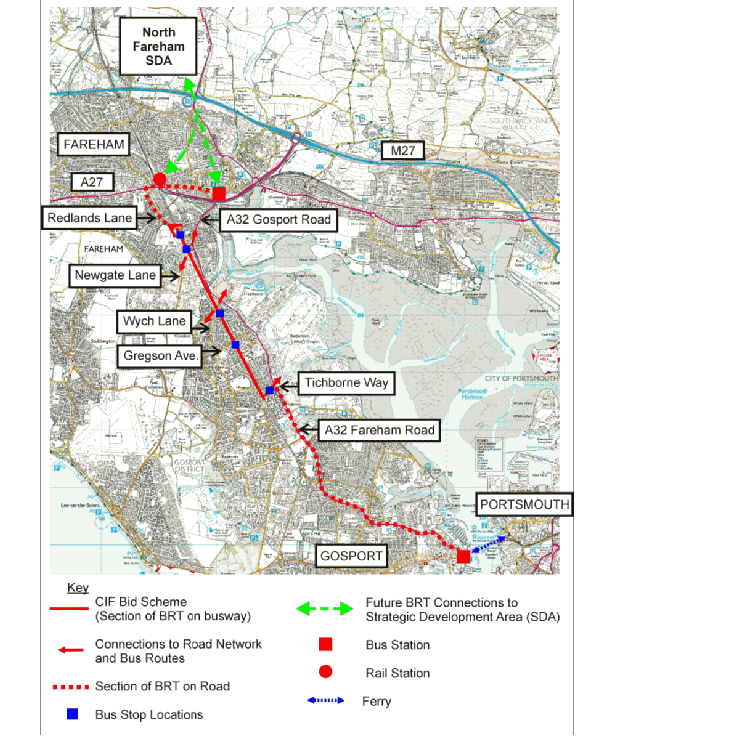
2.2. BRT Phase 1 of the scheme supports these general aims and will connect Gosport with Fareham via the disused former railway corridor, as shown in Figure 2 also attached to this report. Subject to planning permission, the scheme will provide a dedicated two-way unguided bus way, for use by high quality, environmentally-friendly buses. A bus-based scheme of this type has the advantage of being able to combine on-street and off-street running, and the proposed new bus way will be connected to the existing highway at appropriate signal controlled access points along the route taking into account not only existing bus routes and residential areas but also having the potential to link in new services. The scheme would provide a reliable alternative route for buses to use, thus avoiding the A32 corridor, which currently leads to service delays and reduction in journey time reliability. The proposed BRT Phase 1 route will also be able to be used by cyclists and emergency vehicles.
2.3. The calculated Benefits to Cost Ratio (BCR) of 1.5 is considered to represent good value for a public transport scheme of this type; this monetary value assessment having been carried out for this first phase of the wider BRT scheme in isolation. It is important to recognise that, as the wider network is developed, it will contribute to even greater benefits for the South East Hampshire area. A scheme such as this is able to be progressed incrementally and so can be phased to maximise the availability of both public and private sector funding and other opportunities as they arise.
2.4. The Government's "New Approach to Appraisal" (NATA) sets out the principles which have to be used in the assessment of all transport schemes. In broad terms this requires an assessment against the five core Government objectives for transport, ie:
· Environment;
· Safety;
· Economy;
· Accessibility; and
· Integration
and the Business Case demonstrated that the BRT Phase 1, taken as an individual stand-alone project, contributed to a greater or lesser extent to each of these objectives, resulting in an overall beneficial impact.
2.5. Specific objectives of BRT Phase 1 which were identified in the Full Business Case are to:
(i) improve access to future and existing employment sites by public transport, particularly in Gosport and North Fareham;
(ii) improve access to public health services at both local and sub-regional levels by public transport;
(iii) improve access to tertiary education by public transport;
(iv) improve public transport access between the proposed North Fareham SDA and local employment, education and health services;
(v) improve the overall quality of public transport provision in the area; and
(vi) assist in meeting the requirements of the Air Quality Management Areas Plans.
2.6. It is important to recognise that BRT Phase 1 can be judged positively on its own merits and will deliver tangible benefits for the communities of Fareham and Gosport. The scheme will provide a significant enhancement to the existing bus network. Journey speeds will be improved in peak hours, providing more reliable services and accurately timed journeys which, together with the quality of the vehicles and the stops, will provide a better offer to the passenger. Importantly, the scheme will contribute to some decreased congestion at key points on the local highway network. However, it must be recognised that this individual scheme, despite the benefits, should not be regarded as the total solution; rather as an important element of the overall ongoing approach to reducing traffic congestion and providing a greater travel choice in the area in the future. As and when further phases are developed and implemented so the overall benefits of the scheme will increase.
2.7. The Project Appraisal to implement BRT Phase 1 was approved by the Executive Member for Policy and Resources on 29 January 2009, subject to the granting of planning permission, the acquisition of all necessary land and the award of £20 million of CIF2 monies from Central Government (subsequently confirmed on 27 March 2009). That report detailed the complex and extensive engineering works required to deliver BRT Phase 1, which can be summarised as follows:
(i) the provision of 3.4 kilometres from Redlands Lane to Tichborne Way of a 6.2 metre wide unguided bus way;
(ii) high quality, accessible bus stops at regular intervals and at all key junctions;
(iii) CCTV provision;
(iv) street lighting at bus stops and junctions only;
(v) major new junctions and access provision at Redlands Lane, Palmerston Drive, Wych Lane and Tichborne Way;
(vi) to facilitate the provision of the bus way at grade and the demolition of bridges at Newgate Lane/Palmerston Drive (a new bridge will be constructed here to enable the bus way to pass underneath Newgate Lane) and at Wych Lane;
(vii) the lowering of the bus way at Gregson Avenue and Tichborne Way to provide a 5.03 metre clearance beneath existing overbridges; and
(viii) the revision and provision of traffic signal operations to facilitate bus priority.
2.8. The scheme design complies with Department for Transport and Hampshire County Council's standards and has been safety audited at all the appropriate stages in the design process.
3. Statutory Procedures (Planning, Land Acquisition, Legal)
Planning
3.1. Following approval by the Executive Member for Policy and Resources on 29 January 2009, a planning application was submitted to Hampshire County Council on 31 March 2009 in accordance with Regulation 3 of the Town and Country Planning General Regulations 1992 Act (as amended). The planning application would allow for the extension of the bus way southwards beyond Tichborne Way to Military Road in circumstances where additional funding becomes available. Gosport Borough Council and Fareham Borough Council, as the respective local planning authorities, having considered their responses to the application as statutory consultees at their individual Regulatory or Planning and Development Committees in June, have both formally advised the County Council of their support for the proposal. Both authorities have also requested that a number of matters are taken into consideration when the planning application is determined. Other statutory consultees include the Environment Agency, English Heritage, Hampshire Wildlife Trust, and Natural England.
3.2. Hampshire County Council, in its role as planning authority, provided a Screening Report which determined that a full Environmental Impact Assessment was not appropriate for BRT Phase1. Nevertheless, the following detailed appraisal work was required to be carried out and submitted as part of the planning application:
(i) a Traffic Appraisal to evaluate the transport issues and benefits of the scheme;
(ii) in depth analysis of key environmental issues, including: landscape and visual impact, ecology, noise and vibration, drainage, contamination and air quality;
(iii) a Flood Risk Assessment;
(iv) a Design and Access Statement;
(v) a Tree Survey;
(vi) an Outline Waste Management Plan; and
(vii) a Sustainability Appraisal.
3.3. The planning application will be determined by Hampshire County Council's Regulatory Committee at its meeting on 29 July 2009.
3.4. Whilst this site has effectively been left to nature over the years since the railway closed, following the demise of the proposed Light Rapid Transit scheme in 2006 (after the Government's decision not to award funding), it has been formally safeguarded for future use as a transport corridor.
3.5. Advanced site clearance work has been progressed for maintenance of the land and to enable engineering and environmental surveys to be undertaken, that have subsequently been used to inform the design of the scheme and support the planning application. During the clearance works local residents raised concerns regarding the impact on local wildlife habitats, the loss of screening and landscaping to the rear of their properties and the associated increased security issues with respect to their properties during both the construction phase and the future operation of the bus way. This, and also general objections to the proposed scheme from some residents backing onto the railway corridor, has led to the formation of a BRT Action Group that has been quite vociferous in its objection to the scheme.
3.6. The key formal objections that have been made to the planning application highlight environmental and ecological concerns, including the impact on wildlife, protected species, landscape and trees; issues affecting properties backing onto the proposed route, including noise, lighting, air pollution, privacy, security, drainage and the nature of the proposed boundary fencing; the unauthorised use of the bus way; and construction related issues, including disruption during the works, unacceptable working hours and temporary road closures. Other objections have been raised on the following grounds: the scheme will not be attractive to car drivers, nor solve the congestion problems on the A32, and existing bus services may be compromised.
3.7. The BRT Action Group and former County Councillor Dennis Wright have applied for the planning application to be called in under Section 77 of the Town and Country Planning Act 1990 (as amended) and for it to be determined by the Secretary of State for Communities and Local Government. If the call-in request is successful and the decision of the County Council's Regulatory Committee is called in, then this would result in a Public Inquiry which would inevitably delay the determination of the planning application, and would mean that BRT Phase 1 could not be delivered in the required timescale, that is prior to March 2011. However, the Secretary of State will only call in the decision when there is conflict with national policies on important matters, when there are significant effects beyond the immediate locality, when it gives rise to substantial regional or national controversy, raises significant architectural and urban design issues or involves the interests of national security. Members are advised that an application for call-in is considered by the Secretary of State on its individual merits and is very rare.
3.8. If the Secretary of State does not think it appropriate to call-in the planning application, then there is still a risk that the objectors will apply to have any resolution made by the County Council's Regulatory Committee judicially reviewed by the Courts. Any application for Judicial Review has to be made within three months of the date of the resolution to grant, save in exceptional circumstances where this three month period can be extended (refer to Confidential Appendix).
3.9. Whilst it clearly not within the remit of the Cabinet to comment on these planning matters, having regard to the scope of this report, Members are advised that it is believed the planning application that has been submitted is robust and provides detailed information in relation to all these matters. For instance, the Environment Agency and Natural England have been consulted and their requirements followed in relation to the clearance of trees and shrubs and measures to avoid any adverse impact upon or the destruction of wildlife habitats, all of which have been done under the supervision of a specialist ecological Clerk of Works.
Land Acquisition
3.10 Although the majority of land required to construct BRT Phase 1 (subject to planning permission) is already in the ownership of Hampshire County Council, additional land is required around the proposed new junctions. The progress of discussions with third party land owners, all of whom are supportive of the scheme, is highlighted in the Confidential Appendix.
Legal
3.11 The Project Appraisal, approved by the Executive Member for Policy and Resources on 29 January 2009, agreed the advertisement and making of the appropriate Traffic Regulation Orders required to facilitate the construction and implementation of BRT Phase 1. Temporary road closure orders and speed limit reductions will be required to facilitate the construction works, whilst permanent Traffic Regulation Orders will be required to ensure that only buses operated under an open access quality agreement and other appropriately authorised vehicles (eg emergency vehicles) can use the bus way. In addition, changes to parking restrictions in the vicinity of junctions are also anticipated to ensure their continued safe operation. Parking on adjacent roads will be monitored following completion of the BRT Phase 1 scheme and action taken, as appropriate, to resolve any residual problems.
3.12 The Traffic Regulation Orders will need to be processed by the County Council from September 2010 at the latest in order to complete the process prior to the operation of BRT Phase 1.
4. Procurement of Main Contractor
4.1 Delivery of the main works has been procured through a tendering process compliant with the EU Procurement Regulations. Owing to the scale of the works, a formal Contract Notice was issued in November 2008 with expressions of interest received from 14 companies. The published selection procedure was followed in line with the Restricted Procedure, resulting in six companies being invited to tender for the works.
4.2 Tenders for the main works contract were issued on 7 April 2009 for return on 11 June 2009. The tenders were assessed on the basis of 60% Price / 40% Quality, with the quality element consisting of written submissions relating to four key criteria deemed appropriate for the successful delivery of the scheme, namely:
· Organisational Arrangements - Project Management, Contract Management, Key Staff and Resources, Risk Management
· Programming - Planned approach to the scheme, Resources and Adaptability, Ability/Experience, Problem Resolution
· Cost Control - Planned Spend Profile, Systems/Processes and Openness, Early Warnings/Agreement of Accounts
· Environmental Impact - Impact on Residents, Impact on Ecology and Wider Environment, Sustainability.
4.3 In addition to the written submissions, each tenderer was also interviewed on the contents of their documents, to ensure that their proposals were fully understood.
4.4 The Preferred Bidder has now been identified as Bam Nutall, a company that has extensive experience of delivering similar bus way schemes. It is their intention that the contract will be delivered from their Southampton office, using locally sourced suppliers, sub-contractors and labour. In particular, their submission gave confidence of their proposed approach to the scheme, and a strong desire to work closely with the County Council to achieve the desired completion of works on the ground by 31 March 2011.
4.5 Mobilisation discussions are taking place with the preferred bidder and plans will be prepared so that if planning permission is granted on 29 July 2009 the contract for the works could be issued immediately. This would enable ecological works to commence in early August. Main construction works will follow on in September/October.
5. Financial Implications
5.1. As has already been referred to in this report, following an assessment of the Full Business Case (submitted by Hampshire County Council) by the Department for Communities and Local Government and the Department for Transport, Ministers announced on 27 March 2009 that the BRT Phase 1 scheme had been allocated £20 million from the CIF2 towards the overall costs of the scheme. The final assessment at Full Business Case stage had focussed on three key areas:
(i) strategic fit with housing and the wider social and economic benefits - including dependent housing and commercial development;
(ii) transport impacts - the likely increase or decrease in access, congestion or journey times, and any improvements to the sustainability of the locality; and
(iii) deliverability of the scheme by 31 March 2011.
5.2. The Homes and Communities Agency, which is responsible for managing this CIF2 funding, is currently preparing a draft funding agreement for consideration and signature by officers on behalf of the County Council.
5.3. Initial feasibility costs of £1.965 million (in respect of business case preparation and submission, initial design, site clearance, preparation of planning application submission, etc) have been incurred and were included in the 2008/09 budget.
5.4. As the procurement process has progressed to the selection of preferred bidder, a much clearer picture emerged as to the estimated main contract costs and therefore the funding strategy. This detailed information, having regard to the ongoing procurement process, is commercially sensitive and is therefore included in the Confidential Appendix to this report, which sets out the total estimated cost and how it is proposed to be funded. However, the current scheme estimates show that the scheme design and construction costs from April 2009 can be met by the grant award, and that any future land compensation claims could be met from the overall total capital programme allocations available for this project.
6. Risk Assessment
6.1. The level of risk to the BRT Phase 1 scheme with regard to the statutory processes has been well documented in section 3 of this report. Any delay in the determination of the planning application and the planned acquisition of land required both for the construction and the implementation of the scheme would be problematic in terms of completing the scheme within what is a particularly tight delivery timetable. This in turn would have the likely impact of the Council not being able to claim the full £20 million funding and be liable for the costs of any outstanding work to complete the scheme. However, the scheme accords with planning policy, and has the support of both Fareham and Gosport Borough Councils in their role as the local planning authorities. The planning application has been submitted in the approved format, dealing with all major issues and accompanied by the required traffic surveys, environmental surveys, etc. Whilst it is important to acknowledge there is some local objection to this scheme, it is believed those objections have been properly addressed. It has to be said that the number of objections received is very much smaller than might have been expected for a scheme of this type, and this low level of objection, together with the fact that BRT Phase 1 is not a development giving rise to national implications, means the likelihood of a call-in is regarded as extremely low. The County Council's Regulatory Committee is scheduled to consider the Planning Application for BRT Phase 1 on 29 July.
6.2. Provisional terms have been agreed with third party landowners to secure all land required for the scheme. If, however, any further land was required and could not be secured by agreement then compulsory purchase order procedures would be instigated. Any such compulsory purchase orders would have to proceed under the Highways Act 1980.
6.3. The Government's timetable for the CIF2 schemes is particularly tight and this, not surprisingly, has led to an increased level of risk in relation to the design and construction stages of BRT Phase 1. Whilst these have been very well managed by the Council's Engineering Consultancy and its agents there are some potential risks of which Members should be aware.
6.4. Because of the tight timescales there is a lack of firm estimates from the Statutory Undertakers, which could result in the costs of their plant diversions and protection exceeding those assumptions within the overall scheme estimate and tender documents. Everything is being done to obtain the necessary information from gas, water, electric and telecoms undertakers as soon as possible and due regard is being given to the fact that there is often a lengthy lead in time for the delivery of new plant (refer to Confidential Appendix).
6.5. Ecology has necessarily formed an important part of the site preparation works and has been integral to the Planning Application. Whilst all statutory requirements have been complied with, and every attempt has been made to comply with the requests of Natural England there are still potential risks with this element of the BRT Phase 1 scheme. For instance, unforeseen reptile and bat activity could lead to unplanned and increased restrictions on construction activities as could the identification during the construction stage of previously unseen protected species such as dormice or great crested newts. All the detailed surveys that have been carried out do, however, as far as possible, suggest this will not be the case. Much time and effort has been expended in properly identifying the local badger population and where appropriate new badger setts have been constructed (to somewhat exacting design criteria) and therefore whist it is hoped this risk has been averted, if the badgers fail to relocate into their new setts, this again could lead to delayed access to parts of the site leading to increased costs.
7. Conclusions
7.1. In order to fulfil the growth objectives and investment needs of both Hampshire and the sub-region in line with the requirements of the South East Plan, major transport infrastructure improvements are essential. The successful construction and implementation of BRT Phase 1, both in the first instance in its own right and in the future as part of a wider BRT Network for South East Hampshire, is seen as critical in meeting this objective.
7.2. This report has highlighted the substantial progress made in relation to the BRT Phase 1 scheme since the approval by Cabinet on 27 October 2008 of the submission of a Full Business Case which subsequently resulted in the allocation of £20 million from the CIF2 in March 2009.
7.3. However, the constraints imposed by Government in awarding that funding, not least of all the requirement that the scheme must be completed by 31 March 2011, thus reducing the delivery stage, makes this a particularly challenging project. The specific engineering risks, the associated inherent planning and land acquisition risks and risks linked with other statutory procedures, which could all lead to a delay in the completion of the project beyond 31 March 2011, have greater significance in this scheme because of the resultant potential major financial liability to the County Council.
7.4. Whilst taking due account of the major risks identified in this report; the scheme is seen to be an integral element in reducing congestion and offering increased future travel choices, both in its own right and within the wider transport and planning context of the future South East Hampshire Bus Rapid Transit network. A detailed analysis of the financial implications of BRT Phase1 confirms that it is deliverable and a funding strategy is in place. Because of the significant progress made in respect of the preparation of the site, the design of the bus way, and the procurement of contractors, it is considered that the project is deliverable within the required timescale and therefore the £20 million CIF2 funding should be accepted and the project should move to the construction and implementation stage, subject to planning permission being granted.
8. Recommendations
8.1. That final approval be given to implement the South East Hampshire Bus Rapid Transit Phase 1 Fareham-Gosport subject to the granting of planning permission, and notwithstanding that the granting of any such planning permission might be subject to call-in or an application for judicial review.
8.2. That the funding strategy as set out in the Confidential Appendix to the report be approved.
8.3. That delegated authority be given to the Head of Legal Services in consultation with the Director of Environment and the County Treasurer to enter into a funding agreement with the Homes and Communities Agency to secure the allocation of £20 million from the Community Infrastructure Fund 2 in respect of the South East Hampshire Bus Rapid Transit Phase 1 Fareham-Gosport.
8.4. That the financial risks to the County Council as set out in the report be noted.
2083Rpt/757/AQ
Fig. 1
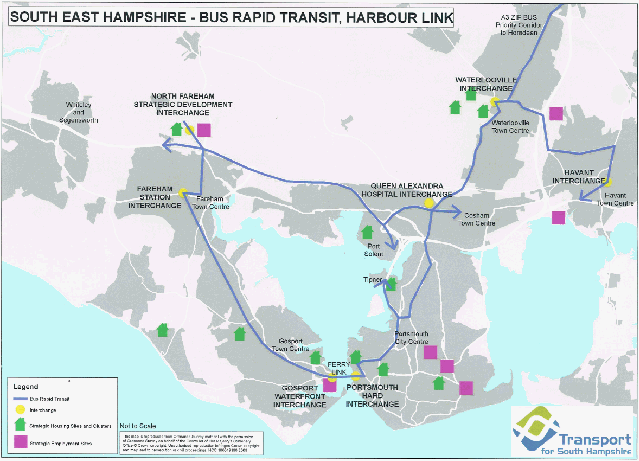
Fig.2
CORPORATE OR LEGAL INFORMATION:
Links to the Corporate Strategy
Hampshire safer and more secure for all: |
yes |
Corporate Business plan link number (if appropriate): | |
Maximising well-being: |
yes |
Corporate Business plan link number (if appropriate): | |
Enhancing our quality of place: |
yes |
Corporate Business plan link number (if appropriate): | |
Other Significant Links
Links to previous Member decisions: |
|||
Title |
Reference |
Date | |
South Hampshire Rapid Transit Report (Cabinet) |
27 Nov 2006 | ||
Transport for South Hampshire Joint Committee Report |
14 April 2008 | ||
Transport for South Hampshire Joint Committee Report |
17 October 2008 | ||
The South East Hampshire Bus Rapid Transit Scheme (Cabinet) |
27 October 2008 | ||
Project Appraisal: South East Hampshire Bus Rapid Transit - Phase 1 Fareham - Gosport (Executive Member - Policy and Resources) |
29 January 2009 | ||
Direct links to specific legislation or Government Directives |
|||
Title |
Date | ||
None |
|||
Section 100 D - Local Government Act 1972 - background documents | |
The following documents discuss facts or matters on which this report, or an important part of it, is based and have been relied upon to a material extent in the preparation of this report. (NB: the list excludes published works and any documents which disclose exempt or confidential information as defined in the Act.) | |
Document |
Location |
As Above |
Environment Department, Southside Offices |
Bus Rapid Transit Full Business Case |
Environment Department, Southside Offices |
IMPACT ASSESSMENTS:
1. Equalities Impact Assessment:
1.1. The scheme will provide enhanced public transport facilities for the whole community, with improved accessibility provided to both waiting facilities and buses operating on the bus way. Older people, young people and those on lower incomes are generally greater users of buses than other age and income groups.
2. Impact on Crime and Disorder:
2.1. There will be a positive impact in terms of security for passengers on the bus way through the provision of high quality waiting facilities, including enhanced lighting and CCTV.
2.2. Unauthorised use of the bus way, potential anti-social behaviour and the security of those properties adjacent to the bus way will be addressed, following consultation with and the taking of advice from the appropriate authorities, through design and enforcement.
3. Climate Change:
a) How does what is being proposed impact on our carbon footprint / energy consumption?
Carbon-dioxide emissions are anticipated to reduce by 1,045 tonnes in the first year of operation (2011), and by a total of 68,535 tonnes over the subsequent 60 year period.
b) How does what is being proposed consider the need to adapt to climate change, and be resilient to its longer term impacts?
In terms of service delivery, consideration will be given to the inclusion in the operating contract of the need for the amelioration of higher summer temperatures in the buses by the most energy efficient means.
Climate change impacts upon design and the specification of the road bed have led to changes in the surface material to be used so as to be more heat-resistant; drainage being able to cope with intense precipitation; to landscaping and to the colour of structures so as to reduce absorbed heat.