
Archived decisions

Hampshire Fire & Rescue Service
Fire Authority Member Review
of
Fleet Maintenance Centre


Martin Kempton
Susan Munro
August 2009
Final Report
CONTENTS
Page
1. Executive Summary .............................................................. 1
2. Recommendations ............................................................... 3
3. Project Scope ..................................................................... 5
4. Project Team ...................................................................... 5
5. Method of Approach ............................................................ 6
6. Strategic Context ................................................................. 6
7. Current Position................................................................... 8
8. Findings ............................................................................. 10
8.1 Commercial and Finance 10
8.2 Operational - Delivery of Maintenance Activities 12
_ Fleet Management Systems 12
_ Planned Maintenance 13
_ Equipment Maintenance 14
_ Reactive/Repair Work 15
_ Warranty Work 15
_ Defect Management 15
_ Vehicle Downtime and Productivity 16
_ Fit Out and Reimbursement 17
_ Delivery and Collection 19
_ Reserve Vehicle Management 19
_ Quality Control 20
8.3 Resources and Organisation 21
_ Premises 21
_ Department Organisation 21
_ Structure 21
_ Fleet Management 21
_ Fleet Maintenance Centre (FMC) 22
_ Workshop Personnel 23
_ Processes 23
8.4 Procurement 24
9. Stores ................................................................................ 25
10. Training .............................................................................. 25
11. Collaboration ....................................................................... 25
12. Benchmarking ..................................................................... 26
13. Acronyms used in this report .................................................. 27
Appendices:
Appendix 1: Performance Dashboard `Scorecard'
Appendix 2: 2008/09 Budgets
Appendix 3: Defect Performance Indicators
Appendix 4: Days in Workshop - 12 Month Service
Appendix 5: Fleet Maintenance Centre - Organisation Chart
Appendix 6: Roadmap for In-House Improvement
Appendix 7: Proposed Organisation Chart
Appendix 8: Service Level Agreement Guidelines and KPI Examples
1. Executive Summary
1.1 The purpose of this report is to review, benchmark and appraise all present operational, commercial and resource arrangements of the Fleet Services function within the Hampshire Fire & Rescue Service (HFRS). This Best Value Review provides Hampshire Fire & Rescue Service with an objective appraisal of the efficiency and cost, and provides a baseline for any future review. This report builds upon previous external and internal reviews conducted since 2005.
1.2 The transport / fleet function provides business critical resilience to Hampshire Fire & Rescue Service to an operational standard, with extremely well maintained vehicles and related equipment.
1.3 During the course of the review, HFRS accepted and implemented our interim recommendations and is now able to demonstrate auditable compliance to all required statutory transport legislation, satisfy the safety and performance requirements of the Vehicle and Operator Services Agency (VOSA) Department of Transport, The Traffic Commissioner, The National Audit Office, Department of Communities and Local Government, Her Majesty's Fire Safety Inspectorate, as well as manufacturers and local operational requirements.
1.4 Budgetary processes require development to ensure clear accountability to senior management.
1.5 There is insufficient provision of readily available accurate fleet management and financial data within the workshop function and this is compounded by the absence of adequate performance targets, and meaningful key performance indicators within suitable service level framework.
1.6 The present organisation and structure requires alignment, and does not promote effective management in terms of accountability, quality assurance and compliance. The management at a local level within the Fleet and Workshop function lacks coordination and requires cross department accountability to operate effectively.
1.7 Local department management requires clear leadership and strategic direction. The function requires experienced professional support and clear "hands on" management to enable it to respond efficiently and effectively to present and future requirements.
1.8 HFRS is unique in that new appliances are commissioned part completed, with the residual fitting out being completed at FMC. HFRS needs to evaluate whether the current workshop specialism's it currently supports in house are core activities which are fundamental to it's strategic and operational objectives in the medium to long term.
1.9 Workshop productivity is low at 68% resulting from poor planning and prioritisation at workshop floor level. In house inefficiencies result in unacceptable delays in bringing new appliances into service. Turnaround times during 2008/09 range from nine to fourteen months from vehicle delivery to active service.
1.10 The total cost for the provision of fleet maintenance for 2009/10 was £1.5m, including c£300k for Fleet Management. The average cost of planned maintenance for appliances is £2,576 per vehicle and remains competitive within the UK Fire and Rescue Service, where costs range from £2,226 - £3,730.
1.11 The published hourly labour rate is competitive within the Public Sector, though the MKA re-calculation shows a revised labour rate based upon attended hours of £44.06 per hour and a productive sold hour recovery rate of £55.07. (effectively a trading loss of £11.01 per hour when the recovered hour labour formula is applied). This has scope to improve through efficiencies and external contribution. (Public Sector benchmarked productive rates £27.90 - £75.00).
1.12 The function is competently administered and provides proactive operational service on planned maintenance and repairs over a range of fleet and equipment, but lacks sufficient focus on reducing downtime.
1.13 There are several examples of best practice within the function, particularly in the areas of scheduled planning, overdue service reporting, stores management and ladder maintenance.
1.14 The selection of SAP as a replacement fleet system requires robust investigation into the functionality of the fleet module. Research to date suggests that SAP does not have a model in operation which provides the necessary resilience.
1.15 There are no formal Client and Contractor roles presently in operation within HFRS although a tactical plan from the Senior Management Team exists. Objectives are not communicated to the workforce, other than the service and overhaul plan. At the operational level the department lacks meaningful performance measurement in the form of operational key performance indicators.
1.16 There will be an opportunity within the next twelve months to review head count within the two functions upon the introduction of a new fleet management system, and completion of any backlog of refurbishment activity within the Allied Trades function of the workshop.
1.17 Opportunities will exist to generate additional income through offering ladder repair activities to neighbouring Fire & Rescue Services and thus increasing income. The generation of additional income on the repair and maintenance of other LGV/HGV fleets is not advised until our recommendations on performance management and organisation are successfully implemented.
2. Recommendations
The recommendations within this report are highlighted within each area, and encapsulated within the suggested next steps In-House Improvement Plan at Appendix 8.
2.1 Develop an In-House Improvement Plan including process mapping of all tasks / key processes within the workshop function prior to consideration of working with external partners.
2.2 Reposition and reorganise the Fleet Management and FMC workshop functions into one organisation with clear accountabilities for statutory traffic requirements, budgeting and planning. During the interim period, it is advised that the Workshop Manager should relocate to the workshop open plan office to have improved visibility with the team. This to be followed by a total department review of all roles after a twelve month period once the actual capacity is determined and future administrative needs understood arising from an implementation of a new fleet management system.
2.3 Review the management reporting line at Directorate level, and reposition the role of Fleet Manager to that of Head of Engineering Services.
2.4 Cease the fit out of new appliances at the earliest opportunity and transfer the skill sets to the completion of the refurbishment programme.
2.5 Have a newly completed vehicle tested by the Vehicle Certification Authority (VCA) to establish compliance to manual handling regulations.
2.6 Reposition the management of the Revenue maintenance budget within Fleet Management.
2.7 Develop and deliver a Service Level Agreement and Fleet Policy/Strategy document over a six month period, which both clearly outlines all tasks, specifications and standards of service required to enable workshops to process servicing and repairs efficiently and in accordance with HFRS's Integrated Risk Management Plan. This will provide a clear mechanism to measure operational performance of the Fleet Department and ultimately the Service.
2.8 It is recommended that Key Stakeholders are engaged in the development of the proposed Service Standard. This should include senior management, workshop personnel, representative bodies and HFRS personnel to ensure clarification and co-operation of the outputs required.
2.9 Take immediate steps to establish tangible deliverables in the form of key performance indicators. The KPIs will reflect the Integrated Risk Management Plan (IRMP), and those within the Three Year Strategic Plan.
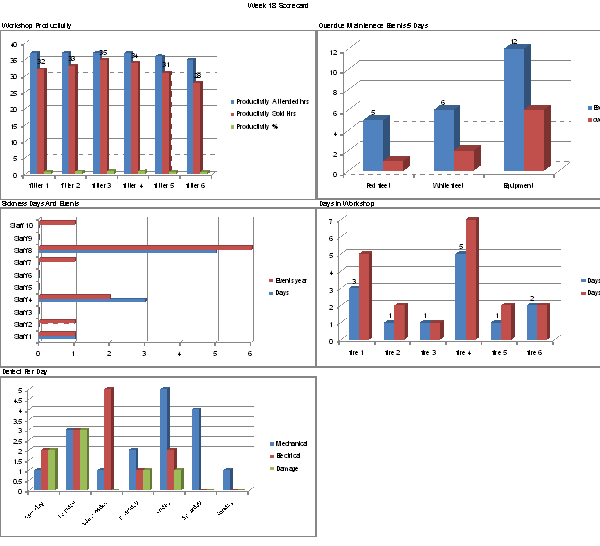
2.10 Develop and cascade the KPIs from the Service Standard to all workshop personnel and monitor and measure performance on a monthly basis. This could be communicated through a `Performance Dashboard.' (See Appendix 1 which is for example only and does not reflect the current position of HFRS's Fleet).
2.11 Review the opportunity to introduce a profile budgeting process, as this would assist long term financial, operational and resource planning whilst establishing whole life costs.
2.12 The selection of SAP as a replacement fleet system requires robust investigation into the functionality of the fleet module. Research to date demonstrates that SAP does not have a model in operation which provides the necessary resilience. MKA recommend HFRS commission a project team comprising of a Steering Group and Project Team to include cross functional end users to scope the requirements of any replacement fleet system, prior to tendering or engaging in commercial discussions with SAP.
2.13 Implement a succession plan for all personnel as part of a potential restructure.
2.14 Appoint the FTA to complete maintenance quality audits and to provide benchmarking data.
2.15 Budget for a refresher training programme for all supervisory staff and mechanics on the statutory standards required by VOSA and CFOA for the maintenance of vehicles.
2.16 Actively seek to participate and collaborate in the Southern Region Transport Officers' Group.
2.17 Continue to source appliances, vehicles and related emergency response equipment from frameworks including Firebuy, Office of Government Commerce, OGC and the National Police Information Association, NPIA where appropriate.
3. Project Scope
3.1 The agreed remit was to establish the commercial and operational efficiency of HFRS's in house operations, together with an indication of any opportunities to improve the current arrangements including tangible key performance indicators, internal accountability from within operational delivery, any future plans for fleet asset strategy which may include support on appropriate fleet management systems. The approach consisted of 4 stages:
3.1.1 Stage 1 - Review the "as is" position regarding the fleet to include types, frequency of planned servicing, overhead costs, internal labour rates, types and frequency of planned maintenance, determining unplanned maintenance, downtime of vehicles to standard times, rates of pay, fleet management systems, sub-contracting, spares provision and a benchmark of any service level agreement in place.
3.1.2 Stage 2 - A benchmark of HFRS activities from existing qualitative data regarding labour rates, costings, parts and materials.
3.1.3 Stage 3 - Establishment of the commercial and operational efficiency of HFRS's in-house operations, together with an indication of any opportunities to improve the current arrangements.
3.1.4 Stage 4 - Identify potential for collaboration with the neighbouring Partners.
3.2 In addition, MKA were asked to consider the option of inter-departmental charging for the vehicle and equipment servicing facility. MKA did not pursue this option as evidence elsewhere within Emergency Services demonstrated that such a regime can, upon occasions, deter budget holders from facilitating the legal obligation to service equipment and vehicles.
4. Project Team
4.1 The Project Team was commissioned by The Hampshire Fire Authority Member Review Working Group of the Fleet Maintenance Centre and undertaken by Susan Munro and Martin Kempton of Munro Kempton Associates Ltd (MKA).
4.2 In addition, MKA consulted with the following personnel and would like to thank them for their hospitality, input and support:
All Fleet Management and Fleet Maintenance Centre Personnel
Andy Bowers - Area Manager, Service Delivery
Tony Cassidy - Stores Manager
Dave Curry - Director of Service Delivery
Alison Day - Local Government Account Manager, SAP.
Gail Hart - IT Consultant
Alan House - Director of Strategic Projects and & Specialist Response
Darren House - Community Support Logistics Manager, Service Delivery
Suzanne van Leewen - Senior IT Consultant, Hampshire County Council
Tim Mansbridge - Fleet Manager
Joanna Matthews - Financial Services Manager
Lee Phillips - Fleet Maintenance Centre Manager
Phillip Webb - Performance Review Manager
Nicki Whitehouse - Assistant Performance Review Manager
Chief Fire Officers Association, Transport Officers Group
Emergency One ( UK) Limited.
FBU, RFBU and GMB Union Representatives
Firebuy Ltd
Officers In Charge of Southsea and St Mary's Fire Stations
5. Method of Approach
5.1 Data gathering was conducted at HFRS Headquarters and the Fleet Maintenance Centre workshop facility during May - June 2009. This process involved a forensic validation of the key activities and processes within the Fleet Management Department and the Fleet Maintenance Centre. In addition consultation was held on a collective basis with all Fleet Maintenance Centre and Fleet Management Personnel and separately with the Blue Watches of Southsea and St Mary's Fire Stations and also the Representative Bodies GMB, The Fire Brigades Union and the Retained Fire Brigades Union.
5.2 All key data was validated during the process of the review and is evidence based.
5.3 Management information was tested by the interrogation of the Fleet Management System, (Trace) within the Fleet Maintenance Centre (FMC) offices.
5.4 Advice on the SAP Fleet Management Module was sought from Hampshire County Council and also directly from SAP.
5.5 Validation of the recent procurement of fire appliances was obtained from Emergency One (UK) Ltd and Firebuy Ltd.
5.6 For the purpose of this report the Transport Function shall mean the combined functions of Fleet Management and the Fleet Maintenance Centre, and Fleet shall mean all vehicles, appliances and equipment maintained within FMC.
6. Strategic Context
6.1 This report follows the Best Value Reviews and Internal Audit Reviews commissioned in 2005, 2006 and 2007.
6.2 The Fleet Maintenance Centre (FMC) and the Fleet Management function is housed within a new purpose built facility based at the Eastleigh Headquarters which became fully operational in April 2008, following the transfer from the former premises in Winchester in January 2008.
6.3 The functions provide a strategic and technical fleet service to 51 fire stations within the county of Hampshire which supports a local population of c 1,705,700 within an area of 1,455 square miles. This includes the cities and ports of Southampton and Portsmouth as well as the large rural terrain of the New Forest.
6.4 Hampshire Fire and Rescue Service is the seventh largest Fire and Rescue Service within the United Kingdom. Vehicles and equipment play a vital role in the operational and commercial resilience of HFRS.
6.5 Within HFRS, fleet and equipment is arguably the most important physical asset that exists in the Service.
· The workplace of personnel.
· Used to carry sophisticated pieces of high value equipment.
· The public image of the organisation.
· Delivers a significant operational service delivery.
6.6 The publication of an Integrated Risk Management Plan, (IRMP) determines the direction and impetus for change and recognises potential for improvements.
6.7 The operational objectives which are focused on Fleet are set out in the HFRS Three Year Community Response Strategy 2009 - 2012:
Aims Providing Best Value
· Meets fleet service requirements of the 21st Century.
· Developing and maintaining effective resource and performance management.
· Developing effective partnerships and collaborative working agreements.
· Strive for a greener, more efficient fleet.
· Developing and maintaining effective customer service.
· Makes effective use of front line resources and maximise productive time.
6.8 This also provides a mechanism to explore opportunities for collaboration within the neighbouring Fire and Rescue Services, Partnerships and other Agencies.
6. Current Position
7.1 In order to effectively control and manage the Transport Function, the function has been organised into two clearly defined and closely linked interactive departments. These departments are Fleet Management and the Fleet Maintenance Centre (FMC).
7.2 The strategic management of the Transport Function is delivered by both the Fleet Manager and the Fleet Maintenance Centre Manager who both report into the Deputy Chief Fire Officer, (DCFO, Director of Strategic Projects and Specialist Response).
7.3 The joint core activity is to administer and deliver the repair, maintenance, technical development, procurement and management for vehicles and the majority of operational equipment within the Ministry of Transport's statutory regulations applicable to equipment.
7.4 MKA were unable to evidence a formal client contractor relationship between the two departments. The inter relationship is managed by the DCFO who prioritises activities in accordance with HRFS operational and commercial objectives.
7.5 There is a limited Service Level Agreement in place between FMC and Service Delivery which focuses solely upon the response to defects and fire ground attendance. There is an informal relationship between Fleet Management, Logistics, FMC and Service Delivery. This is managed on a strategic level at monthly meetings within the Directorate and tactically on a local basis once a week.
7.6 The Logistics team, which reports into Service Delivery, are located within the FMC facility. They liaise with Fleet Management, Stations and FMC regarding the delivery and collection of fleet in line with the published annual maintenance plan to ensure all fleet is maintained in accordance with its schedule. This activity is co-ordinated in line other activities within Logistics operations.
7.7 The combined transport function should deliver HFRS's key objectives by:
· The economic, efficient and effective procurement of fit for purpose vehicles and equipment through national procurement frameworks and the management and maintenance of those resources to enable the Service to better carry out its activities.
· Maintaining resources to deliver more where it matters. The Fleet and Operational equipment maintenance schedule is carried out in accordance with both the manufacturer's and internal standards.
· Developing the skills and knowledge of the workforce to be effective in their roles. A key area of the development is the consideration of training needs with each new vehicle or new technology introduced into the fleet, to include specific training through `Service Delivery Service Orders' and specific operational training to engineering technicians in collaboration with other regional transport functions.
7.8 The core functions of the combined transport function include:
· The liaison with end users through Service Delivery on the needs and role of transport provision.
· The specification of specialist and emergency vehicles.
· The management of fleet resources in terms of life cycle and replacement scheduling.
· The management of fleet budgets and the projection of future spending and budget bidding.
· The provision of maintenance, repairs and testing of all HFRS service vehicles and related equipment.
· The provision of a robust response for the above including defect repair.
· The provision of technical/ legislative support regarding product specification.
· The procurement and disposal of vehicles.
· To carry out all administrative roles regarding maintenance and fleet management.
· To monitor vehicle maintenance, defect and manufacturer's data trends and instigate corrective actions as appropriate.
· To manage and administrate warranty repairs and claims.
· To carry out administration of accident reports.
· The monitoring and provision of fuel supplies.
7.9 The performance of the transport function is now monitored through:
· Publication of the Servicing Schedule.
· All vehicles and equipment should be inspected and serviced annually or in accordance with internal CFOA standards and ICME guidelines, including LOLER and PUWER.
· Response to all urgent defects within an agreed timescale, within a robust prioritisation process.
· Timely procurement of safe and `fit for purpose' vehicles to meet the Service Delivery requirements.
· Ensuring vehicles are procured and disposed of effectively.
· Ensuring all vehicles have correct documents (maintenance history, V5, MOT/DOT where applicable etc in compliance with road traffic legislation).
· Establishing and monitoring of tangible key service levels on a monthly basis.
7.10 The core functions of each department are detailed in section 8.
8. Findings
This section is categorised as follows:
8.1 Commercial and Finance
8.1.1 At the time of the review, the `transport' function was responsible for the maintenance and repair of 267 vehicles and c.2,000 pieces of equipment.
8.1.2 The combined revenue cost of running the two departments is c.£1.5m (includes £300k fleet department costs).
8.1.3 The staffing costs for both functions is £997k for 31.5 personnel. The staffing costs of the personnel reflect the local labour rate for the South East.
8.1.4 A limited amount of external work generated £37k of income. This includes a 31% uplift for parts which is in line with industry practise.
8.1.5 Annual expenditure on spares during 2008/9 equated to £267k.
8.1.6 The HFRS labour rate applied at the time of the review was £42.80, based upon actual attended hours. To provide a basis of comparison, this was recalculated on the basis of actual average attended hours, to £44.06 and is competitive within the Public Sector. (This difference is based upon the Industry Standard calculation of attended hours). In line with industry best practise this is not a fully absorbed labour rate as it does not make provision for Fleet Department staff. The labour rate is fully inclusive of labour overheads, accommodation costs, and central services support charges.
8.1.7 The overall workshop productivity is 68% and is distorted by the contribution made by the fit out activity, compared to the contribution of the maintenance activity.
8.1.8 A validation of productivity from job cards relating to 12 month servicing and fit out activities demonstrated a recovered labour rate of £55.07 based upon the 68% labour efficiency during 2008/09. This has scope to improve through efficiencies and external contribution. (Public Sector benchmarked rates £27.90 - £75.00). The external charge out rate of £42.80 (is effectively a trading loss of £12.27 when the recovered hour labour formula is applied).
8.1.9 The average cost of PLANNED maintenance and inspection per appliance is £2,490 at the lower attended labour rate. The average cost of PLANNED maintenance and inspection per appliance at the actual recovered labour rate is £2,994. Both costs remain competitive as the average within the UK Fire & Rescue Service ranges from £2,226 - £3,740. This is a reflection of a proactive regular repair and maintenance regime and demonstrates that the cumulative standard hours to maintain the vehicles are within the norm.
8.1.10 The 2008/09 budget for fleet maintenance is £1.5m and includes provision for fuel cards, but excludes provision for capital procurement. (See Appendix 2).
8.1.11 The cost of parts and consumables attributed to HFRS is accurately recorded on the fleet system. The stock holding is well managed and is totalled at c£257k.
8.1.12 There is no tangible service level agreement in place between the Transport Function and Service Delivery. The lack of clear deliverables, policies, processes and KPI's has lead to downtime, productivity issues, and conflict over deliveries between the departments.
8.1.13 Best Value for the repair and maintenance revenue budget cannot be proactively challenged or objectively evidenced as this currently resides with FMC, who deliver the activity against the budget. An example being the extreme delays by FMC in providing Fleet management with evidence of repair costs for uninsured loss. This accounting mechanism is not best practice, and may attract criticism from CIPFA as it may potentially stifle contest from the customer, Fleet Management / Service Delivery.
8.1.14 The annual cost of fit out for new appliances within FMC in 2008/9 was £151k based upon 2,308 hours at the understated labour rate of £35.90.
8.1.15 The procurement of vehicles is well managed and the financial terms are in line with National Framework Agreements including those of Firebuy for Appliances. However, the appliances were specified for delivery excluding `fit out' (stowage management systems) as this function has historically been performed internally.
8.1.16 The additional cost from Emergency One to complete a factory fit out for the last seven appliances was £28,963 per vehicle. (Adjusted by Emergency One by £1,000 as a result of online manufacture for future builds). This was compared to the HFRS quote of £22,879, which upon evaluation of actual production hours and the understated labour rate was recalculated at £28,979, demonstrating that is there is no longer a viable commercial reason to conduct this work in house.
HFRS Fit Out Costs |
Initial Quote |
Adjusted |
Parts |
£11,039.00 |
£11,039.00 |
Sub assembly |
£4,659.92 |
# £3,494.94 |
Labour |
£7,180.31 |
£14,445.74 |
Total |
£22,879.23 |
£28,979.68 |
# = 75% of subassembly cost total (removed to avoid double count on labour hours used in labour actual labour calculations.
8.1.17 The overall workshop productivity of 68% is suppressed by the inefficiencies within the fit out process.
8.1.18 The workshop does not benchmark or monitor the standard times set for tasks at technician level.
8.1.19 There was no evidence of FMC benchmarking costs or operations with private sector companies.
8.1.20 During the course of the review, MKA did not find any activity or reason for concern regarding integrity and probity.
8.1.21 Recommendations

A. Introduce a Service Level Agreement which reflects the working relationship, accountabilities between departments.
B. Reallocate budget ownership of maintenance revenue to Fleet Management to ensure objectivity and subsequent Best Value.
C. Terminate the internal fit out activity of appliances and procure the completed vehicles from the manufacturer.
8.2 Operational - Delivery of Maintenance Activities
Fleet Management Systems
8.2.1 The present fleet management system is Trace.
8.2.2 All planning and maintenance activities are programmed annually in advance by the Assistant Fleet Manager using a report generated off system by a bespoke database, and maintenance schedules are distributed to FMC, logistics and stations.
8.2.3 Repair information is not recorded on job-sheets by the relevant tradesman. Jobcards are opened at workshop level on the fleet system including the full scope of work to be completed. This is not best practice and is due to a concerning lack of understanding of VOSA Legislation and CFOA guidelines, and also the poor implementation of the Trace fleet system.
8.2.4 The fleet management system was poorly scoped and subsequently is not able to interface with the financial system. Consequently it does not have a suitable reporting tool such as Crystal reports. However, other Fire and Rescue Services are using the existing Trace system effectively and these include:
· East Sussex (provided accurate data to the HSE during the Marley Farm incident)
· Derbyshire
· Shropshire
· Staffordshire
· Central Scotland
· Somerset
· Norfolk
8.2.5 The Trace system is able to generate key management information such as down time, warranties, total vehicle cost etc. However, due to historical scoping and poor implementation the system within HFRS it is unable to generate key service indicators. This deficiency requires rectification in any replacement or upgrade of the fleet system.
8.2.6 The staff at workshop level has had basic training on the system, but have had limited input into developing its functionality. This has led to a lack of confidence in the system and a breakdown in the client supplier relationship.
8.2.7 A review of fleet systems commenced at a corporate level in April 2009, with a recommendation by Hampshire County Council, HCC, to pursue the options offered by its IT partner, SAP. HCC do not use the SAP fleet module and have opted to continue with a bespoke system. Preliminary research by HFRS has been inconclusive as the only site test has been limited to a review at the Royal National Lifeboat Institution in Poole. The narrow research failed to provide evidence that the SAP product was suitable, as the system viewed did not have a fleet management module. A more relevant reference point such as the Metropolitan Police should have been considered. Should SAP not be able to deliver the functionality required, MKA suggest visits to a selection of those Fire & Rescue Services listed above to understand how Trace can be fundamentally harnessed to deliver an appropriate level of functionality.
8.2.8 Recommendations

A. Implement a process to ensure staff complete job sheets in a compliant manner.
B. Provide training for all supervisory staff to ensure familiarisation of statutory requirements.
C. As a matter of urgency, establish a formal steering and user group consisting of Hampshire County Council IT, HFRS IT and operational Fleet and FMC personnel to accurately review the fleet management system market place and its applicability to the Emergency Services market place.
Planned Maintenance
8.2.9 The servicing and inspection activity is actioned on a weekly basis, and a KPI is produced in the form of an overdue service report.
8.2.10 The Service can demonstrate legal compliance through this visible scheduling mechanism.
8.2.11 Each vehicle/equipment has a service history, which is maintained in both hard copy and on the fleet management system.
8.2.12 There is visible evidence of a robust maintenance plan for all fleet items. A detailed service and routine maintenance plan is in operation for all vehicles and is published by Fleet Management according to a programmed rota, depending upon the vehicle type. The activity is actioned normally within a monthly timeframe. This is in accordance with statutory requirements.
8.2.13 The plan is communicated directly to the station via the Logistics team and FMC at least three weeks in advance to ensure availability. This is recorded in the station diary. However feedback from stations advise that the visibility of the maintenance plan and notification of collection or delivery date for the changeover to reserve vehicles is inconsistent. This has an impact on the operational activity and training and shift planning at stations.
8.2.14 The level of servicing and inspection is performed according to the predefined checklists for both annual maintenance and inspections detailed on each job sheet. The service schedules reflect the manufacturers' specific requirements using generic standard times and are in line with other Fire & Rescue Services for the actual hours taken to perform the standard tasks. However, upon completion of the task, all activity is not recorded on the job card, but is entered onto the Trace fleet system. Analysis of the job cards demonstrates that servicing times do not vary significantly from mechanic to mechanic. However, it is not clear to the mechanics what the allocated time is, and no formal KPI is in place for workshop staff. These standard times require application at Technician and Allied Trade level.
8.2.15 Although the HFRS check sheets are compliant, FMC do not take advantage of the standardised predefined checklists for both inspections and annual maintenance available from the South Eastern Regional Transport Officers Group, which would facilitate the introduction of standard times and ongoing training of personnel. This is a common practice within the majority of UK Fire & Rescue Services.
8.2.16 After the completion of each service, the time and cost of all spares are logged onto the relevant job number, the fleet maintenance system and the vehicle maintenance file. This process of completing the job card is currently taking up to two months to close down. This is unreasonable as they should be closed within a norm of 14 working days in line with best practice.
8.2.17 Thirteen week safety inspections are undertaken on station with annual maintenance, completed at the workshop. On station servicing is completed by a mechanic and an Allied Trade technician to comply with lone working regulations on retained stations.
8.2.18 Upon completion of the tasks, there is no evidence to demonstrate monitoring of times, warranty management or tracking the total cost of maintenance and repair as per VOSA guidelines. This poor practise is systematic of the confused responsibilities and accountabilities between Fleet management and FMC, and may attract criticism from VOSA and other regulatory bodies.
8.2.19 Quality control is applied consistently within FMC with staff being regularly trained to manufacturer specific standards. The Fleet Manager is in the process of researching the engagement of the Freight Transport Association, FTA to provide independent quality assurance and benchmarking within the South East Region on maintenance standards.
8.2.20 Feedback sought from the "Internal Customers" suggests that the service level is high, and the FMC team provides an excellent reactive operational service. However, there is a lack of clarity on planned maintenance appointments and completion of vehicles.
8.2.21 Maintenance downtime could be substantially improved by a more focused approach to collection and delivery of vehicles, to and from workshops. An example of this is the number of downtime events analysed which showed vehicles being delivered to workshops on Fridays for work to commence the following midweek.
8.2.22 Most accident damage is completed in-house including paintwork. The work is conducted to a high standard. Major panel work and specialist repairs are out-sourced to third party local body shops.
Equipment Maintenance
8.2.23 Fleet related equipment is confined to ladders, generators, and light portable pumps. All other equipment is maintained by the Service Delivery Team.
8.2.24 The range of ladders are maintained within a dedicated ladder workshop which is one of several within the UK Fire & Rescue Services. The standard of ladder maintenance is benchmarked as Best in Class within UK Fire and Rescue Services, which also includes state of the act facilities providing the opportunity to expand beyond its existing capacity and external customer base.
8.2.25 Recommendations

A. Proactively seek to engage with the South Eastern Region Transport Officers Group, TOG to share on the best practise of standardised inspections and maintenance sheets.
B. Work with Logistics to provide accurate vehicle collection and delivery schedules to fire stations and introduce as a KPI.
C. Introduce and monitor standard times as a KPI.
D. Monitor warranties and vehicle maintenance costs as KPI's.
E. Appoint FTA to conduct independent maintenance quality audits and local benchmarking.
F. Review all equipment maintenance activity to enable a cohesive Fleet and Equipment Strategy to be determined.
G. Conduct a feasibility study on the options for generating external income from offering Laddershop services to neighboroughing Fire & Rescue Services.
Reactive / Repair Work
8.2.26 Reactive maintenance is performed as part of routine servicing whenever possible.
8.2.27 Reactive work is recorded on the fleet management system and is measured as a KPI by FMC Manager. The level of defects are shown at Appendix 3 and are benchmarked as low for a fleet of this size and age profile.
Warranty Work
8.2.28 Fleet Management is familiar with the major warranty terms and conditions from key suppliers and subcontractors, such as Emergency One, Volvo, and Godiva Pumps. Warranty work performed by FMC is not proactively managed, and hence fails to recognise trends. The recording and communication of warranty issues to Fleet management is adhoc with no systems in place for the recovery of parts or labour from the original equipment supplier.
8.2.29 A refresh from the existing fleet system would greatly assist in the identification and tracking of warranty issues.
8.2.30 Fleet Services management were familiar with the warranty terms available. A robust process is required to manage the recovery of parts. No process for labour recovery was in place.
8.2.31 The current practice of externalising the Volvo chassis warranty work, as provided for within the Firebuy framework agreement, can impact upon appliance availability. FMC may wish to consider seeking `Direct Submission' in house warranty arrangements with Volvo and also for the silver fleet providers.
8.2.32 Recommendation

A. Implement a robust warranty process to manage the recovery of parts and cost of labour.
B. Consider seeking `Direct Submission' warranty status with Volvo under the invest to save scheme to further reduce downtime on appliances.
Defect Management
8.2.33 During the period of the review the defect management sign off process was non-compliant with statutory requirements. HFRS accepted this deficiency and immediately rectified the issue with a new system. HFRS are now able to demonstrate statutory compliance.
8.2.34 HFRS requires a 24/7/365 maintenance facility, which includes a clear procedure for defect management. There is `proactive, high level of response' from the duty technicians. There is a documented procedure which assesses the level of defect and prioritises maintenance activity on a daily basis. A response is given to the station within 24 hours of receiving the defect notification. The defects are prioritised in terms of immediate response, within 24 hours, 5 days and next service. Any deviation from the norm in terms of significant time `off the run' is reported at a monthly operations review, and the station is notified.
8.2.35 When an urgent defect is reported outside of core working hours, the station notifies the on call duty manager. The duty supervisor then contacts the station to determine the issue and assess whether immediate attention is required. However, custom and practice over the years demonstrates that there is prioritisation or `negotiation' with the station, other than to establish the mechanical malfunction and call out is guaranteed.
8.2.36 The defect data in terms of quantity and trends is analysed including the number of out of hours call outs. (See Appendix 3).
8.2.37 The actual number of defects for 2008/09 was 941 which is low for a vehicle fleet of this size and is reflective of the proactive maintenance at the planned servicing. (This compares to 2,518 in 2005/6).
8.2.38 The continued proactive and stringent management of a defect reporting system will enable FMC to improve communications and to track defect issues including the identification of potential driver training needs. It may also place accountability upon fire crews for vehicles being `off-the-run' for non-critical issues.
8.2.39 Feedback sought from the fire crews at St Mary's and Southsea Fire Stations suggests that the service level from FMC is exceptionally high, and that FMC provide an excellent pro-active operational service.
8.2.40 Recommendation

A. A quarterly audit is required on the completion of defect job cards to ensure statutory compliance and to provide assurance as to the accuracy of the KPI.
Vehicle Downtime and Productivity
8.2.41 Vehicle downtime is recorded at the point of repair by the completion of dedicated fields within the fleet system. These fields record the following:
· Vehicle arrival at site
· Start of repair
· End of repair
· Return of vehicle to user location
8.2.42 The information captured is comprehensive and the structure of the fleet system to record and report on vehicle downtime is well thought through. Reports are available that show the accumulated downtime by event.
8.2.43 Downtime is increased by poor productivity (68%). It is evident that workshop staff are being moved from job to job during the working week, as priorities from Fleet Management and Service delivery arise. This has an adverse impact upon all servicing, refurbishment and fit out activities by an average of 21% on annual servicing. This is illustrated below.
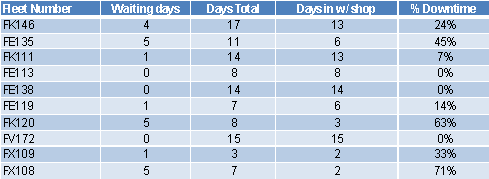
8.2.44 From time to time, the defect management activities contribute to downtime and productivity issues as resources may be allocated to resolve additional defects during the working day. This is illustrated at Appendix 3 which demonstrates for the annual service regime, the cumulative number of days `off the run', the total numbers of hours worked on a vehicle to complete the work, and also the number of hours applied per day, which is on average three hours per day. This is clearly not an effective use of resources and results from poor planning and prioritisation of workshop activities between fleet management, FMC and logistics. (Please see Appendix 4).
8.2.45 Recommendations

A. Stringently coordinate the planning activity on a weekly basis between Fleet Management, Logistics and FMC to ensure more effective co-ordination to reduce unnecessary vehicle downtime prior to work commencing on the vehicle, and also to increase productivity by improved utilisation of labour.
B. Analysis of the maintenance and accident downtime requires monthly review in order to measure both total vehicle downtime per event (time in workshop) and time taken to effect repairs (time booked to job by mechanic or technician). This needs to be a KPI.
C. Consider the accountability of Logistics, Fleet Management and FMC as part of a wider organisational review.
Fit Out and Refurbishment
8.2.46 Fit out has been a historical activity for HFRS for many years and the FMC have acquired a unique set of coach building skills which are not available outside of the traditional fire appliance bodybuilders. This has resulted in a specialist fit out department being created within FMC and is staffed by long serving Allied Tradesmen.
8.2.47 When the Allied Tradesmen are not fitting out new appliances, they focus on refurbishment and where appropriate support the planned maintenance programme. Any reduction in fit out activity will result in excess capacity once the refurbishment programme is stable.
8.2.48 The present procurement specification of appliances excludes an element of the final fit out which is completed in all other cases by the manufacturer. The fit out element comprises of the manufacture and installation of trays, shelving and bollarding with a small element of electrical installation.
8.2.49 The fit out element is not certified as compliant within the Manual Handling Regulations, and hence the appliance is not fully compliant post fit out to EN1846:2.
8.2.50 Compliance to the Manual Handling Regulations is managed by Fleet Management through the use of the Firestore software. The placement of equipment and the subsequent design is reliant upon the combined advice of Service Delivery, Fleet Management and the Allied Tradesmen. The Firestore software is not available to the Controller (Supervisor) of the Allied Tradesmen who actually fit out the vehicles based upon best endeavours knowledge. It is not clear how HFRS evidence compliance to Manual Handling Regulations with completed appliances, other than through a manual risk assessment. This is high risk as all other Fire & Rescue Services rely upon the manufacturer to provide this service.
8.2.51 However, the last batch of seven appliances awaiting fit out from delivery in 2007/8 have taken between nine and fourteen months to reach operational service, with one vehicle still to be issued for operational service.
8.2.52 This has resulted in the following issues impacting upon the operational and commercial resilience of HFRS:
8.2.52.1 The finished appliances have not been quality assured to EN1846:2 by the manufacturer. The exclusion applies to the manual handling aspects of the stowage areas completed by FMC.
8.2.52.2 There is no mechanism to have these appliances certified by the Vehicle Certification Authority, VCA, under the Firebuy framework agreement.
8.2.52.3 Critical components of the vehicle warranty have partly or fully expired prior to the vehicle being in operational service, as per the Firebuy contractual terms. This applies to the body, chassis, pump, lighting and warning systems.
8.2.52.4 HFRS have financed the capital outlay of £1.05m for a period of up to fourteen months with no operational return.
8.2.52.5 The fleet size is overstated by seven appliances as a result of the delays in fit out which hence increases the need to maintain end of life vehicles.
8.2.53 The extreme delays are attributed to the following factors:
8.2.53.1 The transition period of relocating the workshop facilities from Winchester to Eastleigh was underway during the delivery. However, the order book with the supplier was at optimum capacity and HFRS chose to maintain the build slots to secure chassis availability, and to contain the imminent risk of uplift in cost arising from the weakness of Sterling versus the Euro.
8.2.53.2 There were long delays over the decisions over stowage which could have been addressed at the supplier's premises prior to delivery, particularly as the new fibre glass type of construction required a different locker design.
8.2.53.3 Workloads were reprioritised to deal with the issue of the silver fleet, rectification of serious body corrosion, redesign of operational equipment stowage in Special Equipment Units, and fit out of the Southsea aerial ladder platform.
8.2.53.4 All seven appliances have been issued from FMC before the end of the driver training programme and hence remained unissued to stations.
8.2.53.5 Poor planning of the decommissioning of the light vehicles to meet end of lease dates.
8.2.53.6 During the course of the review, HFRS have now taken steps to ease the impact of the arrival of new pumping appliances. They will in future be delivered in batches of up to three, and will have tray/ locker fit-out at build.
8.2.54 The refurbishment programme has also suffered from the lack of focussed planning and availability of Allied Tradesmen.
8.2.55 The quality of the refurbishment work is conducted to a high standard which has demonstrably reduced the number of defects, and continues to maintain a high public image.
8.2.56 The process however cannot demonstrate best value as there is no external benchmarking on costings and the planning of labour contributes to excessive downtime. For example during the review, a vehicle was identified as being off the road for a six month period awaiting completion of refurbishment activity.
8.2.57 Recommendations

A. Provide an appliance for VCA testing on the recently fitted out vehicles to clarify that the vehicles comply with the required standards.
B. Procure completed appliances fully certified to EN1846:2 including manual handling for stowage etc in smaller batches. This will ensure operational and technical compliance whilst reducing lead times from order to operational availability.
C. Conduct regular benchmarking on the provision of refurbishment activity.
D. Utilise the excess capacity of the Allied Tradesmen, resulting from the termination of fit out, to deliver the refurbishment programme in line with the plan.
Delivery and Collection
8.2.58 Fleet is delivered and collected by six response support assistants, managed by Service Delivery, located throughout the County. The delivery and collection of Fleet is managed in conjunction with other corporate activities which can cause disruption for the planning of the workshop. An example of this is vehicles being collected on a Friday but not worked on until the following Wednesday.
Reserve Vehicle Management
8.2.59 Reserve vehicle management is co-ordinated by Logistics in conjunction with Control and the stations.
8.2.60 HFRS currently have 13 fully stowed out reserve appliances, which need to be delivered and changed. This is a well managed process, and provides HFRS with flexibility when vehicles are off the run for unforecasted reasons.
8.2.61 There is a direct link between downtime and the number of reserve appliances required. As downtime management improves there will be an opportunity to review the number of vehicles and hence running costs of the reserve fleet.
8.2.62 Recommendation

A. There is an opportunity to reduce the reliance and hence number of reserve appliances once the logistics co-ordination and downtime in FMC improves. This will also generate a nominal benefit of c£6,000 per appliance on annual maintenance and servicing.
Quality Control
8.2.63 Quality Control is managed by the technicians at each location. The mechanical work is carried out to a high standard which is reflected in the higher than average resale value of vehicles.
8.2.64 Vehicles are MOT tested by external contractors when due. Vehicles are also independently inspected after an incident when there is any reference relating to a defect within the vehicle.
8.2.65 The information given to stations by Fleet Management and FMC is limited. Several other Fire and Rescue Services have introduced `Dashboards' to each Area. The dashboard provides a highlighted summary of the local issues affecting them and provides tailored data on the status of their fleet. An example can be seen at Appendix 1.
8.2.66 It is best practice in UK Fire and Rescue to have objective quality assurance conducted by independent audits from the FTA. They are a `UKas' accredited quality control agency who produce sample inspections, on a rolling annual basis on work performed both internally and externally. These inspections are conducted to VOSA and CFOA level.
8.2.67 The FTA provides bi-monthly management reports within the South Eastern TOG Region showing:
· Contract Average All Defects Found.
· Defects by Location (those identifying potential rogue vehicles and need for training).
· Component defects to be used for warranty.
8.2.68 Recommendations

A. Contract FTA to audit maintenance standards and to provide an element of local independent benchmarking.
B. Implement KPIs for all planned work downtime.
C. Provide a weekly `dashboard' to local Areas on the status of their fleet issues.
8.3 Resources and Organisation
Premises
8.3.1 The Eastleigh workshop is a purpose built secure workshop sharing with other departments. The location is ideal for proximity to the M3 and M27 motorways with a secure storage and parking area and a separate engineering and ladder shop.
8.3.2 The workshop comprises of a 14 servicing bays, a rolling road brake testing facility, deep well testing, paint shop, dedicated car repair area, cabinet making woodwork shop, machine shop, ladder and equipment shop, mezzanine storage area, administrative offices, and well equipped kitchen and rest area and rest room facilities .
8.3.3 The facilities can be considered to be Beacon Status within Local Authorities and are of a standard normally only seen at private sector dealerships.
8.3.4 The workshop shares the building with operational stores department.
8.3.5 Parking for workshops is limited and may restrict the level of external work which may be managed on this site.
8.3.6 The Fleet Management Centre function provides a 24/7/365 on-call mobile service.
Department Organisation
Structure
8.3.7 The Transport Function is organised into two departments, Fleet Management and the Fleet Maintenance Centre (FMC). The strategy is provided by Fleet Management with the operational delivery performed by FMC.
8.3.8 Both functions report into the Deputy Chief Fire Officer, (Director of Strategic Projects and Specialist Response). There is no accountability between functions other than through the strategic direction of the Director.
8.3.9 Such an organisational structure is unique within both public and private sector HGV workshops. The present structure has permitted a fragmented approach to compliance, accountability and activity to develop.
8.3.10 The reporting line into the Deputy Chief Fire Officer is also unusual as elsewhere the function reports into a Director of Assets and Resources, which has total accountability for specification, performance and logistical activity.
Fleet Management
8.3.11 The primary role of the Fleet Management Department is to ensure that the fleet is procured and maintained in accordance with all statutory and industry related road traffic legislation. The holder of the Certificate of Professional Competency (CPC), who has legal responsibility for fleet worthiness on behalf of HFRS, is held by the present Fleet Manager. This is the norm within HGV fleet management within the UK. The Fleet Manager has the responsibility for the production of the service plan, including on site quality assurance, planning and health and safety.
8.3.12 The Fleet Management Department are in effect the "owners" of the fleet vehicles and are responsible for the purchase, management and disposal of all vehicle assets; this includes the production of specifications, determining the servicing, maintenance, repair and refurbishment requirements. It is responsible for the setting of maintenance standards, fleet management records and asset management.
8.3.13 The Fleet Management Department is responsible for managing the changing fleet profile through procurement to ensure that HFRS has a modern fleet which is fit for purpose, affordable and has an appropriate replacement programme in terms of size and type. In addition it is responsible for the research and development of future generations of fire vehicles in conjunction with Service Delivery.
8.3.14 Fleet Management is responsible for the Capital Fleet Budget, including the fit out of new vehicles which are not completed by the manufacturer.
8.3.15 The Fleet Management team comprises of a Fleet Manager who is the HFRS CPC holder, an Assistant, Fleet Manager and an administration assistant. They are located within the FMC office suite.
8.3.16 The servicing and plan is published annually in advance, with monthly updates to reflect any changes to the programme. This is distributed to all stations, and the logistics department who manage vehicle and equipment movements and also to FMC to enable them to plan the workload across the workshop.
8.3.17 Fleet Management Administration provides a vigorous caretaking "administration" role in relation to the legal aspects of running a fleet of vehicles. This includes: the monitoring and provision of vehicle road tax, the administration of accident claims and fleet vehicle lists for the financial system.
8.3.18 The administration of the department is excellent, albeit currently labour intensive due to the double entry required under the present TRACE fleet system.
8.3.19 There are several administrative KPI's set and delivered each month in the areas of budget management, billing, invoicing etc, as well as providing sensitive management data when required in a timely manner.
Fleet Maintenance Centre (FMC)
8.3.20 The Fleet Maintenance Centre's core activity is the operational delivery of the commissioning, servicing, inspections, preventative maintenance, repair, defect response and rectification, refurbishment and modifications, accident repairs, fit-out and decommissioning of fleet and related equipment.
8.3.21 The majority of operational equipment excluding ladders, light portable pumps and generators is maintained by Service Delivery.
8.3.22 FMC is also responsible for the Maintenance and Repair and Refurbishment revenue budgets.
8.3.23 The FMC team comprise of 27.5 posts (see Appendix 5). This is headed up by a FMC Manager, supported by a management team of two workshop controllers and a charge hand. They are supported by a small administrative team of 2.5 posts.
8.3.24 The workshop organisation is both complex and unique. It is divided into three defined skill levels, vehicle mechanics, auto electricians and allied trades (fabricator / welders, paint sprayers, and coachbuilders). This unorthodox structure does lead to an element of demarcation and causes unnecessary disruption within the workshop planning in terms of role and work allocation, which is not typical either within the Fire Service or the private sector.
8.3.25 This structure has evolved from the days when HFRS manufactured their own appliances. Any future recruitment should draw from multi skilled technicians able to perform all workshop functions other than paintshop and electricians where there is an element of specialism required.
Workshop Personnel
8.3.26 All the mechanics are highly skilled with minimum qualifications including IRTEC, have VOSA inspection training and are time served apprentices.
8.3.27 The relevant Controller allocates work each day, working with the workshop planning technician.
8.3.28 Local management supervision within FMC is lax and has poor visibility on the shop floor, which is a contributory factor to the day to day poor productivity, downtime and planning.
8.3.29 There are regular reviews to discuss activity but KPIs are not available to measure progress and activities.
8.3.30 There is visible evidence of staff objectives being set, through the Personal Development Review process, though they need to be visibly evidenced by collective objectives upon the shopfloor.
8.3.31 The average age profile of the mechanics and allied tradesmen currently stands at c.45+. HFRS do support an apprenticeship programme as part of a skills continuity plan.
8.3.32 The Fleet Management, FMC management and Workshop personnel do not operate as a cohesive operational team. The lack of regular reviews against meaningful targets and lack of cross functional objectives level causes issues with accountability
Processes
8.3.33 All operational, administrative and management processes are performed in accordance with an evolved system. The key processes of the system revolve around the repair and maintenance of vehicles and equipment. Activities are not process mapped and documented and safety documents such as jobcards, histories are stored in a manual fleet management system.
8.3.34 There were very few policies, procedures, protocols or process maps in place to document the systems and processes in place. These would normally be evidenced through a Service Level Agreement and also a Fleet and Equipment Strategy Document, both of which are dynamic
8.3.35 Communication requires more structure with the team having regular meetings with all personnel on a monthly basis, for example holding regular `tool box talks'. In addition, formal management meetings are held on a three monthly basis, to measure performance and generally cover issues such as general team briefing, defect response rates, downtimes, service schedules and new fleet acquisition.
8.3.36 No measurements of the performance of technical delivery was available. Some of this is attributed to the lack of a robust fleet management KPI structure, and also lack of technical knowledge at management level.
8.3.37 Recommendations

A. Review the reporting domain at Directorate level as part of a wider management review to also include logistics.
B. Reorganise the management of the Transport Function into one unit, which is accountable at Directorate level for compliance, budget performance, operational delivery of appropriate specifications and workshop performance. A potential revised structure is shown at Appendix 7. This will require a revision to the role of Fleet Manager to that of `Head of Engineering Services' as the responsibilities become far wider.
C. Reallocate the revenue maintenance budget to the above post.
D. Following the selection of a suitable fleet system and the decision to procure fit-out from the vehicle manufacturer, conduct a review of the number of administrative posts required between the two current functions and review the number of allied trades posts in 12 months time, once all backlog of refurbishment is completed.
E. Implement a succession plan as part of a wider restructure to include the continued recruitment of apprentices (supported by the Local Government 100 Apprenticeship Scheme).
F. Conduct regular reviews of workshop performance by advising of KPI measurements and delivery and introducing `toolbox talks' on a monthly basis.
G. The following KPIs require implementing and monitoring and the information made available to the management via a balanced scorecard, or suite of reports and KPIs:
· Number of completed services and inspections.
· Vehicle availability.
· Defect reporting.
· Refreshment programme.
· Spend.
8.4 Procurement
8.4.1 Procurement of transport has over the past ten years enjoyed a high profile internally within HFRS.
8.4.2 Relationships with key suppliers, local parts suppliers, service providers and factors are professional and enable an efficient goodwill service to be delivered to HFRS.
8.4.3 All cars and commercial vehicles are either secured through the NPIA, former PITO arrangements or through local service providers.
8.4.4 All procurement bids are managed in a structured manner and all capital procurement uses Pan Government frameworks where available including Firebuy for appliances, NPIA for cars and vans and OGC for fuel. This procurement process is managed by one of the following:
· Auditable Mini-Competitions
· Use of frameworks, e.g. OGC Fuel
8.4.5 The recent procurement for seven appliances, was the first time HFRS used the Firebuy framework agreement. This mini-competition was robust and would pass an independent audit as it presented a clear business case for the recommendation based upon operational criteria and was managed through a Prince2 risk log process.
8.4.6 In addition the management of request for price increase of some £11k per appliance, resulting from the weakness of the Pound against the Euro was well managed and was contained to c £3.5k increase per appliance.
Stores
9.1. Stores / parts are well managed with minimal and / or imprest stock facilities. However, they need to take ownership of parts ordering from workshop controllers.
9.2. The mobile engineer's van carries an amount of key stock. This is keenly managed by the workshop.
9.3. Housekeeping of stocks is uniformly excellent with kits of parts per vehicle being prepared to facilitate downtime.
9. Training
10.1 There is no formal training programme in place. Integration with the Personal Development Review programme is recommended.
10. Collaboration
11.1 There is limited evidence of collaboration at a local level with other Fire & Rescue Services, Hampshire County Council or other local partners.
11.2 HFRS have recently engaged with Dorset over fleet management activities and have undertaken some joint research on the procurement of aerial appliances with East Sussex.
11.3 However, at a National level, through the Directorate, HFRS have been high profile in stating minimum requirements for vehicle procurement and the impact that that national frameworks can have upon each FRS.
Recommendation
A. HFRS are encouraged to seek participation within the South Eastern TOG Group and to visit other Fire & Rescue Services to understand the processes undergone in recent major organisational and process changes. HFRS are encouraged to visit Northern Ireland, Essex, East Sussex and Staffordshire Fire & Rescue Services.
B. Continue with the use of frameworks including Firebuy, OGC and NPIA.
11. Benchmarking
The benchmarking exercise demonstrates that:
12.1 The fleet is now compliant with all statutory, regulatory and industry standards.
12.2 The present management structure and department organisation is unique, and contributes towards the fragmented approach to compliance, accountability and productivity.
12.3 The integrity of fleet management data shows the lack of relevant proactive measurement and reporting and may expose HFRS to criticism from a regulatory body for poor reporting processes.
12.4 The costs are competitive when compared to other Fire & Rescue Services, but could be improved with the introduction of whole life costing, standard times being applied, productivity being managed and a house warranty provision.
12.5 There is an opportunity to formalise a client/ contractor relationship through the development of an internal Service Standard between a combined fleet and workshop department and the service delivery functions.
12.6 Meaningful benchmarking data will be made available once tangible KPIs are implemented and measured.
ACRONYMS USED IN THIS REPORT | |
CFOA |
Chief Fire Officers Association |
CIPFA |
Chartered Institute of Public Finance & Accountancy |
CPC |
Certificate of Professional Competency |
FMC |
Fleet Maintenance Centre |
FTA |
Freight Transport Association |
HSE |
Health & Safety Executive |
ICME |
Institute of Mechanical Engineers |
IRTEC |
Institute of Road Transport Engineers Certificate |
KPI |
Key Performance Indicator |
LOLER |
Lifting Operations & Lifting Equipment Regulations |
MKA |
Munro Kempton Associates |
NPIA |
National Police Improvement Association |
OGC |
Office of Government Commerce |
PITO |
Police Information Technology Organisation |
PUWER |
Provision and Use of Work Equipment Regulations 1998 |
TOG |
Transport Officers' Group |
VCA |
Vehicle Certification Authority |
VOSA |
Vehicle Operator Services Agency |
Cost Centre/Group F130 Workshops
Fiscal Year 2008
Budget Revenues by Cost Element
H001 Revenue Monitoring (by CE)
Date: 06.01.2009
Pages: 0
Requested by: FIREADO
Controlling Area 1000 Hampshire County Council
Fiscal Year 2008
From Period 1
Plan Version 1
Cost Centre/Group F130 Workshops
Cost Element Group 2000..5995 Cost Element Group
Budget Revenues By Cost Element | |||||
Cost elements |
Plan |
Actual |
Commitments |
Total (inc com) |
Available |
2010 Admin. Staff - Basic |
826,196.53 |
472,067.84 |
|
472,067.84 |
354,128.69 |
2011 Admin. Staff - O'time |
11,899.12 |
2,818.95 |
|
2,818.95 |
9,080.17 |
2014 Admin. Staff - Allow. |
|
46,822.10 |
|
46,822.10 |
46,822.10- |
2018 Admin. Staff - NI |
|
38,972.55 |
|
38,972.55 |
38,972.55- |
2019 Admin. Staff - Pen. |
|
103,644.60 |
|
103,644.60 |
103,644.60- |
2040 Agency Staff - Basic |
|
2,589.92 |
410.08 |
3,000.00 |
3,000.00- |
2440 W/T Firefters - Bsc |
|
|
|
|
|
3787 General Maintenance |
|
2,851.22 |
|
2,851.22 |
2,851.22- |
3796 Elec Maint-Not Prop |
|
213.90 |
|
213.90 |
213.90- |
3798 MechMaint-Not Prop |
|
919.49 |
|
919.49 |
919.49- |
3821 External Works |
566.84 |
|
350.00 |
350.00 |
216.84 |
3900 Electricity |
|
4,016.71 |
|
4,016.71 |
4,016.71- |
3905 Gas |
|
2,766.01 |
|
2,766.01 |
2,766.01- |
3950 Non PUA Gas |
|
2,766.01- |
|
2,766.01- |
2,766.01 |
3951 Non PUA Electricity |
|
4,016.71- |
|
4,016.71- |
4,016.71 |
3955 Non PUA Water - Rated |
|
0.83- |
|
0.83- |
0.83 |
3957 Non PUA Sewage - Rated |
|
21.76- |
|
21.76- |
21.76 |
4001 Uniform Business Rates |
|
|
|
|
|
4010 Water - metered |
|
0.83 |
|
0.83 |
0.83- |
4020 Sewerage - metered |
|
21.76 |
|
21.76 |
21.76- |
4042 Fixts&Fittings-Gen. |
|
9,291.66 |
1,323.15 |
10,614.81 |
10,614.81- |
4060 Cleaning Materials |
1,927.68 |
1,971.79 |
|
1,971.79 |
44.11- |
4070 Contract Cleaning |
3,257.64 |
743.94 |
|
743.94 |
2,513.70 |
4092 Gen. Refuse Collect. |
6,741.16 |
3,186.80 |
75.45 |
3,262.25 |
3,478.91 |
4200 Plant, Tools & Equip |
52,900.60 |
44,590.20 |
1,336.82 |
45,927.02 |
6,973.58 |
4210 R&M - Vchs&Plant |
23,403.20 |
24,574.02 |
84.00 |
24,658.02 |
1,254.82- |
4220 Workshop Spares&Cons |
383,425.48 |
315,944.20 |
14,164.56 |
330,108.76 |
53,316.72 |
4230 Batteries |
7,647.76 |
12,478.55 |
1,929.94 |
14,408.49 |
6,760.73- |
4231 Oil Grease Anti-Freeze |
6,131.12 |
6,339.50 |
11.15 |
6,350.65 |
219.53- |
4232 Vehicle Fuel |
16,756.56 |
7,393.60 |
|
7,393.60 |
9,362.96 |
4235 Tyres, Tubes |
25,750.36 |
39,811.32 |
2,786.20 |
42,597.52 |
16,847.16- |
4236 Vch Running Exp-Oth. |
4,064.68 |
3,031.59 |
40.35 |
3,071.94 |
992.74 |
4280 Car Leasng Bus.Rents |
1,832.40 |
|
|
|
1,832.40 |
4362 Staff Car Allowances |
279.60 |
6,646.12 |
|
6,646.12 |
6,366.52- |
4416 Purch Of Op. Equip |
|
159.40 |
1,646.59 |
1,805.99 |
1,805.99- |
4525 Furniture & Fittings |
5,000.00 |
|
|
|
5,000.00 |
4579 Publications |
|
38.65 |
|
38.65 |
38.65- |
4615 Drugs & Medical |
233.24 |
431.70 |
|
431.70 |
198.46- |
4690 Cont Laund/Dry Cln |
6,865.08 |
4,090.02 |
|
4,090.02 |
2,775.06 |
4700 Protective Clothing |
1,707.72 |
2,910.42 |
183.49 |
3,093.91 |
1,386.19- |
4705 Printing |
1,109.80 |
680.64 |
|
680.64 |
429.16 |
4706 Stationery |
1,098.52 |
572.71 |
40.62 |
613.33 |
485.19 |
4715 P'copiers-Rent/Mtce |
860.60 |
13.54 |
|
13.54 |
847.06 |
5035 IT Consumables |
2,187.32 |
239.77 |
24.00 |
263.77 |
1,923.55 |
5070 Telephones - Rental |
2,207.72 |
341.43 |
|
341.43 |
1,866.29 |
5079 Telephones - Calls |
|
99.00 |
|
99.00 |
99.00- |
5085 Radio System Costs |
8,830.52 |
4,667.25 |
123.00 |
4,790.25 |
4,040.27 |
5086 Other Communications |
3,231.40 |
5,055.74 |
34.04 |
5,089.78 |
1,858.38- |
5091 Postages |
|
10.00 |
|
10.00 |
10.00- |
5169 Travelling And Subs. |
451.60 |
344.50 |
|
344.50 |
107.10 |
5394 Other Misc Expenses |
1,687.24 |
1,099.61 |
72.00 |
1,171.61 |
515.63 |
7022 Workshop - internal |
151,246.96- |
18,431.36- |
|
18,431.36- |
132,815.60- |
7023 Workshop - External |
37,279.56- |
31,310.68- |
|
31,310.68- |
5,968.88- |
7203 General Misc Income |
|
135.13- |
|
135.13- |
135.13 |
* Total |
1,219,724.97 |
1,117,781.07 |
24,635.44 |
1,142,416.51 |
77,308.46 |
Cost Centre/Group ALT.F232 Fleet Maintenance
Fiscal Year 2009
Budget Revenues by Cost Element
H001 Revenue Monitoring (by CE)
Date: 03.06.2009
Pages: 0
Requested by: FIREADO
Controlling Area 1000 Hampshire County Council
Fiscal Year 2009
From Period 1
Plan Version 1
Cost Centre/Group ALT.F232 Fleet Maintenance
Cost Element Group ALTFIRE Total Expenditure (GL 2000-746
Budget Revenues By Cost Element | |||||
Cost elements |
Plan |
Actual |
Commitments |
Total (inc com) |
Available |
2010 Admin. Staff - Basic |
825,228.32 |
102,652.36 |
|
102,652.36 |
722,575.96 |
2011 Admn. Staff - O'time |
12,256.12 |
360.32 |
|
360.32 |
11,895.80 |
2014 Admn. Staff - Allow. |
|
10,095.83 |
|
10,095.83 |
10,095.83- |
2018 Admin. Staff - NI |
|
8,299.04 |
|
8,299.04 |
8,299.04- |
2019 Admin. Staff - Pen. |
|
20,922.49 |
|
20,922.49 |
20,922.49- |
* Admin Staff |
837,484.44 |
142,330.04 |
|
142,330.04 |
695,154.40 |
2440 W/T Firefters - Bsc |
|
|
|
|
|
* W/T Fire Fighter |
|
|
|
|
|
** Pay Costs-Basic,NI,Sup etc |
837,484.44 |
142,330.04 |
|
142,330.04 |
695,154.40 |
3661 Vandalism |
|
104.49- |
|
104.49- |
104.49 |
3787 General Maintenance |
|
219.90 |
|
219.90 |
219.90- |
3821 External Works |
581.00 |
|
|
|
581.00 |
4010 Water - metered |
2.28 |
|
|
|
2.28 |
4020 Sewerage - metered |
647.16 |
|
|
|
647.16 |
4060 Cleaning Materials |
1,975.92 |
14.71 |
|
14.71 |
1,961.21 |
4070 Contract Cleaning |
|
|
|
|
|
4092 Gen. Refuse Collect. |
3,168.48 |
493.19 |
|
493.19 |
2,675.29 |
4200 Plant, Tools & Equip |
44,152.48 |
3,767.60 |
1,517.77 |
5,285.37 |
38,867.11 |
4210 R&M - Vchs&Plant |
23,988.32 |
720.22 |
200.00 |
920.22 |
23,068.10 |
4220 Workshop Spares&Cons |
274,111.16 |
115,285.35 |
5,321.25 |
120,606.60 |
153,504.56 |
4230 Batteries |
15,629.52 |
2,400.00 |
200.00 |
2,600.00 |
13,029.52 |
4231 Oil Grease Anti-Frze |
6,284.36 |
2,079.86 |
|
2,079.86 |
4,204.50 |
4232 Vehicle Fuel |
10,000.00 |
|
|
|
10,000.00 |
4235 Tyres, Tubes |
26,394.16 |
6,025.49 |
|
6,025.49 |
20,368.67 |
4236 Vch Running Exp-Oth. |
4,166.32 |
992.59 |
109.20 |
1,101.79 |
3,064.53 |
4340 Staff Travel Exp-Gen |
|
59.57 |
|
59.57 |
59.57- |
4362 Staff Car Allowances |
438.84 |
521.53 |
|
521.53 |
82.69- |
4416 Purch Of Op. Equip |
|
69.94 |
1,646.59 |
1,716.53 |
1,716.53- |
4615 Drugs & Medical |
239.12 |
|
|
|
239.12 |
4690 Cont Laund/Dry Cln |
7,036.68 |
|
|
|
7,036.68 |
4700 Protective Clothing |
1,750.44 |
|
70.00 |
70.00 |
1,680.44 |
4705 Printing |
1,137.52 |
70.40 |
|
70.40 |
1,067.12 |
4706 Stationery |
1,126.00 |
119.48 |
18.12 |
137.60 |
988.40 |
4715 P'copiers-Rent/Mtce |
|
|
|
|
|
5035 IT Consumables |
2,242.04 |
|
|
|
2,242.04 |
5070 Telephones - Rental |
|
20.26 |
|
20.26 |
20.26- |
5079 Telephones - Calls |
|
22.00 |
|
22.00 |
22.00- |
5085 Radio System Costs |
|
26.04- |
|
26.04- |
26.04 |
5086 Other Communications |
|
|
|
|
|
5169 Travelling And Subs. |
462.88 |
69.72 |
|
69.72 |
393.16 |
5394 Other Misc Expenses |
1,729.48 |
837.59 |
|
837.59 |
891.89 |
** Fire non-pay expenditure |
427,264.16 |
133,658.87 |
9,082.93 |
142,741.80 |
284,522.36 |
7022 Workshop - internal |
36,128.12- |
|
|
|
36,128.12- |
7023 Workshop - External |
38,211.60- |
|
|
|
38,211.60- |
** Fire income |
74,339.72- |
|
|
|
74,339.72- |
*** Total |
1,190,408.88 |
275,988.91 |
9,082.93 |
285,071.84 |
905,337.04 |
Cost Centre/Group ALT.F231 Fleet Management
Fiscal Year 2009
Budget Revenues by Cost Element
H001 Revenue Monitoring (by CE)
Date: 03.06.2009
Pages: 0
Requested by: FIREADO
Controlling Area 1000 Hampshire County Council
Fiscal Year 2009
From Period 1
Plan Version 1
Cost Centre/Group ALT.F231 Fleet Management
Cost Element Group ALTFIRE Total Expenditure (GL 2000-746
Budget Revenues By Cost Element | |||||
Cost elements |
Plan |
Actual |
Commitments |
Total (inc com) |
Available |
2010 Admin. Staff - Basic |
142,227.16 |
19,172.56 |
|
19,172.56 |
123,054.60 |
2011 Admn. Staff - O'time |
|
346.79 |
|
346.79 |
346.79- |
2014 Admn. Staff - Allow. |
|
794.72 |
|
794.72 |
794.72- |
2018 Admin. Staff - NI |
|
1,561.67 |
|
1,561.67 |
1,561.67- |
2019 Admin. Staff - Pen. |
|
3,688.80 |
|
3,688.80 |
3,688.80- |
* Admin Staff |
142,227.16 |
25,564.54 |
|
25,564.54 |
116,662.62 |
** Pay Costs-Basic,NI,Sup etc |
142,227.16 |
25,564.54 |
|
25,564.54 |
116,662.62 |
4201 Vehicle Purchases |
|
|
|
|
|
4232 Vehicle Fuel |
125,015.48 |
15,957.06 |
117,106.24 |
133,063.30 |
8,047.82- |
4233 Road Fund Licences |
1,028.16 |
350.00 |
|
350.00 |
678.16 |
4236 Vch Running Exp-Oth. |
359.84 |
|
|
|
359.84 |
4263 Hire T'port & Plant |
231.56 |
|
|
|
231.56 |
4340 Staff Travel Exp-Gen |
3,084.68 |
549.38 |
667.56 |
1,216.94 |
1,867.74 |
4362 Staff Car Allowances |
5,204.08 |
858.72 |
|
858.72 |
4,345.36 |
4516 Dom&Clng Equip-Purc |
1,110.76 |
269.36 |
|
269.36 |
841.40 |
4579 Publications |
|
|
100.00 |
100.00 |
100.00- |
4705 Printing |
547.24 |
|
598.00 |
598.00 |
50.76- |
4706 Stationery |
151.76 |
|
|
|
151.76 |
5056 Insurance Excesses |
67,798.16 |
1,841.36 |
64,157.30 |
65,998.66 |
1,799.50 |
5169 Travelling And Subs. |
810.24 |
95.00 |
|
95.00 |
715.24 |
5255 Advrtising Non Staff |
1,662.68 |
|
|
|
1,662.68 |
** Fire non-pay expenditure |
207,004.64 |
19,920.88 |
182,629.10 |
202,549.98 |
4,454.66 |
6790 De minimus Cap Rcpts |
21,105.68- |
330.48- |
|
330.48- |
20,775.20- |
7019 Ins Claim Settlemnts |
15,985.24- |
619.11- |
|
619.11- |
15,366.13- |
** Fire income |
37,090.92- |
949.59- |
|
949.59- |
36,141.33- |
*** Total |
312,140.88 |
44,535.83 |
182,629.10 |
227,164.93 |
84,975.95 |
Fleet Maintenance Centre - Defect Performance Indicators | |||||||
Annual Totals |
|
|
|
|
|||
|
|
|
|
|
|||
|
2005/6 |
2006/7 |
2007/8 |
2008/9 |
|||
|
|
|
|
|
|||
Body |
587 |
446 |
290 |
197 |
|||
Electrical |
1058 |
720 |
535 |
381 |
|||
Engineering |
802 |
562 |
381 |
301 |
|||
Equipment |
71 |
124 |
123 |
62 |
|||
|
|
|
|
|
|||
Total |
2518 |
1852 |
1329 |
941 |
|||
Failed to Attend / Complete |
|||||||
|
2006/7 |
2007/8 |
2008/9 | ||||
|
Attend |
complete |
Attend |
complete |
Attend |
complete | |
Category 1 |
6 |
63 |
0 |
14 |
0 |
8 | |
Category 2 |
0 |
3 |
1 |
1 |
1 |
1 | |
Category 3 |
3 |
13 |
3 |
7 |
1 |
1 | |
|
|
|
|
|
|
| |
Total |
9 |
79 |
4 |
22 |
2 |
10 | |
|
|||||||
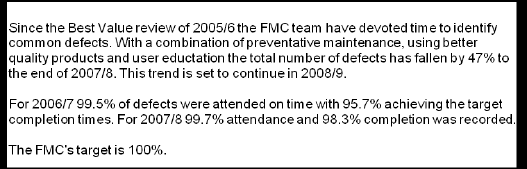
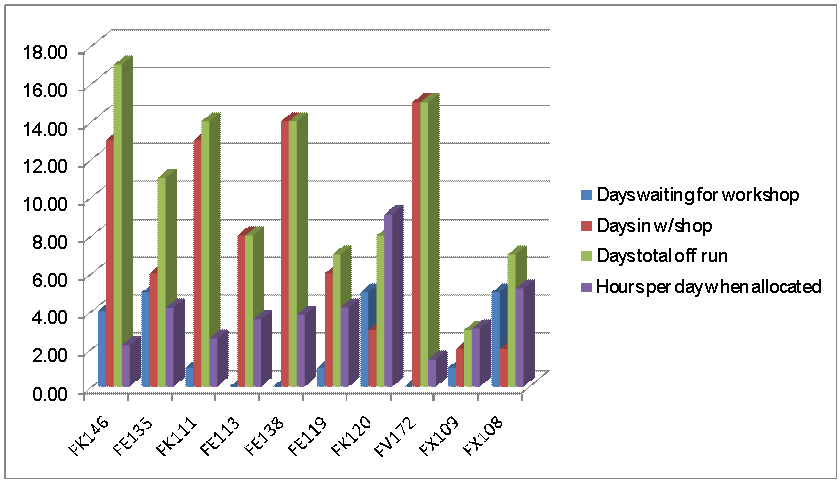
Fleet Maintenance Centre Manager |
||||||||||||||
Controller Workshops |
Controller Projects & Planning | |||||||||||||
|
W/s Charge hand |
|||||||||||||
Allied Trades Technician (8) |
||||||||||||||
LGV Mechanical Technician (6) |
Auto-electrical Technician (3) |
GDA |
Administrator (2.5) | |||||||||||
Allied Trades Apprentice |
||||||||||||||
LGV Apprentice |
Auto-electrical Apprentice |
|||||||||||||
Date |
September 2009 |


BUSINESS REVIEW CASE |
STRATEGY & REVIEW PROCESS DETERMINED |
· Review fit out compliance. · Review organisation |
· Review of KPI'S |
· Interim six monthly review · Link into IRMP 2009-12 plan · Review opportunities with external agencies |
· Review of KPIS |
· Production of end of Year Stewardship Report. |
OPERATIONAL / RESILIENCE ISSUES |
· Agree outline Issues · Agree KPI's and performance management · Commence procedure for defect management · Introduce Standard times · Discontinue fit out. · Undertake a VCA test for manual handling on new appliances |
· Agree Service Level Agreement format · Review recording of defects. · Review interface with logistics. · Measurement of repair & maintenance costs per vehicle . |
· Measurement of time per service · Measurement of repair & maintenance costs per vehicle · Commence review of modification costs. · Commence review of equipment and fleet combined maintenance. · Review defect procedure. |
· Review defect data recording & measurement. · Review measurement of planned v unplanned downtime. · Measurement of time per service · Measurement of repair & maintenance costs per vehicle · Review security |
· Complete acceptance procedure of appliances. · Complete procedure for disposals. · Measurement of time per service · Measurement of repair & maintenance costs per vehicle · Review security |
· Measurement of time per service · Analysis of refurbishment costs. |
MIS ISSUES |
Commission immediate market place review of functionality required |
Agree spec and tender according to procedures |
· Review proposed fleet management system and award appropriately.. |
Agree project management of implementation of new system |
Implement new system |
· Review implementation process |
COMMERCIAL ISSUES |
Reposition Maintenance and Refurbishment budget with Fleet Management. Engage FTA for quality assurance and benchmarking |
· Service Standard Agreement Review |
· Implement revised labour rates. · Introduce profile budgeting |
· Monitor stock levels. · Monitor costs of maintenance |
· Monitor stock levels |
|
INVESTMENT |
Commission Invest to Save bid for Dealership status on warranty with Ford and Volvo |
· Review |
||||
PEOPLE AND ORGANISATION DESIGN |
· Review principles · Consult with personnel over potential reorganisation Review succession. · Review senior Fleet Management position (Head of Engineering Services) |
· Agree principles of HR strategy · Review roles. · Present strategy paper to SMT |
· Team Away Day · Business contingency · Review training |
· Review capacity of mechanics and allied tradesmen |
· Staffing & Resource Profile Identified |
· Review Training needs including apprenticeship Scheme. · Consider a pilot `mentoring' with highlighted FRS. |
ACCOMMODATION |
Review ladder and equipment facilities for expansion with other agencies |
|||||
PROCUREMENT |
Discontinue with fit out on appliances |
Commence benchmarking on refurbishment activity |
||||
COMMUNICATION |
· Summarise key outputs of Best Value Review to FMC staff. · Monthly Transport Personnel briefing. · TOOL BOX CHAT |
· Annual & monthly maintenance plan issued. |
· Quarterly review with stations |
· Industry & potential contractor days. · Stakeholder briefings · Quarterly review with stations |
· Quarterly review with stations |
· Help line/ Fast track issues procedures initiated. · Stewardship monitoring reports initiated · Quarterly review with stations |
PROCESSES |
· Identify all procedures for review · (WIP) |
· Commence review and process mapping of all activities. |
· Conclude Review of Processes. | |||
AUDIT |
· Conduct audit on compliance issues.l |
· Conduct a stewardship review of activity over the past 12 months. |
Head Of Fleet Management (Head of Engineering Services) |
|||||||||||
|
|
||||||||||
Assistant Fleet Manager |
Workshop Manager |
||||||||||
|
|
|
Workshop Administrators x 2.5 |
||||||||
Fleet Administrator |
Workshop Controller x 2 |
||||||||||
|
|||||||||||
Charge Hand |
|||||||||||
|
|
|
|
|
|
|
|||||
LGV mechanics x 6 |
Allied Trades x 8 |
Electricians x3 |
Garage Hand |
||||||||
|
|||||||||||
Apprentices x 3 |
|||||||||||
Service Level Agreement Guidelines and KPI Examples
1. It is suggested that the following key tasks be identified as separate operations with standards set accordingly.
· specification and procurement;
· safety inspection of fleet items;
· scheduled preventative maintenance of fleet items;
· repair of fleet items where the cause is fair wear and tear;
· avoidable repair and avoidable breakdown;
· accident damage;
· fleet item delivery and collection service when required;
· recovery of operational vehicles (beyond roadside repair);
· minor bodywork repair, refurbishment and modification;
· replacement of windscreens;
· fitting of replacement parts, materials and consumable fluids;
· the commissioning of fleet items;
· the de-commissioning of fleet items;
· arranging for the supply, repair and replacement of tyres from the approved contractor;
· installation and maintenance of specialised equipment as directed;
· providing additional modification work as required;
· replacement of all bulbs, lamps and lenses as necessary;
· preparing and submitting vehicles for annual statutory tests;
· ad-hoc support to operational support incidents;
· the fitting of power supplies for [fire service] radios and other electronic equipment;
· manufacture of items of equipment e.g. stowage items, monitors etc;
· responding and attending to defects and minor repairs to fleet items;
· maintaining a fleet management system;
· stores management;
· management activities.
2. In addition it is recommended that the Service Level Agreement sets out key performance levels in the areas of:
· Provision of Maintenance Records through a Fleet Management System.
· Compliance to Health and Safety Standards, Environmental Legislation and the Security Policy.
· Quality Assurance of inspection, maintenance and repair standards.
· Continued provision of auditable fleet management data, which accurately reflect time, logged per type of vehicle.
· Minimisation of downtime through the review of logistics.
· Measurement and reduction of reactive maintenance costs.
· Number of completed jobs against the programme.
· Measurement of planned v unplanned maintenance.
· Vehicle downtime / availability figure.
· Defect Reporting and analysis.
· Measurement of modification programmes.
· Cost of servicing each fleet item.
· Measurement of workshop productivity.
KPIs
(a) The Number of Completed Jobs against the Planned Maintenance Programme
This will be measured as a % of each vehicle / transport equipment type. The targets will be measured monthly against the programme.
(b) Measurement of Planned v Unplanned
This will be as a percentage of planned versus unplanned. The measurement will be taken each month and averaged to give the annual total.
(c) Availability Figure
This will be measured as a percentage of the total vehicles available in each duty. This will be measured on the first day of each month and summed to give the annual figure. This will be measured using the statistics from Controls on slot down time. The targets will be agreed.
(d) Defect Reporting
This will be the frequency of each code of defect discovered each month and summed to give the yearly figure.
(e) Measurement and Modification Programmes
This will be measured as an ad-hoc arrangement as and when modifications are presented for transport to complete. It will be based upon the estimate for the modification versus the actual time to complete. At the commencement of each new modification project a pilot study will be conducted to accurately estimate the number of hours it will undertake to perform the modifications. At the end of each modification project a report will be undertaken to measure the estimate given against the actual time to complete the work.
(f) Cost of Servicing per Vehicle
This will be measured for all Fleet items using a calculation of Contract labour hours used plus all parts and consumables expenditure on an annual basis. This will be shown as both:
· An annual cost per fleet item.
· Pence per mile.