
Archived decisions
Hampshire Fire and Rescue Authority Item 15
16th September 2009
The economic climate and the impact on the Service's operational activity
Report by the Chief Officer
Contact: Mick Crennell, Tel 023 8062 6853, [email protected]
1 |
Summary |
1.1 |
We are in a new period of unprecedented economic uncertainty and instability. We need to prepare for the possibilities of how this downturn may affect the FRS and consider methods to mitigate the effects. |
1.2 |
Evidence and historic analysis strongly suggests that, previously, economic recession has a tendency to adversely impact on the number of arson incidents experienced by fire and rescue authorities. |
1.3 |
In examining how the current economic situation is directly affecting the number of arson-related incidents being attended by HFRS it was found that no strong correlation exists and that to date we are not experiencing an increase in arson which can be directly attributable to the economic climate. |
1.4 |
HFRS continues to make good progress against our challenging arson targets established within the three Local Area Agreements. |
1.5 |
HFRS has seen a minor spike in reported arson incidents over the last quarter (April - June 09). It is considered that this could be as a result of the implementation of the new Incident Recording System (IRS) and the way in which different incidents are now being reported rather then being attributable to the economic situation. |
1.6 |
We will monitor the sensitivity between the economic situation and our established performance indicators and put a range of methods in place to mitigate the potential effects. |
2 |
Recommendation |
2.1 |
That the Authority notes the contents of the report. |
3 |
Introduction and background |
3.1 |
This paper examines how the current economic climate may be impacting on arson and community safety as well as how this could effect our service delivery within our communities. It considers these impacts and provides solutions to mitigate the identified potential effects. |
3.2 |
The Economic Headlines The UK's borrowing has grown to an unprecedented £799 billion or 56% of the UK GDP (Figures up to June 2009). This is at the highest level since records began in 1974. This is as a result of the Government's `quantitative easing' programme designed to stimulate economic recovery. |
3.3 |
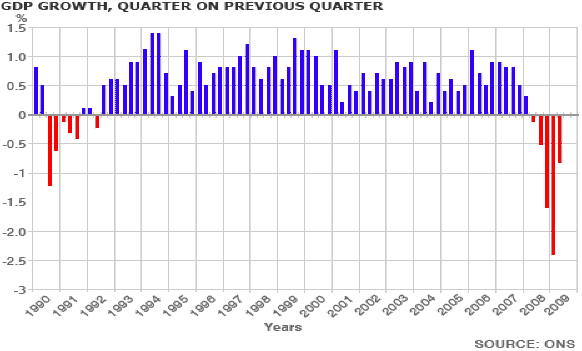
Recent figures for the UK economy show that it has receded for five consecutive quarters, meaning the country has now been in recession for more than a year. The UK economy contracted 0.8% between April and June 09, more than double the 0.3% figure economists had expected. The National Institute of Economic and Social Research (NIESR) sees total UK GDP falling 4.3% in 2009 before growing 1% in 2010 and 1.8% in 2011 and the UK economy will take 5 years to recover.
|
3.4 |
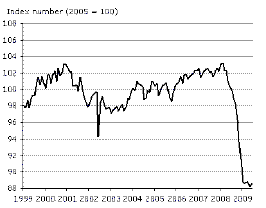
Total UK production output, which accounts for 17.2% of GDP, decreased by 0.6 per cent in the second quarter of 2009 compared with the previous quarter and fell 11.8 per cent against the second quarter of 2008. |
3.5 |
The value of sterling has dropped by 16% against the US Dollar in the past year and the Pound slid to the lowest level against the American dollar in January 2009 since 1985. |
3.6 |
"Factory gate" prices in July were down 1.3% from a year ago, although they were up 0.3% from June. Input prices - the cost of materials and fuels that manufacturers buy - fell at the steepest annual rate in almost 23 years, down 12.2%. |
3.7 |
The current economic downturn is already statistically more severe than the last recession, with Britain's economy shrinking at the fastest rate since 1980. |
4 |
So how does this effect HFRS? |
4.1 |
The previous Minister for Fire, Sadiq Khan, stated in April this year: "As a country, we are in a new period of unprecedented economic uncertainty and instability. We need to prepare for the possibilities of how this downturn may affect the FRS. We now face new challenges. For the fire and rescue service, the economic downturn brings reminders of previous recessions. Based on experience from previous recessions we need to understand that there may be an increased risk of arson. The number of vacant houses may increase; more cars may be abandoned; and business premises may fall into disuse as well as perhaps represent temptation to insurance fraud. These all could present challenges that we all need to rise to" |
The Association of British Insurers (ABI) has warned that its members have already reported an escalation in the number of fires causing damage in excess of £500,000. | |
The cost of fire damage to the insurance industry rose by 16 per cent during 2008 to a record £1.3 billion. This is the equivalent of £3.4 million per day and the highest figure since the Association began recording data 20 years ago" | |
4.2 |
"Fire damage to homes cost £408 million during 2008, 17 per cent more than in 2007, while the cost of damage to commercial premises rose by 15 per cent, to £865 million. The ABI said fires in schools were also on the rise, costing £33 million during the year, with a serious fire occurring once a month on average" http://www.is4profit.com |
4.3 |
Other factors for consideration Historically, arson has also been sensitive with regard to deliberate car fires which have had a correlation related to the price of scrap metal (steel) as a commodity. As the price of scrap metal drops then the prevalence of abandoned cars and subsequent car fires tends to increase. The scrap metal price is also historically a fairly volatile market dependent on supply and demand within manufacturing. Scrap metal prices are currently comparatively low which would suggest that we may see an increase in abandoned vehicles and consequential arson-related incidents. |
4.4 |
As winter approaches, consideration needs to be given to those sections of our communities who find themselves in the situation of fuel poverty. This could lead to people opening up old open fires without having them swept and using inappropriate fuels . Additionally, an increase in the use of candles and tea-lights for lighting may become more widespread along with the associated fire risks. |
4.5 |
The Audit Commission reports that Britain is still in the first phase of the recession, which it describes as economic, with output declining and companies failing. But the country is about to face the second, social phase, where growth returns but long-term unemployment triggers a range of housing, health and domestic problems. The social effects of the economic climate such as an increase in the unemployed labour market tend to be indices which lag behind the economy and we recognise that they may also have an effect on our operational activity. |
4.6 |
As businesses fail the number of empty or disused commercial premises increases, which, if not secured and maintained sufficiently, become inevitable targets for the would-be arsonist. |
4.7 |
We recognise that our own regulatory and enforcement activity can provide financial implications to commerce and industry and we need to be cognisant to balance public safety with reasonableness and a proportionality of approach in terms of sanctions. |
5 |
The current situation and the work HFRS is doing to mitigate the effects |
5.1 |
In analysing the current economic indicators and indices in comparison to our internal fire data, it is apparent that no strong correlation currently exists. We have not seen a significant increase in deliberate fires (property or cars), accidental dwelling fires, or non-domestic fires. |
5.2 |
However, we recognise the need to be cognisant of a potential lag in the correlation between the indicators as the next phase of the recession provides more tangible social effects. |
5.3 |
It should be noted here that we have seen a minor spike in reported arson incidents over the last quarter (April - June 09). It is considered that this may be as a result of the implementation of the new Incident Recording System (IRS) and the way in which different incidents are now being reported rather then being attributable to the economic situation. Monitoring this situation over the next two quarters will provide a clearer indication. |
5.4 |
In order to mitigate the identified potential effects of the economic climate we will: |
5.4.1 |
Continue to work closely with our partners within the LSP's, CDRP's and local forums as well as our Community Safety Liaison Teams and Community Contact Point to ensure that we monitor local intelligence and data in relation to fires and related anti social behaviiour. |
5.4.2 |
Conduct regular environmental visual audits (EVA's) of our communities to identify and remove abandoned vehicles, refuse dumps etc and utilise our established protocols with local authorities. |
5.4.3 |
We are working closely with community warden services to be proactive in identifying problem areas and dealing with them before a fire occurs. |
5.4.4 |
Utilise our Community Risk Intelligence to identify those most at risk and implement a fire safety campaign in the autumn relating to the use of open fires, candles and tea lights during the winter. |
5.4.5 |
We are developing a dedicated fire investigation team to further improve our performance relating to the detection and conviction relating to arson. |
5.4.6 |
We are currently developing different types of community-based initiatives to widen the scope of our highly successful Arson Task Force. |
5.4.7 |
Provision of a community safety campaign for small and medium businesses in relation to how they can protect themselves against possible arson attacks and promote the successes of our arson task force. |
5.4.8 |
We are establishing disused/empty buildings fire safety protocols, in conjunction with Local Authorities, to encourage/enforce building owners to act responsibly within Portsmouth and Southampton i.e. effective boarding up and removal of combustible contents. |
5.4.9 |
We have committed to the payment of our invoices to small and medium enterprises within 10 working days. |
5.4.10 |
Whilst conducting our statutory regulatory and enforcement activities, we will ensure that we pay due regard to reasonableness and proportionality in terms of sanctions and associated costs to organisations. However, we will not compromise public safety in this respect. |
5.4.11 |
We will continue with our core business Community Safety activity with initiatives such as our Local Intervention Fire Education (LIFE), YFA and the Prince's Trust, as well as other children and young people engagement and education activities. |
5.5 |
We will continue to monitor our performance indicators against established targets and react accordingly to reduce any impact that the current economic climate may have on our performance. We are also mindful of the need to ensure the delivery of the Local Area Agreements (LAA's) for Portsmouth, Southampton and Hampshire as well as their inclusive wider national indicators. Each area will need to respond differently according to local needs and priorities as they emerge and we will need to deliver our services flexibly. |
6 |
Contribution to corporate aims and objectives |
6.1 |
Identifying, monitoring and mitigating the effects of the economic climate and how it impacts on HFRS and taking appropriate and timely action will help to mitigate the effect of increasing, accidental dwelling fires and arson incidents. Without this action the economic climate could adversely effect our performance targets internally as well as our arson targets within our LAA's. |
7 |
Risk Analysis |
7.1 |
The risk of not identifying, monitoring and mitigating the effects of the economic climate and how it impacts on HFRS may have the effect of increasing accidental dwelling fires and arson incidents as well as adversely effecting our performance targets internally and the targets for the priorities within our LAAs. |
8 |
Resource Implications |
8.1 |
None applicable. |
9 |
People Impact Assessment |
9.1 |
The proposals in this report are considered compatible with the provisions of the European Convention on Human Rights, the Human Rights Act 1998, and the Race Relations (Amendment) Act 2000. |
10 |
Consultation |
10.1 |
None |
11 |
Conclusion |
11.1 |
It can be concluded that HFRS is in a fairly strong position to mitigate the potential effects of the current economic climate in relation to arson and community safety. However, we must remain vigilant to further and different phases of recession and be proactive both as a Service and as a partner in order to off-set any issues that may hamper us in making Hampshire safer. |
12 |
Background information (Section 100D of Local Government Act 1972) |
12.1 |
The following documents disclose the facts or matters on which this report, or an important part of it, is based and has been relied upon to a material extent in the preparation of the report: Emergency Services News - http://www.esnews.co.uk/?p=3297&mode=1 Note: The list excludes: (1) published works; and (2) documents that disclose exempt or confidential information defined in the Act. |
 Source: ONS
 Secretarial/W/C/HFRA 2009 09 16 Economic climate and impact on operational activity MC/JMW/07/09/09