
Archived decisions

DRIVING SUCCESS
Hampshire County Council's Performance Management Framework

Chief Officer Self-Assessments: 2008/09 Year-end
September 2009
HAMPSHIRE COUNTY COUNCIL
Decision Report
Decision Maker: |
Cabinet | ||||
Date of Decision: |
28 September 2009 | ||||
Decision Title: |
Driving Success: Chief Officer Self-Assessments - 2008/09 Year End | ||||
Decision Reference: |
953 | ||||
Report From: |
Chief Executive | ||||
Contact name: |
Gary Smith | ||||
Tel: |
01962 847402 |
||||
1) Executive Summary
1.1. Cabinet took the decision to significantly strengthen the corporate Performance Management Framework in November 2008 when they approved `Driving Success'.
1.2. Since then the momentum behind Driving Success and the principles underpinning it have been maintained and increased. The step-change in the way performance and improvement is managed across the Council is recognised and welcomed.
1.3. This report is the first in the new Driving Success format. It consists of seven Chief Officer Self-Assessments, one for each department, at the 2008/09 year-end. These self-assessments are the Chief Officer's judgement of what the key issues are for them and their department now and looking forward1.
1.4. Accompanying these Chief Officer Self-Assessments is a short overview by the Head of Improvement which highlights common themes and gives a verdict on the Council's overall position and direction of travel.
Contents
Item |
Section |
Preface by the Leader and Chief Executive |
1 |
Head of Improvement's Council Overview |
2 |
Chief Officer Self-Assessments (COSAs) |
|
· Chief Executive's Department |
3 |
· County Treasurer's Department |
4 |
· Adult Services |
5 |
· Children's Services |
6 |
· Culture, Communities and Rural Affairs |
7 |
· Environment Department |
8 |
· Property, Business and Regulatory Services |
9 |
Appendices |
10 |
Appendix One |
|
Performance Overview |
|
Appendix Two |
|
COSA Prompt List |
|
Appendix Three |
|
Overview of Driving Success |
|
Appendix Four |
|
Driving Success Main Roles & Responsibilities |
Leader's Preface
 From a political perspective residents have an expectation that public services will develop to meet their aspirations and provide value for money. Driving Success provides one means by which the County Council service can be assessed and improvement identified. It is the hallmark of an organisation that it is comfortable with the pursuit of constant improvement. Driving Success provides a means by which political ambition and management leadership can be brought together to look for improved service outcomes.
Cllr K Thornber, Leader of Hampshire County Council
Chief Executive's Preface
 The County Council has been assessed as Four Stars and `Improving Strongly' across its services. Driving Success was developed to look beyond inspection regimes and provide a means by which the performance of the organisation could be assessed, explained and where relevant improved. The size and complexity of the Council means that improving performance requires a framework to be embedded into the management of the Council. Driving Success provides the means by which this can be done and provides momentum for the future.
Andrew Smith, Chief Executive of Hampshire County Council
2) Head of Improvement's Council Overview
The Council's Overall Position & Direction of Travel
2.1. The County Council's strategic performance continues to be strong with service improvements across the board. Service transformation, innovation and value for money remain as key drivers to enhance the quality of life for local residents.
2.2. These performance improvements have been made against the backdrop of an extremely tight financial context, increased service demands and rising public expectations. The County Council can be proud of its achievements working alone and in partnership.
2.3. In addition to this positive direction of travel, the County Council will need to continue to improve overall performance especially in areas of weaker performance, where expectations have increased and around some of the more difficult issues. Through Driving Success2, for the first time, the corporate performance report provides a mechanism to draw out the key issues and to highlight the risks moving forward.
2.4. The new Driving Success format of Chief Officer Self-Assessments, that form the body of this report, enable a greater analysis of the position of each department. They focus on the issues that matter locally rather than the more rigid, sometimes over focus, on national performance indicators. The Chief Officers have drawn out the key issues for improving and sustaining further the performance of their services and the corporate/partner areas they are responsible for.
Corporate Inspection
2.5. In the 2008 Annual Audit and Inspection Letter, the Audit Commission reported that the Council had "accelerated its positive direction of travel", judging the authority as a "Four Star council that is Improving Strongly". They reported improvement in the "majority of those areas which are of concern to local people", including children's services and social care services for adults. Whilst there were no formal recommendations for improvement which is an excellent outcome, the Audit Commission identified some areas where action was needed and these are being followed up as part of or alongside Driving Success. Since then the Council has improved further and built an impressive infrastructure for future improvement.
2.6. The national performance regime has changed and from now on the old CPA3 star ratings will be replaced by the new CAA4 framework. This shifts the focus from service quality and availability as delivered by organisations to service impacts on the ground as they are felt by local residents and their contribution to overall quality of life.
2.7. The separate national performance assessment and inspection arrangements for Children's Services and Adult Services will feed into the CAA framework and will be important in their own right.
2.8. The further embedding of Driving Success will provide strong evidence to the inspectorates of how the Council manages performance and takes action to ensure delivery. It will also help Cabinet and CMT to keep sighted on and manage the risks of the inspections themselves but also on the Council's performance beyond inspection regimes.
Challenges looking forward
2.9. It is clear that Hampshire County Council is a first-rate organisation achieving extremely high performance outcomes. This is recognised by performance results and external independent inspection.
2.10. This central strength also poses the chief challenge to the authority. Sustaining such high standards of performance whilst seeking to stretch this further is extremely difficult to achieve from such a high base - this is the principle challenge facing the Council.
2.11. To move forward requires a greater focus and investment in workforce development than would be the case if the Council was starting at a lower base.
2.12. Whilst the political and managerial leadership are focussed on perpetuating this envious record of achievement it is recognised that the effort and intellectual capacity needed rises disproportionately.
2.13. This is the context for the Chief Officer Self-Assessments and the areas of risk and improvement highlighted reflect this ambition to continually improve on excellence.
2.14. Overall there are four key challenges looking forward, these relate to the financial situation; transformational change; LAA and key performance measures; and the changing external performance regime. The challenge of developing the necessary capacity underlies all of these.
2.15. The worldwide economic situation and national recession represents a double blow for the Council as it limits the likelihood to meet LAA employment targets (eg the overall employment rate) and impacts the state of public finances which the authority will need to prepare for. It is clear that from 2011/12 the financial settlement for local government will face significant pressure at the same time as cost and demand increases will need to be controlled. Whilst the Council is positioned extremely well compared to most because of forward planning, financial stability and capacity, it will still require continued careful management, further efficiency measures and other innovative steps and difficult decisions.
2.16. The scale of transformational change across the Council to redesign services, back office support functions and the asset infrastructure of the Council is massive. This work will enable services to be redesigned around local residents to maximise client value. This will be done whilst ensuring the Council is as lean as it can be, exploits new technology and continues to provide value for money. Building further management and leadership capacity within the organisation will be a key component to deliver this. This has already begun with CMT and through succession planning for senior appointments.
2.17. Performance of the LAA5 is variable and key areas of risk remain. Amongst these and other key performance measures are three Children's Services indicators which require continued attention: placement stability of children in care (three or more placement moves); 16-18 year olds not in education, employment or training (NEET); and the number of children on repeat child protection plans. Children's Services has robust improvement plans in place for each of these with effort and resources being aligned to improve performance, working in partnership where appropriate.
2.18. More broadly tackling health and economic inequalities across the county remains a key area for improvement, these are deeply entrenched issues that go far beyond traditional service delivery. They require innovative new approaches, capacity to be built within communities and partnership working. Success will be slow not because of a lack of focus or momentum but because of the behavioural adaptation required.
2.19. The final key challenge area is the changing national external assessment and inspection regimes. It is unclear how the new CAA performance framework and the first judgements in November 2009 will materialise. What is clear, however, is that there is an expectation that CAA will be an even harder test and it has been made known that no organisation or area is expected to perform highly. This is a disappointing starting point. At the same time the new Ofsted and Care Quality Commission inspection frameworks are also being developed and implemented. As part of this there is a huge focus on safeguarding. The turmoil introduced by these changing regimes is difficult to quantify but it is clear that they will be even more demanding than their predecessors and high scores are unlikely.
Corporate Services Review Implementation Progress
2.20. Review Teams' summaries of direction of travel and specific recommendations were approved by Cabinet on 30/3/09. Implementation or further concept/design work is underway as appropriate for each review, for example, where there are overlaps or dependencies that need to be taken into consideration.
2.21. Business Advice and Members Support; PBRS; and Legal Services are being implemented. Progress on these reviews, plus the IT Services approach to implementation, was considered at the first meeting of the Corporate Services Implementation Board (CSIB) on 4/6/09. The Procurement Corporate Services Review implementation will be through the Efficiency Board and the first meeting took place on the 16/6/09. A new Member Panel will be established in September 2009.
Efficiency Programme Progress
2.22. The Efficiency Board is developing a programme of efficiency work which will be a mixture of quick wins and longer term-strategic changes as well as oversee the implementation of elements of the Corporate Services Review.
2.23. CMT and DMTs have been considering potential efficiency areas and the Efficiency Board will combine this into the formal Efficiency Programme to be delivered over the next three years.
2.24. These proposals will be considered by a Member Efficiency Panel and regular updates will be reported to this panel who will take a strategic oversight of direction and progress.
Finance Overview
2.25. 2008/09 has been economically a very turbulent year in which initially there were fears about containing inflationary pressures as a result of the rising price of oil and other commodities traded on a global basis, despite the effects of the credit crunch.
2.26. In the early autumn, however, the financial crisis accelerated making it necessary for national governments to intervene to support the banking system and a global recession ensued. In the UK action was taken to stimulate the economy using both fiscal and monetary policy, including reducing official interest rates to the lowest level in the history of the Bank of England.
2.27. In this uncertain context the County Council has been very successful in managing its finances in 2008/09, both in containing service spending within cash limits, achieving some planned savings that have been carried forward to 2009/10 and in achieving further savings at the year end mainly in interest costs, which provide some scope to begin to deal with the potential difficulties of 2011/12, when the contraction in public spending is likely to begin.
Workforce Overview
2.28. 2008/09 saw important developments including major changes within Children's Services (the introduction of Children's Centres and transfer of Connexions to the County Council from elsewhere in the public sector); continued improvements in attendance levels; and the financial benefits of the introduction of the Hampshire Recruitment Portal.
2.29. 2009/10 will be a critical year and considerable investment of resources will be required to support both (a) existing Change programmes which impact significantly on staff (eg Personalisation; Safeguarding; and Workstyle) and (b) preparing and putting in place new measures to enable responses to the worsening public sector finances including an inevitable focus on workforce costs and value for money.
2.30. Consideration needs to be given to service transformation and streamlining. This will include the process for managing communication to staff, consultation processes and any changes to ways of working or contractual changes for individuals as appropriate.
2.31. Work is also underway on strengthening strategic approaches to Workforce Planning and Leadership and Management Development to equip the County Council with the tools to sustain the drive to maximise efficiency into the foreseeable future. In addition, CAA includes new areas, including workforce management, which will require the authority to evidence that workforce planning and development is proactive and meets the corporate needs of the organisation.
Conclusion
2.32. From a `Four Star Improving Strongly' base the last 12 months has seen much improvement: Driving Success; Corporate Services Reviews; investment in safeguarding; new senior management appointments; the efficiency work; service and safety improvements with partners; improved two tier working; a focus on rural issues; and the development of a new economic strategy to mention but a few.
2.33. The Council prides itself in its commitment to drive continuous improvement in the things that are important locally and deliver even greater value for money. This is central to what the Council is about and is evident from the leadership, vision and aspiration of both Members and managers.
Recommendations
2.34. It is recommended that Cabinet:
a) Note the Council's overall positive performance and direction of travel.
b) Congratulate Members and staff for their contribution to this high performance record.
c) Ask Executive Members, Scrutiny Members, Chief Officers and other officers to play their full part in performance management and take action to improve performance under Driving Success as set out in the roles and responsibilities in appendix three (this was previously approved by Cabinet in November 2008).
Chief Officer Self-Assessment
Chief Executive's Department



Chief Officer Self-Assessment: Chief Executive's Department
General summary of recent progress and implications for the coming period. |
The focus in 2008/09 was reviewing the role and services of the Department to ensure it is fit for purpose to support the Council's drive to be a modern business providing public services. The work on the Corporate Service Reviews (CSR's) covering HR, Democratic Services, Legal Practice, Economic Development and Hantsdirect has been key to providing the platform for further performance improvement into the future. The implementation of the review outcomes is now the priority and will be challenging. However, there is strong ownership of the reviews amongst managers and a real keenness to implement change. Cabinet and the Employment in Hampshire County Council Committee have approved CSR implementation. Delivering the CSR outcomes, together with the creation of the new Efficiency Board, will be a priority for 2009. The aim is to maximise efficiency savings and build a Department able to meet the future needs of the authority. In addition, in 2009/10 major programmes of strategic developments continue including; the Personalisation agenda, Hampshire Workstyle, Safeguarding, and the wider skills agenda for Hampshire. Demand for input into these and the operational agenda is likely to increase in 2009/10 . Also in the coming year worsening public sector finances will put significant pressure on resources in the County Council and this is likely to result in a reduction in funding available at the same time as there is increasing demand for our services. Following the election in June work will begin with the new administration to deliver on this broad agenda for change allied to their policy priorities. |
Recent achievements and key milestones. |
Completion of the ambitious CSR programme and agreement to the next steps prior to the June 2009 election enables a speedy move to the implementation phase. Development of the new corporate performance framework `Driving Success' which has further shifted the emphasis from performance monitoring to performance management across the whole organisation. |
Retention of Four Stars and the success of moving the authority to the highest ranking of `Improving Strongly' under the Comprehensive Performance Assessment (CPA) was a major achievement. The draft corporate Leadership and Management strategy was agreed for the organisation which will aid succession planning and talent management. Achievement of Level 3 of the Local Government Equalities Standard which has been externally validated. |
In the last year Hantsdirect became further established, not only has it provided a consistent service for customers contacting the council via telephone with increased call handling and longer opening hours it is also proving to be a key driver for improvement in customer services. |
HR is fast developing the strategic agenda to support change in HCC. Internal Service Level Agreements developed for implementation in 2009/10 to support continued service improvement and potential Shared Services developments with Hampshire local authorities |
Key challenges/improvement priorities | |
Subject |
Action being taken. |
The need to develop capacity and new skills has been identified in a number of areas. This, together with the imperative to change some of the more traditional ways of working will provide a significant challenge over the next year |
Implementation of the CSR's and new management arrangements will be rolled-out during 2009 to establish more robust and business focussed service support and delivery. The department will also contribute to the work of the new Efficiency Board to create and manage a three year efficiency programme. |
Impact of the economic downturn on our ability to deliver Local Area Agreements and Corporate Improvement Plan targets |
Development of partnerships with external agencies to ensure HCC is seen as a "model employer" and is developing employment strategies to assist in the current economic downturn. Other recession projects currently being worked on include, credit unions, retail support package, smarter working centres, volunteering work experience and house market stimulation. |
The maintenance of our rating under the new Comprehensive Area Assessment (CAA) regime will be difficult as it is based not only on the County Council's own performance but also on how things are improving for Hampshire as a whole. |
The Head of Improvement is engaging with all departments to co-ordinate the Council's response to the next inspection. |
Safeguarding - Independent Safeguarding Authority (ISA)/CRB - the additional workload that the implementation of the ISA and CRB re-checking will require will be a challenge for the HR Department |
A corporate project is currently underway to develop a policy/ procedures for the implementation of the new Independent Safeguarding Authority's Vetting and Barring requirements in 2009/10 and to also review the current CRB policy. |
Development of Customer Services |
A range of initiatives are being developed to build on the base provided by Hantsdirect. These are aimed at both improving customer service and, by channel shift, reducing the cost of customer transactions. |
Review of accommodation |
In line with the Workstyle strategy use of accommodation will be reviewed and wherever possible flexible and mobile working introduced. This will be supported by the implementation of Hantsfile. |
Corporate workforce planning |
Revised arrangements are being developed to ensure there is a greater emphasis on strategic workforce planning linked to corporate priorities and integrated with service and budgetary planning. |
Chief Officer Self-Assessment
County Treasurer's Department



Chief Officer Self-Assessment: County Treasurer's Department
General summary of recent progress and implications for the coming period. | |
This first Chief Officer self assessment from the County Treasurer sets out both corporate financial management performance and departmental performance. We shall seek to refine the presentation of these two perspectives in future reports. The department has achieved its service improvement plan and Corporate Management Plan targets for 2008/09 and has shown an improvement in the value for money (VFM) benchmarking position. For 2009/10 · The Use of Resources 2009 assessment is underway with the Audit Commission following the submission of a comprehensive self assessment. · The County Treasurer is co-chairing and leading the Efficiency Board and Efficiency programme. · The department plans a o review of best practice in financial reporting o review of capital budget monitoring to deliver consistent and efficient processes across the County Council o fundamental rather than roll forward review of our service plan. | |
Recent achievements and key milestones. | |
Use of Resources 2008 achieved the top grade with an increase to a score of 4 in three indicators giving an overall score of 4 out of 4 | |
Council tax increase for 2009/10 of 1.9%, the lowest for the County Council in 39 years - from an already low base and lowest government grant | |
Recorded efficiency savings from the County Council of £25.5m in 2008/09 or 3.49% exceeding the Government target | |
Successful implementation of payroll changes for staff during year end close period, heavy and complex workloads at peak time. | |
Customer Review 2008 completed with 398 responses. 88% of customers rated our overall performance in the last 12 months as good or excellent. Narrative feedback will identify suggestions for service improvement | |
Key challenges/improvement priorities |
Action being taken. |
|
Medium term financial strategy refresh for 2009 - 2012 will be carried out later this year and will aim to mitigate the impact on the County Council |
|
Scenarios to be developed in conjunction with Medium Term Financial Strategy refresh |
|
Risks of delayed recovery of property market and to income collection performance, which could impact on the County Council's budget, to be monitored |
|
Investment Strategy revised, quarterly reporting of changes to the approved list of the organisations we lend to (and the periods of that lending) to be implemented as part of monitoring of financial health indicators |
|
Monitoring of potential increases in order to consider the impacts on the funding strategy |
|
Pension Fund Panel reviewing the future of the alternative investments portfolio |
|
Financing risk given current market position. |
|
An efficiency review of the payroll structure and approach to steps, step increases and pay awards to mitigate the difficulties caused by complexity and the need for manual processes of current process. |
|
The medium term financial strategy regularly assesses the risk, funding through capitalisation requests to the DCLG is being sought and work is underway through Schools Forum to identify funding mechanisms for schools' based claims. |
|
With the implementation of the new Organisational Assessment and Use of Resources framework, the Audit Commission is again raising the bar which means that we expect the top score to be more difficult to achieve. A full and compelling self assessment has been submitted and regular review meetings are underway to monitor progress and issues. |
 Recession impacts for Hampshire County Council
 Treasury Management
Chief Officer Self-Assessment
Adult Services
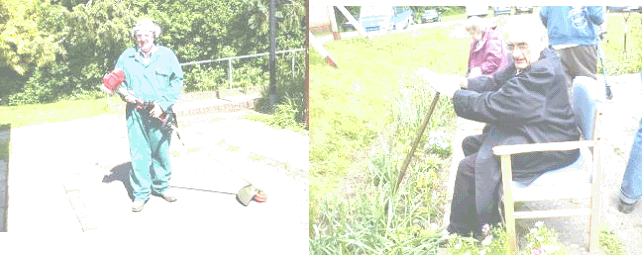
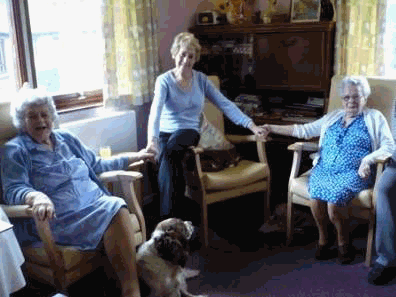
Chief Officer Self-Assessment: Adult Services
General summary of recent progress and implications for the coming period. |
|||
The substantial programme of change underway in Adult Services is part of a long term national and local strategy to reform adult social care. The `Hampshire Model' is transforming local services and builds on the recommendations of the Hampshire Commission on Personalisation. Good progress is being made in delivering the Corporate Improvement Plan, with the target for Extra-care housing exceeded in 2008/09. The Hampshire Model is a priority area within the plan and is already delivering better outcomes for people, notably those who are part of the Self Directed Support programme in Basingstoke. A strategic review of risks has been undertaken and is summarised over the page. A cross departmental group, led by Adult Services, has been established to embed Personalisation across the County Council. There is early evidence that the Local Area Agreement is successfully targeting those wider `health and wellbeing' indicators identified by the Joint Strategic Needs Assessment as presenting the greatest challenges in the local population. Targets for action are to reduce health inequalities, promote good health through exercise, less smoking and sensible drinking of alcohol, reduce emergency admissions to hospital and support older people to maintain independent living. Well established joint performance management arrangements with the PCT are supporting the Partnership Board. Work on the Health and Wellbeing Strategy for Hampshire has commenced. Adult Services has direct responsibility for delivering 11 of the National Indicator Set (NIS) and monitors an additional 25 to which it contributes or has an interest. While still `early days' for many of the NIS, we have built up a good knowledge of local performance where it is possible to do so. Indications are that compared to other county councils, we continue to perform well across adult social care indicators. The Care Quality Commission Annual Performance Assessment of adult services has recently concluded in Hampshire with the Annual Review Meeting on 18 June 2009. Indications are that, although the bar has been raised for 2009, the department will retain its 2008 performance ratings. | |||
Recent achievements and key milestones. | |||
National excellent accreditation for `Supporting People' housing related support; and for `Shared Lives' which arranges family placement for vulnerable people in need of support. | |||
In 2008/09, 240 clients used Self Directed Support during Phase 1 in Basingstoke | |||
HantsDirect is now the county-wide point of contact, advice and information for those wishing to contact the department | |||
Successful application to Dept of Health has secured £2.8m funding to become a national demonstrator site for the Common Assessment Framework. A benefit for service users who are NHS patients is that they will only need to give their information once. | |||
Achievement of Level 3 of the Local Government Equalities Standard which has been externally validated | |||
Key challenges/improvement priorities |
Action being taken. | ||
Managing within the cash limited budget in the context of increased public expectation brought about by the Personalisation agenda, heightened awareness of adult safeguarding issues and the economic downturn |
Rigorous monthly budget monitoring linking performance and financial management, commencing with a joint budget and performance year end report to the Executive Member for Adult Services in July 2009. Regular briefings for The Leader and Strategic Update by The Director to CMT and Cabinet Further linkage of budget monitoring and performance monitoring to Members | ||
Green Paper of future funding of adult social care is due out in June |
The Hampshire Commission on Personalisation made national recommendations to Government to be considered as part of this process | ||
Safeguarding of Adults |
Additional investment in the workforce to enhance capacity and skills across the front line and to ensure strong leadership. This includes working with many partner and agencies throughout Hampshire and with national bodies such as banking institutions regarding financial abuse. A baseline assessment is being carried out utilising the Care Quality Commission's new national performance standards for `excellent' councils. This includes an audit of care files and is due to report in Sept. | ||
Skills and Capacity to implement the Hampshire Model |
Organisational Development specialist engaged to facilitate the management of change in relation to the implementation of the Hampshire Model | ||
IT |
Swift (managed by an external supplier) is the core system for social care and any changes have the potential to seriously impact on the business. The supplier is currently working on a version to implement personalisation, although the service has input to this work the outcomes are unknown at present. | ||
Partnerships present challenges at both a strategic and operational level in relation to business as usual and implementation of the Hampshire Model |
Operational and strategic risk will continue to be addressed through existing risk management processes within the Department. In addition governance and risks for partnership working during the transformational change will be monitored by the Hampshire Model Risk Management and Governance Group led by members of DMT. Potential economic pressures on the public sector could lead to challenges in achieving partnership outcomes. | ||
Chief Officer Self-Assessment
Children's Services




Chief Officer Self-Assessment: Children's Services
General summary of recent progress and implications for the coming period | ||
The Children's Services Department consistently delivers good and improving services (Ofsted Annual Performance Assessment, 2008). Specific actions to address areas for improvement are contained within the new Children and Young People's Plan (CYPP) 2009-12 (www.hants.gov.uk/cypp), approved by Full Council and the Children's Services Department Plan for 2009/10. Department priorities for 2009/10 reflect the Corporate Improvement Plan. Children's Services allocation of resources is good, with a clear focus of activity across the five outcomes ensuring that there is strong financial stability (APA, 2008). The planned under spend in the schools' budget and non-schools' budget in 2008/09 is being used to meet ongoing and emerging pressures. Efficiency saving targets have been established, amounting to £1.56m in 2009/10 and a further £0.734m in 2010/11. The Children's Services workforce has increased over the last year, primarily as a result of the TUPE transfer of Connexions staff (from elsewhere in the public sector) in April 2008 and the additional posts required for the current 60 children's centres to become fully operational. The Apprenticeship, Skills, Learning and Children Bill (progressing through Parliament) will have a significant impact by transferring responsibility for securing 16-19 education to the local authority and placing Children's Trusts on a statutory footing (further details provided under `risk', below). Changes to the Ofsted inspection framework, as part of the new Comprehensive Area Assessment (CAA), will place an increased emphasis on safeguarding and outcomes for children in care. The framework consists of quarterly `performance profiles', an annual self-assessment, three-yearly safeguarding inspections and an annual unannounced safeguarding `visit'. Furthermore, the recent consultation document 21st Century Schools outlines the vision for the future of schools, with a focus on `raising the bar' - practice previously graded in Ofsted inspections of schools as good may now be considered only satisfactory, potentially reducing the proportion of schools judged as good or outstanding. The County Council has bid to enter the next `wave' of the national Building Schools for the Future (BSF) programme. A statement of `Readiness to Deliver' has been submitted, with the outcome expected during Summer 2009. Havant and Gosport have been identified as Hampshire's highest priority areas for BSF investment, as areas of the county with the highest levels of social and educational need (as measured by Tax Credit data and GCSE performance). The first phase will cover six secondary schools and three special schools in Havant and Horndean. Children's Services is committed to sustained and continuous improvements in safeguarding, including refreshing the Local Safeguarding Children Board (LSCB) performance framework and revision of LSCB membership in line with national recommendations, post Laming. | ||
Recent achievements and key milestones | ||
Children's Services' main strengths, as identified in the last Ofsted inspection (APA, 2008), are as follows: services are good across all outcome areas; all services benefit most children and young people and the gap in provision/outcomes is narrowing for the most vulnerable groups; and children are actively engaged and believe the county is a good place to live, work & study. 71.2% of primary schools and 68.2% of secondary schools inspected between 1 April 2008 and 31 March 2009 were found to be good or outstanding (significantly higher than the national averages of 63% and 57% respectively). The 2009 inspections for the Adoption and Fostering services were both judged as good and as a result of new investment, the Fostering Service been expanded. Analysis of Children's Services National Indicators (NIs), demonstrates positive trend from 2007/08 to 2008/09. A comparison of NI performance against statistical neighbours, using the data provided in the Pricewaterhouse Cooper benchmarking toolkit (n.b. data is only available for seven of the 10 statistical neighbour authorities), has found that 53% of indicators are in the top two quartiles, with 31% in the top quartile. Areas of strong performance are educational attainment and key well-being indicators, including substance misuse, teenage conceptions and participation in positive activities. Areas for improvement include some social care indicators (particularly children in care experiencing three or more placement moves in one year), educational attainment of children in care and the proportion of 16-18 year olds not in education, employment or training (NEET). Final 2008/09 year end data is not currently available for a number of Local Area Agreement (LAA) targets. However, of the 20 Children's Services targets, two have already been achieved (Child and Adolescent Mental Health Services and first time entrants to the Youth Justice System). 40% of targets are on track for achievement, with 35% of targets at risk and three targets not achieved: children in care experiencing three or more placement moves in one year, repeat child protection plans and 16-18 year olds NEET. High performing LAA indicators include the percentage of pupils achieving 5 or more A*-C grades at GCSE (including English and Maths) and progression in English by two levels between Key Stage 1 and 2. A key milestone is the publication of a new CYPP, setting the strategic direction and priorities for services for children, young people and families in Hampshire over the next three years (2009-12). The vision of the Plan is to make Hampshire a better place for children and young people, where all of them, including those who are vulnerable or disadvantaged, have the best possible start in life and are supported by the whole community to reach their potential. | ||
Key challenges/improvement priorities |
Action being taken | |
Safeguarding and children in care |
Poor performance against some key social care indicators (NI 62 and NI 65) - LAA targets for 2008/09 not achieved, despite recent improvement Increasing pressure on social care teams as a result of rising numbers of children in care and children subject to child protection plans Increased emphasis placed on safeguarding and services for children in care by new Ofsted inspection framework - poor performance could restrict Children's Services annual grading, impacting upon CAA |
Reconfiguring of social care teams, focusing on services for children in care Development of intensive support service in the north of the county, supporting those on the edge of care (preventing them entering care) and supporting foster placements to increase stability Safeguarding audit currently in place, with expected recommendations for improvement with regard to child protection plans Capacity increased with new investment in unqualified social worker posts and the Independent Reviewing Service Robust monthly monitoring by Children's Services Department and scrutiny of practice at an area level through the Local Safeguarding Children Board Plans in place to mitigate against potential risks and ensure readiness for inspection |
Local Children's Partnerships |
The Apprenticeship, Skills, Learning and Children Bill will place Children's Trusts on a statutory footing; extend the duty to co-operate to schools, colleges and Jobcentre Plus; and place ownership of the CYPP with the Children's Trust Board - local implementation to be completed by April 2010. |
Development of local children's partnership arrangements, taking into account the most appropriate geographical groupings for local communities, schools and partners to deliver improved outcomes for children and young people against CYPP priorities at a local level Hampshire Children's Trust is currently working with key partners to develop and implement these arrangements, whilst maintaining service delivery and improvement Consideration is therefore being given to an expansion of the management team. |
Impact of recession |
The potential non-achievement of key LAA targets, including the proportion of 16-18 year olds NEET and the percentage of care leavers in education, employment or training is a key challenge Percentage of NEET increased during 2008/09. However, since January 2009, the NEET figures have shown month by month improvement |
Fortnightly targeting of support to NEET young people by Connexions advisors New action plans for NEET and provision of information, advice & guidance Targeting of young people at risk of becoming NEET when they leave school Increasing accessibility of Connexions advice through a variety of venues |
Chief Officer Self-Assessment
Culture, Communities and Rural Affairs


Chief Officer Self-Assessment: Culture, Communities & Rural Affairs
General summary of recent progress and implications for the coming period |
Participation levels remain high with most services reporting an increase in physical visits and online use. The challenge is to continue to develop a better understanding of who is and isn't using the services through community profiling, and make better use of this knowledge to inform our decisions about future investment and to target our audience development and marketing activities e.g. Culture-all. Good progress made with the development of a significant relationship for CC&RA with Adult Services supporting the cross departmental working personalisation group and Universal Offer action plan. We have set up a joint working party of local managers in Basingstoke and Deane to action projects targeting vulnerable adults, including the Basingstoke library refurbishment which incorporates developments to support and improve access for vulnerable adults and older people creating Hampshire County Council's first "one stop shop" - due to open Spring 2010. The department continues its emphasis on customer experience with a successful Charter Mark recertification and we will reinforce this focus with an assessment against the new Customer Service Excellence Standard in 2010. Implementation of a new structure and ways of working is the priority in Q1-3 to create greater capacity at senior level to lead on key cross-cutting service priorities and deliver improved outcomes and efficiencies. |
Recent achievements and key milestones |
1. The Library & Information Service Vision and Strategy 2009-2014 is due to go to Cabinet on 29 June recognising the significance and contribution of the service to corporate priorities following the Scrutiny Review. Project teams under 5 key areas have reported initial findings which all contribute to continued transformation. The first phase of the Action Plan will go for approval of the Executive Member in July. |
2. The negotiation of renewed key partnership agreements - with Sport England to support SHIOW6 particularly targeted towards interventions around 30 minutes regular exercise, and with MLA7 as the Renaissance SE hub lead targeted to extending use by young people and schools. Both agreements have undergone a significant overhaul in terms, funding and drivers to respond to agendas set externally (by dept of health and MLA) and aligning these with key local priorities for improved access and broadening participation - both show early significant increases. |
3. Countryside Service Review completed and new structure implemented (April 2009) to embed improving public access into all areas of the service, this includes the radical overhaul of the way Rights of Way are managed particularly the interface with the Contact Centre - already showing improvement. |
4. Good progress in defining the direction for work with Schools and the Learning Outside the Classroom manifesto reflected in the increase in numbers. There is agreement and cross-dept working to present a coherent offer to schools. Challenge is to evidence better outcomes and engagement with more young people as a result, particularly targeting children in care and at risk of exclusion. Real progress has been made with developing programmes for young people with disabilities. |
5. The Community Libraries Project (LEAD) is making good progress. 2 of the 5 libraries have opened following refurbishment, creating new spaces for learning. Big Lottery grant is dependent on the numbers of people participating in learning opportunities available - targeted number of enrolments is 4,500 including 1,000 new learners. |
Key challenges/improvement priorities |
Action being taken |
|
All departments need to support work around these priorities and the LAA targets. Steps will be taken to challenge the County Council's current support capacity e.g. supporting voluntary activity of staff and capturing the contribution of volunteers to achieving service outcomes. Report to CMT to develop both areas in Q2. |
|
Consultation on the review and future ways of working is underway. A new structure will be in place in Q3. We are in the early stages of putting together Plans and key milestones around the Corporate Improvement Plan areas for Culture and Recreation and Deprived communities - these will be in draft by mid Q2 to guide early action and will be completed as part of the dept's service planning process in Q3. |
|
The challenge is to achieve a real difference and impact through the agreed Action Plans and ensure future sustainability of services. Business case funding bids have been invited for allocation of the £200k rural fund to select projects that will deliver against key criteria. Projects to start by September 2009 and progress report for year end 2009/10. |
|
This is being taken forward in the developing Library Action Plan looking at everything from existing staffing arrangements to internal process to improving self-issue. The progress on all the aims within the Action Plan will be regularly reported to the Executive Member. |
|
There is no evidence of a negative impact of the economic downturn on service use or income. The potential impact on revenue is a risk that will be closely monitored. We are working proactively with Districts and partners to identify risks earlier and seek solutions in partnership. The aim is to develop a Culture, Communities & Rural Affairs efficiency programme as part of service planning in Q3. |
|
Considerable progress has been made in investing in the department's building assets particularly around libraries and museums. The expansion of the Parish Paths Partnership grants has made a positive impact in the quality of the local Rights of Way network. A review of the `green estate' within the department is being undertaken with a view to a report being presented to the Executive Member in the autumn. |
 Corporate focus on narrowing the gap, inequalities, community engagement and volunteering
 Implementation of the dept Management review - impact on our capacity to deliver against corporate improvement priorities
Chief Officer Self-Assessment
Environment



Chief Officer Self-Assessment: Environment Department
General summary of recent progress and implications for the coming period. |
Good progress has been made achieving improvements in the delivery of our key services as featured within the Corporate Improvement Plan and LAA priorities. Notable successes include making good progress with reducing road casualties and the continuing improvement in our national leading position to divert waste from landfill. All key workforce objectives are on track. The achievement of efficiencies and savings enabled us to meet our budget whilst also meeting new service pressures. |
Recent achievements and key milestones. |
We diverted 90% of waste from landfill in 2008/09 and in doing so we further improved our already impressive performance and maintained our position as lead authority in this field. Although, we will not be able to eradicate the final 10% without further infrastructure investment, recent reductions in waste per capita and the success of our trade waste control programme has partially reduced the urgency for more landfill diversion facilities. That said, the Government has signalled further landfill tax rises in the recent budget to £72 per tonne by 2013 (current rate £40 per tonne). Accordingly, minimising landfill is still a business imperative going forward. Work to locate appropriate future strategic waste sites is set to gather pace in 2009/10. We successfully concluded contract negotiations early in 2009 that together with lower waste volumes helped to contribute towards a £7m budget efficiency in 2009/10 or 0.5% in Council Tax terms |
Our Highways and Transport services achieved improvements against a number of our key performance targets. Overall, the condition of our highways improved during the year. On Road Safety, casualty levels dropped to a new low thus boding well to exceed our LAA targets. The bulk of the 120 Village 30's schemes have been delivered and the initial monitoring is showing some encouraging results against the overall speed reduction target of 10%. In addition, the winter road maintenance service coped well with the worst winter weather conditions for 18 years. The subsequent impact of the bad weather was tackled quickly through the extra resources allocated to the 'pothole busters' and much of the damage has now been repaired. |
Key challenges/improvement priorities |
Action being taken. |
|
We are approaching S106 negotiations with the aim of offsetting the risk that developer contributions will reduce as the recession squeezes housing development. We remain committed to investing in the transport evidence base across Hampshire to improve our chances of success through the national/regional bidding process though we recognise the risk of a finance squeeze as the Govt raises requirements for LAs to provide evidence of need and invest in feasibility studies. We are working with sub-regional groups, HA and the Regional Transport Board to offset the risk that Govt will find reasons to delay major schemes agreed through the Regional Funding Allocation. |
|
The £20 million bid to fund the first phase of the Bus Rapid Transit route between Gosport and Fareham was approved in March 2009. However we are mindful of the risks associated with the need to spend that funding before 31 March 2011 and avoid outstanding costs falling on the Council. Consequently, early preparatory work progressed by completing two stages of public consultation and undertaking some time critical site clearance works during early Spring 09. |
|
The South Coast Street Lighting PFI is approaching final tender. Slippage by the DfT on its approval to go for final tender raises uncertainties about delivery which in turn risks the current contract expiring before the PFI is in place. Subject to DfT approval, final bids will be assessed for commencement in Autumn 09, but with the financial crisis there is still a risk to the timing and affordability. A back up plan is in place should the PFI fail. The imminent loss of the project manager has led to the internal selection of a new Project Manager to ensure a smooth transition of the service although it is recognised that new risks may be posed should the process not be straightforward from this point on. |
|
We are working closely with PBRS and Treasurer's on a corporate Carbon Management Plan in response to the Government's Carbon Reduction Commitment (CRC) Trading programme. A report will be presented to CMT and Cabinet in the autumn setting out business options for containing and reducing future energy use. We are also co-ordinating work as part of the LAA aimed at producing a Climate Change Vision and Strategy for Hampshire as a whole. Linked to this work, we are organising a County wide Energy Conference in June 2009 and working with the Leader and Executive Member for Environment on plans to hold a high level Climate Change conference later this year, the outputs of which will help inform the ultimate strategy and associated action plan. |
Chief Officer Self-Assessment
Property, Business and Regulatory Services


Chief Officer Self-Assessment: Property, Business & Regulatory Services and IT (PBRS&IT)
General summary of recent progress and implications for the coming period. |
PBRS&IT sets out to lead, innovate, design and protect to deliver outstanding services, value and outcomes to customers and the public The department is `performing well' and delivers services and uses resources appropriately. IT Services joining the PBRS department offers further opportunities to build on these strengths. Achievements, innovations and excellence are identified in the published performance report which includes projects and awards. There are no significant issues for the delivery of the Corporate Improvement Plan, Local Area Agreement (LAA) targets and National Indicators at this time. Improvement plans and evidence of actions which are based on clear priorities are in place, together with plans to build capacity and growth through the economic downturn. This assessment outlines the key issues and most important challenges or risks for the department, the County Council and the communities of Hampshire. |
Evidence to support assessment of `performing well' |
The department is the corporate and county lead for extensive transformation and change management programmes including; Workstyle (with shared services opportunities), Facilities Management and the Corporate Community Safety Strategy. Development of technology solutions including secure access for home working, flexible wireless access from any building and Hantsfile, the County Council's new information management system. |
The department has benefited from an increase in income from external organisations. This was achieved as a result of Property Services undertaking new areas of work, growth in shared service arrangements and a programme of capital improvements for the Law Courts. Similar initiatives such as shared service arrangements have increased external income for IT Services. Business units have also increased their combined year end surplus with a further increase in primary school meal provision. |
The department is the corporate lead on efficiency savings at regional and county level. This includes £7.2m in procurement efficiencies for participating Tier 1 authorities in the Improvement and Efficiency South East (IESE) framework. An Information Technology Management Partnership agreement and Hampshire Public Services Network (HPSN2) has been agreed with all local authorities in Hampshire; these are expected to provide significant efficiency savings from shared service arrangements. |
The department has successfully delivered Hampshire construction projects valuing £85.7m, £20m of external projects, with a further £100m of external work commissioned by Reading Borough Council. IT Services have delivered successful technology project valuing £8.5m to include the Electronic Social Care record and personalised portal for members to provide significant business impact. |
Key challenges/ improvement priorities |
Proposed action |
|
Transfer of the Computer Suite from Elizabeth II Court to Ashburton Court involves the relocation of 700 servers for the safe storage of electronic information and successful continuity of service. There would be a significant impact across all services and supported external organisations if migration failed however, an external review concluded that there is an "effective and well structured programme of work that should manage this migration successfully". |
|
A recruitment programme is underway for Workstyle and the Facilities Management team has been confirmed. Community Safety are working with other departments to embed crime and disorder strategies into everyday working practices. Implementation of Hantsfile, the County Council's new information management system, represents a key challenge in the delivery of efficiency savings and new ways of working linked to Workstyle. Success of the above relies on other departments and staff embracing cultural and behavioural change and the development of the Corporate Change Board. Additionally, the department is developing a trading company model to underpin its regional leadership which will enhance skills and capacity. |
|
Integration of IT Services within PB&R to provide improved services and project delivery to customers with potential efficiency savings from re-engineering back office functions and leaner management structures. Implementation plans are being developed to deliver the recommendations of Corporate Services Review (CSR) outcomes relating to procurement and the category management framework to support the efficiency agenda. Plans and outcomes will be managed through Departmental Management Team (DMT) and CSR Implementation Board. |
|
The department has the lead role and is working with Environment on the production of a Carbon Management Plan designed to respond to Government targets and considering the business options for reducing future energy consumption. A department Sustainable Action Group has been established and a DMT sponsor appointed to provide clear leadership, supported by a communication strategy to raise awareness and embed sustainability in everyday working practices. |
|
Potential for shared services and new business opportunities are being explored to ensure ongoing financial viability of trading/business units when existing SLA's expire in 2011. Property Services will utilise available capacity to drive business transformation and exploit external opportunities following reductions in income and a reduced Capital Programme. With reduction in capital receipts, alternative approaches to strategic land management are being implemented. |
 Successful migration of electronic information and continuity of IT systems.
Appendix One: Performance Overview
Corporate Improvement Plan Performance
1.1. The Corporate Improvement Plan identifies the key priorities for the organisation, and measures the effectiveness of work undertaken to address them.
1.2. No areas within the plan are currently at specific risk of non-delivery. The two strongest-assessed areas of work are `Extra-Care (Increase the level of extra-care housing options)' and `Waste (Increase recycling and further reduce landfill)', where the authority is currently achieving above its target.
Local Area Agreement Performance
1.3. All areas of the LAA are now beginning to show progress.
1.4. Prospects for future improvement on Theme A (Children and Young People) are good with sustainable improvements already made in a large majority of indicators despite some 2008/09 targets being missed and three areas being highlighted as very high risk. Similarly Theme B's (Economy and Skills) skills and business targets are on track, whilst government has accepted that the Employment rate target will not be achieved.
1.5. On Theme C (Accessibility and Transport) more work is needed in a relatively short space of time on the local congestion and accessibility indicators. Surprisingly in Theme D (Housing) the recession did not badly affecting housing development to date but looks likely to slow down significantly from now on.
1.6. In Theme E (Community Safety), the picture is of overall good progress particularly in regard to reducing incidents of rowdy and inconsiderate behaviour. Excellent progress has been made on Theme F (Health & Wellbeing), but the targets are challenging and some may take longer than the first three years of the LAA to start to see an impact.
1.7. As regards to Theme G (Environment), partnerships are now in place and have the capacity to deliver on the targets set. Finally, Theme H (Strong Communities), progress was held up on two of the three indicators until the Place Survey results and baselines were known in March 2009 but progress is now beginning to take place here as well.
National Indicator Set Performance
1.8. 2008/09 is the first year for which Hampshire will be reporting the new National Indicator (NI) set as opposed to the BVPI8 set.
1.9. As a number of indicators are new, there are gaps in regard to the direction of travel for many of the indicators. In addition, the delay with release of Place Survey data and the fact that different NIs are reported at different times through the year mean that there are significant gaps at this stage.
1.10. Where baselines are available and 2008/09 data has been returned into CorVu, Hampshire shows an improvement in 58% NIs, no change for 8%, and a fall in performance of 34% of the NIs.
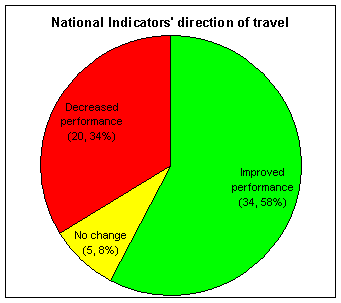
1.11. Due to the lack of information on NIs, departments have also been providing assessments on expected performance compared to other authorities. Overall, where estimates are deemed reliable, it is believed that Hampshire will perform better than average in 49% of NIs, about average in 31% of NIs, and below average in 20% of NIs.
1.12. PricewaterhouseCoopers' Benchmarking Toolkit has placed the County Council in the second quartile of their selected comparator group of counties and ex-counties. This is an improvement on last year's position and is supported by particularly noteworthy improvement in Children's Services.
1.13. Work has been done using data available (it should be noted that in some instances this data is pretty old) through the `Floortargets Interactive' resource on calculating Hampshire's relative performance on the most recent data available, and from this it can be seen that 20% of NIs are in the top quartile, 13% in the 2nd quartile, 9% in the 3rd quartile and 11% in the bottom quartile. There is no comparative data for 47% of the NI set.
1.14. Due to the lack of available data for many of the NIs at this time, there is a limited amount of knowledge on the direction of travel of NIs in the corporate basket. Of the 29 NIs which make up the corporate basket, 12 have direction of travels which can be shown - 5 show declining performance and 7 of these show improved performance.
Place Survey Performance
1.15. In regards to the 18 NIs which are in the Place Survey, three are in the top quartile of county council performance (NI 1: percentage questioned who agree that their local area is a place where people from different backgrounds get on well together; NI 119: percentage questioned who say their health is good or very good; and NI 140: percentage questioned who would say that they have been treated with respect and consideration by their local public services in the last year).
1.16. There are five bottom-quartile NIs (NI 3: percentage questioned who have been involved in decisions that affect the local area in the past 12 months; NI 22: percentage questioned who agree that in their local area parents take enough responsibility for the behaviour of their children; NI 27: percentage questioned who agree that the police and other local public services seek people's views about anti-social behaviour and crime in their local area; NI 37: percentage questioned who feel informed about what to do in the event of a large-scale emergency; and NI 139: percentage questioned who think that older people in their local area get the help and support they need to continue to live at home for as long as they want to).
1.17. There are sizeable differences between districts in terms of performance in the Place Survey. Whilst a number of districts compare consistently well other districts show concentrations of weaker results from the Place Survey data. It will be important to understand these variations across the county in order to take a targeted approach to address them.
1.18. It should be noted that, however, the publication of the Place Survey data was delayed by several months and there still appears to be some discrepancies in the data. These are currently being queried and when the results can be validated the Council will be in a better position to decide how to respond appropriately.
Appendix Two: Chief Officer Self-Assessment Prompt List
The following is a `prompt list' of issues or questions that Chief Officers were given to guide them in the preparation of their one/two sides of A4 self-assessments. This list is intended to prompt the consideration of the significance of particular issues, they are not a prescription of what must be included - this is for the Chief Officer to decide.
The key point is that these self-assessments need to be the Chief Officer's judgement of what the key performance issues are for them now and looking forward. The `so what' factor should be applied when considering what to include in the self-assessment - why does Cabinet or CMT need to know this: it needs to have corporate impact, significance and/or a need for corporate (or other departmental) support or resource allocation.
The 'prompt list' includes - does your self-assessment outline:
· Direction of Travel: Overall strategic performance and direction of travel (inc whether this is sustainable)?
· Risks: Key issues, risks or 'hotspots' looking forward and how these are being addressed?
· CIP, LAA & NIS: Areas of concern within the Corporate Improvement Plan, LAA or NIS which your department takes the lead or makes a significant contribution to?
· Finance & workforce: Departmental financial health and, where relevant, key workforce issues?
· Management: Significant departmental value for money, management or efficiency issues/improvements?
· Statutory & inspection: Any issues/concerns in relation to statutory responsibilities or inspection/audit?
· Sensitivities: Any areas of specific Member interest or public trust/confidence risks?
· External: Significant external changes or implications (eg regulatory or legislative changes)?
· Equality & Sustainability: Any significant equality or sustainability issues?
· Balance: Give a balanced view in terms of overall (good) performance against areas for further improvement (or at least put them into context)?
· Coverage: Have the most significant areas of services delivered and budget been reflected - do they need to be?
Appendix Three: Overview of Driving Success
Chief Officers, with their Executive Member, own and lead performance management for their department. This is central to the new framework but Driving Success also recognises that there needs to be corporate visibility of this, particularly areas of risk or weakness. Driving Success strengthens self-awareness and mechanisms to enable corporate discussions about areas for improvement - in the spirit of collective responsibility.
Driving Success has four key underpinning principles:
· Keep it simple
· Honesty should be central
· Concentrate on the critical issues that matter most locally and not everything
· Do something about performance and improvement when action is required.
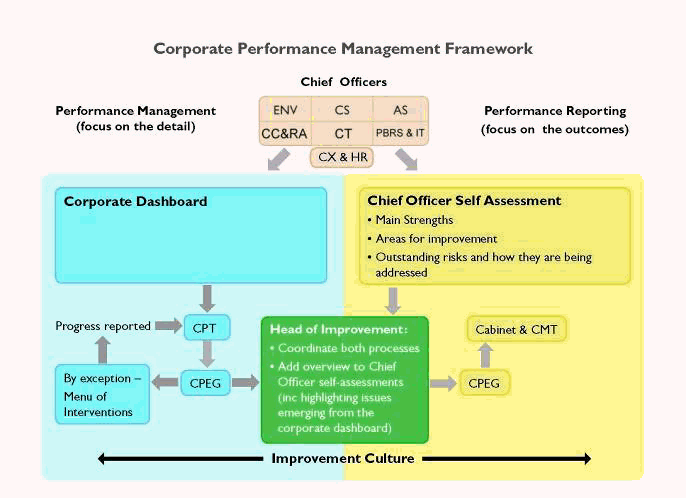 The diagram below sets out the revised corporate Performance Management Framework, making the distinction between the corporate performance management process (on the left) and the corporate performance reporting process (on the right). It also introduces the two new concepts of the Corporate Dashboard and the Chief Officer Self-assessment:
Appendix Four: Driving Success Main Roles & Responsibilities
Role |
Responsibility | |
Chief Officers |
Leading and managing service delivery and driving continuous improvement, reporting weaker performance and risk corporately |
Take an honest self-awareness approach to departmental performance and take action to improve performance - escalating issues to the Leader and Cabinet, as appropriate |
Executive Members |
Keeping a watching brief of the performance of services in their portfolio, particularly areas of poorer performance and risk, as well as setting ambition in areas of best practice and innovation |
Working with and challenging Chief Officers to drive continuous improvement - escalating issues to the Leader and Cabinet, as appropriate |
Head of Improvement |
Keeping a watching brief of the Council's overall performance position, acting as a catalyst to drive improvement and reporting areas of risk |
Work with and support Chief Officers to drive improvement in the areas that matter most locally and report this to CPEG, CMT and Cabinet, as appropriate |
CPEG |
Considering the Council's corporate position and significant outstanding areas of concern in order to agree or commission action to address as well as ensuring the Council is being ambitious enough |
CPEG will agree action on behalf of CMT in response to outstanding areas of concern. The Head of Improvement will liaise with CPEG to prepare reports to CMT (and ultimately Cabinet) twice a year, or by exception |
Chief Executive |
Ensuring action is being taken to address areas of poorer performance and risk as well as develop areas of best practice and innovation |
Taking action to address or escalating issues, as appropriate, to CMT, Cabinet and the Leader |
Executive Member for Efficiency, Performance & Rural Policy |
Keeping a watching brief of the Council's overall performance position, particularly areas of poorer performance and risk as well as areas of best practice and innovation |
Advising, alerting and challenging Cabinet and Executive Members to issues |
CMT, Cabinet & Leader |
Overseeing performance and setting the overall level of ambition for the authority |
Challenging areas to improve and of risk |
Select Committees |
Holding the Executive to account on performance issues and providing challenge, as appropriate |
Undertaking specific reviews to scrutinise decisions and/or offer alternative policy or service proposals to help improvement |
CORPORATE OR LEGAL INFORMATION:
Links to the Corporate Strategy
Hampshire safer and more secure for all: |
yes |
Corporate Business plan link number (if appropriate): | |
Maximising well-being: |
yes |
Corporate Business plan link number (if appropriate): | |
Enhancing our quality of place: |
yes |
Corporate Business plan link number (if appropriate): | |
Other Significant Links
Links to previous Member decisions: |
||
Title |
Reference |
Date |
Driving Success |
24/11/08 | |
Section 100 D - Local Government Act 1972 - background documents | |
The following documents discuss facts or matters on which this report, or an important part of it, is based and have been relied upon to a material extent in the preparation of this report. (NB: the list excludes published works and any documents which disclose exempt or confidential information as defined in the Act.) | |
Document |
Location |
Departmental performance submissions and further information |
Corporate Performance Team |
Departmental budget submissions and further information |
Corporate Finance Team |
Departmental workforce submissions and further information |
HR |
IMPACT ASSESSMENTS:
The corporate Performance Management Framework, Driving Success, and the Corporate Improvement Plan were equality impact assessed in December 2008. Copies of the assessments are available on request.
Impact on Crime and Disorder:
This report gives details of progress towards the achievement of council and partnership priorities. Within these priorities are those specifically relating to crime and disorder.
Climate Change:
How does what is being proposed impact on our carbon footprint / energy consumption?
This report gives details of progress towards the achievement of council and partnership priorities. Within these priorities are those specifically relating to energy consumption.
How does what is being proposed consider the need to adapt to climate change, and be resilient to its longer term impacts?
This report gives details of progress towards the achievement of council and partnership priorities. Within these priorities are those specifically relating to climate change.