Archived decisions
Have Your Say
about Changes to the
Hampshire Minerals & Waste
Core Strategy
|
|
|
|



[draft for Cabinet]
Summary
Hampshire County Council in partnership with Southampton and Portsmouth City Councils and the New Forest National Park Authority, are responsible for ensuring enough aggregates and other minerals are supplied and sufficient waste infrastructure is available to meet Hampshire's needs. This is facilitated by the Hampshire Minerals & Waste Development Framework (HMWDF), which comprises a set of documents to guide investment decisions.
The Core Strategy is the principal document in the HMWDF and sets out the vision and principles for how much and what minerals and waste development should take place in Hampshire.
The need for minerals - vital for construction
Although an essential part of modern life, we rarely stop to think about minerals or where they come from.
Minerals are in many everyday things around us - from buildings, to roads, cars to toothpaste and even cleaning products. They cover a wide range of natural materials including sand, gravel, oil, gas and clay and are only found in certain areas. But because of planning restrictions that protect the environment, sterilisation of resources by existing development, and a lack of transport access, opportunities for potential extraction are limited.
Much of Hampshire is chalk, but this is hardly extracted these days. The main minerals exploited are sand and gravels, plus some clay for brick making and limited production of oil and gas.
Sand and gravel are used mostly in aggregates for construction and maintaining existing homes, schools, businesses and infrastructure essential for Hampshire's continued prosperity. As these materials are expensive to transport, they need to be sourced close to where they will be used. This means that demand is mainly in the south and north east of the county - the main centres for population and business.
Planning for minerals and waste
Hampshire's Minerals & Waste Core Strategy sets out a long-term vision for minerals and waste planning in Hampshire and contains the primary policies and proposals to deliver that vision. The Strategy includes objectives for recycling and composting for instance, and sets out the type of new waste management facilities needed in Hampshire by 2020.
The Strategy also sets out the amount of sand and gravel that Hampshire should provide each year from local sources. This amount, or `apportionment', is set by the Government. Hampshire's and its partners' strong commitment to recycling and reuse reduces the amount required as recycled aggregates are promoted where possible. Moreover, a large amount of sand and gravel is also dredged from the sea, and crushed rock is imported by rail from Somerset. The apportionment takes these other sources into account.
Accordingly sites and facilities for aggregates from all these sources have to be planned for. We also have to `safeguard' mineral and waste management facilities to protect the land from other development such as housing.
Changes to the Hampshire Minerals & Waste Core Strategy
In 2007 the Core Strategy was `adopted' by the four Hampshire authorities. However, as a result of a legal challenge by Associated British Ports Ltd (ABP) three polices relating to wharves and rail depots were removed from the plan. The `apportionment' that Hampshire has to provide is also under review and the outcome is likely to change the current amount identified in the Core Strategy.
It is for the above reasons that we are proposing to makes changes to a limited number of key planning policies in the Core Strategy.
Consultation
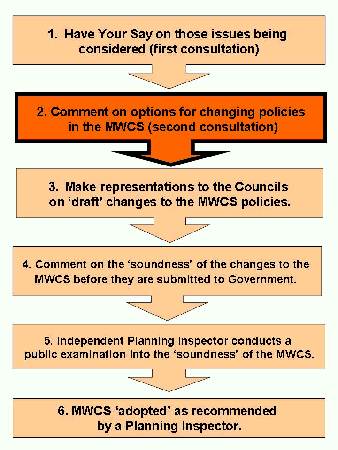
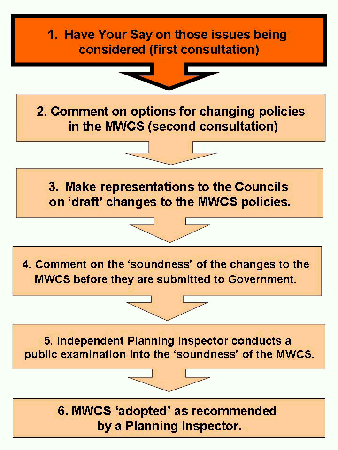
Before we can go ahead with any detailed changes, we need to make sure that all our information and evidence is accurate and up to date, including seeking views from residents, businesses and other interested people. This consultation will be in two stages:
· the first stage takes place in the autumn of 2009 and is an opportunity to comment on those parts of the Core Strategy we suggest require updating
· the second stage will be held in 2010 - this will set out options for the specific changes to policies. The responses from this consultation will help shape the future development of minerals and waste planning.
To find out more visit www3.hants.gov.uk/core-strategy-revision.htm
1 What is this consultation about?
1.1 Hampshire County Council, Portsmouth City Council, Southampton City Council and the New Forest National Park Authority are Minerals and Waste Planning Authorities. We are responsible for preparing `plans' for the development of mineral and waste management facilities in Hampshire.
1.2 These plans contain policies that guide decisions on planning applications for any mineral or waste development.
1.3 Together we are considering changes to a limited number of policies in the main minerals and waste plan for Hampshire - the "Core Strategy". The Core Strategy sets out a long-term vision for minerals and waste planning in Hampshire and contains the core policies and proposals to deliver that vision. The Core Strategy (2007) is available online at: www3.hants.gov.uk/core-strategy.htm .
2 The purpose of this document
2.1 This document provides an opportunity to express your views on potential changes to the Minerals and Waste Core Strategy.
2.2 This consultation is the first opportunity for you to comment on those parts of the Core Strategy we are seeking to replace and revise, and to gain an understanding of the facts and issues that surround our future decision-making.
2.3 Before we can decide in detail how we wish to change the Strategy, we have to be sure that all our information and evidence is correct and up to date. This includes seeking views from residents, businesses and other interested people.
2.4 A second consultation document will be available later in the process. This will set out the options for specific changes to some Core Strategy policies. These timescales are dependent on when relevant plans being prepared by Government are finalised next year (this is explained later in the document).
3 Why do we need to change parts of the Core Strategy?
3.1 In 2007, we 'adopted' a Minerals and Waste Core Strategy following public consultation and approval by the Government.
3.2 There is currently a debate underway with Government about exactly how much sand and gravel each Mineral Planning Authority in the south east region is required to identify for extraction (its "apportionment"). The outcome of this debate is likely to result in a different amount than that currently set out in our Core Strategy. We therefore need to update our policy relating to sand and gravel supply in Hampshire. This is explained in more detail later on in this document.
3.3 Secondly, the adopted Strategy was subsequently challenged by Associated British Ports Ltd. This resulted in three policies concerned with aggregate wharves and rail depots in the Core Strategy being removed. New policies need to be written to replace these policies.
3.4 Thirdly, we have identified other parts of the Core Strategy that require updating in order to ensure the policies which seek to manage minerals and waste development continue to meet planning requirements and latest Government policy.
In summary, this consultation document seeks your views on the following four topics:
1. The amount of land-won sand and gravel from local sources to be supplied from Hampshire until 2026.
2. How to make provision for wharves and rail depots to facilitate the movement of minerals and waste.
3. How to protect, or 'safeguard' minerals and waste operations against other competing types of development.
4. Whether to update several of the planning policies needed to inform decisions on minerals and waste applications (so-called development management policies).
3.5 This document contains sections for each of these topics which include a set of questions you may like to answer.
4 How can I comment?
Please note that this consultation only focuses on possible changes to a limited number of policies in the current Core Strategy, as described above. Whilst comments on any aspect of this consultation document are welcome, you may prefer to focus your response using the questions shown throughout the document.
4.1 Comments should be sent to Hampshire County Council (Planning & Development) by date to be confirmed, using the contact details below. We would prefer to receive your comments by email or via our online consultation website at http://consult.hants.gov.uk/portal .
4.2 Alternatively you can send written comments to the address below.
Email: [email protected]
Planning and Development (Environment Department)
Hampshire County Council
The Castle
Winchester
SO23 8UD
Telephone: 01962 845515 or 01962 845517
5 Sand & Gravel Extraction in Hampshire- How much?
· Sand and gravel is required to provide construction materials essential to delivering new housing and maintaining roads and buildings.
· Aggregates - including soft sand, and sharp sand and gravel - are found across Hampshire. Crucial for Hampshire's supply of construction materials and continued economic prosperity, we are responsible for planning to ensure these valuable resources are made available. The main mineral types worked today in Hampshire are sand and gravel.
· We aim to ensure the need for aggregates will be met, without avoidable delay or disruption to supply, and with minimum environmental damage.
· Sand and gravel used in Hampshire comes from four sources: extracted from land ('land-won'), the sea ('marine'), imported by rail, or through the recycling of construction waste ('recycled'). Whilst the majority of aggregates are produced from land-won and marine dredged sources, we do not have responsibility for marine-won sand and gravel.
· Every Mineral Planning Authority (including Hampshire) is required to maintain a supply of land-won sand and gravel from their area up to 2026. This amount, or 'apportionment', is set by Government.
· The South East England Partnership Board is responsible for regional planning. This includes planning for the amount of aggregates - sand and gravel, and crushed rock -extracted in the South East each year.
· National Government sets the amount of sand and gravel for each region in national guidelines. These guidelines were recently reviewed and a new figure was set for the South East region of 12.18 million tonnes a year. The figure is important as it directly affects Hampshire's share, or 'apportionment'.
· The regional planning body (formerly the Regional Assembly) considered this figure set by Government. Subsequently, following consultation in 2008, the South East England Partnership Board is proposing a lower apportionment for the South East region of 9.01 million tonnes a year. This could mean a reduced apportionment of 1.62 million tonnes a year for Hampshire, although sand and gravel supply would need to be planned for over a longer plan period (now up to 2026).
· The case for this lower regional figure is currently being put forward to a Planning Inspector, and will be examined on behalf of the Government during October 2009. The outcome will be announced early next year.
5.1 Issues for Hampshire
· The apportionment means we are committed to maintaining a "landbank" of sand and gravel supplies (i.e. a stock of permitted extraction sites expressed in terms of years).
· We need to provide for a supply of land-won sand and gravel, taking into account geological, environmental and market considerations. Minerals development is different from other forms of development because minerals can only be worked where they naturally occur.
· It is recognised that the growth in the number of specially designated areas, notably the South Downs and New Forest National Parks, and the extent of environmental constraints generally, is likely to cause difficulties in maintaining some minerals reserves.
· Extraction tends to take place close to recognised market areas for sand and gravel. This seeks to meet local demand for sand and gravel and reduce the transportation of aggregates by road.
· As explained above, it is currently proposed that Hampshire should make provision for 1.62 million tonnes per year up to the year 2026.
Questions- Have Your Say
1. We currently support the proposed target (or "apportionment") for sand and gravel supply in Hampshire of 1.62 million tonnes a year, and believe that planning should be based on that figure. Do you have any views on this?
2. How do you think the balance should be struck between ensuring sand and gravel extraction takes place as near as possible to the recognised market areas for construction materials in Hampshire, and the need to protect the environment and quality of life of residents?
Further Information
· Regional Planning website (minerals):
www.southeast-ra.gov.uk/sustainability_minerals.html
· The South East Plan: Regional Spatial Strategy for the South East of England (GOSE, 2009).
· Draft Hampshire Minerals Plan Development Plan Document (Hampshire County Council, July 2008).
· Minerals Policy Statement 1: Planning and Minerals (Communities and Local Government, 2006).
6 The Need for Additional Wharf & Rail Facilities
· We need to promote and make provision for transporting minerals by rail, sea or inland waterways in order to reduce their transportation by road (i.e. lorries).
· Wharves are waterside facilities that allow for the importing and exporting of materials. Most wharves in Hampshire are aggregate wharves that receive marine dredged sand and gravel. One wharf in Hampshire has a waste management use, although it is allocated for regeneration.
· Hampshire currently has fourteen permitted wharves, although four are currently inactive. Nine wharves are located in and around the city of Southampton and the rest are located around Portsmouth and Fareham.
· There are currently three aggregate rail depots (located in Eastleigh, Fareham and Botley) which receive aggregate such as crushed rock by rail and then transfer the material to road for local distribution.
· The South East region is dependent on imports of crushed rock and on marine-dredged materials. It is crucial that sufficient capacity at wharves and rail depots is maintained and provided for.
· An independent study has recently been undertaken to assess the need for wharves and rail depots in Hampshire, and the capacity of the existing facilities to supply imported material. The findings of this study will be considered further as relevant parts of the Core Strategy are prepared.
· The study, or 'Needs Assessment', suggests that new aggregate rail depots at Basingstoke and Micheldever could potentially be needed. Apart from this, the study suggests that Hampshire has sufficient wharf and rail depot capacity to meet needs up to 2026, and that this should be monitored up to 2026 and beyond.
· When planning for aggregate wharves, it is important to recognise the development pressures and issues facing ports. Southampton for instance is a major port and Associated British Ports Ltd is currently consulting on the Port of Southampton Master Plan- a vision for the future development of the port to 2030.
Questions- Have Your Say
3. Do you agree that new aggregate rail depots at Basingstoke and Micheldever could potentially be needed up to 2026?
4. Do you agree with the statement that Hampshire has sufficient wharf capacity to import crushed rock and marine-dredged materials up to 2026, and that this needs to be monitored?
Further Information
· Draft Hampshire Minerals Plan (Hampshire County Council et al, July 2008)
· Wharves and Depots Need Assessment (Land & Mineral Management, 2009) (Non-technical Summary by Hampshire County Council also available).
· Port of Southampton Master Plan: Consultation Document (Associated British Ports, 2009)
· South East Plan: Regional Spatial Strategy for the South East of England (GOSE, 2009).
· Minerals Policy Statement 1: Planning and Minerals (Communities and Local Government, November 2006).
7 Safeguarding of minerals and waste developments for the future
· Given the conflicting demands for land, we need to decide which mineral and waste development sites to protect, or 'safeguard'. This includes considering which existing, planned and potential wharves and depots need to be protected. This helps to ensure that capacity exists to maintain a sufficient mineral supply and to manage Hampshire's waste.
· 'Safeguarding' sites in the Core Strategy allows us to object and resist other types of future development which could be incompatible with the minerals and waste use.
· Wharf facilities are generally located in urban areas. The waterside nature of the wharves can mean that they are sometimes identified for regeneration to create attractive housing and/or shopping locations. As such, there is sometimes a need to balance regeneration desires for an area and the need to protect wharves. This is a key consideration when deciding which wharves to protect.
· The Wharves and Depots Needs Assessment recommends that we should give different levels of protection ('safeguarding') to wharves and rail depots depending on the activities that take place on site. For example, the Needs Assessment identifies that some wharves and depots are more important than others and need a greater level of protection. Important minerals and waste activities (such as aggregate processing) may take place on these larger sites for instance. Other sites are important, but may not need the same level of protection- they may be solely for landing material which means they could be easier to replace elsewhere.
Questions- Have Your Say
5. Do you think some wharves and depots are more important that others and therefore require a greater level of protection?
6. Do you agree that a balance is required between regeneration and the need to protect wharves to ensure the sufficient supply of minerals?
7. Do you have any views on the potential relocation of wharves to suitable alternative locations?
Further Information
· Draft Hampshire Minerals Plan (Hampshire County Council et al, July 2008)
· Wharves and Depots Need Assessment (Land & Mineral Management, 2009) (Non-technical Summary by Hampshire County Council also available).
· Minerals Policy Statement 1: Planning and Minerals (Communities and Local Government, November 2006)
8 Managing Development- policies to inform planning decisions
The current Minerals & Waste Core Strategy includes "development control" policies. These seek to facilitate the delivery of sustainable minerals and waste development, protect environmental assets, and so on.
These planning policies set out our approach to managing development and give guidance to applicants seeking planning permission.
A selection of these planning policies require updating. For example, we need to ensure measures to address climate change impacts are properly considered when judging planning applications.
It is also important that nationally designated sites (such as National Parks, Areas of Outstanding Natural Beauty and historic assets) are given the appropriate level of protection.
We are also required to ensure Special Areas of Conservation (SAC), Special Protection Areas (SPA), and Ramsar sites are given the highest level of protection as they are of international nature conservation importance.
We are required to provide guidance to the public, and to mineral operators, about the issues that will be considered when planning applications for sand and gravel working are submitted.
We are also required to set out criteria against which planning applications for wharves
and rail depots development will be assessed.
Finally, we need to make clear how infrastructure which is needed to support future minerals and waste development will be provided, including through the use of planning obligations (such as negotiated 'developer contributions').
Questions- Have Your Say
8. We need to update our current planning policy which seeks to secure sustainable development. Do you have any views on how we do this?
9. We need to update our current planning policy which seeks to protect nationally designated sites and their settings and European nature conservation designations. Do you have any views on how we do this?
10. We need to update our current planning policy which informs decisions on sand and gravel proposals. Do you have any views on how we do this?
11. We need to include a new policy to inform decisions on wharf and rail depot proposals. Do you have any views on how we do this?
12. We need to include a new policy specifying our approach to 'planning obligations' (i.e the kind of things we would expect developers to contribute towards). Do you have any views on how we do this?
Further Information (national policy)
· Government Circular 05/05: Planning Obligations (2005).
· Minerals Policy Statement 1: Planning and Minerals (DCLG, 2006).
· Planning Policy Statement 1: Planning and Climate Change (Supplement) (DCLG, 2007).
9 Where can I find out more?
9.1 Further information and copies of this document are available online at www3.hants.gov.uk/core-strategy-revision.htm.
9.2 If you have questions about any aspect of this document please email, write or telephone using the contact details given at the front of this consultation document.
9.3 Copies of this document are also available in council offices and libraries (find your nearest library at: www3.hants.gov.uk/library/library-finder.htm).
Useful Websites:
· Timetable for plan preparation: www3.hants.gov.uk/development-scheme.htm
· How to get involved: www3.hants.gov.uk/get-involved.htm
· Minerals & Waste Planning Policy: www3.hants.gov.uk/planning-policy.htm
10 What happens next?
10.1 This document is part of the first consultation stage in the process of making required changes to the Core Strategy.
10.2 We will use your comments to inform the second stage consultation. This will propose options for how we should amend policies in the Core Strategy. The second stage consultation will take place once Hampshire's revised apportionment figure is announced by Government. This is expected early in 2010.
10.3 Progress on the work programme and timetable will be provided on our website (see above) and via Newsletters to stakeholders.
10.4 Should you wish to receive a copy of the Newsletter, please contact us using the details provided at the front of this consultation document.