
Archived decisions
HAMPSHIRE COUNTY COUNCIL
Decision Report
Decision Maker: |
Buildings, Land and Procurement Panel | ||||
Date of Decision: |
2 October 2009 | ||||
Decision Title: |
Strategy for the Built Estate - Risk Management 2008/09 | ||||
Decision Reference: |
909 | ||||
Report From: |
Director of Property, Business and Regulatory Services | ||||
Contact name: |
Steve Clow | ||||
Tel: |
01962 8467858 |
Email: |
|||
1. Executive Summary
1.1. The purpose of this paper is to explain the Risk Management Strategy for the Built Estate and the distribution of funding towards the highest priorities to ensure that the Built Estate is safer and more secure for all users in support of the Corporate priorities. This paper:
· identifies health and safety priorities for 2009/10 through the strategic risk management framework
· proposes that resources are directed to the highest and most significant liabilities across the built estate
· confirms performance over the past 12 months and summarises the planned actions and resources required for continuous improvement
· provides an update on key strategic risks
2. Contextual information
2.1. Risk Management Strategy for the Built Estate
The Panel reviews the Risk Management Strategy for the Built Estate once a year to ensure that resources are directed at the highest and most significant risks and provide assurance that the buildings remain safe to occupy.
2.2. Resource Allocation
The strategic risk profile informs the allocation of resources from the landlord's repairs and maintenance budgets and New Deal for School (NDS) Condition funding. Over the last five years, members have agreed to direct the majority of funding towards the highest priorities relating principally to fire, structural collapse, electrical safety and asbestos. The total level of spend over the past five years is illustrated in Appendix 1a and Appendix 3 sets out the planned programme of actions for implementation in 2009/10.
2.3. Table 1 below sets out the revised allocations for 2009/10 (excluding fees) and includes amounts carried forward from 2008/09.
2.4. Table 1 - Capital Budget
Risk heading |
Capital Budget 2009/10 £000 fees excluded |
Fire including arson |
1362 |
Condition of building fabric |
8017 |
Asbestos Management# |
824 |
Electrical Services Failure |
1379 |
Higher level access for maintenance |
181 |
Swimming pool plant failure |
72 |
Mechanical Engineering Failure |
1839 |
Detection of legionella |
75 |
Glazing and window safety |
66 |
Structural Collapse |
552 |
Other CRA Priorities |
688 |
Total |
15,055 |
# Asbestos management includes £414k for the annual re-survey programme in 2008/09 and £408k in 2009/10.
2.5. The Revenue and Capital Repairs budget allocation for 2009/10 will deliver the Strategy for the Built Estate considered by the Panel in March 2009. This provides funding to improve County Council properties and provide better, safer and more sustainable buildings to benefit all building users. The strategy will :
· direct resources to the highest and most significant liabilities
· develop long term strategies (such as Test and Invest) to address the backlog of maintenance liabilities
· maximise opportunities for planned maintenance regimes as opposed to reactive `patch and mend'
· ensure buildings are accessible and remain open for business
· maintain strong links with schools throughout the Service level Agreement (SLA) to ensure that schools have access to corporate property advice
· develop Hampshire Workstyle Programme
· develop Building Schools for the Future Programmes
· develop the climate change strategy to achieve a carbon reduction from the built estate (e.g. through installation of smart metering in schools).
2.6. Table 1 represents the optimum position to enable compliance with statutory inspections balanced against essential maintenance programmes. It remains a challenge to deliver improvement programmes for the highest risks whilst continuing to manage and maintain performance in other lower risks. In order to free up resources, a `Test and Invest' risk management strategy was developed for electrical systems in 2007. http://www3.hants.gov.uk/corporate-strategy-home/cmt-text-with-picture-right-3/corpstrat_outcometargmeasure.htm
3. Risk Management Strategy 2008/09
3.1. The strategic risk assessment and performance framework for the Built Estate for 2008/09 is attached at Appendix 2, with a commentary on each risk. Members should note that the corporate programme requires the risk assessment to be subject to annual review in September each year, therefore the current strategic risk register is dated 2008/09 and is funded largely by resources available during the financial year 2009/10.
3.2. Twenty strategic risks are ranked with a detailed assessment and management programme. Risk headings have changed little over the past 10 years since it was first developed in 1998, with Fire remaining the top strategic risk. However with an estimated investment of £100m over the past decade, some risks have been managed through investment programmes reducing them from high to low - examples include scalding from hot water, burns from unprotected hot surfaces, and risk of legionella outbreak.
3.3. Across twenty strategic risks, there are sixteen green and four amber performance ratings illustrating that the risk management programmes are achieving positive outcomes, with sustained improvement year on year. Key actions resourced and completed during 2008/09 are summarised in Appendix 3 along with the proposed programme of risk improvements for approval in 2009/10.
4. Fire Safety Strategy
4.1. Fire and arson remains the highest risk particularly in residential buildings such as older persons homes. Irrespective of the cause, malicious or otherwise, fires can present a significant business or community loss causing serious damage to buildings including schools, offices, public buildings and day centres. The estate is categorised into risk groups and subject to a comprehensive survey and joint inspection programme with Hampshire Fire and Rescue Service (HFRS). The County Council's Fire Safety Manual was reviewed and reissued in 2008 to comply with the Regulatory Reform (Fire Safety) Order 2005. A further revision of the Fire Safety manual was made available to all users on 1 July 2009 with the aim of making the document easier to use and will be formally launched over the coming months. A strategy for arson reduction is in place and appears to be reducing the risks and costs of incidents in schools.
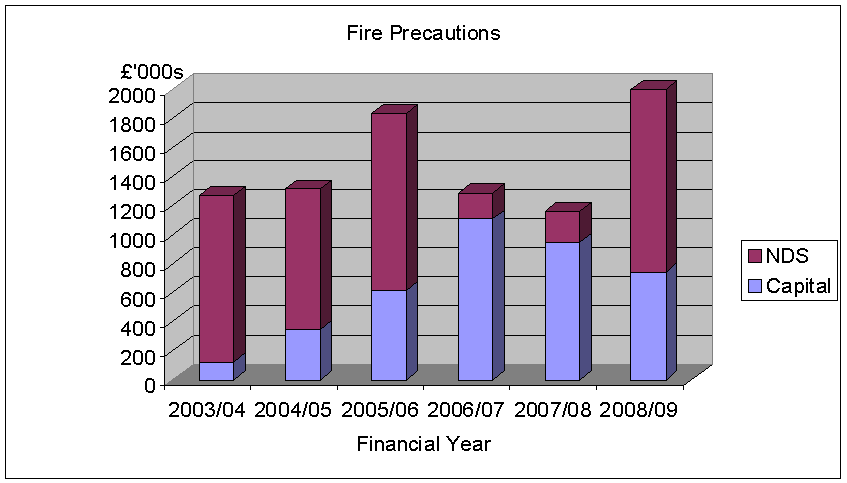
4.2. Appendix 1b illustrates the significant resources (in excess of £1m pa) to deliver fire precautions improvements across the County Councils property portfolio.
4.3. Achievements in 2008/09 include upgrading of structural fire precautions in the remaining residential homes for older persons to improve structural fire precautions. Capital Landlord's CRA and NDS Programmes have included major spending to support improvements to fire precautions in those fully Resourced and accessible Secondary Schools identified by Children's Services, Libraries, residential Children's homes, residential and respite care homes for adults, day centres, museums and other public buildings identified as part of the risk profile of the built estate and Joint Fire Safety Audit Programme. This work reduces the amount of risk by agreeing an action plan with the responsible Manager in each building so they can manage the building safely and inform future programmes of investment in improving fire alarm and structural fire precaution measures. This work has been supported by funding contributions from Children's Services and Culture, Community and Rural Affairs (formerly Recreation and Heritage).
4.4. Significant investment is planned during 2009/10 using Landlords and NDS Capital Investment in Fire Precautions. This includes investment of £1,300,000 to improve fire precautions in highest risk properties. The breakdown of the work is as follows:
· £150,000 for Primary Schools, £725,000 for Secondary Schools |
· £25,000 for Children's Services Non-School premises |
· £50,000 for Culture, Communities & Rural Affairs premises |
· £500,000 for Adult Services Older Persons Residential Premises. |
4.5 A comprehensive schedule of Fire Safety Audits will continue with HFRS across the County Council estate, with a focus on fire management arrangements and evacuation drills to protect building users in the event of a fire.
4.6 The Strategic Partnership between the County Council and HFRS was considered by the Panel on 7 October 2008 and renewed for a four year period from October 2008 to October 2012. The partnership is proving effective at raising awareness of fire safety in the County Council's buildings and is beginning to show good results in reducing the cost of arson to the County Council. The continuation of such a strategic partnership can only enhance the County Council's performance in respect of any future Comprehensive Area Assessment. The cost of arson incidents involving the County Council's buildings decreased significantly in 2007/08.
5. Condition of Building Fabric
5.1. The 5 year condition liability for the combined Education and Non-Education Estate remains high and is currently in the order of £450m. Despite the management controls that are in place, it is possible that incidents may occur in our buildings associated with the condition of building fabric.
5.2. The forthcoming Primary Capital and Building Schools for the Future Programmes provide the next major opportunities for making an impact on the backlog of maintenance and repairs in the Education sector. There is however no significant increase in investment anticipated in the Non - Education Estate in the short to medium term although Workstyle Programmes will reduce liability within office accommodation portfolio via disposals and re-investment strategies. It will become an increasing and significant challenge to maintain and retain these properties at an acceptable standard into the future at current investment levels.
5.3. To ensure that capital resources achieve maximum strategic impact, a Test and Invest Strategy was developed to change annual test and inspection programmes from published standards to a Hampshire Standard which ensure safety of the estate whilst providing significant funding for investment. Members supported the Test and Invest Strategy and this approach is being developed across the risk register where practicable. A particular example of this is the Electrical Test and Inspection Programme where the funding released is starting to reduce liability and the associated risks with old fitting and switchgear. During 2009/10 the focus will be on school sites which have unbalanced or overloaded circuits which can cause power cuts during periods of high demand.
6.0 Asbestos Inspection Programme
6.1 Asbestos management is ranked fifth on the Property Services Strategic Risk Register as a medium risk with a green performance rating for 2008/09. Asbestos is no longer used in the construction of new Hampshire County Council buildings. However, asbestos was widely used in the UK until 1985 when the use of products containing certain types of asbestos was banned. Until this time, the use of asbestos products within Hampshire County Council's estate was typical of the UK construction industry at the time. A total ban on the use of any form of the material was introduced in 1999 and Hampshire County Council complied with this requirement for subsequent construction works. The key to the management of asbestos is to have robust survey arrangements and to ensure there is no unmanaged disturbance. Requirements of Control of Asbestos Regulations (CAR) 2006 are to take reasonable steps to find materials likely to contain asbestos. The County Council's surveying consultancy partners commenced a type 2 survey programme to improve the accuracy of asbestos registers in April 2006 which is expected to be completed in 2012. This contract represents good value for money and helps manage asbestos efficiently within the allocated budget.
6.2 To meet legal requirements, the County Council has committed to formally re-inspecting asbestos materials on a periodic basis using contractors specially trained for the purpose. A risk based programme has been adopted to inspect high risk materials annually, and lower risk materials on a biennial basis. A full re-inspection programme for 2008/09, of both high and low risk materials, was delivered to schedule and on budget.
6.3 Quality of asbestos removal works has been improved by resourcing air monitoring using the in house team; this has also reduced sub-contractor spend by around £200,000 bringing better value to construction projects.
7.0 Conclusions
7.1 Continuous progress is being achieved through focused management action and capital investment according to the rank order and published improvement agenda. Strategic risks are monitored biannually to quantify the level of risk retained by the County Council and provide information about resources required to control or eliminate each risk. The annual risk review provides clear evidence that risk management is being effective in all areas and leading to positive and sustained improvement in risk handling.
8. Recommendation(s)
That the Buildings, Land and Procurement Panel advises the Executive Member for Policy and Resources to approve:
8.1 The implementation plan for Property Services Strategic Risk Register for 2008/09 as set out in table 2 in Appendix 3b entitled "Summary of planned actions for implementation in 2009/10".
CORPORATE OR LEGAL INFORMATION:
Links to the Corporate Strategy
Hampshire safer and more secure for all: |
yes/no |
Corporate Business plan link number (if appropriate): | |
Maximising well-being: |
yes/no |
Corporate Business plan link number (if appropriate): | |
Enhancing our quality of place: |
yes/no |
Corporate Business plan link number (if appropriate): | |
Section 100 D - Local Government Act 1972 - background documents | |
The following documents discuss facts or matters on which this report, or an important part of it, is based and have been relied upon to a material extent in the preparation of this report. (NB: the list excludes published works and any documents which disclose exempt or confidential information as defined in the Act.) | |
Document |
Location |
IMPACT ASSESSMENTS:
1. Equalities Impact Assessment:
1.1. There is no impact identified
2. Impact on Crime and Disorder:
2.1. Some of the programmes support the strategy for crime and disorder to include arson reduction, modifications to buildings to reduce vandalism etc.
3. Climate Change:
a) How does what is being proposed impact on our carbon footprint / energy consumption?
Some of the programmes replace buildings fixtures which are more efficient and reduce energy consumption e.g. relamping of buildings.
b) How does what is being proposed consider the need to adapt to climate change, and be resilient to its longer term impacts?
The department has a Sustainability/Climate Change Board which is directing resources and new strategic risk will be added in 2009/10 to join up activity across both agendas.
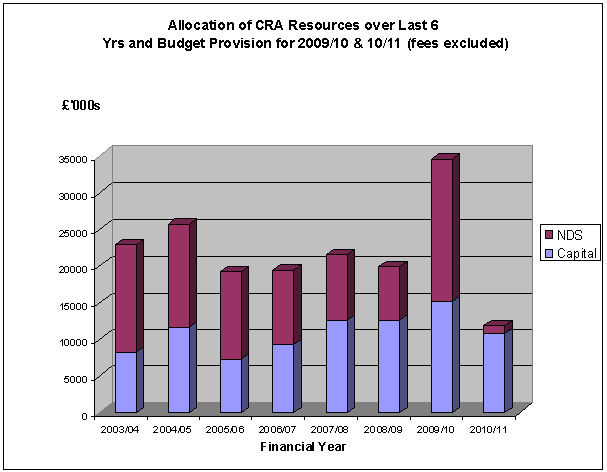
All but £1043k of NDS funding has been accelerated to 2009/10 as a direct result of a request from the DCSF. This will help stimulate the local economy in the current downturn.
Property Services Strategic Risk Register 2008/09 Appendix 2
Summary of ten highest risks WITH controls in rank order showing current performance using a traffic light colour coding
Level of risk |
Risk Title |
Risk description |
Traffic light to illustrate performance |
High |
Fire including arson |
Fire and arson remains the highest risk particularly in residential buildings such as older persons homes. Irrespective of the cause, malicious or otherwise, fires can present a significant business or community loss causing serious damage to buildings including schools, offices, public buildings and day centres. The estate is categorised into risk groups and subject to a comprehensive survey and joint inspection programme with Hampshire Fire and Rescue Service (HFRS). The Fire Safety Manual has been reviewed and reissued to comply with the Regulatory Reform (Fire Safety) Order 2005. A strategy for arson reduction is in place and appears to be reducing the risks in schools. |
Amber |
High |
Condition of building fabric including vandalism - non educational |
Since there are a broad range of non educational buildings in terms of age and construction, this risk associated with condition is defined as the state of repair of all components including fabric, plant and services and the risk of failure of components. Condition surveys are completed every five years and annual management partnership meetings are undertaken. |
Amber |
Medium |
Asbestos management |
This risk covers the management of asbestos containing materials (ACM) within all County Council buildings through a comprehensive survey programme, database of identified materials and publication of an annual asbestos register for every site. Guidance, instruction and training has been developed and updated for property services staff, building users and monitored contractor performance. ACMs were used in construction until 1999 when legislation prevented use. This means that the majority of the County Council's buildings have asbestos material requiring comprehensive survey and planning before undertaking invasive work such as refurbishment. |
Green |
Medium |
Condition of building fabric including vandalism - education. |
The risk associated with condition of education buildings describes the state of repair of all components including fabric, plant and services and the risk of failure of components. A Condition survey programme is in place, a helpdesk to provide reactive response, revised security contracts and annual management partnership meetings. Capital Repairs and NDS funding has benefited schools over the past 5 years increasing the quality of the buildings and reducing liability compared to non-education stock identified as a separate risk in this register. |
Green |
Medium |
Electrical services failure |
This risk covers any loss or damage associated with electric shock or short circuit in the built estate associated with the fixed installation and equipment in all County Council premises and sites. Term contracts are in place for day to day maintenance and a five yearly or less inspection and testing regime completed by specialist contractors with high risk properties requiring more frequent inspections. An in-house database and management system record T&I inspections and are updated regularly with quarterly reports discussed at Engineering meetings. Impact include reputation, minimal environmental impacts and some business continuity impact if the failure affects the servers or IT2000 computer system. |
Green |
Medium |
Higher level access for maintenance to plant and buildings. |
This risk describes the risk of personal injury or fatality by contractors or site staff required to access plant and parts of buildings. This requires contractors staff etc to set controls, or carry out repairs, maintenance or servicing. Other people at risk are trespassers who may attempt to access plant rooms if there are access arrangement in place. Access to plant, lift rooms, water towers roofs staircases, balconies and balustrades where we have provided access systems e.g. ladders to water towers. This risk also covers working in close proximity to drops where such equipment would be used when carrying out basic maintenance tasks and the arrangements for the certification and inspection of fall arrest systems, and security eyebolts. |
Amber |
Medium |
Swimming pool plant failure |
This risk covers hazards associated with swimming pools including management systems and the condition of the plant, equipment etc. Many facilities are approaching 30 years old. A management review programme is being completed during the 2007-2012 SLA to review risk management and operating arrangements for pools while regular water testing is provided by Hampshire Scientific Services (HSS) to maintain water quality. Reactive maintenance arrangements are in place with term contractors where inspections and improvement are identified. Significant investment programmes are required to update pools to modern standards or alternatively demolish the pools where this is appropriate. |
Green |
Medium |
Mechanical engineering service failures |
This risk covers mechanical engineering plant such as gas appliances, pressurised systems and ventilation systems associated with building services. Mechanical engineering plant is usually located within dedicated plant rooms or kitchens and have the potential for fire or explosion associated with failures. This risk also includes bottled gases, school teaching equipment, welding equipment and expansion vessels. Regular servicing via term contractors and inspection and testing are completed and recorded within a database which also records replacement of safety valves etc. The County Council has a written scheme of examination delivered by competent staff and this is monitored through quarterly meetings and monitoring of risk assessments |
Green |
Medium |
Management of trees and grounds management including pesticides. |
This risk covers Hampshire County Council term contracts for Grounds Maintenance for Children's Services, Adult Services, Office Accommodation, Libraries, Estate Practice properties, any other County Council owned sites which require grounds maintenance and some work for outside clients. The work mainly comprises grass cutting, tree surgery, horticultural works (shrub bed maintenance and hedge cutting) preparation of external sports facilities and the application of pesticides (generally herbicide). |
Green |
Medium |
Failure to manage contractors and supply chain. |
This risk covers poor contractor performance which could give rise to an incident or accident where the County Council is the client or client agent. The register of contractors identifies 120 general builders and 200 specialist traders approved to carry out projects. Robust selection and appointment procedures are in place with annual checks of insurance. Contractors are monitored every month and suspended for poor performance evidenced through site safety checks. |
Green |
Property Services Strategic Risk Programmes 2008/09 and 2009/10 Appendix 3
Table 1: Summary of ten highest risks confirming achievements during 2008/09
Strategic risk |
Achievements or key actions completed in 2008/09 |
Fire including arson |
· All Fire Alarm Systems with an existing link to a central monitoring station have been registered with Hampshire Fire and Rescue Service (HFRS) and ensure Unique Reference Numbers have been issued. This ensures HFRS will respond to an automated call in the event of a fire alarm being raised. · Delivered a substantial programme of Capital improvement work for Children's Services Department, Adult Services Department, Culture, Communities and Rural Affairs Department (CCRA) and the PBRS Capital Programme. Improvements programme priority based on risk following agreement at FMPRG and HSEG. |
Condition of building fabric including vandalism - non educational |
· First Phase of FM arrangements for Ashburton Court now in operation · Strategic Liaison arrangements up and running with CCRA. This will assist in better prioritisation of works and joining up of funding streams leading to better outcomes for this portfolio. |
Asbestos management |
· The quality of asbestos removal works has been improved by bringing all air monitoring work back in house - this has reduced sub-contractor spend by around £200,000. · Site asbestos registers have been improved following a comprehensive review of data and plans prior to distribution. |
Condition of building fabric including vandalism - education. |
· Centralised Reactive Maintenance team in place and working effectively · Good progress on framework arrangements which will lead to improved effectiveness and best value - SME Framework in place and operating, Reactive maintenance contracts - now at contract formation stage, external redecorations out to tender. |
Electrical services failure |
· Reviewed T & I arrangements for County Farms to include management regime, add information to single database. · Southern Electric Contracting successfully carried out the testing programme for 2008. · Directory of reports in electronic format with asset photographs. |
Higher level access for maintenance to plant and buildings. |
· Term maintenance Engineers have been appointed which limits the number of contractor accessing high level plant, and improves the provision of information about the issues, thus reducing liability. · £ 160,000 was allocated within 2008/2009 to address high priority Plant Access issues. · The Database developed further to confirm future priorities for investment in 2009/10 to fit with re-investment programmes such as Workstyle and BSF. |
Swimming pool plant failure |
· There were no targets set for 2008-09 because the procedures for the term contractor responsibilities for regular visits had been put in place the year before and is working well without any problems to report. It has been made easier by the closure of pools. |
Mechanical engineering service failures |
· The surveys of LPG installations were completed by a specialist and this has ranked HCC LPG sites as high, medium and low risk. A programme of remedial works has been developed and remedial works completed to the sites identified as high risk by 31/3/2009. · Training has been completed for all PBRS mechanical engineering staff Corgi Industrial and commercial gas safety during the past year. |
Management of trees and grounds including pesticides. |
· Developed and published safe routes through school sites for large plant and machinery. · A 24 month period timetable of inspections on all Estate Practices sites including County Farms based on a risk assessment taking into account the age, type and condition of trees. |
Failure to manage contractors and supply chain |
· Improved engagement with contractors through the Contractors forum provided some useful feedback to improve performance of contracts. · H&S Inspectorate team developed (formally called Clerk of Works) has improved monitoring and feedback process to contractors. |
Table 2: Summary of planned actions for implementation in 2009/10
Strategic risk |
· Key actions proposed for 2009/10 |
Fire including arson |
· Deliver a further substantial programme of Capital improvement work for Children's Services Department, Adult Services Department, CCRA and the PBRS Capital Programme. Improvements programme priority based on risk following agreement at FMPRG and HSEG · Agree and implement updated County Council policy to reflect revised HFRS policy on lift rescue · Identify sites in the County Council using Acetylene with a view to reducing it's use as part of the HFRS Acetylene Risk Reduction Strategy. Benefit to the County Council and the wider community in reducing disruption caused by Acetylene cylinders involved in fires. |
Condition of building fabric including vandalism - non educational |
· Development work to be completed on joint AMP and structural inspection programme. · Resources to be targeted to complete Landlords programme |
Asbestos management |
· Transforming Through Technology - the new mobile asbestos survey data capture system (MASS) is now being used by re-survey contractors. Phase two of this project is now underway to incorporate use of the MASS system in the delivery of project related asbestos surveys. · Reduction of Asbestos Incidents - The number of asbestos related incidents increased during 2008/09 Work is therefore underway to reduce this number through raising awareness of this trend with Contractors and Property Services staff, and working proactively with those involved in incidents to identify the root causes to ensure appropriate action plans are instigated. |
Condition of building fabric including vandalism - education. |
· IT Development work in progress to provide a single asset management system to manage data associated with built estate. · Resources to be targeted to complete Landlords programme |
Electrical services failure |
· Work is being carried out on a framework agreement for the 2010 testing programme onwards. This is due to be ready by September 2009 for the start of a new T&I programme from November 2009. · Relocation of computer suite with improved backup arrangements to prevent loss of IT2000. - implementation in North Block of ABC. · Work is being carried out to provide a web database which to record information on the T&I testing contract and programme and the subsequent remedial works. It will improve the quality of the reports available from this data. |
Higher level access for maintenance to plant and buildings. |
· Formation of a contract to test eye bolts following the collapse of the company previously employed. · Develop a protocol document for the fall arrest and working restraint equipment installed in HCC properties. |
Swimming pool plant failure |
· Spot checks will be continue to be carried out during 2009-10 to ensure the term contractor is performing adequately. · The chemicals used at each of the pools will be checked and listed and the contractor's data base will be developed to include plant data and water treatment plant inspections. |
Mechanical engineering service failure |
· The surveys of LPG installations were completed in February 2008 at a cost of £17183. A programme of remedial works has been developed and remedial works completed to the sites identified as high risk by 31/3/2009, and remaining sites by Dec 2009. · Surveys for TPR valves & replacements by competent persons A contract has been developed for survey and replace where necessary any TPR ( Temperature pressure relief valves) fitted to domestic hot water generating plant. This contract will survey approx 830 HCC sites and work is anticipated to be complete by December 2009. · Assess benefits of installation of battery carbon monoxide detectors in domestic residential accommodation and implement through term contract arrangements. · Complete programme of upgrades to oil pipes and tanks to prevent ground contamination/pollution. |
Management of trees and grounds management including pesticides. |
· Development of an audit checklist which will be completed on site for grounds management at the same time that tree surveys take place. · Review and develop the Hampshire County Council Pesticide Policy booklet |
Failure to manage contractors & supply chain. |
· Include environmental protection as a feature in the workplace inspections and subsequent feedback to contractors. · Continue to work with contractor to improve health and safety performance and quality of finished work. |