
Archived decisions
Item 6
HAMPSHIRE COUNTY COUNCIL
Report
Committee: |
CHILDREN AND YOUNG PEOPLE SELECT COMMITTEE | ||||
Date of meeting: |
8 OCTOBER 2009 | ||||
Report Title: |
SCHOOL ADMISSIONS: ARRANGEMENTS AND OUTCOMES | ||||
Report From: |
DIRECTOR OF CHILDREN'S SERVICES | ||||
Contact name: |
Martin Goff | ||||
Tel: |
01962 846185 |
Email: |
|||
1. Purpose of the report
1.1. To provide an introduction to and overview of school admission arrangements in Hampshire County Council's administrative area and, where appropriate, raise cross border issues.
1.2. To provide a summary of recent outcomes for parents when applying for school places and for those pursuing a school admission appeal.
2. Context
2.1. In the autumn term the Admissions Team has four main themes to its work.
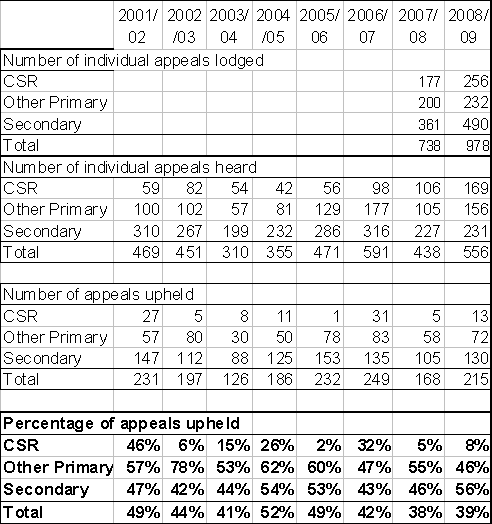
· A review of the appeals heard for entry in the previous academic year (in this case 2008/2009).
· Pupils, who were part of the recent main admissions round i.e. the September 2009 intake, start school.
· The September 2010 admissions procedures begin with approximately 34 000 families making their applications for places in reception classes in infant and primary schools, junior schools and secondary schools; deadline for secondary applications is Friday 23 October 2008, primary deadline is Friday 20 November 2008.
· The consultation for the 2011 admission arrangements is carried out within the authority and with neighbouring authorities between October 2008 and March 2009.
2.2. School admissions operates in a constraining legal framework. The local authority must set admission arrangements for its own community and voluntary controlled schools, must organise a co-ordinated scheme so that families receive one offer of a school place and police voluntary aided and foundation schools that are their own admissions authority. The authority is supported by Hampshire's Admissions Forum; the authority must have regard to the advice of the Forum.
3. Admission arrangements and their publications
3.1. Three handouts will be supplied at the meeting; the authority's composite prospectus, a directory of primary schools and a directory of secondary schools. Some discussion about policies and processes will follow on using those publications.
4. Meeting preferences for the main admissions round 2009
4.1.
Round |
Number of applications |
Successful First Preference |
Successful Second Preference |
Successful Third Preference |
Allocations |
Secondary |
13,973 |
12925 (92.5%) |
671 (4.8%) |
126 0.9% |
251 (1.8%) |
Infant to Junior |
6871 |
6818 (99.2%), |
30 (0.4%) |
N/A |
23 (0.3%) |
Reception |
13501 |
12283 (91.0%), |
674 (5.0%) |
N/A |
544 (4.0%) |
4.2. Comparative data for other LAs is collected and published by DCSF only for secondary transfer. Other authorities are notably less successful in meeting first preferences; Surrey 79.4%, Kent 78.4%, Wiltshire 88.7%, Devon 91.1%, Hertfordshire 76.2%.
5. School Admission Appeals; numbers and their outcomes
5.1. Every parent that is refused an application for a school place is entitled to appeal against the refusal; their case is heard by an Independent Appeal Panel. The appeal hearing itself, and process leading up to and after the hearing, follows a legislative framework. A panel consisting of three panel members, (trained through Hampshire County Council's Chief Executive department), with legal support on the day from a trained clerk, hears the authority's case for refusing admission. If the authority's case is successful then the panel hears the parent's case and then balances the two cases. The panel can require the authority to admit the pupil, even when it has acknowledged that the school is full. There is a different legislative framework for appeal hearings when the Infant Class Size legislation (no more than 30 pupils in an infant class with only one teacher present) applies.
5.2. Voluntary Aided and Foundation schools are responsible for organising their own appeals process. Many Aided schools use an appeals service provided by their Diocesan Board of Education.
6. In-year admissions, children missing education, Fair Access
6.1. In-Year Admissions
The Admissions Team has recently begun handling many in-year admissions as part of preparing for a new statutory requirement beginning in September 2010. By the close of play on 25 September 2009, 420 offers had been made to primary age children and 166 to secondary age children. A further 142 cases are being handled: some of these have already started in their school place and others will be more complicated admissions. In addition a further 52 applications have been received. (i.e. a total of 780 approaches that have resulted in applications). From September 2010 the process must be co-ordinated across all Hampshire maintained schools and all neighbouring authorities.
6.2. Children Missing Education
The Admissions Team has, since January 2009, provided a CME tracking function. In the spring and summer terms of academic year 2008/2009, 343 pupils were identified as having left a Hampshire school with no known destination. A further 42 from this term can be added to the list. 313 of those pupils have had their CME referral closed; of the remainder many are located but the authority awaits formal confirmation of their current situation. In future this function needs to grow its capacity to work with information from the independent sector as well as developing its approach as the authority's knowledge base improves from its involvement in in-year admissions and the intended introduction of regular polling of schools' MIS.
6.3. Fair Access
It is a requirement that all local authorities operate a Fair Access protocol and all schools must participate in the admission of children covered by the protocol. In Hampshire the protocol gives priority to children from vulnerable groups, service families, Year 11 and Year 6 pupils etc., when they are applying for places outside the main admission rounds. The Fair Access process sits alongside the work of Inclusion Partnerships which primarily deal with ensuring school places for children with challenging behaviour. A key feature of Fair Access is that all schools take their share of Fair Access pupils and of those with challenging behaviour. Legislation exists to ensure that schools with places do not disproportionately enrol more challenging children and that schools with full year groups can still admit Fair Access pupils. The numbers of pupils that are offered places is difficult to track, the authority's involvement in all in-year admissions should aid this process.
7. Conclusions
7.1. The County Council has a large responsibility to ensure admissions arrangements in Hampshire are clear, fair and objective in their design and then properly applied. There are many cross border issues that make that requirement apply, in effect, beyond the administrative boundary.
7.2. Schools and the authority must work together to ensure that, as far as possible, parental preference is met, and ultimately that all pupils have access to a school place. Administrative processes must not provide a delay when families are seeking school places. Schools are encouraged to work in partnership with each other, as well as the LA, to realise quick access to the most suitable available place for vulnerable children.
7.3. School admissions has a high political and media interest, is often of huge importance to families and is the gateway to children accessing the educational provision that is intended to help them to realise their potential. The policy and system must provide the best possible framework so that the admissions service has high levels of credibility within the County Council, with schools and with families.
Section 100 D - Local Government Act 1972 - background documents | |
The following documents discuss facts or matters on which this report, or an important part of it, is based and have been relied upon to a material extent in the preparation of this report. (NB: the list excludes published works and any documents which disclose exempt or confidential information as defined in the Act.) | |
Document |
Location |