
Archived decisions
Agenda Item 4
HAMPSHIRE COUNTY COUNCIL
Report
Committee: |
Policy & Resources Select Committee | ||||
Date of meeting: |
15 October 2009 | ||||
Report Title: |
Support provided to Deafblind Children and Adults - Motion Referred from County Council | ||||
Report From: |
The Chief Executive | ||||
Contact name: |
Marie Mannveille, Scrutiny Officer | ||||
Tel: |
01962 845018 |
Email: |
|||
1. Purpose of Report
1.1. At a meeting of the full County Council held on 17 September 2009, Cllr Alan Dowden put forward a notice of motion regarding recent Department of Health guidance on support to deafblind Children and Adults. An amendment was proposed by Cllr Felicity Hindson, Executive Member for Adult Social Care. It was decided at full Council to refer consideration of this motion to the Policy & Resources Select Committee. This committee is requested to consider the motion, and report back to full Council at its next meeting, due to be held on 19 November 2009.
2. Contextual Information
2.1. The notice of motion and proposed amendment are attached as appendix one. Both the Adult's Services and Children's Services Departments have provided briefing notes giving details of what they are doing in relation to the 6 points raised in the motion (see appendices 2 and 3).
2.2. The motion relates to a circular by the Department of Health published on 23 June 2009. The motion picks up the six areas under which Local Authorities are required to take action. The circular is accompanied by statutory guidance giving further detail. This is available online from the DoH website: http://www.dh.gov.uk/en/Publicationsandstatistics/Lettersandcirculars/LocalAuthorityCirculars/DH_101114
2.3. While there is no formal definition of deafblindness, the accepted description for this condition is that persons are regarded as deafblind `if their combined sight and hearing impairment cause difficulties with communication, access to information and mobility. This includes people with a progressive sight and hearing loss'. People may be deafblind from birth, may be either deaf or blind from birth and lose the other sense later due to trauma disease or old age, or acquire impairment of both senses in later life. Deafblindness can be found in all age groups, but the incidence is greatest in older adults. A person may not be totally blind and totally deaf, but if both senses are impaired this may have a significant impact on their communication, access to information, and mobility.
2.4. The Department of Health estimate there are over 2.7 million people in the UK1 with combined sight and hearing impairment, ranging from minimal to severe, including 24,000 deafblind people2. The estimated prevalence rate is 40 per 100,000 population.3
2.5. The following are figures from the November 2008 Hampshire Joint Strategic Needs Assessment (based on clients receiving social care services):
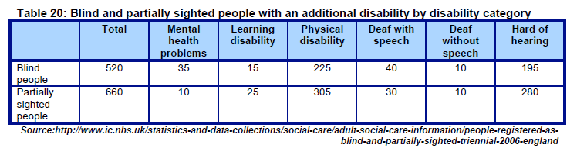
2.6 Figures from the JSNA for Children and Young People indicate the numbers of Children with different Special Educational Needs. For Multi sensory impairment the figures are as follows:
Type of School |
Hampshire Numbers |
Hampshire % of total SEN |
England Number |
England % of total SEN |
Maintained Primary |
9 |
0.1 |
540 |
0.2 |
Maintained Secondary |
X |
X |
230 |
0.1 |
Maintained special schools |
X |
X |
150 |
0.2 |
Source: The Department for Children, Schools and Families. The Annual Schools Census and SEN2 Survey January 2007
X - 1 or 2 pupils, or a rate based on 1 or 2 pupils
3. Conclusions
3.1. This cover report provides contextual information regarding the issue of deafblindness. The committee is asked to consider the information provided at appendices 2 and 3, in order to come to a view regarding the motion at appendix 1.
3.2. The committee is required to formulate a recommendation back to full Council regarding the motion. This may be accepting the motion as it stands, accepting the proposed amendment from Cllr Hindson, or recommending a different amendment.
Section 100 D - Local Government Act 1972 - background documents | |
The following documents discuss facts or matters on which this report, or an important part of it, is based and have been relied upon to a material extent in the preparation of this report. (NB: the list excludes published works and any documents which disclose exempt or confidential information as defined in the Act.) | |
Document |
Location |
IMPACT ASSESSMENTS:
1. Equalities Impact Assessment:
1.1. N/A
2. Impact on Crime and Disorder:
2.1. N/A
3. Climate Change:
3.1. How does what is being proposed impact on our carbon footprint / energy consumption?
N/A
a) How does what is being proposed consider the need to adapt to climate change, and be resilient to its longer term impacts?
N/A
Appendix 1
COUNTY COUNCIL - 17 SEPTEMBER 2009
NOTICE OF MOTION
AGENDA ITEM 10(b)
Council Motion
This Council welcomes the Department of Health's Social Care for Deafblind Children and Adults - LAC (DH) (2009) 6 circular. The implementation of this guidance will have a positive impact upon the support that deafblind people receive. The deafblind guidance expects this council to:
(1) identify, make contact with and keep a record of the deafblind people within Hampshire
(2) ensure that assessments are carried out by properly trained personnel
(3) ensure that appropriate services are provided for deafblind people-remembering that individual services for people who are deaf or who are blind may not be appropriate for someone who is both deaf and blind
(4) ensure that they have access to fully trained, one- to- one support workers if necessary
(5) provide information in a suitable format which is accessible to deafblind people
(6) ensure that a senior manager is given responsibility for deafblind services.
This Council will implement the guidance without delay
Proposer Cllr. Alan Dowden
Seconder Cllr. Brian Dash
PROPOSED AMENDMENT:
Delete the final sentence and insert "This council is pleased that the Children's services and health Services departments are already working to these guidelines".
Proposed by: Councillor Felicity Hindson
Seconded by: Councillor Peter Edgar
Appendix 2
Notice of Motion County Council 17th September 2009
Response from Adult Services
1. Identify, make contact with and keep a record of the deaf/blind people within Hampshire.
Social care services for disabled adults are generally provided under section 29(1)
of the National Assistance Act 1948 in conjunction with section 2 of the
Chronically Sick and Disabled Persons Act 1970. This provides that local
councils may, and in certain circumstances must, make arrangements for
promoting the welfare of disabled people over the age of 18. This includes people who are deaf/blind.
There is currently no separate registration for deaf/blind people. Most service users with acquired dual loss will become known to the Adult Services Department through the ophthalmology or audiology services. There has been an average of 250 `dual sensory loss' referrals annually across the county over the past three years for the Hampshire County Council Adult Services Department. By far the most significant proportion of this group are older people who have age related acquired dual loss. There is smaller group of people who are younger. These include people with Usher Syndrome, those who have lost sight and hearing through meningitis and those who have congenital deafness and acquire sight loss through trauma or disease.
2. Ensure that assessments are carried out by properly trained personnel.
Those users whose first language is BSL will be clients of the specialist county wide Deaf Services team but that team will assess need and agree a suitable package of support in conjunction with colleagues from the Sensory Loss team in order to draw on their expertise in blindness/sight loss.
There are staff within the Sensory Teams who are specifically trained to work with deaf/blind people but there is no nationally agreed standard with regard to what training a person should have in order to be regarded as `properly trained'.
The Transition Social Work Teams also ensure that care pathways for young people who are moving into Adult Services are also taken into account in future planning.
There are courses to assist staff in developing the skills necessary to communicate effectively with deaf/blind users and the department may need to audit existing skills within its workforce and commission further training where appropriate.
3. Ensure that appropriate services are provided for deaf/blind people-remembering that individual services for people who are deaf or who are blind may not be appropriate for someone who is both deaf and blind
Services for deaf/blind users are being considered in planning for Personalisation and the Hampshire Model which includes the development of self directed support. Both the Sensory Loss service and Deaf Services Team are currently developing strategies which will respond to these changes. The vision for the Sensory Support pathway is to develop, in partnership, "a clear and robust pathway for people with sensory impairments that will provide a high quality, prompt, effective and efficient information and support service." This should enable them to increase their wellbeing, independence and inclusion through services which promote individual choice.
4. Ensure that they have access to fully trained, one- to- one support workers if necessary.
As described there are specialist trained staff in the sensory and deaf services teams who can and do provide one to one support when necessary . In addition specialist services can be commissioned on an individual basis to provide for particular individual need. There are only 2 national agencies which offer services specifically for people who are deaf/blind. These are Sense and Deaf Blind UK. We are aware that because of the small size of the market and the highly specialist skills needed to work with this group of people market development presents challenges for the County Council.
5. Provide information in a suitable format which is accessible to deaf/blind people
HCC Communications team provides a range of materials to assist effective communication with deaf/blind people and recognises that there is a requirement to respond to the variety of methods that people with sight and hearing loss will chose to communicate. These include the Deafblind Manual Alphabet, Hands-on Signing, Visual Frame Signing, Block and Keyboard Interpreting as well as the more widely used BSL and Braille.
6. Ensure that a senior manager is given responsibility for deaf/blind services.
Ruth Dixon, Assistant Director for Older People and People with a Physical Disability, has a lead for all sensory services for adults across the county and is supported in this role by a Service Manager for County Sensory Services, leading the operational teams, and a Commissioning Manager with a specific lead for Sensory Services.
Appendix 3
Notice of Motion - County Council 17th Sept 2009
Children's Services Department Response
1. Identify, make contact with and keep a record of the deafblind people within Hampshire
Under the 1989 Children Act, Hampshire's Children's Services Department keeps a voluntary register of disabled children - within this, deafblind children are registered on a voluntary basis.
The register is called the Joint Information Link and is supported by a full- time member of staff. The parents who register their children receive a two monthly newsletter called LinkLines, which keeps them up to date with both the local and national initiatives, activities and legislation.
Through our Aiming High for Disabled Children Commissioning Strategy, designed by consultation with over 600 parents (including those of deafblind children) we have commissioned Barnados and the Rose Road Association to develop 3 participation / information centres for parents/carers and an interactive website `Parent Voice'; providing support for parents and opportunities for `short breaks' for parents of all disabled children.
We are working with the Hubs to increase the number of families who register on JIL, by providing greater incentives. However there is currently no separate registration for deaf and blind young people.
The Specialist Teacher Advisory Service (STAS) provides information, advice, support and training to parents, and school staff. There is a team for visually impaired children and one for those with hearing impairments with teachers working together in to ensure that the needs of children with sensory impairments including those who are deafblind are appropriately identified, assessed and their special educational needs met. There is an established protocol of joint working. The service is involved with children at the pre-school stage, in many cases from birth, and receives referrals from health services, other professionals and parents. A record is held of each deafblind child known to the service.
The Portage Service provides home visitors for pre-school children who have a significant delay in their development and liaises with the STA Service and early years providers to ensure a smooth transition into a setting.
2. Ensure that assessments are carried out by properly trained personnel
All deaf-blind children are visited by specialist teachers from the STA Service, who have an additional qualification in working with children with a visual impairment or a hearing impairment, to assess their individual needs. The emphasis is upon collaborative working. In a small number of cases it is necessary to obtain additional specialist advice and Hampshire County Council has an agreement with SENSE, a national organisation, to provide specialist assessments of individual children and a written report with recommendations. The STA Service works closely with SENSE to ensure the ongoing implementation of the recommendations.
Within the STA Service there are two Paediatric Rehabilitation Officers for Visual Impairment who provide assessments and training for children to increase their independent mobility in the community. The current post holders both have substantial experience of working with deafblind children. There is a close working relationship between services within the Children's Services Department to ensure the holistic educational and care needs of children are met as they progress through the journey to adulthood.
As part of our partnership with parents we have undertaken a review of the social care eligibility criteria which we will report to Executive Member in December 2009.
Through the consultation and design section of this, sensory services have been well represented through parents, practitioners and the regional lead through National Deaf Services. Deafblind children will receive a service under these draft proposals.
3. Ensure that appropriate services are provided for deafblind people - remembering that individual services for people who are deaf or who are blind may not be appropriate for someone who is both deaf and blind
There is a range of children who may fall within the definition of having profound and multiple learning difficulties, severe learning difficulties or moderate learning difficulties and also be deafblind. Depending on the level of learning difficulty and degree of deafblindness children may attend mainstream schools or special schools. During the statutory assessment processes detailed reports will be drawn together from parents and a range of professionals resulting in a clear picture that enables Hampshire County Council to provide a suitable educational placement and care arrangements, as necessary. The Paediatric Rehabilitation Officers members of the STA Service provide mobility and orientation training as appropriate. Trained intervenors are provided to a small number of children at school.
4. Ensure that they have access to fully trained, one to one support workers if necessary
Social care have a trained workforce within the Disabled Children's Teams; some workers have additional qualifications to work with deafblind children. We also have an excellent partnership with workers in Adult Services who have specially trained workers.
As part of the County Council's Aiming High for Disabled Children Commissioning Programme we are working closely with our Third Sector partners and parents to ensure we have a trained workforce to deliver short breaks.
Over the summer holidays deaf/blind young people have been provided with a short break adventure programme with trained workers. Activities have included:
· A day at Calshot Multi Sports Centre.
· Wildlife Safari
· Art and sculpture day
Individual support is provided in school through Learning Support Assistants under the supervision of a teacher with programmes advised by the teacher advisers and other relevant professionals. Programmes are regularly monitored and reviewed in liaison with parents. Training and support will be individually tailored according to the child's assessed needs. All teacher advisers have received training from SENSE in the implications of deafblindness and school support staff attend courses organised by sense.
5. Provide information in a suitable format which is accessible to deafblind people
HCC communications team provide a range of materials to assist effective communication with deafblind people and recognises that there is a requirement to respond to the variety of methods that people with sight and hearing loss will chose to communicate. These include the Deafblind Manual Alphabet, Hands on Signing, Visual Frame Signing, Block and Keyboard Interpreting as well as the more widely used BSL and Braille.
The Children's Services Department has also been working with disabled young people to produce an easy read version of the 2009 - 2012 Children and Young People's Plan, this will be made available for blind/deaf children.
Materials in school are specifically adapted to enable access to the curriculum and to information. In schools children are taught appropriate methods, communication e.g. Braille, finger spelling, makaton.
6. Ensure that a senior manager is given responsibility for deafblind services
Colin Hardy is the Aiming High for Disabled Children lead. Furthermore, there is both a Commissioning lead in the Special Educational Needs Service/STA Service (Felicity Dickinson) and in Social Care (Howard Firth) who work closely to coordinate the work of Education and Social Care.