
Archived decisions
HAMPSHIRE COUNTY COUNCIL
Decision Report
Decision Maker: |
Cabinet | ||||
Date of Decision: |
26 October 2009 | ||||
Decision Title: |
Port of Southampton Master Plan - Consultation | ||||
Decision Reference: |
993 | ||||
Report From: |
Director of Environment | ||||
Contact name: |
Steve Blyth | ||||
Tel: |
01962 846777 |
Email: |
|||
1. Executive Summary
1.1. This paper sets out a recommended approach and response to the public consultation on the Port of Southampton Master Plan. The closing date for comments is 13 November 2009.
1.2. The Master Plan outlines Associated British Ports' (ABP) planning strategy for the port for the medium (up to 2020) to long term (up to 2030). Following this consultation, a final version is expected to be published by ABP in 2010.
1.3. The Master Plan indicates that between 2021 and 2027 expansion beyond the current operational port estate will become necessary and that the only option is development at Dibden Bay. Arguably, this is the most contentious issue raised in the Master Plan. In 2000, ABP promoted a proposal for port development at Dibden Bay. Hampshire County Council, as the then Strategic Planning Authority, objected to the proposal and presented evidence to the public inquiry. The proposal was rejected by the Secretary of State for Transport.
1.4. The County Council responded via officers to the pre-consultation draft of the Master Plan, indicating that the Council saw no reason to alter its previous position on the basis of current circumstances.
1.5. In September 2009 the County Council unanimously passed a motion that included a statement that "the County Council believes that the need for the [proposed Dibden Bay] development does not outweigh the environmental consequences."
1.6. Whilst the Master Plan provides an indication of ABP's aspirations for the port, the new National Policy Statement (NPS) on Ports, to be published for consultation by Government in the autumn, will also be an important determinant of the future of the port. The NPS will be the principal policy document used by the new Infrastructure Planning Commission (IPC) to help determine future decisions on port developments nationally. With uncertainty over how the IPC will operate in practice, and the extent to which local interests will be allowed to participate in its decision making, it is important that the County Council articulates the key issues which should be considered at every opportunity, starting with its response to the Port Master Plan.
1.7. The purpose of this report is to seek Cabinet approval for the response recommended in the report.
2. Background
2.1. The Government recommends that major ports produce master plans, and consult on them. ABP, the owner and operator of the Port of Southampton, is undertaking a public consultation of the Port of Southampton Master Plan 2009. The closing date for responses is 13 November.
2.2. A principal objective of the Master Plan is to clarify the Port's strategic planning for the medium (up to 2020) to long term (up to 2030) to assist regional and local planning bodies, and transport network providers, in preparing and revising their development strategies.
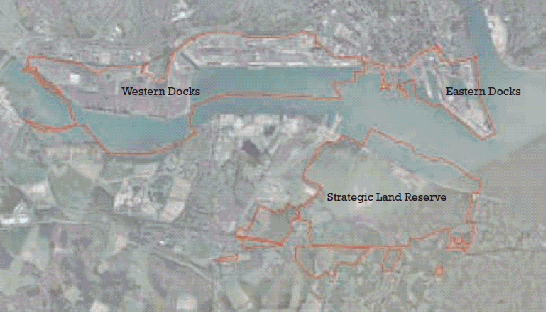
2.3. ABP landholdings comprises three main areas (see map below):
(i) Eastern Docks - approximately 170 acres - in port use;
(ii) Western Docks - approximately 585 acres - in port use;
(iii) Dibden reclaim - approximately 800 acres - reclaimed land which ABP owns for longer term port use.
2.4. The Eastern and Western Docks are located wholly within the City of Southampton's administrative boundary. The Dibden reclaim is located on the western side of Southampton Water, within the administrative boundary of New Forest District Council. It is outside, but adjoins, the New Forest National Park.
2.5. The Port of Southampton is important to the national, regional and local economy. It is a major international gateway into the UK, and handles some 20% by value, of UK trade with non EU countries. The Port employs approximately 12,000 people, and in 2007 its overall contribution to the local economy was estimated to be £2 billion. It is an important part of the Solent maritime economy, which is estimated to support 77,000 jobs, and is calculated to generate a total GDP of £5.5 billion.
2.6. The Dibden foreshore is a Special Protection Area (SPA), Ramsar site (wetland of international importance) and a Site of Special Scientific Interest (SSSI). The reclaim itself is also an SSSI. The Solent Maritime Special Area of Conservation is in the immediate vicinity and would be affected by any port development at Dibden Bay.
Map 1. Location Map
3. The Draft Port Master Plan
3.1. The Master Plan looks ahead to 2020 and 2030 and identifies the spatial changes necessary to meet ABP's trade demand forecasts. Those forecasts are based on Department for Transport (DfT) projections, but the full detailed supporting information has yet to be evaluated by the County Council.
3.2. ABP forecasts that by 2030 trade will substantially increase:
(i) a near doubling of cruise passengers to almost 2 million passengers per year;
(ii) a 60% increase in dry bulk volumes to almost 2.2 million tonnes per year;
(iii) a trebling of the number of containers handled to 4.2 million units per year; and
(iv) a 25% increase in liquid bulks to more than 35 million tonnes per year.
3.3. ABP anticipates that the port growth in the short to medium term can be accommodated within the Eastern and Western Docks through more intensive use of land already in port use, including the construction of multi-deck car compounds, re-commissioning berths for container use and the construction of additional container storage sheds, etc. However, it believes that between 2021 and 2027, outwards expansion of the port will be necessary onto the Dibden reclaim.
3.4. The Master Plan acknowledges that any future proposal to develop the Dibden reclaim for port use will need to address the requirements for new road and rail access to the site. The Master Plan also proposes a major increase in the proportion of freight moved by rail and coastal shipping to manage the increased volumes proposed through both the existing as well as any new facilities developed at the port.
4. Previous proposal for Dibden Bay
4.1. As recently as 2000, ABP unsuccessfully sought to develop a container terminal at Dibden Bay. A lengthy and thorough Public Inquiry took place in 2001/02 at which the County Council, along with New Forest District Council and others, objected to the proposal. The County Council's principal objections included:
(i) whether there was a genuine `need' for development on Dibden Bay;
(ii) the availability of alternatives to Dibden Bay, including planned expansion at other ports, and their ability to provide better solutions to meeting the predicted growth in UK trade;
(iii) nature conservation implications;
(iv) impact on the landscape; and
(v) impact on the New Forest.
4.2. The Secretary of State for Transport agreed with the Inspector that, in accordance with the relevant conservation legislation, the project could only be allowed to proceed for imperative reasons of overriding public interest, and that there were credible alternatives for container port development. Overall the Secretary of State agreed with the Inspector that the disadvantages of the scheme, as borne out by its impacts on internationally and nationally environmentally sensitive sites, outweighed the potential benefits.
4.3. For the 2002 Public Inquiry, a report on the local economic benefits of the proposed development was commissioned by the County Council and New Forest District Council from expert consultants. In the event of any new development proposal being lodged, this work would need to be revisited.
5. The County Council's interests
5.1. The Port of Southampton makes a major contribution to the regional and national economy, but has not benefitted in recent years from the level of investment in transport infrastructure which some other port areas have seen. The recent funding approval for the rail freight gauge upgrade is very welcome, but only came about through local lobbying leading to the submission of a bid to the DfT Transport Innovation Fund by the South East and West Midlands Regional Development Agencies (RDA). On this basis confidence is not high that Government funding for infrastructure would automatically come with any proposed development of the Port.
5.2. The future development of Southampton Port generally, and any development at Dibden Bay in particular, would have implications for the County Council as a highways and transport authority, and potentially as a minerals planning authority.
5.3. Department for Transport data up to 2008 show that national road traffic volumes for all motor vehicles has increased by 4.4% since the Public Inquiry finished in 2002. Considerable housing and employment space growth is envisaged in the South East Plan period (up to 2026), and by 2025 DfT forecasts that national road traffic volume in England will have increased by 32%. Furthermore, the South East region is expected to experience slightly higher than average road traffic growth (34%) to 2025. Therefore there will be considerable pressure on the area's highways even with no development at Dibden Bay.
5.4. When the potential development is taken into account, the following additional effects could be expected:
Road
(i) increased traffic congestion on A326 corridor between Dibden and M27 caused by additional Heavy Goods Vehicle (HGV) traffic and commuting by port workers; and increased traffic impacts on the communities surrounding the proposed new port area;
(ii) increased congestion on Highways Agency network due to additional HGV flows on strategic corridors: M27 between Junctions 2-4, M3 Junctions 9-14 and A34;
(iii) A34 already has high flows of HGVs (14%) and this would increase, possibly requiring investment in crawler lanes on steep gradients or overtaking bans;
(iv) possible need for further signalisation or free-flow off-slip at M27Junction 2;
(v) increased traffic congestion on A35 corridor between Totton and existing container port entrances caused by ABP trips between two port sites;
(vi) increased need for strategic lorry parking facilities (new or expanded) at Rownhams and Winchester motorway service areas and along A34 corridor.
Rail
(i) need for new rail terminal, additional track capacity and signalling improvements on Waterside line to allow intermodal container rail freight to run to and from Dibden;
(ii) need for rail gauge to be enhanced to W10 gauge between Redbridge and where Waterside line diverges;
(iii) need for additional passing loops or diversionary routes along the Southampton to West Midlands rail corridor, to ensure route can cope with additional container trains generated by the port.
5.5. If port development there was approved, the developers and the Government would need to fund an appropriate level of infrastructure to accommodate the increased traffic demand.
5.6. Port development at Dibden Bay would provide the opportunity for a wharf to handle aggregates imported from other counties or countries or dredged from the seabed. Such aggregates could reduce the need for mineral extraction within Hampshire and could replace less conveniently sited wharves elsewhere on the Hampshire coast. An assessment of the need for aggregate wharves has been carried out for the partial review of the Hampshire Minerals and Waste Core Strategy in line with Policy M5 in the South East Plan. The assessment concludes that, although there is no need for an aggregate wharf at Dibden Bay for the period to 2026, though land should be safeguarded for this purpose in the event that a port is developed.
5.7. In addition to these specific statutory responsibilities, the County Council (like all local authorities) has a general power to promote the economic, social and environmental well-being of its area.
5.8. It is the impact of port development on the social and environmental well-being of the Waterside that will generate most local interest. These dimensions are assessed in section 7 of this report, which looks at the impact of such development.
5.9. Since the County Council last considered the question of port development at Dibden Bay, the wider context and the Council's role have both changed. At that time, the County Council was the strategic planning authority for the area and the Hampshire County Structure Plan was the strategic plan against which the proposal had to be assessed. Since then, the strategic planning authority role has been transferred to regional level while the Structure Plan has been superseded by the South East Plan.
6. Planning Policy Context
6.1. The South East Plan states that the major ports should give priority to the preparation of port master plans as a means of identifying future infrastructure requirements. It recognises the Port of Southampton as a major international deep-sea port with significant global and economic importance and advises that its infrastructure and development needs, both short and long term, require further consideration. However, Dibden Bay is not specifically referred to in either the region-wide or South Hampshire sub-regional sections.
6.2. At the Local Development Framework (LDF) level, the Inspector's Report on the Examination into the New Forest District Outside the National Park Core Strategy Development Plan Document (an important element of the New Forest District Council LDF) has recently been published. In relation to Dibden Bay the Inspector has recommended that the LDF text be changed to acknowledge the importance of the Port of Southampton and recognise that Dibden Bay is the only land capable of accommodating significant expansion of the port. However, because of the environmental designations, any future expansion would need to satisfy the requirements of the Habitats Regulations.
6.3. The Inspector goes on to say that "as the resulting text does not represent a specific policy, it is not necessary for soundness reasons that Dibden Bay should be identified by a particular notation on the Core Strategy's Key Diagram." For information the full text recommended by the Inspector is included in Appendix 1.
6.4. The South East England Partnership Board will now have the task of assessing port proposals in relation to the strategic plan and commenting more generally from a strategic planning point of view. Meanwhile, any planning application would be decided by the new IPC now being established by Government. The IPC will have the authority to grant approval for nationally significant infrastructure proposals without reference to Ministers, including major port development proposals such as that envisaged by ABP at Dibden Bay.
7. Port development at Dibden Bay
7.1. Development at Dibden Bay would have significant impacts and raise important issues that will need to be taken into consideration by the County Council and help inform its position. These include:
(i) development at Dibden would further enhance the Port's international maritime gateway role, and bring a substantial injection of capital into the local and regional economy;
(ii) investment in infrastructure upgrades in the immediate area, eg rail and A326;
(iii) opportunity to safeguard an aggregates wharf should the need be identified;
(iv) new jobs in both the construction and operation of the new port, plus further jobs in local businesses associated with port operation, with consequential benefits to the Hampshire economy. ABP is also likely to argue that, were the development not to proceed, existing port business would be lost to other UK ports, with consequent impact on the economic health of South Hampshire and the wider county;
(v) development at the port will help improve the region's economic performance and assist in delivering important aims and objectives of the South East Plan. It would also help achieve the South East Plan strategy and objectives for economic growth in South Hampshire;
(vi) local transport impacts, with increased heavy goods vehicle movements in the Waterside area, with associated noise, congestion and air pollution;
(vii) significant environmental impacts on designated sites of international and national importance for nature conservation (listed in paragraph 2.6.);
(viii) impact on the amenity of local communities through noise disturbance and visual impact, during both the construction and operational phases of development;
(ix) landscape and environmental impacts on the adjacent New Forest National Park and nearby Waterside communities;
(x) development could increase the demand for storage facilities for both containers and cars outside the Port, where storage is likely to be cheaper for companies importing and exporting goods. The demand for storage puts pressure on land use in the locality, particularly employment sites in the Waterside area where significant areas of land are currently given over to storage facilities;
(xi) impacts on the wider transport system and capacity of the strategic route network within Hampshire and beyond, including the M27/M3, the A34 and the rail network north of Southampton. Given the role of the port as an international gateway to the UK, the strategic transport requirements to support it should be recognised as a national issue for Government action and support and not be left solely to local or regional funding.
8. Towards a County Council response
8.1. The Port Master Plan is an indication of the port operator's aspirations for further development, but is no more than that. It has no statutory planning status in itself, although it will no doubt be used by ABP in seeking to influence statutory planning decisions.
8.2. In this respect it is regrettable that the underlying assumptions and technical data were not published alongside the Master Plan to allow full scrutiny of the proposed development. As such the need for the development remains unproven to the County Council.
8.3. Potentially of far greater significance will be the Government's NPS on ports, which is due to be published this autumn for public consultation. That will be part of a suite of such Statements covering all types of nationally significant infrastructure, which will in turn guide decisions by the IPC. Whether the NPS will provide guidance in terms of preferred locations to accommodate national expansion of port capacity however remains to be seen.
8.4. The implication of this is that the NPS is technically the more important document and therefore the County Council will also need to give this close attention. Whereas consultation on the draft Port Master Plan ends on 13 November 2009, consultation on the draft NPS is likely to begin this autumn and close towards the end of 2009 or early 2010. So, whilst the Council will want to comment on the draft Master Plan, it has a longer period in which to formulate its response to the statutory planning framework (ie the NPS). In this context it is perhaps regrettable that the Master Plan has preceded the NPS, and it would be reasonable to expect the final version to await publication of the draft NPS.
8.5. On 17 September the County Council unanimously passed a motion asking the Secretary of State for Environment, Food and Rural Affairs to use his powers to incorporate the Dibden Bay area into the New Forest National Park. The motion went on to say that "the County Council believes that the need for the [proposed Dibden Bay] development does not outweigh the environmental consequences." This resolution is attached as Appendix 2 of the report.
8.6. It is proposed that the County Council's response - based on the above with any amendments agreed by this Cabinet meeting - be signed off by the Leader for submission to ABP.
9. Recommendations
9.1. That the County Council re-affirm its objection to the proposed development of Port Facilities at Dibden Bay on the basis that the need for the development has not been demonstrated, and therefore there is no case to set aside the adverse environmental impacts of the development, as confirmed by the Secretary of State in 2002.
9.2. That the County Council objects to the Master Plan proposals on transport on the basis that there is inadequate consideration of the likely transport impacts of significantly increased throughput at the Port, and inadequate consideration of new transport infrastructure to address such impacts.
9.3. That the County Council will monitor the use and demand for port facilities, and the transport situation, to ensure that its position remains up-to-date.
CORPORATE OR LEGAL INFORMATION:
Links to the Corporate Strategy
This proposal does not link to the Corporate Strategy but, nevertheless, requires a decision because: Responding to this consultation allows the County Council to make clear its position on an issue of environmental and economic significance to Hampshire. |
Section 100 D - Local Government Act 1972 - background documents | |
The following documents discuss facts or matters on which this report, or an important part of it, is based and have been relied upon to a material extent in the preparation of this report. (NB: the list excludes published works and any documents which disclose exempt or confidential information as defined in the Act.) | |
Document |
Location |
IMPACT ASSESSMENTS:
1. Equalities Impact Assessment:
1.1. Not applicable.
2. Impact on Crime and Disorder:
2.1. Not applicable.
3. Climate Change:
a) How does what is being proposed impact on our carbon footprint / energy consumption?
The Master Plan commits the Port to a range of measures to reduce emissions and energy use, to contribute to a reduction in the carbon footprint of the Port, including a new agreement with Utilicom to supply heat and power, which will reduce the overall carbon footprint of the Port by some 30%. However it also acknowledges that a number of these initiatives will only be partially successful in the short term due to the varying compatibility of visiting ships in respect of utilising port supplied electricity for example. With recent evidence of concerns over maritime emissions, the increase in shipping movements, as well as the likely increased transport movements associated with an expanded port activity there is likely to be an increase in the carbon footprint of the Port and in emissions on the strategic transport routes into Hampshire.
b) How does what is being proposed consider the need to adapt to climate change, and be resilient to its longer term impacts?
The Master Plan identifies the opportunities that new Port development brings to address flood defence and estuary management, which will contribute to the resilience of the Port of Southampton and the upper reaches of Southampton water.
New Forest Core Strategy: Dibden Bay replacement text
"National policy and the Regional Spatial Strategy recognise the Port of Southampton as a major international deep sea gateway port with significant global and economic importance. The reclaimed land known as Dibden Bay is the only area of land which is physically capable of accommodating significant expansion of the port. However, the land at Dibden Bay is a Site of Special Scientific Interest (SSSI) and adjoins the New Forest National Park. The foreshore is of international importance, being designated as a Special Protection Area (SPA) and Ramsar site, as well as an SSSI. In 2004 the Secretary of State rejected previous proposals for port development at Dibden Bay principally because of its environmental impacts. Whilst there may be a strong economic case for the physical expansion of the Port of Southampton, any future expansion would, amongst other considerations, need to satisfy the requirements of the Habitats Regulations. In particular, the applicant would need to demonstrate either that the proposals would have no adverse impact on the integrity of the international designations; or, if there is an adverse impact, that the alternative put forward for approval is the least damaging (regardless of economic considerations), that no other feasible alternative exists that would not affect the integrity of the site, and that there are imperative reasons of overriding public interest. Adequate compensation would also be required."
Hampshire County Council Resolution re Dibden Bay - 17 September 2009
"This Council recognises the significant contribution of Totton and the Waterside to the economy of Southern Hampshire, in particular through two power stations, a major refinery, its satellite industries, an Energy from Waste plant catering for a third of Hampshire's capacity, a Military Port, a hazardous waste disposal plant and a new marine industrial park.
The Waterside also contributes to the Hampshire ecology and wider environment including part of the New Forest National Park. It contains an internationally protected RAMSAR and SPA foreshore and Site of Special Scientific Interest as well as a Site of Importance for Nature Conservation at Dibden Bay.
Whilst it is clear that the Secretary of State may grant permission for development within a National Park boundary if there is a proven national need for the development, nevertheless the County Council believes that the need for this development does not outweigh the environmental consequences.
Given the nature of the County Council's previous objections to the proposed Dibden Terminal, and having regard to the Secretary of State's decision refusing the proposal on nature conservation grounds, the Council would not be prepared to alter its position on the basis of current circumstances. The Council will continue to monitor the use and demand for port facilities to ensure that its position remains relevant and up-to-date later in the next decade when the need for additional facilities needs to be considered. As Highways Authority, the County Council will also have particular regard to the transport implications of future development on the highway network. In the event that the port develops as envisaged in the Master Plan, substantial upgrading of transport infrastructure would be required.
As Hampshire County Council supported the inclusion of Dibden Bay within the original proposed New Forest National Park boundary and the Government's advisors on boundary delineation the Countryside Commission (now Natural England) similarly proposed that Dibden Bay should be included in the New Forest National Park boundary, this Council requests the Secretary of State Hilary Benn, Huw Irranca-Davies, Defra and Natural England, using powers under the Wildlife and Countryside Act 1981, to include Dibden Bay within the New Forest National Park as originally proposed without further delay."