
Archived decisions
HAMPSHIRE COUNTY COUNCIL
Decision Report
Decision Maker: |
Cabinet | ||||
Date of Decision: |
26 October 2009 | ||||
Decision Title: |
Interim arrangements to support the Councillor Call for Action - draft protocol. | ||||
Decision Reference: |
956 | ||||
Report From: |
Chief Executive | ||||
Contact name: |
Denise Holden | ||||
Tel: |
01962 847338 |
Email: |
|||
Executive Summary
1. The purpose of this report is to provide the Cabinet with information and guidance about the `Councillor Call for Action' (CCfA). This process enables County Councillors to raise a local government matter with the relevant Select Committee. It was introduced in the Local Government and Public Involvement in Health Act 2007 (LGPIH Act) and came into effect in April 2009. It does not affect the existing decision making responsibilities and management arrangements of the County Council or partner authorities.
2. A complementary process for raising a CCfA was introduced in the Police and Justice Act 2006 at the same time, enabling local authorities to scrutinise and review local Crime and Disorder Partnerships in relation to crime and disorder and community safety matters.
3. National Guidance has been published setting out best practice in relation to the CCfA and matters that would be considered exempt under these arrangements. Local arrangements to support Members wishing to raise a CCfA, and the criteria that would guide any Select Committee in responding to such a referral are attached in the draft protocol at Appendix One.
4. The CCfA supports the community leadership role of County Councillors in improving services for local people. From the perspective of the County Council the CCfA is not a new way of working in as much as it simply formalises the existing routes through which individual Members can raise issues with lead officers and Executive Members. It does however introduce a mechanism through which local issues that relate to partners authorities and LAA targets may be addressed and if appropriate subject to local authority scrutiny.
5. The Health Overview and Scrutiny Committee (HOSC) is already required to consider referrals similar to the CCfA. Two examples where an issue raised by a Councillor has resulted in wider improvements to services in Hampshire are:
· The inconsistency in the provision of continence pads: further to a referral from a member of the HOSC this matter was raised with the NHS. It transpired that differing policies existed in different areas of the county, based on former PCT boundaries. In some areas frontline staff were interpreting old policies too literally, effectively limiting access to continence pads for some patients. The policy was subsequently up-dated and clarified to ensure that supplies were provided according to need.
· End of Life Care: this matter was raised with the HOSC by the Executive member for Adult Services. As a result a wide ranging review took place and a series of recommendations were made. This resulted in improved access to equipment, stronger partnership working and investment in training staff. Joint working across health and social care is continuing and regular reports on progress are provided to the HOSC.
Legislative context
6. The principal national policy driver behind the CCfA is the LGPIH Act. This is a wide-ranging piece of legislation that affects many aspects of local authorities' governance, powers and partnership arrangements as well as the new provisions for patient and public involvement in health and social care. This Act picks up key elements of the Strong and Prosperous Communities White Paper which was published in summer 2006.
7. A number of elements of the Act do not confer specific powers or responsibilities but depend on Regulations or Statutory Guidance from the Secretary of State. These are still emerging.
8. The Police and Justice Act 2006 is a related piece of legislation, part of which makes amendments to the Crime and Disorder Act 1998, and adds to local government legislation in this area. Home Office Guidance relating to the scrutiny of crime and disorder issues and the operation of the associated CCfA was published in May 2009.
9. The draft protocol included at Annexe One includes:
· A brief introduction to the CCfA
· The limits of the CCfA
· Raising a CCfA
· Managing a CCfA referral
· Details of partner authorities as defined in the LGPIH Act
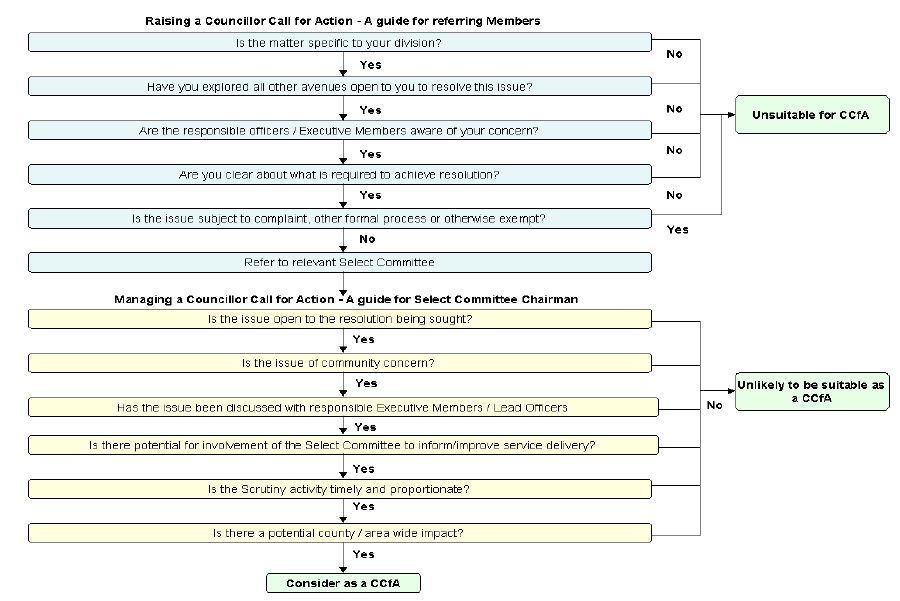
· A flow chart to guide County Councillors considering a CCfA
Risks of not having the CCfA in place
10. Unless action is taken now to agree the protocol Members may not be aware of the CCfA or how it will be managed by Hampshire County Council. There needs to be clarity about the responsibilities of both the referring Councillor and the Select Committee as well as what can and cannot be considered in this process. Arrangements should be able to allow genuine CCfAs to be dealt with fairly and openly and vexatious or unreasonable referrals to be managed appropriately. This is a process that needs to be managed proactively, not in the middle of a contentious or high profile dispute.
11. Inconsistency in the way in which referrals are dealt with may have reputation management implications with the potential for legal challenge.
Action required in relation to the CCfA
12. Protocols supporting the work of the Cabinet and Select Committees as set out in the County Council Constitution have been adjusted to ensure that these are consistent with the new requirements. In order to comply with the legislation Paragraph 1.9 of the Policy Review Rules of Procedure has been adapted to extend to all members the right to refer a matter to the relevant Select Committee.
13. A draft protocol for managing the CCfA is set out at Annexe One for consideration by Cabinet. The Policy and Resources Select Committee has seen and commented on the draft protocol. When Cabinet is content with the suggested arrangements the protocol will be circulated widely across the County Council and to partner authorities for information and feedback.
14. The protocol will be regularly reviewed to take account of relevant emerging legislation. The Policy and Resources Select Committee will review the protocol after six months to ensure that it is functioning as intended, both in terms of the support provided to a County Councillor wishing to make a referral and the Select Committees in responding to any such referral.
15. Members considering raising a CCfA about a local matter will be expected to demonstrate that they have explored fully all options open to them in raising the issues with the responsible lead officers, Executive Member or partner authorities.
16. The implications for the Departments and partner authorities in responding to a potential CCfA must also be well understood and effectively communicated in order to facilitate early resolution of issues of concern raised by local Members. Some training support may be required.
Financial Implications
17. At this point it is not possible to predict the extent to which the CCfA will be used by Members. There may be resource implications in terms of the Business Advice and Member Support team and Departmental officer time.
Conclusion
18. The CCfA strengthens and formalises the arrangements already in place across Hampshire County Council to allow Members to raise issues of concern to existing Select Committees. The Health Overview and Scrutiny Committee (HOSC) already has provision for other local authorities and public sector partners to make referrals to the Committee. This has not resulted in a multitude of referrals and the majority of issues raised in this way have been dealt with through signposting for local resolution. Where the HOSC has taken action in relation to the referral this has resulted in tangible service improvement.
19. Hampshire County Council Select Committees have agreed criteria for informing the in-depth scrutiny reviews that are undertaken and managing referrals from Local Involvement Networks (LINks). These provide a sensible basis for ensuring that CCfA's that are referred to the Select Committees are dealt with promptly and communicated effectively.
20. Arrangements for the CCfA and associated constitutional changes are relatively straight forward. A CCfA can only be raised by a County Councillor when other routes for addressing an issue of local concern have been exhausted. It does not guarantee that the issue will be resolved or a decision changed.
21. The CCfA is distinct from other mechanisms for raising issues of concern with the County Council, such as petitions or District/Borough scrutiny of LAA performance which are in the process of being implemented through alternative regulations.
22. There are implications for Hampshire County Council and partner authoirties in terms of recognising and anticipating those issues that have the potential to be raised as a CCfA.
Recommendations
23. The protocol attached at Annexe One is approved.
24. The actions identified in paragraphs 12-16 of this report are initiated.
Annexe: Hampshire County Council CCfA: Draft Protocol
Introduction
1. The Councillor Call for Action (CCfA) was introduced by the Local Government and Public Involvement in Health (LGPIH) Act 2007 and came into effect in April 2009. It enables any County Councillor to raise a local government matter for consideration by the relevant Select Committee. It does not affect the existing decision making and management arrangements of the County Council or partner authorities.
2. A complementary process was introduced in the Police and Justice Act 2006 at the same time, providing local authorities with the power to respond to CCfAs relating to local crime and disorder matters, and to scrutinise and review local Crime and Disorder Partnerships in relation to crime and disorder and community safety matters.
3. The purpose of the CCfA is to help Councillors to address issues and problems on behalf of their residents. It is not simply a `scrutiny' process and the national Guidance produced to support the CCfA stresses its role in supporting front line Councillors. Its introduction sits alongside wider changes in local authorities, particularly in the arena of partnership working. This includes the extended powers of overview and scrutiny in relation to partner authorities, the introduction of petitions and setting up of joint committees, the regulations for which are yet to be announced.
4. The Guidance is clear that `processes and procedures are necessary to ensure that the CCfA is targeted and relevant, and that it occupies a central role in improving services, but these should not be too prescriptive'. This protocol therefore sets out key points for any Member considering making a CCfA and the criteria that will inform the response of the Select Committee to any such referral. Emphasis is placed on the early resolution and effective communication of any concern raised in this way regardless of whether it becomes a `formal' CCfA. These arrangements will need to be reviewed as further regulations relating to partnership working are published.
Scope of the CCfA
5. Consideration of the CCfA by Select Committees will take place only after all other avenues for taking action have been exhausted. Executive Members, lead officers and partner authorities will need to be alerted to `potential' CCfAs by the Business Advice and Member Support team at the earliest opportunity.
6. County Councillors wishing to raise a CCfA will need to be aware of the options for addressing issues of local concern if problems are to be dealt with effectively.
7. The Council has amended the Constitution to make provision in its Constitution for any member of the Council to refer to a Select Committee a "local government' or `local crime and disorder' matter which falls within the Committee's remit that `affects all or part of the electoral area for which the Member is elected, or any person who lives or works in that area and is not an excluded matter'.
8. A `local government matter' means one which:
· Relates to a function of the authority, and
· Affects all or part of the member's division - or the people that live or work in it, and
· Is not an excluded matter e.g. a local licensing or planning decision.
9. The Guidance encourages consideration to be given to a broader interpretation of a `local government matter' and include delivery of agreed LAA targets by partner authorities. Details of the partner authorities as defined by the LGPIH Act are attached at Appendix One.
10. A `local crime and disorder' matter means one which concerns
· crime and disorder (including in particular forms of crime and disorder that involve anti-social behaviour or other behaviour adversely affecting the local environment), or
· the misuse of drugs, alcohol and other substances in that area which affects all or part of the electoral area for which the member is elected or any person who lives and works in that area.
11. A crime and disorder matter can only be scrutinised if it relates to the Crime and Disorder Reduction Partnership as a whole, not individual partner organisations.
Limits of the CCfA
12. Any matter that is considered to be vexatious, discriminatory or not reasonable is excluded from being considered as a CCfA. The definitions applied to this are the same as those used for the purposes of the Freedom of Information Act.
13. Other issues that would not be considered under a CCfA would be individual complaints, planning and licensing matters and `all other areas where a person has an alternative avenue to resolve an issue' (e.g. through the complaints/ appeals process).
14. The Guidance is clear that a CCfA is not guaranteed to solve a given problem. Members of the relevant Select Committee will determine how to respond to the CCfA taking account of feedback from responsible officers, Executive Members, Cabinet and partner authorities as appropriate. There is no appeal process.
15. The CCfA does not cut across the decision making and management arrangements of the County Council and is not a means for challenging Executive decisions. It does not give Members a `second bite of the cherry' where a `call in' or petition/deputation on the same matter has not been successful.
16. The following are also unlikely to be appropriate to raise as a CCFA
· Matters that have been subject to previous scrutiny or review in the last six months unless the referring Member is able to demonstrate a material change in the evidence or circumstances.
· Issues that are to be subject to scrutiny /review as part of a planned work programme, although there will be scope for the concern raised to inform the focus of the topic being scrutinised.
· Matters relating to partner authorities that are not subject to agreed LAA targets
Raising a CCfA Referral
17. The CCfA should relate to an issue in a Member's division. It is not an alternative to routine case work but a `long stop technique' to be used when other methods for addressing an issue have not succeeded'.
18. A Member can refer a matter even if it has not been raised by his/her constituents. There is no requirement in multi-member divisions for there to be agreement about raising a matter as a CCfA, although an indication that some level of discussion has taken place is likely to be helpful.
19. There are many options open to Members seeking to influence change including:
· Raising the matter direct with the responsible officers
· Approaching the responsible Executive Member /partner authority
· Informal discussion with officers or other Members
· Questions at Executive decision days
· Motions on the agenda at full Council
· `Call-in' of a decision
· Deputations/petitions
· Formal letters on behalf of constituents.
20. A flow chart setting out the options open to Members considering raising a CCfA is attached at Appendix Two.
21. Key questions to be addressed by a Member considering raising a CCfA include:
· Is this a matter specific to your division?
· Is the issue subject to complaint, other formal process or otherwise exempt?
· Have you explored all other avenues open to you to resolve the issue?
· Is the matter open to resolution and what would be required to achieve this? (e.g. additional resources, change in policy, service improvement)
Managing a CCfA referral
22. The HOSC and Safe and Healthy People Select Committee have arrangements in place to manage and report referrals from the Local Involvement Network (LINk) and other partners. Management of the CCfA will follow a similar same process i.e.
· The scrutiny officer, in conjunction with the relevant Select Committee Chairman will provide advice to any Member considering a CCfA
· The relevant Executive Member, lead officer and/or partner authority will be alerted to the issue and invited to respond to the referring Councillor.
· The Leader and Chief Executive will be informed of the CCfA and any action proposed
· The matter raised will be reported to the next meeting of the Select Committee together with any action required.
23. Each CCfA will be considered on its merits, taking into account the guiding questions set out in paragraph 21 and the criteria included at paragraphs 24 and 25 of this document.
24. In deciding how to respond the Select Committee should take into account action already initiated by the Member and may "have regard to" two particular points:
· The possibility of asking the Executive to consider delegating power to the local councillor to deal with a local matter (under another new provision in S.236 of the LGPIH Act, also introduced in April 2009)
· Representations made by the member as to why the Select Committee should take the matter up.
25. The Select Committee will need to consider if the CCfA is open to the resolution being sought by the referring Member. Additionally, based on the current arrangements for managing referrals from the LINk the criteria to be considered when responding to a CCfA will be:
· The issue is of significant concern to the community affected
· The scope for local action/resolution with the officers, responsible decision makers or lead agency has been exhausted
· Intervention by the Select Committee is proportionate to the matter being referred
· There is evidence that intervention by the Select Committee has the potential to inform/improve service delivery
· There is a potential county/area wide impact on local people
· Due process has not been followed in making a decision (e.g. duty to involve and consult has not been discharged)
· The issue is not exempt or subject to alternative statutory arrangements (e.g. licensing or planning matters)
26. In responding to a referral the Select Committee will be mindful that the County Council and partner authorities may have to make decisions that are difficult and that, even following extensive engagement/consultation it may not be possible to achieve consensus across all sections of the community affected.
27. Issues that are more effectively dealt with through other routes or subject to another statutory process (e.g. complaints procedures or planning/licensing issues) will be signposted accordingly.
28. If a Select Committee decides not to consider a CCfA referred to it the reasons for this need to be clearly set out and communicated to the referring Member.
29. If a Select Committee does decide to scrutinise an issue appropriate arrangements will need to be put in place to ensure that the Member that raised the CCfA is informed and/ or involved.
30. CCfA referrals relating to crime and disorder issues and community safety matters will be considered by with by the Safe and Healthy People Select Committee. Issues subject to scrutiny will only take place in relation to matters that affect the Crime and Disorder Reduction Partnership as a whole.
Relevant Partner Authorities List
Local Government and Public Involvement in Health Act 2007
(Section 121 - Information from partner authorities)
Relevant partner authorities
(Part 5, Chapter 1, Section 104 contains specific definitions)
· any district Council which is not a responsible local authority;
· a fire and rescue authority;
· a National Park authority;
· the Broads Authority;
· a police authority;
· a chief officer of police;
· a joint waste authority established under section 207(1);
· a waste disposal authority;
· a metropolitan County passenger transport authority;
· Transport for London;
· a Primary Care Trust;
· a Regional Development Agency;
· a local probation board;
· a youth offending team;
· a National Health Service trust;
· an NHS foundation trust;
· the Arts Council of England;
· the English Sports Council;
· the Environment Agency;
· the Health and Safety Executive;
· the Historic Buildings and Monuments Commission;
· the Learning and Skills Council for England;
· the Museums, Libraries and Archives Council;
· Natural England;
· the Secretary of State, but only in relation to certain functions as a highways authority, traffic authority and with regard to employment and training ( this is subject to clarification but is believed to refer to the Highways Agency and Jobcentre Plus)
The ability to require information from some of the "relevant partner authorities" is already covered in other legislation and so these are not included in the list above. These include:
· the responsible and co-operating authorities for Crime and Disorder, as defined in the Crime and Disorder Act 1998 (Police, Local Authority, Police Authority, Fire and Rescue Authorities, Local Health Boards in Wales, Primary Care Trusts (PCTs), Probation Board, Parish Councils, NHS Trusts, NHS Foundation Trusts, Governing bodies of schools, Proprietors of independent schools, Governing bodies of an institution within the further education sector1); and
· local NHS Bodies, as defined in the NHS Act 2006 at Section 244 (an NHS Body other than a Special Health Authority - the latter are national service providers such as the National Patient Safety Agency).
CORPORATE OR LEGAL INFORMATION:
Links to the Corporate Strategy
Hampshire safer and more secure for all: |
yes |
Corporate Business plan link number (if appropriate): | |
Maximising well-being: |
yes |
Corporate Business plan link number (if appropriate): | |
Enhancing our quality of place: |
yes |
Corporate Business plan link number (if appropriate): | |
Section 100 D - Local Government Act 1972 - background documents | |
The following documents discuss facts or matters on which this report, or an important part of it, is based and have been relied upon to a material extent in the preparation of this report. (NB: the list excludes published works and any documents which disclose exempt or confidential information as defined in the Act.) | |
Document |
Location |
IMPACT ASSESSMENTS:
1. Equalities Impact Assessment:
1.1.
2. Impact on Crime and Disorder:
2.1.
3. Climate Change:
a) How does what is being proposed impact on our carbon footprint / energy consumption? Not applicable
b) How does what is being proposed consider the need to adapt to climate change, and be resilient to its longer term impacts? Not applicable