Archived decisions
HAMPSHIRE COUNTY COUNCIL
Decision Report
Decision Maker: |
Cabinet | ||||
Date of Decision: |
26 October 2009 | ||||
Decision Title: |
Medium Term Financial and Efficiency Strategy 2009/10 to 2011/12 | ||||
Decision Reference: |
764 | ||||
Report From: |
County Treasurer | ||||
Contact name: |
Nick Gibbins | ||||
Tel: |
01962 847544 |
Email: |
|||
1. Executive Summary
1.1. The purpose of this report is to bring together the various elements of the County Council's medium term financial strategy within a single document incorporating the strategy for achieving efficiency savings. The report also contains details of the forecast cumulative efficiency savings indicator for 2008/09 and 2009/10, for approval.
1.2. A provisional budget and capital programme for the period 2009/10 to 2011/12 was agreed by the County Council in February, but it had been anticipated that a Spending Review would take place in the summer of 2009. This would have provided a firmer basis for financial planning in 2011/12 and onwards, beyond the period of the current three year grant settlement. The Spending Review has been deferred but nonetheless the County Council, for planning purposes needs to maintain and roll forward its medium term financial plans.
1.3. This report contains an updated strategy for 2009/10 to 2011/12 and proposals for provisional budget guidelines for 2012/13 in order to maintain a rolling three year financial plan.
1.4. The basis for this plan is more uncertain than in recent years, due to the global economic situation and the pending General Election, which have delayed a review of the Government's public expenditure plans, including details of proposed grants to local authorities beyond 2010/11.
1.5. The provisional cash limits for services set in February for 2010/11 and 2011/12 remain unchanged, despite the serious deterioration of the public finances and the anticipated cuts in local government spending and funding in 2011/12. Capping limits will be tight and government supported capital programmes are likely to be about half their present values.
1.6. Two major changes are proposed to the underlying assumptions:
· Cabinet will wish to reduce the projected council tax rise in 2011/12 from 3.8% to 1.9%
· Government grant will be reduced by 2% in cash terms in 2011/12 (compared with the previous assumption of a floor cash increase of 1.25%).
1.7. The effect of these two changes results in a budget gap of £15m. It is proposed that the gap will be eliminated by setting a corporate efficiency savings target of £15m. The Efficiency Panel will agree and bring forward proposals to achieve cash savings of this amount, which will be deducted from the relevant cash limits in 2011/12, without a direct impact upon the delivery of front line services. The areas being targeted are pay costs, procurement savings, increased income and general housekeeping and other efficiency savings.
1.8. Progress will be reported regularly to Cabinet, but the provisional budget guidelines for 2011/12 will be set on the basis that the full year recurring savings of £15m will be achieved. Certainty on cash limits for two years will give Executive Members flexibility and time to plan for the much tighter cash limits expected from 2011/12.
2. Contextual information
2.1. Attached as Appendix 1 to this report is a medium-term financial strategy for approval by the Cabinet. The main elements of the strategy relating to 2009/10 and 2010/11 were approved by the Cabinet in February 2009 at the time of the approval of the 2009/10 budget. The Chancellor of the Exchequer's 2009 Budget envisages a sharper slowdown in public spending after 2011/12 than previously envisaged. However the Government has confirmed its intention of holding to the planned final year of the three year local authority grant settlement for 2010/11, originally announced in December 2007. The County Council is continuing to plan its budget for 2010/11 within the same spending and taxation assumptions, though the proposed Corporate Efficiency Strategy will be seeking to make further efficiency savings in 2010/11 in advance of the start of the much more difficult period in budgetary terms likely to commence in 2011/12.
2.2. Prospects for public spending beyond 2011/12 have changed significantly over the last twelve months since the provisional budget guidelines for 2011/12 were initially set. At the time of the approval of the medium term financial strategy for 2008/09 to 2010/11 in October 2008, the effects of the banking crisis last autumn were difficult to forecast and this followed a period in which UK monetary policy had been largely framed in the context of concerns about increased inflationary pressures. In view of the changed economic landscape, this strategy reviews the previous assumptions underlying the 2011/12 provisional budget. It remains unclear how far the Government may clarify its spending plans and priorities beyond 2010/11 in the Chancellor of the Exchequer's Pre Budget Report this Autumn, and therefore whether the assumptions in this report will need to be reviewed again later.
2.3. The Government's spending plans for the period beyond the present spending review period ending in 2010/11 have been set at an aggregate level and have become progressively tighter over the last twelve months. There are two main measures that have been included in the relevant reports - one looking at the overall increase in current spending in real terms and the other at the overall support for public sector capital investment expressed in terms of the proportion of gross domestic product (GDP). The table below summarises the progression of the measures since the March 2008 budget.
Table 1 - Government spending after 2011/12 | |||
Budget 2008 - March 2008 |
2008 Pre Budget report - November 2008 |
Budget 2009 - April 2009 | |
Current spending growth in real terms (%) per annum |
1.9 (2011/12 to 2012/13) |
1.2 (2011/12 to 2013/14) |
0.7 (2011/12 to 2013/14) |
Public sector net investment (as % of GDP) |
2.25 (2008/09 onward) |
1.8 (2013/14) |
1.25 (2013/14) |
2.4. In relation to current spending, the 2009 budget still indicates a small increase (0.7%) in real terms over the period 2011/12 to 2013/14, although this is only about one third of the level envisaged in the 2008 Budget. However the prospects for cash limited public expenditure, controlled within departmental expenditure limits, is likely to be substantially more constrained than the overall growth in real terms in current spending. Higher government borrowing and increased social security and tax credit payments as a result of the recession, suggests that spending on both debt interest and social security benefit is expected to increase by a lot more than 0.7% in real terms. The Institute of Fiscal Studies have projected that an annual reduction of 2.3% in real terms would be required in departmental expenditure limits, to keep within the overall 0.7% increase. If priority continues to be given to international development, health, education, law and order and defence, whether by excluding these programmes from having to make any real terms reductions or by requiring smaller reductions than in other programmes, the impact for other programmes is that reductions required will be significantly higher than 2.3% in real terms. With the possible exception of direct grants to schools (and that now seems more doubtful given recent pronouncements by the Secretary of State of possible savings) it is unlikely that Government grants to local authorities will be a priority area.
2.5. Support for capital investment tends to be more volatile than current spending and the Government has sought to bring forward support for capital investment in 2009/10, as part of the fiscal stimulus. Public sector net investment is planned to increase from 2.1% of GDP in 2007/08 to 3.1% in 2009/10 and then decline progressively to 1.25% in 2013/14. Though this represents a sharp decline from current levels, it nonetheless represents a similar level to that of 2001/02 before the 2002 spending review and is higher than in the period 1996/97 to 2000/01, when it never exceeded 1% of GDP.
2.6. The main impact upon the County Council's medium term financial planning of the state of the public finances relates to the level of Government grant, grant and borrowing support in respect of capital investment and government policy relating to the exercise of council tax capping powers. The effect on local taxpayers is also a critical element in making decisions on council tax levels, irrespective of the guidance on council tax capping.
3. Government grant
3.1. The current three year grant settlement covers the period up to 2010/11, so that unless there is a change in Government policy, existing grant assumptions for 2010/11 should remain unchanged. Reductions have occurred in some specific grants previously announced as a result of Government reprioritisation of programmes in the recession eg growth point funding for the Partnership for Urban South Hampshire has been reduced.
3.2. The County Council's current provisional budget for 2011/12 assumes that formula grant will increase by 1.25%, reflecting an assumption that the current trend in the grant increase for floor authorities would continue, as set out below:
Table 2 - Government floor grant increase for the County Council | |
% | |
2008/09 Settlement |
2.0 |
2009/10 Settlement |
1.75 |
2010/11 Provisional settlement |
1.5 |
2011/12 Forecast |
1.25 |
(It was also assumed that area based and specific grants would increase on average by 1.25%.)
3.3. The 2011/12 grant increase assumption no longer seems realistic for a floor authority, which would expect to receive a below average increase in grant, given the deterioration in the prospects for public spending outlined in Table 1 above. A more realistic assumption would be that for upper tier local authorities generally grant might be frozen in 2011/12 in cash terms at the 2010/11 level, and that floor authorities could expect a reduction of 2%, or 4% in real terms given the Government's 2% inflation target.
3.4. The County Council's position as a floor authority in relation to formula grant would not necessarily result in below average increases (or bigger reductions) in area based grant and non-schools specific grants, though allocations might be influenced by similar policy priorities. It is however also possible that the focus for reductions in government grant might be targeted more at area based grant/non-schools specific grants than at formula grant, which might be presented as being core funding. The proposal is to assume a 2% cash reduction in area based and non-schools specific grants in 2011/12, in line with formula grant council tax.
3.5. Currently formula grant only finances 22% of the County Council's budget requirement, with the balance of 78% being funded from council tax. This reflects the changes made to the funding of schools in 2006/07, which involved the majority of upper tier authorities' formula grant being transferred into the new Dedicated Schools Grant with no corresponding changes to the balance of funding for other authorities. It is possible that there might be some rebalancing of the funding of the budget requirement between tiers of authority in the next grant settlement, which would result in district council, police and fire authority council taxes increasing and county council council taxes reducing, but the Government has not indicated that it intends to implement this change. At this stage it is assumed that council tax will continue to finance the majority of the County Council's budget requirement.
3.6. The budget for 2009/10 and provisional budget for 2010/11 are formulated so as to limit the annual increase in council tax to 1.9%. This is possible partly as a result of the carry forward of one-off savings achieved primarily in 2007/08 and 2008/09. Although spending assumptions in 2011/12 are more restrictive than in 2009/10 and 2010/11, a 3.8% council tax increase is required in the provisional budget for 2011/12.
3.7. The Cabinet in considering the final accounts for 2008/09 and reviewing the initial 2009/10 budget monitoring report in September has identified savings of £2.5m in 2008/09 and further possible savings in capital financing costs of up to £2.9m in 2009/10. These savings could be utilised to reduce the council tax increase in 2011/12 to around 2.8%, while allowing a longer time scale to achieve longer term efficiency savings to replace one-off savings.
3.8. The proposals for setting revised budget guidelines for 2011/12 and initial budget guidelines for 2012/13 are based on the assumption that the County Council would not in the current economic climate want to increase council tax by more than 2% per annum during the period. This is in line with the Government's inflation target and would therefore represent a real terms freeze in council tax, despite increased real terms growth due to demographic pressures, especially on Adult Services, having to be met by giving priority to frontline services.
3.9. In addition to the Band D council tax set by the County Council, the other factors which determine the level of council tax income generated are the surplus/deficit on the collection fund and the annual change in the council tax taxbase. The assumptions made in the provisional budgets for 2010/11 and 2011/12 are that a collection fund surplus of £1.5m per annum will be achieved and that the taxbase itself increases by 0.4% per annum. Both assumptions are lower than assumed in the 2009/10 budget, when the collection fund surplus was £2.5m and the increase in the taxbase was 0.6%. The effect of the slowdown in the housing market could be expected to have some further impact in 2010/11 and 2011/12. At this stage however it is not proposed to alter the current assumptions, but to have regard to the potential risk in assessing the target level of the revenue account balance.
3.10. The impact of the various assumptions about spending and income is as follows:
Table 3 - 1% variation in main budget assumptions | |
£m | |
* 1% on pay |
1.8 |
* 1% on prices |
4.7 |
* 1% on short term interest rates |
1.0 |
* 1% on the budget |
6.6 |
* 1% on formula grant |
1.4 |
* 1% on council tax |
5.1 |
3.11. This shows that the key variables are changes in the assumptions made about council tax and price inflation (the consumer price index for services - the best general proxy for council services is still running at around 2%, despite retail price inflation being -1%. All measures of inflation are expected to pick up again by 2011/12 at around 2%)
4. Support for capital investment
4.1. The County Council's capital programme is made up of a programme of schemes which are determined by Government approvals, in the form of capital grant or supported borrowing and of a locally resourced programme supported by revenue contributions to capital and from general capital receipts. A decision was taken in October 2008 to set guidelines for the locally resourced capital programme for 2009/10 to 2011/12 on the basis of spreading the existing programme for 2009/10 and 2010/11 over three years. This effectively made the assumption that there would be no general capital receipts available to support a new locally resourced capital programme over this period, both as a result of much lower levels of anticipated capital receipts and the need to utilise any available general receipts to repay temporary prudential borrowing entered into to finance committed capital spending. It is too early to forecast with any confidence the extent to which there might be a recovery in the level of capital receipts from 2011/12 and it is proposed that the three year locally-resourced programme guidelines for 2010/11 to 2012/13 be set at the same levels as the current 2009/10 to 2011/12 capital programme.
4.2. The impact of reduced Government support for capital investment from 2011/12 on the County Council's capital programme is more difficult to assess, as approval levels are more volatile at individual authority level from year to year than for revenue spending. The future of the Building Schools for the Future programme is a critical factor. The impact of the split of government approvals between supported borrowing and capital grant also affects the County Council's financial position. For as long as the County Council is a floor authority for formula grant, reductions in supported borrowing have less impact on the County Council in the short-term as the approvals would in any case not have been taken up in full.
5. Efficiency strategy
5.1. The County Council is also developing a more strategic approach to its efficiency programme, following the decision taken by the Cabinet in October 2008 to develop a three year efficiency programme, including a programme of corporate reviews, together with the establishment of a corporate policy fund. Apart from where major corporate investment has been required for example in SAP and Hantsdirect, the main focus of the Council's efficiency arrangements previously has been primarily on providing incentives to services to achieve efficiency savings which can either be redeployed to meet budget pressures within the service or to meet part or all of any general savings target required within the budget strategy.
5.2. The Efficiency Panel considered a report on 22 September 2009 which recommended that the Efficiency Board develop a programme of both short-term and longer-term efficiency projects designed to achieve recurring efficiency savings of £15m per annum from 2011/12, and in addition achieve some initial savings from the implementation of short term savings in 2010/11. This efficiency programme would result in targeted reductions in service cash limits, rather than being available for redeployment with services, intended to represent the principal means by which the County Council would seek to accommodate the impact of the deterioration in the public finances, while protecting vital frontline services. Targets would be set for savings in 2010/11 and 2011/12 during this year's budget process arising from short term projects approved for implementation.
6. 2009/10 efficiency indicator
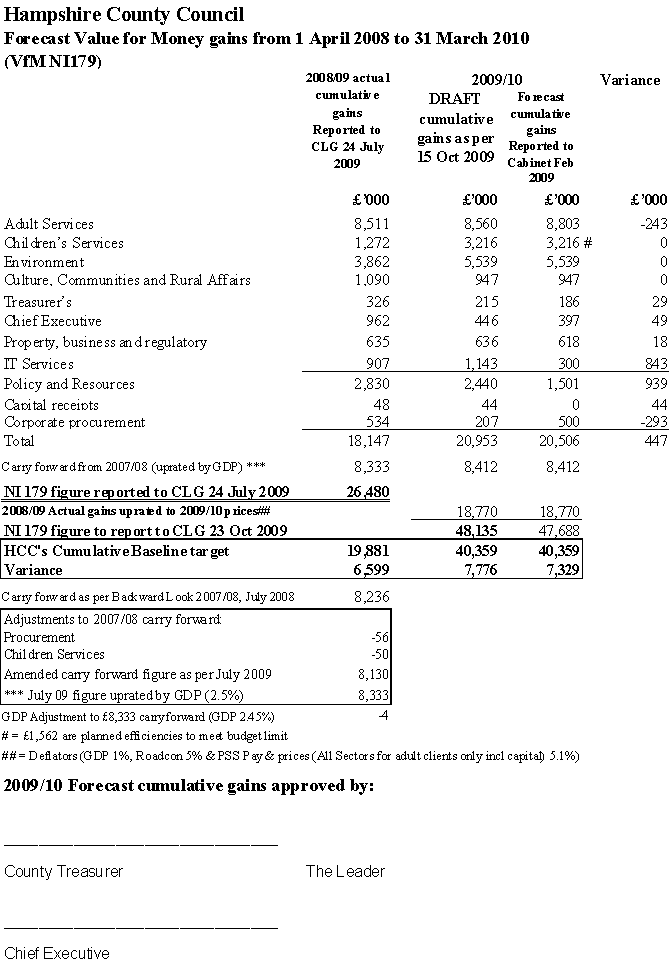
6.1. The County Council is required to publish its forecast of cumulative efficiency savings for the period from 1 April 2008 to 31 March 2010, in October 2009. Appendix 2 contains a summary of the position and the Leader, Chief Executive and County Treasurer are required to approve the proposed indictor data, which indicates that the County Council is expected to continue to meet the Government's target for the period, based on efficiency savings of 3% per annum, increasing to 4% per annum in 2010/11. Assessed gains in 2009/10 are £0.4m higher than initially estimated in the budget, and inclusive of the carry forward of £8.4m from 2007/08, the latest forecast indicates that the County Council will be £7.8m above target at 31 March 2010.
7. Cash limits for 2010/11, 2011/12 and 2012/13
7.1. As indicated in paragraph 5.1 above, some targeted efficiency savings will be reflected in the 2010/11 budget. These would include any savings that might be achieved in the form of lower pay and price increases, compared with the budgeted assumption of 1.5% for pay and 2.25% for average price increases. A saving of approximately £0.5m could be achieved by limiting the increased provision for pay to 1.3%, in recognition of the saving achieved in 2009/10 from a pay award costing approximately 1% rather than the 1.2% allowed in the budget.
7.2. The assumptions discussed in paragraphs 3.1 to 3.9 would require savings of approximately £15m to be achieved in 2011/12, as set out below.
Table 4 - Proposed efficiency savings target to reduce the 2011/12 council tax increase to 1.9% | |
£m | |
Reduction in council tax increase in provisional budget from 3.8% to 1.9% (savings in 2008/09 and 2009/10 could cover up to £5.4m on a one-off basis in 2011/12) |
10.0 |
Revision of grant increase assumption from 1.25% to -2% |
|
- formula grant |
5.0 |
15.0 | |
7.3. Chief Officers and Executive Members would be requested to review the implications of setting budgets for 2011/12 and 2012/13, to include targeted reductions for savings arising from the corporate efficiency programme.
7.4. The Cabinet will also need to consider both the form and timing of any public consultation on the budget options for 2011/12 and 2012/13, both of which are likely to be based on assumptions that have yet to be underpinned by any formal decisions on spending levels and priorities by the Government.
7.5. The Treasurer will continue to model the impact of different assumptions for 2011/12 and this can be refined after the 2010/11 budget has been set and the new Government's proposals for spending in 2011/12 become clearer in about a year's time.
8. Conclusion
8.1. The current medium term financial strategy for 2009/10 to 2011/12 and the prospects for 2012/13 contain assumptions which need significant revision in the light of the current prospects for the UK economy. A firm strategy for 2011/12 utilising a £15m efficiency savings target to reduce the proposed council tax rise to 1.9% is proposed assuming a 2% cash reduction in Government grant.
9. Recommendations
9.1. To agree the basis for setting provisional budget and capital programme guidelines for 2010/11 to 2012/13, including proposed corporate efficiency targets; subject to further consideration by the Cabinet in December 2009 following the grant settlement and Pre Budget Report.
9.2. To approve the proposed cumulative efficiency indicator for 2009/10 as set out in Appendix 2.
9.3. To approve the medium term financial strategy for 2009/10 to 2011/12, as set out in Appendix 1.
CORPORATE OR LEGAL INFORMATION:
Links to the Corporate Strategy
Hampshire safer and more secure for all: |
Yes |
Corporate Business plan link number (if appropriate): | |
Maximising well-being: |
Yes |
Corporate Business plan link number (if appropriate): | |
Enhancing our quality of place: |
Yes |
Corporate Business plan link number (if appropriate): | |
Section 100 D - Local Government Act 1972 - background documents | |
The following documents discuss facts or matters on which this report, or an important part of it, is based and have been relied upon to a material extent in the preparation of this report. (NB: the list excludes published works and any documents which disclose exempt or confidential information as defined in the Act.) | |
Document |
Location |
IMPACT ASSESSMENTS:
1. Equalities Impact Assessment:
1.1. Equality objectives are not considered to be adversely affected by the proposals in this report.
2. Impact on Crime and Disorder:
2.1. The proposals in this report are not considered to have any direct impact on the prevention of crime.
3. Climate Change:
a) How does what is being proposed impact on our carbon footprint / energy consumption?
No specific proposals
b) How does what is being proposed consider the need to adapt to climate change, and be resilient to its longer term impacts?
No specific proposals affecting adaptation to climate change
Medium Term Financial and Efficiency Strategy 2009/10 - 2011/12
1) Introduction
1.1. The County Council's medium term financial strategy brings together in a single document all the elements of the County Council's financial strategy for the next three years, including the proposed efficiency strategy .
1.2. The strategy incorporates
· the three year budget plan, comprising the 2009/10 budget and the provisional budget for 2010/11 and 2011/12
· the capital programme for 2009/10 to 2011/12, also included in the County Council's budget book
· a number of underpinning policy statements and strategies
- financial management policies
- treasury management and investment strategies, prudential and financial health indicators
- the capital strategy
2) Links to the corporate strategy
2.1. The central purpose of the County Council's medium term financial strategy is to promote the achievement of the objectives of the corporate strategy, within the context of the County Council's financial management policies. The resource allocation decisions within the strategy, which are reflected in the three year budget plan and capital programme are based on the factors highlighted in the financial context to the corporate strategy, the key priorities of the Corporate Improvement plan, the local area agreement themes and the financial management policies which determine the framework for the base budget, the starting point from which budget decisions are made. Annex 1 of this strategy highlights the links between the growth and redeployment proposals in the budget and the corporate strategy, as reflected in the report presented to the Cabinet in February 2009, at the time the three year budget plan was approved provisionally.
2.2. The Corporate Strategy set the overall direction for the Medium Term Financial Strategy and the budget. This strategy is closely linked to the Corporate Improvement Plan priority of increasing capacity to deliver, in particular with the priority of improving value for money. There is a two way relationship with the corporate improvement plan as the improvement priorities are set within the context of anticipated resource availability as well as the allocation of resources being linked to priorities in the improvement plan.
Partnership Working
2.3. The eight themes of the Local Area agreement 2008/11 (LAA) contains the priorities and targets underpinning the Sustainable Community Strategy. The LAA is the main focus at strategic level of the County Council's joint planning with its partners to improve the outcomes of the residents of Hampshire, both at officer level and through the Hampshire Senate. The themes and targets incorporated within the LAA reflect the joint planning within the various strategic partnerships, dealing for example with Children and Young people, Health and Wellbeing and Crime Reduction.
2.4 Partnership arrangements are also critical at operational level and require joint budgeting arrangements to be put in place to co-ordinate the financial plans of the partners. The implications of partnership co-ordination are taken into account in formulating service budget proposals within the framework of the three year budget plan and capital programme.
Financial context
2.5 The key elements to the financial context to the corporate strategy as they effect the period 2009/10 to 2011/12 are:
· the County Council's grant entitlement under the current formula is well below the grant floor which results in only the minimum increase in Government grant
· budget pressures which are caused by significant demographic and legislative issues
- an aging population and an increasing number of young people with complex disabilities living into adulthood and adding progressively to the demand for care
- waste disposal costs continuing to rise at above the level of inflation as a result of national policies to reduce reliance on landfill by increasing taxes in order to make more expensive alternatives competitive with landfill
- increased numbers of vulnerable children required to be looked after by the County Council, despite a declining child population
- the resolution of equal pay claims arising from the implementation of the County Council's new pay structure in April 2007
· the implications of the deterioration in the British economy
since the last Spending Review in 2007, with the likelihood of a period of reductions in public spending commencing in 2011/12
· the impact of major change programmes underway in the County Council
- the completion of the initial project to develop a contact centre (Hantsdirect) to deliver improved and more efficient call handling across all services
- the introduction of the Hampshire model as part of a long term strategy to transform adult social care services, based on the recommendations of the Hampshire Commission on Personalisation
· successful action being taken to address spending pressures, with a strong focus on review programmes to find better ways of doing things, and an established value for money strategy, which has delivered annual efficiency improvements in excess of the Government's targets
Financial management policies
2.6 Resource allocation decisions in the budget are also influenced by the financial management policies, which define the framework for setting the base budget, the starting point from which budget decisions are made. They are summarised in Annex 4. The core policies are designed to encourage services to maximise their sources of income and to contain cost increases. Key policies in this respect relate to :
· the cash-limiting of budgets based on the inflation assumptions approved in the previous year's budget, requiring any excess inflation to be absorbed from savings elsewhere in the budget.
· the assumption that fees and charges for services will be increased in line with the cost increases relevant to that particular service
· allowing for service cash limits to be adjusted upwards or downwards to reflect changes in the level of specific and area based grants.
2.7 The policies are subject to review in each budget cycle, and were as part of the consultation on the 2008/09 to 2010/11 Medium Term Financial Strategy last year subject to a wider officer consultation.
2.8 Annex 1 contains a summary of the growth and redeployment proposals in the 2009/10 to 2011/12 three year budget plan, showing how these are linked to the financial context of the corporate strategy, to the priorities of the Corporate Improvement Plan, the themes of the Local Area Agreement and to the Council's financial management policies.
3) The national context
3.1 The County Council's medium term financial strategy is set within the context of national economic and public expenditure plans, national priorities influencing the distribution of Government grant between local authorities and national legislation defining the scope for the County Council to raise income from council tax and to borrow.
National economic and public expenditure plans
3.2 The three year period of the current strategy covers 2009/10 to 2011/12. The first two years coincide with the final two years of the three year local authority grant settlement for 2008/09 to 2010/11, agreed in December 2007, following the 2007 Comprehensive Spending Review (CSR07). A further Spending Review was anticipated in 2009, covering the period to 2012/13, but as a result of the global financial crisis in the autumn of 2008 and the effects of the subsequent UK recession, the Government concluded that the economic position was too uncertain to be able to set firm spending plans for 2011/12 to 2012/13 at this stage. The Government has confirmed its intention to stick to the grant allocations for 2010/11 provisionally agreed in December 2007, though a general election has to be held at the latest by May 2010, which could result in a new Government revising 2010/11 grant allocations during the course of the year. Though it is possible that some changes could be made to the provisional grant settlement for 2010/11, the much greater uncertainty concerns 2011/12 and later years.
3.3 The provisional budget for 2011/12 approved by the County Council in February 2009 took account of the overall projections for growth in Government current spending contained in the 2008 Budget and 2009 pre-budget report, which provided the only guidance available on the Government's spending plans. Budget 2009, announced in April 2009, further scaled back the projected increase in current spending in real terms to 0.7% per annum and allowing for the impact of the recession on borrowing costs and on the cost of welfare benefits, the Institute of Fiscal Studies forecast reductions of at least 2.3% per annum in real terms for any programmes not given specific priority by the Government.
3.4 In the light of these projections, a revised set of assumptions about Government grant and the maximum acceptable level of council tax are proposed for 2011/12, assuming a reduction of 2% in government grant rather than an increase of 1.25% and that the increase in council tax is contained at the planned 2010/11 level of 1.9%. The effect of these assumptions is to require further efficiency savings of £15m to be achieved to balance the budget.
3.5 Capital approvals for 2009/10 and 2010/11 are also covered by the three year grant settlement. Because of the effect of the damping arrangements for formula grant on the mechanism for reflecting higher borrowing costs arising from the take up of supported borrowing on the level of formula grant payable, the provisional capital programmes for 2009/10 and 2010/11 assume that supported borrowing is not taken up in full. In order to limit the increase in the capital financing requirement to 2.5% per annum, supported borrowing of £8.7m and £7.7m respectively in 2009/10 and 2010/11 is not planned to be taken up. The impact of the squeeze on public spending expected to come into effect in 2011/12 is likely to be felt more severely on the level of capital approvals than current spending. Public sector not investment is expected to fall from its current high level of 3.1% of GDP in 2009/10 (reflecting the present fiscal stimulus) to 1.25% in 2013/14 and this is likely to impact particularly on government support for children's services and transport capital programmes.
3.6 The original efficiency targets for 2008/09 to 2010/11 set in CSR07 required local authorities to achieve cashable efficiency savings of 3% per annum, requiring cumulative savings of 9.3% to be achieved over the three year period. The 2009 Budget increased the 2010/11 target to 4%, increasing the cumulative three year target to 10.3%.
Local authority grant distribution
3.7 The three year grant settlement for 2008/09 to 2010/11 provided provisional grant allocations for a three year period. No grant allocations have yet been provisionally announced for 2011/12. Since the changes made to the grant distribution formulae in 2006/07, Hampshire County Council and a number of other South East county councils have been in a position where their grant entitlement under the formula is substantially below the minimum floor level set for damping purposes. The prospect for the County Council is therefore of receiving a minimum grant increase based on the floor increase for the foreseeable future, as long as the current formulae remain in place.
3.8 In 2009/10 the County Council is receiving the fourth highest level of damping protection (exceeded by Surrey, Buckinghamshire and Hertfordshire) and can therefore expect its funding position relative to other County Councils to deteriorate more than all but these other three County Councils. For the period 2009/10 to 2010/11, the County Council's formula grant increase is determined by the criteria for setting the floor for upper tier authorities with a tapering rate of grant increase of 1.75% in 2009/10 and 1.5% in 2010/11. The table below summarises the County Council's formula grant for 2009/10 and 2010/11 and illustrates the impact of the grant floor. The lower than average increase in the County Council's grant gradually moves the County Council's actual grant entitlement closer to the floor level.
2009/10 |
2010/11 | |||
Formula grant |
£m |
% of total |
£m |
% of total |
Formula entitlement |
120.2 |
83.0 |
126.1 |
85.9 |
Floor entitlement |
24.6 |
17.0 |
20.7 |
14.1 |
144.8 |
100.0 |
146.8 |
100.0 | |
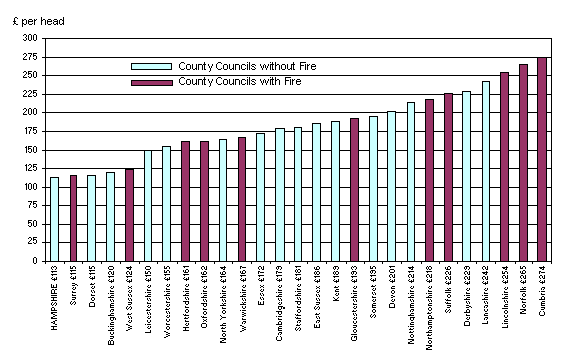
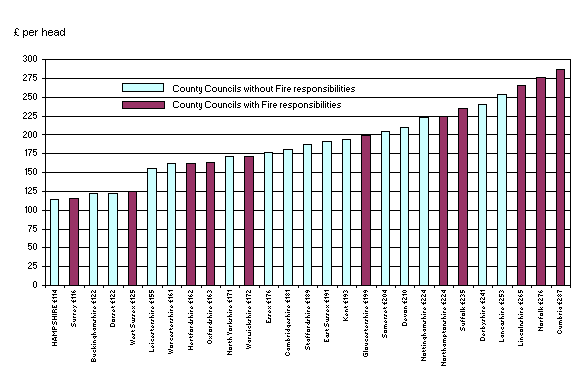
3.9 The graphs below illustrate the comparative position of the County Council relative to other county councils in 2009/10 and 2010/11. The County Council for the first time receives the lowest level of Government grant per head in 2009/10 amongst comparable counties, and yet still has more potential than any other County Council apart from Surrey, Buckinghamshire and Hertfordshire to see its relative funding position fall further after 2010/11 against other County Councils. This represents a very challenging Government funding position against which the County Council has had to develop its medium term financial strategy.
County Councils' Formula Grant 2009/10 per head - after floor damping
County Councils' Formula Grant increases 2009/10
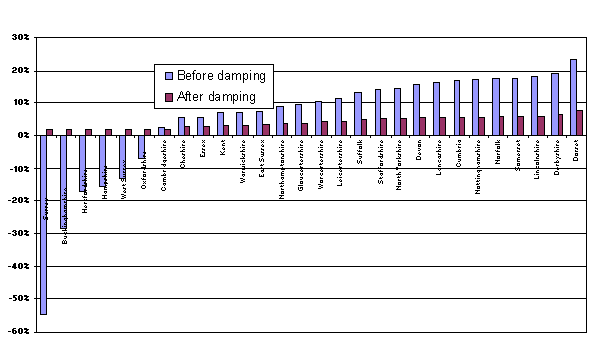
County councils' average: before floor damping +6.2%, after floor damping +4.16%.
County Councils' Formula Grant 2010/11 per head - after floor damping
 County Councils' Formula Grant increases 2010/11
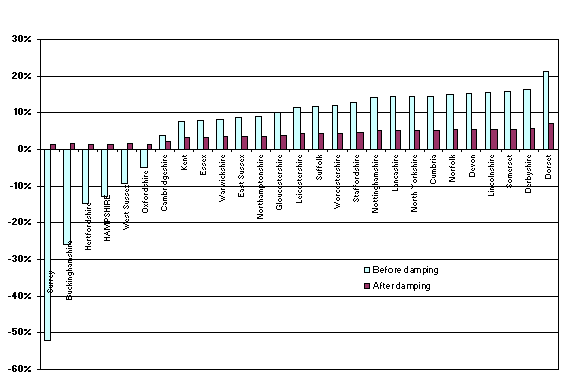
County councils' average: before floor damping +6.4%, after floor damping +4.0%
Council tax and borrowing
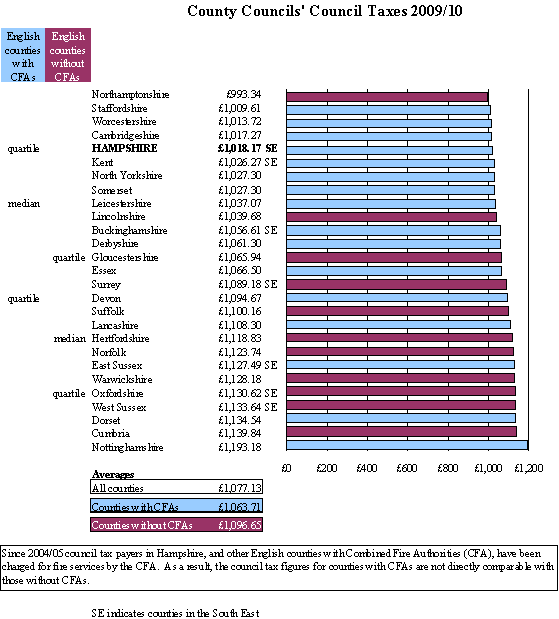
3.10 The Government abolished the practice of pre-announcing capping limits for local authority council tax as from 1999/00, (referred to as `crude and universal capping') but retained reserve powers in the 1999 Local Government Act both to cap the current year's council tax, requiring a rebilling; or to `nominate' the authority for possible capping in the following year. In recent years, although there has been no return to the formal pre-announcement of capping limits that were a feature of the pre-1999 system, the Secretary of State has given fairly clear indications of his intention on the use of the reserve capping powers before local authorities have set their budgets. For 2009/10 the Local Government Minister announced in December 2008 that the Government expected to see average council tax increases of substantially less than 5% and would use the reserve capping powers to deal with excessive increases. Hampshire's council tax increase of 1.9% in 2009/10 was the third lowest County Council increase and enabled the County Council to maintain its position of setting a Band D council tax in the lower quartile of comparable County Councils .
3.11 Part 1 of the Local Government Act 2003 introduced a new approach to the control of local authority borrowing to finance capital expenditure, replacing a system of Government borrowing approvals with the requirement to comply with a Code of Practice, the Prudential Code for Capital Finance in Local Authorities, designed to allow local authorities to determine their own capital investment plans, subject to them being affordable, prudent and sustainable. Government has continued to provide support through the grant system for implementing projects/programmes it has approved though this has been rendered ineffective by the extensive damping of formula grant since 2006/07. However local authorities are now able to incur additional unsupported borrowing subject to the requirements of the code and the County Council has established a policy on unsupported borrowing that has enabled the capital programme to be extended to support projects which will generate a financial return to the County Council either in the form of additional operating income or lower operational expenditure or in the form of capital income from land disposals and developer contributions.
3 Three year budget plan 2009/10 to 2011/12
3.1 The three year budget plan for 2009/10 to 2011/12 has been set within the context of the County Council's corporate strategy, outlined in Section 2 and of the national policies outlined in Section 3.
Provisional budget guidelines
3.2 Provisional budget guidelines for 2009/10 to 2011/12 were set in October 2008 in conjunction with the approval of the medium term financial strategy and were confirmed in December 2008 following confirmation by the government that it did not intend to alter the provisional grant allocations for 2009/10 announced twelve months earlier. The guidelines were initially based on an assumed council tax increase of 3% in 2009/10 and 2010/11 and on the assumption that the council tax base would increase by 0.5% per annum and that there would be an annual collection fund surplus of £1.5m. During the course of the budget process the inflation assumptions were lowered in response to the impact of the recession and some one-off and continuing savings were identified outside service cash limits, mainly in 2008/09. This enabled some additional mainly non-recurring spending to be approved and the council tax increase in 2009/10 and 2010/11 to be reduced to 1.9%.
3.3 The spending assumptions underpinning the three year budget plan for 2009/10 to 2011/12 can be summarised as follows:
· pay increases in 2009/10 and 2010/11 to average 1.5% and increases in prices to average 2.25%, together with provision for the phased increase in employer's pension contributions based on the 2007 actuarial review. For 2011/12 allowance was made for pay increases to average 2% and price increases of 2.5%
· that supported borrowing would not be taken up in full and that corporate support for new borrowing would be limited to a level consistent with a 2.5% increase in the capital financing requirement
· allowance was made for above inflation increases in adults and children's social care in all three years of the plan, in recognition of demographic and legislative pressures and to support the safety and security of vulnerable members of the community. The increases total to £7.9m in 2009/10 and £8.3m in 2010/11, but are reduced to a lower level of £3.4m, equivalent to a 1% increase in the budget in 2011/12
· additional contingency provision made for the anticipated impact of increased landfill tax, higher waste volumes, and inflation affecting the waste management contract
· for all other services, that any new service developments or increased service demands would have to be met by efficiency savings or from redeploying resources from lower priority services
· release of the grant equalisation reserve on a tapering basis over the period to 2016/17, as agreed in the previous Medium Term Financial Strategy. This policy provides support to the budget as reductions in damping grant take effect, but without creating a cliff edge.
3.4 Chief officers produced a detailed budget for 2009/10 and outline provisional budgets for 2010/11 and 2011/12 within these guidelines, for approval by Executive members, and then by Cabinet in February 2009.
3.5 Since the three year budget plan was agreed in February 2009, the 2009 Budget has taken place. While the Government has confirmed its commitment to the third year of the current three year grant settlement (2010/11), the previous assumptions relating to 2011/12 now look rather over optimistic. Assuming a potential reduction in government grant and 1.9% increase in council tax, the budget requirement for 2011/12 would need to be reduced by about £15m below its current planned level. The County Council is putting in place a corporate efficiency programme, which will be targeted with achieving efficiency savings of £15m in 2011/12 and on a continuing annual basis. This would enable cash limits to be reduced in 2011/12 but without any impact on the current planned level of services.
Partnerships
3.6 One of the key considerations in drawing up service budget proposals is the need to link the County Council's decisions on resource allocation with its responsibilities to operational partnerships, those partnerships where there is either a formal or informal pooling of budgets in seeking to secure agreed common priorities. These partnerships are numerous and affect the majority of services eg. Supporting People, Comprehensive Children's and Adolescent Mental Health Services Commissioning Trust, Integrated Mental Health and Substance Misuse Services, Safer Roads, Transport for South Hampshire, Partnership for Urban South Hampshire, Project Integra, Wessex Youth Offending Team, Integrated Community Equipment Service, Basingstoke Canal, Sir George Staunton Country Park and the South East Museums Hub. In some cases there are dedicated partnership funding streams, but in most instances partners are required to co-ordinate their decisions on budget contributions within the context of the authority's budget strategy.
Risk Management
3.7 The approach to risk management in formulating the three year budget was related to the corporate risk assessment process and adopted a number of different approaches to the management of those risks. The most significant of the financial risks, associated with equal pay claims, is being addressed by means of an earmarked reserve and subject to Government approval the impact may also be spread over up to 20 years by capitalisation. IT risks associated with business continuity are being addressed by establishing back up arrangements for critical systems. The financial impact of arson is addressed through the insurance reserve and by the allocation of resources arising from the risk assessment of the built estate. Other risks and uncertainties are addressed either by specific earmarked reserves, contingency provisions in the budget or as part of the risk assessment of general balances, carried out in conjunction with the S25 report to the Council on the robustness of the estimates in the budget and adequacy of financial reserves.
Efficiency Strategy
3.8 The Cabinet in October 2008 agreed a strategy for developing a three year efficiency programme. This involves a more corporate and strategic approach to the targeting and delivery of efficiency savings, designed to embed efficiency savings into the management of the Council. In addition to continuing to provide services with incentives to achieve efficiency savings that can be redeployed within service budgets the efficiency strategy involves the establishment of an Efficiency Panel and Efficiency Board to manage a corporate review programme to produce efficiency savings for utilisation within the Corporate Policy reserve.
3.9 The programme is designed to represent the principal means by which the County Council will seek to accommodate the impact of tighter restrictions on public spending, commencing from 2011/12, while protecting front line services. Targets will be set for savings in 2010/11 and 2011/12 during the 2010/11 budget process arising from the short term projects approved for implementation.
Alternative scenarios
3.10 The level of uncertainty associated with the assumptions in this three year budget plan is considerably greater than in the equivalent plan considered by the Cabinet past autumn. The medium term certainty about grant levels following the first three year grant settlement has been eroded by the deferral of the 2009 Spending Review which means that from 2010/11 local authorities may well be operating again within a one year planning horizon.
3.11 The sharp deterioration in the public finances and uncertainties about the length and depth of the recession creates a range of possible economic policy options within which to determine income and spending assumptions. Among the key issues are the future path for inflation, how soon and how severely public expenditure is constrained in order to redress the structural aspects of the public sector borrowing requirement, and government policy on council tax levels. The range of possible scenarios for the period 2011/12 onwards is quite wide.
3.12 The County Council's proposed provisional budget guidelines for 2011/12 assumes that the squeeze on public spending will start in 2011/12, either because there is sufficient evidence of recovery in activity levels in the private sector to reduce the fiscal stimulus or because of concerns about the impact of funding Government debt on long term interest rates. It also assumes that there will be a sustained period of public sector spending constraint rather than a short but more severe adjustment to spending levels. The principal means of addressing uncertainty is through the level of general balances, the risk assessment taking account of the level of risk associated with estimates in the budget. The table below summarises the impact upon spending on the level of council tax of some alternative scenarios, before allowing for the possible use of balances.
Impact on level of net expenditure or council tax requirement | |
£m | |
1% on pay |
1.8 |
1% on prices |
4.7 |
1% reduction in government grant |
1.4 |
Nil increase in tax base |
2.0 |
No collection fund surplus |
1.5 |
1% lower council tax increase |
5.1 |
3.13 The Council's policy is to set challenging but realistic budget assumptions, but risk assesses its general level of balances accordingly. However the degree of risk associated with spending, grant and efficiency assumptions in 2011/12 is untypical and further modelling work will be undertaken for 2011/12 after the budget for 2010/11 is set, subject to expected pronouncements on local government spending for 2011/12 after the general election.
3.14 The proposed three year budget increases are summarised in the table below. The increases quoted represent the underlying impact on the increase in the budget requirement made by each service, and are adjusted for transfers between services, capital/revenue transfers and the use of reserves and specific grants. There are nonetheless some significant variations in service spending increases between financial years. These reflect the impact of savings in the waste management contract ( Environment), one-off funding and invest to save repayments ( Children's Services and Environment), the timing of the County Council elections ( Policy and Resources) and the smaller increase for demographic/ legislative change in 2011/12 ( Adult and Children's social care).
2009/10 Increase |
2010/11 increase |
2011/12 increase | ||||
£m |
% |
£m |
% |
£m |
% | |
Adult Services |
11.6 |
4.8 |
12.0 |
4.8 |
8.9 |
3.4 |
Children's Services |
4.2 |
3.1 |
2.1 |
1.6 |
5.4 |
3.8 |
Culture, Communities and Rural Affairs |
0.9 |
2.6 |
0.6 |
1.6 |
1.0 |
2.8 |
Environment |
-1.5 |
-1.3 |
5.1 |
4.6 |
4.3 |
3.7 |
Policy and Resources |
2.5 |
4.1 |
-0.2 |
-0.4 |
1.1 |
1.9 |
17.7 |
3.0 |
19.6 |
3.3 |
20.7 |
3.4 | |
Other budgets |
-3.0 |
-5.1 |
-6.5 |
-10.0 |
3.5 |
6.0 |
Efficiency savings/ Use of balances |
- |
- |
- |
- |
-15.0 |
- |
Budget requirement |
14.7 |
2.3 |
13.1 |
2.0 |
9.2 |
1.4 |
Formula Grant |
2.5 |
1.75 |
2.2 |
1.5 |
-2.9 |
-2.0 |
Council Tax requirement |
12.2 |
2.4 |
10.9 |
2.1 |
12.1 |
2.3 |
Council tax at Band D (£) |
1,018.17 |
1.9 |
1,037.88 |
1.9 |
1,057.86 |
1.9 |
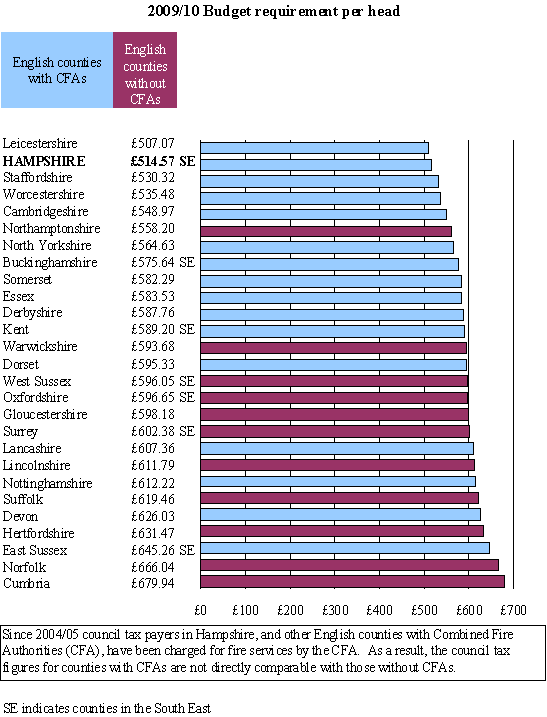
3.15 The County Council's 2009/10 Council Tax at Band D is within the lower quartile of comparable County Council council taxes. The County Council's budget requirement per head is also in the lower quartile. The following graphs demonstrate the County Council's comparative position in relation to both Council tax and budget requirement.
4.16 Annex 2 contains some further analysis of the three year budget in graphical form and a summary of the projected balance sheet for the period, differentiating between spending funded from taxation, including schools and other spending financed by specific grant, and spending which forms part of the budget requirement funded by formula grant and council tax, which the County Council has the responsibility for determining.
4 Capital Programme 2009/10 to 2011/12
4.1 The County Council approved a capital programme for 2009/10 to 2011/12 at its meeting in February 2009. The capital programme is integrated within the medium term financial strategy in a number of respects.
· it reflects the capital strategy approved by the Cabinet in July 2008 (and subsequently reviewed in September 2009), and the priorities of the corporate strategy
· the programme is drawn up in accordance with the capital programme policies included within the County Council's financial management policies
· decisions on the level of revenue contributions to capital and on the affordability of supported borrowing have been taken in conjunction with the decisions taken in agreeing the three year budget plan
· the use of unsupported borrowing is determined in conjunction with the setting of the prudential indicators, approved by the County Council in accordance with the prudential code of practice
· the treasury management strategy incorporates the strategy for making borrowing decisions.
4.2 Alongside decisions on the three year budget plan, guidelines for the preparation of the capital programme for 2009/10 to 2011/12 were provisionally set by the Cabinet in October 2008 and confirmed in December 2008. The guidelines comprise three elements:
· a locally resourced capital programme - supported by revenue contributions to capital, capital receipts and the non-transport and non - education elements of the single capital pot. Guidelines were set based on the previously approved 2009/10 and 2010/11 programmes adjusted for inflation but spread over three years to reflect the sharp downturn in the availability of capital receipts.
· a programme of projects supported by Government grants and scheme or programme specific supported borrowing allocations allocated over the three years, subject to limits on the take up of supported borrowing allocations designed to restrict the increase in the capital financing requirement to 2.5% per annum
· the use of unsupported borrowing in accordance with the County Council's policy on prudential borrowing, which concentrates its use on supporting projects which yield a financial return and which are therefore self-sustaining in the medium and longer term. Unsupported borrowing is also used in the short-term to deal with any slippage which may arise in the generation of capital receipts to support the capital programme guidelines. With the uncertain state of the property market, there are no projects in the 2009/10 to 2011/12 capital programme dependant on the generation of capital receipts.
4.3 Based on these three elements, the capital programme for 2008/09 to 2011/12 totalled £427.2m made up as follows:
Locally resourced |
Government approvals |
Unsupported borrowing |
Total | |
£000 |
£000 |
£000 |
£000 | |
2009/10 |
19,868 |
154,531 |
3,064 |
177,463 |
2010/11 |
29,762 |
117,791 |
- |
147,553 |
2011/12 |
13,958 |
88,244 |
- |
102,202 |
63,588 |
360,566 |
3,064 |
427,218 |
4.4 This programme comprises a mixture of start values, mainly for larger specific projects, and planned expenditure in the year, mainly for capital repairs and other block sum approvals. Annex 3 summarises graphically the overall programme for the three years over services.
5 Underpinning policy statements and strategies
Financial management policies
5.1 The County Council's financial management polices relating to financial planning are set out in Annex 4, covering overall financial planning and budget strategy, capital programmes and value for money. These policies form the framework within which the three year budget plan and the capital programme are set, and within which the other policies and strategies included in this section are framed.
Treasury management and investment strategies, prudential and financial health indicators
5.2 These strategies provide the framework within which authority is delegated to the County Treasurer to make decisions on the management of the County Council's debt and the investment of the County Council's surplus funds. The County Council is authorised to borrow on a long-term basis to finance capital expenditure and short-term to deal with cash flow fluctuations pending the receipt of revenues.
5.3 The starting point for the development of the treasury management strategy for the period 2009/10 to 2011/12 is the assessment of changes in the long-term borrowing position which is dictated by changes in the capital financing requirement, even though in the short-term the need to borrow may be offset by surplus funds derived from holding reserves and balances and from creditors exceeding debtors. The main determinants of the change in the capital financing requirement are:
· the level of new borrowing approved in setting the capital programme, taking into account new unsupported borrowing approved in accordance with the County Council's financial management policy and the repayment of any temporary unsupported borrowing
· the annual repayments charged to the revenue account or to external bodies in respect of transferred services, based on the requirement to make a minimum revenue provision for the repayment of debt within the revenue budget on a prudent basis.
5.4 The capital financing requirement for the period 2009/10 to 2011/12 is estimated as follows:
2009/10 |
2010/11 |
2011/12 | |
£m |
£m |
£m | |
Capital financing requirement at 1 April |
648.8 |
687.7 |
692.6 |
New borrowing net of repayments of temporary unsupported borrowing |
65.2 |
33.1 |
-1.8 |
Repayments charged to revenue account and external bodies |
-26.3 |
-28.2 |
-28.6 |
Capital financing requirement at 31 March |
687.7 |
692.6 |
662.2 |
5.5 The other key consideration in setting the treasury management strategy is the assessment of interest rate trends and the balance struck between the certainty and stability of longer term fixed rate borrowing and the flexibility of short-term borrowing at variable rates. Lender's option/borrower's option's loans (LOBOs) provide an opportunity for variable rate borrowing over longer term periods as an alternative component of the strategy, though as a result of the credit crunch rates have been unattractive since 2007/08.
5.6 The treasury management strategy for 2009/10 to 2011/12 set a target variable/fixed ratio of 55%/45%, including allowance of 15% within the variable rate proportion for LOBOs. Based on this ratio an annual guideline target of up to £17m was set for 2009/10 to 2011/12 for long-term fixed rate borrowing, subject to interest rate conditions being appropriate. No target was set for the take up of LOBOs given current market conditions. In considering whether contributions are appropriate for further long-term fixed borrowing, the strategy proposes a trigger rate of 4.2% at which rate and below further long-term borrowing would be considered, unless clear signs of a rising trend in rates occur, in which case it might also be appropriate to borrow at higher rates.
5.7 The strategy also authorised the County Treasurer to consider the scope for further restructuring of long term loans in view of the changes in regulations for accounting for the amortisation of premiums incurred from debt restructuring, for the purposes of setting council tax. Due regard would be paid to the need to avoid a heavily skewed maturity profile as a result of any restructuring, and to the Public Works Loan Board's policy on the calculation of premature repayment premiums, which changed adversely during 2007/08. No further restructuring has taken place since 2007/08.
5.8 The County Council's investment strategy treats security and liquidity as paramount in investing surplus funds and such funds are invested solely in what are defined by the Government as `specified investments'. Surplus funds are invested in:
· fixed term deposits for periods up to 1 year with local authorities, the Government's Debt Management Office, or banks and building societies rated at least A2 by Moody's, a credit rating agency
· call deposits with the Natwest Bank (rated AA3), and three managed AAA - rated money market funds
5.9 The lending list is reviewed monthly using Moody's ratings, and other information, and limits are placed on the levels and the maturity profile of deposits made with individual institutions. Changes in the lending list are reported in the quarterly review of the financial health indicators. An overall review of the lending list and the investment limits is undertaken annually, subject to the approval of the County Treasurer.
Prudential indicators
5.10 The Prudential Code for Capital Finance incorporates a series of indicators requiring annual approval by the County Council, designed to ensure that:
· capital programmes are affordable
· external borrowing and other long-term liabilities are within prudent and sustainable levels
· treasury management decisions are taken in line with professional good practice.
5.11 The relevant indicators are reported alongside the financial health indicators in Annex 5. The single most important indicator is the capital financing requirement, and in particular the component within it relating to unsupported borrowing, as this is the most important measure of the affordability of the capital programme and of the prudence and sustainability of borrowing levels. The Council's policy on the use of unsupported borrowing is set out in financial management policy 32 (as set out in Annex 4).
Financial Health indicators
5.12 Annex 5 sets out a series of financial health indicators which form the basis for the regular monitoring of the strategy as part of the quarterly budget monitoring report to Cabinet. These cover budget variances, the management of the capital programme, and income collection, in addition to the key prudential indicators.
Capital strategy
5.13 The capital strategy 2009 was approved by the Cabinet in September 2009 and brings together the Council's key policies for managing all its capital assets, including land, buildings and roads. Together with the appropriate financial management policies it provides the strategic framework for the preparation of the capital programme. Among the key policies in the 2009 strategy are:
· to focus attention on the most effective and efficient use of the Council's capital assets
· to link directly to the Council's corporate strategy and Corporate Improvement Plan, to the Hampshire Sustainable Community Strategy and to the priorities in the Hampshire Local Area Agreement
· to improve the management, utilisation and efficiency of the use of capital assets alongside the Council's policy and service objectives
· improving the procurement strategy and creating long-term collaborative relationships with the public and private sector to ensure value for money and continuous improvement
Adult Services
Proposals for growth and redeployment 2009/10 to 2011/12
Proposals are shown at outturn prices for the relevant year.
Agreed proposals will be incorporated into future year's base budgets and so on-going costs are shown in the first year only. One-off costs are shown in the first year and subtracted from the following year.
Staffing (FTEs) |
||||||||
2009/ |
2010/ |
2011/ |
2009/ |
2010/ |
2011/ |
Link to Corporate Strategy |
||
£'000 |
£'000 |
£'000 |
||||||
Growth proposals and unavoidable service pressures: |
||||||||
Dependency & Demographic |
9,895 |
8,613 |
7,353 |
19 |
9 |
8 |
c) 1.1 | |
Commissioning/ inflation |
3,354 |
478 |
478 |
- |
- |
- |
c) 2.1 | |
* |
Transformation Programme |
588 |
(1,291) |
146 |
9 |
(2) |
5 |
a) 1.2 |
Safe and Secure |
652 |
(41) |
- |
9 |
(1) |
- |
a) 2.10 | |
Other operational pressures |
3,978 |
(115) |
(12) |
22 |
- |
- |
c) 1.1 | |
Unallocated balance to meet unidentified growth and pressures in future years |
- |
550 |
- |
|||||
Total increase |
18,467 |
8,194 |
7,965 |
59 |
6 |
13 |
||
* |
This plus £3.6m funded by Social Care Reform Grant makes the total increase £22m |
|||||||
|
2009/ |
2010/ |
2011/ |
2009/ |
2010/ |
2011/ |
Link to Corporate Strategy | |
£'000 |
£'000 |
£'000 |
FTEs |
FTEs |
FTEs |
|||
Redeployment and savings proposals: |
||||||||
Dependency & Demographic |
(1,500) |
(500) |
- |
- |
- |
- |
c) 1.3 a) 3.1 | |
Commissioning/ inflation |
(1,528) |
(553) |
(844) |
- |
- |
- |
c) 1.3 a) 3.1 | |
Transformation Programme |
(1,126) |
(30) |
(60) |
(1) |
- |
- |
c) 1.3 a) 3.1 | |
Other operational pressures |
(4,145) |
(96) |
- |
(4) |
- |
- |
c) 1.3 a) 3.1 | |
Efficiencies to be identified |
- |
(3,455) |
(4,461) |
c) 1.3 a) 3.1 | ||||
Efficiencies subtotal |
(8,299) |
(4,634) |
(5,365) |
(5) |
- |
- |
||
Scope to increase income |
(7) |
- |
- |
- |
- |
- |
c) 1.3 a) 3.1 | |
Scope to reduce services |
(6) |
(15) |
- |
- |
- |
- |
c) 1.3 a) 3.1 | |
Total redeployment proposals |
(8,312) |
(4,649) |
(5,365) |
(5) |
- |
- |
||
Net growth pressures |
10,155 |
3,545 |
2,600 |
54 |
6 |
13 |
||
Planned underspend from 2008/09 |
(3,455) |
3,455 |
- |
|||||
Net growth |
6,700 |
7,000 |
2,600 |
54 |
6 |
13 |
||
Guideline additional funding |
6,700 |
7,000 |
2,600 |
Children's Services
1. Proposals for growth and redeployment 2009/10 to 2011/12 - Schools
Proposals are shown at outturn prices for the relevant year.
Agreed proposals will be incorporated into future years' base budgets and so on-going costs are shown in the first year only. One-off costs are shown in the first year and subtracted from the following year.
Staffing (FTEs) | ||||||
2009/10 |
2010/11 |
2011/12 |
2009/10 |
2010/11 |
2011/12 | |
£000 |
£000 |
£000 |
||||
Growth proposals: |
||||||
Growth in Delegated Funding |
||||||
General Deprivation Funding |
2,043 |
4,039 |
61.0 |
112.0 |
||
Children Looked After |
100 |
-100 |
||||
English as additional Language / Ethnic Minority |
212 |
248 |
8.0 |
8.0 |
||
Pay and Benefits in delegated budgets |
1,401 |
2,070 |
||||
ICT for Schools |
1,000 |
|||||
Outreach work for Special |
108 |
111 |
3.0 |
3.0 |
||
Mainstreaming Autistic Provision |
110 |
2.0 |
||||
Infant Class Size |
52 |
|||||
Independent Safeguarding |
150 |
-150 |
||||
Sub-total Delegated Growth Proposals |
5,066 |
6,328 |
- |
72.0 |
125.0 |
- |
Growth Non Delegated Funding |
||||||
14 to19 Provision |
750 |
|||||
Extended Early Years Entitlement |
1,070 |
470 |
||||
Early Years SEN |
52 |
55 |
||||
New SEN Early Years Resourced Provision |
145 |
110 |
||||
Early Years Formula - Transition |
56 |
|||||
SEN Preventative Services |
59 |
|||||
Pay and Benefits - Central Spending |
119 |
159 |
||||
Specialist Education Support for Children |
27 |
1.0 |
||||
Prudential Borrowing - Autistic Provision |
165 |
|||||
Communication and Language Team |
99 |
2.0 |
||||
Specialist Teacher Advisory Service |
73 |
2.0 |
||||
Behaviour Intervention Service |
40 |
|||||
Education Inclusion Service |
200 |
5.1 |
||||
Ethnic Minority Service |
44 |
0.4 |
||||
Admissions |
150 |
75 |
3.0 |
|||
Other Supply Cover |
100 |
|||||
Children Looked After in Early Years Settings |
92 |
|||||
Minibus Driver Training |
20 |
40 |
||||
Equal Pay Fund |
396 |
-396 |
||||
Sub-total Non Delegated Growth Proposals |
2,683 |
1,487 |
13.5 |
|||
Total increase allowed in the budget guidelines |
7,749 |
7,815 |
- |
85.5 |
125.0 |
- |
2. Proposals for growth and redeployment 2009/10 to 2011/12 - Non Schools
Proposals are shown at outturn prices for the relevant year.
Agreed proposals will be incorporated into future year's base budgets and so on-going costs are shown in the first year only. One-off costs are shown in the first year and subtracted from the following year.
Staffing (FTEs) |
|||||||
2009/ |
2010/ |
2011/ |
2009/ |
2010/ |
2011/ |
Link to Corporate Strategy | |
£000 |
£000 |
£000 |
|||||
Growth proposals: |
|||||||
Building Schools for the Future |
200 |
100 |
3.0 |
2.0 |
a) 1.5 | ||
Children in Care (Foster Care allowances, skills fees and support) |
600 |
550 |
500 |
1.0 |
1.0 |
1.5 |
a)2.3 |
Family Group Conferences |
50 |
50 |
c) 1.1 | ||||
Wessex Youth Offending Team |
25 |
1.0 |
b) 5.4 a) 1.1 | ||||
Home to School Transport |
800 |
200 |
200 |
c) 1.1 | |||
Services for Young People |
381 |
351 |
330 |
b) 1.5 | |||
IT Operational Investment |
339 |
b) 1.7 | |||||
Interest on School Balances |
750 |
c) 2.1 | |||||
Other Operational Pressures |
168 |
48 |
2.0 |
1.0 |
Various | ||
Young Carers |
45 |
b) 1.7 | |||||
One-off Invest to Save Funding in 2008/09 |
1,400 |
||||||
Invest to Save Repayment |
1,400 |
-1,400 |
|||||
Resources to be Allocated |
2,120 |
||||||
Total Growth Proposals |
4,758 |
2,699 |
1,750 |
7.0 |
4.0 |
1.5 |
1.5 |
Redeployment proposals: |
|||||||
Reduction in Independent Fostering Placements |
-300 |
-600 |
-800 |
a) 3.1 C) 1.3 | |||
Re-profiling of Children in Care Budgets |
-400 |
a) 3.1 C) 1.3 | |||||
Reduced Contribution to Hampshire Inspection and Advisory Service |
-315 |
a) 3.1 C) 1.3 | |||||
Home to School Transport contracts |
-200 |
-200 |
-200 |
a) 3.1 C) 1.3 | |||
Denominational Transport |
-25 |
a) 3.1 C) 1.3 | |||||
Use of Grant Flexibility |
-756 |
95 |
a) 3.1 C) 1.3 | ||||
Further Savings to be Identified |
-1,562 |
-734 |
a) 3.1 C) 1.3 | ||||
Total Redeployment Proposals |
-3,558 |
-1,439 |
-1,000 |
a) 3.1 C) 1.3 | |||
Total increase allowed in the budget guidelines |
1,200 |
1,260 |
750 |
7.0 |
4.0 |
1.5 |
|
Total Schools and Non Schools: |
|||||||
Growth Proposals |
12,507 |
10,514 |
1,750 |
92.5 |
129.0 |
1.5 |
|
Redeployment Proposals |
-3,558 |
-1,439 |
-1,000 |
- |
- |
- |
|
Net Growth and Redeployment Proposals |
8,949 |
9,075 |
750 |
92.5 |
129.0 |
1.5 |
|
Environment
Summary of service pressures, redeployment of resources and savings 2009/10 to 2011/12
Proposals are shown at outturn prices for the relevant year.
Agreed proposals will be incorporated into future year's base budgets and so on-going costs are shown in the first year only. One-off costs are shown in the first year and subtracted from the following year.
Staffing (FTEs) |
|||||||
2009/ |
2010/ |
2011/ |
2009/ |
2010/ |
2011/ |
Link to Corporate Strategy | |
£'000 |
£'000 |
£'000 |
|||||
SERVICE PRESSURES | |||||||
Highways maintenance Routine highways maintenance | |||||||
Term highways contract - excess inflation arising from annual contract re-pricing |
665 |
- |
- |
- |
- |
- |
c) 2.1 |
Flood mitigation and response - preparation of management plan, mapping and additional infrastructure works |
380 |
-50 |
-50 |
- |
- |
- |
a) 3.5 b) 7.3 |
Verge and shrub maintenance - additional sum to manage shrub encroachment |
50 |
- |
- |
- |
- |
- |
|
A and B roads speed limit review |
50 |
- |
-50 |
- |
- |
- |
b) 3.2 b) 3.3 a) 1.4 |
Street lighting | |||||||
Street lighting PFI - higher maintenance costs |
300 |
300 |
- |
- |
- |
- |
a) 3.7 |
Energy - price rises at end of current contract |
- |
- |
1,000 |
- |
- |
- |
c) 2.1 |
Total highways maintenance |
1,445 |
250 |
900 |
- |
- |
- |
|
Road safety | |||||||
Village 30 - advertising and enforcement |
213 |
4 |
- |
- |
- |
- |
b) 3.3 a) 1.4 |
Total road safety |
213 |
4 |
- |
- |
- |
- |
|
Public transport | |||||||
Bus subsidies - estimated higher costs arising from area retendering process, commercial service de-registrations, revenue support for ferries and tendering community transport contracts |
272 |
502 |
375 |
- |
- |
- |
c) 2.1 |
Fall out of existing external funding (DfT bus challenge funding for Fordingbridge and Romsey) |
- |
45 |
- |
- |
- |
- |
c) 2.4 |
Total public transport |
272 |
547 |
375 |
- |
- |
- |
|
Staffing and support costs |
|||||||
Traffic Management Act (TMA) - additional resources required for works and event co-ordination under TMA Network Management Duty |
60 |
100 |
- |
2 |
4 |
- |
b) 3.4 a) 3.6 |
Income - estimated reduction in net income from land search and other development related fees |
100 |
100 |
- |
- |
- |
- |
c)2.2 |
IT - additional costs arising from departmental office moves and implementation of Hampshire workstyle programme |
214 |
-23 |
- |
- |
- |
- |
a) 3.1 |
Partnership activities - replacement of one-off funding for contribution to Partnership for Urban South Hampshire |
85 |
- |
- |
- |
- |
- |
a) 3.6 |
Externally funded staff - provision for additional staff within Landscape, Planning and Heritage, and Ecology sections |
78 |
- |
- |
2 |
- |
- |
c) 1.3 a) 3.1 |
Total staffing and support costs |
537 |
177 |
- |
4 |
4 |
- |
|
Major scheme development | |||||||
Replacement of one-off funding towards the development of major transport schemes |
480 |
- |
- |
- |
- |
- |
a) 3.6 |
Total major scheme Development |
480 |
- |
- |
- |
- |
- |
|
Total service pressures |
2,947 |
978 |
1,275 |
4 |
4 |
- |
|
REDEPLOYMENT AND SAVINGS PROPOSALS | |||||||
Term highways contract - programme of initiatives to improve efficiencies under the contract |
50 |
50 |
50 |
- |
- |
- |
a) 3.1 c) 1.3 |
Street lighting PFI - agreed corporate funding towards project |
300 |
- |
-300 |
- |
- |
- |
a) 3.7 |
Safer Roads Partnership - anticipated reduction in County Council contribution to Partnership |
213 |
4 |
- |
- |
- |
- |
a) 3.1 c) 1.3 |
Waste management - reduced budget requirement for abandoned vehicles |
100 |
- |
- |
- |
- |
- |
a) 3.1 c) 1.3 |
Staffing and support costs - staff savings arising from management reviews and other efficiencies |
579 |
- |
- |
-18 |
- |
- |
a) 3.1 c) 1.3 |
Non staff overheads - various efficiency savings |
60 |
18 |
- |
- |
- |
- |
a) 3.1 c) 1.3 |
Externally funded staff - match funding income from other local authorities and highways consultant fees |
78 |
- |
- |
- |
- |
- |
a) 3.1 c) 4.3 |
Transport capital programme - transfer to provide funding towards the development of major transport schemes |
300 |
- |
- |
- |
- |
- |
a) 3.1 c) 1.3 |
Re-prioritisation of budgets to accommodate spending pressures and offset higher inflation costs |
1,217 |
472 |
225 |
- |
- |
- |
a) 3.1 c) 1.3 |
Public transport - savings from reduction in publicity for one year and use of savings available in base budget |
50 |
25 |
- |
- |
- |
- |
a) 3.1 c) 1.3 |
Future funding to be identified, including sums required to offset higher street lighting PFI and energy costs |
- |
459 |
1,300 |
- |
- |
- |
a) 3.1 c) 1.3 |
Total redeployment and saving proposals |
2,947 |
978 |
1,275 |
-18 |
- |
- |
|
Policy and Resources Service
Proposals for growth and redeployment 2009/10 to 2011/12
Proposals are shown at outturn prices for the relevant year.
Agreed proposals will be incorporated into future year's base budgets and so on-going costs are shown in the first year only. One-off costs are shown in the first year and subtracted from the following year.
Staffing (FTEs) |
|||||||
2009/10 |
2010/11 |
2011/12 |
2009/10 |
2010/11 |
2011/12 |
Link to Corporate Strategy | |
£'000 |
£'000 |
£'000 |
|||||
Redeployment proposals: |
|||||||
Chief Executive: |
|||||||
HR pay and benefits team |
425 |
-425 |
- |
- |
-7 |
- |
c) 1.2 |
HR team - equal pay claims |
125 |
-60 |
-65 |
- |
-1 |
-1 |
c) 1.2 |
Employment law team - equal pay litigation |
100 |
-50 |
-50 |
- |
-1 |
-1 |
c) 1.2 |
External legal costs - equal pay litigation |
150 |
-75 |
-75 |
- |
- |
- |
c) 1.2 |
County Treasurer: |
|||||||
Pay and benefits implementation |
45 |
-45 |
- |
- |
- |
- |
c) 1.2 |
Property, Business and Regulatory Services: |
|||||||
Community Safety Officer Service |
50 |
- |
- |
- |
a) 1.1 | ||
Hampshire workstyle project team costs |
249 |
-249 |
- |
- |
- |
a) 3.1 | |
Carbon reduction commitment |
187 |
-187 |
- |
- |
- |
a) 3.5 | |
Property Services |
200 |
-200 |
- |
- |
- |
||
Total redeployment proposals |
1,531 |
-1,291 |
-190 |
- |
-9 |
-2 |
|
Funding: |
|||||||
Transfers from capital |
636 |
-636 |
c)1.3 | ||||
Transfer from SEERA budget |
50 |
a) 3.1 c) 1.3 | |||||
Pay and Benefits reserve |
845 |
-655 |
-190 |
c) 1.2 | |||
Total funding |
1,531 |
-1,291 |
-190 |
||||
Culture, Communities and Rural Affairs
Proposals for growth and redeployment 2009/10 to 2011/12
Proposals are shown at outturn prices for the relevant year.
Staffing (FTEs) |
|||||||
2009/10 |
2010/11 |
2011/12 |
2009/10 |
2010/11 |
2011/12 |
Link to Corporate Strategy | |
£'000 |
£'000 |
£000 | |||||
Growth proposals: | |||||||
Spydus |
150 |
- |
- |
- |
- |
- |
c) 1.2 |
Transforming through Technology Agenda (including Hants File) |
70 |
- |
- |
- |
- |
- |
c) 1.2 |
Health and Safety Auditor |
25 |
- |
- |
- |
- |
- |
a) 1.6 |
Rural Strategy Implementation |
30 |
- |
- |
- |
- |
- |
a) 2.1 |
Adult Learning |
35 |
- |
- |
- |
- |
- |
a) 1.6 |
Countryside Access Grants |
25 |
- |
- |
- |
- |
- |
a) 1.6 |
Service Development |
70 |
- |
- |
- |
- |
- |
a) 1.6 |
Youth Officer |
25 |
- |
- |
- |
- |
- |
a) 1.6 |
Total increase allowed in the budget guidelines |
430 |
- |
- |
- |
- |
- |
|
Redeployment proposals: |
-430 |
- |
- |
- |
- |
- |
a) 3.1 c) 1.3 |
Total redeployment proposals |
-430 |
- |
- |
- |
- |
- |
|
Net change |
- |
- |
- |
- |
- |
- |
|
Linking Spending and Savings Proposals to the Corporate Strategy
Key to references in Annex 1A to 1E
a) Corporate Improvement Priorities
1 Customer / Community Focus - What People Want
1.1 Community Safety: Work in partnership to tackle violent crime and assault with injury
1.2 Personalisation: Roll out the personalisation agenda (inc work with partners)
1.3 Road Maintenance: Improve the condition of the most highly trafficked roads (principal & non principal) and reprioritise spending to prevent pot hole formation and flood risk
1.4 Road Safety: Reduce road accidents (KSI) and local traffic calming (e.g. Village 30)
1.5 Schools: Maintain and continue to improve general school attainment
1.6 Culture and Recreation:
· Widen services to older people, including access, wellbeing and adult learning
· Grow offer to young people universally to improve wellbeing (in addition to intervention services)
1.7 Extra Care: Increase the level of extra care housing options
1.8 Care Services: Improve acceptable waiting times for care packages and equipment
1.9 Waste: Increase recycling and further reduce landfill
1.10 Community Intelligence and Engagement: Strengthen understanding and influence of the local community, particularly hard to reach groups
1.11 Service Channels: Continue to exploit Hantsdirect and new avenues for access
1.12 Locality Working: Develop locality working
2 Reducing Inequalities
2.1 Rural: Tackle inequalities of access to local services in rural areas, particularly for older and younger people, and strengthen rural sustainability
2.2 Inequalities: Address inequalities, particularly health and economic
2.3 Children in Care: Improve placement stability and educational attainment
2.4 Safeguarding: Secure child safeguarding, specifically repeat child protection plans
2.5 Vulnerable Groups: Narrow the attainment and life chances gap
2.6 Children with Disabilities: Extend respite and leisure opportunities
2.7 Health Services: Improve health services for children, specifically CAMHS, teenage conceptions and obesity
2.8 NEET: Reduce young people not in employment, education or training
2.9 Permanently Excluded from School: Reduce the number and strengthen alternative educational provision
2.10 Safeguarding: Improve the number of adults referred and Board membership
2.11 Quality of Life: Increase telecare take-up, integrated single assessments and direct payments
2.12 Learning Disabilities: Help adults with a learning disability to live at home
2.13 Deprived Communities: Grow aspirations, community development and cohesion
3 Improving Capacity to Deliver
3.1 Value for Money: Deliver the efficiency programme, corporate and central services review and Hants workstyle
3.2 Strategic HR: Strengthen workforce planning and organisational development
3.3 VCS: Increase engagement and develop capacity in the voluntary and community sector
3.4 Joint Working with Health: Increase learning disability clients living in NHS campuses, continuing healthcare, joint budgets and co-production
3.5 Sustainability and Climate Change: Foster and encourage sustainability and build resilience to climate change
3.6 Growth: Manage growth, including transport, planning, housing and utilities
3.7 Street Lighting PFI: Manage the risks and implementation
b) Local Area Agreement Themes
1 Children and Young People (A)
1.1 Improve mental and emotional health
1.2 Tackle childhood obesity
1.3 Reduce teenage pregnancies
1.4 Reduce the gap in achievements of the most vulnerable children
1.5 Improve the life chances of 16-19 year olds at risk of under-achievement
1.6 Improve services for children in care and on the edge of care
1.7 Safeguarding children
1.8 Statutory targets - early years progress, school attainment, secondary school absence, attainment of looked after children
2 Employment, Skills and Business Support (B)
2.1 Improving skills
2.2 Employment
2.3 Business growth
2.4 Resident / Worker earnings gap
3 Accessibility and Transport (C)
3.1 Highway maintenance
3.2 Road safety and casualties
3.3 Quality of life and safety in rural villages
3.4 Congestion hot-spots
3.5 Accessibility
4 Housing and Accommodation (D)
4.1 Affordable housing
4.2 Fuel poverty
5 Safer Communities (E)
5.1 Domestic abuse
5.2 Reduced adult re-offending
5.3 Drug related offending
5.4 Youth Justice system entrants
6 Health and Wellbeing (F)
6.1 Emergency hospital admission risk, especially for vulnerable people
6.2 Information and support for older people to live independently
6.3 Improved health and wellbeing and reduced inequalities related to deprivation
6.4 Promote independent living for vulnerability
6.5 Alcohol abuse
7 Environment (G)
7.1 Efficient use of material resources
7.2 Mitigate progress of climate change
7.3 Adapt to consequences of climate change
8 Strong Communities (H)
8.1 Improve community engagement
8.2 Sustainable third sector
c) Financial context to the corporate strategy
1 Financial Context to the Corporate Strategy
1.1 Demographic and legislative pressures:
· Aging population and increased number of young people with complex disabilities living into adulthood
· Higher waste disposal costs due to national policies linked to landfill and hazardous waste directives
· Increased numbers of vulnerable children being identified
1.2 Major change programmes:
· Development of Hantsdirect
· Pay and benefits programme
1.3 Review programmes to enable spending pressures to be accommodated and to achieve targeted efficiency savings
2 Financial Management Policies
2.1 In order to allow services to operate within firm cash limits, allocate provision for inflation to services at the start of the financial year and require excess inflation to be absorbed.
2.2 Services expected to contain spending within the approved cash limit with no supplementary allocations being available other than in exceptional circumstances unless a specific contingency provision made within the budget
2.3 Services expected to carry forward 100% of any overspending against the overall service case limit, but are allowed to retain up to 100% of any planned underspending identified prior to the approval of the following year's budget. 50% of any unplanned underspending can automatically be carried forward
2.4 Encourage chief officers to submit applications for specific grant / partnership funding designed to maximise the resources available to the County Council, by allowing capital and revenue cash limits to be adjusted to reflect changes in grant levels
2.5 Require Services to review the level of fees and charges at least annually and set budget limits on the assumption that the level of charges will be increased in line with assumed inflation on gross expenditure.
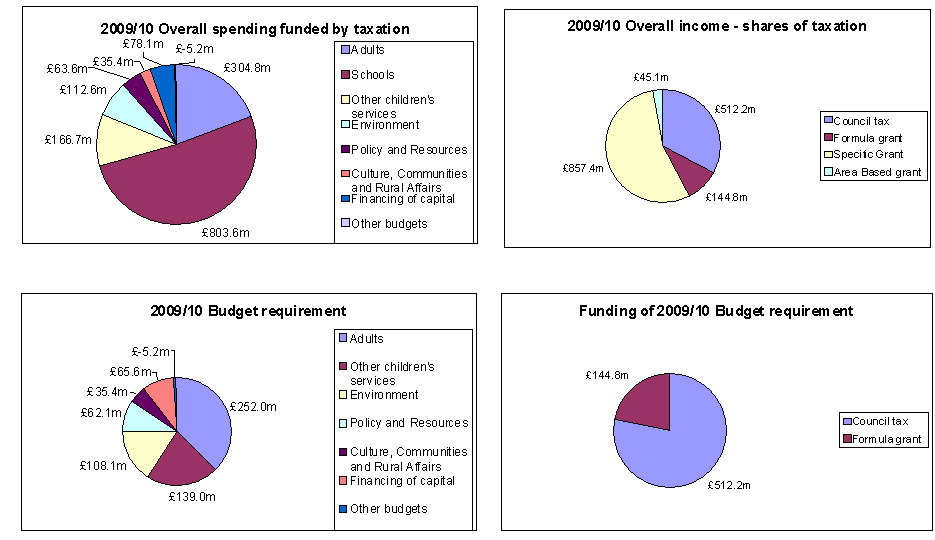
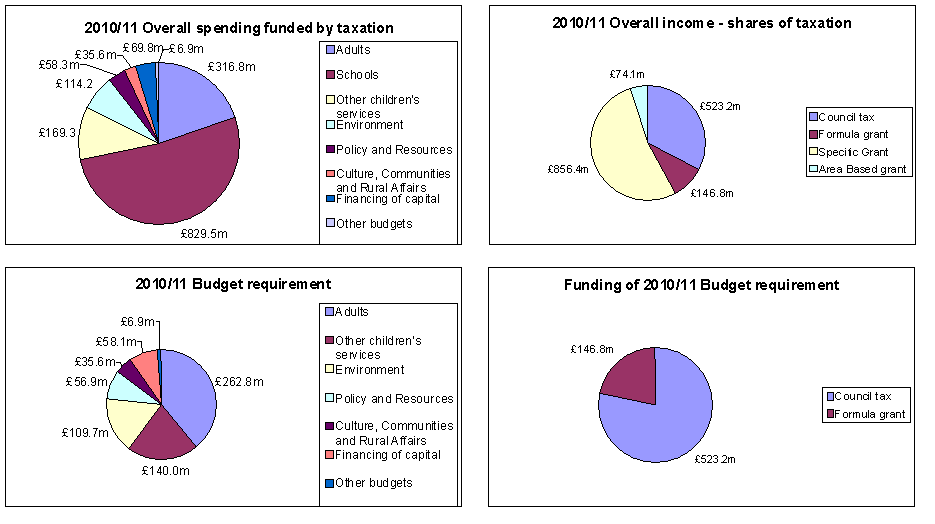
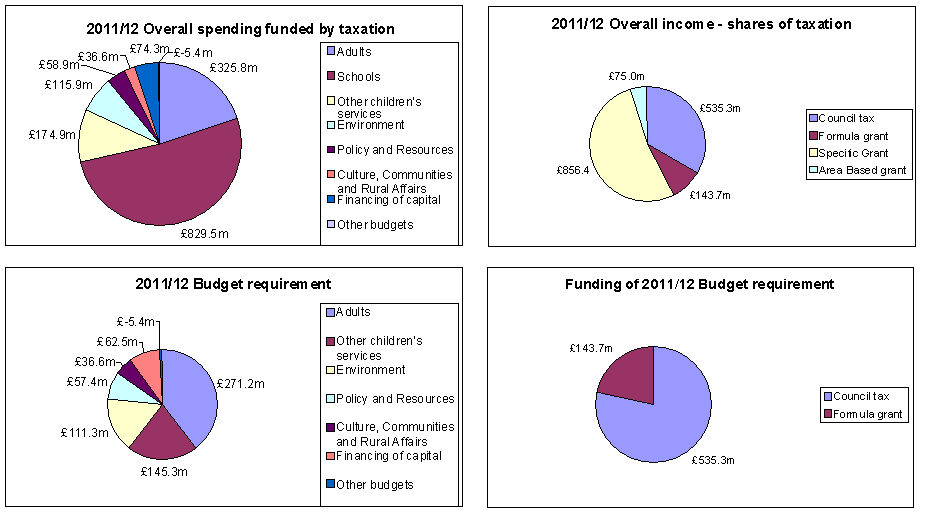
Projected Balance Sheet
Actual |
Estimated | |||
31.3.09 £000 |
31.3.10 £000 |
31.3.11 £000 |
31.3.12 £000 | |
Net Assets |
||||
Fixed assets |
3,443,865 |
3,604,929 |
3,770,109 |
3,923,708 |
Long-term debtors |
40,788 |
39,082 |
37,436 |
35,847 |
Current assets |
274,390 |
281,968 |
290,553 |
294,316 |
Current liabilities |
-327,655 |
-398,755 |
-420,827 |
-418,396 |
Long-term borrowing |
-336,996 |
-353,996 |
-370,996 |
-387,996 |
Deferred contributions and Government grants |
-473,118 |
-508,876 |
-586,541 |
-657,061 |
Developer contributions |
-32,706 |
-29,735 |
-27,297 |
-22,087 |
Provisions |
-5,215 |
-5,215 |
-5,215 |
-5,215 |
Pension fund liability |
-727,570 |
-577,570 |
-577,570 |
-577,570 |
Total |
1,855,783 |
2,051,832 |
2,108,089 |
2,183,982 |
Net worth |
||||
Fixed assets/capital adjustment accounts |
-2,386,456 |
-2,459,940 |
-2,518,247 |
-2,598,382 |
Unapplied capital receipts |
-2,290 |
- |
- |
- |
Pension reserve |
727,570 |
577,570 |
577,570 |
577,570 |
Earmarked reserves |
-160,095 |
-142,828 |
-145,921 |
-145,444 |
Revenue account |
-34,512 |
-26,634 |
-21,491 |
-17,726 |
Total net worth |
-1,855,783 |
-2,051,832 |
-2,108,089 |
-2,183,982 |
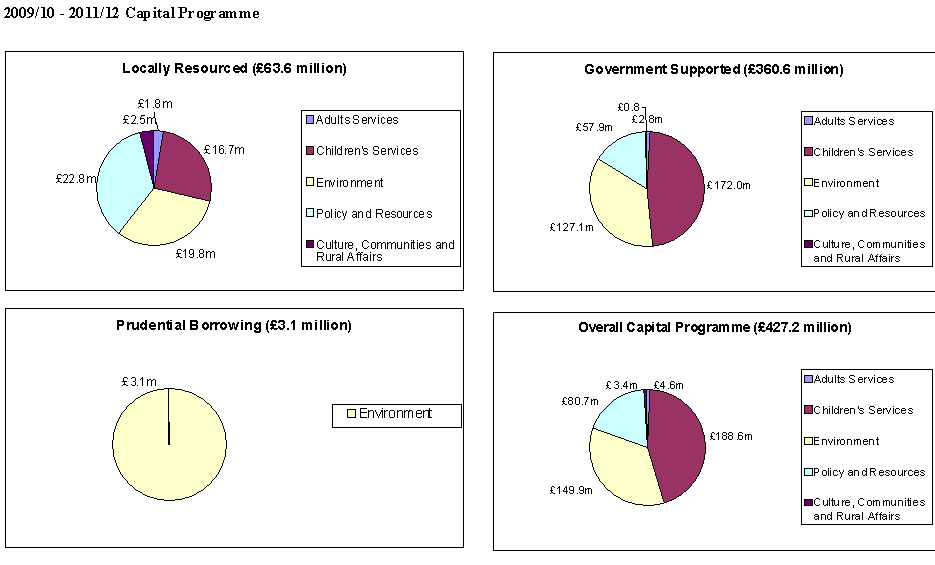
Financial Management Policies 2009/10 to 2011/12
Policy |
Related targets/outcomes | ||
Overall financial planning and budget strategy |
|||
1 |
Budget strategy related to corporate priorities, as reflected in corporate improvement plan with links to the Local Area Agreement. |
Linkage to Corporate Strategy made explicit in budget proposals and in preparation of business cases requiring approval prior to the release of increased sums in the budget, or in developing savings plans. | |
2 |
Consult on a cyclic basis with interested stakeholders (e.g. the public, private sector and staff) on budgetary priorities. |
Stakeholder meetings held in the autumn 2008 and January 2009 during the development of the 2009/10 budget and a consultation with Citizens Panel on spending priorities in July 2008. | |
3 |
Growth and saving plans to be submitted to the appropriate executive member or to the Cabinet, identifying planned outcomes and performance improvements for budget growth and mechanisms for achieving any significant savings. |
Savings plans monitored by the Cabinet on a quarterly basis. | |
4 |
Ensure that the long-term level of revenue commitments does not exceed long-term funding likely to be available including forecast levels of future grant settlement and council tax. |
Revenue commitments to be assessed based on the three year grant settlement and Council tax assumptions built into the three year budget plan | |
5 |
Ensure integration of medium term financial and service planning. |
Framework developed by Corporate Performance and Efficiency group, focussing on the Corporate improvement Plan and Local Area Agreement. | |
6 |
Incorporate in the medium term financial strategy the impact of joint plans agreed with partners. |
Medium term financial strategy sets out how the County Council incorporates partnership arrangements within the budget process. | |
7 |
Maintain three year budget projections in order to support medium term financial planning, subject to fine tuning of resource allocation decisions on an annual basis. |
A budget for 2009/10 and provisional budgets for 2010/11 and 2011/12 have been presented to the Cabinet and County Council for approval. | |
8 |
Minimise levels of non-earmarked reserves, at a level determined by risk assessment, in order to maximise use of available funds on service provision. |
Risk assessment incorporated in 2009/10 budget, with a target of 2.4% of the net budget requirement in 2009/10 as a result of the assessment. | |
9 |
Review the rationale and adequacy of earmarked reserves on at least an annual basis. |
Protocol reviewed twice yearly, in conjunction with approval of the budget and final accounts by the Cabinet. | |
10 |
Build up an earmarked reserve in recognition of the equal pay compensation risks associated with Pay and Benefits implementation. |
Reserve estimated at £38.4m at 31 March 2009. | |
11 |
Seek to minimise the degree of instability in the employers' contribution to the Hampshire Pension Fund, subject to objective of securing 100% funding in the long-term. |
Stepped increase of 0.5% per annum over the period 2008/09 to 2010/11 has resulted from the March 2007 actuarial review. Further increases are not expected in 2011/12 from the March 2010 actuarial valuation | |
12 |
Continue policy of increasing budgets for Children's Social Care in recognition of increased service demand. |
Increases in real terms of £1.2m in 2009/10, £1.3m in 2010/11 and £0.8m in 2011/12 incorporated in budget guidelines. Additional growth of £1.2m to improve the safeguarding of children is included in the 2009/10 budget. | |
13 |
Budget guidelines provide an annual increase in the Adult Services budget to recognise increased service demand. |
Inclusive of specific and area grants spending on Adult Services is budgeted to increase by 6% in 2009/10, 4.7% in 2010/11 and 3% in 2011/12. | |
14 |
Set a schools budget in consultation with the Schools Forum based on specific grants allocated by the Government. |
2009/10 budget set at a level equal to estimated specific grants, plus a County Council contribution of £128,000 to reflect further delegation of functions to schools since 2006/07. | |
15 |
Manage the application of the grant equalisation reserve in order to protect services from future grant loss from the 2006/07 and 2008/09 revised formulae. |
2009/10 to 2011/12 budgets allow for use of the grant equalisation reserve over an 8 year period to phase in the impact of loss of grant. | |
16 |
In order to allow services to operate within firm cash limits, allocate provision for inflation to services at the start of the financial year and require excess inflation to be absorbed. |
Inflation allocations for 2009/10 to 2011/12 agreed in setting a three year budget plan. | |
17 |
Services expected to contain spending within the approved cash limit, with no supplementary allocations being available other than in exceptional circumstances unless a specific contingency provision made within the budget. |
Policy applied in 2008/09, with exceptions in relation to electricity prices, rights of way legal costs. | |
18 |
Services expected to carry forward 100% of any overspending against the overall service cash limit, but are allowed to retain up to 100% of any planned underspendings identified prior to the approval of the following year's budget. 50% of any unplanned underspendings can automatically be carried forward. The policy applies to spending financed by Area Based Grant, subject to specific consideration of the Supporting People programme. |
Policy applied in dealing with under and overspendings in 2008/09's final accounts, allowing the remaining 50% of unplanned underspendings to be retained by services for use in 2011/12. | |
19 |
Require the continuing absorption of cost increases by expecting services to absorb any net cost arising from the annual cost of salary step increases. |
Step increases of £2.6m to be absorbed in 2009/10 budget. | |
20 |
Seek to deliver efficiency gains in line with the Government target of 3% annually, with a view to enabling cuts in service to be avoided. |
Summary of planned efficiencies from 2008/09 to 2011/12 included in 2009/10 budget report. Initial estimate for 2009/10 achieves the 3% target. | |
21 |
Encourage service chief officers to submit applications for specific grants/partnership funding designed to maximise the resources available to the County Council, by allowing capital and revenue cash limits to be adjusted to reflect changes in grant levels. |
Applied in 2009/10 to 2011/12 budget process. | |
22 |
Assist in developing the third sector's capacity by setting financial assistance within clear frameworks and on a three year basis where possible. |
Basis of current grants to community based organisations under review. | |
23 |
Require services to review the level of fees and charges at least annually and set budget limits on the assumption that the level of charges will be increased in line with assumed inflation on gross expenditure. |
Reflected in 2009/10 budget strategy. | |
24 |
Seek best value in spending, bearing in mind that considerations of quality, risk, sustainability, environmental impact, local economic development and equalities may all be relevant in addition to price. |
Reflected Local PSA and LAA outcomes and CPA Use of Resources assessment for value for money. | |
25 |
Seek to retain relatively low council taxes in Hampshire. |
2009/10 council tax within the lower quartile of County Council's without fire funding responsibilities. | |
Capital programming |
|||
26 |
Review capital strategy on an annual basis and prepare three year capital programme (consistent with CSR periods) in accordance with the strategy. |
Revised strategy approved by the Cabinet in September 2009. | |
27 |
Seek to maintain the level of the locally-resourced capital programme by continued recycling of surplus assets to generate capital receipts. |
2009/10 and 2010/11 programmes spread over three years in view of slow down in capital receipts. | |
28 |
Allow services to retain at least 25% of the value of their capital receipts and where necessary to finance investment in replacement assets, up to 100%. |
Services authorised to retain £1.5m of 2008/09's capital receipts. | |
29 |
Adopt a Public Private Partnership (PPP) approach, including the use of the Private Finance Initiative (PFI), where this provides best value for the Council. |
Procurement under way for a street lighting column replacement project in partnership with West Sussex County Council and Southampton City Council. The Government's Building Schools for the Future programme for investment in secondary schools envisages new schools being procured by means of PFI. | |
30 |
Make full use of Government-supported borrowing, subject to the affordability of the additional capital financing costs generated. |
2009/10 to 2011/12 capital programme guidelines based on limiting the take up of supported borrowing to a level consistent with a 2.5% annual increase in the capital financing requirement from supported borrowing, in view of the implications of being an authority well below the grant floor. In finalising the 2008/09 budget additional borrowing above this level was agreed for 2008/09 and 2009/10. | |
31 |
Seek to maximise capital resources by developing capital schemes in conjunction with external partners where appropriate. |
Funding of £41.2m by external partners, incorporated in 2009/10 to 2011/12's estimated capital payments. | |
32 |
Approve the use of unsupported borrowing within the framework of the County Council's prudential code - business unit investment where the financing costs will be funded by charges made to customers - `invest to save' projects generating savings which will enable the financing costs to be funded, capital receipts or developer contributions which will enable borrowing to be repaid, or alternative costs to be avoided. - Temporary borrowing to cover short-term shortfalls in capital financing resources. |
Proposals have either been approved or are being submitted in the 2009/10 to 2011/12 capital programme which involve in aggregate potential unsupported borrowing of £120.4m by the end of 2010/11 in accordance with County Council's code. A revision to the policy was introduced in 2006/07 to require services to absorb the revenue cost of temporary unsupported borrowing rather than recovering these costs in arrear when the capital receipt / external contribution is received. | |
A. Summary of Prudential Indicators |
2007/08 Actual |
2008/09 Estimate |
2009/10 Estimate |
2010/11 Estimate |
2011/12 Estimate | ||
Prudential indicators for capital expenditure | |||||||
Capital expenditure |
£m |
176.5 |
215.0 |
159.1 |
162.7 |
151.0 | |
Capital financing requirement |
£m |
586.3 |
648.8 |
687.7 |
692.6 |
662.2 | |
Prudential indicators for affordability | |||||||
Ratio of financing costs to net revenue stream |
% |
5.35 |
5.40 |
6.40 |
6.72 |
6.56 | |
Incremental impact of capital programme on council tax |
£ |
n/a |
n/a |
11.55 |
5.16 |
4.98 | |
Prudential indicators for prudence | |||||||
Medium-term borrowing not to exceed capital financing requirement |
County Treasurer will ensure this is not breached | ||||||
| |||||||
Prudential indicators for external debt | |||||||
Actual external debt |
£m |
404.3 |
n/a |
n/a |
n/a |
n/a | |
Authorised limits |
£m |
590.0 |
620.0 |
690.0 |
700.0 |
670.0 | |
Operational boundaries |
£m |
480.0 |
510.0 |
510.0 |
580.0 |
550.0 | |
Prudential indicators for Treasury Management | |||||||
Adoption of CIPFA Code of Practice |
Agreed by the Cabinet in February 2003 | ||||||
Upper limits - fixed rates |
£m |
256.0 |
300.0 |
320.0 |
320.0 |
320.0 | |
Upper limits - variable rates |
£m |
202.0 |
370.0 |
440.0 |
450.0 |
430.0 | |
Maturity structure of fixed-rate debt | |||||||||||||
Upper limits | |||||||||||||
Under 12 months |
% |
2 |
1 |
10 |
10 |
10 | |||||||
12 to 24 months |
% |
2 |
3 |
10 |
10 |
10 | |||||||
24 months to 5 years |
% |
5 |
6 |
20 |
20 |
20 | |||||||
5 years to 10 years |
% |
16 |
14 |
30 |
30 |
30 | |||||||
10 years and beyond |
% |
75 |
76 |
90 |
90 |
90 | |||||||
Lower limits |
|||||||||||||
Under 12 months |
% |
2 |
1 |
0 |
0 |
0 | |||||||
12 to 24 months |
% |
2 |
3 |
0 |
0 |
0 | |||||||
24 months to 5 years |
% |
5 |
6 |
0 |
0 |
0 | |||||||
5 years to 10 years |
% |
16 |
14 |
10 |
10 |
10 | |||||||
10 years and beyond |
% |
75 |
76 |
70 |
70 |
70 | |||||||
Total sums invested for more than 364 days |
£m |
Nil |
Nil |
Nil |
Nil |
Nil | |||||||
B. Financial Health Indicators |
2007/08 Actual |
2008/09 Estimate |
2009/10 Estimate |
2010/11 Estimate |
2011/12 Estimate | ||||||||
Variance from budget | |||||||||||||
Net service spending |
% |
-0.3 |
-0.5 |
+/-1 |
+/-1 |
+/-1 | |||||||
Overall spending met from formula grant, council tax and balances |
% |
-1.4 |
-1.4 |
+/-2 |
+/-2 |
+/-2 | |||||||
Balances as a % of budget requirement |
% |
3.9 |
4.5 |
3.7 |
2.8 |
2.5 | |||||||
Capital programme management | |||||||||||||
Carry forward of schemes |
% |
29.0 |
20.0 |
20.0 |
20.0 |
20.0 | |||||||
Actual capital expenditure compared with estimate |
% |
-6.3 |
+/-10.0 |
+/-10.0 |
+/-10.0 |
+/-10.0 | |||||||
Actual capital receipts and third party contributions compared with estimate |
% |
-0.2 |
-72.3 |
+/-10.0 |
+/-10.0 |
+/-10.0 | |||||||
Income collection | |||||||||||||
% of outstanding debt more than 12 months old |
% |
16.1 |
17.5 |
17.5 |
17.5 |
17.5 | |||||||
% of outstanding debt more than 6 months old |
% |
24.7 |
20.0 |
20.0 |
20.0 |
20.0 | |||||||
% of outstanding debt under 60 days old |
% |
63.2 |
60.0 |
60.0 |
60.0 |
60.0 | |||||||
% of debt written off to debt raised |
% |
0.2 |
<1.0 |
<1.0 |
<1.0 |
<1.0 | |||||||