
Archived decisions
Agenda Item: 4
HAMPSHIRE COUNTY COUNCIL
Report
Committee: |
Safe and Healthy People Select Committee | ||||
Date of meeting: |
13 November 2009 | ||||
Report Title: |
Mental Health National Service Framework: Autumn Assessment 2008, Use of the Mental Health Act 1983 in 2008/09, National Mental Health Service User Survey 2009 and Joint Mental Health Commissioning Strategy update | ||||
Report From: |
Director of Adult Services | ||||
Contact name: |
Neil Dhruev | ||||
Tel: |
01962 845609 |
Email: |
|||
1. Purpose of Report
1.1. To inform the Safe and Healthy People Select Committee of:
· the findings of the 2008 Autumn self assessment of the Mental Health National Service Framework (NSF), showing progress and actions to address targets requiring improvement
· the use of the Mental Health Act 1983 (MHA) in 2008-09 - work undertaken by Approved Mental Health Professionals (AMHPs) in relation to assessments under the MHA 1983, including the County Council's use of Guardianship (s7)
· the National Patient Survey (NPS) which in 2009 covered mental health acute inpatient service users
· progress on the Joint Mental Health Commissioning Strategy
2. Contextual Information
2.1. Mental Health NSF
2.1.1 This is the final year of the NSF ten year programme for modernising mental health services. NHS Hampshire and the County Council's Adult Services hold joint responsibility for the implementation and monitoring of the NSF in partnership with statutory, third sector organisations, service users and carers. In Hampshire there are three Local Implementation Teams (LITs) covering the South East, West and North of the county and one Stakeholder Group in the North East, which are the primary means for achieving this. There have been annual assessments on a range of targets since 2000, which have changed depending on national progress on implementation and, in recent years, the responses to the themed reviews. The report describes the LITs' self assessment on the 2008 targets and response to the themed review on `the Regional Vision' post NSF, as ratified by the Strategic Health Authority (SHA).
2.2. Use of the Mental Health Act 1983
2.2.1 This section of the report details statistics relating to the County Council's role and responsibilities under the MHA 1983, as amended by the MHA 2007. Under s114 of the Act, the Local Authority has a duty to appoint a `sufficient' number of AMHPs to carry out its legal responsibilities of assessment of individuals who are identified as suffering from a mental disorder and in need of hospital admission, which might require detention.
2.2.2 The AMHP service is managed in collaboration with Hampshire Partnership NHS Foundation Trust (HPFT) and Surrey and Borders Partnership NHS Foundation Trust (SABP). Although the MHA 2007 permits AMHPs from other professions, such as Psychiatric Nurses and Occupational Therapists employed by other organisations, to be warranted by the County Council, to date that has not occurred in Hampshire, although work continues to allow this in the future.
2.2.3 The County Council retained responsibility for the governance of the AMHP service under the MHA 2007, which includes ensuring competence of staff prior to, during and after training (now at Master's level), warranting and supervision.
2.2.4 Section 7 of the MHA 1983 (Guardianship) gives the County Council powers in relation to people with mental disorder; to require residence, to require attendance at a specified time for the purpose of medical treatment, occupation, education or training, or to require access by a Doctor, AMHP or other person specified by the guardian.
2.2.5 Amendments to the MHA 1983 largely came into force on 3.11.08. Key changes are shown in Appendix 4.
2.3. National Patient Survey 2009 (NPS)
2.3.1 The NPS programme was introduced in 2001 by the Department of Health (DH) and is now undertaken by the Care Quality Commission (CQC). Previous surveys of mental health service users carried out from 2004-2008 focused on community mental health. For the first time in 2009, people aged 16-65 who had stayed on an in-patient psychiatric acute or intensive care ward for at least 48 hours between 1 July 2008 and 31 December 2008 and were not an in-patient at the time of the survey, were questioned about their experience while on the ward.
3. Outcome of the Autumn Assessment of the NSF 2008
3.1 The self assessment targets and outcomes with a 2007 comparison are shown in Appendix 2. Comparative data from other LITs in the SHA is not yet available. A paper based on the regional themed review submission to the DH, but with Hampshire examples, is shown in Appendix 3.
3.2 For the first time since 2000, there are no red ratings within Hampshire and no ratings regressed from last year.
3.3 All targets relating to teams - Crisis Resolution and Home Treatment (CRHT), Early Intervention in Psychosis (EIIP), Assertive Outreach (AOT) and In-Patient Units and those relating to legislation, MHA 2007 amendments and Mental Capacity Act 2005 (MCA) - remain green. New targets for Offender Mental Health and Commissioning are also green.
3.4 The Delivering Race Equality (DRE) targets are now all green following progress on implementation of DRE policies.
3.5 The work led by Public Health on suicide prevention and mental health promotion strategies was completed resulting in improved scores, with local action plans being developed to fully implement health promotion in 2009-10.
3.6 During the year, the reviewing and tendering of advocacy and Independent Mental Health Advocacy (required under MHA 2007) services was completed allowing green scores to be recorded across Hampshire.
3.7 However, delays in fully implementing Improved Access to Psychological Therapies (IAPT) means the score moved to amber rather than green.
3.8 There is now a Dual Diagnosis (mental health and substance misuse) Strategy with work ongoing this year to develop and implement the action plan.
3.9 Although much work has been undertaken on the involvement of service users and carers and updating the social inclusion plans, it is recognised that more could be achieved and LITs will continue to progress these.
4. Use of the Mental Health Act 1983
4.1. There were 68 AMHPs employed and warranted by the County Council during this reporting period, mainly based within various integrated adult mental health community teams, with 5 based in older persons teams and 5 in the Out of Hours Team (OOH).
4.2. All the AMHPs received training on the MHA 2007 and were able to undertake their new duties on 3.11.08. All changed documentation was in place and partner agencies had also received information about the changes and it's effect on their roles.
4.3. Led by Hampshire, but involving Southampton and Portsmouth Cities, the Isle of Wight, Poole, Dorset and Bournemouth, an in-house Consolidation and Preparation for Specialist Practice Module has been developed for professional staff to undertake prior to AMHP training. Prior to this the module was purchased from Bournemouth University.
4.4. Data collected in 2008-09 from AMHPs relating to their activity under the MHA 1983 is shown in Appendix 5.
4.5. The number of referrals again appears to have increased, although improved data collection may account for this.
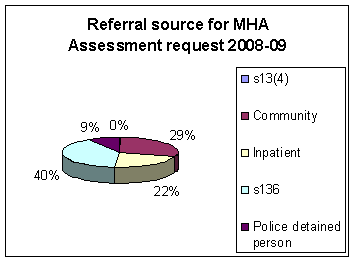
4.6. There appears to be a reduction in community referrals for assessment which is likely to be attributable to the development of effective specialist community teams, such as EIIP and AOT offering intensive support to service users outside hospital settings and CRHT having an explicit role in preventing admissions to hospital.
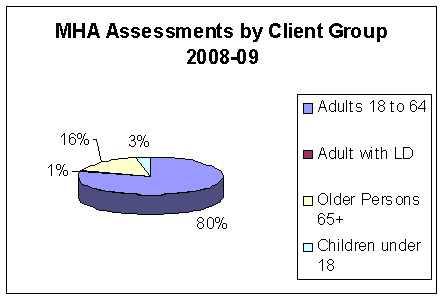
4.7. Of the 1,574 assessments that took place across Hampshire, 80% involved adults aged 18-65, 16% older people, 3% children and young people and 1% people with a learning disability. The assessment of older people continues a downward trend and there was a slight reduction in assessments of people with a learning disability. It is possible that use of the MCA 2005 might account for these trends. Males accounted for 52% of the assessments and females 48%.
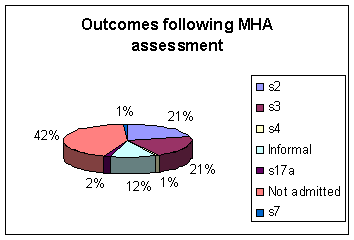
4.8. 43% of assessments led to detention, with 42% of the assessments resulting in no admission to hospital and 12% in an informal admission, showing that the Least Restrictive Guiding Principle in the MHA Code of Practice - "People taking action without a patient's consent must attempt to keep to a minimum the restrictions they impose on the patient's liberty, having regard to the purpose for which the restrictions are imposed." - is being adhered to. The other 3% relate to Guardianship and CTOs, which are community based sections.
4.9. There is an expectation of a future rise in the number of s2s (up to 28 days for assessment) and a decrease in the number of s3s (up to 6 months, initially, for treatment), due to the European Convention of Human Rights and increasing case law. The impact of this practice is already evident in OOH team practice, where no s3 applications were made in the last six months. s4 as an emergency power (requiring only one medical recommendation and lasting up to 72 hours) has also not been used anywhere in the County in the last six months.
4.10. S25a (after-care under supervision) has now been repealed and s17a Community Treatment Orders (CTO) have been enacted. 31 applications for CTOs were requested with 28 being agreed.
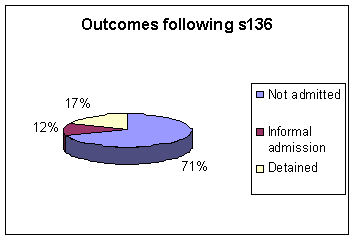
4.11. The service is currently investigating the high levels of work linked to s136 detentions (Police power to remove a person thought to have a mental disorder from a public place to a Place of Safety). 40% of the AMHP work in Mid Hampshire and 67% of the OOHs work derives from s136 referrals. Within care groups, 48% of adult, 46% of children, 33% of learning disability but only 6% of older persons assessments followed detention under s136. Interestingly, following assessment, only 17% are detained, with 71% not requiring admission and 12% agreeing to informal admission.
4.12. 87% of people assessed under the MHA in this period with a known ethnicity were White British, 9% were from other white populations, 2% were from BME groups and 2% were from other classification. The BME figures are below the Hampshire population levels, but it would appear there is an elevated level of white Europeans, excluding Irish, being assessed under the Act.
4.13. As indicated in last year's report, there has been an increase in the number of people subject to Guardianship through renewals or new referrals; 20 compared to 11 and 13 in the previous two years. Unlike the previous two years though, the new referrals have not been exclusively older people.
4.14. It is possible that changes in the MHA 2007, including the introduction of CTOs and Deprivation of Liberty Safeguards may have an effect on use of Guardianship in future years, which will be monitored over time.
5. National NHS Patient Survey 2009
5.1. Comparisons cannot be made to last year's survey results due to the change in focus and it should be noted that concerns have been expressed nationally about the results, for example, one could argue that people detained under the MHA might give more negative responses to the questions and the response rate is lower than to the community survey.
5.2. The results from HPFT are shown in Appendix 6. Additionally, they continued the community survey on the same basis as the previous year.
5.3. At present, HPFT are developing an action plan to address issues from the NPS, which has not been ratified and is therefore not yet available.
5.4. Initial data from the surveys shows that 54% of people who used in-patient services in HPFT considered them as `excellent' or `very good' compared to the national average of 48% and there was a slight increase from 81% to 82% of people using community services who thought they were `good', `very good' or `excellent'.
5.5. The results and response paper for SABP are shown in Appendix 7. Although their overall results do not appear to be as positive as those from HPFT, they must be seen in the context of having four in-patient units, only one of which (Wingfield Ward) admits people from Hampshire. The situation pertaining to Wingfield Ward is detailed in the response paper.
5.6. The NPS is also only one aspect of the CQC's rating of Trusts. In their overall rating, they scored both Trusts as `good' for quality of services and financial management.
6. Progress report on the Mental Health Joint Commissioning Strategy
6.1. NHS Hampshire and Adult Services are developing a joint health and social care commissioning strategy which will be the vehicle for achieving personalisation, choice, quality and empowerment to improve access to services and reduce inequalities in outcomes over the next few years.
6.2. An engagement event took place on 8 October 2009, attended by 131 people from statutory and voluntary sector organisations, service users and carers. Through a World Café process, they discussed and voted on existing services that are working well and need to be continued and those they would like to be in place. Very positive feedback has been received about the style of the event, allowing people to express their views and it's timing at the start of the process.
6.3. Further views will be obtained from groups using a consultation pack and via organisational emails for individual comments. A website will be set up to give information about the process, progress and contributions received. Following data collection and analysis, the draft strategy will be written by May 2010, with formal consultation in summer 2010.
6.4. Early emerging themes include requests for development of one-stop shops to facilitate easy accessible to all, greater service user involvement, increased usage of Wellness Recovery Action Plans (WRAP), early intervention and preventative work and awareness raising about mental health issues.
7. Conclusions
7.1. Outcomes of all the work described impact on the delivery of the following Corporate Priorities:
· Hampshire safer and more secure for all - through implementation of the MHA 1983 and suicide prevention strategies reducing risk to services users and others
· Maximising wellbeing - particularly through commissioning, social inclusion plans and recovery based services.
7.2. Outstanding work following the final Autumn self assessment forms the workplans of each LIT and will feed into the Joint Commissioning Strategy.
7.3. In respect of the MHA, work continues to ensure there is appropriate capacity across all areas of Hampshire, to improve data collection and to monitor and analyse trends, to inform training and resources.
7.4. Both Trusts will continue their work to improve quality and respond to Service User feedback about services. In turn that will be monitored by NHS Hampshire and Adult Services through existing processes.
Section 100 D - Local Government Act 1972 - background documents | |
The following documents discuss facts or matters on which this report, or an important part of it, is based and have been relied upon to a material extent in the preparation of this report. (NB: the list excludes published works and any documents which disclose exempt or confidential information as defined in the Act.) | |
Document |
Location |
None |
|
IMPACT ASSESSMENTS:
1. Equalities Impact Assessment:
1.1. All the work described in the report has either required an Equalities Impact Assessment or has specifically requested information on work with different ethnic groups or on the ethnicity of participants in the survey.
1.2. People with mental health problems are the most disadvantaged group of people with a disability. They are the least likely to be in employment and are the most socially excluded. All work in mental health is aimed at improving this situation through care and treatment and challenge to stigma and discrimination.
1.3. In contrast to national data, there is little evidence that people from Black and Asian groups in Hampshire are disproportionately detained under the MHA, but there is evidence of an increase in the number of people from white European, mainly Eastern European, origin being assessed. This is being closely monitored and such trends will be incorporated and acted on via the Joint Commissioning Strategy.
2. Impact on Crime and Disorder:
2.1. The County Council has a legal obligation under Section 17 of the Crime and Disorder Act 1998 to consider the impact of all decisions it makes on the prevention of crime.
2.2. It is known that people with mental health problems are disproportionately represented within the criminal justice system. Within the contracting portfolio of both Adult Service and NHS Hampshire and provision in both Trusts, there are schemes to divert people with mental health needs out of the criminal justice system.
2.3. Improving health promotion, ensuring early intervention, prevention and social inclusion, all elements of the Autumn Assessment and the Joint Commissioning Strategy, will impact positively on reduction of crime and disorder.
3. Climate Change:
3.1. How does what is being proposed impact on our carbon footprint / energy consumption?
a) How does what is being proposed consider the need to adapt to climate change, and be resilient to its longer term impacts?
The report is for information only and does not include major proposals for change which would need to consider this.
Appendix 1 - Glossary
Approved Mental Health Professional (AMHP) |
Previously known as Approved Social Workers (ASWs), professionally qualified staff who have undertaken further training, now at Masters level, and supervised experiential learning to obtain their warrant to undertake duties under the MHA 1983. Although acting on behalf of a Local Authority, they carry personal responsibility for their decisions. |
Assertive Outreach Team (AOT) |
An active form of care and treatment for people with severe and persistent mental disorder who have difficulty in maintaining lasting and consenting contact with services. |
Care Quality Commission (CQC) |
Independent regulator of health and social care in England established on 1 April 2009 following the amalgamation of the Healthcare Commission, Mental Health Act Commission and Commission for Social Care Inspection. |
Community Treatment Order (CTO) |
S17a of the 1983 MHA, as amended 2007, introduced Supervised Community Treatment through the use of CTOs to enable people detained under s3 of the Act to be discharged from hospital, whilst still detained, with a power of quick recall and imposed conditions. |
Crisis Resolution and Home Treatment Team |
For adults with severe mental illness with an acute psychiatric crisis of such severity that without the intervention of a CRHT team would require hospitalisation. |
Dual Diagnosis |
(Also known as Co-Morbidity) A broad spectrum of Mental Health and Substance Misuse problems that an individual might experience concurrently. |
Early Intervention in Psychosis Team (EIIP) |
A service designed to intervene at an early stage in the first episode psychosis for people aged 14 to 35. This is important as the first four years of psychosis carry the highest risk of serious sustained physical, social and legal harm. |
HPFT |
Hampshire Partnership NHS Foundation Trust. |
IAPT |
Improving Access to Psychological Therapies in primary care, linked to increasing numbers of people with mental health problems in employment. |
IMHA |
Independent Mental Health Advocacy introduced in the MHA 2007 to ensure that people detained under the Act have access to independent advocacy. The service is commissioned by NHS Hampshire. |
LIT |
Local Implementation Team to implement and monitor the National Service Framework for mental health. |
MCA |
Mental Capacity Act 2005. |
MHA |
Mental Health Act 1983. From 3.11.08, the MHA 2007 amends parts of the 1983 Act. |
New Horizons |
Future programme for mental health, following the end of the 10 year NSF work plan. Aims to improve the mental health & wellbeing of the population and improve quality & accessibility for those with poor mental health. National consultation ended 15.10.09. |
North East Hants Stakeholder Group |
Covers Aldershot, Farnborough, Fleet and surrounding areas, but also extends into Surrey Heath, which reports into the Surrey LIT. |
North Hants LIT |
Covers Basingstoke & Deane, Alton and Bordon areas |
NSF |
National Service Framework (for mental health) 1999. |
SABP |
Surrey and Borders NHS Foundation Trust which covers NE Hampshire. |
SHA |
Strategic Health Authority - South Central for Hampshire. |
South East LIT |
Covers Fareham, Gosport, Havant and Petersfield. |
West Hants LIT |
Covers New Forest, Eastleigh, Romsey, Winchester and Andover. |
WRAP |
Wellness Recovery Action Plans, developed in the USA by Mary Ellen Copeland and used by service users in HPT. "A simple self-help system for identifying personal resources and then using those resources to stay well and help you when you feel badly." |
Appendix 2 NSF Autumn Assessment by Hampshire LITs with 07 comparison
Target |
North |
Change |
NE |
Change |
SE |
Change |
West |
Change |
Primary/Secondary Care |
AMBER |
No |
GREEN |
No |
AMBER |
No |
AMBER |
No |
Crisis Resolution |
GREEN |
No |
GREEN |
No |
GREEN |
No |
GREEN |
No |
Early Intervention in Psychosis |
GREEN |
No |
GREEN |
No |
GREEN |
No |
GREEN |
No |
Assertive Outreach |
GREEN |
No |
GREEN |
No |
GREEN |
No |
GREEN |
No |
Acute Inpatient |
GREEN |
No |
GREEN |
No |
GREEN |
No |
GREEN |
No |
Social Inclusion |
AMBER |
No |
AMBER |
No |
AMBER |
No |
GREEN |
Improvement |
Vocational Support |
GREEN |
No |
AMBER |
No |
GREEN |
No |
GREEN |
No |
Employment of Service Users |
GREEN |
No |
GREEN |
No |
GREEN |
No |
GREEN |
No |
Recovery |
AMBER |
No |
GREEN |
Improvement |
AMBER |
No |
AMBER |
No |
DRE: BME people's services |
GREEN |
Improvement |
GREEN |
Improvement |
GREEN |
Improvement |
GREEN |
Improvement |
DRE: Implementing DRE in mental health care |
GREEN |
Improvement |
GREEN |
Improvement |
GREEN |
Improvement |
GREEN |
Improvement |
DRE: Community Development Officers |
GREEN |
No |
GREEN |
No |
GREEN |
No |
GREEN |
No |
Governance |
GREEN |
No |
GREEN |
No |
AMBER |
No |
GREEN |
No |
Service User Involvement |
GREEN |
Improvement |
GREEN |
No |
GREEN |
No |
AMBER |
No |
Carer Involvement |
GREEN |
Improvement |
GREEN |
No |
AMBER |
No |
GREEN |
Improvement |
Commissioning for the Third Sector |
GREEN |
No |
GREEN |
No |
GREEN |
No |
GREEN |
No |
MH needs of Older People: Strategy |
GREEN |
Improvement |
GREEN |
Improvement |
GREEN |
Improvement |
GREEN |
Improvement |
MH needs of Older People: Commissioning |
GREEN |
Improvement |
GREEN |
Improvement |
GREEN |
Improvement |
GREEN |
Improvement |
MH needs of Older People: Service Delivery |
AMBER |
No |
GREEN |
Improvement |
AMBER |
No |
AMBER |
No |
Learning Disabilities and Mental Health |
GREEN |
No |
AMBER |
Improvement |
GREEN |
No |
GREEN |
No |
Suicide Prevention: PCTs |
AMBER |
Improvement |
GREEN |
Improvement |
AMBER |
Improvement |
AMBER |
Improvement |
Suicide Prevention: Mental Health Providers |
GREEN |
No |
GREEN |
No |
GREEN |
No |
GREEN |
No |
Advocacy |
GREEN |
Improvement |
GREEN |
Improvement |
GREEN |
Improvement |
GREEN |
Improvement |
MH Promotion: Strategy & Implementation |
AMBER |
Improvement |
AMBER |
Improvement |
AMBER |
No |
AMBER |
Improvement |
Personality Disorder |
AMBER |
No |
AMBER |
No |
AMBER |
No |
AMBER |
No |
MHA 1983: s135/136 Places of Safety |
GREEN |
No |
GREEN |
No |
GREEN |
No |
AMBER |
No |
Mental Capacity Act 2005 |
GREEN |
No |
GREEN |
No |
GREEN |
No |
GREEN |
No |
MHA 2007 |
GREEN |
No |
GREEN |
No |
GREEN |
No |
GREEN |
No |
Improving Access to Psychological Therapies |
AMBER |
Improvement |
GREEN |
Improvement |
AMBER |
Improvement |
GREEN |
Improvement |
Dual Diagnosis |
GREEN |
Improvement |
GREEN |
Improvement |
GREEN |
Improvement |
GREEN |
Improvement |
Offender Mental Health |
GREEN |
New |
GREEN |
New |
GREEN |
New |
GREEN |
New |
`Abuse question' in assessment documentation |
AMBER |
New |
GREEN |
New |
AMBER |
New |
AMBER |
New |
Commissioning MH services |
GREEN |
New |
GREEN |
New |
GREEN |
New |
GREEN |
New |
Appendix 3
DH Submission - Themed Review
Regional Vision for Mental Health NHS South Central
Introduction
This year's themed review `SHA Regional Vision for Mental Health' has been managed by individual SHAs, acknowledging the variations in SHA Visions, consequently the review will differ from previous reviews in that the emphasis will be on separate SHA reports. The aim of the themed review is to scope progress so far on service transformation and innovation, in line with our regional vision.
The review contained thirteen free text questions, six questions that were set nationally and seven set against our regional vision.
SHA Overview
This years themed review process has given a useful opportunity to review current progress being made across the patch in understanding the over arching vision of the regional review and progress to date.
There has been excellent engagement across the patch from Mental Health Commissioners and Providers in undertaking this exercise.
Questions
1. All areas that scored red in the 2008 - 09 self assessment audit are identified, with lessons learned and action plans.
Milton Keynes Mental Health Promotion - Plan in place to complete a strategy. No timescale given.
Dual Diagnosis - Plan in place to develop a strategy. No timescales given.
Buckinghamshire There have been no areas scored `red'.
Oxfordshire There have been no areas scored `red'.
Berkshire East CPA Documentation - Plan in place, will be compliant by Dec 2009.
Berkshire West There have been no areas scored `red'
Hampshire There have been no areas scored `red'.
Southampton There have been no areas scored `red'.
Portsmouth Assertive Outreach - Plan in place
Isle of Wight Suicide Prevention - Suicide prevention forum re- established, currently looking at reviewing and updating policy.
Advocacy - Joint commissioning process in hand to commission across Island Advocacy service.
Offender Mental Health - Commissioning plan in hand.
2. Clinical engagement and leadership in Mental Health
Where this is at its most positive there is a robust PCT focus, with a multitude of examples across Commissioner and Provider activity, that deal with leadership as a strategic focus, allied to service re-design and development. In areas with less developed engagement good examples are given of clinical engagement and leadership with specific projects or structures.
3. The mechanisms in place to ensure engagement and buy in from the PCT and Local Authority commissioners to deliver the regional vision recommendations.
Ambition is in place for delivery; however, there is still work to be done on a common and equitable `mechanism' description. Many areas have formal joint commissioning arrangements in place. There are lots of excellent examples of joint service developments across the patch; however these continue to be local examples that don't always demonstrate senior engagement across organisations. Challenges also occur where organisational processes, procedures and timescales are not aligned.
4. Mechanisms in place to implement the regional vision recommendations.
Already embedded in current behaviour, there is still movement around the pragmatic application - however, there is an understanding of a "regional vision"
5. Identified risks associated with the implementations of the regional vision recommendations.
· Flu pandemic
· M H not DOH priority.
· Lack of National targets.
· IAPT rated vital sign C
· SHA level prioritisation of MH particularly related to the economic down turn
· Poor data reporting tools.
6. Working towards integrated whole system commissioning which is strategic, informed by Public Health data and outcome focussed.
There were some good examples of joint needs assessment and joint Commissioning Strategies, with specific examples around Dementia that involved public health. However, commissioning for quality/national outcomes in mental health remains patchy with some areas starting conversations with providers to develop clinical indicators, but with little or no progress noted in other areas. Organisations raised the lack of cohesive national lead on commissioning outcomes.
7. There is a fundamental interrelationship between mental and physical experience in wellbeing, health and ill-health.
Among the many innovative examples given were examples from Hampshire:
· People with schizophrenia are offered physical health check
· Smoking cessation counselling
· Falls work
· Improving Health Project funded from Big Lottery, covering physical health, healthy eating and mental wellbeing
· Staff accessing Southampton University training module on physical assessment and monitoring
There is some evidence of senior buy in across organisational boundaries.
8. There should be equitable access to specialised Mental Health services for all vulnerable/hard to reach groups.
Many positive practice examples with good organisational sign up. Good
evidence of increased staff training. Some work going on across the patch to identify hard to reach groups, as this is no longer limited to a small number of well identified populations.
9. Service User involvement in commissioning, in the governance and operational structures across the organisations, developing outcome measures and service design is ensured by:
Again good examples of engaging current service users. There is clear understanding of the importance of this work, and therefore a real emphasis given to it. The next step will be for this involvement to be enshrined in strategy and embedded in Commissioning
10. Permeable interfaces between services and agencies, with whole system pathways are/have been created by:
There is evidence of protocols/ strategies in place to support the interface between traditional services e.g. LD, Children etc... However there continue to be challenges with particular groups
· Autistic spectrum condition
· Dual diagnosis
· Personality Disorder
11. A skilled and effectively deployed workforce with the competences and leadership necessary for modern systems of care delivery are/have been created by:
The examples mainly demonstrated a skilling of workforce rather than strategic leadership provision.
12. Examples of Dementia care:
All areas demonstrated good progress in undertaking base line assessments and starting to implement the National Dementia Strategy. There were good examples of robust partnership planning and project structures to support implementation e.g. from Hampshire:
· Dementia Advisor pilots
· Training plans- including training for GPs
· Memory clinics
· Alzheimer cafes
Data collection remains a problem.
13. Perinatal maternal mental ill-health
Very few examples of good practice and only one example of local strategic planning that have enabled new services to be commissioned that provide a robust community based service. Hampshire, Berkshire and Oxfordshire have a range of services in place but it is fair to say none provide a pathway for the full spectrum of need.
Specific next steps
· To ensure the key findings from this report are incorporated into the over arching MH Work programme, to ensure focus, priority and monitoring
· To ensure consistent clinical engagement is embedded strategically within all organisations, to look at hosting a good practice event.
· To feedback nationally and regionally the need to ensure strategies, targets and expectations are aligned.
· The SHA is leading a number of pieces of work looking at developing Clinical Indicators for MH.
· There will need to be further discussion about how to ensure equitable senior engagement across organisations
· To scope a piece of work looking at the continued over representation of BME populations detained under the MHA and the poor access to CBT.
· Ensure service user involvement is `enshrined in strategy and embedded in Commissioning - Provider strategic procedures across the region
· Discuss with workforce and Leadership Leads to ensure MH are fully accessing the current range of Leadership opportunities.
· The specific service development areas need to be incorporated into the MH work programme with detailed implementation plans.
Taken from report compiled and submitted to the Department of Health by
Julie Kerry Christopher Gill
Mental Health Lead Mental Health Consultancy Manager
South Central SHA Collaborative Solutions
South Central SHA
Appendix 4 Key amendments to the MHA 1983
introduced by the MHA 2007
· Introduction of supervised treatment in the community (CTO - s17A) for suitable people following a period of detention and treatment in hospital (s3, s37, s47 and s48). It's aim is to ensure that people comply with treatment and enable action to be taken to prevent relapse and avoidable readmission to hospital. Same criteria, duration & renewal as s3. Supervised discharge is abolished
· Expansion of the range of professionals responsible under the Act. In place of Approved Social Workers will be Approved Mental Health Practitioners (AMHPs) and in place of Responsible Medical Officers will be Responsible Clinicians (RCs). Local Authorities retain responsibility for approving AMHPs and training courses will still be subject to statutory regulation as well as approval by the GSCC
· Simplified single definition of mental disorder which removes the four specific categories to ensure that no one is denied treatment because they fall outside those categories. New definition of mental disorder is "any disorder of mind or brain"
· Removal of exclusions relating to "promiscuity or other immoral conduct" and "sexual deviancy", but dependency on drugs or alcohol remains an exclusion
· Treatability test - new criteria establishes that it is sufficient that the intention of treatment is therapeutic
· New duty for hospital managers in relation to patients under 18 to ensure they are accommodated in environment suitable for their age & geared to meet their needs
· Introduction of independent mental health advocacy for people detained under any section except s4, s5, s135 & s136 but including s7 & s17A
· Changes to Nearest Relative to include civil partners and to allow patients with reasonable objections to apply to the County Court to replace a Nearest Relative. The hierarchical list of Nearest Relatives remains
· Reduction in time before cases are referred to Mental Health Review Tribunal (MHRT) - automatic referral after 6 months with a power to shorten the period
· Abolition of finite restriction orders (s41) - removal of the power of criminal courts to impose time-limited restrictions orders when detaining people to hospital. Not retrospective
· Introduction of deprivation of liberty safeguards (Bournewood) for people who lack capacity to understand and agree to a deprivation of their liberty in hospital or residential care that is deemed necessary to prevent harm. Allows the PCT or LA to authorise deprivation of liberty (DOL)
· Extension of victims' rights to allow victims of violent and sexual offences, committed by mentally disordered offenders, knowledge of changes relating to the offender and to have representation regarding those changes, including discharges back into the community. Victims will have a right to information about and representation at MHRTs for unrestricted patients detained under s37 and s47
· Transfers between places of safety for people detained under s135 and s136 will be allowed within the 72 hour detention period
· Informal admission of 16 and 17 year olds now amended so that a person with parental responsibility cannot override consent or refusal of consent re: admission to hospital
· Introduction of capacity threshold for ECT. It may not be given to a patient with capacity who refuses consent or to one without capacity if it conflicts with an advanced directive, Court of Protection decision except in an emergency. Second Opinion Approved Doctor must approve ECT for any patient under 18 whether detained or informal
· Penalty for ill-treatment or neglect extends from 2 to 5 years imprisonment
Appendix 5
Use of the Mental Health Act 1983 2008-09
1. Referrals by Source
s13(4) Nearest Relative |
Community |
Inpatient |
s136 |
Police detained person |
Total |
5 |
469 |
349 |
627 |
148 |
1598 |
2. Assessments by Client Group
Client Group |
Assessments |
Adults 18 to 64 |
1253 |
Adults with LD |
9 |
Older Persons 65+ |
260 |
Children under 18 |
54 |
Total |
1576 |
Assessments by Ethnic Origin
Ethnic Origin |
Number |
% |
Bangladeshi |
1 |
0.07 |
Black African |
10 |
0.69 |
Black Caribbean |
8 |
0.55 |
Black Other |
5 |
0.35 |
Chinese |
0 |
0 |
Indian |
6 |
0.41 |
Pakistani |
2 |
0.14 |
Vietnamese |
3 |
0.21 |
White British |
1262 |
87.21 |
White Eastern European |
13 |
0.90 |
White Irish |
9 |
0.62 |
White Other European |
101 |
6.98 |
Other |
27 |
1.87 |
Total stating ethnic origin |
1447 |
|
Refused |
0 |
|
Requested info unable to provide |
129 |
|
Total |
1576 |
3. Outcomes following MHA assessment
s136 information
Client Group |
s136 assessments by client group |
% assessment work of client group |
Adults 18 to 64 |
93.5% |
48% |
Adults with LD |
0.5% |
33% |
Older Persons 65+ |
2.3% |
6% |
Children under 18 |
3.7% |
46% |
4. Guardianship (s7)
1/4/08 - 31/3/09 |
1.4.07 - 31.3.08 |
1.4.06 - 31.3.07 | |
No. applications accepted |
8 |
9 |
13 |
Breakdown of orders by: |
|||
1. Mental Disorder* |
|||
Mental disorder |
4 |
N/A |
N/A |
Mental illness |
3 |
2 |
8 |
Mental impairment |
1 |
7 |
5 |
Severe mental impairment |
0 |
0 | |
Psychopathic disorder |
0 |
0 | |
2. Gender |
|||
Female |
5 |
7 |
10 |
Male |
3 |
2 |
3 |
3. Age |
|||
Over 65 |
5 |
6 |
9 |
Under 65 |
3 |
3 |
4 |
4. Care Group |
|||
Older persons |
4 |
6 |
9 |
Mental health |
3 |
0 |
0 |
Learning disabilities |
1 |
0 |
0 |
5. Ethnicity |
|||
White British |
8 |
9 | |
White Irish |
1 | ||
Black African |
|||
Black Caribbean |
|||
Black other |
|||
Other ethnicity |
|||
No renewed in period |
12 |
2 |
0 |
No discharged by Responsible Medical Officer |
5 |
6 |
4 |
No lapsed |
2 |
3 |
1 |
No deceased |
1 |
1 |
0 |
* After November 2008, there is only 1 category called Mental Disorder
Appendix 6
National Patient Survey Results
Hampshire Partnership NHS Foundation Trust
Based on service users' responses to the survey, this trust scored: |
How this score compares with other trusts |
|
For questions about |
6.5/10 |
About the same |
For questions about About the ward |
7.5/10 |
About the same |
For questions about Psychiatrists |
7/10 |
About the same |
For questions about Nurses |
6.5/10 |
About the same |
For questions about Medications |
4.7/10 |
About the same |
For questions about |
6.1/10 |
About the same |
For questions about Talking therapies |
6.9/10 |
About the same |
For questions about Activities |
3.6/10 |
About the same |
For questions about |
7/10 |
About the same |
For questions about Rights |
6.5/10 |
About the same |
For questions about Leaving hospital |
7.6/10 |
About the same |
For questions about Overall |
6/10 |
About the same |
About these scores
We asked people to tell us what they thought about different aspects of the care and treatment they received. Each health care organisation received scores out of 10, based on the responses given by the people using their services. A higher score is better.
The results from each trust take into account the age and sex of respondents, compared with the age and sex of all people across England that returned the questionnaire. This helps to remove any differences between the results from trusts that may simply be due to differences in the type of people responding.
Taken from HPFT Board Report on National Patient Surveys - Community Patient Survey and In-patient Survey (excluding
older people)
Hampshire Partnership NHS Foundation Trust
1.0 Introduction
1.1 This year the Trust has taken part in two annual National Patient Survey's which are designed to obtain views on care and treatment from those people accessing adult and older person's community mental health services and adult mental health inpatient services (excluding older people).
1.2 This is the first year a national patient survey has been conducted for adult mental health inpatient services and as such no comparative data is available.
1.3 Undertaking the community mental health survey was voluntary and it was decided to continue with it for the purpose of collecting valuable feedback and to allow comparative data to be collected and measured against previous years results.
1.4 A total sample of 850 people was used in the community survey and the initial findings are enclosed at Appendix 2. A sample of 540 in-patients were issued the survey with 194 completed surveys returned. The initial findings are enclosed at Appendix 3.
1.5 For the community survey The Trust received a 39% response rate this year - exactly the same response rate as last year. This puts the Trust in the top 5 Trusts who received response rates between 35% and 40%. For the in-patient survey the Trust received a 36% response rate putting us in the top 8 Trusts receiving a response rate of 36% - 39%.
1.6 At the time of this briefing, the full management report for the community survey has not yet been received. It is expected by the first week of September. The full management report for the inpatient survey has been received and shared appropriately internally.
1.7 The Care Quality Commission (CQC) will be using the results of the inpatient survey for ranking purposes under Health Check, however no results have yet been posted on the CQC website. Data for the in-patient survey is expected to be available on the CQC website towards the end of September 09 and for the community survey, towards the end of October 09.
2.0 Community Survey - key initial findings
2.1 Community Survey - Areas the Trust has increased on significantly (by 5%
or above) Compared to 2008
· Less people had their appointments with a psychiatrist cancelled or changed
· More people had been seen by a CPN in the last 12 months
· More people had been told who their care co-ordinator was
· More people had been given or offered a copy of their care plan
· More people were offered information about local support groups
· More people received help with finding work
· More people, when sectioned, had their rights explained to them
· More people reported that a family member or someone close to them had been given enough information about their mental health problems
· More people felt family or someone close to them had enough support offered to them
2.1 Community Survey - Areas the Trust has decreased on significantly (by 5%
or above) Compared to 2007
· Less people said they had a say in decisions about their medication
· Less people said the purposes of the medication was explained to them
· Less people said they had been told who their care co-ordinator was
· Less people said they were involved in deciding what was in their care plan
· Less people said they had received a care review in the last 12 months
· Less people said they were given the number of someone to call out of hours
3.0 In-patient Survey - key initial findings
3.1 In-patient Survey - Areas the Trust has performed significantly better (by
5% or above) than other Trusts.
· More people rated hospital food `very good'
· More people were able to get a specific diet from the hospital
· More people rated the hospital room, ward and bathroom facilities `very clean'
· More people said nurses always treated them with respect and dignity
· More people reported having talking therapy
· On leaving hospital more people were given the number of someone to phone out of hours
· Before leaving hospital more people were given information about how to get help in a crisis
· More people had been contacted by a member of staff after leaving hospital
· More people rated their care as excellent or very good
3.2 In-patient Survey - Areas the Trust has performed significantly lower (by
5% or more) than other Trusts.
· Less people reported talking therapy was helpful to them
· Less people reported having medical tests for their physical health
4.0 Conclusion
4.1 In the community survey the Trust has slightly increased its scoring in the number of people who overall rated the care they received in the last 12 months as `excellent', `very good', or `good' from 81% to 82%.
4.2 In the in-patient survey, 54% of people rated the care they received as either excellent or very good compared to the national average of 48%.
4.3 The Care Quality Commission will be providing the Trust with an analysis of comparative data against all other mental health trusts nationally in the next few months and this will be reported to the Trust Management Team as soon as it is available.
5.0 Next Steps
5.1 Senior managers and clinicians will be receiving a comprehensive and detailed presentation of the findings of the survey at the next senior staff seminar on 9 September 2009.
5.2 An action plan will be developed by each directorate to address the gaps identified, specifically in relation to the areas that contribute to the Health Check scoring. As part of our obligation to report through quality standards and clinical quality performance indicators, these action plans are required to be submitted to the PCTs within 60 working days of being published on the Care Quality Commission's website.
5.3 Results from both surveys will be made available to Governors, Foundation Trust members, service users and carers, Commissioners and published on the Trust website.
Pam Sorensen
Head of Consumer Experience & Engagement
August 2009
Appendix 7
National Patient Survey Results
Surrey and Borders Partnership NHS Foundation Trust
Based on service users' responses to the survey, this trust scored: |
How this score compares with other trusts |
|
For questions about |
5.6/10 |
About the same |
For questions about About the ward |
6.8/10 |
About the same |
For questions about Psychiatrists |
6.3/10 |
Worse |
For questions about Nurses |
6/10 |
About the same |
For questions about Medications |
3.4/10 |
Worse |
For questions about |
5.5/10 |
Worse |
For questions about Talking therapies |
6.4/10 |
About the same |
For questions about Activities |
3.7/10 |
About the same |
For questions about |
6.2/10 |
Worse |
For questions about Rights |
6/10 |
About the same |
For questions about Leaving hospital |
6.7/10 |
About the same |
For questions about Overall |
5.1/10 |
About the same |
About these scores
We asked people to tell us what they thought about different aspects of the care and treatment they received. Each healthcare organisation received scores out of 10, based on the responses given by the people using their services. A higher score is better.
The results from each trust take into account the age and sex of respondents, compared with the age and sex of all people across England that returned the questionnaire. This helps to remove any differences between the results from trusts that may simply be due to differences in the type of people responding.
 LISTENING TO PATIENTS
MENTAL HEALTH ACUTE INPATIENT
SERVICE USER SURVEY 2009
BACKGROUND
The National Mental Health service user survey assessed for the first time in 2009 the experience and satisfaction of people who were acute inpatients, of working age, between July and December 2008. The national response rate was lower (28%, with a spread of 19% - 39%) than the usual community survey, with confidence in the date therefore lower. This presents some national methological problems.
Nevertheless, and in the absence of definitive conclusions, Surrey & Borders Partnership NHS Foundation Trust (SABP) has responded to the findings of the Survey.
Broadly, SABP scored well, but scored less favourably than other Trusts in four of the measured criterias. Each criteria poses a number of questions and so a less favourable response can be in relation to a very specific area of questioning. Additionally, SABP has four hospitals admitting people of working age with acute mental ill health. The survey provides results by Trusts, rather than individual hospitals - which may make learning rather more general.
PURPOSE OF PAPER
Despite the above caveats, this paper seeks to demonstrate that SABP has responded to the findings of the survey generally and specifically describes services in respect of the population of working age adults in North East Hampshire, who are admitted to Wingfield Ward at The Ridgewood Centre.
WINGFIELD WARD
Wingfield Ward is an 18 bedded acute unit admitting working age adults experiencing mental ill health. It is part of a fully integrated pathway, which includes Home Treatment (as defined by the National Service Framework) and an Acute Therapy Programme. The pathway is now supported by a full out of hours crisis telephone service. The model pioneered at Wingfield is being rolled out across our other units and is recognised as a high performing service.
Each year SABP audits all services in a Periodic Service Review (PSR). This is an internal quality improvement tool, gauging compliance against quantative & qualatitive measures. Winfield scored exceptionally highly in both 2008 (98%) and 2009 (97%). Additionally, the service was awarded Team of the Year in the last Trust awards.
For the purposes of this paper innovative local practices being described are confined to those areas being considered as a result of the survey. However, the service welcomes the scrutiny of stakeholders at any time and regards their feedback as a learning opportunity.
Areas for Improvement identified in the Acute Inpatient Survey
Improving Communication between Patients and Psychiatrists
· Trust Action Plan
¬ Ward rounds have been reviewed or replaced to maximise opportunities and flexibility for patients to meet with their consultant psychiatrists.
¬ The Local Acute Care Partnerships are actively considering how to strengthen communication between psychiatrists and patients.
· The Local Picture of Wingfield
¬ Wingfield medical treatment is managed by just two consultant psychiatrists who cross cover for each other. This enables both to be familiar with all people in the acute care pathway. Both consultants work exclusively within this pathway and so are highly accessible.
The traditional "ward round" has been replaced. Patients are reviewed as indicated (sometimes several times a day, rather than weekly) and they, along with their families/carers can book to see their consultant at a time and location convenient to them, as often as required.
A daily multi-professional meeting is in place attended by a consultant, where the treatment plan for the day is agreed. Dedicated psychology works alongside to support people with complex needs.
Enhancing Care & Treatment Relating to Medicines
· Trust Action Plan
¬ The medications management policy has been updated to include a new medicines procedure - `Involving people in managing their medicines and supporting adherence'. This has been developed to ensure that patients are actively included in the decision making process relating to their medication. This policy is awaiting approval from the Executive Board in November 2009.
¬ A `Medication Patient Information Leaflet Pack' containing straightforward information on 61 of the commonly used medicines in mental health and learning disability and handy charts to help people compare the medicine treatments available, is currently available on the Trust's extranet and includes a copy of the procedure. In December the folders will be disseminated across all 24 hour inpatient services with a covering letter from the Head of Pharmacy.
¬ A `Choice diary' has been developed whereby patients can record a number of things, such as what's important to them, relating to medication and side effects. Individual experiences can then be used to inform discussions with their health professionals.
¬ The patient's experience will be monitored through the feedback Tracker system for inpatients.
¬ Medication management groups are to be established early in 2010 across 24 hour inpatient services.
¬ Medication management training for nurses and junior doctors is scheduled to take place in January 2010 to support the roll out of the new information packs and support staff in their psycho educational role.
¬ A patient's charter has currently been developed and is awaiting funding prior to publication.
¬ Investment in new equipment and training of nursing staff during 2009 has enabled the implementation of people who use the service being able to bring in and use their own medicines.
· The Local Picture of Wingfield
¬ At Wingfield discussions related to medication commence at the point of admission and are included in the Orientation Pack, which is worked through with people who have been admitted.
Resource packs have been developed in relation to medication, including invitations to request more information if desired.
All individuals have access to the internet café, with support available to access and download information, including that on the SABP extranet.
"Medication Matters" are included in the Acute Therapy Programme and doctors are available daily to discuss issues relating to medication with patients and their families/carers.
The traditional medication rounds have been replaced by a one stop dispensing system, which provides a more individual service.
Enhancing Care & Treatment in relation to Privacy in discussion with Hospital Staff
· Trust Action Plan
¬ Privacy and Dignity is a core component of the Matron`s role and responsibilities and is reflected in the job descriptions of those working across the 24 hour services.
¬ The Nurse Director and the Director for IM&T and Built Environment meet on a regular basis to monitor privacy and dignity alongside other environmental issues.
¬ Privacy and Dignity concerns are included in the Matrons briefing papers to the Executive Board.
¬ Individual rooms have been made available on each of the wards/units to ensure privacy and dignity is maintained for patients discussing their condition or treatment.
¬ The Trust's 24 hour services have taken part in the South East Coat's Privacy and Dignity Audit which resulted in the Trust securing funding to assist in the implementation of identified Gaps.
· The Local Picture of Wingfield
¬ The Unit has benefitted from a significant refurbishment of the day therapy area, which includes group and individual interview space. There are also a number of similar areas on the main ward, all of which comply with SABP soundproofing requirements.
¬ The Ward is currently (in real time) undergoing a programme of redecoration, which will make such spaces more pleasant.
Physical Health Checks
· Trust Action Plan
¬ Following collaboration with stakeholders, a physical health policy has been developed and subsequently implemented. The policy is now under review following publication of the NICE Schizophrenia 2009 guidelines.
¬ Partnership working with a pharmaceutical company has been established resulting in 85 nurses receiving training in physical health care. A number of wards have commenced physical health care clinics.
¬ SABP has completed a gap analysis of the equipment required to deliver the physical health policy and made arrangements to address the identified shortfall.
¬ The locally Trust-wide devised Clinical Risk Alert has been circulated across all 24 hour services, highlighting the role and responsibilities of staff in monitoring physical health care.
¬ We have established a pilot smoking cessation project to support people using acute services to quit smoking with a view, following evaluation, to implement across all 24 hour acute services.
· The Local Picture of Wingfield
¬ A physical health monitoring tool is in place, including the requirement for a full physical examination and prescribing the range of investigations to be carried out.
¬ Staff have undertaken ECG Training and the mandatory CPR Training. A number of nursing staff have been trained in smoking cessation, with clinics in place and others have trained to become gym instructors, facilitating popular sessions in the on site gym.
¬ "Look good feel good" sessions are included in the therapy programme, including areas such as diet, sleep and exercise.
¬ A multi faith/sanctuary room supports general wellbeing.
SUMMARY
Whilst wishing to learn from the survey and acknowledging services can always improve, I am satisfied that people admitted to Wingfield Ward receive high quality care and treatment.
Local feedback mechanisms include:
· The Trust's complaints procedure
· Open Matron's clinic, weekly, for people who have been admitted and their families.
· Weekly forum - "The Wingfield Voice" - independently chaired by the PALS Manager.
· "The Ridgewood Rag", a publication produced and edited by people on Wingfield Ward.
· Feedback/evaluation questionnaires given to all people on discharge.
· Feedback from the NE Hants/Surrey Heath Stakeholder Group/
Helen Wood
Associate Director for Working Age Adults
29 October 2009