
Archived decisions
Agenda Item: 7
Committee: |
Safe and Healthy People Select Committee | ||||
Date of meeting: |
13 November 2009 | ||||
Report Title: |
Hampshire Health and Wellbeing Partnership Board | ||||
Report From: |
Director of Adult Services | ||||
Contact name: |
Samantha Hudson | ||||
Tel: |
01962 845605 |
Email: |
|||
1 Purpose of the Report
1.1 The purpose of this report is to provide information on the Hampshire Health and Wellbeing Partnership Board (the Board), its composition, purpose and activities to date.
2 Contextual Information
2.1 Hampshire Health and Wellbeing Partnership is the principal vehicle for enabling a collaborative approach across Hampshire in order to deliver the health and wellbeing aspirations described within Shaping our future together Hampshire's Sustainable Community Strategy 2008-2018.
2.2 The Board operates as a thematic partnership within the context of the Sustainable Community Strategy and Local Area Agreement. The Board reports to the Hampshire Senate and is jointly chaired by the Hampshire County Council (HCC) Cabinet Member for Adult Services and the Chair of NHS Hampshire. All of the 11 District Councils are represented and provide a link to their local Health and Wellbeing Partnership Boards. There is also provision for the voluntary sector, service providers, users and carers to be non-voting members. In order to pick up cross cutting issues from other thematic partnerships Board have representatives and provide quarterly briefings. It has had presentations from LAA Themes such as Affordable Housing and Fuel Poverty. As the Board matures and ensures implementation there will be a greater need to link with other partnerships.



Performance Group


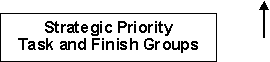



Health and Wellbeing
Board Structure
3 Purpose and function of the Board
3.1 The Partnership Board exists to provide a platform for partners to work better together, to ensure that everyone in Hampshire is able to benefit from improvements in health and well-being. The Board provides strong leadership and direction of the health and wellbeing agenda by agreeing priorities for health and wellbeing. It seeks to hold partners to account and promote action in order to develop and implement Healthier Hampshire - Health and Wellbeing Strategy.
4 Key activities
4.1 The Board has only been in operation for just over one year. During that time it has focused on bringing members up to date on current issues and activities. It has begun to develop a structure that will be best placed to monitor developments. To this end a multi- agency performance group has been developed to track progress and produce detailed reports on LAA targets for both the Board and LAA Executive.
4.2 On 23rd June 2009 the Board held its first annual conference. This offered an opportunity to showcase good practice, launch the consultation of Healthier Hampshire and further develop the focus of the Board. The conference was extremely popular and was over subscribed. Plans are already being developed for next year's conference which will take place on 18th June 2010.
4.3 On the 18th September 2009 the Healthier Hampshire consultation concluded. Over 1000 people took part in the consultation and176 formal responds have been received from individuals and organisations within the deadline. Over 47 events took place across Hampshire and these have consisted of presentations, briefings, workshops and seminars. A wide range of stakeholders have engaged in the consultation including:
· People who live and work in Hampshire - service, users, patients and carers,
· District, Borough, Town and Parish Council's,
· Local Strategic Partnerships and Area Fora,
· Voluntary and Community Sector
4.4 On 14th October the Partnership agreed the draft Strategy with a view that it be shared with all member organisations. It will therefore be presented to Cabinet on 23 November 2009. A copy of Healthier Hampshire and Cabinet report can be downloaded from /decisions/decisions-index/index-mtg-249
The three priority areas of the Strategy will be
Promoting healthy lifestyles
Increased opportunities for more people to take greater responsibility for their own lifestyles by promoting healthy living
Focusing on people at risk through early intervention
Proactively identifying people whose independence is at risk in order to halt or slow down any deterioration in physical and emotional wellbeing
Healthy communities
Seeking to ensure that all sections of the community experience better health by addressing the wider determinants of health through targeting neighbourhoods and groups in greatest need
Section 100 D - Local Government Act 1972 - background documents | |
The following documents discuss facts or matters on which this report, or an important part of it, is based and have been relied upon to a material extent in the preparation of this report. (NB: the list excludes published works and any documents which disclose exempt or confidential information as defined in the Act.) | |
Document |
Location |
IMPACT ASSESSMENTS:
1. Equalities Impact Assessment:
The principle behind the Strategy is to protect and promote health and wellbeing of all citizens. This will require taking a location based approach as well as targeting specific communities of interest.
2. Impact on Crime and Disorder:
Addressing health and wellbeing will have an impact on reducing crime and disorder. There are numerous cross cutting issues such as alcohol and drugs misuse and domestic abuse. Specifically action is taking place in relation to alcohol through the work being carried out to reduce alcohol related hospital admissions.
3. Climate Change:
3.1. How does what is being proposed impact on our carbon footprint / energy consumption?
At present, there is no impact on HCC carbon footprint or energy consumption. However increased collaboration offers opportunities to reduce duplication of effort and support efficiencies by partners sharing resources in relation to building, budgets and personnel.
a) How does what is being proposed consider the need to adapt to climate change, and be resilient to its longer term impacts?
Planning for the future to address health and wellbeing requires awareness of climate change. This requires understanding the collation between issues such as air quality and severity of weather on respiratory and cardiovascular disease, food safety and food poisoning, and allergenic disease such as asthma and rhinitis. Implementation of the Strategy will need to be mindful of the impacts of climate change and seek to mitigate disproportionate impact on vulnerable groups.