Archived decisions
Agenda item: 14
HAMPSHIRE COUNTY COUNCIL
Decision Report
Decision Maker: |
Pension Fund Panel | ||||
Date of Decision: |
20 November 2009 | ||||
Decision Title: |
Economic and financial background | ||||
Decision Reference: |
1080 | ||||
Report From: |
County Treasurer | ||||
Contact name: |
Harvey Cole | ||||
Tel: |
01962 865930 |
||||
1. Executive Summary
1.1. The following are the thoughts of the Independent Adviser as at 11 November 2009.
1.2. On this occasion I have concentrated on the financial aspects and prospects to the virtual exclusion of economic matters. Suffice it to say that, at the present time, the latter are unusually dependent on the course of the former and that a testing time for the strength and sustainability of the current tentative improvement of the economies of the main developed countries will occur between now and early 2010.
2. Background - a potted history of banking
2.1. Banking is said to originate from goldsmiths undertaking (for a fee) to look after the valuables of medieval soldiers or merchant venturers when they went off to war or on trading expeditions.
2.2. They soon discovered that they could loan out part of these `deposits' at interest - and that it was quite safe to tie up about a tenth of the total they held as the other 90 per cent would remain untouched.
2.3. The first brilliant innovation was the discovery of double-entry book keeping. This followed the realisation that if you lend someone money, that loan represents both an asset and a liability. As long as the loan is duly repaid, this meant that you could lend up to 90 per cent of your total balance sheet.
2.4. Modern banking came to be leveraged to the extent that as little as 5 per cent of risk capital could appear to support 30 times as much on the loan books.
2.5. Occasionally, when depositors wanted to hold more cash, banks ran into a liquidity problem but, outside of a widespread financial or economic crisis, any resultant panic was kept in check by the unaffected institutions rallying around to assist their afflicted colleagues.
2.6. The next leap came when banks widened their function beyond simply making advances to customers and keeping the transaction on their own books. Traditional commercial banks started to operate in the same way as merchant (or as they came to be known) investment banks. They started to trade on their own account in specialist markets such as foreign currency, options and transactions in commodity futures, using their ordinary customers' cash balances to provide much of the operational capital.
2.7. Eventually, many of them came to use securities deposited by their customers against their loans as collateral for their own `proprietary' business. (When Lehman Bros eventually collapsed this involved many of its own debtors finding that their collateral had evaporated. This process, known by the ugly term of `rehypothecation', was regarded as quite normal in the banking world - although frowned upon when, as recently with UBS, individual employees were found to be using clients' funds in this way on their own initiative).
2.8. The final stage in the increasing sophistication of the banking process was securitisation. Instead of keeping loans to customers, and therefore also the accompanying risk, on their own books, banks bundled up parcels of mortgages and commercial securities into instruments containing `tranches' of varying degrees of risk which were then sold to investors. The proceeds of these sales were then channelled into making further loans or speculative transactions.
2.9. In theory there was no limit to the number of times this merry-go-round could be repeated and capital profitably recycled at ever higher multiples of basic equity. At the same time it was assumed that the wide dispersion of risk was tantamount to reducing it substantially, if not to vanishing point.
2.10. We all know what happened when the resulting runaway inflation of house prices and other financial assets finally, and inevitably, led to the bursting of the resultant bubbles.
2.11. In a famous passage, Adam Smith, in `The Wealth of Nations' wrote:
"(Every individual) generally neither intends to promote the public interest, nor knows how much he is promoting it .... he intends only his own gain and in this he is .... led by an invisible hand to promote an end which was not part of his intention .... by pursuing his own interest he frequently promotes that of the society more effectually than when he really intends to promote it."
2.12. What the experience of the last two years has demonstrated is that there is more than one way in which the combined efforts of many individuals can promote an unexpected and unintended outcome: an altogether too visible fist has dislocated the workings of the delicately intricate mechanism of money and finance.
3. Mending the system
3.1. A new industry has been growing up, with the self-appointed aim of putting the banking system to rights. One of the biggest problems is that, because of the economy as a whole relies for credit to underpin its operation, and even more its expansion, the banks have to be kept alive.
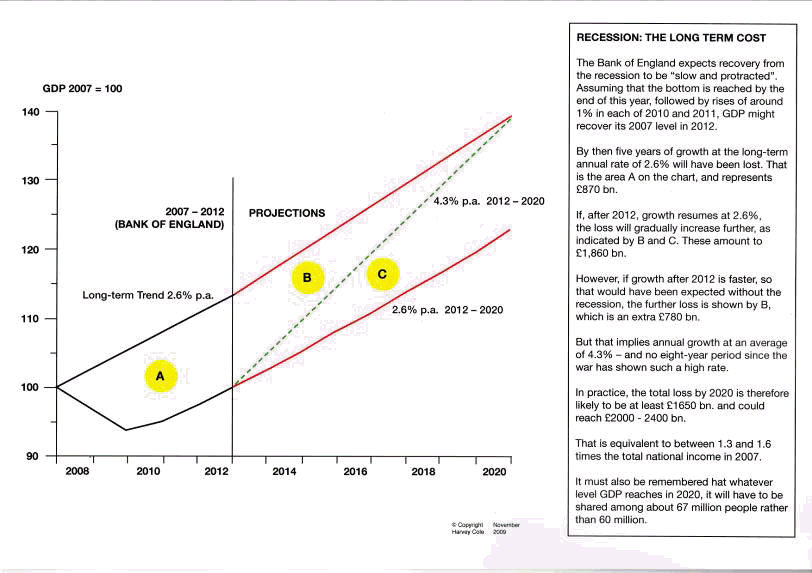
3.2. Thus enormous sums of money have been pumped in by governments, with the result that taxpayers (and shareholders) have plugged the enormous holes caused by fearsome losses, and banking as a whole is again highly profitable in less than two years in spite of the enormous damage caused to the world economy (as a chart appended to my report shows, even on optimistic projections, that damage will cause the loss of more than a whole year's GDP in the case of the UK).
3.3. The process has also, unfortunately, seemed to confirm the belief of leading bankers that they are a special elite group, if not a race apart, as shown by Lloyd Blankfein, head of Goldman Sachs, who claims that by making large profits the banks are doing God's work for him.
3.4. Most suggestions for reform concentrate on two lines of action. First, in some way to split banks into those providing traditional customer-based services - mainly taking deposits and lending them for personal and business purposes while keeping these loans on the bank's own books - and secondly, the banks which undertake entrepreneurial activities on their own behalf. Secondly, closer and tighter regulations of banks is proposed, centred on greatly increasing their equity capital and other internal resources used to underpin activity, thereby reducing the level of risk, and preventing the use of customers' deposits to finance banks' own ventures.
3.5. Unfortunately, trying to define banks into one or other of two categories is likely to prove frustrating and unsatisfactory. After all, in any such classification Lehman Bros and Northern Rock would certainly be in different categories, and yet they both imploded spectacularly.
3.6. More promising is to require operations of all banks to support various activities by specific levels of their own capital directly related to the risk attached to each transaction - together with ensuring that they retain a slice of any securitised deals on their own books.
3.7. This would of course need a high degree of oversight, and would involve lower leverage, a reduced return on capital and slower expansion. These would be a small price to pay for a smoother pattern of operation and the reduction in the risk of frenetically high returns for a run of years being more than wiped out by a sudden collapse every decade or so.
4. Cyclical remedies are not enough
4.1. There is a danger of overlooking the need to make sweeping structural changes in the organisation and operation of the financial system. It is necessary to look beyond the immediate cyclical problems: simply attempting ad hoc solutions to deal with those merely ensures a repetition of recent events a few years down the line.
4.2. The apparent swift return of the banking system to robust health (after taking perfunctory care of the walking wounded and writing off a few fatalities) illustrates the danger of reverting to former (bad) habits because the storm has for the moment apparently blown itself out. The risk is all the greater because not merely do the banks seem to have come through the storm robustly, but because this seems to have led them to believe that this is entirely due to their own achievements rather than to massive assistance from the state, for which the rest of the country will be footing the bills for many years to come.
4.3. Indeed, one could almost say that the banks have never had it so good.
4.4. The difficulties that many companies find themselves in have opened up new opportunities for bringing about mergers and acquisitions. In spite of many studies having documented the fact that about two-thirds of such transactions destroy value rather than create it, takeovers and the search for (elusive) `synergy' go on apace. While many will fail, each and every one yields juicy fees to the professional adviser, led by the investment banks, that negotiate (and often instigate) these deals.
4.5. The enormous profitability of the banks is a classic example of how lack of competition leads to the ability to extract economic `rent' from a virtual oligopoly. Although they are nominally owned by shareholders, it has been the employees of the investment banks that have secured the lions' share of earnings.
4.6. As an example, in the ten years from 1999 to its collapse, Lehman Bros had net earnings of $21 billion. Over the same period employees received $50 billion including bonuses. In the year it collapsed (2008) a net loss of $22 billion wiped out the earnings over the whole of the rest of the decade, but employees still received $6 billion.
4.7. As a footnote, there are estimated to be 2,000 professionals (mainly lawyers and accountants) spread around the world trying to sort out the wreckage, at a cost to date put at $4 billion - or $2 million a head.
4.8. Any attempt to improve the system must take account of the ability of those in charge of its operations as well as repairing defects that can be found in its structure.
4.9. Leaving aside the way in which the pattern of incentives works to produce a lop-sided attitude to risk (a bonus for me if I win, and a bill for the shareholders and taxpayer if I don't) the sheer complexity of computerised and instantaneous ability to deal mean that all too often outcomes depend on the machine rather than their human operators - masters of the universe as they may call themselves.
4.10. Emerging stories of the collapse on Wall Street make it clear that many of those nominally in charge of enormous trading programmes did not really understand what their mathematical geniuses were telling them. In all probability the task may have become impossible for mere mortals. In that case, it is not much help to change those at the top, and continue to employ the alchemists whose arcane formulas always eventually end in a failure to turn lead into gold.
4.11. At the same time attitude to risk needs to change so that steady achieving of moderate returns is to be preferred over hectic short periods of wild profits and a worse overall outcome in the longer run. The pattern of incentives must therefore come right at the top of any list.
4.12. Nor can all businesses expect to secure the services of the best and brightest to fill their top positions anyway. Warren Buffet sensibly said that he prefers to invest in businesses that can be run by idiots because, sooner or later and idiot will. It follows that tasks at the top need to be redefined so that they do not require highly able people who nevertheless find themselves out of their depth.
4.13. Lord Turner recently put a large cat among the pigeons by querying whether a high proportion of business on the financial exchanges serves any socially useful purpose. With turnover on the foreign exchange and derivative markets amounting each week to a multiple of the total annual GDP of the entire world, he certainly appears to have a point.
4.14. Speculative operations have a role to play in assisting and smoothing the workings of the economy. The farmer who can sell his crop for a predetermined price well before he has even harvested it, or the manufacturer who can ensure he knows the cost of his raw materials months ahead and the amount he will receive in his own currency for his sales to foreign customers, benefit from the commodity and foreign exchange markets.
4.15. His transactions depend on finding someone to buy or sell to who will (for a price) assume the burden of the risk of price fluctuations.
4.16. But the markets are now dominated by transactions which are simply bets between two consenting parties, with no more direct interest that if they were just betting on who will score the first goal in a football match or drop the first catch in a Test.
4.17. One positive move is to reduce the total risk involved by setting up a clearing house, similar to those operated for many years by the banks, so that only the net amounts, rather than the vastly greater gross sums, are outstanding.
4.18. This could lead the way to a charge being made to those who do not have some actual economic interest either as a buyer or a seller. There is of course then the problem that, unless such a scheme applied to all relevant markets in every country, business could shift to those outside the net.
4.19. There are two points to be made here. First, existing stock exchanges operate fees and charges which vary considerably, as do Government duties on transactions, and, in practice, if the markets handling the majority of transactions came on board it would prove unrewarding to engage in transactions in non-participating jurisdictions.
4.20. The main objection to the recently revived idea of the so-called Tobin tax on financial transactions is not so much its practicality but the failure to appreciate its impact.
4.21. A proposed rate of 0.05 per cent sounds absolutely minimal. But instead of putting a useful grain or two into the financial machinery to deter transactions with no positive purpose, it could cause the machinery to seize up.
4.22. If applied to financial trading of an estimated £50,000 billion a year in the UK (just over three times its GDP), the resultant revenue would be £25 billion, or nearly 5 per cent of all Government income. Unfortunately, while this is indeed only a tiny percentage of turnover, it represents a much higher proportion of the profitability of the business. The unreality is shown by the fact that, if achieved, this income would be about four times as much as all the corporation tax paid by the entire financial sector last year.
4.23. If the sector is indeed to be reduced in its importance, the most reliable way is, ironically, to encourage more competition and to tax its present monopolistic `rent'.
4.24. This would also counter the rise in bank lending within the financial sector itself, at the expense of loans to productive businesses. US banks in 2007 channelled 80 per cent of their advances to the `real' economy, up from 50 per cent in the `50's and 60 per cent three decades later.
4.25. Lending to productive business will normally create a surplus out of which borrowers can both repay and make a profit. Financial assets do not necessarily do the same, and to sell at a profit will involve the creation of more debt and will be a zero sum game unless the rest of the economy can provide more money to support that debt. As the bubble grows, more and more funds tend to be attracted to financial assets, thus increasing the debt level and with it the costs of servicing the loans, and finally depressing consumption and the scope for profitable expansion of the rest of the economy.
5. QED - quantitative easing dissected
5.1. The original intention of the QE process was to provide the banking system with cash in exchange for Government bonds and other high-quality fixed interest securities. (In the event its purchases have been well over 90 per cent in gilts, to the point where the authorities are sitting on almost a third of all gilt-edged stock in issue.)
5.2. The banks were then supposed to be encouraged to make loans to industry and commerce to sustain their liquidity and provide finance for investment and expansion. Things have worked out rather differently.
5.3. First, there has been leakage: a significant proportion of the securities tendered was from foreign owners, and the domestic effect of that was very limited. Then, the banks found themselves presented with the biggest opportunity that had come their way for a risk-free `carry' trade - without even any exposure to foreign currency risk.
5.4. They have happily sat back borrowing funds from the Government at 0.5 per cent, and immediately reinvested the proceeds in 10 year gilts at price yields that have steadily advanced from 3.4 to 3.9 per cent since the scheme started.
5.5. At the same time surviving banks took advantage of the casualties among their ranks to improve their margins on their normal operations: foreign currency offered more profit and the general level of charges was pushed up.
5.6. Most noticeable was the widening of the differential between interest paid on personal accounts and the charges for overdrafts. Recently interest has been reduced by, typically half to a mere 0.5 per cent, while even fully authorised overdrafts now cost 11 per cent or more.
5.7. The effect of this has been to lead customers to run down the balances they hold and to reinvest in a wide variety of other assets. Indeed, by putting money back into stock markets and supporting companies raising fresh capital, the private investor has been largely meeting the function that was intended for the banks.
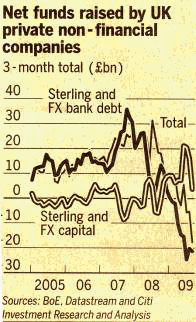
5.8. To some extent, therefore, the complaint that the banks are `not lending' has been concealing the fact that business borrowers have, by and large, been able to meet their financial requirements, although the smaller less credit-worthy companies have continuing difficulties. Nevertheless it seems to be the case that it is harder to raise money to roll over existing borrowing than to finance growth: quarterly figures for total new credit have been steadily declining since mid-2007 as the following table shows.
5.9. The QE programme has therefore had a positive effect, although diluted by the unexpected way in which it has worked in practice. It is certainly the case that, without it, economic conditions would have deteriorated further.
5.10. The question now assuming importance is, given that QE looks like ending in February, whether the withdrawal of this crutch will leave business able to walk without its support - let alone start running to catch up.
5.11. Meanwhile the boom in banking profits continues at a pace which makes shooting fish in the proverbial barrel look very difficult. It is rather like paying the croupiers in a casino large salaries for shuffling the cards at the blackjack tables, and then rewarding them further with enormous bonuses.
5.12. While reality will intervene eventually to bring bank profits back towards earth, it is sobering to note that this year will see the contribution of the financial sector in the US reach an all-time high as a proportion of the total output of all corporations at 19 per cent.
6. Inflation or deflation
6.1. The answer is probably `flation'.
6.2. There are opposite and closely balanced opinions as to where the price level is heading, both in this country and many others.
6.3. Fears are widespread that the need for numerous governments to bring down the high levels of public sector borrowing that have been encouraged in order to prevent economic collapse will lead to the soft option of deliberately inflating part of the debt mountain away rather than adopting the sterner course of a combination of cuts in public expenditure and raising taxes.
6.4. On the other hand there is apprehension that cutting off the inflow of money would risk a cumulative slowing in activity and lead to a deflationary renewal of recession.
6.5. In practice, an outbreak of sharply rising inflation looks unlikely. There is a substantial amount of productive capacity currently underused or temporarily not in use at all which could cushion a revival in demand without putting any great pressure on prices. Indeed, it could well prove the case that the recent sharp rises in commodity prices reflect the pressure of an indiscriminate rush into assets of any kind instead of low-yielding cash rather than anticipation of a recovery in industrial output. (On the other hand, it is possible that some of the under-utilised capacity that we now have will prove redundant to future requirements.)
6.6. It is possible to be over-intimidated by the sheer apparent size of public debt. In this country we have led a sheltered existence due to the arbitrary adoption of a ceiling target for public debt traditionally set at 40 per cent of GDP. There is no logical justification for this figure. However, as it rises towards 90 per cent over the next few years, it takes on the appearance of a monstrous burden - quite apart from the fact that most major economies are contemplating similar levels, and that many of them were operating in more `normal' times on ratios well in excess of 40 per cent anyway.
6.7. Martin Wolf of the Financial Times put things in a commonsense perspective recently when he pointed out that the real interest rate on US public debt is under 2 per cent, so that if the debt reached 100 per cent of GDP annual growth at 4 per cent, including 2 per cent for inflation, would stabilise the real level of debt. (He thoughtfully added: "this is an observation, not a recommendation.")
6.8. However even a small rise in prices may persuade at least some countries to start putting up interest rates as a precautionary move. If this is combined with the withdrawal, or sharp reduction, in continuing measures to stimulate sluggish economies, the scales could swiftly shift towards deflation again. The question has been asked: "how would consumers cope with interest rates and taxes rising simultaneously?" (A further complication is what might be thought to be a favourable trend: productivity has been rising very sharply in many countries, including Britain and the US as employment is falling faster than output. This would tend to hold back the rate at which jobs increase again. This effect would be intensified the slower any recovery.)
6.9. But the potential elephant in the room is the strong possibility that the balance sheets of many banks still conceal a more toxic assortment of dubious assets than they would like us to believe. In addition, there are what might be called `normal' losses on commercial transactions which are being carried forward but which will eventually have to be written off.
6.10. The IMF has estimated that total losses to the world's banking networks since the beginning of 2007 amount to around $3,000 billion of which just under half have so far been written off. Even if the remaining losses are reduced by a better than first expected rate of eventual recovery, the largest liability is in the US, at around £400 billion but that represents only 40 per cent of the original total. The UK will need to write off a slightly smaller amount $380 billion but that is 60 per cent of the original amount. Europe has further liabilities of even more than the US at over $500 billion and is the worst placed area as this is still over 60 per cent of the initial figure.
6.11. Filling the gap will require substantial injections of new capital. It has been calculated that to raise event the present 4 per cent level of `tangible common equity' the UK needs an injection of about $110 billion over the next two or three years; the US $120 billion and the Euro area a massive $300 billion unless such amounts are found - and diverted from other uses.
6.12. On top of this, banks also face stiff requirements to roll over existing debt. Between now and 2012 bonds to the value of $7,000 billion will mature worldwide, with a further $3,000 billion falling due by 2015. About half is accounted for by the US and will have to be raised by American banks. The average maturity for their debt halved to 6.5 years in the three years to 2009, and at the moment it looks as if it would cost 7 extra percentage points of interest to replace expiring bonds with 10 year paper. The chart below shows the sharp increase in bond funding expected in the US and Europe next year:
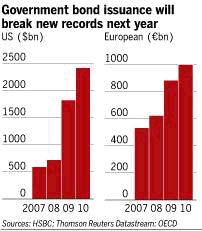
6.13. This raises the prospects of banks actually having to shrink their asset base, requiring other institutions to increase still further their share of commercial bond issuance, which has already risen 44 per cent since the beginning of this year, while the banking system reduced its activity in this field by 14 per cent.
6.14. The balance of the odds remain on the deflationary side. It may be noted that low inflation tends to reduce the real rate of earnings on company shares, even though these may increase in nominal terms.
7. De-re-Globalisation
7.1. Second only to the effect of governments all over the world supporting their economies by pumping in cash and taking other measures to sustain demand, a partial reversing of the globalisation process has played a major role.
7.2. Initially, not merely did the Asian economies and those of other emerging nations such as Brazil participate in the collapse of 2007-8, but at times also seemed to be leading the downward rush. Subsequently, however, they began to decouple, with China and Brazil in the lead. Indeed, it is now estimated that even at its reduced rate of expansion (around 8 per cent this year) China could contribute two percentage points to an increase in world GDP next year.
7.3. Total world output is projected to raise by perhaps 3 per cent, so that the earlier feared decline seems as if it will be avoided. However, this will be just about in line with the continuing growth in world population.
7.4. It will also be accompanied by a rebalancing of the world economy as a whole. If China, and other emerging countries, expand by more than the rate for the global economy, there must be a corresponding contraction in the level of GDP in the developed countries.
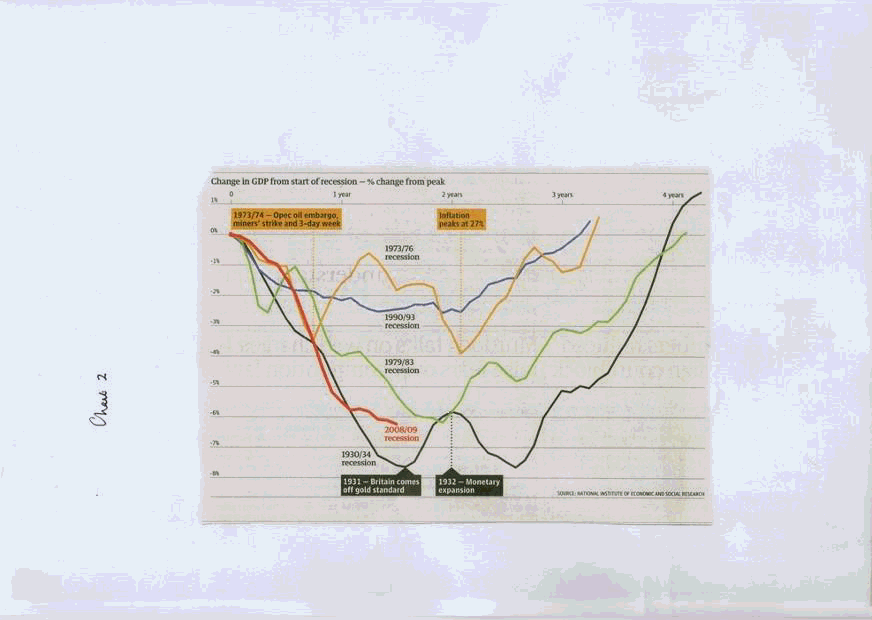
7.5. Indeed, the effects of the recession will be quite sharp and will continue for many years. As well as causing the loss of at least one year's entire national income in the UK as already mentioned, the downturn has been almost as sharp as in the Great Depression of 1929-34 - as shown on the second of the appended charts.
7.6. Rebalancing the global economy does not in itself ensure continuing steady progress. That the particular problems that will arise have emerged before is no guarantee that they will be effectively solved this time round.
7.7. "There must be a readjustment of the balance of exports and imports. America must buy more and sell less". That is J M Keynes writing in 1921.
7.8. Even more striking is the following:
"As long as we have a policy of promoting exports and of a full collection of debts, so long must we finance our exports very largely through the medium of lending foreigners the money to pay for them."
That was John Foster Dulles in 1928. Of course he was talking about the US but today his words apply with equal force to China.
7.9. The imbalance of Chinese foreign trade has subsided to some extent this year: exports have fallen and imports are up, and strong efforts are being made to stimulate the domestic economy and private consumption to offset the millions of jobs that have been lost in the export sector.
7.10. All is not plain sailing however. Part of the rise in imports seems to be due to stockpiling of raw materials against possible future price increases, and while private consumption has been rising, its share of GDP has actually fallen from 49 per cent in 1990 to 35 per cent this year.
7.11. This is partly because investment has increased very rapidly going up from 35 to 44 per cent of GDP over the same period. Because of the concentration on developing the country's infrastructure, the rise in employment has been subdued and the Chinese still have to pay from their private incomes for much of the health services and even education.
7.12. The pace of investment has led to soaring bank loans, and a consequent leakage of funds into speculative ventures of all kinds. The Government is trying to control this, but there are signs that a financial bubble may be building up. So far defaults and the level of non-performing loans have remained relatively low, but there are ominous signs that beneath the surface things are deteriorating: some major government guaranteed bonds are being rolled over on reaching maturity for a whole decade without any explanation.
7.13. The main continuing concern, however, remains the rate of exchange. China, after allowing an appreciation of the Rmb of as much as 20 per cent between 2006 and 2008, is now keeping the rate steady against the dollar again. And other Asian countries, from South Korea and Taiwan to Thailand and the Philippines, are following similar policies. As a result the proportion of the world's currency reserves has risen in the past year from 62 to 66 per cent.
7.14. Thus, the Chinese dilemma echoes that of the US in the late `twenties. Maintaining the value of its currency ensures that trade imbalances continue to distort world trade, and throws the burden of adjustment disproportionately on other currencies such as the euro. On the other hand, allowing the Rmb to appreciate is to incur corresponding losses on China's vast holdings of US Treasury bonds, while selling these would not only crystallise that loss but play havoc with the financial position of the US.
7.15. The much commented on purchase of 200 tonnes of gold by China earlier this month is irrelevant in terms of diversifying the country's reserves. The $6.7 billion cost represents only just over 2 per cent of its total stock. What is more is that this purchase amounts to about 5 per cent of the total annual world production of gold. Put another way, if China were to buy up every ounce of gold produced this year, the metal would still account for less than 8 per cent of its reserves.
7.16. There is no clear cut answer to how the Chinese conundrum can best be resolved. That means that the threat of some implosion of the developing credit bubble will remain a threat to world recovery into the future.
7.17. The other side of that coin is the paradoxical behaviour of the US dollar, which is only aggravated by the Chinese puzzle. It is paradoxical because the dollar has tended to be strong when the US economy looks weak, and to resume a downward drift when conditions appear better. The explanation is that the dollar is regarded as a safe haven in times of uncertainty, and the security attached to it then outweighs immediate return. When things appear more rosy, the appetite for risk and its possible rewards reasserts itself and the dollar is sold again.
7.18. But there is considerable danger in the current trend for the dollar to be used as the low-yielding currency to finance international `carry' trading, replacing in that role the Japanese yen several years ago.
7.19. If, or perhaps when, something occurs to check this activity, the speed and scale on which outstanding market positions will be reversed will be faster than the eye and the hand can adjust to and a major crash could follow.
7.20. The world benefited from a pause and partial reversal of the trend to globalisation this year. There are clearly difficulties with a world economic system that is totally harmonised, and which would tend to magnify both upward and downward fluctuations. But in the longer run globalisation will resume - there is no other game in town.
8. Domestic matters
8.1. In this section I comment on several points more closely affecting the performance and organisation of the pension fund.
A. Investment Theory
8.2. The collapse of the markets struck a damaging blow to the so-called efficient market theory - the idea that prices always reflect all the information available and behave in an entirely rational way.
8.3. This always seemed open to the challenge that, if this were so, why would investors and their advisers always be searching for apparent anomalies in quoted prices and, at least occasionally, profiting from their efforts?
8.4. More recently it has clearly emerged that mathematical models based on statistical theories that assume a `normal' or bell-shaped pattern of outcomes may be reliable for much of the time, but when they fail the result can be catastrophic. The investment world does not work in the same way as biology.
8.5. People are far more irrational than they are prepared to accept, and are prone to accept more readily evidence which accords with their initial opinion and to dismiss anything that conflicts with them.
8.6. The simplest example of irrationality in investment is the widespread habit of labelling some particular price level, such as a round figure like 5,000 on the FTSE, as important or `psychologically significant'. Rationally, no price is significant in itself
8.7. The art of investment is not so much in getting it right yourself, but to anticipate what the balance of opinion will be: failure to appreciate this explains the continual complaints by, for example, chairmen of companies whose shares have failed to rise that `the market does not understand us'.
8.8. A valiant attempt has been made to rescue the beleaguered hypothesis by arguing that a mistaken belief can nevertheless be entirely rational. For example, if you happen to believe, on the basis of the best evidence you have, that thunder is the result of gods expressing their anger, then you are behaving sensibly if you act on that belief.
8.9. That is true, but what does not follow is that your actions remain rational once you become aware that thunder in fact has a different cause.
B. Flexibility
8.10. Recent events have demonstrated that asset allocations made for a three-year period (even with a built-in range) can become outdated well within the chosen time-scale. This can occur either through changes in the relative attraction of different asset classes, or through differential price movements between classes.
8.11. The challenge is to secure flexibility without falling into the trap of making frequent short-term changes in investments.
8.12. The Pension Fund is exploring possible methods of achieving this - and a suitable vehicle, if identified should then probably be treated as a distinct alternative asset class of its own.
8.13. The possibility of having an option to vary, at a suitable notice, the amount included in existing mandates should also be investigated.
C. Funding and Viability
8.14. The idea of calculating the effective funding level of the scheme at a variety of future dates instead of simply on an overall basis has been included in the recent response to consultation by the Government.
8.15. A further step in this direction might be to analyse the Pension Fund's portfolio into segments related to the liabilities arising at different future dates. Thus, a portfolio appropriate for meeting pension liabilities in the next five years would differ from the pattern required by those retiring between 5 and 10 years, and so on.
8.16. Taking the idea to its (hopefully) logical extreme, mandates to managers could be constructed and allocated to reflect this. For example, a portfolio for retirees within the next decade could be made up predominantly of index linked bonds, whereas future pensioners twenty years ahead would require investments with greater growth potential, but also have a time-scale in which the associated additional risk could be absorbed.
D. UK and Global Equities
8.17. There has been some discussion of the balance between the two mandates. At present UK equities account for 13 and 15 per cent of value of holdings in our `global' portfolios - incidentally, 50 per cent above the benchmark proportion.
8.18. The main argument for holding UK shares (more accurately shares in London quoted companies) is the avoidance of currency risk. However eight of the ten largest holdings in Aberdeen's portfolio earn well over half their profits abroad and are therefore exposed to currency risk in any event.
8.19. Of the combined end-September value of Aberdeen's global and UK portfolios of some £580 million some £250 million is in London-quoted securities, or around 43 per cent.
8.20. It may be preferable to split the equity mandates differently, with two being global in coverage but with one specialising in large companies and the other on smaller ones. It is a reasonable guess that in emerging markets it will prove to be the latter that, given the sound selection, will show the better growth. The distinction between `Low Risk' and High Performance' (not, incidentally, `High Risk and Low Performance(!)) should perhaps disappear.
8.21. The third equity portfolio could then possibly have an unfettered discretion as to what companies to invest in.
Rip Van Winkle Portfolios: Performance to 30 October 2009
Background
These portfolios were established, on a dummy basis, in November 2008 to test the suggestion that, over the following two years, there would be little difference between an investment in cash and one in the FTSE All-share index - or between varying mixtures of cash and the index.
The outcome up to the end of October is summarised below:
Investment |
2008 30 November |
2009 30 June |
2009 30 October | |||
FTAS |
% |
Cash |
||||
RVP 1 |
100 |
0 |
100 |
99.24 |
119.45 | |
RVP 2 |
75 |
25 |
100 |
100.36 |
115.92 | |
RVP 3 |
50 |
50 |
100 |
101.48 |
112.40 | |
RVP 4 |
25 |
75 |
100 |
102.61 |
108.88 | |
RVP 5 |
0 |
100 |
100 |
103.74 |
105.36 | |
NOTE: Dividends/Cash reinvested gross
After almost one year of this two-year experiment, the All-Share index has more than recovered its initial 10 per cent lag recorded in February.
The race is not yet over, but it is worth noting that the maximum level that can be recorded by the cash portfolio by November 2010 is 113.5 of its starting value.
CORPORATE OR LEGAL INFORMATION:
Links to the Corporate Strategy
Hampshire safer and more secure for all: |
yes/no |
Corporate Business plan link number (if appropriate): | |
Maximising well-being: |
yes/no |
Corporate Business plan link number (if appropriate): | |
Enhancing our quality of place: |
yes/no |
Corporate Business plan link number (if appropriate): | |
OR | |
This proposal does not link to the Corporate Strategy but, nevertheless, requires a decision to accept the comments of the Independent Adviser. | |
Other Significant Links
Links to previous Member decisions: |
|||
Title |
Reference |
Date | |
Direct links to specific legislation or Government Directives |
|||
Title |
Date | ||
Section 100 D - Local Government Act 1972 - background documents | |
The following documents discuss facts or matters on which this report, or an important part of it, is based and have been relied upon to a material extent in the preparation of this report. (NB: the list excludes published works and any documents which disclose exempt or confidential information as defined in the Act.) | |
Document |
Location |
IMPACT ASSESSMENTS:
1. Equalities Impact Assessment:
1.1. Equality objectives are not considered to be adversely affected by the proposals in this report.
2. Impact on Crime and Disorder:
2.1. The proposals in this report are not considered to have any direct impact on the prevention of crime.
3. Climate Change:
a) How does what is being proposed impact on our carbon footprint / energy consumption?
No specific impact.
b) How does what is being proposed consider the need to adapt to climate change, and be resilient to its longer term impacts?
No specific impact.
Chart 1