
Archived decisions
HAMPSHIRE COUNTY COUNCIL
Decision Report
Decision Maker: |
Cabinet | ||||
Date of Decision: |
23 November 2009 | ||||
Decision Title: |
Healthier Hampshire - Health and Wellbeing Partnership Strategy | ||||
Decision Reference: |
879 | ||||
Report From: |
Director of Adult Services | ||||
Contact name: |
Samantha Hudson | ||||
Tel: |
01962 845605 |
Email: |
|||
1. Executive Summary
1.1. The purpose of this paper is to provide information on the process taken to develop Healthier Hampshire - Health and Wellbeing Partnership Strategy, the key messages gained from the consultation and the partnership Strategy document.
1.2. This paper seeks cabinets approval of Healthier Hampshire - Hampshire's first Health and Wellbeing Partnership Strategy.
1.3. The starting point of the partnership Strategy was the Joint Strategic Needs Assessment, Local Area Agreement (LAA) priorities and the aspiration for health and wellbeing as described in the Shaping our future together - Hampshire Sustainable Community Strategy 2008-2018. The Strategy document has been significantly shaped by the views of people who live and work in Hampshire through an inclusive 3 month consultation.
1.4. The Strategy will give partners the opportunity to express their commitment to working better together and using innovative approaches to join up the way they work. This will involve sharing existing resources in relation to expertise, buildings and staff in a more cost effective and efficient way. By working better together there will be a reduction in duplication leading to improved productivity and efficiency. This will result in increased opportunities to improve the quality of experience for citizens.
1.5. Healthier Hampshire will provide a joined up approach to meet the shared objectives of partners to tackle unhealthy lifestyles, health inequalities and join up health and social care responses.
2. Contextual information
2.1. Hampshire Health and Wellbeing Partnership Board (the Board) operates as a thematic partnership within the context of the Sustainable Community Strategy and Local Area Agreement.
On the 23rd June 2009 the Board launched a 3 month consultation in order to develop the first Hampshire Health and Wellbeing Strategy - Healthier Hampshire.
2.2 The Strategy seeks to add value to the current activity being carried out by partners by articulating the shared strategic partnership focus and defining an agreed set of strategic outcomes.
2.3 The Strategy is informed by the feedback form the consultation and illustrates areas where one or more partners have agreed to work together to deliver improved outcomes.
2.4 Although health and well being in Hampshire is generally considered to be good there are still areas that could be improved. The 2008 Hampshire Joint Strategic Needs Assessment highlighted
· demographic changes, with the number of over 65's rising by 14% by 2012 and people with dementia set to double over the next 30 years
· inequalities in life expectancy in key population and geographic areas,
· the main causes of death in Hampshire are cardiovascular disease (coronary heart disease and stroke) and cancer
· growing rates of obesity in adults and children
Poor health and wellbeing has a negative impact on individuals, families, communities and the economy. To maintain good health and wellbeing it is important to ensure the right social, economic and environmental factors are in place. All departments of the County Council have a part to play in improving health and wellbeing as the diagram below illustrates.
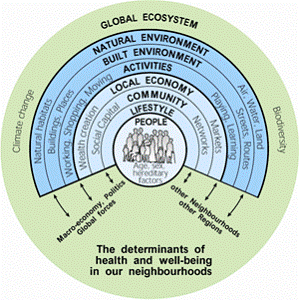
The Health Map, Barton and Grant 2006 based on a public health concept by Whiteread and Dahlgren, The Lancet 1991
2.3 The County Council, District and Borough Council services can have a positive impact on health and wellbeing. Areas such as planning, refuse collection, leisure facilities, countryside management, housing, education and social services all can make a contribution to improving health and wellbeing of citizens.
3. Finance
3.1. The Strategy will give partners the opportunity to express their commitment to working better together and using innovative approaches to join up the way they work. This will involve sharing existing resources in relation to expertise, buildings and staff.
3.2. The Strategy will enable partners to better utilise existing resources by achieving economies of scale, reducing duplication and waste. As the Partnership matures there will also be opportunities to be better placed to bid for additional funding and grant aid.
3.3. In line with the Government's funding regime for the Area Based Grant there is the potential for the County Council, as lead partner, to consider the future direction of the spend of the grant and how it might best support delivery of the Strategy.
3.4. Healthier Hampshire will support delivery of the designated targets from theme F of the LAA. It will therefore support partners to take action to achieve LAA targets. Action taken will contribute towards the release of LAA incentives through the designated targets which will determine the level of reward money received for the overall LAA.
4. Performance
4.1. Healthier Hampshire prioritises actions that will contribute to the following targets:
LAA Priority |
Indicator |
Manage the risk of emergency hospital admission and length of stay, especially for vulnerable people |
NI 134 |
Provide information and support to enable older people to live independently |
NI 139 (LI F1) |
Improve health and wellbeing whilst reducing inequalities between areas with high and low deprivation scores |
NI 120 |
Reduce levels of smoking (those aged 16 and over who successfully quit smoking using NHS Quit Smoking Service) |
NI 123 (LI F2) |
Rushmoor | |
Gosport | |
Havant | |
Increase levels of physical activity (the number of people taking at least 30 minutes of exercise five times a week) |
LI F3 |
Promote independent living for vulnerable people |
NI 142 |
Tackle alcohol abuse |
NI 39 (LI F4) |
4.2. The achievement of these national indicator targets will contribute to the delivery and potential level of reward for the whole of the overall LAA.
4.3. The success of Healthier Hampshire will help support strategic partnership working. It will help to better position Hampshire County Council to fulfil it's community leadership function and support improved delivery in a variety of areas, particularly in addressing health inequalities. This will help provide a positive picture of progress made and provide strong evidence for the CAA.
4.4. The Health and Wellbeing Partnership Board are working to strengthen it's structure and function in order to maximise impact and ensure delivery of the Strategy.
4.5. A Performance Group has already been established with clear systems and cycles. This Group will increase the ability to evidence partners contributions and embed the tracking of progress into the work of the Board.
5. Developing the Strategy
5.1. Over 1000 people took part in the consultation and176 formal responds have been received from individuals and organisations within the deadline. Over 47 events took place across Hampshire and these have consisted of presentations, briefings, workshops and seminars. A wide range of stakeholders have engaged in the consultation including:
· People who live and work in Hampshire - service, users, patients and carers,
· District, Borough, Town and Parish Council's,
· Local Strategic Partnerships and Area Fora,
· Voluntary and Community Sector
5.2 The consultation asked three key questions
· What the key areas for focus should be,
· What difference the Strategy should make - the strategic outcomes and;
· Who should be responsible for delivering the Strategy.
6. Healthier Hampshire Strategy Document
6.1. The Strategy is being developed to reflect the views of Health and Wellbeing Board members and the key issues that have been presented from the consultation. It seeks to articulate a new approach for partners through having a clear commitment statement committing members to work through the Partnership Board to :
"provide a platform for innovation, providing coordination to joint action,
by supporting activities that make an increased contribute to good health
and wellbeing. Action will focus on using existing joint resources to do
things differently through adopting new ideas and methods in order
that places such as homes, schools and workplaces become
healthier places to live, learn and work".
The success of the Strategy is dependent on improved coordination in order to enable partners to work better together and develop a level of maturity that enables innovation and redirection of existing resources.
7. Timelines/next steps
7.1. The development of the Strategy is the beginning of a process to ensure a more focused and coordinated approach to improved outcomes for all Hampshire citizens. On the 14 October 2009 the Strategy document was presented to the Health and Wellbeing Partnership Board for consideration and amendment. Once all partner organisations have approved the Strategy it will be presented to the Senate in January 2010.
7.2. The timeline for developing the Strategy is as follows:
Annual Conference 23rd June 2009 (Consultation launch)
Adult Services DMT 10th September 2009 (information report)
Consultation closes 18th September 2009
CMT 30 September 2009
Adult Services DMT 5th October 2009 (draft Strategy)
H&WB Partnership Board 14th October 2009
All partner organisation October - December 2009 (approve Strategy)
HCC Cabinet 23 November 2009 (Strategy for approval)
NHS Hampshire 26 November 2009
8. Conclusion
8.1. Healthier Hampshire offers partners an unique chance to agree a joined up approach to tackling health and wellbeing issues across Hampshire. It will act as the focus for the work of the Health and Wellbeing Partnership Board, offering increased opportunities for innovation, better use of resources and consistent evidence based approaches. The most efficient and effective way of addressing health and wellbeing issue is for partners across the statutory, community and voluntary sector to come together in order to work smarter to deliver the necessary changes.
8.2. The Strategy offers an opportunity for the County Council to consider how it can best meet the health and wellbeing of both it's staff and the people that it serves. There is an opportunity to work more effectively with partners to delivery the necessary wellbeing gains, as well as consider how to ensure that it leads by example through providing a healthy workplace.
9. Recommendations
9.1. That Cabinet agree the Healthier Hampshire, Hampshire's first Health and Wellbeing Partnership Strategy
9.2. That Cabinet note the content of the report and the actions taken to ensure engagement.
Appendices
Appendix 1 Draft Strategy
CORPORATE OR LEGAL INFORMATION:
Links to the Corporate Strategy
Hampshire safer and more secure for all: |
Yes |
Corporate Business plan link number (if appropriate): | |
Maximising well-being: |
Yes |
Corporate Business plan link number (if appropriate): | |
Enhancing our quality of place: |
Yes |
Corporate Business plan link number (if appropriate): | |
Section 100 D - Local Government Act 1972 - background documents | |
The following documents discuss facts or matters on which this report, or an important part of it, is based and have been relied upon to a material extent in the preparation of this report. (NB: the list excludes published works and any documents which disclose exempt or confidential information as defined in the Act.) | |
Document |
Location |
IMPACT ASSESSMENTS:
1. Equalities Impact Assessment:
1.1. One of Healthier Hampshire starting points was the Joint Strategic Needs Assessment in order to take an evidence based and balance approach to developing the Strategy.
1.2. The consultation identified the need to work better with disadvantage groups by focusing on inequalities of outcome, access and engagement. The Strategy has therefore prioritised health inequalities and using an evidence based approach to ensure that action is targeted in communities and groups that are most in need.
1.3. Healthier Hampshire seeks to address health inequalities through addressing modifiable risk taking behaviours as well as support partnership actions that address the wider determinants of health.
1.4. The Health Inequalities Action Plan will focus partners attention on the key disadvantaged groups as well as working across Hampshire to determine geographic areas of need.
1.5. As the Health and Wellbeing partnership matures it will be better placed to focus action where it can best reduce inequalities. An annual equality check will be carried out to support partners to ensure that actions are having the desired outcome.
2. Impact on Crime and Disorder:
2.1. Healthier Hampshire will seek to address some of the underlying cause of crimes and disorder such as alcohol abuse and community cohesion issues
3. Climate Change:
a) How does what is being proposed impact on our carbon footprint / energy consumption?
Effective partnership working offers opportunities to reduce duplication and use resources better. By focusing on improving efficiency there will be opportunities to work with partners to better use resources collectively and reduce negative impact.
b) How does what is being proposed consider the need to adapt to climate change, and be resilient to its longer term impacts?
Healthier Hampshire seeks to support people to take greater personal responsibility for their health and well being. This involves better understanding the impact of their behaviours on their own bodies and the community that they live.
Part of the partnership approach to delivering the Strategy will work collaboratively to support solutions that are sustainable