
Archived decisions
Adult Services Department
Workforce Plan 2008/2011
Summary 2
Key Strategic Issues 2
Corporate Priorities for Adult Social Care 2
Budget 2
Performance & Efficiency 2
Hampshire Model 2
Self Directed Support 2
Free Crisis Care - Community Innovations 2
The Process and Efficiency Workstream of the Hampshire Model 2
Health Partnerships 2
Learning Disability Service Integration 2
Other critical issues 2
General Workforce Issues 2
Recruitment, Retention and Turnover 2
Remuneration 2
Employment and Skills Initiatives 2
Learning and Development 2
Summary
The purpose of this report is to outline a departmental workforce plan for Adult Services in line with corporate reporting requirements. The plan covers the three year period 2008/2011. The plan was refreshed in Autumn 2009 at the end of the first year of work on the Hampshire Model (see below). It supports the directorate service plans and is in turn supported by the Learning and Development Plan.
It aligns with the departmental budget whose workforce summary for 2009/10 is at appendix 1
Key Strategic Issues
The key and fundamental issue for Adult Services is its modernisation programme which seeks to deliver service improvement and long term sustainability, maintaining and improving outcomes for service users. In particular, the department has used the Hampshire Model, developed following the county council's Hampshire Commission of Inquiry into the Future Services For Adults In Need Of Support And Care, as the vehicle for this programme.
Adult Services has an intrinsic role to play in the development of strong communities with the capacity to facilitate real life opportunities for even their most vulnerable members.
Corporate Priorities for Adult Social Care
In support of corporate priorities, the department has identified a vision for adult social care "Life opportunities for all"
To support the development of thriving communities in which all people have real life opportunities, to make their own choices and contribute to their communities. We will achieve this by:
focusing on delivering the best possible outcomes for Hampshire residents, and the most vulnerable members of the community
learning from communities, valuing their diversity and ensuring equality of access to services
providing strong and effective leadership for staff, ensuring they are equipped with the appropriate tools to undertake their work
being accountable to the community through our elected members
delivering our services within the corporate framework of the County Council
working in partnership with internal and external partners in order to achieve best outcomes
regularly reviewing and improving our performance, ensuring that we are open, transparent and honest in all that we do
These are now supplemented by the Hampshire Model which forms the framework for departmental service planning and resource management.
Budget
The financial years 06/07 and 07/08 were extremely challenging for Adult Services because of additional care commitments deriving from the increasing complexity and level of need which in turn led to an accumulated overspend. Thanks to the modernisation approach the department met its target to recover financially by the end of 2007/08.
In 2009/10 the County Council made a significant investment in Adult Services' modernisation programme. Together with some funding from the Social Care Reform Grant (£9.6 million over 3 years) and the LD Campus Reprovision Grant (£6.1 million over 3 years) this has allowed approved growth of 138.5 new posts, 75 of which are permanent (see Appendix 2). These grants are time limited and very specifically support the modernisation of social care so the department has kept this provision under very close scrutiny as the work on the Hampshire Model has progressed.
It is the nature of change programmes of this scale that they are complex and require more detailed evaluation and planning. For this reason it is not possible to make firm predictions on the shape of the workforce in the long term. Work carried out in Year One of the Hampshire Model has enabled the department to start to flesh out its future shape, recognising that it will need to meet both current and future, growing demand within its present cost envelope.
Preparation for 2010/2011 Budget has focused on the priorities of Year Two for the Hampshire Model and the corporate efficiency drive.
Performance & Efficiency
Hampshire County Council Adult Services department was judged by CSCI (now CQC) as a three star performer in its 2007 and 2008 assessments. Maintaining this level of achievement has required strong leadership and support from elected Members and corporate colleagues. Adult Services staff have worked hard to ensure that services are of high quality with excellent outcomes for service users.
The characteristics that CSCI (CQC) looks for in order to award 3 stars are:
Strong management and leadership and a political commitment to social care
Emphasis on dignity and respect
Increased ability for people who use services to personalise services
People who use services, carers and staff are integral to service development
Effective strategic planning based on a robust needs analysis
Joint commissioning of services with health
Effective engagement with the local care market
A skilled and stable workforce
Robust financial management
Working with other agencies such as health, social care and police to improve adult safeguarding
Provision of internal and external adult safeguard training.
Hampshire Model
The Leader of Hampshire County Council, Cllr. Ken Thornber set up a commission of inquiry to help shape future services for people in need of support and care.
The Commission, formed of a number of significant names in the field of social care and with cross party support in Hampshire, sought to understand what `personalisation' means for individuals and the impact of implementation on all those who are involved in support and care.
They gathered people's ideas, comments and experiences in relation to the personalisation of adult social care, how social care can be funded, and how it will change the relationship between the state and service users.
The Commission report and recommendations helped the department to develop its approach to meet the challenges of personalising services, meeting the demographic changes and resource constraints and also informed the forthcoming government green paper on future funding of Social Care. Hampshire's response is called the Hampshire Model. The model also includes projects which are part of the wider transformation agenda to implement best practice, ensure improved joint working with health and the voluntary sector, or identify and realise efficiencies across the department.
The Hampshire Model contains a series of key areas of work, supported by a range of cross project work streams such as Process and Efficiency, User Engagement, and Organisational Change. The key planks of the model are:
_ The Universal Offer - access to information and advice, help with assessing care and support needs (including self-assessment tools), signposting to community support, developing community infrastructure, access to universal public services, public services planned for and targeted at vulnerable and disabled people and carers
_ Self Directed Support - already in pilot stage in Basingstoke
_ Free Crisis Care - early intervention/crisis prevention - Community Innovation Teams, hospital admission avoidance and timely discharge, implementation of the joint Older People's Mental Health strategy
_ Learning Disability Transformation - integration with health, Day Services, Learning Disability Campus re-provision; Learning Disability Employment (a CAA target for Hampshire), Housing and the development of a County wide strategy for Autism/Autism Spectrum Disorder
_ Carers - implementing the joint Hampshire Carers Strategy to raise awareness of local carers and providing improved ways of working with carers in partnership; providing more support for carers through improved assessments and developments in self-service options; ensuring county-wide coverage for respite services and a consistent standard of access and quality; developing the Resource Allocation System (RAS) for carers; developing a robust internal infrastructure in performance and finance to support carers; developing robust external partnerships to deliver improvements for carers across all Hampshire Model work streams and the wider social landscape.
_ Market development - developing new types of service and helping care providers to develop more flexible services; involving service users and other interested people in planning and commissioning the service of the future; and working with education and training providers to develop a range of career pathways in social care
The programme aims to deliver the following benefits overall:
A better service
_ Improved customer satisfaction with services
_ Increase in the services available at the first point of contact
_ Reduction in the number of complaints received
_ Reduction in avoidable contacts
A more cost-effective and performance-focused organisation
_ Ability to meet increased demand for services due to demographic pressures
_ Reduction in unit costs of providing care across all services
_ Reduced management and support costs, allowing resources to be targeted towards frontline services
_ Maintenance and improvement on current performance indicators
_ Reduction in number of processes which do not add value to the customer
_ Improved processes for performance management and information
Better prevention and early intervention
_ A shift in resources and in planning emphasis to prevention and early intervention
_ Increased self direction by service users
_ More people who need care being supported to live in their own homes
_ More choice and a stronger voice for individuals and communities
_ Service users and their carers having more say over where, how and by whom their support is delivered, and better access to information that helps them make their own choices about this
More support for people with long-term needs
_ Service users with long-term needs and their carers receiving supportive services that respond to their preferences and choices, in a location convenient to them
_ Ongoing reductions in avoidable hospital admissions
_ Health and social care services becoming better co-ordinated to meet the needs and wishes of individuals with long-term needs
Self Directed Support
Self Directed Support has been piloted in the Basingstoke & Deane District by social care community teams for both Older Persons/Physical Disability and Learning Disability. This project has longer term implications for the nature of the social care workforce and its skills. There will also been significant cultural and attitudinal change necessary as the focus shifts from providing for people to facilitating them to achieve their aspirations.
The Learning & Development team are a key part of this project and will continue to evaluate the training delivered and also build an awareness of this focus in to the core training programme.
Phase 1 - Basingstoke & Deane
Phase 1 of self directed support allowed the department to test the new systems and processes. Basingstoke & Deane staff have played a vital role in testing self directed support in phase 1. Learning from what worked well and what didn't has helped shape the roll out plan for SDS.
Key areas that the review highlighted:
_ Staff need to be part of the process
_ Staff need the right systems in place to support them
_ Service users involved in phase 1 have found the experience positive, even describing it as `life changing'
_ Real outcomes are already being delivered
_ Better communications are needed with staff
_ Tools & processes developed and tested, but needs to be more ready for the roll out.
Roll out
The roll out plan will cover two years. This time is needed to make the changes addressed in the review. The plan allows for training and testing the news systems and processes. It also makes sure that we have time to work with staff, service users, carers, providers, voluntary organisations and colleagues in Health to prepare for the introduction of SDS.
By starting the next `go live' in 2010, the groundwork will be in place and the roll out can be put into practice more quickly.
Year one - prepare the county 2009
Staff and external training & development is key to this stage. Positive risk management is one area that staff will be given specific training on.
Other training will include the wider context of personalisation, and an introduction to SDS. Managers and care managers will be invited to events between now and December to prepare them for SDS.
Another key aspect to this stage is the delivery of required process change. The systems and paperwork we use needs to change and training will be given for this.
Year two - go live 2010
On successful completion of the first stage, Year two will begin with focussed training for frontline staff on the mechanics of delivering SDS. This will be delivered locally to maximise coverage and minimise disruption.
Following this, the locations trained will `go live' for all new service users, and those coming up for review.
The countywide rollout will be phased geographically along with training for nine months from January 2010. This will help dedicate sufficient resource to the on-site training and support.
Planned geographical rollout:
North April 2010
South July 2010
West October 2010
Training
The training to support SDS has two stages. The first stage is about preparing managers and care managers for SDS. The second stage, from February 2010 is more detailed system and process training ready for the roll out from April.
Free Crisis Care - Community Innovations
As outlined above, the Free Crisis Care workstream of the Hampshire Model targets early intervention and crisis prevention including the development of Community Innovation Teams. These are small "virtual" teams of health and social care staff whose work focuses on the local cluster of GP practices and targets those individuals who community health (and others) have identified as being at risk of hospital admission. The social care posts within the virtual teams are new and may be either social workers or occupational therapists. Currently, the pilot phase is moving into rollout with the present 9 teams to be extended to 16 by the end of the next finanical year.
The Process and Efficiency Workstream of the Hampshire Model
This work stream contains projects which cut across all of the other workstreams. The key aim of this area is to ensure that the programme is managed holistically and that the technology, business processes, project management skills, performance frameworks, finance and resources are available to deliver the programme as whole. Critical to the County Council is the department's ability to use its transformation programme to drive out efficiencies in our services.
It is looking at a number of key areas, including corporate efficiency and service improvement initiatives:
Improvements to IT systems (SWIFT/AIS)
Hampshire Workstyle
Programme Management
Hantsfile
Business Process Improvements
Payment Cards (for service users)
Health Partnerships
The creation of a single Primary Care Trust (PCT) for Hampshire has helped Adult Services to work more closely with Health and develop a shared approach to health and wellbeing.
This year's renewal of the section 75 agreement to deliver integrated services for adults with mental health problems and the establishment of a new agreement for Learning Disability Services, whilst providing continued challenges in HR terms, will give a strong platform from which to deliver improved and coherent outcomes for service users. (see Learning Disabilities Integration below)
Adult Services will continue to work closely with health colleagues, particularly in the Hampshire Partnership Trust but also in Surrey and Borders Trust to ensure common approaches to learning and development, shared good practice and workforce development and planning
Learning Disability Service Integration
The benefits gained by working jointly with health colleagues to deliver services to people with learning disabilities and family carers have been recognised both nationally and locally for many years. Valuing People (2001) and Our Health, Our Care, Our Say (2006) both promote more integrated working between NHS and Social Services.
Currently social care services provide for people with a learning disability either directly or through the commissioning of care managed services. Hampshire Partnership NHS Trust provides specialist Health Care services for people with a learning disability for the majority of Hampshire (and Southampton); Surrey Borders Trust for North East Hampshire. With the exception of a team in Eastleigh, these services are currently located and managed as separate services. Service users and family carers have identified a number of difficulties that these arrangements present.
The purpose of moving to an integrated service approach is to achieve single line management arrangements with common operational processes. Adult Services has lead responsibility for the delivery of community services across health and social care. The ultimate aspiration of co-located teams based in community resource centres that house care managers, nurses, and occupational therapists working to jointly agreed operating policies and protocols is well on the way to achievement.
A Modernisation and Integration board is overseeing the project. The new integrated service has integrated line management structure for its `community team services'.
All changes to the workforce must be completed within current budget allocations. No additional resources can be made available. No-one will be made redundant as a result of integration and modernisation. People may be required to work in a different way from the way that they work now.
The process of integration does not require staff to change their own employing organisation. Staff retain accountability to their professional leads within their employing organisation.
Appointments for Locality Service Managers and Integrated Team Managers have been made.
The developments within the wider structure will focus on building capacity to operationally manage the day to day service, concurrently with developing a structure that is responsive to managing change, particularly within in-house day and residential services.
Modernisation of Learning Disability in-house Services
As part of the Personalisation of services, the department will review its inhouse provision for residential and day services with a view to promote greater independence and choice.
Other critical issues
Safeguarding of Vulnerable Adults
As part of the countywide review of the Corporate Criminal Records Bureau Checking Policy and the preparation for the introduction of the Vetting and Barring Scheme under the Independent Safeguarding Authority, Adult Services has reviewed the scope and frequency of checking and rechecking for all its staff. The department has been working with the HR leads for this area to ensure consistent and effective joint working.
Training for key staff in the procedures for investigation of adult protection issues has been and remains a priority.
Joint Hospital Discharge Teams
A great deal of evidence exists which demonstrates the change in demographic demand, age, acuity and dependency of people requiring inpatient NHS interventions. It is therefore increasingly evident that no single agency response i.e. social care will fully be able to assess and /or meet the needs of many of these people with more complex requirement for support.
In order to address this at the point of inpatient assessment and discharge we are committed to developing models of joint working - multidisciplinary discharge teams - collocated with NHS partners. These teams are now in place at all our acute hospitals and to support their effective working, a comprehensive training and development programme has been designed and delivered.
General Workforce Issues
Improving Attendance project
In line with the corporate targets to build workforce capacity through improved attendance, the department has focused on levels of long-term sickness and has acted as a pilot in the initiatives to manage absence in a more effective and consistent way. With improvements in the levels of long term sickness, the current level of absence although it remains high has been showing strong downward trends. This progress has been slightly overtaken by the incidence of swine flu but the good practice is now well embedded in the department. The department has resourced a back care advisor to improve the effectiveness of manual handling practice and reduce absence due to musculo skeletal injury and additional HR support for managers in their handling of absence problems.
Accommodation and Flexible Working
Departmental headquarters functions moved into Elizabeth II Court in June 2009. The review of the move highlighted much good practice and staff have taken to the new ways of working with considerable enthusiasm. To quote one staff member:
" Generally a positive experience, It has enhanced networking significantly and has improved efficiency in being able to see and converse with people and get quick results rather than send emails or arrange meetings. The environment is much improved and gives an air of quality"
The approach to this and other issues around the strategic property review, Hantsdirect, sustainability issues, our own new structure, integration with Health teams and flexible working allows the department to continue to respond and contribute to corporate initiatives in this area
Equalities and Diversity
Adults work with the most vulnerable and excluded groups in our community. It is important that our workforce understands and reflects the diversity of our population. The way we deliver support and care needs to be based on an understanding of diverse needs and expectations. It is also important that we show leadership and model inclusive attitudes in how we employ and manage our workforce.
Equalities and valuing Diversity is therefore a key principle of Adult Services work. It provides a quality framework and supports the seven outcomes for Adults:
Improved health and emotional well-being
Improved quality of life
Making a positive contribution
Increased choice and control
Freedom from discrimination or harassment
Economic well-being
Maintaining personal dignity and respect.
The department has recently self assessed against the race equalities standard at Level 3. However, issues remain around our employment of staff who may need support for spoken and basic written English. In the delivery of our equality duty, we will continue to monitor our workforce profile, and ensure that we tackle institutional factors/barriers that may prevent our staff from maximising their potential. The Strategic Action Group on Equalities recently undertook a survey of staff about their experience and attitude to sexual orientation. This was generally received positively by staff and provides useful information to form an action plan. This work has informed the county initiative of staff groups.
The department has now recruited a number of Community Development Workers, locally based to support work with black and minority ethnic groups.
Investors in People
As part of the corporate reaccreditation process, Adult Services was adjudged to meet the new "Investor in People" standard. In 2008, the inspector congratulated the department on the progress which had been made since his visit in 2007. The department has worked hard to maintain engagement with its staff through DMT Roadshows held twice yearly.
Health & Safety
A health and safety policy framework outlines the management standards expected within the Department and is useful as a measure upon which our health and safety performance can be assessed. The new Health & Safety Auditor will carry out regular reviews of compliance with both these policies and other requirements. This year seven new or revised health and safety policies have been produced and there are now 33 in our own framework which augment those issued at corporate level.
The departmental health and safety web page provides safety-related information for managers and staff. It is a first point of contact for obtaining health and safety advice at any time of day. We will continue to add features and listen to feedback from our staff. One example of feedback has resulted in 90 Health & Safety Manuals being produced and circulated to managers so that hard copies of essential information are available to visiting CQC Inspectors and staff.
The department has a substantial service level agreement with Hampshire learning Centre to provide health & safety training to its staff. This was reviewed early in 2009 and the delivery adapted to make training more locally based. A further review is under way to drive further efficiencies from the arrangement.
The computer-based incident reporting system captures all incidents, including those involving clients, and provides us with copious information but also as a result something of a challenge for us to manage. Critical, (Red) incidents, are covered by specific procedures but now we need to ensure that Amber (potentially serious) incidents receive adequate investigation too. The Incident Reporting Group plays a key role in lessons learned but the new health and safety team need to investigate incidents and feedback as much information as possible to everyone involved. Getting all aspects of incident reporting and any corrective action right remains an important goal for us during the coming year.
Recruitment, Retention and Turnover
Recruitment is now carried out for Adult Services by a single dedicated team which has improved the focus for managers. Towards the end of 2008, the team implemented the new Recruitment system which will allow managers to monitor the progress of their vacancy via the Hantsnet website. A draft Resourcing Strategy has been prepared and is currently out for consultation with senior managers.
In 2008, the Resourcing Centre managed 1,063 appointments for Adult Services Department. This recruitment activity is detailed below:
Sector |
Total number of people recruited |
Older People & Physical Disabilities |
837 (plus 50 casuals) |
Learning Disabilities & Mental Health |
52 (plus 51 casuals) |
Commissioning & Partnerships |
7 |
Performance & Business Management |
99 (plus 1casual) |
Administration Staff |
68 |
Of the total number of people recruited during 2008, 54.8% were external.
Recruitment difficulties are a common trend across all sectors and areas however these are more acute in the north of the county. This appears to be for two main reasons, firstly North Hampshire may be less attractive to those relocating from outside of Hampshire, and secondly for those who already live in North Hampshire they are within commuter distance to Surrey and London Boroughs where salaries are higher than Hampshire.
Another common trend across the sectors is difficulty in filling lower paid roles, such as care assistants, kitchen and domestic assistants. It is thought that competition from other low skill roles within the private sector where pay is more attractive is the main cause of these difficulties. Improved pay rates from the implementation of the new pay framework have reduced this problem. In order to support optimum use of bed capacity in residential and nursing homes and to minimise the dependency on agency staff and the costs associated with this, the service has been working hard to get staffing establishments up to full complement. Total spend on agency staff for 2008/2009 for Residential and Nursing was £3,298,809 equating to 251,240 hours. Partnership between service managers and the HR team have improved co-ordination and planning, both within and across units, enabling a more strategic approach to recruitment to be adopted, thereby maximising best use of resources.
Turnover
The long term turnover trends for the department continue to fall from 15.3% in 2006/7, 18.2% in 2007/8 (exceptional because of home care modernisation), 12.9% in 2008/9 and for the first 2 quarters of 2009/10 stands at 10.1%. It can be assumed that this is due in part to the economic climate.
Remuneration
The County Council's new pay framework was implemented in February 2008. This is the culmination of several years of work and represents a significant investment in staff.
Adult Services is a significant beneficiary of the new framework as it recognises previous inequalities in pay for staff who prior to the Single Status Agreement in 1997 were paid under Manual Worker terms and conditions,
The outcomes for Adult Services are summarised in the chart below (data shows full-time equivalents):
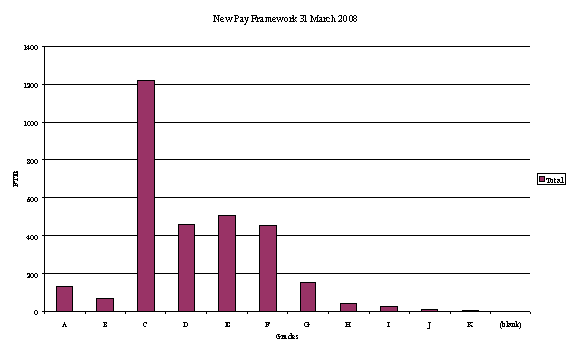
The impact of the new framework, with its broader bands, will drive flatter organisational structures. This in itself will also have an impact on staff development both within role and in terms of succession planning and the development of career pathways and on policies for social work and other vocational training.
The new appraisal system, Individual Performance Planning (IPP) launched during 2006 requires further work to support managers in setting "smart" targets and being confident in applying ratings against individual staff performance, which it is intended to link to pay progression. It is vital that IPP is embedded in the organisation to enable performance management improvements, an ongoing maintenance programme needs to be developed to refresh and develop managers in conducting IPP and supervision
Work is also required to identify any additional roles which are suitable for Job Standard IPP approach, this is where all staff with same role profile are measured in the same way against set targets and criteria.
The updated Supervision policy and procedure with strong links to IPP recommended that supervision become mandatory for all staff within Adult Services. This also emphasised some mandatory areas for discussion which will contribute towards more ownership and improved practice and performance in Adult protection and quality audits.
Work being undertaken around the corporate efficiency programme focused on workforce effciiencies will need full engagement from the department.
Employment and Skills Initiatives
The County Council is suppporting a number of key initiatives in the area of skills and employment through its membership of the Prosperity Through Diversity strategy. This partnership aims to support the workforce needs of the Hampshire economy by ensuring a skilled and diverse labour pool is available to employers. This also supports the Adult Services target of increasing the number of people with a leaning disability in employment. An example of such work is shown below:
MP is a young man with a learning disability who had contact with Day Services through the process of transition as his full-time education had come to an end. MP wanted to be in employment and have ordinary inclusive opportunities in the community. He had a range of skills but needed initial support from the service to develop his independent use of public transport. Due to the existence of a new local Cinema Club for adults with a learning disability, the partnership had been extended to allow for work experience at the Cinema. MP was given an opportunity to undertake a variety of tasks appropriate to the role of a Cinema Operative. MP would also work alongside other staff who were willing to take over some of his workplace support needs. On completion of his work experience MP was successful in securing 16 hours paid employment per week. This would include some reasonable adjustments to support MP with his confidence and literacy. MP has now been working as a Cinema Operative for almost one year. Through his employment MP has also had the opportunity to make friends and socialise outside of work. Currently consideration is being given to the request from him that he be considered for an increase in his working hours.
Workright
Joint working between Adult Services and Human Resourecs has resulted in the appointing of a Workright Co-ordinator working with the County Council and its District Council partners to support the appointment of people with a learning disability into suitable employment.
Apprenticeships
Adult Services is supporting the development of the Corporate apprenticeship strategy, which will see 30 apprentices joining the Council over the next few months as part of a pilot project. The initial five apprentices will be followed by others over the next two years. This is seen as particularly valuable given that the age profile of Care roles in the department is aging and these roles will be focused primarily on younger people.
Future Jobs Fund
Hampshire County Council made a successful bid to the Future Jobs Fund as part of a wider consortium which will provide 900 jobs to the long term unemployed, 90 of whom will be employed by the County council itself. These jobs need to be of benefit to the community and would not otherwise be provided.
Skills for Life/Skills Pledge
Through its initiative on Skills for Life the county council is supporting its own staff to improve their basic skills. Adult Services Learning and Development staff will actively promote this, particularly to staff in residential and nursing homes for whom English is not a mother tongue.
Hampshire County Council has signed the Skills Pledge, aimed at improving the qualifications levels of our staff. The department currently sponsors staff from registered services to gain their NVQ2 in Care as this enables the statutory standards to be met and quality to be driven up. Over 250 places are filled annually on vocational training programmes.
Learning and Development
The agreement for a Learning and Development Team to be established to support Adult Services as an integral part of the department has now been implemented.
The new team supports social care staff through commissioning planning and in some case delivery of learning and development interventions. In addition to a comprehensive short course programme, support is provided for post qualification training, student placements, NVQ training, social work training and management development. In addition, the County Council actively supports the private and voluntary sector through the PaCT (Partnership in Care Training) Programme.
Much of the programme, both internal and external is developed through strategic workforce development activity working with the Sector Skills Council for adult social care - Skills for Care (SfC), at Regional and Sub-Regional level. Critical to the work with the private and voluntary sector is the identification of new and existing income streams to support workforce development activity to support achievement of departmental performance targets. Current examples of external funding sources - SEEDA, LSC and SfC.
Another key element of the team's work is the co-ordination of workforce development activity across organisational boundaries for key stakeholder groups, private and voluntary sector, neighbouring Local Authorities, Strategic Health Authority and primary and secondary care trusts.
Learning and Development plan for Adult Services
The aim of the plan is to develop an integrated workforce capable of delivering a quality service meeting the needs of the department, partners and the community of Hampshire by the establishment and maintenance of a sufficient and appropriately competent workforce.
Social Work Taskforce
The department has set up its own Social Work Task Force to position itself to respond to the government initiative of the same name. The interim report outlines a vision for social work as a profession:
_ Confident about its values, purpose and identity;
_ Working in partnership with people who use its services, so that they can take control of their situation and improve the outcome;
_ Working cohesively with other professions and agencies in the best interest of people in need of support;
_ Demonstrating its impact and effectiveness and therefore its value to the public;
_ Committed to continuous improvement, with the training and resources it needs to be effective and a vigorous culture of professional development
_ Understood and supported by employers, educators, government, other professionals and the wider public, and
_ Well led at every level: in frontline practice; in influencing the shape and priorities of local services; in setting and maintaining the highest possible standards within the profession; and in influencing policy developments and priorities at national and political level.
Unlike some of its comparator authorities, Hampshire does not believe that Personalisation brings a diminution of the social worker role and is pledged to support a continuing quality and professional service.
Newly Qualified Social Worker Programme
The department is committed to support the new NQSW programme, now extended to Adult Social Care. The department currently receives a £30k grant from `Skills for Care' which requires some mandated `best practice': a 10% reduction in work-load for NQSWs, an agreement to fortnightly supervision, mandated attendance on an action learning programme, and a limit on the complexity of casework. The Learning & Development team support this programme.
Partnership in Care Training Programme - PaCT
PaCT represents a comprehensive workforce development programme managed by Adult Services to support private and voluntary sector organisations located in Hampshire, and providing contracted social care services to Adult Services.
Where changes to types of services / new ways of working / new worker roles have emerged as a result of the Hampshire Model the PaCT programme has provided targeted support to employers in the private and voluntary sector to met the skills gaps and workforce development activity needed.
The core programme covers Adult Protection; Dementia Care; Moving & Handling; Medicines Management; Infection Control; Palliative Care; Leadership & Management
Employer organisations make financial contribution for all courses.
The Programme supports private and voluntary sector employers to meet the priority areas for learning and development activity identified in the National Minimum Care Standards. All programmes are linked to the relevant national occupational standards, Skills for Care knowledge and skills sets and Common Induction Standards to enhance value to both employer and employee.
In particular, the team has developed an approach to work collaboratively with independent sector providers to enable them to improve their CQC star rating, contributing to a real improvement in outcomes for service users.
Appendix 1 - Staff Budget 09/10
Fte | ||
Assessment & Care Management |
Fieldwork Staff - older persons |
376 |
Fieldwork Staff - people with a physical disability |
185 | |
Fieldwork Staff - people with a learning disability |
100 | |
Fieldwork Staff - people with mental health needs |
131 | |
Fieldwork Staff - other |
16 | |
Fieldwork Staff - out of hours service |
20 | |
Day Care |
People over 65 |
47 |
Younger Adults with a Physical Disability |
44 | |
Younger Adults with a Learning Disability |
257 | |
Younger Adults with Mental Health Needs |
0 | |
Domiciliary care |
All groups |
360 |
Nursing Homes |
People over 65 |
597 |
Residential care |
People over 65 |
715 |
Residential care |
Younger Adults with a Learning Disability |
104 |
Residential care |
Younger Adults with a Physical Disability or sensory Impairment |
24 |
Other Care |
Support services for people in their own home, including equipment |
64 |
Supporting People (including shared lives) |
22 | |
Drug Action Team |
9 | |
Management and Support |
Includes additional staff for SDS training, safeguarding, LD Campus Reprovision programme |
358 |
Appendix 2 - Growth 09/10
Adult Services 2009/10 New Staff FTE Analysis | |||||
Total |
Temp |
Perm |
Funding | ||
32.0 |
0.0 |
32.0 |
Workforce plan increase agreed 1.10.08 | ||
Budget growth | |||||
18.6 |
0.0 |
18.6 |
Dependency & demographics growth | ||
9.3 |
4.0 |
5.3 |
Transformation growth | ||
8.5 |
1.0 |
7.5 |
Safe & secure growth | ||
22.5 |
6.0 |
16.5 |
Other operational pressures growth | ||
(5.4) |
11.0 |
(16.4) |
Efficiency savings | ||
53.5 |
22.0 |
31.5 |
Sub total budget growth | ||
30.0 |
24.0 |
6.0 |
Social Care Reform Grant | ||
21.0 |
15.5 |
5.5 |
LD Campus Reprovision Grant | ||
2.0 |
2.0 |
0.0 |
Stroke Carers Grant | ||
138.5 |
63.5 |
75.0 |
Total | ||
2. Detail |
|||||
fte |
Type |
What they do | |||
11.0 |
Perm |
Safeguarding work - Approved by Executive Member for Adult Social Care - 1/10/2008 | |||
19.0 |
Perm |
Innovations development | |||
1.0 |
Perm |
Programme co-ordinator | |||
1.0 |
Perm |
Hampshire House receptionist | |||
32.0 |
Total |
||||
2.2 Dependency and Demographics - Funded by growth in Budget | |||||
Proforma Ref. |
fte |
Type |
What they do | ||
OPPD-P05 |
8.3 |
Perm |
More carers - move to dementia care at all residential homes - more complex needs | ||
COM-P04 |
4.0 |
Perm |
Alcohol Strategy development officers | ||
PBM-P24 |
5.3 |
Perm |
PACT support for quality framework | ||
DIR-P02 |
1.0 |
Perm |
Communications Officer | ||
18.6 |
Total |
||||
2.3 Transformation - Funded by growth in Budget |
|||||
Proforma Ref. |
fte |
Type |
What they do | ||
LD-P04 |
1.0 |
Temp |
Project Management for LD integration with HPT | ||
LD-P04 |
1.5 |
Perm |
Additional administration officers to support integrated teams | ||
PBM-P01 |
1.0 |
Perm |
Quality and Audit Officer to support operational managers through changes in working practices | ||
PBM-P03 |
1.0 |
Perm |
Support for web services for flexible working | ||
PBM-P04 |
0.8 |
Perm |
Support for Hampshire Work Style and ABC move | ||
PBM-P04 |
1.2 |
Temp |
Support for Hampshire Work Style and ABC move | ||
PBM-P12 |
0.8 |
Temp |
Support for Aspire project | ||
PBM-P16 |
1.0 |
Temp |
Development of "Shop for Support" | ||
COM-P08 |
0.5 |
Perm |
OPMH LD strategy project Manager | ||
COM-P09 |
0.5 |
Perm |
Practise Based Commissioning Manager | ||
9.3 |
Total |
||||
2.4 Safe and secure - Funded by growth in the budget | |||||||
Proforma Ref. |
Staff fte |
Type |
What they do | ||||
COM-P07 |
3.0 |
Perm |
Quality improvement officers | ||||
COM-S03-P |
3.0 |
Perm |
Adult Placement Assistant Officers | ||||
DIR-P03 |
1.0 |
Perm |
Work with offenders - help into the community | ||||
DIR-P04 |
0.5 |
Perm |
Make equalities manager post full time. Work with minority groups | ||||
PBM-P14 |
1.0 |
Temp |
Security officer for partner information | ||||
8.5 |
Total |
||||||
2.5 Other Operational Pressures - Funded by growth in Budget | |||||||
Proforma Ref. |
Staff fte |
Type |
What they do | ||||
PBM-P05 |
1.0 |
Perm |
Business Process officer - to support business process | ||||
OPPD-P19 |
1.0 |
Perm |
Newman Bassett Day Centre domestic staff | ||||
OPPD-P21 |
10.0 |
Perm |
Cleaning staff in in-house homes | ||||
OPPD-P22 |
2.0 |
Perm |
Occupational therapy & domestic at John Darling Mall | ||||
MH-P04 |
1.5 |
Perm |
Learning & development Officers to implement MH Act | ||||
PBM-P18 |
1.0 |
Perm |
IS Innovations team development work | ||||
PBM-P21 |
6.0 |
Temp |
Hantsfile record management officers | ||||
22.5 |
Total |
||||||
2.6 Efficiency savings in budget |
|||||||
Proforma Ref. |
fte |
Type |
What they do | ||||
OPPD-S18 |
(12.0) |
Perm |
Homecare modernisation (transformation) | ||||
GEN-P06-S |
11.0 |
Temp |
Hantsdirect double running (transformation) | ||||
MH-S02 |
(4.0) |
Perm |
MH Workforce reconfiguration (other operational) | ||||
OPPD-S17 |
(0.4) |
Perm |
Care broker phased retirement (other operational income) | ||||
(5.4) |
Total |
||||||
2.7 Social Care Reform Grant funded |
|||||||
Staff fte |
Type |
What they do | |||||
24.0 |
Temp |
||||||
6.0 |
Perm |
6 Care brokers |
|||||
30.0 |
Total |
||||||
2.8 LD Campus Reprovision Grant funded |
|||||||
Staff fte |
Type |
What they do | |||||
15.5 |
Temp |
Commissioning, Supported living, contracts support | |||||
5.5 |
Perm |
Client affairs administration. | |||||
21.0 |
Total |
||||||
2.9 Stroke Carers Grant funded |
|||||||
Staff fte |
Type |
What they do | |||||
2.0 |
Temp |
Administer carers grant distribution | |||||
2.0 |
Total |
||||||