
Archived decisions
HAMPSHIRE COUNTY COUNCIL
Decision Report :
Decision Maker: |
Executive Member for Adult Social Care | ||||
Date of Decision: |
11 December 2009 | ||||
Decision Title: |
Implementation of Self Directed Support | ||||
Decision Reference: |
878 | ||||
Report From: |
Director of Adult Services | ||||
Contact name: |
Lucy Butler and Gemma Wickes | ||||
Tel: |
01962 845546 |
Email: |
|||
1. Executive Summary
1.1 On 27 March 2009, the Executive Member for Adult Social Care approved the strategic approach for countywide roll-out of Self Directed Support (SDS). This report provides an update on work completed to date, and further work planned for completion between now and the first go-live date of April 2010. It seeks permission to proceed with roll-out of SDS on this basis.
1.2 The proposed approach outlined in the 27 March Executive Member Report covered a two year plan, including an initial period of process design, systems development, financial modelling, and training (year 1) followed on successful completion of this, by a phased geographical implementation around the county (year 2). The go-live phasing was proposed as North (April 2010), followed by the South (July 2010) and then the West (October 2010).
1.3 This approach was approved, but the Executive Member requested a further report prior to roll-out. This report responds to that request, and provides further detail on progress to date and the predicted financial impact of introducing SDS, based on learning from the Basingstoke pilot. This report also seeks to update the Executive Member on progress made and sets out the work which needs to be completed before January 2010, (the start of on-site specific training for the North of the county), in preparation for the first go-live in April 2010.
2. Contextual Information
2.1 Hampshire County Council's wider Transformation programme for Adult Services, `The Hampshire Model', is a grounded and practical model for `putting people first' in a local authority in partnership with health and other key partners, moving the personalisation agenda from rhetoric to reality. It responds to both the government consultation `A Case for change - Why England needs a new care and support system' and Putting People First; a ground breaking concordat, which outlined a shared vision for the transformation of adult social care and called for central and local government and the NHS to make a strong commitment to the personalisation of care services over the next three years.
2.2 The work required to move Adult Social Services from a service led system, to one that promotes peoples' autonomy and independence through an SDS approach is an important pillar of work to deliver the Hampshire model. Putting People First sets out a requirement that service users and their carers as well as front line staff and providers will experience significant progress in all local authority areas by March 2011. The performance framework has been amended to reflect these strategic objectives, and the introduction of SDS is essential to maintain or improve performance on a range of national indicators.
2.3 Hampshire County Council has made a commitment to implement SDS for individuals with ongoing, eligible social care needs. SDS enables people and their families to increasingly shape their own support, maximising choice and control over the way support is received.
2.3 SDS has been successfully piloted in Basingstoke and Deane since May 2008. The objectives of the pilot were to;
· Pilot SDS in one district Adult Social Care office
· Develop a target operating model for the future of Adult Services in Hampshire.
2.4 The scope for the pilot included the application of Self-Directed Support to all new individuals presenting at the pilot office across the following client groups;
· Older People
· Physical Disabilities
· Learning Disabilities
2.5 In October 2008 a review of the pilot was conducted. The review concluded that the pilot had partially delivered on both objectives. The lessons learned from this review have been used to inform the implementation plan for the proposed countywide roll out of SDS.
2.6 The conclusion of the review was positive, with staff and service users reporting an improvement in outcomes as a direct consequence of adopting SDS. The review also served to identify a number of areas where further work was required to support countywide roll-out. The main findings and recommendations from the review can be found in the Executive Member Report which was approved on 27 March 2009.
2.7 Following this, an implementation plan for countywide roll-out of SDS was developed. This is a two year plan due to be completed by October 2010. Year 1 focuses on the design and development of the new service model for SDS. This includes the design of business processes, supporting tools (including Resource Allocation System), policies and procedures, awareness raising training for all staff, training in positive risk taking, and the development of the systems infrastructure.
2.8 Year 2 (commencing January 2010) will begin with focused training for frontline staff on the mechanics of delivering SDS. This will be delivered locally, to maximise coverage and minimise disruption. Following focused training, the locations trained will `go live', offering SDS to new service users, and for existing service users as they come up to review.
2.9 Training and `go live' will be phased geographically, in order to dedicate sufficient resource to on-site training and support. This will commence in the North (January - April 2010), followed by the South (April - July 2010) and then the West (June - October 2010).
3. Key Issues
3.1 Lessons from Basingstoke
3.1.1 Extending the pilot in Basingstoke has provided invaluable learning and experience. Developing SDS in a single, geographical site across client groups is now recommended as a best practice approach and the opportunities to learn have certainly supported this decision in Hampshire. The experience from eighteen months of development and testing have enabled us to distill key learning points. These are:
· The importance of clear and consistent training and management approaches to SDS
· The importance of coproduction with service users in tools, processes and training
· The importance of regular monitoring and adjustments to the RAS
· The importance of clarity around the function of each step in SDS, the decisions which belong to the service user and those which Adult Services must retain in order to fulfill its responsibilities
3.1.2 These key learning points have all been incorporated into the roll out plan, with particular focus on the training modules to support go-live. A separate pilot to develop SDS with the Mental Health client group is being jointly implemented with Health partners. All of the learning and outputs from the Basingstoke pilot are also being used to support this work.
3.2 Success
3.2.1 The pilot in Basingstoke has provided evidence to support the principle that SDS delivers positive outcomes by enabling choice and control. Individual testimony about the experience of SDS has certainly supported this:
"It's given me my life back."
"Since I've come into Hampshire County Council I've become a human being whereas I didn't feel I was before."
"SDS has given me the flexibility that I didn't have before"
3.2.2 However, Adult Services has additionally been collecting feedback from all service users, through a series of `Quality of Life' questions. This has allowed us to measure the effectiveness of SDS, but has also allowed service users to reflect on their own journey - and any changes they feel have been part of that. Staff in Basingstoke have been comparing the responses given by people to the Quality of Life survey at the time of their assessment compared to their responses to the same questions at review. Although the sample size is still small, the results are very encouraging. People using SDS increasingly feel safe, in control of their lives and choices - and feel they have enough money to lead the lives they want to. On average, we are seeing an increase of 10 to 15% in positive responses. We will continue to monitor and track this in Basingstoke, and around the county during rollout.
3.3 Process
3.3.1 There are three key steps in SDS - which should be viewed as a circle of support, with the service user at the centre.
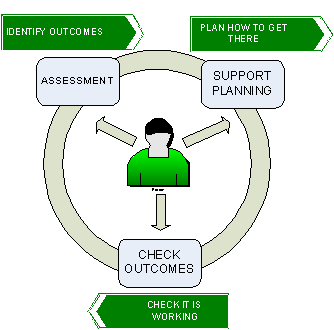
ASSESSMENT:

3.3.2 The process is designed to identify a service user's outcomes and suggest a reasonable sum of money (the indicative amount) for the service user to begin planning. The indicative amount is there to fund eligible need only.
3.3.3 The assessment asks the service user to think about their current levels of ability in eleven different areas. It has been deliberately designed to focus on what a person can do, rather than what they can't. This is to identify their needs. Each of these eleven different areas then generates an outcome. The assessment is expressed as outcomes to make sure it is forward looking, but assesses needs to ensure those are met and that the department is clear as to what it will contribute in meeting those needs. The areas has been designed not to be restrictive - but to focus the assessment on specific outcomes and needs that relate to independent living, staying healthy and safe and maximising involvement and control.
SUPPORT PLANNING:

3.3.4 Support planning belongs to the service user - and it is the process by which they plan how they want to meet their outcomes. This is where the service user makes their choices - and there are a wide range. Support planning will cover support which needs to be purchased, and that which the service user can access through family, friends or the wider community. It will look at the choice between managing their own budget as a direct payment or a trust, or asking adult services to commission services for them - or a mixture of the two. It will identify how the service user might want to purchase support or services to meet their outcomes and eligible needs - and where they want to purchase them from. A good support plan will also look at wider support to meet outcomes that the service user wants to achieve, but which will not be funded by Adult Services.
3.3.5 Once the service user has done this planning, adult services needs some of the information from this. This focuses on three things - content, risk and funding. This process is called support plan validation - and it is how we ensure we are meeting our statutory obligations.
CHECKING OUTCOMES:

3.3.6 This is the opportunity for the service user and adult services to review how things are going. It is a critical part of SDS, as it is the opportunity to check that the plan is working - and for choices to be made to respond to any changes. A good support plan will include back-up plans, and choices about what to do in case of change.
3.3.7 The circle reflects the fact that a service user journey is not linear - and at any point they may need to focus on different steps. If everything is going well, they may stay at the point of checking outcomes. If their situation changes significantly, they may need to redo the support planning, or even work with adult services to do another assessment to see if their needs and outcomes have changed.
3.3.8 A detailed process map has been developed including all decision points and systems inputs that underpin these three key stages. This built on the existing process in Basingstoke, but has improved it by addressing specific issues identified during the pilot. The improved process was developed at a series of workshops with staff from Basingstoke and other teams not involved in the SDS pilot, and tested by all stakeholders.
3.3.9 Supporting policies and procedures are currently being developed and are required for roll-out. These will be used as the basis for developing a practice guidance manual for staff which in turn will form the basis of training.
3.4 Systems Infrastructure
3.4.1 The improvement of the detailed business process has provided the base for the approach to systems support. One of the key pieces of learning from the Basingstoke pilot was that a system designed to support the process is essential. As such, a series of bespoke tactical tools are now being developed and tested to support the SDS process. These are being based on the redesigned business process and will allow staff to input and access information more smoothly. This approach will allow roll-out to progress as planned, without compromising operational, budget or performance monitoring capacity.
3.5 Financial Assessment
3.5.1 An assessment of the financial impact of the pilot has concluded that
the introduction of SDS has not in itself placed undue pressure on budgets and has not raised any financial issues that should prevent further roll-out - as long as appropriate management control is in place. The pilot has however underlined the importance of appropriate financial management controls and the need for staff training and programme communications to reinforce messages around eligibility.
3.5.2 The assessment included a review of the budget position in Basingstoke as compared to the rest of the County, an analysis of SDS packages, an analysis of forecast outturn trends and an analysis of county, Basingstoke and SDS purchasing patterns. Taken with the operational experience of running SDS, this information has highlighted some key learning:
· No evidence to suggest that SDS packages cost more than care managed packages
· No evidence to suggest a financial reason to delay or slow rollout
· Evidence to support the importance of consistent management approaches to eligibility and package content.
· Evidence that whilst SDS has not placed undue pressure on budgets in itself, it is being delivered during a period when significant pressure is being placed on the department, particularly with regard to demographic increases and growth in complexity
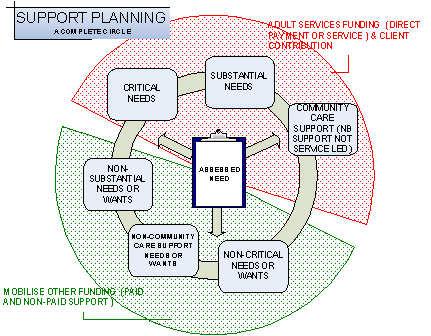
3.5.3 In line with the experience of other authorities, early work on SDS showed a `drift' in package content, with regards to the application of the eligibility criteria. This drift has been identified by local managers and addressed, but underlines the importance of balancing messages around a holistic approach to support planning with an unchanged position on the application of eligibility criteria (as pictured below). This has been addressed in both the SDS project plans for training and communication and in management actions, which have successfully remedied the issue.
3.5.4 Adult Services can and will mitigate any financial risks that are within our control. However, the experience in Basingstoke has also shown that SDS will be introduced in an environment of significant and ongoing external pressure. The impact of the economic climate on the department and our partners, demographic growth and the growth in complexity will all continue to be felt during the rollout of SDS and beyond.
3.5.5 The review focussed on the operational financial impact. The temporary cost of implementing SDS in Hampshire will be met separately by the Social Care Reform Grant, funding made available by the Department of Health to undertake the redesign of systems, processes and transactions to transform delivery.
3.5.6 A review has also been undertaken of introducing SDS with the current charging policy. Although the detailed SDS process was designed to incorporate the charging policy, it nonetheless provides challenges for implementation. The current challenges and future direction for charging were clearly set out in the report of the Hampshire Commission of Inquiry `Getting Personal: a fair deal for better care and support', as approved by Cabinet in December 2008. However, whilst we wait for national policy to be set with particular reference to the Personal Care at Home Bill, we will rollout SDS under the current charging policy.
3.5.7 The impact of this is likely to be twofold; a slower process due to the need to calculate service-based charges, and a potential drop in departmental income. As a result of the review, we have introduced a range of factors to mitigate the risk. These include process review with the Financial Assessments team, additional training for staff and new recording processes. We will continue to monitor this risk and respond accordingly both before rollout and during the go-live period.
4. Training
4.1 Preparations for training staff in SDS are progressing well, with initial awareness raising sessions completed, along with workshops and initial training in positive risk taking. The on-site training team have been recruited and are now in post, and have started the work needed to develop detailed training modules.
4.2 Training for frontline and support staff in core SDS processes will commence in early 2010, phased in line with the planned implementation timetable for each area. Training sessions will be delivered locally to maximise coverage and minimise disruption to service delivery as usual, and will be consolidated by post-implementation training and support in each area. Training will be delivered locally, and will address key components and principles of SDS, use of tools and processes, systems interfaces, roles and functions and key messages, based on the learning from the Basingstoke. Supporting documents, including process maps and a guidance manual will also be provided. Achievement of the first go-live date of April 2010 is dependent upon staff having received the required training. Planning is currently on target to achieve this.
5. Workforce impact
5.1 The roll-out of SDS is the first step in wider programme of work linked to the Hampshire Model to redesign business processes and workforce structure across the department. In order to support the roll-out starting in April, there is a need to assess the impact of implementing SDS on existing role profiles and to develop recommendations for necessary changes to these. This work in currently being undertaken and will be completed before Christmas to allow time for any changes (should they be required) to be made prior to rollout. At this point, we do not have sufficient evidence to indicate which changes would be required in the overall balance of roles and functions across the whole department. Adult Services is therefore taking the approach that SDS will require the skills and expertise of our staff to make it a success. Therefore we will introduce only those changes required to support rollout at this stage, and continue to assess roles and functions more widely as part of the introduction of the Hampshire Model, using further evidence gained during rollout.
6. Impact on departmental performance
6.1 In order for the department to be able to improve its overall Outcomes rating, one of the key criteria is for SDS to be offered and made available to clients across the county. It is therefore a priority that the department proceeds with rollout to the current timeframe. Additionally, a number of key performance areas are expected to be positively impacted upon as a result of SDS being extended across the county.
6.2 The implementation SDS represents a fundamental change to the way social care is provided. The scale of change should not be understated, and there is a risk that operational performance will be impacted as staff and managers adapt to new processes and ways of working.
6.3 The roll-out approach has been designed to mitigate this risk. The phased approach to the roll-out enables the Project Team to monitor operational performance during the three month period from go-live and to make any appropriate changes to process, training, and support. Managers and staff will be supported during the post-implementation period by on-site Floorwalkers who will identify further learning and development needs.
7. Co-production with service users
7.1 Service User input from the pilot review helped us plan the roll out - and continues to be vital to ensure that SDS in Hampshire is a co-production. Currently the Personalisation Expert Panel are involved in developing the detailed training modules, and we hope that service users will be able to participate in the delivery of training too. We are working with user groups to develop and support existing peer support arrangements, which are vital for the success of SDS.
7.2 The bespoke tools developed in Hampshire have also been designed with service users. A dedicated Quality Review Panel was set up specifically to allow as many voices as possible to be brought together to help us improve the quality of the tools we developed for SDS. The QRP was made up of service users, internal Hampshire County Council Adult Services professionals and third sector organisations. The Adult Services staff included representation from finance, audit, performance, care management, BME community development and communications. The aim was to have an independent quality check of the documents produced - to improve where we needed to, and be confident that what we have is as good as it can be.
7.3 Hampshire has also developed its own Resource Allocation System (RAS) as part of the SDS pilot - and testing and development work on this has been extensive with both staff and service user representatives. Ongoing improvements have been made and will continue to be incorporated as a result of their input.
8. Market Development
8.1 A significant amount of engagement with providers has already been undertaken and will continue throughout the rollout year and beyond. This includes working groups to support the development of the voluntary sector, workshops held around the county to give information and the opportunity for providers to understand and engage with SDS and the wider transformation to Personalisation. The department has also developed a website specifically for providers to share market data and encourage good business planning for SDS. Other partners in the Council have been actively supporting the agenda, including work with Culture, Communities and Rural Affairs in Basingstoke to support the pilot and the wider rollout. Adult Services has also developed commissioning frameworks to promote and develop personalised services and is supporting the use of Individual Service Funds.
9. Brokerage and Support Planning Model
9.1 The experience in Basingstoke has also made clear that a range of choices need to be available at the point a service user begins support planning. There are several options for service users; they may choose to do their support planning themselves, supported by friends or family. They may ask Adult Services to work with them to put together their support plan. But we also believe there is a key role for other choices to be available here, and funding has been allocated to develop external resource for support planning and care purchasing (brokerage) to extend the model in Basingstoke. We are working with external organisations to help us understand how we best ensure that a range of support is available for people at this point, and how we develop both availability and quality in the support available. We are currently working with a number of organisations in Basingstoke to offer this choice, and the learning from this will be used to extend the model into other areas in the County to support rollout.
10. Policy to Promote Independence and Choice
10.1 Training in positive risk taking has already commenced and will form a key part of the SDS process. The policy to promote independence and choice is essential to SDS, and the process of support planning is key to both positive risk taking and to Adult Services' duty of care. Our statutory duties around safeguarding remain in place and will continue to be a priority throughout the change.
11. Communications and engagement
11.1 A full communications and engagement plan has been prepared, based on learning in Basingstoke, to support the countywide rollout. This includes updates and key messages for staff and peer support and tools for service users, focussed on delivering a clear, transparent process from beginning to end. The plan also covers information and engagement with key partners and stakeholders.
11.2 Local member engagement
11.2.1 Member engagement at a local level will form a key part of the communications plan to support rollout, both prior to and during go-live. We will actively engage with local members in the run up to go-live, and offer the opportunity to visit Adult Services offices to engage with staff and service users as the process is implemented.
11.3 Controls during go-live period
11.3.1 It has been noted that the relative size of our SDS population compared to the county as a whole does necessitate caution when predicting trends or patterns. Whilst the experience in Basingstoke has been invaluable in helping us understand and prepare for potential issues, there is a need to continue tracking and monitoring during rollout as the numbers continue to increase.
11.3.2 The SDS rollout will be monitored weekly by the project team, in conjunction with operational colleagues, colleagues in performance, IS and finance. We have deliberately phased the approach to help us manage any impact, and we are confident that the amount of preparation we are currently doing will help ensure rollout goes smoothly. However, the monitoring will provide a rapid response to any budget, performance or capacity issues which might develop, including those which are already being actively monitored and any specific local issues which may arise during go-live. These will be alerted to the SDS Board and the Departmental Management Team and the decision to proceed with each successive go-live, or to delay if necessary, will be based on this information.
12. Conclusion
12.1 SDS underpins the Hampshire Model. The successful pilot in Basingstoke has allowed for significant lessons to be learnt - and care has been taken to incorporate these into planning a countywide implementation of the three key steps in SDS - assessment, support planning and checking outcomes. The proposed approach allows for issues to be resolved, identifies key processes in management control, supports the staff, service users and partners involved and continues to place Hampshire at the forefront of transformation to a more person-centred or `personalised' adult social care system.
13. Recommendations
13.1 That the Executive Member notes the work completed to date and information contained in this report regarding progress and the projected financial impact of implementing SDS.
13.2 That the Executive Member notes the remaining work due for completion between now and April 2010 in relation to process design, systems development, and training, upon which the achievement of the first go-live date of April 2010 is dependent.
13.3 Following the above, that approval is given to proceed with the phased geographical implementation of SDS starting in April 2010, and noting the proposals for monitoring and control during the rollout period.
13.4 That the significant contribution of staff involved in the Basingstoke pilot to the development of SDS in Hampshire is recognised.
CORPORATE OR LEGAL INFORMATION:
LINKS TO THE CORPORATE STRATEGY | ||||
Yes |
No | |||
Hampshire safer and more secure for all |
||||
Corporate Business plan link no (if appropriate) |
||||
Maximising well-being |
||||
Corporate Business plan link no (if appropriate) |
||||
Enhancing our quality of place |
||||
Corporate Business plan link no (if appropriate) |
||||

OTHER SIGNIFICANT LINKS: | ||
Links to Previous member decisions: | ||
Title |
Ref |
Date |
Cabinet Report on Commission of Inquiry into Personalisation and the proposed model for adult social care in Hampshire |
458 |
22 December 2008 |
Executive Member Report Implementation of the Hampshire Model Workstreams |
27 March 2009 | |
Direct Links to Specific Legislation or Government Directives | ||
Title |
Date | |
Putting People First |
December 2007 | |
Section 100 D - Local Government Act 1972 - background documents | |
The following documents discuss facts or matters on which this report, or an important part of it, is based and have been relied upon to a material extent in the preparation of this report. (NB: the list excludes published works and any documents which disclose exempt or confidential information as defined in the Act.) | |
Document |
Location |
NONE |
|
IMPACT ASSESSMENTS:
1. Equalities Impact Assessment:
A full equalities impact assessment has been undertaken by the SDS Project Team. This reinforces that the rollout of SDS offers benefits across a wide range of groups in terms of transparency, choice and control with particular reference to the choices available and increased accessibility to both tools, process and information. The assessment also highlighted the need for ongoing detailed work throughout the rollout period and this will be delivered by the project team in liaison with the Departmental Equalities Group and the SDS Programme Board.
2. Impact on Crime and Disorder:
The County Council has a legal obligation under Section 17 of the Crime and Disorder Act 1998 to consider the impact of all the decisions it makes on the prevention of crime. The proposals in this report have no proven impact on the prevention of crime.
3. Climate Change:
a) How does what is being proposed impact on our carbon footprint / energy consumption?
No impact has been identified.
b) How does what is being proposed consider the need to adapt to climate change, and be resilient to its longer term impacts?