Archived decisions
HAMPSHIRE COUNTY COUNCIL
Decision Report
Decision Maker: |
The Executive Lead Member for Children's Services | ||||
Date of Decision: |
17 December 2009 | ||||
Decision Title: |
Aiming High for Disabled Children - Eligibility Criteria for access to specialist care services | ||||
Decision Reference: |
779 | ||||
Report From: |
Director of Children's Services | ||||
Contact name: |
Colin Hardy | ||||
Tel: |
07718 146800 |
Email: |
|||
1. Executive Summary
1.1. The purpose of this report is to confirm the eligibility criteria to be used in assessing the needs of disabled children and considering how those needs could be met, within the resources available, through a range of specialist social care services.
1.2. This report also comments upon progress by Hampshire NHS in developing arrangements for the assessment of Continuing Health Care needs and in their development programme to address the needs of disabled children with complex needs.
1.3. The Executive Member has previously considered reports identifying the requirements of the Government's Aiming High for Disabled Children programme and subsequently has approved the strategy to develop services within the additional grant of £1.4m in 2009/10 rising to a total of £4.5m in 2010/11.
1.4. In addition to developing services to improve opportunities for carers to have a short break, guidance requires Local Authorities to ensure that the criteria for access to services are clear and that the way in which assessments are undertaken and decisions made is transparent.
1.5. The review of eligibility criteria has been informed by earlier consultation, including through a Select Committee workshop, which confirmed that parents found the existing criteria difficult to understand.
1.6. The criteria attached to this report have been developed following consultation with stakeholders, parents and carers, which has included a parent reference group to advise on the drafting of criteria. Consultation has also included consideration of compliance with the DDA and the advice from the County Council's Legal Practice has been available.
1.7. The criteria are framed to support local managers in considering assessment of need in individual cases and determining how those needs could best be met through access to the available services
1.8. The review of existing eligibility criteria has also been informed by guidance available from the DCSF, via Together for Disabled Children who support Local Authorities in implementing the Aiming High Programme. However no common national criteria exist and Local Authorities are required to develop their own arrangements that reflect their framework for access to universal, targeted and specialist services and the availability of resources.
1.9. The Council for Disabled Children has also produced guidance for local authorities following the `Islington judgement' in which the High Court considered how eligibility criteria were applied.
1.10. The attached Eligibility Criteria confirms access to targeted services in special schools and for those claiming higher rate DLA payments without a further needs assessment. The document also includes reference to the development of a mediation opportunity where families feel the criteria have not been properly applied, prior to their considering if a complaint should be made
1.11. Further practice guidance will be made available to local managers and the criteria will be widely publicised as the eligibility criteria are implemented from April 2010.
2. Contextual information
2.1. Earlier reports to the Executive Member have confirmed the strategy for the development of short breaks, which is summarised below
· Improving access to universal services - for example through capital support to the existing Play Builder schemes with District Councils to develop more specialist open space play opportunities for disabled children, through the extended services programme in all schools and the development of better opportunities in youth and leisure services
· Providing services targeted to children and young people with significant disabilities - which is achieved through an offer to all children attending special schools and those claiming higher rate Disability Living Allowances. The offer of a number of evening, week end and holiday short breaks is delivered through extended services in special schools and by funding the additional care support needs of those claiming DLA who wish to attend universal sport, play and leisure facilities. These two `offers' do not require additional assessments and are intended to reach an additional 3500 children and young people by the end of 2010/11
· Confirming the arrangements for assessment for those disabled children whose needs can only be met by access to additional specialist service. These services include, overnight short breaks, family link carers, and individual support in and outside the home by domiciliary carers. Some of these services can be accessed through a Direct Payment that enables parents to make their own arrangements for care and short breaks within an agreed annual value. Currently in the order of 900 children and young people access specialist services and 170 families use a Direct Payment to access specialist service. Access to specialist services is via an assessment of needs and the eligibility criteria attached to this report clarifies those needs that can be met within the available resources.
2.2. Eligibility criteria must be informed by the duties under Section 49a of the Disability Discrimination Act (1995 and 2005), to eliminate discrimination, promote equity of opportunity and to encourage participation by disabled people.
2.3. The measures introduced in implementing Aiming High comply with these duties in that access to universal services is better supported and there is greater equity in the opportunities for disabled children and young people in the way their needs may be met.
2.4. The eligibility criteria for access to specialist services also support the duties under the DDA by ensuring that an initial assessment is undertaken in all cases where a child may be in need, either due to a disability within the criteria for access to a specialist service or more generally by identified needs being met through signposting to alternative services.
2.5. The Local Authority is able to take available resources into account in the way it identifies the eligibility criteria for services and the type of services it chooses to make available to meet those needs. Once an assessment of need is complete those needs identified that are within the criteria must be met. The authority is able to consider how the need should be met by considering both the nature and the scale of services that should be allocated and at that stage the authority can not take resources into account as the need must be met in a reasonable way.
2.6. If carers elect to receive a Direct Payment the value of services allocated is identified and a budget made available to the carer to use to make their own arrangements.
2.7. Government guidance requires Local Authorities, in reviewing eligibility criteria, to consider the needs of specific groups who historically have not been well served. These include those on the autistic spectrum with challenging behaviour, those with moving and handling needs and those with complex needs.
2.8. Draft national guidance has also been made available to NHS bodies in considering assessment and decision making in relation to those with a Continuing Health Care need, where the NHS remains responsible. Locally, Hampshire NHS is engaged with neighbouring PCTs to revise the assessment arrangements and the process to agree how costs might be shared with Local Authorities.
2.9. These arrangements, when finalised, will include greater clarity about the services that individual families could expect from the NHS, which will include access to palliative care, community health care services including paediatric therapies, OT and nursing support in the community and in schools.
2.10. Local NHS bodies have received additional funding, to a similar level as the Aiming High Grant to Local Authorities, and discussions are in hand with Hampshire NHS to confirm their commissioning intent for the development of NHS services. Guidance to NHS bodies includes a need to improve overnight short breaks for those with complex needs and continuing health care needs, to improve access to wheel chairs, community equipment and palliative care services. Unlike the grant funding to Local Authorities, the additional funds to NHS bodies are not ring fenced and in 2009/10 the NHS has identified £250,000 for the development of services to disabled children.
2.11. The eligibility criteria for access to specialist services are summarised below and the full document is attached to this report at appendix 1.
In order to achieve outcomes appropriate to their potential, and as a result of their disability, the child requires total or substantial support, appropriate to their age, from another person, which is not available within the family network
For example
o Child uses specialist equipment for mobility
o Child requires support for all basic self care functions when no longer age appropriate.
o Child needs constant supervision throughout the day and for prolonged periods at night when no longer age appropriate
o Child has behaviour as a result of disability that is a serious risk to self and or others, including self harm.
o Child has communication needs which without support severely affects personal safety. i.e. deaf, blind, without speech.
o Child has been assessed as having Profound and Multiple Learning Disability, Severe Learning Disability, or Autism with challenging behaviour, which results in a significant risk of self harm or harm to others

3. Finance
3.1. Currently in the order of 900 individual children and young people are supported by specialist services, through locally held budgets, following a needs assessment. These services include 3 HCC short break residential services and contracts for services in the independent sector for overnight short breaks and domiciliary care. The overall value of these services in 2009/10 is in the order of £11m and there are currently pressures on budgets due to both the level of demand and the complexity of needs, which often requires a high level of care support.
3.2. In 2009/10 the Aiming High Grant of £1.4m has been directed largely towards developing extended services in special schools, funding the additional care needs of those claiming higher rate DLA in accessing universal services and in putting in place participation and support networks to assist parents in knowing about, and accessing, services. These services are available, to the target groups, over and above any specialist services that may be provided following a needs assessment.
3.3. The Grant increases to a final year total of £4.5m in 2010/11 and there is currently no available advice about funding the Aiming High service development programme in future years. The grant conditions include that spending is focused on providing additional short break opportunities and that the needs of vulnerable groups, historically less well served, such as those with very challenging behaviour on the autistic spectrum, are addressed.
3.4. The revised eligibility criteria address these issues and it is not envisaged that the total number of those whose needs fall within the criteria will increase significantly. Additionally as other service opportunities in universal services and special schools are taken up it is possible that the need for specialist service could be reduced.
3.5. As the 2010/11 budget is finalised, and subject to the grant conditions that spending must be evidenced by additional short break opportunities, some additional funds will be available to local managers, who will continue to balance demand against available resources by considering the nature and level of services that are allocated to reasonably meet assessed needs.
4. Performance
4.1. Grant conditions include an audit of additional services delivered against a base line established in 2008/9 and performance in monitored by Together for Disabled Children on behalf of the DCSF. Hampshire is meeting all performance targets and is accessing low levels of support from TDC as a result. Hampshire is part of a National Challenge Programme and is supporting other local authorities in their Aiming High development programmes, for which an additional grant of £15,000 is made in 2009/10.
4.2. A single national performance indicator, NI 54, exists and performance is measured by a national survey levels of parent knowledge of and satisfaction with services. It is anticipated the survey will be implemented in Hampshire during 2009/10
5. Recommendation
5.1. That the Executive and Lead member for Children's Services approves the eligibility criteria for providing access to specialist services to be implemented from April 2010
CORPORATE OR LEGAL INFORMATION:
Links to the Corporate Strategy
Hampshire safer and more secure for all: |
no |
Corporate Business plan link number (if appropriate): | |
Maximising well-being: |
yes |
Corporate Business plan link number (if appropriate): | |
Enhancing our quality of place: |
no |
Corporate Business plan link number (if appropriate): | |
Other Significant Links
Links to previous Member decisions: |
||||
Title |
Reference |
Date | ||
Aiming High for Disabled Children |
12th March 2009 | |||
Aiming High for Disabled Children |
18th December 08 | |||
Aiming High for Disabled Children |
16th October 2008 | |||
Aiming high for Disabled Children |
22nd May 2008 | |||
Direct links to specific legislation or Government Directives |
||||
Title |
Date | |||
Aiming High for Disabled Children -better support for families |
May 2007 | |||
Section 100 D - Local Government Act 1972 - background documents | |
The following documents discuss facts or matters on which this report, or an important part of it, is based and have been relied upon to a material extent in the preparation of this report. (NB: the list excludes published works and any documents which disclose exempt or confidential information as defined in the Act.) | |
Document |
Location |
None |
|
IMPACT ASSESSMENTS:
1. Equalities Impact Assessment:
1.1. The revised Eligibility Criteria for implementation from April 2010 will ensure equity of access to specialist service by ensuring that families know how assessments will be undertaken and how decisions are made
2. Impact on Crime and Disorder:
2.1. N/A
3. Climate Change:
a) How does what is being proposed impact on our carbon footprint / energy consumption?
N/A
b) How does what is being proposed consider the need to adapt to climate change, and be resilient to its longer term impacts?
N/A
Appendix 1
Eligibility Criteria for access by Disabled Children and Young People to Universal, Targeted & Specialist Social Care Services
November 2009 for implementation from April 2010
The Aiming High for Disabled Children transformation programme has enabled Hampshire Children's Trust to deliver an improved volume, range and quality of service for all disabled children and their families through 3 levels of services
· Universal
· Targeted services
· Specialist services, accessed through a social care assessment
Universal services
The Hampshire Children's Trust is committed to ensuring disabled children can access positive experiences and families can get the support they need in universal services such as :-
· Children's Centres
· Early Years services
· Extended services in schools
· In sport, youth and leisure services
To support parents in knowing about and accessing services, Hampshire County Council has established contracts with Barnardos and The Rose Road Association for the provision of an information and participation support service. Parent Voice Information Centres will provide a one-stop approach, which will:-
· Provide advice on services and how to access them
· Give opportunities to speak and meet with other parents
· Enable parents to access an interactive website providing a wide range of information
· Support parents though advocacy and mediation
· Organise short break events for children and parents and carers
· Develop training programmes on disability issues for parents and carers
Targeted services
A targeted short break offer for children and young people attending special schools in Hampshire or claiming higher rate care and/or mobility Disability Living Allowance (DLA) is available without a needs assessment. The offer is:-
· For children claiming Higher-rate care and / or mobility DLA:
19 evening or weekend activity sessions and five days summer holiday care scheme, each year. Delivered through universal services with funding for the additional care support as necessary
· For young people attending BESD or Secondary MLD Special Schools:
19 After School or Saturday Sessions a year - 1 in each 2 weeks of term time and 5 days a year at a Holiday Scheme
· For young people attending SLD, PD, LD or Primary MLD Special Schools:
19 After School Sessions a year - 1 in each 2 weeks of term time, 10 Sessions a year at a Saturday Scheme and 5 days a year at a Holiday Scheme
Specialist Services
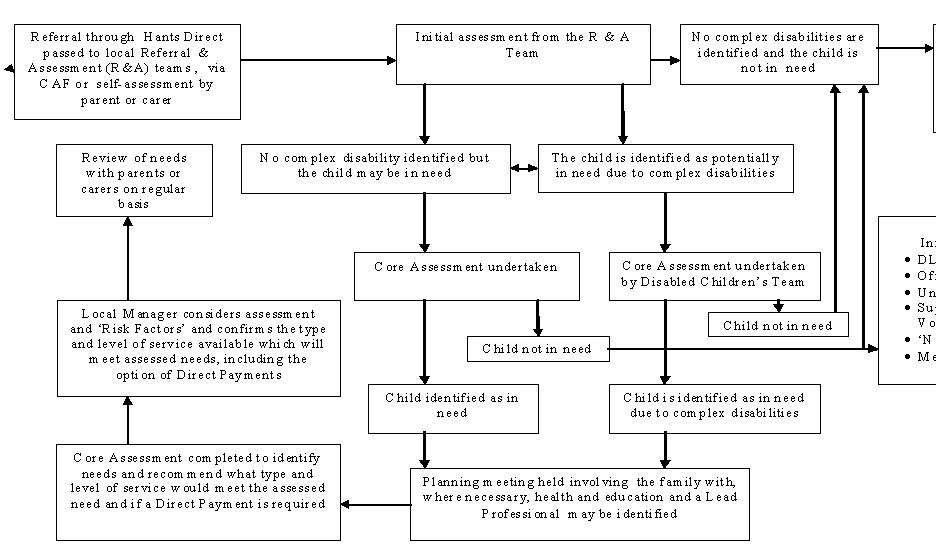
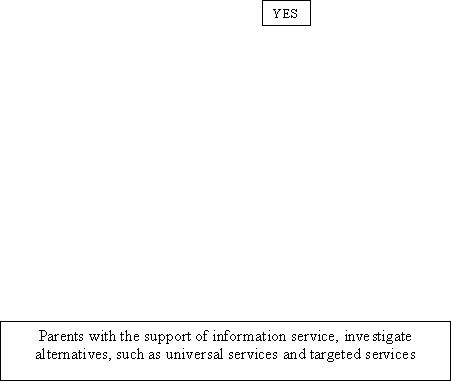
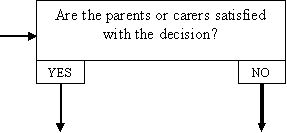
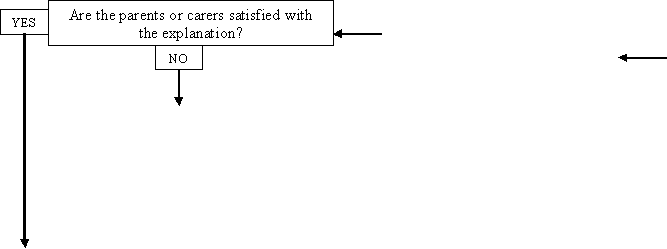
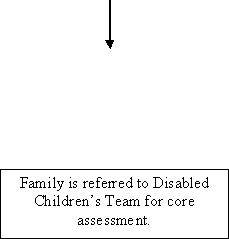
Specialist services are available for those whose needs, following an assessment, fall within the eligibility criteria. They are provided to children with the most complex needs and services include care supports within and outside the home, overnight short breaks and access to family link carers. The attached flow chart explains the process of referral, assessment and decision making.
This document also includes a glossary of terms and a list of key factors taken into account within assessments, which will support families in undertaking a level of self-assessment prior to seeking an assessment of need and assist in understanding how decisions are taken about the nature and level of service necessary to meet assessed need.
The Every Child Matters programme underpins assessment of need and access to specialist services as we want all children to:
· Be Healthy
· Stay Safe
· Enjoy & Achieve
· Make a Positive Contribution
· Achieve Economic Wellbeing
Throughout the assessment process the following considerations remain paramount.
· If assessed needs fall within the eligibility criteria the child and family will be eligible for a specialist social care service
· The nature and level of service is determined by the outcome of the assessment and takes into account a range of family factors in addition to the needs of the child or young person
· Currently the available resources will support providing a service which reasonably meets the needs identified in the eligibility criteria and If additional resources are available we may be able to meet a broader range of needs or provide a broader range of services
· It may be necessary for there to be a Continuing Health Care needs assessment to determine those needs which should be met by the NHS or a Mental Health Assessment from the Child and Adolescent Mental Health Service (CAMHS)
· Children who are assessed as in need, but whose needs do not fall within the criteria for accessing specialist services for disabled children, may be supported by access to other services, within the context of duties under the Children Act 1989.
Eligibility Criteria for access to specialist social care services
In order to achieve outcomes appropriate to their potential and as a result of their disability, the child requires total or substantial support, appropriate to their age, from another person, which is not available within the family network For example · Child uses specialist equipment for mobility · Child requires support for all basic self care functions when no longer age appropriate · Child needs constant supervision throughout the day and for prolonged periods at night when no longer age appropriate · Child has behaviour as a result of disability that is a serious risk to self and or others, including self harm · Child has communication needs which without support severely affects personal safety. i.e. is deaf, blind or without speech · Child has been assessed as having Profound and Multiple Learning Disability, Severe Learning Disability or Autism with challenging behaviour, which results in a significant risk of self harm or harm to others |
Process Flowchart
Factors which will be taken into consideration during Initial and Core Assessments
· Carer has physical or mental health problems which significantly affects their ability to care for a disabled child · Actual or potentially high level of risk to health or safety of carer · Carers or other family members suffer sleep deprivation on a regular basis due to needs of the disabled child through the night · The child or young person's behaviour is a serious risk to self or others and requires a structured behaviour management programme. Parents or carers may be unwilling or unable to implement programme and behaviours may result in the child being excluded from some situations · Child has been, or is currently, the subject of a Child Protection Plan · One other, or more than one other, person with disabilities or ongoing long-term health needs in the household who needs some support · Sole carer and has a limited support network, which may include physical and or social isolation of family. · There are some significant or complex pressures in the family e.g. domestic violence or substance misuse · There is risk to the child because of the physical environment · There is a risk of the disabled child's care breaking down · Without support the child or young person is likely to need a specialist residential or educational placement · The family is experiencing difficulties in meeting financial commitments or is on a low income and this affect their care of the child · There are stressful family relationships, or some difficulties in relationships with peers which may be harmful to the disabled child · Impact on siblings e.g. needs of other children in the family at risk of not being met as a result of family priorities with the disabled child |
Jargon Buster - Frequently Used Terms and Abbreviations
CAF Common Assessment Framework - one assessment document applicable to all agencies and which identifies need for early intervention and lead professional to co-ordinate the actions of all agencies involved with the child
Child Under18 years of age
Child in Need Section 17 of the Children Act 1989 defines a child in need---either because the child is disabled within the meaning of that Act or because the child needs local authority services to achieve or maintain a reasonable standard of health and development
Continuing Health Care NHS responsibilities for providing ongoing services to disabled children to meet assessed health care needs
DCT Disabled Children's Team
HantsDirect Phone call centre for members of the public and professionals to make enquiries about services and to seek further support or assessments
Initial & Core Assessment Department of Health needs assessment framework for social care to be completed within agreed timescales. Core assessment follows initial and is a comprehensive needs assessment with contributions from health and education as necessary
Parent Voice, Information Hubs A `one stop shop' providing parents of disabled children with information and advice.
PMLD Profound and Multiple Learning Disabilities
R&A Social Care Referral and Assessment team . First point of contact for referrals to social care
Self-Assessment Parent/Carer working in partnership with social worker at the initial referral stage
SLD Severe learning Disabilities
SEN Special Educational Needs
TAC Team Around the Child - Group of professionals & family to agree and co-ordinate action plans
Targeted services Services aimed at a specific group of children
Universal services Services available to any child or family e.g. playgroups, play schemes, youth clubs
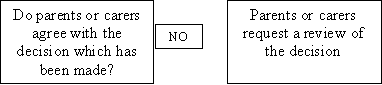
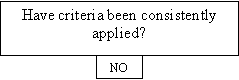
Mediation process
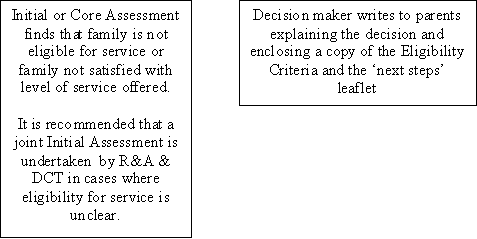



 Letter to family confirming the decision and signposting to the Information Hubs
The decision is reviewed by R&A team manager & DCT team manager, which could involve another area within Hampshire, to identify if the assessment has been properly completed and if the criteria have been consistently applied
 Parents may request a meeting with a Service Manager from Children's Services to discuss their concerns
 YES
YES