
Archived decisions
HAMPSHIRE COUNTY COUNCIL
Decision Report
Decision Maker: |
Executive Lead Member for Children's Services | ||||
Date of Decision: |
17 December 2009 | ||||
Decision Title: |
Children's Services Department 2009/10 Revenue Budget Monitoring - Period 7 (end of October 2009) | ||||
Decision Reference: |
1082 | ||||
Report From: |
County Treasurer and Director of Children's Services | ||||
Contact name: |
Gordon Shinn | ||||
Tel: |
01962 847545 |
Email: |
|||
1. Executive Summary
1.1. The purpose of this paper is to set out for the Executive Lead Member for Children's Services the current position on the Children's Services revenue budget for 2009/10 as at the end of October (period 7).
1.2. The report sets out the key emerging financial pressures faced by the department in 2009/10 relating primarily to activity-led areas, currently resulting in a forecast pressure of £4.3m (£0.5m Schools Budget, £3.8m non-schools budget). This represents a net reduction of £0.3m since the position reported to the Executive Lead Member in October 2009 (£0.5m reduction against the Schools Budget, offset by an increase of £0.2m against the non-schools budget).
1.3. This net reduction has been achieved through the identification of a number of budget savings (amounting to approximately £1.3m), reflecting changes in both anticipated demand against some budget headings as well as various management actions undertaken to reduce the overspend previously reported.
1.4. However, since the last report, an increased pressure of approximately £1.0m has emerged in relation to the Children Looked After budget as a result of changes in the number of children and young people who are currently being supported in higher cost placements.
1.5. It is anticipated that, with further planned management action, the overall budget pressure reported will reduce by a further £1.8m to £2.5m resulting in a balanced Schools Budget and an overspend of £2.5m against the non-schools budget.
2. Contextual information
2.1. The 2009/10 budget was agreed by the County Council on 19 February 2009.
2.2. Appendices are listed at paragraph 11.1.
3. 2009/10 Revenue Budget Summary as at 31 October 2009 (period 7)
3.1. The overall 2009/10 cash limited budget for Children's Services has increased since the original budget was set in February 2009 as outlined below:
Schools £000 |
Non-Schools £000 |
Total £000 | |
Original Agreed Cash Limited Budget |
803,587 |
166,654 |
970,241 |
Approved Changes: |
|||
Grant adjustments and other minor changes |
7,165 |
7,054 |
14,219 |
Current Cash Limited Budget* |
810,752 |
173,708 |
984,460 |
*Excludes assumptions around Schools Budget carry-forward to 2010/11.
3.2. The projected outturn reported for 2009/10 is an overspend of £4.3m. This represents a net reduction of £0.3m since the last report to the Executive Lead Member in October (£0.5m reduction against the Schools Budget offset by an increase of £0.2m against the non-schools budget). It is currently anticipated this position can be reduced by approximately £1.8m (£0.5m Schools and £1.3m non-schools budget) resulting in a forecast overspend of £2.5m.
3.3. The variance reported by each branch and by Schools Budget and non-schools budgets is as follows:
Period 5 |
Period 7 |
Change | |
£000 |
£000 |
£000 | |
Performance & Resources |
-851 |
-1,186 |
-335 |
Education & Inclusion |
+1,852 |
+1,510 |
-342 |
Children & Families |
+3,617 |
+4,011 |
+394 |
Total |
+4,618 |
+4,335 |
-283 |
After anticipated impact of further management action |
-855 |
-1,835 |
|
Adjusted position |
+£3,763 |
+2,500 |
-1,263 |
Period 5 |
Period 7 |
Change | |
£000 |
£000 |
£000 | |
Broken down by: |
|||
Schools Budget |
+1,046 |
+544 |
-502 |
Non-schools budget |
+3,572 |
+3,791 |
+219 |
Total |
+4,618 |
+4,335 |
-283 |
After anticipated impact of further management action |
-855 |
-1,835 |
|
Schools Budget |
+1,046 |
- |
-1,046 |
Non-schools budget |
+2,717 |
+2,500 |
-217 |
Total |
+3,763 |
+2,500 |
-1,263 |
3.4. A number of significant issues contribute to the position currently reported for the service. Many of these were outlined within the report presented to the Executive Lead Member for Children's Services in October 2009. This report can be found at 091015-excsed-R1008105631.htm. However, key contributing factors include:
· an increase in the number of children and young people supported in the activity-led budget areas such as:
o Special Educational Needs (SEN) and Out County Special School Placements. A number of strategies are currently being explored to address the level of overspend reported for Out County placements (e.g. re-negotiation of school fee levels with providers). However, it is not expected that these will impact on the service until the 2010/11 financial year at the earliest
o Home to School Transport. An increase of 2.3% increase in the number of pupils supported by this budget between September 2008 and 2009 has resulted in an increase in the number of season tickets (+5.5%) and contracts (+9.3%). Home to School Transport is a key focus for the Corporate Efficiencies targets and Children's Services will be working closely with the Corporate Efficiencies Board and Environment Department to effect the target savings in the vehicle procurement contract costs. These savings will not be available to offset any existing departmental pressures as they are part of the central efficiencies targets. At the same time Children's Services will be reviewing policy, entitlement and exceptions activity and the impact of SEN decisions on costs and these efficiencies will remain within the department. There is also potential for consideration of a restructure of the process between Children's Services and Environment Grouping, which, if supported by changes to IT systems could produce savings in administrative costs.
o Children Looked After. A sustained increase in the overall number of children in the care of the County Council during the 2008/09 financial year has resulted in a significant financial impact against this budget. Further information is provided at paragraph 5.22 onwards.
· the low bank base rate, which means that there is an estimated £0.5m shortfall on the budget for Interest on School Balances
· lower levels of staffing vacancies during 2009/10 than in previous years has also placed additional pressure on employee budgets
· increased costs in relation to some services, especially Home to School Transport, where increasing fuel prices may impact on some contract prices (despite the current economic climate), and Special Educational Needs (SEN) Out County Placements where inflation increases have been agreed regionally at a 2.8% increase for residential schools (0.3% above the inflation allocation of 2.5%).
3.5. The 2010/11 budget will address the on-going implications of these issues.
3.6. For the current financial year, various budget savings have been identified since the last report which include changes in the expected level of demand against some budgets, as well as a review of previously planned expenditure as part of the department's budget recovery plan. These changes amount to a net reduction in the forecast outturn of approximately £1.3m against both the Schools and non-schools budgets and include:
· reduced levels of forecast expenditure than originally anticipated against some budgets (e.g. Local Management of Schools (LMS) contingency and inter-authority recoupment, both of which are Schools Budget)
· savings achieved through further staff turnover experienced and very close scrutiny of recruitment to vacancies as they arise
· a review of planned IT development and other support services expenditure
· a review of the planned use of `core' contributions made to business units supporting schools.
3.7. However, an increase in the current forecast expenditure against the Children Looked After budget of approximately £1.0m has offset a significant proportion of this reduction. This change is primarily due to an increase in the proportion of children who are now placed within more costly types of arrangements such as purchased residential or foster care compared with that reported in October.
3.8. Key changes since the last report are outlined within section 5, which includes a more detailed summary of the contributing factors relating to the increase in forecast expenditure against the Children Looked After budget.
3.9. A number of emerging factors are expected to further affect the final position. As previously outlined, the department has already taken steps to reduce the overspend position reported (the outcomes of which are reflected within the forecast outturn) and further plans are currently being developed intended to further reduce the forecast overspend by approximately £1.8m (£0.5m Schools and £1.3m non-schools), from £4.3m to £2.5m. Key actions include:
· a continued review of some team structures to bring these in line with the budget available
· further scrutiny of decisions to recruit to vacancies across the department as they arise with a view to achieving one-off savings during 2009/10
· implementation of strategies intended to reduce the need to bring children in to care
· further negotiation with Hampshire Primary Care Trust around financial contributions being sought in relation to children and young people with complex health needs
· a review of existing service provision to ensure it is effectively meeting the needs of children and young people whilst achieving value for money (e.g. social care packages for care leavers and provision of transport to support contact arrangements with Children Looked After by the County Council)
· consideration of invest to save opportunities.
3.10. In addition, the department will continue to review all service budgets with the aim of identifying further savings to offset the wider department pressures.
4. Key Activity, Performance and Workforce information
4.1. The department is developing links between budgets, performance and human resource information and has implemented an integrated planning approach that embraces these elements.
4.2. Information is currently in the process of being compiled in respect of the end of quarter 2 position for performance and workforce related issues. An update will, therefore, be provided to the Executive Lead Member as part of the January 2010 report.
5. Major budget variations
5.1. The main variations of the forecast outturn based on the position as at the end of October (period 7) against the cash limit are outlined in the following table, with the most significant changes shown in bold:
Cash Limit £000 |
Period 7 Variance £000 |
Period 7 Variance % |
Period 5 Variance £000 |
Change £000 |
Report para | |
Schools Budget: |
||||||
LMS Contingency |
9,065 |
-340 |
-3.8 |
-199 |
-141 |
5.3 |
Teachers Threshold Payments and Performance Related Payments |
19,084 |
-190 |
-1.0 |
-190 |
0 |
|
Education Inclusion Service |
8,718 |
+297 |
+3.4 |
+315 |
-18 |
|
Statemented Pupils |
9,176 |
-163 |
-1.8 |
-196 |
+33 |
|
Inter Authority Recoupment |
615 |
+16 |
+2.6 |
+197 |
-181 |
5.7 |
Out of County Special Schools |
8,764 |
+960 |
+11.0 |
+960 |
0 |
|
Non-Schools Budget: |
||||||
Interest on Schools Balances |
-490 |
+510 |
+104.0 |
+510 |
0 |
|
Government Grant (relating to 2008/09) |
165 |
-165 |
-100.0 |
-165 |
0 |
|
Information Technology |
11,609 |
-330 |
-3.6 |
-90 |
-240 |
5.10 |
Workforce Development |
1,914 |
-162 |
-8.5 |
-95 |
-67 |
|
Primary and Secondary National Strategy Co-ordination |
1,577 |
-195 |
-12.4 |
0 |
-195 |
5.13 |
Home to School Transport |
24,414 |
+1,178 |
+4.8 |
+1,166 |
+21 |
5.15 |
Locality Teams (Education Welfare Officers) |
1,842 |
+113 |
+6.1 |
+121 |
-8 |
|
Commissioning and Social Work |
14,085 |
-289 |
-2.1 |
-287 |
-2 |
|
Children Looked After |
32,682 |
+2,845 |
+8.7 |
+1,819 |
+1,026 |
5.22 |
Family Support Services |
8,197 |
+192 |
+2.3 |
+265 |
-73 |
|
Youth Justice (includes Secure Unit) |
381 |
-190 |
-49.9 |
-222 |
+32 |
|
Other Children's Services |
7,604 |
+887 |
+11.7 |
+1,027 |
-140 |
5.78 |
Services for Young People (Connexions Consortia and District Youth Teams) |
11,563 |
+65 |
+0.6 |
+152 |
-87 |
|
Unallocated Budget |
908 |
-605 |
-66.6 |
-605 |
0 |
5.2. The following paragraphs provide details on significant changes to forecasts since the last report.
Schools Budget
Local Management of Schools (LMS) Contingency -£340,000 (-3.8%)
5.3. A change of -£131,000 since the October report.
5.4. This budget includes amendments made to schools' budget allocations, as well as Nursery School payments, money for excluded pupils and payments to schools for newly qualified teachers.
5.5. A significant proportion of the underspend reported relates to an increase of £196,000 in the cash limit against the LMS contingency in respect of Schools Budget which had previously been allocated to Early Years (for the New Opportunities Fund) but which is no longer required for this purpose. This is, therefore, now available to offset other pressures within the Schools Budget.
5.6. The remaining underspend of £134,000 (and the primary change since the last report) relates to the net effect of a combination of budget share amendments (including those for rates and temporary classrooms), and allocations for newly qualified teacher mentoring which, has been lower than originally budgeted for.
Inter-Authority Recoupment +£16,000 (+2.6%)
5.7. A reduction of -£181,000 since the last report.
5.8. The budget represents the net position of payments and receipts arising from Hampshire pupils placed in other local authority schools and vice versa. The forecast outturn against this budget is based on known current activity levels, but this is subject to change throughout the year.
5.9. The current position reported reflects the inclusion of several additional pupils from other local authorities placed within Hampshire schools which were not known about at the time the previous forecast was reported.
Non-Schools Budget
Information Technology (IT) -£330,000 (-3.6%)
5.10. A change of -£240,000 since the last report.
5.11. As part of the 2009/10 budget strategy a proportion of the 2008/09 underspend carried forward to the current financial year was allocated toward meeting the cost of a number of IT development projects. As part of the department recovery plan, some development projects identified as being low priority have been delayed and this previously resulted in savings of approximately £90,000 being reported. A further review of remaining projects has now identified additional in-year savings of £90,000 (an overall total of £180,000).
5.12. In addition a proportion of the core funding provided to the EdICT business unit for 2009/10 is expected to be returned to the department (£150,000).
Primary and Secondary National Strategy Co-ordination -£195,000 (-12.4%)
5.13. This represents a change of -£195,000 since the last report.
5.14. A combination of factors including vacancy management, overhead costs being lower than expected and opportunities to fund some aspects of this work from alternative sources have contributed to this underspend position.
Home to School Transport +£1,177,000 (+4.8%)
5.15. Whilst there has not been a significant change to the position presented previously (an increase of £21,000 has been reported), this budget continues to present a significant financial challenge to the department.
5.16. This is an activity-led budget, which (despite having had much additional resource added over the years including £575,000 in 2009/10) has been under constant pressure for several years. As well as transport inflation being high, there has been an increase in contract numbers (the main cost driver).
5.17. The following table shows that there has been an increase in the level of activity against this budget over the past financial year.
Number as at September 2008 |
Number as at September 2009 |
Increase % | ||
Pupils transported (A) |
Mainstream |
11,897 |
12,115 |
+1.8 |
Special / EIS |
2,325 |
2,439 |
+4.9 | |
Total |
14,222 |
14,554 |
+2.3 | |
Season Tickets (B) |
2,187 |
2,308 |
+5.5 | |
Pupils transported by contract (A) - (B) |
12,035 |
12,246 |
+1.8 | |
Number of Contracts |
Mainstream |
731 |
823 |
+12.6 |
Special / EIS |
609 |
641 |
+5.3 | |
Total |
1,340 |
1,464 |
+9.3 |
5.18. This table demonstrates that a significant proportion of the growth in pupil numbers (4.9%) since September 2008 relate to an increase in those educated in either special school provision (SEN pupils in mainstream are included with the mainstream pupil numbers) or other non-mainstream school arrangements such as pupil referral units.
5.19. The forecast overspend includes:
· £246,000 (6.5%) on escort costs. This position includes a pressure of £210,000 in respect of salary costs. This is a mixture of Pay & Benefits costs where escorts have moved from a `spot salary' to an incremental pay scale (£105,000), as well as increased hours worked (£96,000) due to a combination of more pupils requiring escorts and longer journeys being made as reflected in the activity information shown above. The remaining £36,000 relates to the cost of the three yearly CRB renewal checks which will be undertaken during 2009/10
· £871,000 (4.4%) in respect of contract costs, including an increased number of contracts, the effects of above inflation price rises, offset by planned transport reviews and spend to save initiatives
· season ticket costs are forecast to overspend by £83,000 (6.9%) as a result of estimated increases in respect of entitlement to season tickets in secondary and FE sectors
5.20. Offsetting this position is £22,000 of additional income forecast to be received than had originally been budgeted for. This income is primarily received from parents who are not eligible to receive free transport, but who pay a contribution to use available transport where capacity exists.
5.21. Further information outlining the key issues which contribute to the current position reported is contained within the previous report.
Children Looked After +£2,845,000 (+8.7%)
5.22. The position as at the end of October 2009 reflects a significant increase in forecast expenditure of £1,026,000 since the last report as outlined below:
August 2009 Variance £000 |
October 2009 Variance £000 |
Change £000 | |
Purchased Residential Care (Non-County Placements (NCPs) and Secure Welfare*) |
-444 |
+237 |
+681 |
Purchased Fostering (IFPs) |
+1,305 |
+1,508 |
+203 |
HCC Fostering |
+411 |
+368 |
-43 |
HCC Children's Homes |
+534 |
+499 |
-35 |
Other Residential |
+13 |
+233 |
+220 |
Total |
+1,819 |
+2,845 |
+1,026 |
*Expenditure on Secure Welfare amounts to approximately £230,000 of the forecast outturn reported against purchased residential placements
5.23. This is based on an assumption that current known activity levels will remain stable throughout the remainder of the financial year. Further information on the changes reported against each of these individual budget headings is provided within paragraphs 5.59 to 5.77 of the report.
5.24. Activity levels for Children Looked After (CLA) steadily increased over the latter part of 2008/09, from 1,023 as at 31 March 2008 to 1,084 at 31 March 2009 (an increase of 6.0%). Since the beginning of the 2009/10 financial year, activity levels have fluctuated slightly (as demonstrated in the graph below). However, as at the end of October the number of CLA was 1,084, remaining in line with the position reported at the end of March and August 2009. 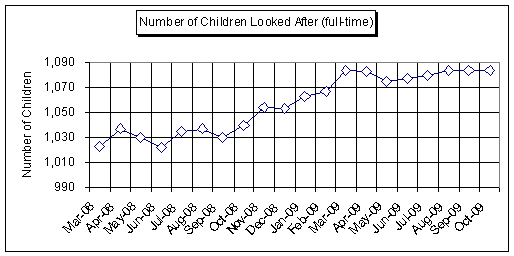
5.25. The trends in Hampshire are consistent with national trends and are also linked to a range of other workload pressures in relation to vulnerable children.
5.26. There have been a number of drivers for these developing pressures but the two most prominent factors have been the public and professional reaction to the Baby P tragedy in Haringey and the impact of the recession. Further possible factors include changes in the legal process (the `public law outline'), the improved early identification of risk and need in relation to children, and the fact that these are national issues meaning that, on occasions, demand for placements far outstrips supply. This latter point adds an inflationary factor to the costs of placements on top of the simple quantitative pressure.
National trends
5.27. It is useful to set out the national picture, in so far as the evidence is emerging, and then set out the current position in Hampshire.
5.28. The ratio of children in care in Hampshire has historically stayed around the figure of 37 per 10,000 children. With the latest rise included this figure rises to 39 per 10,000. The table below demonstrates that Hampshire compares favourably to other similar authorities in this regard.
Lancashire |
51 |
Northamptonshire |
42 |
Essex |
44 |
Norfolk |
51 |
Cornwall |
44 |
Devon |
37 |
Gloucestershire |
38 |
Wiltshire |
33 |
Source: DCSF, October 2009
5.29. In another recent snapshot survey, authorities were asked to identify current placement budget pressures in 2009/10. Of the 13 Counties included in this survey, eight had pressures in excess of those experienced in Hampshire and, in some areas, the pressure far outstripped that seen here.
% overspend | |
Hampshire |
8.7 |
Average |
25.2 |
Highest |
76.0 |
Lowest |
0.0 |
Source: Buckinghamshire County Council, November 2009
5.30. The rise in Children Looked After of 6% is relatively low compared with other authorities. A recent survey of councils undertaken by East Sussex County Council (November 2009) showed significant pressures emerging in the South East and the Association of Directors of Children's Services (South East Region) has written to the Secretary of State outlining the position across all south east authorities where the rise in numbers varies between 5% and 32%.
5.31. As stated above, one important driver of this increase is the `post Baby P effect' of increased awareness of child protection issues amongst the public and professionals, including health, police and education staff. Social workers generally respond to referrals from these other professionals and the public. There has been a national increase in the number of referrals and the local picture is set out below. This has led to a reported increase in child protection activity. Although national data on this has yet to be produced, a South East regional survey showed increases in child protection activity ranging from 10% to 80%. There is a clear link between child protection activity, such as making a child subject to a child protection plan in order to protect them at home, and the numbers of children who, ultimately, may need to be looked after by the local authority in order to protect them.
5.32. The second driver has undoubtedly been the recession which has placed considerable strain on some vulnerable families. Nationally, Cafcass (the Children and Family Courts Advisory Service) has reported a 50% increase in care applications in the family court.
Hampshire Trends
5.33. The overall picture in Hampshire can be characterised as having followed national trends but to a lesser degree than many other authorities.
5.34. The number of children looked after has increased by 6%. However, the number of children subject to child protection plans has increased by 53% (from 444 children in July 2008 to 682 currently). Similarly the number of care proceedings initiated has risen over 20%.
5.35. There has also been an 80% rise in referrals and contacts to Children's Social Care services. However, this figure should be treated with some caution as, during this period, Hantsdirect has become the contact centre for children's social care thus making initial contact and referral easier for the public and professionals. Therefore, there may be some distortion in the data although it can be said with some authority that there has been a significant increase in activity.
5.36. Recent investment in social work teams by the Council has enabled more social workers to carry out their duties with greater effectiveness. However, this has been counterbalanced by increased child protection and court work. Both of these types of work are priorities to ensure the immediate protection of children but increased workloads in these areas of 50% and 20% respectively have led to reductions in social worker time elsewhere. This has had an impact on the ability of social work teams to work intensively to prevent family breakdown where older children are exhibiting problematic behaviours in families. Another factor which has become evident recently, although there is no historical data to compare with, is a growing number of sibling groups that are being looked after. Typically, these may include a two year old, an eight year old and an older teenager.
5.37. The increased workloads have reduced the flexibility within fieldwork teams to work to reduce the numbers of children coming into care and this decreased elasticity has also come into play in relation to the types of placements that are available for children who are looked after. Managers report no reduction in the thresholds that are used to assess the need to accommodate children, indeed some decision making has been moved to more senior managers to ensure firm "gatekeeping."
5.38. The fostering service has been successful in growing its number of foster carers but not at a rate fast enough to accommodate the step change in the looked after children population. The increase in demand has made it impossible to reduce the usage of Independent Fostering Providers (IFPs) and indeed there has been a slight increase arising from the need to place teenagers and, more recently, growing numbers of sibling groups when there are no vacancies with Hampshire carers.
5.39. The following table outlines various comparisons between the number of children placed with in-house foster carers and Independent Fostering Providers, including the Foster Care business case base line assumptions and the business case target for October 2009.
Number of Children in Provision |
Business Case Baseline |
Adjusted Business Case Target Oct 2009 |
Client numbers at Mar 2009 |
Client numbers at Oct 2009 |
Increase in numbers from target position Oct 2009 |
In house foster care |
534 |
593 |
630 |
621 |
+28 |
Independent Fostering providers (IFP) |
142 |
137 |
175 |
178 |
+41 |
In house children : 1 IFP |
3.76 |
4.32 |
3.60 |
3.49 |
-0.83 |
5.40. Overall, an additional 28 placements have been made as at the end of October 2009 with in-house foster carers than had originally been envisaged when the business case was developed. This demonstrates the success of the foster care investment strategy so far in terms of avoiding additional expenditure which might have otherwise been incurred from an even greater use of IFP placements.
5.41. Whilst this comparison demonstrates a lower ratio of children placed with in-house foster carers to those with IFPs for October 2009 than the business case target (3.49:1 compared with 4.32:1 respectively), this needs to be considered alongside the wider context of increasing numbers of CLA.
5.42. Additional investment will continue during 2009/10 on marketing campaigns targeted at recruiting new and experienced foster carers to the service and it is envisaged that further capacity will continue to be created within the service during 2009/10. Providing Children Looked After activity levels do not rise further it is anticipated that whilst a further budget pressure may emerge against the HCC fostering service, any additional capacity generated (in particular for older children) will contribute toward achieving a reduction in the number of IFP placements required. This should in turn enable budget savings to be delivered. However, as indicated above this will be dependent upon future activity levels and demand for foster care placements stabilising.
5.43. It is of significant professional concern that there is firm evidence that the IFPs are also reaching capacity and more frequently are unable to place children we have referred to them. Our intelligence is leading us to believe that the regional increase in the numbers of children looked after across local authorities is leading to a high demand that is outstripping supply leading to higher charges.
5.44. This shortage of foster placements has led to more children being placed in residential children's homes in an emergency when a foster placement cannot be found. The children's homes have been operating at near full and full capacity for some time. They have been managing high risk placements as well as emergency admissions which in most cases is outside of their statement of purpose and makes management of the group of young people very challenging. Ofsted has expressed concern about emergency placements and have placed a requirement on senior managers after an inspection of one home not to place children without more consideration of the needs of the individual children and existing resident group. The `lack of headroom' in the system and challenging behaviour resulting from inappropriate mixes of young people, has led to the recent increase in Non-County Placements (NCPs), further driving up costs as such placements again have to be purchased. A significant proportion of NCPs are for children with disabilities who can no longer be maintained at home with care packages. Historically, the cost of such placements has been split between the Primary Care Trust, Special Educational Needs and Children's Social Care. Unfortunately, we are seeing increasingly small contributions from the PCT for such packages further adding to pressures.
5.45. In addition to the above, Children Looked After can be placed in a variety of other arrangements such as supported lodgings, secure welfare accommodation (secure remand accommodation arrangements are not reflected within Children Looked After activity or expenditure), children placed for adoption (subject to final approval), as well as in some circumstances living at home with their parent(s) on care order.
5.46. The cost to the County Council of these different types of arrangements vary considerably and can, therefore, have a significant impact on the position reported if changes are experienced in the proportion of children accommodated in more costly types of arrangements. For example, the annual cost of supporting a child in care can range from a relatively small amount (e.g. less than £1,000) for a child living at home with their parents on a care order, to as much as £300,000 per annum for a residential placement for a child with very complex needs.
5.47. The table below outlines the number of children looked after by type of placement as at the end of August 2009 (as reported in October), compared with the end of October 2009.
Number of children in full-time care by children with a disability (CwD) and non-disabled children) |
August 2009 |
% |
October 2009 |
% |
Change (August to October) 2009 |
% | |
Non-county placements |
Non-disabled |
17 |
1.6 |
14 |
1.3 |
-3 |
-0.3 |
CWD |
38 |
3.5 |
43 |
4.0 |
+5 |
+0.5 | |
Total |
55 |
5.1 |
57 |
5.3 |
+2 |
+0.2 | |
HCC residential children's homes |
Non-disabled |
30 |
2.8 |
31 |
2.9 |
+1 |
+0.1 |
Independent Fostering Providers (IFP) |
Non-disabled |
155 |
14.3 |
164 |
15.1 |
+9 |
+0.8 |
CWD |
13 |
1.2 |
14 |
1.3 |
+1 |
+0.1 | |
Total |
168 |
15.5 |
178 |
16.4 |
+10 |
+0.9 | |
HCC Fostering |
Non-disabled and CwD |
629 |
58.0 |
621 |
57.3 |
-8 |
+0.7 |
Other |
Non-disabled and CwD |
202 |
18.6 |
197 |
18.1 |
-5 |
-0.5 |
1,084 |
1,084 |
- |
|||||
5.48. This table demonstrates that whilst the overall number of CLA has remained stable at 1,084 since August 2009, the proportion of children who are supported within more costly arrangements (e.g. residential care and external foster care) has increased compared with those placed within less costly arrangements (e.g. in-house foster care or other types of arrangements such as children placed at home on care orders or in supported lodgings).
5.49. These changes have, therefore, had a considerable further impact on the budget pressure now reported for 2009/10.
5.50. An analysis completed of the age profile of the Children Looked After population has determined that no significant change has been observed since the end of August 2009.
Age Group |
Number of CLA as at: | |||
31 August 2009 |
31 October 2009 |
Change Aug to Oct | ||
Number |
% | |||
0 to 4 |
231 |
225 |
-6 |
-2.6 |
5 to 10 |
233 |
237 |
+4 |
+1.7 |
11 to 15 |
431 |
430 |
-1 |
-0.2 |
16+ |
189 |
192 |
+3 |
+1.6 |
Total |
1,084 |
1,084 |
- |
|
5.51. However, further analysis of this information, also taking into consideration the average length of time a child is in care for each age group, will be undertaken over the coming months to determine the potential impact on the Children's Services budget in future years.
5.52. An additional financial pressure may also emerge over the coming months following the conclusion of a recent case (G vs Southwark) regarding homeless 16/17 year olds. A ruling by the House of Lords on 20 May 2009 states that "local authorities should presume any lone, homeless children should be provided with accommodation under section 20 of the 1989 Children Act. Where the criteria for section 20 have been met, children's services do not have the discretion to choose to use section 17 powers instead to provide accommodation".
5.53. This means that the County Council has a statutory duty to carry out an initial assessment (and most likely a core assessment) for all 16 and 17 year olds and a potentially significant cost pressure could arise as a result. Further work is currently being undertaken by the department, and nationally by the Local Government Association, to determine the implications of this judgement.
Management activity to reduce budget pressures
5.54. The department believe that, through a combination of alternative approaches to decision making, support arrangements and placement planning, the number of children in care can be reduced to a level of 1,020 by March 2011. The main strand of activity to bring down the budget pressures relating to looked after children is the introduction of the Intensive Support Service (ISS). This scheme has been piloted in the South East of Hampshire where it has worked with over 200 children on the threshold of care. Early results are encouraging. The aim is to provide intensive support to families of teenagers to prevent those children coming into care. The scheme will be rolled out to the north and west of the county in the next two months.
5.55. In addition, senior managers have taken steps to oversee decision making to ensure that thresholds are consistent. For example, the decision to take a child into care can now only be taken by a District Service Manager (previously team manager), the decision to apply for a non county placement must be approved by an Area Director following a panel recommendation.
5.56. A pilot scheme has been introduced in the South West to improve care planning and to improve gate-keeping for children coming into care, particularly the older age range.
5.57. The Children and Families Branch are currently reviewing all Independent Fostering arrangements and Non-County placements for older children to see whether any of their needs could now be met by in-house services.
5.58. It is, therefore, expected that whilst savings will be achieved compared within the current financial year, an overall growth pressure of £1.0m will remain in 2010/11 against the provisionally agreed cash limit.
Purchased Residential Care or Non-County Placements (NCPs)
5.59. The forecast overspend for NCPs is £237,000, or 2.6% of the cash limit of £8,955,000. This position represents an increase of £681,000 since the last report.
5.60. This budget includes both Non-County residential children's homes and school placements as well as the externally sourced secure welfare placements.
5.61. The forecast is based on any known changes to current activity levels with 57 placements as at the end of October 2009, a net increase of two since August 2009 (ten new placements and eight recorded as having ceased).
5.62. However, much of the budget saving achieved as a result of the eight placements recorded as ending had already been reflected in the forecast outturn previously reported. The average unit cost of a purchased residential placement is approximately £160,000 (although this can range from a contribution of £10,000 for a School placement to meeting the full placement costs of £300,000). This increase in new placements has, therefore, had a significant impact on the budget pressure reported at the end of October.
5.63. This budget continues to pose a significant area of risk. A review of future potential placements has identified at least two further potential placements which may need to be made in December at a part-year cost of approximately £150,000. Further savings of approximately £90,000 may also be achieved from the possible early cessation of one existing placement which, could offset these increases. However, as these changes are still uncertain at this stage these potential additional costs/savings have not been incorporated into the forecast outturn at this stage.
Independent Fostering Providers (IFPs)
5.64. The forecast outturn indicates an overspend of £1,508,000 (an increase of £203,000 since the last report), which represents +25.2% of the cash limit of £5,976,100. This cash limit includes the reduction of £300,000 forecast savings included within the 2009/10 Budget Strategy.
5.65. The number of children placed with IFPs has increased to 178 at the end of October from 168 at the end of August (a net increase of ten). During September and October 21 new IFP placements have been made and 11 have ceased.
5.66. Due to the sustained increase in the number of children looked after during the current financial year the overall use of external foster care placements has been considerably higher than had been budgeted for. Increased capacity generated within the in-house service has avoided the need for even higher increases, but the increasing demand for foster care placements in general this year has resulted in the expected level of budget savings (as assumed in the foster care investment business case) not being achieved.
5.67. Activity in this area will continue to be monitored carefully during 2009/10, as clearly any increases in CLA during the remainder of the year could have significant effects on the full year outturn.
HCC Fostering Service
5.68. The current forecast outturn indicates an overspend of £368,000 which represents +3.3% of the cash limit of £11,167,600. This cash limit includes the growth of £600,000 agreed in the foster care investment business case for 2009/10.
5.69. The position reported is based on an assumption that current activity levels will remain stable for the remainder of the year. As at the end of October, 621 children were placed with in-house foster carers. This represents a net reduction of eight placements since the end of August.
5.70. Despite this recent reduction, the number of HCC foster carers has remained relatively stable at 597 (598 as at the end of August). Further work is being undertaken to understand the reasons why the number of in-house placements is beginning to reduce with IFPs increasing in light of this increased capacity within the service and to develop strategies to respond to this. However, initial indications suggest that this maybe due to the majority of new carers being registered to take children below 10 years of age, with most of the demand for new foster care placements arising in respect of children above this age.
5.71. Whilst the overall age profile analysis outlined above does not necessarily support this position, a closer review of the age profile by placement type confirms that the overall increase in foster care (and IFPs in particular) since August has mainly occurred within the 11 to 15 age group.
Age Group | |||||||||||||||
0 to 4 |
5 to 10 |
11 to 15 |
16+ |
Total | |||||||||||
Aug |
Oct |
+ / - |
Aug |
Oct |
+ / - |
Aug |
Oct |
+ / - |
Aug |
Oct |
+ / - |
Aug |
Oct |
+ / - | |
In-house Foster Care |
165 |
161 |
-4 |
156 |
161 |
+5 |
240 |
240 |
- |
68 |
59 |
-9 |
629 |
621 |
-8 |
IFP |
11 |
9 |
-2 |
24 |
26 |
+2 |
102 |
116 |
+14 |
31 |
27 |
-4 |
168 |
178 |
+10 |
Total |
176 |
170 |
-6 |
180 |
187 |
+7 |
342 |
356 |
+14 |
99 |
86 |
-13 |
797 |
799 |
+2 |
5.72. This position will need to carefully scrutinised and monitored over the coming months.
5.73. As outlined earlier in the report, growth in the overall number of children requiring a foster care placement over the last year has clearly impacted on the service's ability to react to the full level of demand for placements within the additional capacity generated which has resulted in the continued need to procure from Independent Fostering Providers (IFPs).
Residential Children's Homes
5.74. The current forecast outturn indicates an overspend of £499,000 which represents +8.3% of the cash limit of £6,022,000.
5.75. Many of the children's homes are reporting considerable overspends for 2009/10 as a result of demands against their staffing budgets (e.g. use of overtime and agency staff to cover sickness and holidays). Higher levels of occupancy observed in some of the units during 2009/10 compared with 2008/09, together with the accommodation of some children requiring very intensive support and supervision (e.g. 1 to1 supervision and waking night staffing) has clearly impacted on the department's ability to manage within its available budget. This will be addressed as part of the 2010/11 budget setting process.
Other Residential
5.76. The current forecast outturn indicates an overspend of £233,000 which represents +57.8% of the cash limit of £402,500
5.77. This budget includes support for children in care who are placed in independent and supported living arrangements (e.g. 16 and 17 years olds). The reasons for a increased pressure reported against this budget is being investigated, but it is possible that the Southwark judgement (paragraph 5.52) is beginning to impact.
Other Children's Services +£887,000 (+11.7%)
5.78. A net reduction of £140,000 since the last report.
5.79. The forecast overspend consists of:
August Variance |
October Variance |
Change | |
£000 |
£000 |
£000 | |
Adoption Services |
+366 |
+394 |
+28 |
Leaving Care Services |
+268 |
+159 |
-109 |
Other Children's Services |
+393 |
+334 |
-59 |
Total |
+1,027 |
+887 |
-140 |
5.80. The overspend reported within the adoption service has arisen for a number of reasons including anticipated expenditure on interagency placements resulting from an increase in the number of externally arranged adoption placements, as well as an increase in expenditure on adoption allowances since last year. The average number of children who were being financially supported through adoption allowance payments in 2008/09 was 225, compared with an average of 240 as at the end of October, an increase of 6.7%.
5.81. A further increase in the number of externally arranged adoption placements has resulted in an increase of £28,000 on the variance reported previously.
5.82. The overspend against the Care Leavers budget reflects a steady increase in the number of care leavers who are continuing to be supported by the department since 2006/07. This is demonstrated in the graph below: 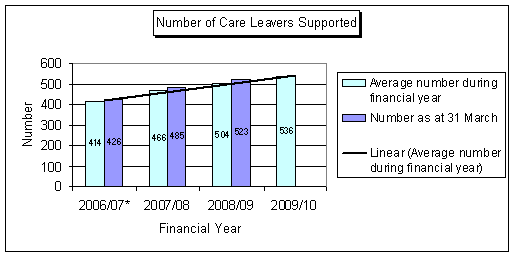
* Average figure for 2006/07 is based on period August 2006 to March 2007 only.
5.83. This change represents a 6.3% increase since 2008/09 in the average number of care leavers who continue to be supported by the County Council.
5.84. Since the last report, further work has been undertaken to review current support packages for care leavers and this has identified additional budget savings of approximately £109,000.
5.85. The overspend within the Other Children's Services budget is mainly due to pressures relating to the provision of social care related transport for children. Further management action is being taken to address this level of overspend through reviewing the current provision of transport to support contact arrangements for Children who are Looked After. Whilst the full impact of this change is unclear, the forecast reported has reduced by approximately £59,000 since the last report.
6. Children's Centres
6.1. A further update on Children's Centres will be provided within the January 2010 report. It is possible that some savings will accrue in 2009/10 following the finalisation of the Phase 3 contracts.
7. Business Units
7.1. There has been no significant change in the Business Units position since the last report. A further update will be provided in the January 2010 report.
8. Partnerships
8.1. Within Children's Services there are two significant partnerships that are currently reported on - Wessex Youth Offending Team (YOT) and Hampshire CAMHS Commissioning Partnership. A partnership is considered to be significant where the County Council has a net financial impact estimated to be in excess of £0.250m over the life of partnership. In this context there is a third partnership for which the governance and partnership funding arrangements are being finalised - the Hampshire Safeguarding Children's Board (HSCB).
8.2. The following positions were reported to the Executive Lead Member in October (based on September board reports) and further updates will be available in the January report:
· Wessex Youth Offending Team. An overspend of £38,000 attributable primarily to the reduced contribution from the Police Authority. The Hampshire Constabulary has subsequently agreed to increase it's contribution by £33,000
· Hampshire CAMHS Commissioning Partnership. A forecast underspend of £270,000 was reflected in October (September position). The partnership is currently engaging in a major re-tendering process, with a view to implementation in April 2011.
8.3. The Hampshire Safeguarding Children Board includes many partners. The funding agreement is being finalised and includes financial contributions from the Hampshire PCT, Police, District Councils, Probation and the Children & Family Court Advisory & Support Service (Cafcass). The total budget is in the region of £250,000 per annum. A budget update will be provided following the next Board meeting in January 2010.
9. Efficiencies and Savings Targets
9.1. An update of the current achievement against the department's savings targets for 2009/10 of £3,558,000 is shown in Appendix 4. This identifies that £2,496,000 of this overall target is currently expected to be achieved.
9.2. The key areas where the target is not currently reported as being achieved are:
· £300,000 in respect of Independent Fostering Provider placements. This is primarily due to growth in the number of children who are looked after by the County Council
· £200,000 in relation to Home to School Transport. Growth in the number of children being transported has impacted on the ability to generate budget savings
· £562,000 of the £1,562,000 `savings to be identified' target. The department has been successful in absorbing in the region of £1m of this savings target. However, additional budget pressures are expected to impact on the departments ability to manage within it's available cash limit.
9.3. Children's Services is engaging fully with the County Council efficiency programme and will be making contributions to the corporate targets in workstyle, home to school transport, contracting work, transition as well as various other measures. In addition Children's Services management team are considering what further efficiency measures can be taken that can help offset future departmental pressures.
10. Future direction
10.1. The department will monitor its forecast outturn against the available cash limit throughout 2009/10 using a risk based approach to reporting variances. A regular update report will be presented to the Executive Lead Member for Children's Services outlining any key or high risk issues.
10.2. This information will be used as part of a wider integrated service planning approach by the department to inform the proposed budget for 2010/11 to 2012/13.
11. Appendices
11.1. The following appendices are attached:
Appendix |
||
1 |
Budget Monitoring Summary | |
2 |
Activity Data |
(a) termly (b) monthly |
3 |
Forecast Business Unit balances | |
4 |
Savings Targets | |
12. Recommendations
12.1. Agree the current financial issues that are being addressed within the 2009/10 budget and the management action required in the areas of particular pressure.
12.2. Receive a detailed progress report on the key activity, spending pressures and recovery plan actions at the next Decision Day.
CORPORATE OR LEGAL INFORMATION:
Links to the Corporate Strategy
Hampshire safer and more secure for all: |
Yes |
Corporate Business plan link number (if appropriate): | |
Maximising well-being: |
Yes |
Corporate Business plan link number (if appropriate): | |
Enhancing our quality of place: |
No |
Corporate Business plan link number (if appropriate): | |
Other Significant Links
Links to previous Member decisions: |
|||
Title |
Reference |
Date | |
Children's Services Revenue Budget 2009/10, 2010/11 , 2011/12 |
Item 2 |
21 January 2009 | |
Children's Services Department 2008/09 Revenue Budget Final Position and 2009/10 Budget Monitoring - Period 2 (End of May 2009) |
Item 1 |
22 July 2009 | |
Children's Services Department 2009/10 Revenue Budget Monitoring - Period 5 (end of August 2009) |
Item 2 |
15 October 2009 | |
Direct links to specific legislation or Government Directives |
|||
Title |
Date | ||
Section 100 D - Local Government Act 1972 - background documents | |
The following documents discuss facts or matters on which this report, or an important part of it, is based and have been relied upon to a material extent in the preparation of this report. (NB: the list excludes published works and any documents which disclose exempt or confidential information as defined in the Act.) | |
Document |
Location |
IMPACT ASSESSMENTS:
1. Equalities Impact Assessment:
1.1. Equality and diversity objectives are not considered to be adversely affected by the proposals of this report.
2. Impact on Crime and Disorder:
2.1. Crime and disorder objectives are not considered to be adversely affected by the proposals of this report.
3. Climate Change:
a) How does what is being proposed impact on our carbon footprint / energy consumption?
· No impact
b) How does what is being proposed consider the need to adapt to climate change, and be resilient to its longer term impacts?
· No impact