
Archived decisions

HAMPSHIRE COUNTY COUNCIL
Decision Report
Decision Maker: |
Cabinet | ||||
Date of Decision: |
21 December 2009 | ||||
Decision Title: |
Driving Success: Chief Officer Self-Assessments - 2009/10 Quarter Two | ||||
Decision Reference: |
1123 | ||||
Report From: |
Chief Executive | ||||
Contact name: |
Gary Smith | ||||
Tel: |
01962 847402 |
Email: |
|||
1) Executive Summary
1.1. Cabinet took the decision to significantly strengthen the corporate Performance Management Framework in November 2008 when they approved `Driving Success'.
1.2. Since then the momentum behind Driving Success and the principles underpinning it have been maintained and increased. The step-change in the way performance and improvement is managed across the Council is recognised and welcomed.
1.3. This report is in the new Driving Success format. It consists of seven Chief Officer Self-Assessments, one for each department, at quarter two of 2009/10. These self-assessments represent the Chief Officer's judgement of the key issues for them and their department now and looking forward1.
1.4. Accompanying these Chief Officer Self-Assessments is an overview by the Head of Improvement which highlights common themes and gives a verdict on the Council's overall position and direction of travel.
Contents
Item |
Section |
Preface by the Leader and Chief Executive |
1 |
Head of Improvement's Council Overview |
2 |
Chief Officer Self-Assessments (COSAs) |
|
· Chief Executive's Department |
3 |
· County Treasurer's Department |
4 |
· Adult Services |
5 |
· Children's Services |
6 |
· Culture, Communities and Rural Affairs |
7 |
· Environment Department |
8 |
· Property, Business and Regulatory Services |
9 |
Appendices |
10 |
Appendix One |
|
COSA Prompt List |
|
Appendix Two |
|
Overview of Driving Success |
|
Appendix Three |
|
Driving Success Main Roles & Responsibilities |
Leader's Preface
 From a political perspective residents have an expectation that public services will develop to meet their aspirations and provide value for money. Driving Success provides one means by which County Council services can be assessed and improvement identified. It is the hallmark of an organisation that it is comfortable with the pursuit of constant improvement. Driving Success provides a means by which political ambition and management leadership can be brought together to look for improved service outcomes.
Cllr K Thornber, Leader of Hampshire County Council
Chief Executive's Preface
 The County Council has been assessed as Four Stars and `Improving Strongly' across its services. Driving Success was developed to look beyond inspection regimes and provide a means by which the performance of the organisation could be assessed, explained and where relevant improved. The size and complexity of the Council means that improving performance requires a framework to be embedded into the management of the Council. Driving Success provides the means by which this can be done and provides momentum for the future.
Andrew Smith, Chief Executive of Hampshire County Council
2) Head of Improvement's Council Overview
The Council's Overall Position & Direction of Travel
2.1. The County Council's strategic performance continues to be strong with service improvements across the board. Service transformation, innovation and value for money remain key drivers to enhance the quality of life for local residents.
2.2. This high base and positive direction of travel is the context for the Head of Improvement's assessment below which deliberately focuses on areas for improvement. Whilst the danger is that this gives a skewed view of overall performance it does allow some of the key or more difficult issues to be given more attention.
2.3. The Driving Success2 format of Chief Officer Self-Assessments, that form the body of this report, enable a greater analysis of the position of each department. They focus on the issues that matter locally rather than the more rigid, sometimes over focus, on national performance indicators.
2.4. The Chief Officers have drawn out the key issues and risks for improving and sustaining further the performance of their services and the corporate/partner areas they are responsible for.
Challenges looking forward
2.5. The last Chief Officer Self-Assessment Driving Success report identified four ongoing key challenges for the authority. Unsurprisingly these four challenges remain at the end of quarter two although the Council's approach to tackling them shows positive signs.
2.6. The four key challenges identified were as follows - an update against each of these has been added:
1. Financial situation:
o Whilst elements of the economy have shown some positive signs and several major countries around the world have officially come out of recession, the situation remains stark with budget restraint and efficiency savings a likely characteristic of the public sector over the medium term.
o The Council is positioned extremely well compared to most because of forward planning, financial stability and capacity. It will still require continued careful management, further efficiency measures and other innovative steps and difficult decisions. Department budgets face not insignificant pressures and this is being managed through the budget process and management action is being taken.
o The economic situation continues to limit the likelihood to meet LAA employment targets (eg the overall employment rate) and economic LAA targets have been suspended nationally.
o One key risk will be to ensure that services and general performance do not suffer as efficiency becomes an increasing focus. As part of this, it will be important that improvement activity in priority areas does not unduly suffer as increasingly difficult efficiency saving decisions are made.
2. Transformational change:
o Whilst there has been no let up in transformational change and service improvement across the authority, the prospects for greater coordination and management have improved now that the Change Board, with this as its specific remit, has been established.
o The Change Board has now met twice and its immediate priorities are to identify the current `big ticket' change programmes; ensure that the infrastructure supporting these are robust; review the linkages between current programmes and identify potential economies of scale; and develop a longer term change programme for the Council.
o Building further management and leadership capacity within the organisation will be a key component to deliver change successfully. Significant progress has been made over the first two quarters with several senior management changes and appointments. Furthermore, HR is working on the implementation of a Corporate Workforce Plan which will better address the future workforce issues, skill gaps, talent management and staff development.
3. LAA & key performance measures:
o Whilst a number of LAA3 targets and other NIs4 remain a concern, the LAA Executive has significantly strengthened its performance management framework over the first two quarters which has increased improvement prospects.
o Service interventions have also started to have an effect, with performance improving during quarter one in all three NIs highlighted previously. In the second quarter, two of these have continued to see improved performance, whilst external factors have led the performance of one to decline - all three remain areas of focus. Children's Services has robust improvement plans in place for each of these, with effort and resources being aligned to improve performance, working in partnership where appropriate:
_ The percentage of children with a repeat child protection plan shows sharp improvement since 2008/09 year-end, which has increased the Council's quartile ranking; and is currently achieving in line with the stretch target for 2009/10. Progress over the last two quarters has been strong.
_ Placement stability of children in care (the proportion of children experiencing three or more placement moves in a year) has also shown improvement, but remains in the bottom quartile. The rate of improvement needs to significantly increase in order to meet the year-end target, achievement of which would still leave the County Council in the bottom quartile. This remains a key area of focus.
_ The percentage of 16-18 year olds not in education, employment or training (NEET) improved in the first quarter of 2009/10. However, there has been a sharp rise in NEET nationally over the last few months and this trend has been reflected on performance in Hampshire during the second quarter. Whilst there are increasing numbers of NEET in Hampshire, relative performance seems to be more positive, as the annual increase across Hampshire was 0.8% in 2008/09 compared to a South East average of 1.2%.
o There is clearly a focus on driving improvement across a range of other performance indicators across the Council and these will continue to be closely monitored. The Head of Improvement will highlight any significant issues and the action taken to address these in future Driving Success reports, as appropriate.
o Tackling health and economic inequalities across the county remains a key area for improvement, these are deeply entrenched issues that go far beyond traditional service delivery. They require innovative new approaches, capacity to be built within communities and partnership working. Success will be slow not because of a lack of focus or momentum but because of the behavioural adaptation required. Proposals to strengthen the Council's role in tackling these inequalities are currently being developed.
4. Changing external performance regime:
o Whilst frustrations remain with aspects of CAA, the Council is cautiously optimistic of a positive result. However, the authority will be watching closely to see the ratings achieved in other counties to ensure consistency of judgements.
o Good progress has also been made with the new Care Quality Commission and Ofsted inspection frameworks. The Care Quality Commission will publish their reports and judgement scores on the 2/12/09. The Ofsted and CAA reports and judgement scores will be published on the 10/12/09.
o During quarter one Ofsted completed their annual two-day unannounced inspection of the Council's children's safeguarding referral and assessment services. Whilst there were a few areas for follow up, generally this was positive.
o It will be important to consider whether there are any areas highlighted within these inspection reports where the Council should consider further improvement activity. Looking ahead it will also be necessary to consider the ongoing value attached to CAA relative to other inspection frameworks and wider improvement activity.
2.7. It was recognised that the challenge of developing the necessary capacity underlies all four of these areas. Moving forward requires a greater focus and investment in workforce development than would be the case if the Council was starting at a lower base.
Corporate Improvement Plan
2.8. The further development and embedding of Driving Success continues to progress well with strong momentum. As part of this, it is necessary to start to think about the Corporate Improvement Plan for next year (2010/11). The current Corporate Improvement Plan was successful in identifying the key corporate improvement issues across the Council and providing a framework to manage them. Looking to next year it is proposed to focus the plan down to an even smaller number of really key improvement priorities and strengthen it further from a performance management perspective. The timing to look at next years Corporate Improvement Plan is good with departments in the midst of service planning and budget preparation.
2.9. The intention is to identify a much smaller number of Corporate Improvement Plan aims which represent the really corporately significant improvement areas and key cross-cutting issues, perhaps on a more thematic basis. To achieve this it may be that a distinction needs to be made between corporately important areas (eg general educational attainment, diversion of waste from landfill) and areas in need of focussed improvement (eg educational attainment of vulnerable groups, NEETs). The aim would be to create a Corporate Improvement Plan which is:
· Shorter;
· More focussed on the most important improvement areas and where a difference can be made; and
· Clearer with greater clarity on the outcomes for local residents trying to be achieved and stronger performance management
2.10. It will be key to build on the principle that departments, and Executive Members, own and lead driving improvements in their services whilst drawing out those issues which need greater corporate visibility, focus and/or collective action.
2.11. Further options on this will be brought forward in due course.
Conclusion
2.12. It is clear that Hampshire County Council is a first-rate organisation achieving extremely high performance outcomes. This is recognised by performance results and external independent inspection.
2.13. This central strength also poses the chief challenge to the authority. Sustaining such high standards of performance whilst seeking to stretch this further is extremely difficult to achieve from such a high base - this is the principle challenge facing the Council.
2.14. This is the context for the Chief Officer Self-Assessments and the areas of risk and improvement highlighted reflect this ambition to continually improve on excellence.
Recommendations
2.15. It is recommended that Cabinet:
1) Note the Council's overall positive performance and direction of travel.
2) Congratulate Members and staff for their contribution to this high performance record.
3) Ask Executive Members, Scrutiny Members, Chief Officers and other officers to play their full part in performance management and take action to improve performance under Driving Success as set out in the roles and responsibilities in appendix three (this was previously approved by Cabinet in November 2008).
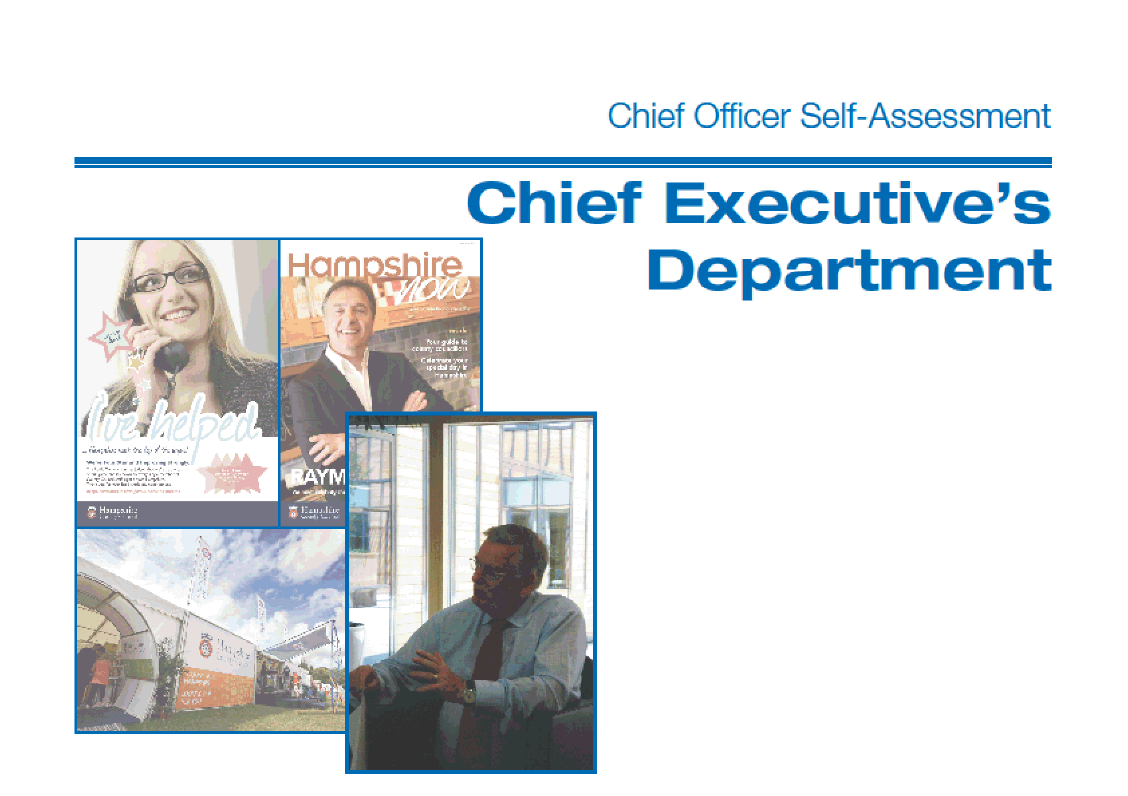
Chief Officer Self-Assessment: Chief Executive's Department (including HR and Economic Development)
General summary of recent progress and implications for the coming period. | |
Work continues to implement the outcomes of the Corporate Service Reviews. Progress will be monitored in future by the newly established Change Board chaired by the Director of HR. The Board is currently developing its programme of work. This will include ensuring any necessary organisational changes are made to create the environment required to successfully deliver the significant efficiency savings targets set for 2011/12 and beyond. In relation to future job opportunities for young people, stronger and closer links are being developed with Job Centre Plus to support their `Backing Young Britain' campaign. The County Council has been successful in being awarded funding to create temporary jobs for 900 unemployed young people across Hampshire over the next 18 months. Discussions have been held to consider how to improve partnership working between Fire, Police and NHS Hampshire with a number of possible priority areas being identified. Development of partnership working for 2010 onwards is a key objective. The Chief Executive has been developing new ways to share thoughts and opinions on emerging issues directly with staff and to hear their views. One new initiative has been to hold a series of regular informal discussions at which staff from across the departments are invited to talk about how they feel the organisation is working and to ask the Chief Executive questions about some of the issues we face | |
Recent achievements and key milestones. | |
Corporate Leadership and Management strategy - progress pathways approved and in place | |
One millionth call received at Hantsdirect | |
The Economic Development capacity of the organisation and partnership working has been significantly strengthened | |
Arrangements for revised locality working due to be considered by Cabinet in November | |
HR have engaged with East Hants/ Havant to explore the delivery of HR Services and Payroll for them | |
The Apprenticeship pilot project was successfully launched which will employ 30 apprentices initially with a wider roll out in 2010/11 | |
Stands were organised at both the New Forest and Romsey Shows showcasing the availability of the County Council's services | |
The management infrastructure of the organisation has been strengthened to ensure capacity and momentum continues to be built in the things that are important locally | |
Key challenges/improvement priorities |
Action being taken |
|
Throughout 2009/2010 implementation of the CSR's and development of a three year efficiency programme. Progress in second quarter -. Good progress is being made with the implementation of the CSR action plans. The Efficiency Panel has been established and has set a target of £15m savings. |
|
Development of partnerships with external agencies to ensure HCC is seen as a "model employer" and is developing employment strategies to assist in the current economic downturn. Other recession projects currently being worked on include, retail support package, smarter working centres, volunteering work experience, supporting military personnel and land based industries on skills and start-ups. Progress in second quarter - There are a number of issues which could impact on the achievement of targets, these include the slow rate of improvement in the percentage of the workforce who are not qualified to NVQ level 2 (currently 25%) and the disproportionate effect the recession is having on the employment of young people. Work continues to develop the corporate apprenticeship scheme and implement the Future Jobs Fund programme. Smarter Working Centres have been piloted in Fordingbridge and Whitchurch with up to a dozen planned for the next six months. |
|
The new Director of Economic Development started at the beginning of September. |
|
The Head of Improvement is engaging with all departments to co-ordinate the Council's response to the next inspection. Development of `hard to shift' indicators and outcomes, planned as part of the Corporate Improvement Plan. Progress in second quarter - All the work is complete in regards to both the Organisational and Area Assessments. The results are due to be published nationally on 10 December. |
|
The corporate policy implementation of the new Independent Safeguarding Authority's vetting and barring requirements in 2009/10 has now been developed and agreed. Progress in second quarter - Departments have agreed an approach to ISA implementation, which was ratified by CMT in October 2009. There is a significant amount of work that must be completed by HR and departments which will prove challenging given the timescales, and a report is due to be presented on this at Cabinet on 21 December 2009. |
|
A range of initiatives are being developed to build on the base provided by Hantsdirect. These are aimed at both improving customer service and , by channel shift, reducing the cost of customer transactions. Progress in second quarter - A workshop was held with the Efficiency Board on the links between improving customer experience and increasing efficiency. The focus of this is likely to be around reducing avoidable contact and increasing web self-service |
|
In line with work style strategy use of accommodation will be reviewed and wherever possible flexible and mobile working introduced. This will be supported by the implementation of Hantsfile. Progress in second quarter - Progress on this has been slower than hoped. It is likely that some short term fixes will be put in place pending a more comprehensive review in the longer term. |
|
Revised arrangements are being developed to ensure that there is a greater emphasis on strategic workforce planning, linked to corporate priorities and integrated with service and budgetary planning. Progress in second quarter - A Corporate Workforce Plan has been developed and approved and a planning model has been drawn up for 2010/11. Whilst considerable progress is therefore being made, the CAA inspection may highlight that our arrangements are not as embedded as they should be. A wide range of potential workforce efficiencies have been identified. Analysis shows that the areas likely to achieve significant savings will be challenging. The scale of organisational change is likely to require significant HR input, which could potentially put strain on the resources available. |
 The need to develop capacity and new skills has been identified in a number of areas. This, together with the imperative to change some of the more traditional ways of working will provide a significant challenge over the next year
Chief Officer Self-Assessment: County Treasurer's Department
General summary of recent progress and implications for the coming period. | |
This second quarter Chief Officer self assessment from the County Treasurer sets out both corporate financial management performance and departmental performance. Service and budget planning is underway for the department with the forward budget due for discussion with the Leader in November. The County Council accounts were closed on time and the District Auditor has issued a certificate of completion. An unqualified opinion was reported to the Audit Committee in September. The Use of Resources assessment for 2009 has been through the Audit Commission moderation process and the challenge at that stage did not affect the potential scores as we understand it. A number of "knowledge captures" evidencing best practice are being considered for the Audit Commission website including one on our development and use of value for money scorecards. The message continues to be that it is not expected that any local authority will achieve a score of four on any of the three themes with the harder test this year. A positive outcome is, however, expected. The forward budget process is underway with key meetings scheduled for each service with the Leader and Cabinet will be reviewing the Medium Term Financial Strategy in October. Select committee briefings scheduled in for November and whole Council briefing on 25 November 2009. | |
Recent achievements and key milestones. | |
Use of Resources 2009 national moderation completed and draft report and scores expected. Best practice case studies being considered by the Audit Commission for their website. | |
Accounts closed for the County Council by 30 June 2009, with Audit Commission certificate issued by 30 September , with unqualified opinions on both County Council and Pension Fund accounts and only two non-trivial misstatements incorporated in the Governance reports to the Audit Committee. | |
The Teachers Pension annual return of service was completed in full and returned to the Teacher's Pensions Agency deadline, the pay award was applied and removal of pay protection (as part of Pay and Benefits implementation) was completed in the quarter. | |
Annual Benefit Statements for LGPS members are being produced and issued with joint working with the Department of Work and Pensions meaning they include a combined pension forecast for the first time this year. | |
An HR payroll shared services submission for Havant Borough Council and East Hampshire was completed on 30 September with a decision expected in early November. The proposal offers service improvements and potential cashable efficiencies for Havant BC and a contribution to overheads to Hampshire County Council. Further shared services work is progressing with both authorities. | |
Two new self service functions were implemented this quarter with Member self service travel claims and devolved grants. | |
Although there was considerable publicity for the problems faced by the Student Loan Company in making timely payments to students in the transition year of the new national service, all deadlines were met for dealing with those continuing students still the responsibility of the department's Student Support team. | |
Key challenges/improvement priorities |
Action being taken. |
|
Medium term financial strategy will develop further the impact and approach. Budget and performance monitoring is helping highlight some areas of pressure including free school meals and children looked after, which will have forward budget implications. |
|
Medium Term Financial Strategy to Cabinet in October will set out efficiency strategy. The Efficiency Panel and Efficiency Board are both newly established and working to deliver a programme of cashable efficiencies from across the County Council's activities for 2011/12. |
|
Delayed recovery of property market and income collection performance could impact on the Council's budget, to be monitored. |
|
Investment Strategy revised, quarterly reporting of changes to the approved list of the organisations we lend to (and the periods of that lending) has been implemented as part of monitoring of financial health indicators. Benchmarking data demonstrates the priority given in 2008/09 to capital security in determining maturities and the more widespread use of money market funds to diversify counterparty risk. |
|
Monitoring of potential increases in order to consider the impacts on the funding strategy, now aided by the DCLG consultation on a new financing plan. The resourcing strategy is underway to address key areas of pensions administration in the lead up to valuation. |
|
A risk of deficits to the fund arising from the default of admitted bodies, a review is underway with the fund actuary to sustain the affordability and scheme membership, particularly for voluntary organisations and smaller member organisations. |
|
The transfer of commissioning and funding for 16-18 education takes place on 1 April 2010. At this stage the staffing transfer from LSC is still not known nor is the funding to support it and the National Commissioning Framework has still not been published for consultation. Hampshire County Council is working through the Regional Planning Group and nationally through LGA and DCSF to secure progress. |
|
The medium term financial strategy regularly assesses the risk. Scope to spread costs by capitalisation direction from CLG were announced with no approval for Hampshire for 2009/10. For 2010/11 the position is more critical and potentially more risky. |
|
With the implementation of the new Organisational Assessment and Use of Resources framework, the Audit Commission has again raised the bar. Draft reports have been issued which set out a strong narrative on the County Council's record and approach on value for money following our full and compelling Use of Resources self assessment and a positive outcome is expected. |
 Treasury Management
 Risk to the Pension Fund of default of admitted bodies
Chief Officer Self-Assessment: Adult Services
General summary of recent progress and implications for the coming period | |
The Care Quality Commission's Annual Performance Assessment for 2008/09 is not published until 2 December 2009. Initial indications are that our performance in delivering the seven outcomes of adult social care remains at the previous level of `good'. Early feedback particularly recognised the work of the Department to support user and carer involvement in service development; and also notably the role of the Hampshire Commission on Personalisation in enabling a wide cross sector of residents and agencies to influence the Green Paper on the future of adult social care. Maintaining performance' is a significant achievement in the light of the raising of the bar to deliver Personalisation; and indicates CQC's confidence in the ambitious and challenging plans that are in place to become `excellent' over the next two years. The Care Quality Commission has published the annual performance rating for NHS Hampshire. The Trust is rated as `good' for Quality of Commissioning and `fair' for its Quality of Financial Management. The department is working with the Trust in a number of areas where improvement is required. The rating does not impact on the APA for Adult Services (or the Council's organisational assessment), though areas of joint working such as hospital discharges feature in both assessments. The NHS Hampshire assessment will be reflected in the Audit Commission's overall Comprehensive Assessment of Hampshire. The 2009/10 budget position has improved from a predicted overspend of £2.1m to £1.4m as a result of management action. In setting the 2010/11Budget, the department has taken into account a range of increasing external pressures which fall into three main categories: demography and complexity (the rising costs of people living longer with more complex needs); ordinary residence (whereby the cost to the department in respect of clients living in non-registered exceeds the amount that is offset by other authorities) ; and Continuing Health Care (the costs to the department in respect of clients awaiting the outcomes from assessments or decisions which would potentially secure ongoing NHS funding). While the current financial position is manageable, the trends indicate longer-term budget pressures. The Local Area Agreement continues to act as a driver for positive working between organisations to help promote healthy lifestyles and support older people to remain independent. Good progress is being made to address the changes in lifestyle that will help Hampshire residents remain healthy into later life and to support older people to remain in their own homes - key aims of Theme F (Health & Wellbeing). In particular, the Supporting People process continues to help older people to remain in their own homes, with NI 142 on track to meet targets. The first half of this year has seen a clear reduction in delayed hospital discharges (NI 131) as part of our integrated work with health to reduce the number of hospital emergency bed days (NI 134). Work to reduce health inequalities remains challenging and we are looking to work more closely across the Council and with Districts to identify the best way to move this forward. Adult Services has direct responsibility for delivering 11of the National Indicators (NIs), and for monitoring an additional 25 NIs to which we contribute or have an interest. As more information has become available over the last quarter, it has been possible to undertake detailed benchmarking of our 2008/09 performance in relation to our comparator councils. This has confirmed that we continue to perform well against the Adult Services NIs, particularly NI 132 waiting times for assessments, NI 136 clients supported to live independently and NI 146 number of LD clients in employment. It has also enabled the department to set appropriate targets for 2009/10, ensuring that performance keeps pace with the other authorities. Good progress towards these targets has continued during Quarter 2, and action plans have been developed for each NI reported by Adult Services. | |
Recent achievements and key milestones | |
The availability of a direct line for health and other care professionals to contact HantsDirect from September 2009 (Universal Offer). | |
251 people (18.2% eligible clients in the Basingstoke Self Directed Support pilot) with a completed support plan as at the end of September 2009 (Self-Directed Support). | |
The service user conference on 25 September 2009 which built on the positive engagement achieved through the 2008 Commission of Inquiry (User Involvement). | |
Awarded £363k by Improvement and Efficiency South East to support a two-year partnership project with the You Trust to provide Telecare for people with learning disabilities. | |
The start of the Extra Care scheme in Brighton Hill, Basingstoke and the award of £1.1m from the Housing Corporation to the scheme in Fleet. | |
Cabinet approval of the Department's response to the Green Paper on the future shape of the care and support system in England. | |
Key challenges/ improvement priorities |
Action being taken |
|
Invoking a formal financial focus, similar to the recovery process in 2006-08, with rigorous monitoring linking performance and budget management with regular briefings for the Leader, strategic update by the Director to CMT and Cabinet, and joint budget and performance reports to Members. Further actions include: targeted vacancy management prioritising front-line services and the implementation of the Hampshire Model; reviewing grant conditions and flexibilities and use of grant carry forwards to offset future pressures. |
|
An action plan for each area has been developed and is being implemented. The plan and progress will be submitted to CQC in December as part of the evidence base for the 2010 performance assessment. |
NI 134 emergency bed days - performance is moving in the wrong direction. NI 139 perception that older people have services and support to remain in their own home - performance remains low in Hampshire compared to other areas. |
An integrated action plan to address the increase in emergency bed days has already seen a significant reduction in delayed discharges from hospital, supported by the introduction of re-ablement beds in Basingstoke, closer working with Community Response Teams and streamlined processes between Health and Adult Services. The impact of this work on overall numbers is being monitored. A multi-agency action plan to improve perceptions on NI 139 has been agreed by the Information Sub-Group of the Older Persons' Wellbeing Partnership and is being implemented, with an additional issue of Hampshire Now produced in August. The strengthening of the Universal Offer and the launch of the Care Choices website from November 2009 will improve the accessibility of information and support. |
|
While performance, as measured by NI 130, appears to remain below that of other councils, targeted work is currently being undertaken to increase the numbers of people with an Individual Budget/Direct Payment and to ensure best practice in SDS through using the lessons learned in Phase 1 (Basingstoke) as we progress to full rollout by April 2010. |
|
Management action to address financial pressures potentially places performance at risk in these areas. This is being addressed through the focus on reviews as part of the preparation for the roll out of SDS and through rigorous monitoring of review timescales - a critical component of the department's financial management strategy outlined above. The department is looking at ways to improve performance in waiting times for assessment, according to the new NI definitions which now include all client groups, including workshops within the Learning Disability sector. |
|
The continued rise in the number of reported incidents, a measure of the success of awareness raising and partnership working, has improved performance when benchmarked with other councils. The challenges are to ensure referrals are appropriate, dealt with in a timely manner, and victims attain satisfactory outcomes. New guidance enables practitioners to determine the most appropriate level of response. A scorecard is in use to monitor activity levels and timescales for decision making. Work is on track to further improve data collection and to collaborate with partners to inform the understanding of, and response to, the complexities of safeguarding and to prepare for the first mandatory national return from April 2010. |
 Managing within the cash limited budget in the context of increased volume and complexity of need, particularly in respect of adult safeguarding, and the transformation of adult social care.
Chief Officer Self-Assessment: Children's Services
General summary of recent progress and implications for the coming period | ||
Children's Services Department is due to receive an annual grade from Ofsted in December 2009, as part of the new inspection framework. The Department is confident of being rated as performing well following the unannounced inspection of arrangements for contact, referral and assessment in August 2009; and publication of two `performance profiles' (a quarterly Ofsted summary of local authority performance against key indicators and inspections of provision including childcare, schools and fostering). The unannounced inspection highlighted a number of strengths and confirmed child protection thresholds are well understood and appropriately applied. The areas for development identified by Ofsted are already being addressed through the departmental improvement plan for safeguarding. The most recent Ofsted performance profile (August 2009) shows that the large majority of the county's schools have been judged as good or better in inspection; and that performance against 93% of National Indicators (NIs) is above or in line with similar areas and the national figures. Efficiency saving targets have been established, amounting to £3.5m in 2009/10. There are significant in-year budget pressures which are being addressed but which may have performance implications in future - these pressures around demand-led services for vulnerable children appear to be typical of other authorities. There are no workforce issues to report at half-year. | ||
Recent achievements and key milestones | ||
Provisional exam results for 2008/09 show that Hampshire pupils continue to do well in national tests. Achievements in Key Stage 2 tests in English (82%), maths (81%), and science (91%) are above the national average (80%, 79% and 88% respectively). The percentage of pupils achieving Level 5, which indicates that pupils are working at a level above that expected for their age, also continues to be above national averages for English, maths and science at 32%, 37% and 47% (national averages 29%, 35% and 43%). The percentage achieving Level 4 or above in both English and maths (NI 73) is 75%, which is ahead of the national average, but indicates that the LAA target for 2008/09 has not been achieved (81%). The percentage of children in care achieving Level 4 in English at Key Stage 2 (NI 99) has increased from 35% in 2007/08 to 46.5% in 2008/09 (provisional), whilst the proportion achieving Level 4 in maths (NI 100) has increased from 31% in 2007/08 to 48.8% in 2008/09 (provisional). This is significant improvement, although indicates that the LAA targets for 2008/09 have not been achieved (59% and 61% respectively). The percentage of Hampshire pupils achieving five or more GCSEs at grades A*-C including English and maths (NI 75) remains above the national average at 54.7% (national average 49.7% - both provisional figures), an improvement of two percentage points on the previous year, but missing the LAA target of 58%. The proportion of children in care achieving five or more GCSEs at grades A*-C including English and maths (NI 101) has risen from 4.9% in 2007/08 to 6.3% in 2008/09, although this is short of the LAA target of 12.3%. Hampshire Music Service has recently been judged as excellent by The Federation of Music Services. Inspectors noted that the service excelled in support for learners; personal development of pupils; the breadth and access of provision; and leadership and management. Specific strengths identified included the responsiveness and flexibility of staff; the integration of all strands of musical opportunity and the service's rigorous safeguarding procedures. Analysis of half year data available for 39 Children's Services NIs (53% of all Children's Services NIs) demonstrates a positive trend from 2008/09 year end, with significant improvement in placement stability (16.4% at 2008/09 year end; 14.4% for the 12 months to September 2009) and repeat child protection plans (16.8% at 2008/09 year end; 11.2% for the 12 months to September 2009). However, these remain key areas for improvement. In total, 64% of the NIs with half year data available are showing an improvement trend from 2008/09 year end and 36% are showing a small fall in performance. The latter are being closely monitored. This demonstrates improvement from quarter one, where only 50% of NIs had improved from 2008/09 year end. Quarter two data is available for 15 Local Area Agreement (LAA) targets, 87% of which have improved from 2008/09 year end. The number of LAA indicators on track to achieve 2009/10 targets remains the same as at quarter one (11 on track to achieve targets; 9 are at risk). Targets at risk are outlined below. | ||
Key challenges/improvement priorities |
Action being taken | |
Safeguarding and children in care |
|
· A self-assessment of safeguarding and children in care services has been completed, with the identified areas for improvement being addressed through a quality improvement plan. As part of this, a refresh of social care case file auditing procedures and dedicated `pre-inspection' audit has taken place. The quality improvement plan also includes any recommendations from the Ofsted unannounced inspection of arrangements for contact, referral and assessment (August 2009) · Social care teams have been reconfigured, enabling a focus on services for children in care · Development of intensive support service (ISS) in the north of the county, supporting those on the edge of care (preventing them entering care) and supporting foster placements to increase stability. ISS has been in place for two years in the south east of Hampshire, where it has supported 93 children to remain with their families (rather than entering care) and 10 children whose foster placement was at risk of breaking down · Robust monthly monitoring by Children's Services Department and scrutiny of practice at an area level through the Local Safeguarding Children Board |
Local Children's Partnerships |
|
· Development of Local Children's Partnerships, taking into account the most appropriate geographical groupings for local communities, schools and partners to deliver improved outcomes for children and young people against CYPP priorities at a local level · Further consultation has taken place with key partners to determine and agree groupings and membership. Arrangements are due to be finalised by April 2010 |
Impact of recession |
|
· Fortnightly targeting of support to NEET young people by Connexions advisors · New action plans for NEET and provision of information, advice & guidance · Targeting of young people at risk of becoming NEET after leaving school · Increasing accessibility of Connexions advice through a variety of `open access' venues, including community centres and libraries |
Chief Officer Self-Assessment: Culture, Communities & Rural Affairs
General summary of recent progress and implications for the coming period |
NI data from the Active People survey for participation in culture and sport (NI 8,9,10,11) are good. Targets set to be top quartile and to address variation between districts (especially in libraries) with a focus on activities in deprived communities - Havant, Gosport etc. Place Survey analysis is informing development of CCRA Business Plan for 2010/11. Library and museums visits show decrease on previous year but improved in Q2. Decline in library visits has slowed due in part to the impact of the Discovery Centres. Visits and use of other services is currently exceeding levels at half year last year with visits to principal countryside sites up 7.2%. |
Recent achievements and key milestones |
1. Cultureall promotion and Passport has generated high level of interest - 600 Passports sold have generated £35k income. A proposal will be taken to the Executive Member recommending that from April 2010 `cultureall' becomes the public facing identity for CCRA services when jointly promoted. 2. A 50% Discount Card for armed service families and new citizens has been launched broadening access for these communities 3. The Summer Reading challenge generated a 9% increase in children's book issues. 14% more children participated and the SRC was taken to rural communities via a mobile library for the first time in New Forest and Test Valley (case study) 4. Winchester Discovery Centre won the "Architecture meets Practicality" category at the Public Library Building Awards. 5. 90 000 people attended events at Countryside sites we organised or hosted on our sites which includes everything from the Girl Guides 100th anniversary event; Culture in the Park; sports events; Live! youth and the Water Festival. |
Forward look - New management structure will be fully implemented and CCRA Business Plan for 2010/11 developed through Q3/Q4. CCRA is developing its strategy to take advantage of the opportunity afforded by Building Schools for the Future to improve cultural provision through an integrated approach and also developing a strategy to respond to the greater demand for targeted, intervention programmes e.g. Wessex Dance Academy. Continuing to develop our work with Adult Services on the Basingstoke Pilot and Discovery Centre, supporting Care Choice and developing the Library Service role in supporting personalisation and specifically information and advice role for older people and Basingstoke and Waterlooville will be pilots for Hantsdirect local following refurbishment in 2010. |
Key challenges/improvement priorities. |
Action being taken |
|
The condition survey is almost complete and the levels of works identified as unacceptable has increased the rating to red. The financial implications are being costed by engineers prior to a senior officer meeting with Surrey to discuss the implications of the condition survey. |
|
Proposed approach to community engagement presented to CMT Awayday in Sept, to address deprivation issues, new HATS and support to develop a mechanism for better engagement and objectives at a local level. |
|
An approach to how the County Council works with the voluntary sector presented to CMT to support the LAA target. Need to carry through proposals as practical actions. |
|
Renaissance and SHIOW, EDGE and Find Your Talent are projects at risk and significant to the core aim to broaden access through targeted activity. We are working with partners and funding bodies to assess the liabilities and impacts of loss of funding to plan for the future sustainability of these programmes to ensure that the best of these programmes continue as core business in future. |
|
The framework for the provision of static and mobile libraries was agreed by the Executive Member in September 2009. This is a key foundation stone for the future development of the library service and sets out for the first time our commitment to the residents of Hampshire on the standard of service (e.g. range of stock, opening hours, public IT access) to be provided by each type of library. Corporate issue around Saturday enhancement and service conditions to be reviewed. |
Chief Officer Self-Assessment: Environment Department
General summary of recent progress and implications for the coming period | |
Good progress continues to be made in achieving our key service priorities with a focus on our Corporate Improvement Plan and Local Area Agreement priorities to improve road condition, reduce traffic speeds in villages, reduce waste to landfill, proactively manage the growth agenda and promote measures to mitigate and adapt to climate change. Sound risk management processes are now embedded in the Department's decision-making at all levels: thus exploiting opportunities for service improvements. Five key areas have been identified for a short term action focus. Crucially, this will include ensuring that our highways service makes the best of an additional £3million of investment to improve road condition and service satisfaction. | |
Recent achievements and key milestones | |
· Progress continues on our LAA target to improve our capacity to adapt to the pressures of climate change although achieving Level 3 of NI 188 by the end of the final reporting period will require additional effort. The mechanism to achieve this has been identified as an integrated Vision & Strategy for Hampshire. · Further progress has been made on the Village 30 programme, with works in 106 villages being substantially completed. Additional funding has enabled a further 26 schemes to be added. Monitoring of traffic speeds in these villages continue to show a 9% reduction. · Our work with Quality Bus Partnerships have encouraged significant service improvements to the modernised Queen Alexandra Hospital from Waterlooville and Havant and a new direct evenings minibus service to Gosport. · Construction works have commenced on the repaving of Winchester High Street and the South Winchester P&R continues to progress to programme. · Works for Phase 1 improvements at M27 Jct. 5 commenced in October 2009. These will bring congestion and safety benefits. · The series of summer workshops with District Authorities were successful in achieving support for the proposed HCC Highways Authority policy in respect to the Manual for Streets, Department for Transport and DCLG guidance on Highways Design. · Among all SE authorities Hampshire's overall road condition was rated second in the National Highways and Transport Network Satisfaction Survey. · The securing of 15% energy savings in the proposed street lighting contract will bring commensurate cost and carbon reductions. · As part of our work on the Improvement and Efficiency South East (IESE) we are procuring a regional 3-supplier framework from January 2010 that will realise highways and transport services costs savings for us and our partner local authorities. · Successful negotiations have taken place with DEFRA in relation to the South Downs National Park Transition Arrangements, achieving agreement to the delegation of planning functions to local authorities · The Schools Landscape Programme's Big Landscape EXperiment initiative won a national award from the Landscape Institute for the work they have been doing to influence behavioural change in young people and to raise awareness about sustainable solutions in school grounds. Good progress continue to be made on achieving our LAA priorities with overall improvements in our confidence of achieving our targets. | |
Key challenges/improvement priorities. |
Action being taken |
|
National and regional transport investment is likely to be cut severely from 2011, with capital reductions of up to 50%. Local capital receipts and income from developer contributions have also reduced. The draft Community Infrastructure Levy Regulations, if enacted as proposed at present , are also likely to reduce developer funding for strategic infrastructure from the County Council. These factors mean it may not be possible to keep highway maintenance funding and performance at current levels without significantly reducing safety, bus subsidy and/or transport improvement programmes. To mitigate this, we are working to improve capital programme delivery and accelerate the release of developer contributions already received. We are also engaged in Local Transport Plan consultation about future priorities, challenges and possible strategies with County Members, and over the autumn this will be widened to stakeholders including district councils, the Highways Agency and Network Rail. |
|
Further to securing planning permission in July 2009 and preparatory ecological and site clearance work getting underway on this £20m scheme a judicial review on the planning decision was heard at the High Court on 14/15th October 2009. HCC mounted a robust defence and the final judgement is currently awaited. In the meantime, a Court Order is restricting planned preparatory work, and the contract programme is being reviewed to consider the impact of the delays to the overall scheme. A key focus remains completion of the works in advance of 31st March 2011 within the budget. Options to accelerate the construction works to meet this timescale have been investigated and look promising should the Judicial Review find in our favour. Preliminary discussions have taken place with Government over the potential for changing the funding arrangements to provide more flexibility, whilst we have not reached any agreement yet discussions are at an early stage. |
|
This project is progressing well but there remains a risk of delay in DFT issuing PFI credit promissory note following agreement of revised pricing model and agreement between councils in distributing amongst ourselves. Also, the risk of lending rates (Swap rates) on the day of financial close increasing above current assumptions remains. Update report due for Cabinet in November. |
|
The first of a two-stage public consultation process on Core Strategy Policies starts in November 2009. This will seek to ensure any proposed policy changes benefit from a sound evidence base mitigating risk of legal challenge. The case for a reduced apportionment for Hampshire has been made at the Examination-in-Public (EiP) of the Regional Apportionment Policy. The Panel report should be submitted to SoS in late November 2009 with proposed policy changes then likely in Spring 2010. An unfavourable or late decision may add delay to the progression of the Minerals Plan. Technical work on the Waste Plan has started. This aids progression of the sites document reducing likelihood of infraction proceedings relating to non-compliance with the Waste Framework Directive. |
|
There is a need to strengthen corporate focus on the Adaptation agenda and develop Adaptation thinking, for example on County Council coastal interests. Proposals are being developed, including overall Climate Change governance, for CMT December away day. |
|
Perception of the delivery of highway maintenance works has fallen recently. Actions being taken to correct this trend include; · Engagement with Amey to develop and deliver a performance improvement action plan immediately; · A review of the ways programmes and contracts are managed. |

Chief Officer Self-Assessment: Property, Business & Regulatory Services (including IT Services)
General summary of recent progress and implications for the coming period | |
The department is leading on Efficiencies, Business Transformation and Crime and Disorder reduction within the Corporate Improvement Plan and supporting enhanced customer outcomes and carbon reduction work streams. The key challenges are around improving public perception of crime and anti-social behaviour as well as achieving targets around carbon reduction. Customer feedback has continued to improve with a 30% increase in satisfaction with IT projects and 6% increase for Property Services project delivery. Introduction of Hantsdirect in Registration has improved customer access with the number of calls receiving a response increased from 58% to 95%. HC3S customers have also responded positively with increases of 3.3% and 4.3% respectively for school meal provision in primary and secondary schools. Trading Standards have added a further 43 areas to the No Cold Calling Zone scheme and launched a Making Money Matter booklet and DVD in partnership with Adult Services. Senior Manager appointments have been made in IT, Property and Procurement to support the implementation of CSR. Over the coming months key milestones will include business plan approval for Havant PSV and the next phase of the Workstyle project. | |
Recent achievements and key milestones | |
The department is the corporate and county lead for extensive transformation and change management programmes including; Workstyle (with shared services opportunities), Facilities Management and the Corporate Community Safety Strategy. IT Services are leading on the development of technology solutions including secure access for home working, flexible wireless access from any building and Hantsfile, the County Council's new information management system. | |
The department is the corporate lead on procurement related efficiency savings at regional and county level. This includes £16.5m benefits reported so far against an annual target of £25m for participating Tier 1 authorities in the Improvement and Efficiency South East (IESE) framework as well as £10m procurement efficiencies identified from integration of corporate and local procurement functions and processes. Estimated savings of £1.4m per year are anticipated across the organisation following implementation of Hampshire Public Services Network (HPSN2) which has been agreed with all local authorities in Hampshire. Further examples of efficiency savings at team level include savings of over £600k achieved by the ratings team through negotiated reductions in rateable values. | |
The department is continuing to expand its business activities with other public sector organisations, for example HC3S are now providing a catering service at 10 schools in neighbouring authorities, and the shared service arrangement with Reading Borough Council is anticipated to generate a further £1.6m in fee income this year. County Supplies continue to expand their portfolio of contracts and to add new customers for their services - a new Further Education college has recently completed an agreement for 19 multi-function devices (the total number of machines on the Hampshire contract is now more than 3,500) and the number of community and voluntary sector groups registered as customers has increased to some 630. Hampshire Scientific Service have received £80k of new funding from the Food Standards Agency. | |
The department has successfully delivered 313 construction projects valued at £48m during the first 6 months of 2009/10, as well as the substantial completion and subsequent occupation of Elizabeth II Court. Land and property interests have been acquired to support the bus rapid transit project linking Fareham and Gosport. The first phase of BSF funding of £80m to improve the standard of educational facilities available in Havant and Gosport has been secured. IT Services have delivered successful technology projects valued at £4.6m to include the Lagan Swift integration, along with the successful migration of 1040 servers during the transfer of the computer suite to Elizabeth II Court. | |
Key challenges/improvement priorities. |
Action being taken |
|
Service planning in 2010/11 is being used as a vehicle to explore ways to generate new income and achieve efficiencies in revenue budgets. With reduction in capital receipts, alternative approaches to strategic land management are being implemented. The new HPSN2 contract represents a huge challenge but also significant partnering opportunities. The department will be working with partners to develop the Senate's plans to achieve 500 affordable homes to support residents on low income and in rural areas. Outline planning consent has also been obtained for 700 homes under the Rowner Renewal Urban Regeneration scheme in Gosport. |
|
A new model for a streamlined PBRS/IT Headquarters administration function has been agreed for implementation over the next 6 months. Revised organisational structures in IT and Property Services will provide a new leaner senior management team structure, enhance skills and capacity and support the launch of a Trading Company. The department continues to make best use of internal resources with agency staff and consultants costs reduced by 70% and 29% respectively. |
|
Implementation of Hantsfile, the County Council's new information management system, represents a key challenge in the delivery of efficiency savings and new ways of working linked to Workstyle. Successful integration of Facilities Management Services is underway following the appointment of staff and implementation of structure in June. FM procedures continue to be developed and tested for the benefit of building users. Success for these initiatives relies on other departments and staff embracing cultural and behavioural change and the development of the Corporate Change Board. Moving the Council Data Centre remains a major project risk due to scale and complexity, but is progressing well. |
|
PBRS has the lead for community safety at the operational level via the ACSO Service to provide public reassurance and respond to anti-social behaviour and strategically via the County Strategy Group on Crime and Disorder. Agreement has been reached with Basingstoke and Deane Borough Council for the joint management of its 10 ACSOs. In order to address residents low perceptions revealed in the Place Survey for NI 22 - parental responsibility for the behaviour of their children, and NI 27 - understanding anti-social behaviour and crime issues by local councils and police, Hampshire partners are working closely to highlight to residents what is actually happening and increase public confidence. |
|
A corporate Carbon Management Group has been established to deliver a number of workstreams to achieve carbon consumption reductions. A detailed plan is being prepared in order to recommend achievable but stretching targets to the Council. Quarterly highlight reports are produced for each section and action plans are being developed in line with the approach initiated by the Green IT Plan. A pilot scheme of 5 sustainable homes has been completed as part of the Merton Rise development including the first property to achieve a level 6 for the Code for Sustainable Homes (CSH) which rates new houses against a series of criteria intended to deliver the Government's target of zero carbon emissions for all new homes from 2016. This builds upon the County Council's commitment of creating a sustainable urban extension at Merton Rise, which includes the provision of a site-wide Sustainable Urban Drainage System and a vision for a specific "eco-parcel" of 15-20 dwellings. |
 Economic and financial climate impact on income
 Appendix One: Chief Officer Self-Assessment Prompt List
The following is a `prompt list' of issues or questions that Chief Officers were given to guide them in the preparation of their one/two sides of A4 self-assessments. This list is intended to prompt the consideration of the significance of particular issues, they are not a prescription of what must be included - this is for the Chief Officer to decide.
The key point is that these self-assessments need to be the Chief Officer's judgement of what the key performance issues are for them now and looking forward. The `so what' factor should be applied when considering what to include in the self-assessment - why does Cabinet or CMT need to know this: it needs to have corporate impact, significance and/or a need for corporate (or other departmental) support or resource allocation.
The 'prompt list' includes - does your self-assessment outline:
· Direction of Travel: Overall strategic performance and direction of travel (inc whether this is sustainable)?
· Risks: Key issues, risks or 'hotspots' looking forward and how these are being addressed?
· CIP, LAA & NIS: Areas of concern within the Corporate Improvement Plan, LAA or NIS which your department takes the lead or makes a significant contribution to?
· Finance & workforce: Departmental financial health and, where relevant, key workforce issues?
· Management: Significant departmental value for money, management or efficiency issues/improvements?
· Statutory & inspection: Any issues/concerns in relation to statutory responsibilities or inspection/audit?
· Sensitivities: Any areas of specific Member interest or public trust/confidence risks?
· External: Significant external changes or implications (eg regulatory or legislative changes)?
· Equality & Sustainability: Any significant equality or sustainability issues?
· Balance: Give a balanced view in terms of overall (good) performance against areas for further improvement (or at least put them into context)?
· Coverage: Have the most significant areas of services delivered and budget been reflected - do they need to be?
Appendix Two: Overview of Driving Success
Chief Officers, with their Executive Member, own and lead performance management for their department. This is central to the framework but Driving Success also recognises that there needs to be corporate visibility of this, particularly areas of risk or weakness. Driving Success strengthens self-awareness and mechanisms to enable corporate discussions about areas for improvement - in the spirit of collective responsibility.
Driving Success has four key underpinning principles:
· Keep it simple
· Honesty should be central
· Concentrate on the critical issues that matter most locally and not everything
· Do something about performance and improvement when action is required.
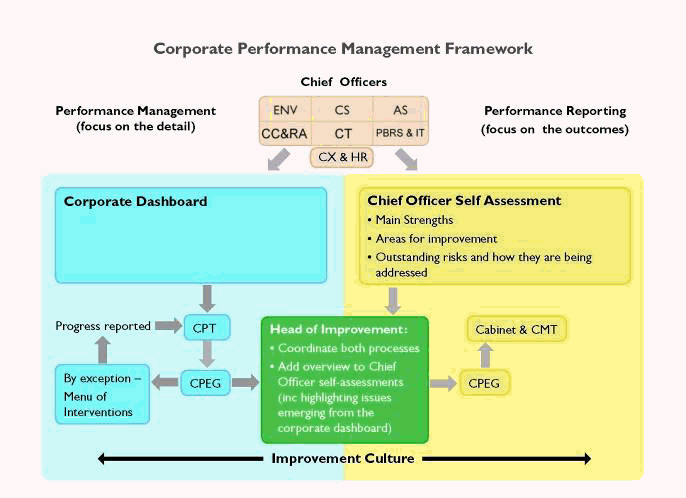 The diagram below sets out the corporate Performance Management Framework, making the distinction between the corporate performance management process (on the left) and the corporate performance reporting process (on the right). It also introduces the two new concepts of the Corporate Dashboard and the Chief Officer Self-assessment:
Appendix three: Driving Success Main Roles & Responsibilities
Role |
Responsibility | |
Chief Officers |
Leading and managing service delivery and driving continuous improvement, reporting weaker performance and risk corporately |
Take an honest self-awareness approach to departmental performance and take action to improve performance - escalating issues to the Leader and Cabinet, as appropriate |
Executive Members |
Keeping a watching brief of the performance of services in their portfolio, particularly areas of poorer performance and risk, as well as setting ambition in areas of best practice and innovation |
Working with and challenging Chief Officers to drive continuous improvement - escalating issues to the Leader and Cabinet, as appropriate |
Head of Improvement |
Keeping a watching brief of the Council's overall performance position, acting as a catalyst to drive improvement and reporting areas of risk |
Work with and support Chief Officers to drive improvement in the areas that matter most locally and report this to CPEG, CMT and Cabinet, as appropriate |
CPEG |
Considering the Council's corporate position and significant outstanding areas of concern in order to agree or commission action to address as well as ensuring the Council is being ambitious enough |
CPEG will agree action on behalf of CMT in response to outstanding areas of concern. The Head of Improvement will liaise with CPEG to prepare reports to CMT (and ultimately Cabinet) twice a year, or by exception |
Chief Executive |
Ensuring action is being taken to address areas of poorer performance and risk as well as develop areas of best practice and innovation |
Taking action to address or escalating issues, as appropriate, to CMT, Cabinet and the Leader |
Executive Member for Performance |
Keeping a watching brief of the Council's overall performance position, particularly areas of poorer performance and risk as well as areas of best practice and innovation |
Advising, alerting and challenging Cabinet and Executive Members to issues |
CMT, Cabinet & Leader |
Overseeing performance and setting the overall level of ambition for the authority |
Challenging areas to improve and of risk |
Scrutiny Select Committees |
Holding the Executive to account on performance issues and providing challenge, as appropriate |
Undertaking specific reviews to scrutinise decisions and/or offer alternative policy or service proposals to help improvement |